
Lake Temperature Data Over Decades Show Warming
Large, increasing methane emissions from northern lakes:
Methane is increasing in the atmosphere, but many sources are poorly understood. Lakes at high northern latitudes are such a source. However, this may change with a new study published in Nature Geoscience. By compiling previously reported measurements made at a total of 733 northern water bodies — from small ponds formed by beavers to large lakes formed by permafrost thaw or ice-sheets — researchers are able to more accurately estimate emissions over large scales.
“The release of methane from northern lakes and ponds needs to be taken seriously. These waters are significant, contemporary sources because they cover large parts of the landscape. They are also likely to emit even more methane in the future,” says Martin Wik, PhD student at the Department of Geological Sciences and Bolin Centre for Climate Research, Stockholm University, who led the study.
With climate warming, particularly at high northern latitudes, longer ice-free seasons in combination with permafrost thaw is likely to fuel methane release from lakes, potentially causing their emissions to increase 20-50 precent before the end of this century. Such a change would likely generate a positive feedback on future warming, causing emissions to increase even further.
“This means that efforts to reduce human induced warming are even more urgent in order to minimize this type of feedback of natural greenhouse gas emissions. In a sense, every reduction in emissions from fossil fuels is a double victory,” says David Bastviken, Professor at Tema Environmental Change, Linköping University.
Source: January 4, 2016 – Stockholm University, ScienceDaily.com.
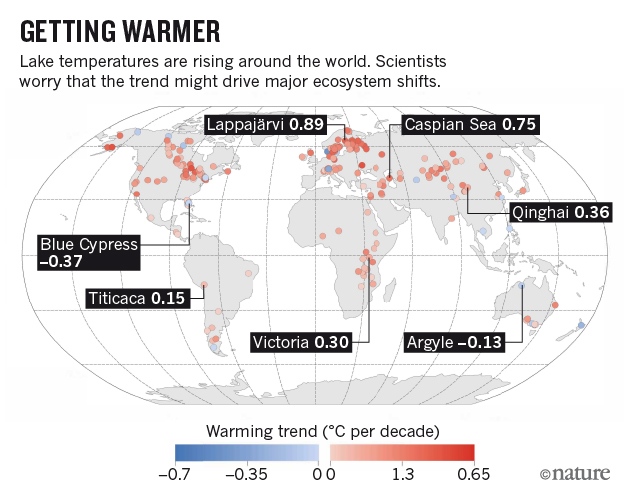
Climate change is rapidly warming lakes around the world, threatening freshwater supplies and ecosystems, according to a study spanning six continents.
The study is the largest of its kind and the first to use a combination of satellite temperature data and long-term ground measurements. A total of 235 lakes, representing more than half of the world’s freshwater supply, were monitored for at least 25 years. The research, published in Geophysical Research Letters, was announced today at the American Geophysical Union meeting.
The study, which was funded by NASA and the National Science Foundation, found lakes are warming an average of 0.61 degrees Fahrenheit (0.34 degrees Celsius) each decade. That’s greater than the warming rate of either the ocean or the atmosphere, and it can have profound effects, the scientists say.
Algal blooms, which can ultimately rob water of oxygen, are projected to increase 20 percent in lakes over the next century as warming rates increase. Algal blooms that are toxic to fish and animals would increase by 5 percent. If these rates continue, emissions of methane, a greenhouse gas 25 times more powerful than carbon dioxide on 100-year time scales, will increase 4 percent over the next decade.
“Society depends on surface water for the vast majority of human uses,” said co-author Stephanie Hampton, director of Washington State University’s Center for Environmental Research, Education and Outreach in Pullman. “Not just for drinking water, but manufacturing, for energy production, for irrigation of our crops. Protein from freshwater fish is especially important in the developing world.”
The temperature of water influences a host of its other properties critical to the health and viability of ecosystems. When temperature swings quickly and widely from the norm, life forms in a lake can change dramatically and even disappear.
“‘These results suggest that large changes in our lakes are not only unavoidable, but are probably already happening,” said lead author Catherine O’Reilly, associate professor of geology at Illinois State University, Normal. Earlier research by O’Reilly has seen declining productivity in lakes with rising temperatures.
Temperature increases close to or above the average .61 degrees F rise were seen in some of the world’s most popular waters, including Lake Tahoe (+.97 F by hand, +1.28 by satellite), the Dead Sea (+1.13 F), two reservoirs serving New York City, Seattle’s Lake Washington (+.49 F), and the Great Lakes Huron (+1.53 F by hand, +.79 by satellite), Michigan (+.76 F by hand, +.36 by satellite), Ontario (+.59 F) and Superior (+2.09 F by hand measurement, +1.44 F by satellite).
Study co-author Simon Hook, science division manager at NASA’s Jet Propulsion Laboratory in Pasadena, Calif., said satellite measurements provide a broad view of lake temperatures over the entire globe. But they only measure surface temperature, while hand measurements can detect temperature changes throughout a lake. Also, while satellite measurements go back 30 years, some lake measurements go back more than a century.
“Combining the ground and satellite measurements provides the most comprehensive view of how lake temperatures are changing around the world,” he said.
The researchers said various climate factors are associated with the warming trend. In northern climates, lakes are losing their ice cover earlier, and many areas of the world have less cloud cover, exposing their waters more to the sun’s warming rays.
Previous work by Hook using satellite data indicated that many lake temperatures were warming faster than air temperature and that the greatest warming was observed at high latitudes, as seen in other climate warming studies. This new research confirmed those observations, with average warming rates of 1.3 degrees Fahrenheit (0.72 degrees Celsius) per decade at high latitudes.
Warm-water, tropical lakes may be seeing less dramatic temperature increases, but increased warming of these lakes can still have large negative impacts on fish. That can be particularly important in the African Great Lakes, where fish is an important source of food.
“We want to be careful that we don’t dismiss some of these lower rates of change,” said Hampton. “In warmer lakes, those temperature changes can be really important. They can be just as important as a higher rate of change in a cooler lake.”
In general, the researchers write, “The pervasive and rapid warming observed here signals the urgent need to incorporate climate impacts into vulnerability assessments and adaptation efforts for lakes.”
The Great Lakes are some of the world’s fastest warming lakes.
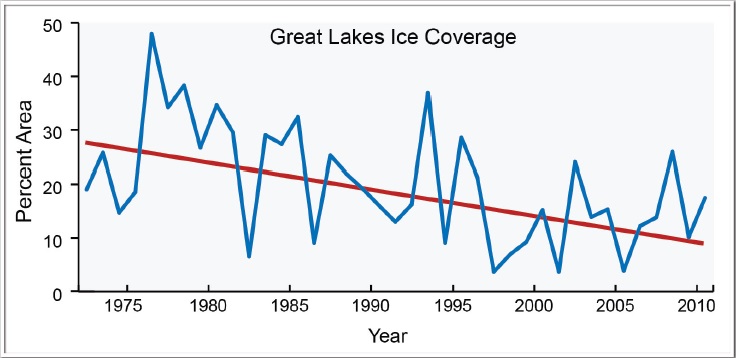
The decline of Great Lakes ice cover over the past several decades is contributing significantly to the rate of increase of summer water temperature, the study said.
The data also shows the world’s lakes are warming faster than the air around the lakes.
The study, published in the Geophysical Research Letters, finds that Lake Superior is warming the fastest of any of the Great Lakes.
The downside to warming waters is a more rapidly changing Great Lakes ecology. Warmer waters can negatively effect some native Great Lakes species, and increase invasive species.
Lake Superior is warming at a rate of 2.1°F per decade, according to the study.
Northern Lake Michigan is warming 0.4°F per decade, while southern Lake Michigan is warming at 0.76°F.
Northern Lake Huron is warming faster than southern Lake Huron. Northern Lake Huron is warming at a rate of 1.5°F and southern Lake Huron .79°F.
Lake Ontario is warming at .59°F per decade.
Lake Erie has been the slowest to warm at 0.15°F per decade.
The study looked at data from 1985 to 2009. It used satellite data, and actual water and air temperature measurements from buoys on the Great Lakes.
One would think the water would warm at the same rate as the air above it. The study showed this is not the case. Great Lakes water temperatures are actually rising about 50 percent faster than the overlying air temperatures.
An increasing number of ice-free days on each Great Lake are a major culprit in the warming, the study said. Lack of ice causes summer stratification of the water to occur earlier in the summer. Once summer stratification occurs, Great Lakes waters can warm faster on the surface.
Summer stratification means the water is warmer on the top surface of a lake, and then gets colder in gradually deeper water. This stratification develops during the spring and early summer. Coming out of winter, the surface water is coldest, and maybe ice covered, and the water gets warmer as you go to deeper depths. The temperature pattern then flip-flops heading into summer.
An older study found that this summer stratification is occurring nearly 14 days earlier in the last 27 years.
Although 2.1°F warming over a decade may not sound like a lot, that’s a 4.5°F water temperature rise on Lake Superior since 1979.
The study exemplifies the interdisciplinary work of WSU’s Grand Challenges, areas of research addressing some of society’s most complex issues. The study is also in keeping with the theme of the challenge “Sustainable Resources: Food, Energy, and Water,” which will develop strategies that link optimized agricultural practices, water management, and energy production.
Sources:
Washington State University – reported in ScienceDaily.com
Mark Torregrossa | mtorregr@mlive.com
150-year global ice record reveals major warming trend
September 7, 2000 By Brian Mattmiller
Sources as diverse as newspaper archives, transportation ledgers and religious observances, scientists have amassed lake and river ice records spanning the Northern Hemisphere that show a steady 150-year warming trend.
The study, which includes 39 records of either freeze dates or breakup dates from 1846 to 1995, represents one of the largest and longest records of observable climate data ever assembled. University limnologist John Magnuson led a team of 13 co-authors who contributed to the report, to be published in the Sept. 8 issue of the journal Science.
Sites ranges from Canada, Europe, Russia and Japan. Of those, 38 indicate a consistent warming pattern. The average rate of change over the 150-year period was 8.7 days later for freeze dates; and 9.8 days earlier for breakup dates. A smaller collection of records going well past 150 years also show a warming trend, at a slower rate.
“We think this is a very robust observation: It is clearly getting warmer in the Northern Hemisphere,” says Magnuson. “The importance of these records is that they come from very simple, direct human observations, making them very difficult to refute in any general way.”
Magnuson says the observational nature of the study is “both its strength and its weakness,” and the results do not offer specific proof that greenhouse gases are driving the warming trend. However, the findings are consistent with computer-generated models that have been developed to estimate climate change from greenhouse gases over a 125-year time period, he says.
The findings also correspond to an air temperature increase of 1.8 degrees Celsius over the past 150 years. A temperature change of 0.2 degrees Celsius typically translates to a one-day change in ice-on and ice-off dates.
Freeze dates were defined in the study as the observed period the lake or river was completely ice-covered; the breakup date was defined as the last ice breakup observed before the summer open-water phase.
Ice records have valuable attributes for climate researchers, Magnuson says. They can be gathered across a wide range of the globe, and in areas traditionally without weather stations. Their primary weakness is that early observers did not document the methods used.
“Of course, 10,000 years ago the Midwest was covered by ice, so we know it’s getting warmer,” he says. “What’s troubling and scary to people is that these rates in recent decades are so much faster.”
Climate models have predicted a doubling of total greenhouse gases in the next 30 years or so, a change that could potentially move the climate boundaries for fish and other organisms northward by about 300 miles, approximately the length of the state of Wisconsin, Magnuson says.
The records in this study are part of a decade-long project led by Magnuson and the UW–Madison Center for Limnology to build a database of lake and river ice records from around the world. The project was supported by the National Science Foundation’s Long-Term Ecological Research program, which emphasizes tracking and understanding global changes.
“It’s kind of a new science, you might call it network science,” Magnuson says. “We reached out to colleagues around the world and asked for these records. It turned out some people had very rich stores of data.”
The records in this study represent the longest and most intact of 746 records collected through the project. Some individual records are of astonishing lengths, with one dating back to the 9th century, another to the 15th century and two more to the early 1700s.
For example, Lake Suwa in Japan has a record dating back to 1443 that was kept by holy people of the Shinto religion. The religion had shrines on either side of the lake. Ice cover was recorded because of the belief that ice allowed deities on either side of the lake — one male, one female — to get together.
Lake Constance, a large lake on the border of Germany and Switzerland, has a peculiar record dating back to the 9th century. Two churches, one in either country, had a tradition of carrying a Madonna figure across the lake to the alternate church each year it froze.
Two other long records come from Canada’s Red and McKenzie rivers, which date back to the early 1700s and were kept because ice cover and open water were critical to the fur trade. Records from Grand Traverse Bay and Toronto Harbor, both on the shores of the Great Lakes, reflect their prominence as shipping ports.
Other records included in the study are from lakes Mendota, Monona and Geneva from Wisconsin; lakes Detroit and Minnetonka from Minnesota; lakes Oneida from New York and Moosehead from Maine; Lake Kallavesi from Finland; and the Angara River and Lake Baikal from eastern Russia.
Another finding in the study, based on the 184 ice records from 1950 to 1995, showed the variability in freeze and breakup dates increased in the last three decades. Magnuson says it might be related to intensification of global climate drivers such as the El Nino /La Nina effects in the Pacific Ocean.
Magnuson says the ecological effects of global warming are only beginning to be studied. But studies already exist that have shown the northern ranges of some butterflies and birds have been extending northward.
Source: University of Wisconsin – Madison
Read Dr. Seuss’s Book, “The Lorax”, to Celebrate Dr. Seuss’s Birthday,n or Better Yet – Read it to a Child or Friend

March 2nd is Dr. Seuss’s birthday, he would be 112 this year. While he is no longer with us, his legacy lives on in the pages of his books. A book that all parents might want to read to their children is Dr. Seuss’s “The Lorax”. It’s message is most applicable to finally being recognized environmental crisis of global warming and climate change, which continues to worsen.
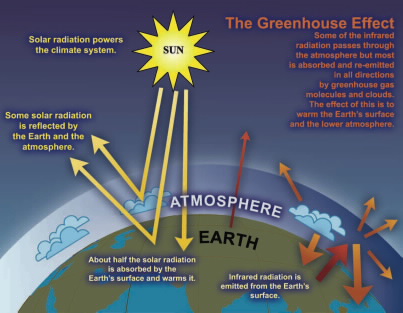
Children should know we humans have already saturated Earth’s atmosphere with the residuals from excessive burning of earth’s fuels, the effect of which, together with the cutting down of the carbon dioxide sequestering tropical rain forest, has lead to an unhealthy and unnatural buildup of carbon dioxide and other greenhouse gases in Earth’s atmosphere, which means that more of the Sun’s radiant heat is being trapped near Earth’s surface, which has already caused destabilized the earth’s climate systems, to the suffering and harm to many living species, including millions and ultimately billions of the human population, in areas which have experienced major and significant changes in weather events, more severe storms and flooding in some areas, but not enough rain for others.
Long before saving the earth became a global concern, Dr. Seuss, speaking through his character the Lorax, warned against mindless progress and the danger it posed to the earth’s natural beauty.
A boy living in a polluted town visits a strange isolated man called the Once-ler “at the far end of town where the Grickle-grass grows… [on] the Street of the Lifted Lorax”, who never appears fully in illustrations; only his arms are shown. The boy pays the Once-ler fifteen cents, a nail, and the shell of a great-great-great grandfather snail to explain why the area is in such a run-down state. The Once-ler explains to the boy (shown in flashback) how he once arrived in a beautiful, pristine valley containing happy, playful fauna (Brown Bar-ba-loots, Swomee Swans, and Humming Fish) that spent their days romping around blissfully among “Truffula trees”. The Once-ler proceeded to cut down the Truffula trees to gather raw material to knit “Thneeds,” a ridiculously versatile invention of his, “which everyone needs”. Thneeds could be used as a shirt, a sock, a glove, a hat, a carpet, a pillow, a sheet, a curtain, a seat cover, and countless other things.
By cutting down the tree, he summoned the titular Lorax to appear from the stump of a Truffula tree. He “speaks for the trees, for the trees have no tongues” and warned the Once-ler of the consequences of cutting down the truffula trees, but the Once-ler ignored him, instead contacting all his relatives to help him with his business.
The Once-ler’s small shop soon grew into a factory and new equipment was made to keep up with the demand for more Thneeds, and signs of damage to the Truffula Forest became evident to the Lorax. The Lorax first complained to the Once-ler that the Truffula trees, being chopped down, were also the food source of the Bar-ba-Loots, who are now facing a terrible food shortage and a disease called “the Crummies because of gas and no food in their tummies.” To save them, the Lorax sent them off to find another food source. At first, the Once-ler only showed a little remorse, but still focused on expanding his business.
Soon, the Once-ler’s Thneed-making business expanded tenfold and now used delivery trucks to take out the shipments. The Lorax eventually came back complaining to the Once-ler that the factories were belching out so much “smogulous smoke” that it was giving the Swomee Swans sore throats, leaving them unable to sing. After the Lorax sent them off, he also complained to the Once-ler about his machinery making a goo by-product called “Gluppity Glup” and “Shloppity Shlop,” and how it was being dumped into the ponds where the Humming Fish live, leaving them unable to hum and forcing the Lorax to send them away too.
The Once-ler, disgruntled by this, still dismissed the Lorax’s pleadings and declared his intention to keep “biggering” his operations, but at that very moment, the “The very last Truffula tree of them all” falls. Without raw materials, his factory shut down; without the factory, his relatives left. Then the Lorax, silently, with one “very sad, sad backward glance”, lifted himself by the seat of his pants and flew away through the clouds.
The Once-ler lingered on in his crumbling residence, living in seclusion and remorse, while pondering over a message the Lorax left behind: a stone slab etched with the word “Unless”. In the present, he now realizes what the Lorax meant. He tells the boy, “Unless someone like you cares a whole awful lot, nothing is going to get better. It’s not.” The Once-ler then gives the boy the last Truffula seed and tells him to plant it, saying that if the boy grows a whole forest of the trees and keeps them protected from logging, “the Lorax, and all of his friends may come back.”
In Wake of Flint, Michigan’s Lead in Its Drinking Water, U.S. EPA Sends Letters to All State Governors to Ensure Protection of Public from Lead in Its Drinking Water
As with many environmental pollution and resource destruction activities, once the problem reaches a crisis stage, which might also be called “the tipping point”, the impacts or “unintended consequences become essentially “irreversible” — that is, the damage is done and there is no way to return things to the earlier preconditions.
The problem of excessive greenhouse gases in our atmosphere from too much fossil fuel burning by humans over the past 100+ years is a comparable situation, but is occurring on a much larger scale, of course. There will be essentially no going back to previous conditions that existed on earth before global warming from human activities began sticking up its ugly head.
To return to the lead in drinking water problem, the U.S. Environmental Protection Agency (EPA) on February 29th sent letters to all state governors and water regulators across the U.S. promising greater enforcement of rules to protect citizens from lead in their drinking water, in the wake of the drinking water contamination crisis in Flint, Michigan, where many children tested extremely high concentrations of lead in their bodies, high enough to cause irreversible brain damage. The EPA is urging every state in the U.S. to locate all water lines in their jurisdiction that could potentially be distributing lead-contaminated drinking water to the public, which apparently was already required of every state in the U.S..
As reported in the Detroit Free Press Sunday, millions of lead service lines remain buried in cities across the nation, but in many cases water utilities are uncertain where those lines are, making it difficult for EPA to monitor many utilities’ compliance with the lead testing requirement, even at locations most likely suspected to have high concentrations of lead already in their public’s drinking water coming out of the tap.
The EPA, having already been criticized by some for not moving more quickly in Flint after learning of the elevated lead level in at least one home in February, 2015, and two months later, found to be not practicing corrosion control as was required, said it is now increasing its regulatory oversight over state programs – “to identify and address any deficiencies.”
The EPA outlined its plans in two letters sent Monday: One, from agency Administrator Gina McCarthy to governors in 49 states; and a second, with more detail, from Deputy Assistant Administrator Joel Beauvais in the EPA Office of Water, to state regulators. The state of Wyoming did not get letters because it has not taken primary responsibility for drinking water, so it remains with EPA.
In January, McCarthy issued an emergency order taking over testing and putting other requirements on Michigan and the city of Flint, saying they were delaying implementation of recommendations made by the federal agency. That came, however, some 20 months after Flint switched water sources and the state Department of Environmental Quality, with primary responsibility, failed to require corrosion control, which apparently allowed lead to leach from aging lines into residents’ taps.
While the state DEQ has borne most of the blame, the EPA has been criticized for not moving more decisively to restore corrosion control and react to fears of widespread lead contamination after the state acknowledged in April of last year that it did not believe it had to require corrosion control under the 25-year-old Lead and Copper Rule at that point. It has since acknowledged the mistake.
McCarthy said in her letter that her staff “will be meeting with every state drinking water program across the country to ensure that states are taking appropriate action to identify and address” any issues of lead levels being above acceptable levels.
She also called for states to do more to ensure that the public receives “better and quicker” information on lead risks, and said her agency will be working with states to make sure there is “adequate and sustained investment” in regulatory oversight of drinking water laws. She said EPA will be looking to help find financing for the “upgrading and replacement of aging infrastructure, especially for poor and overburdened communities.”
A Day to Remember – February 29, 2016
I could not allow this day – Feb. 29 – to pass without comment. Leap year – a year having an extra day in February – occurs only every four years.
So, is that good or bad?
It’s not good, in fact it’s DISASTROUS, because yet ANOTHER day, and year, and decade has gone by while our elected officials in the State of Wisconsin Legislature, and the U.S. Congress, and the population of our state and country, refuse to take the threat, and now reality, of global warming caused by too much fossil fuel burning – in cars, trucks, airplanes, electric power producing plants that burn fossil fuels, seriously, despite alarming increases in sea levels.
Too much fuel burning primarily coal, methane (natural gas), and oil products, have been burned by humans over the past decades and centuries for the energy that has been produced, resulting in the emission and accumulation of elevated concentrations of “greenhouse gases” in earth’s atmosphere, resulting in global warming, the rise in the elevation levels of earth’s oceans, due to the melting of the earth’s Arctic and Antarctic Circle’s land ice and snow, the shrinking of earth’s mountainous glaciers, a thawing of the earth’s permafrost region (one-fifth of the earth’s land surface), causing a warming, expansion, and acidification of earth’s oceans, leading to a dangerous rise in sea level.
The warming is already wreaking of havoc on earth’s biological systems, including humans, most notably in poorer, tropical countries, many of which are already experiencing grave losses due to extreme weather events, such as drought, heat waves and severe storms, along with unprecedented flooding, all of which had been scientifically predicted well over a century ago!
The warming has been compounded by the increasing loss of vegetation, particularly the loss of the tropical rainforests, which had been naturally sequestering carbon dioxide from the atmosphere, but not anymore, by the ones which have been replaced by other forms of development or money producing mono-culture agriculture.
Global warming from human causes is not rocket science, despite what the flat earth believers may still be claiming. However, saying that human-caused global warming is not occurring, because it has not been “proven” to be happening – as of this February 29, 2016, is utterly preposterous, and those who claim human-caused global warming is not happening are either fools or worse yet – liars.
CBS News Special: “Earth Day – A Question of Survival”, with News Anchor Walter Cronkite
The first Earth Day in the United States was held on April 22, 1970. CBS-TV aired it as a 13-part CBS news special. It was a time when the vast majority of Americans generally counted on the major television network news anchors to accurately inform them of the important news of the day, and CBS’s Walter Cronkite was considered the most honest of them all. National news reporting was viewed as having no relationship whatsoever to money provided by networks’ sponsors, and instead was information that viewers could count on as being accurate and true concerning the national events and threats that were occurring in the country and what American viewers would want to know to keep themselves well informed of the country’s news. While Madison’s Gaylord Nelson Institute at the University of Wisconsin states that the CBS news report which aired that night didn’t do justice to much of the participation in the events that were held on the first Earth Day in 1970, the fact that it documented many of the other people concerns that Americans had about the state of the environment in 1970 is worth noting.
The first earth day came about because people were really fed-up with the undeniable pollution of the waters, air and land around them, some even getting sick, while others feared things were likely to get worse and worse because the pollution was getting worse and worse. The following ten years of federal and state law making and enforcement to prevent the continued degradation of U.S. drinking and surface waters, air in the U.S., wetlands and land protection, too, led many to later call the decade of the 1970s “the environmental decade”.
This was also a time of great concern because of the large amount of the country’s money was going for military purposes in fighting the Vietnam War, money which could have gone to keeping the county’s important natural resources clean and healthy, and improving living conditions in “the urban ghettos” including homes for the homeless. A “teach in” was being held across the United States by anti-war advocates at the same time when Senator Gaylord Nelson from Wisconsin came up with the idea of having a similar day set aside for a teach-in about the need for change to ensure a healthy future for the planet, including the nation’s people who were suffering in the ghettos. View all 13 parts of the CBS’s special news report, anchored by Walter Cronkite, of the first Earth Day here.
This CBS special news report for Earth Day is well worth the investment of everyone’s time viewing it, or reading the transcript of the report. A similar degree of response is what is needed now to prevent an even worse and tragic consequence of human and animal life lost and suffering as we continue to add more and more quantities of greenhouse gases to the atmosphere by continuing to burn vast quantities of fossil fuel, for electric power generation, heating and long distance or daily travel requiring oil burning, and many countries continuing to pave over the landscape with concrete, and most every country suffers from a lack of an appropriate adaptation plan in the likely case now that the worse of the climate extremes will ultimately result, and that the inundation of the world’s currently most populous coastal cities will also result, and that many island nations will require resettlement, as the ones that are presently livable are predicted to become submerged completely if major and significant change is not made soon by the most highly developed countries. Our U.S. Congress continuing its refusal to enact laws to reduce greenhouse gas emissions, let alone refusing to alert the American people of the grave unfortunate results of ignoring all climate experts’ warnings means that it’s almost certain the worst predictions are ultimately likely to occur from our lawmakers’ inaction, and the similar expected inaction by many other countries that might otherwise follow our lead, and the paving of the remaining green space on the planet, is unconscionable. If our political office holders are not interested in doing this for us living here today, they should not leave the full burden of living on our likely inhospitable planet to fall on today’s and tomorrow’s children, including those who reside here, as well as elsewhere.
Report: Warming Seas Expanding Twice as Fast as Previously Thought

A new study suggests that warmer water temperatures are causing the seas to expand twice as fast as previously thought, leading to greater sea level rise. The study analyzed more than a decade of satellite data. It was published in the peer-reviewed Proceedings of the National Academy of Sciences. The study also found sea level rise varied by location, with the Philippines experiencing sea level rise at five times the average global rate.
How much damage is the Porter Ranch leak doing to the climate?

How much damage is the Porter Ranch leak doing to the climate?
Stephen Conley has flown pollution-detecting airplanes over some of the largest oil and gas fields in the nation. But never before has the UC Davis scientist encountered as much methane in the air as in recent months over suburban Los Angeles.
A Remarkable State of the State Speech by the Governor of Wisconsin

Governor Scott Walker’s 6th “State of the State” address was remarkable, not because of anything the governor said in the speech, but rather because of what the Wisconsin governor chose to exclude from the speech. Delivered in the historic State Capitol building to the Wisconsin State Legislature and a TV audience on Tuesday, January 21, 2016, the remarkable thing is that the governor continues to claim everything is rosy not just here and now but also for all of Wisconsin in the future. But such is far from the case.
Wisconsin’s economic and environmental future looks increasingly more dismal and bleak, because our governor, along with most of the Republican dominated Wisconsin Legislature, continue to ignore the greatest challenge of our lifetime – global warming and its accompanying changes to our climate. Despite alarm bells being sounded by scientists everywhere, including those at NASA and NOAA, the threats of our planet’s warming, including rising sea levels and more extreme weather occurrences, is irrefutable. Our president and the entire scientific community call the situation “urgent”.
It is unconscionable for Wisconsin’s governor and our state and federal office holders to continue to tell Wisconsinites nothing is wrong or, just as bad, to say nothing about the real truth behind the catastrophic rise in greenhouse gases in our atmosphere, the oceans, mostly from burning too much fossil fuels, including gasoline, aviation fuel, coal and natural gas (methane). The governor’s speech moreover did not acknowledge Wisconsin’s economy is already failing countless Wisconsin families, preventing them from enjoying a decent standard of living, and having a future not marred by an inhospitable climate. In fact, Governor Walker’s speech was devoid of saying anything negative about the state’s current and projected future, much less identifying any plans whatsoever for the state to address or adequately respond to the expected future conditions.
And not unlike what has happened in Flint Michigan, where the governor and city officials failed to inform the residents that their drinking water had been contaminated with lead, Governor Walker and Wisconsin officials are similarly not informing residents of Wisconsin of the growing perils which await future citizens of Wisconsin. Scientists everywhere are now saying the record high buildup of greenhouse gases in the atmosphere and oceans represent a “grave risk” for humanity and other species sharing earth as their home. The governor and all Wisconsin’s citizens should know that allowing such problems to continue to fester, unabated, will inevitably lead to disaster the longer we all wait to take action, just like what happened in Flint, Michigan.
Please somebody wake up Governor Scott Walker – BEFORE IT’S TOO LATE! And Governor Walker please be truthful in what you tell Wisconsin’s families and businesses what the real state of our once great state is, and will be, if we continue to do “business as usual”.
NASA, NOAA Analyses Reveal Record-Shattering Global Warming Temperatures in 2015


According to NASA and the National Oceanic and Atmospheric Administration (NOAA), 2015’s global temperature average was 1.62ºF above the 1901-2000 average, making 2015 “by far the warmest year on record”. Ten of 2015’s monthly global temperatures tied or broke existing records.
Globally-averaged temperatures in 2015 shattered the previous mark set in 2014 by 0.23 degrees Fahrenheit (0.13 Celsius). Only once before, in 1998, has the new record been greater than the old record by this much.
NOAA scientists concur with the finding that 2015 was the warmest year on record based on separate, independent analyses of the data.
“Climate change is the challenge of our generation, and this issue affects every person on Earth,” said NASA Administrator Charles Bolden. “Today’s announcement should make policy makers stand up and take notice – now is the time to act on climate.”
Global concentrations of carbon dioxide in Earth’s atmosphere surpassed 400 parts per million for a monthly average in spring, 2015, breaching a symbolic barrier set by climate scientists and policy makers.
Concentrations of other greenhouse gases produced from human activities, such as methane and nitrous oxide, also reached records in 2014, the World Meteorological Organization announced in its annual Greenhouse Gas Bulletin. The report is one of several measurements made by different climate agencies to address the state of greenhouse gases.
“This evidence shows us that the concentrations are increasing, and they are increasing with increasing rates,” said Oksana Tarasova, chief of the W.M.O.’s Atmospheric Environment Research Division. “This calls for urgent and very strong actions to limit the emission of those greenhouse gasses.”
Hotter air can hold more moisture, which exacerbates greenhouse warming. According to Dr. Tarasova, if carbon dioxide levels reach 560 parts per million, or double their preindustrial levels, the feedback loop would cause water vapor and clouds to increase atmospheric warming to a rate that is three times as much as what the human-caused gases can do by themselves.
“We shouldn’t blame water vapor for making this place warmer,” she said. Rather, she said, by limiting the emissions of carbon dioxide, nitrous oxide and methane, people can balance the feedback loop and mitigate future warming.
The planet’s average surface temperature has risen about 1.8 degrees Fahrenheit (1.0 degree Celsius) since the late-19th century, a change largely driven by increased carbon dioxide and other human-made emissions into the atmosphere.
Most of the warming occurred in the past 35 years, with 15 of the 16 warmest years on record occurring since 2001. Last year was the first time the global average temperatures were 1 degree Celsius or more above the 1880-1899 average.
NASA’s analyses incorporate surface temperature measurements from 6,300 weather stations, ship- and buoy-based observations of sea surface temperatures, and temperature measurements from Antarctic research stations.
Coyote Carnage for “Sport” Allowed by Wisconsin Governor Walker’s Department of Natural Resources this Weekend in Forest and Bayfield Counties

A one-day coyote hunting contest near Crandon in northeastern Wisconsin starts this morning. Aside from the concerns of many animal lovers that such massive shooting sprees of wild animals “for the fun of it” are ethically and morally inhumane, environmental groups have also concerned that federally protected wolves could unknowingly be killed in the process.
The hunt will offer prize money for the largest, smallest and most coyotes killed. It’s one of a number of such competitions that hunters and the Department of Natural Resources say have been taking place for years.
Saturday’s event, run out of a tavern in Argonne on the edge of the Chequamegon-Nicolet National Forest, caught the attention of representatives of the Friends of the Wisconsin Wolf, Sierra Club, Humane Society of the United States and the Center for Biological Diversity and other groups who criticized the contest element of the hunts.
“Killing for prize or trophy is not an adequate reason for hunting,” said Melissa Smith, executive director of Friends of the Wisconsin Wolf. “It’s unjustified and unsportsmanlike.”
The groups also said they were worried that gray wolves could be shot or mauled by dogs that are often used in such hunts.
“I am worried that this just increases the risk of someone violating the endangered species law,” Smith said.
Saturday’s event has categories for hunters who use hounds and those who use calls to attract coyotes.
It is illegal to kill wolves in Wisconsin, although there were wolf hunting seasons in 2012, 2013 and 2014 that were used as a means to control the state’s growing wolf population.
A federal judge in December 2014 struck down a decision by the U.S. Fish and Wildlife Service to remove gray wolves from the endangered species list in Wisconsin, Minnesota and Michigan — a ruling that also ended legalized hunts.
A coyote killing contest is also being held this weekend near Washburn in Bayfield County.
The DNR says that it can be difficult at a distance to tell the difference between a wolf and a coyote. Wolves are larger and bulkier than coyotes. Wolves weigh 50 to 100 pounds. Coyotes weigh 25 to 45 pounds.
Predator killing contests have come under criticism elsewhere, including several western states. In December 2014, the California Fish and Game Commission banned killing contests for predator animals, such as coyotes, fox and bobcat.
California officials acted on a petition from Project Coyote, a Larkspur, Calif.-based organization that has worked with other groups to try to stop the practice in Arizona, Nevada, Idaho, Oregon and New Mexico.
Camilla H. Fox, executive director of Project Coyote, predicted that other states will eventually follow California.
“This is very different from killing deer to put meat on the table,” Fox said. “This is gratuitous killing.”
In its petition in California, Project Coyote used written testimony by more than two dozen academics and conservationists, including Adrian Treves, an associate professor of environmental studies and founder of the carnivore coexistence lab at the University of Wisconsin-Madison. Treves also serves on the science advisory board of Project Coyote.
In their testimony, the scientists and conservationists said that “indiscriminate killing is ineffective” in controlling livestock losses because “only some, often few, individual predators participate in depredation.” They also said such contests are not a reliable method of regulating deer populations.
“There is not a lot of scientific justification for it,” Treves said. Deer populations, for example, are much more influenced by food supply and climate conditions in the winter, he said.
David Walz, a DNR conservation warden supervisor, said wardens will be working in the Crandon area on Saturday and will keep tabs on the contest. He said hunters have killed wolves during the gun-deer season, thinking that the wolves were coyotes.
The state fine for unintentional killing of a wolf or other endangered species is up to $4,143, plus one-year revocation of all hunting licenses. If the killing is intentional, the fine is up to $5,500 and/or up to nine months jail, plus a three-year revocation of hunting licenses, according to the DNR.
Source: Lee Bergquist f the Journal Sentinel, January 21, 2016.
 All Things Environmental

Recent Comments