
Catastrophic Climate Change and National Security

Selected Remarks by National Security Adviser Susan E. Rice on Climate Change and National Security at Stanford University, October 12, 2015: [Full Text of Speech]
… In 1985—fall quarter of my senior year—scientists from around the world met to express concern that a buildup of greenhouse gasses, and specifically carbon dioxide, would result in “a rise of global mean temperature…greater than any in man’s history.” By 1990, the Intergovernmental Panel on Climate Change issued its first report, detailing how a warming climate would affect our ecosystem. There have since been four more reports, each with more sophisticated science to support ever more dire warnings.
So, it’s not that we didn’t see climate change coming. It’s that for the better part of three decades we failed, repeatedly, to treat this challenge with the seriousness and the urgency it deserves. As an international community, we succumbed to divisive global politics that set developing countries against industrialized nations and stymied international consensus on climate change.
At home, we succumbed to divisive domestic politics that allowed entrenched interests to push a calculated agenda of doubt, denial, and delay. And, we focused, quite understandably, on other critical national security priorities—from coming to grips with globalization, halting proliferation, and above all, keeping the American people safe in a post-9/11 world….
We are seizing opportunities and meeting challenges head on. And, today, we face no greater long-term challenge than climate change, an advancing menace that imperils so many of the other things we hope to achieve. That’s why, under President Obama, we have put combating climate change at the very center of our national security agenda….
In the past 15 years, we’ve had 14 of the hottest years on record—which is exactly the kind of change those climate scientists back in 1985 suggested we could be seeing by now. Last year, 2014, was the hottest. And, scientists say there’s a 97 percent chance that we’ll set a new record again this year. The seas have risen about eight inches over the past 100 years, and they’re now rising at roughly double the rate they did in the 20th century. Arctic sea ice is shrinking. Permafrost is thawing. The Antarctic ice shelf is breaking up faster than anticipated. Storms are getting stronger. Extreme precipitation events are becoming more frequent. Heat waves are growing more intense. The bottom line is this: we’re on a collision course with climate impacts that have inescapable implications for our national security. Let me sketch out a few of them.
First, climate change is a direct threat to the prosperity and safety of the American people. We’re losing billions of dollars in failed crops due to extreme drought. Millions of acres of forest have been lost to fire. In addition to longer fire seasons and drier summers here in the West, on the East Coast we’re seeing record rain events. Last week in the Carolinas, unprecedented amounts of rain fell—enough in just five days to put a serious dent in California’s multi-year drought. And, while we can’t say that climate change is the direct cause of any specific weather event, these are exactly the trends that we expect to see more of, if climate trends continue on their current trajectory.
Along our coasts, we’ve got thousands of miles of roads and railways, 100 energy facilities, communities of millions—all of which are vulnerable to sea-level rise. Remember Super Storm Sandy—how it hobbled America’s largest city and plunged everyone south of 34th Street into darkness for days? We saw a cascading failure of infrastructure. Water flooded an electrical substation, and backup power was either flooded or insufficient. Over 6,000 patients had to be evacuated from powerless hospitals down stairwells. Transportation broke down, because you can’t pump gas without electricity. Wastewater treatment plants shut down. One critical sector pulled down other vital systems. And, with warmer oceans and higher seas, New York City will have to be prepared for Sandy-level flooding to happen every 25 years.
When I visited Alaska with President Obama last month, we saw rapidly disappearing glaciers and a native community whose island home is already being washed away. The question for them is not if they will have to abandon their traditional homes and way of life, but when. These are real threats to our homeland security, and they’re happening now.
Second, climate change will impact our national defense. We’ve got military installations that are imperiled by the same rising seas as our civilian infrastructure. Here in the western United States, ranges where our troops train are jeopardized by heat and drought. In fact, this summer we had to cancel some training exercises, because it got too hot.
Climate change means operating in more severe weather conditions, increasing the wear on both service members and their equipment. There will also be new demands on our military. A thawing Arctic means 1,000 miles of Arctic coastline and new sea lanes to secure. Around the world, more intense storms—like the massive typhoon that decimated part of the Philippines two years ago—will mean more frequent humanitarian relief missions. And, our military will have to deal with increased instability and conflict around the world.
That’s a third major national security concern, because climate change is what the Department of Defense calls a “threat multiplier”—which means, even if climate change isn’t the spark that directly ignites conflict, it increases the size of the powder keg. A changing climate makes it harder for farmers to grow crops, fishermen to catch enough fish, herders to tend their livestock—it makes it harder for countries to feed their people. And humans, like every other species on this planet, scatter when their environment can no longer sustain them. As the Earth heats up, many countries will experience growing competition for reduced food and water resources. Rather than stay and starve, people will fight for their survival.
All of these consequences are exacerbated in fragile, developing states that are least equipped to handle strains on their resources. In Nigeria, prolonged drought contributed to the instability and dissatisfaction that Boko Haram exploits. The genocide in Darfur began, in part, as a drought-driven conflict. In the years prior to civil war breaking out in Syria, that country also experienced its worst drought on record. Farming families moved en masse into urban centers, increasing political unrest and further priming the country for conflict. In fact, last year, a Stanford research group determined that a rise in temperature is linked with a statistically significant increase in the frequency of conflict. There is already an unholy nexus between human insecurity, humanitarian crises, and state failure—climate change makes it that much worse.
Around the world, more than 100 million people now live less than one meter above sea level—including entire island countries in the Caribbean, the Pacific and the Indian Oceans. Consider the impacts—to the global economy and to our shared security—when rising seas begin to swallow nations whole.
Fourth, we face spreading diseases and mounting threats to global health. Already, more mosquito-borne diseases are spreading from the tropics to temperate zones as climates warm. Viruses like West Nile and Chikungunya are growing more prevalent in the United States. India is currently in the grip of the worst dengue fever outbreak in years. Livestock diseases are expanding northward into Europe. These advancing diseases cost billions of dollars a year to treat and contain, not to mention the immeasurable cost in human lives and suffering.
Finally, we cannot dismiss the worst-case predictions of catastrophic, irreparable damage to our environment. If the Greenland ice sheet melts, seas could rise not just the one to four feet many scientists predict, but eventually as much as 20 feet. If the oceans continue to acidify, it will devastate the marine coral reefs, compromising the food chain, and imperiling a major source of protein for 3 billion people worldwide.
These aren’t marginal threats. They put at risk the health and safety of people on every continent.
Often in the shadows, 12 special interests wage aggressive anti-solar campaigns

Often in the shadows, 12 special interests wage aggressive anti-solar campaigns
By Environment America
Thursday, October 8, 2015
Phoenix, AZ –The Koch brothers, Duke Energy, and Arizona Public Service are among 12 special interest groups waging aggressive anti-solar campaigns across the country, often coordinated and behind the scenes, a new Environment America Research & Policy Center report said today.
While American solar power has increased four-fold since 2010, state by state, utilities and powerful industry front groups have begun chipping away at key policies that helped spur this solar boom, according to the analysis, Blocking the Sun: 12 Utilities and Fossil Fuel Interests That Are Undermining American Solar Power.
“Fossil-fuel interests and their allies have been using the same playbook to undermine solar power across the country,” said Bret Fanshaw, the solar program coordinator for Environment America. “And they’ve largely been operating in the shadows.”
The playbook: a national network of utility interest groups and fossil fuel industry-funded think tanks provides funding, model legislation and political cover for anti-solar campaigns. The report examines five of these major national players — Edison Electric Institute, American Legislative Exchange Council, the Koch brothers and their front group Americans for Prosperity, the Heartland Institute, and the Consumer Energy Alliance.
Then, in state after state, electric utilities use the support provided by these national anti-solar interests, supplemented by their own ample resources, to attack key solar energy policies. The report features seven utilities — Arizona Public Service, Duke Energy, American Electric Power, Berkshire Hathaway Industries, Salt River Project, FirstEnergy, and We Energies.
“We found that most attacks on solar energy happen behind closed doors in utility agencies, or in dense regulatory filings — away from public view,” said Gideon Weissman of the Frontier Group, co-author of the report. “That’s probably because they’re aimed at very popular policies that give regular consumers the chance to go solar.”
Charles and David Koch have an enormous financial stake in the fossil fuel industry through their company Koch Industries and its many subsidiaries. Koch Industries alone operates around 4,000 miles of pipeline, along with oil refineries in Alaska, Minnesota, and Texas.
Through its front group Americans for Prosperity and funding to other like-minded entities, the Koch brothers have attacked solar laws in several states including Florida, Georgia, Kansas, North Carolina, Arizona, Minnesota, Ohio, South Carolina, and Washington state.
Utilities like Arizona Public Service augment resources from interests like the Kochs to forward an anti-solar agenda. APS admitted to funding anti-solar ads by 60 plus, a national Koch-backed front group that purports to represent seniors, and it has been accused of improper influence with the Arizona Corporation Commission.
“I’ve seen first-hand how some energy monopolies have used money in campaigns to intimidate and manipulate policy makers and elected officials,” said Rep. Ken Clark, a state representative from Arizona who has pushed APS to disclose its political spending. “Aside from the question of renewable energy, this activity has become a threat to our electoral system.”
APS’s latest stealth move against solar has been to withdraw its request to raise fees on solar owners until the commission completes a study that would only examine costs, and not benefits, of the resource.
In Florida, where solar capacity is far beneath its potential, Koch-backed Americans for Prosperity and Duke Energy, the largest utility in the U.S., have teamed up to block pro-solar policies. Duke Energy spent heavily to help re-elect Gov. Rick Scott, who campaigned against a state renewable electricity standard. AFP has mobilized its members and waged an aggressive ad campaign against a ballot initiative to expand rooftop solar by allowing third-party sales of panels. Duke Energy has also contributed to that effort.
The anti-solar coalition Consumers for Smart Solar, backed by AFP, Duke Energy, and others, has now put forward a competing ballot measure in Florida to undermine the rooftop solar amendment and is spreading misinformation about both measures.
“By wide margins, Americans support pro-solar policies,” said Fanshaw. “That’s why fossil fuel interests and their front groups have resorted to shady and deceptive tactics to undermine them. Ultimately it’s up to state leaders to reject these attacks and support a clean energy future.”
Stop Oil Development in Coastal Habitat

One oil spill or accident in Grays Harbor could wipe out a significant portion of the Red Knot population in the Pacific Flyway. Speak out against the development of oil terminals in Grays Harbor.
Critical coastal estuaries could face devastating consequences for birds if the oil industry is successful in expanding its operations in Grays Harbor in Washington state—a site visited by hundreds of thousands of migrating shorebirds every year. Three proposed new oil terminals would store roughly 91 million gallons of toxic crude, most of it for export to China. Our birds rely on this Pacific coast estuary to rest and refuel during migration. One oil spill would devastate this fragile marine ecosystem.
Write the Washington Department of Ecology and the City of Hoquiam today and tell them to reject the oil terminals.
Located on Washington’s outer coast, Grays Harbor is a critical spring migration stop-over site for Red Knots in the Pacific Flyway. A climate-endangered bird, the Red Knot uses the North Bay of Grays Harbor almost exclusively during the month of May to feed on rich marine food sources before flying non-stop to northwestern Alaska and Wrangel Island, Russia to nest and raise their young. One oil spill or accident could wipe out a significant portion of the Red Knot population in the Pacific Flyway.
Oil extraction, transport, and export across our country contributes to greenhouse gas emissions responsible for global warming. If the terminals are built, as much as 126,860 barrels of crude would arrive by train every day, another enormous source of risk. Oil trains have a bad safety record—in 2014 there were 141 oil train spills across the United States.
The deadline to speak out against two of the proposed terminals in Grays Harbor is October 29. Please add your voice in support of our birds. Tell the State of Washington that Grays Harbor is important to all of us who care about birds. We can’t afford to turn over our best coastal habitat to an industry that has shown it cannot prevent or contain oil spills. We’ve seen the devastating effects of oil spills in Alaska and the Gulf Coast—let’s keep that from happening in Washington.
Tell the Washington Department of Ecology and City of Hoquiam not to allow the development of oil terminals in Grays Harbor.
For your information and use, I am including a reproduction of the message I sent to the State of Washington’s Department of Ecology and the City of Hoquiam, Washington, on October 16, 2015, requesting that they NOT allow the development of the proposed crude oil terminals in Gray’s Harbor, Washington:
“Critical coastal estuaries could face devastating consequences for birds if the oil industry is successful in expanding its operations in Grays Harbor in Washington state–a site visited by hundreds of thousands of migrating shorebirds every year. Three proposed new oil terminals would store roughly 91 million gallons of toxic crude, most of it for export to China. Our birds rely on this Pacific coast estuary to rest and refuel during migration. One oil spill would devastate this fragile marine ecosystem.”
Report: 150 Countries Emitting 90% of the World’s Carbon Emissions Have Pledged to Reduce Them

TheGuardian.org has reported that some 150 countries representing around 90% of the world’s carbon emissions have now filed pledges to curb them, dramatically increasing the chances of a deal at the Paris climate summit in December.
The promises made so far would still put the world on track for dangerous global warming rise of 3C (around 9F). But they could be adjusted in the future to meet the 2C target recommended by international scientists, the EU’s climate commissioner, Miguel Cañete, told a UN conference in Rabat, Morocco.
“The gap is not as big as expected if the INDCs (intended nationally determined contributions) are transformed and fully implemented,” said Cañete. “Their scope and scale is an achievement in itself.”
The French development minister, Annick Girardin, said that many of the pledges came from developing countries, and had brightened prospects for a climate treaty in December.
“We’ve now got a global positive dynamic telling us that the world is moving on climate change,” said Girardin. “It was unexpected to receive all these contributions and it sends a very strong signal from Rabat that we can reach a global agreement in Paris.”
Privately, EU officials admit that many national pledges have been conservative, reflecting caution about an untried INDC process. Ambitions were also dented by the onus on countries to make pledges in advance of a final deal or, often, knowledge of other countries’ offers.
But there is growing certainty among diplomats that a deal will be signed in Paris, succeeding the 1992 Kyoto protocol. By the time the US withdrew from it in 2005, Kyoto only covered 35 countries, and 14% of the world’s emissions.
Unlike that treaty, the Paris agreement will have no ‘stick’ of legal sanctions or formal enforcement to use against countries which renege on their commitments. “It is a bottom up approach as there are no compulsory targets and sanctions,” said Cañete.
Instead, officials hope that performance reviews will take place at regular five-yearly intervals to “facilitate” emissions-cutting reforms. “If you are serious about this message, the INDCs need to be revised before they start in 2021,” said Wendel Trio, the director of Climate Action Network Europe. “Unfortunately, there is no agreement on that and I wouldn’t expect any.”
Cañete suggested that the EU would consider progress towards meeting carbon-cutting promises, when assessing future climate funding payouts. “We have to assess globally how the INDCs have been implemented,” he said. “If there is additional financial support available, those who have made conditional pledges, we will have to look at them and see how we target financial support.”
The EU is the world’s biggest donor of funds for climate aid and disaster relief, and the UK, France and Germany say they will double their climate spending by 2020. France has promised revenues for an early warning system that can be installed in developing countries, while Germany has pledged €400m (£298m) of funds for an insurance scheme to help people in poor southern countries that are vulnerable to natural disasters.
Globally, countries have signed off on the creation of a $100bn-a-year green climate fund, which should disburse climate aid by 2020. Only a tenth of that has been ring-fenced so far, but the Organisation for Economic Cooperation and Development says that£40bn was channelled to developing world climate projects by their richer neighbours last year.
Oxfam is unhappy that much of this money may be double counted from overseas development aid budgets. But after fears at the highest level this summer that slow progress could doom an agreement in Paris, a sense of relief, if not optimism, was tangible in Rabat.
“We are making history,” the Moroccan environment minister, Hakima el-Haité told the UN meeting. “The fight against climate change is not going to end in Paris. It is not going to end with our generation. It is a long term struggle and our efforts so far are not sufficient. But in terms of progress, we have made a revolution in just one year.”
Announcing Creation of “Strawberry Fields Forever” Awards in Honor of John Lennon, Co-Founder of “The Beatles”

On the day of what would have been John Lennon’s 75th birthday (October 9th), I am announcing with this post the creation of “John Lennon Strawberry Fields Forever Awards” – to be given to individuals, political representatives, members of the mass media and government officials who best put John Lennon’s “Strawberry Fields Forever” song lyric “Living is easy with eyes closed…Misunderstanding all you see.” into practice.
2015 winners of the John Lennon Strawberry Fields Forever award are the following:
The Wisconsin Legislature, Governor Walker, and his administration – for again failing in 2015 to take up the threat of global warming and climate change on Wisconsin, its natural resources and Wisconsin’s current and future businesses, residents and visitors. While scientists with the state’s many colleges and universities, including the University of Wisconsin – Madison, all say there is ample evidence now that global warming and climate change are occurring, will be with us for the long term, and that the impacts on Wisconsin’s people, animals and businesses will be increasingly negative and irreversible, Wisconsin’s publicly elected officials in the legislative and executive branches of Wisconsin’s government have continued their practice of avoiding any discussion of climate change and what the state’s position ought be on it, despite ample evidence that changes to the climate now underway are human caused, linked to too much fossil fuel burning and deforestation (paving), which have led to unprecedented increases in the concentrations of greenhouse gases in the atmosphere.
Governor Walker and his security personnel have contributed hundreds of thousands of additional greenhouse gases to the atmosphere in their countless plane trips around the U.S. and to foreign countries in his failed campaign for the Republican nomination for the U.S. presidency; and more hundreds of thousands of GHGs were undoubtedly emitted in his trade missions to Europe and China, to say nothing of the massive volumes of GHG emissions from trade with far away countries. (You may also want to read this that there is no mention of greenhouse gases in the trade pact President Obama is supporting (The TPP), that greenhouse gas emissions generated by international transportation are substantial yet widely overlooked by those pushing to “fast track” the 12 nation agreement by the Pacific Ocean boarding countries.)
The Legislature refused to take up the threat of global warming and climate change, despite numerous letters to newspaper editors from Wisconsin citizens and testimonies given at public hearings on the state budget on the importance of addressing climate change in Wisconsin. Instead, it has been advancing bills that provide: for more lenient campaign finance laws and a doubling of the amount of money that can be donated to political candidates; allowing blaze pink colors for deer hunters; overhauling Wisconsin’s Civil Service System.
The Legislature also failed at ensuring Wisconsin’s workforce is fairly paid for its labor, allowing countless residents to make no more than the federal minimum wage of $7.25 per hour. New census data released in September show nearly a quarter of a million Wisconsin children lived below the poverty line in 2014; 738,000 people in the state were living in poverty in 2014, 150,000 more than in 2007.
The poverty rate for people who identified as black or African-American was 37.7 percent in 2014 compared to 9.6 percent among white non-Hispanic Wisconsinites. The poverty rate for black children was 49.4 percent, four times the rate of non-Hispanic Wisconsin children in 2014.
Gaylord Nelson said “Some people who talk about the environment talk about it as though it involved only a question of clean air and clean water. The environment involves THE WHOLE BROAD SPECTRUM of man’s relationship to ALL other living creatures, INCLUDING OTHER HUMAN BEINGS. It involves the environment in its broadest and deepest sense. It involves THE ENVIRONMENT OF THE GHETTO, which is the WORST environment, where the worst pollution, the worst noise, the worst housing, the worst situation in this country — THAT HAS TO BE A CRITICAL PART OF OUR CONCERN and consideration in talking and cleaning up the environment” [Emphasis added].
Every member of the U.S. Congressional Delegation in Washington DC is awarded the John Lennon Strawberry Fields Forever award for being missing in action in 2015; as were previous congressional delegations the last two decades who have exhibited callousness on a grand level about the greatest threat for all earthlings for far too many years already. The mass media ought have held the Congresses’s “feet to the fire” to get legislative action taken by our government but no doubt that would not go over well with the automobile industry, who pays TV networks for the countless number of automobile advertisements broadcast to American households every week during NFL football games.
Wisconsin Public Radio is awarded a Strawberry Field award for continuing to sponsor its exotic trips to far away lands that require long distance air travel, done for the purpose of fundraising. Flying airplanes has been labeled as the worst single activity an individual can do as far as adding more greenhouse gases to the atmosphere, now linked with certainty to more rapid global warming and climate change. Public radio’s encouragement of atmosphere – damaging airline travel is the opposite of what it should be doing – encourage less fossil fuel burning by everyone.
The typical American consumer, who continues to burn excessive quantities of fossil fuels in transportation, heating, and using electricity derived from burning fossil fuels, and consumes far too many products requiring burning large quantities of fossil fuels, despite warnings of irreparable harm due to climate change from all credible scientists.
The failure of all media to issue needed public action alerts for the mounting accumulation of greenhouse gases in the atmosphere, as they do for other weather and climate threats to people, animals and property, is inexcusable.
The awards go to individuals or groups who close their eyes and minds to the fact that global warming caused climate change and sea level rise is now a reality and is a growing threat to the safety and well-being of all people and animals living on Earth today, and is a much greater threat for future humans and animal lives who have yet to be born.
Remembering the 1871 Peshtigo Fire – the Worst Fire in North America
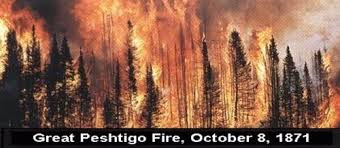
On the evening of October 8, 1871 the worst recorded forest fire in North American history raged through Northeastern Wisconsin and Upper Michigan, destroying millions of dollars worth of property and timberland, taking between 1,200 and 2,400 lives, and burning over one million acres of forest land.
Madison music artist, recorder, performer and environmental advocate Ken Longquist and his band were guests in the studio yesterday on WORT-FM radio’s “8:00 O’Clock Buzz”, hosted by Madison’s Tony Castañeda. Their visit to the radio station was made in recognition of the 144th year anniversary of the historic Peshtigo fire, which took so many human lives and undoubtedly countless wild animals as well. According to Longquist’s research of this historical event in Wisconsin’s history, the fire followed a period of prolonged and widespread drought and high temperatures combined with human carelessness. In those days, developers often set small fires as a way to clear forest stumps and land for farming and railroad construction. On the day of the Peshtigo fire, the fires that were set got out of control and the strong, cyclic winds escalated the fire to massive proportions. By the time the fire was over, 3 days later, more than 1,875 square miles or 1.2 million acres of forest land had burned to the ground. Twelve communities in the area were completely destroyed.
An accurate death toll has never been determined for the tragedy as local records were destroyed in the fire and no one had anticipated what was about to take place. Much like today’s global warming-aided extreme weather, worldwide, linked to a 50 percent increase in the carbon dioxide concentration of the atmosphere and rising concentrations of other greenhouse gases in the atmosphere, primarily from humans carelessly and knowingly burning huge quantities of fossil fuels; there have also been huge, deadly and costly catastrophic fires occurring in the western U.S. states the last few years. The Peshtigo fire was similarly caused by careless human activity – actions that were clearly dangerous to the people, animals and all the other things around them – much like humans burning fossil fuels, despite their seeing signs that earth’s climate has already changed around them and created considerable havoc, loss of life and property.
Listen to Ken and his band perform their new song “Peshtigo” live on radio (or via computer) on the 147th anniversary of the fire yesterday morning, October 8, 2015, at WORTFM Community Radio, Madison.
Jonathan Patz to Discuss Climate Change and Global Health
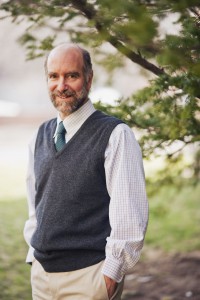
GHI Director Jonathan Patz will be at the Minocqua Brewing Company for the monthly “Science on Tap-Minocqua” series, a science cafe that brings UW researchers to Wisconsin’s Northwoods and lets attendees start a conversation on everything from fisheries, to loons, to Vitamin D.
Patz’s talk, titled “Human Health and a Changing Climate” will start an important discussion on how a warmer world means more than melting ice caps and rising seas.
“Climate Change poses serious harms to our health,” says Patz. “Climate change actions, however, offer enormous health benefits. I’d go so far as to say that achieving a clean energy society may be the greatest public health opportunity we’ve had in more than a century.”
Patz, who spent 15 years as the lead author for the United Nation’s Intergovernmental Panel on Climate Change (IPCC), will touch on these topics, as well as field questions from the audience — an interaction that makes Science on Tap-Minocqua such an important extension of the Wisconsin Idea, says Susan Knight, interim director of Trout Lake Station.
It will be livestreamed
Wednesday October 7th, 2015, 6:30 pm (CST) Duration: 120 minutes
The Trans-Pacific Partnership Is Now Finalized, but You Can’t Read It Quite Yet

October 5, 2015
The final version of the Trans-Pacific Partnership (TPP) was just agreed upon at a big, multinational meeting in Atlanta, Georgia, attended by trade negotiators from the 12 Pacific Rim countries involved in the deal. The TPP, which is supported by President Barack Obama, and whose biggest players are the United States and Japan, has been in the works for about eight years. But its text has not been made available for public consumption, and still has to be put to a strictly yes-or-no vote in Congress before it can take effect.
No specific timeline for that vote exists, although according to The Washington Post, Obama legally he has to wait at least 90 days to sign the agreement now that he has notified Congress, and the text must be public for 60 of those days. That means the full text of the TPP might be shown to the public in early November.
As we’ve mentioned before, the TPP, like most international trade deals, is meant to enable free trade between member countries. With this particular agreement, Obama hopes to further the United States’ ability to set global standards for trade, rather than allow the agenda to be set by that other economic juggernaut of the Pacific, namely China.
The centerpiece of today’s announcement is the fact that the deal will knock out 18,000 tariffs, which is probably good news if you’re a consumer, and definitely good news if you’re a shipping magnate.
But a few provisions in leaked versions of the TPP have sparked outrage among the public. One such example is the concept of “investor-state dispute settlements,” which allow international companies to bring their grievances to legally-binding tribunals, which could potentially override laws in member countries. The TPP has also raised concerns about a possible overhaul of intellectual property law, as some fear an expansion of US laws restricting companies from manufacturing cheaper generic drugs will keep drug costs up worldwide.
While the newly agreed-upon draft remains shrouded in secrecy, the official summary released by the Obama administration this week does address the previous controversy about those two issues, albeit sort of vaguely.
In the case of intellectual property, the summary’s section on pharmaceuticals doesn’t exactly make it clear what will happen to drug profiteers like most-hated-man-in-America Martin Shkreli. The summary simply states that the agreement “contains pharmaceutical-related provisions that facilitate both the development of innovative, life-saving medicines and the availability of generic medicines.”
Presumably this availability of generics will be helped along by the elimination of “patent linkages,” a provision that scared Politico’s Michael Grunwald when it appeared in a previous leaked version of the TPP. Today, Grunwald tweeted that it sounds like these linkages were “stripped out” of the new version of the deal.
The US Trade Representative has also put up a page offering alternative talking points about investor-state dispute settlements (ISDS). In response to critics who claim the ISDS provision would allow international companies to undermine environmental and consumer safety laws in the US, the Trade Representative says the administration has been “upgrading” the agreement, presumably to avoid any such nightmare scenarios. The site also offers a few factoids for context: 51 trade agreements already have investor-state dispute settlements in place; “only” 13 ISDS cases have been brought against the US in the past; and so far, the US has always won.
The summary itself is light on details about ISDS, however. But there is a very specific line saying that the tribunals will need to go out the window if the dispute involves “a claim challenging a tobacco control measure of the Party.” In other words, a built-in exemption to TPP means that tobacco companies won’t be among the entities with the power to challenge laws in signatory countries.
For what it’s worth, North Carolina Republican Senator Thom Tillis is pretty upset about this provision aimed at the tobacco industry, writing in a statement Monday that, “the Obama Administration has decided to use the TPP as a laboratory for partisan politics by discriminating against specific agricultural commodities.”
In the wake of the TPP announcement, an anti-globalization group called “Flush the TPP” has issued a call to action, scheduling a protest to run from November 14-18 in Washington, DC. The group says protesters will be urging the government to stop making deals like these, and to come up with “alternative international agreements that put people and the planet first.”
By Mike Pearl, Staff Writer for VICE

U.S. Passenger Airlines Report After-tax Net Profit of $5.5 Billion for 2nd Quarter of 2015
U.S. Department of Transportation Releases 2nd Quarter (April-June) of 2015 Airline Financial Data
U.S. scheduled passenger airlines reported an after-tax net profit of $5.5 billion in the second quarter of 2015, up from $3.1 billion in the first quarter of 2015 and up from $3.6 billion in the second quarter of 2014, the U.S. Department of Transportation’s Bureau of Transportation Statistics (BTS) reported today.
The 26 U.S. scheduled service passenger airlines reported an after-tax net profit as a group for the ninth consecutive quarter.
In addition to the after-tax net profit of $5.5 billion based on net income reports, the scheduled service passenger airlines reported $8.2 billion in pre-tax operating profit in the second quarter of 2015, up from $5.1 billion in the first quarter of 2015 and up from $5.5 billion in the second quarter of 2014. The airlines reported a pre-tax operating profit – as a group – for the 17th consecutive quarter.
Net income and operating profit or loss are two different measures of airline financial performance. Net income or loss may include non-operating income and expenses, nonrecurring items or income taxes. Operating profit or loss is calculated from operating revenues and expenses before taxes and other nonrecurring items.
Total operating revenue for all U.S. passenger airlines in the April-June second-quarter of 2015 was $43.9 billion. Airlines collected $33.2 billion from fares, 75.7 percent of total second-quarter operating revenue.
Total operating expenses for all passenger airlines in the second-quarter of 2015 were $35.8 billion, of which fuel costs accounted for $7.9 billion, or 22.1 percent, and labor costs accounted for $11.0 billion, or 30.7 percent.
In the second quarter, passenger airlines collected a total of $962 million in baggage fees, 2.2 percent of total operating revenue, and $773 million from reservation change fees, 1.8 percent of total operating revenue. Fees are included for calculations of net income, operating revenue and operating profit or loss.
Baggage fees and reservation change fees are the only ancillary fees paid by passengers that are reported to BTS as separate items. Other fees, such as revenue from seating assignments and on-board sales of food, beverages, pillows, blankets, and entertainment are combined in different categories and cannot be identified separately.
See BTS Airline Financials Release for summary tables and additional data. See airline financial data press releases and the airline financial databases for historic data.
South Carolina Flooding Is The Scary New Reality For Businesses
By Alexander C. Kaufman, Business Editor, The Huffington Post
“Businesses confront a lot of challenges and have a wide range of risks, but this is large and it is growing. It’s just one you can’t ignore.”
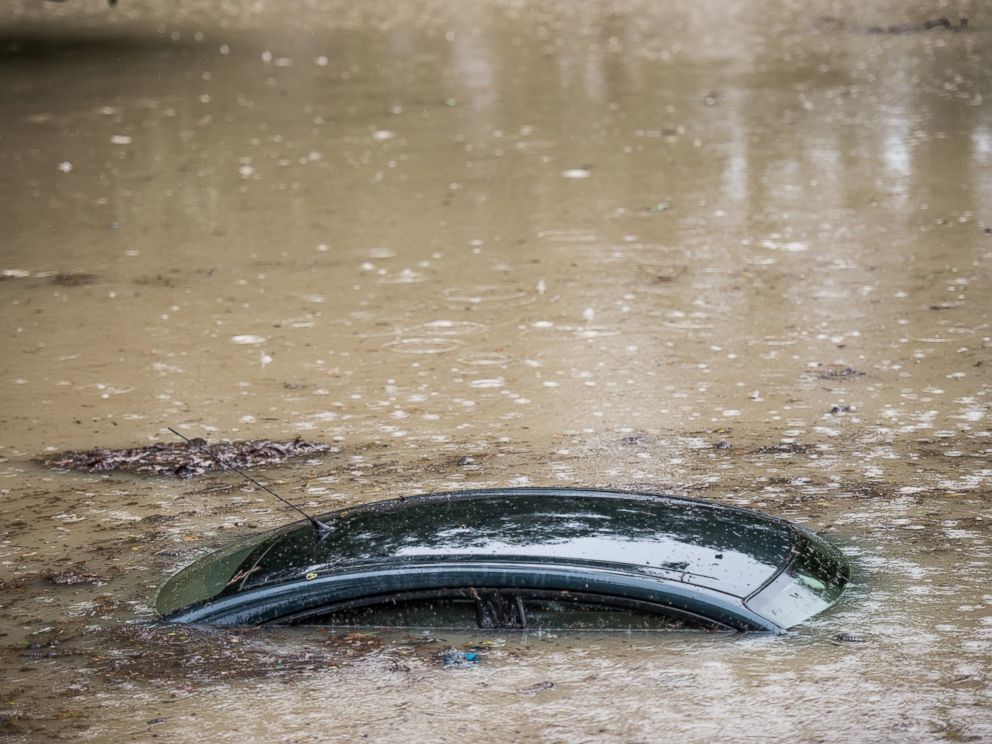
In South Carolina, where heavy weekend rainfall caused the worst flooding in a millennium, the local economy has ground to halt. Rescue workers are evacuating those trapped in flooded neighborhoods of the counties surrounding Columbia, the state’s capital. Officials have also warned other residents to stay home during the cleanup. In many parts of the state, customers can’t shop and employees can’t work.
The floods resulted from Hurricane Joaquin, which never made landfall over South Carolina but combined with other weather systems, soaking the region on Sunday. Nine people have died. It’s unclear how costly the damage will be.
Such extreme events are expected to become more common in the coming years, as the already-irreversible effects of climate change take hold. And bad weather is not good for business.
“It’s a reality of doing business, it’s a reality of life for all of us,” Cynthia McHale, the director of insurance at the sustainability nonprofit Ceres, told The Huffington Post on Monday. “We’re in for a lot of rough weather, among other things.”
Wildfires that destroy property and uproot residents. Heat waves that, as refrigerators and air conditioners roar, cause outages on power grids. Droughts that make water for agriculture and manufacturing even more scarce.
“You need to know the climate change risks to you and your business and, in the case of floods, have an emergency plan for the evacuation of employees,” McHale said. “At some point, you may decide you can’t continue to operate your business where you have been.”
Businesses can even feel ripple effects from storms and floods halfway around the world.
In 2011, deadly deluges in Thailand damaged factories in Bangkok’s bustling manufacturing sector, disrupting supply chains for multinationals such as Apple, Toyota and Unilever. More than 800 people died in the floods, which caused nearly $46 billion in property damages, according to the World Bank.
To be sure, businesses around the world have awakened to the new realities of climate change and the need to mitigate its effects.
Earlier this month, during a series of announcements in New York for Climate Week, business leaders put pressure on political officials to curb carbon emissions.
An unlikely coalition of big corporations — including Goldman Sachs, Johnson & Johnson and Walmart — formed to set dates by which they would completely convert to using renewable energy. Since last year, the number of companies vowing to wean off fossil fuels by setting internal carbon pricing has tripled.
Even bankers are waking up to the need for radical change. In a joint statement released last week, a group of six colossal U.S. banks called for a “strong global climate agreement” during the United Nations’ conference in Paris in December.
“It’s really gargantuan, it really is,” McHale said of climate risks. “I understand that businesses confront a lot of challenges and have a wide range of risks, but this is large and it is growing. It’s just one you can’t ignore.”
 All Things Environmental
Recent Comments