
What is Wrong with Our People in Washington D.C.?
So what if the price of oil falls to its lowest point in 12 years! Our federal lawmakers in Washington already gave in to the oil industry by removing the 40-year old crude oil export ban, and now they are talking about expediting the process for exporting liquefied natural gas, subsidizing private infrastructure with U.S. taxpayer money including money for upgrading pipelines, transmission lines, rails and roads, to “help our industry compete” by allowing energy to get to market “more quickly and cheaply” by “loosening environmental and other regulations”.
Our governmental officials in Washington D.C. say they will work towards continuing and giving more U.S. taxpayer money to reward already wealthy companies like ExxonMobil and other highly profitable energy companies who have already profited greatly with the U.S. Government financial assistance over a number of decades with ill effects on millions of us already, and many more millions of us who will be so unfortunate as to succeed us on a planet rocked by ever increasing and ever more deadly extreme weather tragedies, that is, of course, if they manage to keep their heads above earth’s rising ocean levels, which have submerged some island countries already. Exxon’s own scientific studies predicted all these bad things would result if humans continued to recklessly burn more and more fossil fuels for energy, sending the concentrations of many greenhouse gases, such as carbon dioxide and methane to evermore dangerous levels in our Earth’s atmosphere, oceans and water bodies. Yet still they kept their research to themselves, hiding the many catastrophic consequences of global warming, and funded global warming denial campaigns, which allowed them to continue to enrich themselves at the world and future world’s expense!
Where is the justice in all of this? There isn’t any. Not here, there or anywhere. And certainly not in the chambers in Washington D.C.. Change has got to come, now, before it’s too late. And it has to be the RIGHT kind of change – the equitable kind. It has to be a change that will help all of us who currently and in the future call Earth our home. There is no other hospitable place we can go.
Our Representatives and Senators in Washington D.C. need to wake up to the scientific reality that confronts all of us – that we have already exceeded the safe level of heat trapping gases in the atmosphere. Not only must we stop adding more and more greenhouse gases to the atmosphere, but we must also accept the moral responsibility of helping those likely to be hurt the most by Earth’s rising seas and other adverse and compounding realities stemming from human-caused changes in the climate, especially those who can least afford appropriate adaption measures that will allow them to humanely live with the changes, particularly those who have contributed the least to the problem that now confronts us all.
Those presently in Washington D.C. who are continuing to act as though the threats and costs of global warming and climate change resulting from human activity are nonexistent should go do something else.
Rally Planned at Madison Capitol Steps to Voice Wisconsin People’s Opposition to Enbridge Crude Oil Pipeline Capacity Expansion Through Dane County and 12 other Wisconsin Counties
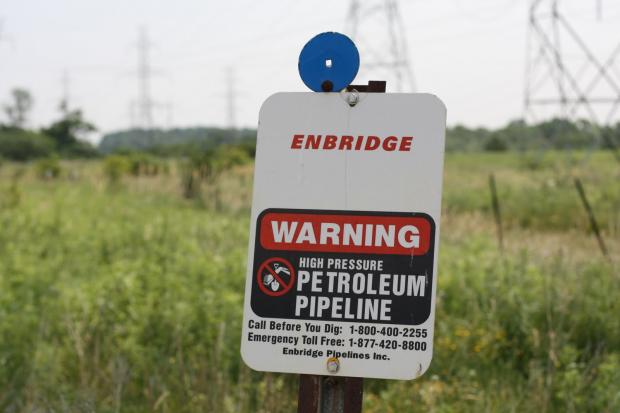
Local and National Speech will be delived at a public rally on the State Street side of the Wisconsin Capitol Building Saturday, at 3;00 o’clock pm on Saturday, 12 December. All people concerned about oil spills and the warming planet will be in attendance.
A federal judge says courts don’t have the authority to question U.S. State Department decisions in a cross-border pipeline dispute.
Environmental groups brought a lawsuit against Enbridge Energy, claiming the firm is illegally transporting more oil from Canada by switching it between lines at the border. But a U.S. district judge ruled this week that because the State Department OK’d the reroute, it’s not subject to legal challenges.
Enbridge proposed to nearly double the amount of oil on its Line 67 pipeline that runs from Alberta to Superior. According to Wisconsin Safe Energy Alliance co-founder Carl Whiting, the pipeline switch at the border is already sending that much more to Wisconsin. He said the move skirts national laws on cross-border expansions and expressed disappointment with the judge’s ruling.
“The last thing this region – Wisconsin in particular – needs is to become the major corridor for tar sands at a time when we’re facing climate issues,” he said.
Whiting said parties to the suit are considering other options. Enbridge spokeswoman Lorraine Little said the judge’s ruling affirms the State Department’s decision that the company is operating its pipelines at the border in accordance with existing permits.
Little provided the following statement:
“Wednesday’s decision leaves in place the State Department’s approval of Enbridge’s use of Line 3 and Line 67 consistent with its existing permits. The interconnections are simply leveraging the flexibility we have under our existing permits to meet our obligations to shippers and to continue the vital service of transporting reliable, secure supplies of North American crude oil.”
Winona Laduke, executive director of the group Honor the Earth and member of the White Earth Nation called the ruling “baffling” in a press release.
“The federal government has allowed Enbridge to violate federal laws, but the federal courts don’t feel they have jurisdiction to intervene … Ojibwe tribes stand united in opposition to this pipeline invasion and we will continue our resistance until justice is served.”
WPR Article By Danielle Kaeding, 11 December 2015
President Obama Should Request U.S. Congress to Issue Declaration of War to Fight Global Warming
On December 8, 1941, the United States Congress declared war on the Empire of Japan in response to its surprise attack on Pearl Harbor, the United States naval base at Pearl Harbor in the U.S. Territory (soon to become state) of Hawaii the morning of December 7, 1941.
The Declaration of War was formulated an hour after President Franklin D. Roosevelt’s famous Infamy Speech at 12:30 pm on December 8, 1941. The declaration quickly passed the Senate and then the House at 1:10 p.m the same day. Roosevelt signed the declaration at 4:10 p.m., December 8, 1941. The power to declare war is assigned exclusively to Congress in the United States Constitution; however, the president’s signature was symbolically powerful and resolved any doubts.
Two days later, a similar war declaration against Germany and Italy passed both the Senate and the House of Representatives.
In the Joint Resolutions declaring war against the Imperial Government of Japan, Germany and Italy, the Congress pledged “all the resources of the country of the United States” … “and the president is hereby authorized and directed to employ the entire naval and military forces of the United States and the resources of the government to carry on war … to bring the conflict to a successful termination.”
The magnitude of the threat of accelerating global warming and a rapidly changing climate that would undeniably accompany the continued and increasing accumulation of greenhouse gases in the atmosphere, as a direct consequence of human actions, mainly from too much fossil fuel burning and continuing and increased deforestation, especially in the tropics, upon the United States of America and the rest of the world, both now and into the future, easily dwarfs the loss of life, injury and misery to humans and animals wrought by all known wars, and therefore justifies a declaration of war by all countries of the world to slow and ultimately halt global warming and climate change, worldwide. Such declarations should be made now, without delay, to ensure an hospitable and safe world for all Earth’s current and future generations.
It is morally essential that Government, businesses, individuals and families begin to meet this challenge of increasing global warming and climate change that has already begun to cause loss of human lives, other species living in the world, and brought pain and misery to so many. To ignore and campaign against actions that reduce this growing threat, which will unquestionably hurt the people of the world’s poorer countries and Earth’s millions and millions of species, is utterly and morally reprehensible and is a practice that ought stop immediately because it needlessly delays progress in attacking this major problem of untold negative consequences for centuries to come.
As Earth Warms, NASA Targets ‘Other Half’ of Carbon, Climate Equation in Advance of United Nations climate conference in Paris

Carbon dioxide emitted into the atmosphere by human activities influences the amount of the sun’s energy trapped by Earth’s atmosphere. These emissions are the subject of a United Nations climate conference in Paris later this month. To improve the information available to policymakers on this issue, scientists are grappling with the complex question of whether Earth’s oceans, forests and land ecosystems will maintain their capacity to absorb about half of all human-produced carbon dioxide emissions in the future.
“NASA is at the forefront of scientific understanding in this area, bringing together advanced measurement technologies, focused field experiments, and cutting-edge research to reveal how carbon moves around the planet and changes our climate,” said Michael Freilich, director of NASA’s Earth Science Division. “Understanding how the planet responds to human carbon emissions and increasing atmospheric CO2 levels will position our nation to take advantage of the opportunities and face the challenges that climate changes present.”
Atmospheric carbon dioxide levels recently surpassed a concentration of 400 parts per million (ppm) — higher than at any time in at least 400,000 years — and continue to increase at about 2 ppm per year. Levels of the even more potent heat-trapping gas methane — also carbon-based — now exceed pre-industrial amounts by about 2.5 times. Calculations show that, on average, only about half of the carbon emitted by human activities remains in the atmosphere.
This “other half” of the carbon problem — how and where it is absorbed on land and sea — is a priority for carbon cycle scientists at NASA and around the world. Scientists are investigating how Earth’s warming environment will affect the ability of ecosystems around the world to absorb carbon naturally, and what changes in those ecosystems could mean for future climate. It’s a major research question involving several NASA satellite missions, multi-year field campaigns and new instruments that will fly on the International Space Station in coming years.
Scientists discussed the ongoing analysis of the first year-plus of satellite data from NASA’s recently launched Orbiting Carbon Observatory-2 — the agency’s first satellite designed to measure carbon dioxide from the top of Earth’s atmosphere to its surface.
“As carbon dioxide is the largest human-produced driver of our changing climate, having regular observations from space is a major step forward for our ability to understand and predict climate change,” said Annmarie Eldering, OCO-2 deputy project scientist at NASA’s Jet Propulsion Laboratory (JPL) in Pasadena, California. “Precisely measuring carbon dioxide in the atmosphere has been one of the most difficult observations to make from space.”
OCO-2 already is demonstrating the accuracy, precision and coverage needed to provide the first complete picture of both human and natural sources of carbon dioxide and the places where they are being absorbed. While the mission gives scientists new, near-global data on atmospheric carbon dioxide, satellite data cannot directly observe the processes by which the gas is absorbed on the land and ocean. To better understand these processes, NASA scientists will use satellite data and detailed field experiments in concert with super-high-resolution computer models. Scientists need this integrated approach in order to continue to more accurately predict how carbon-absorbing ecosystems will respond to a warming climate.
“The land and the ocean are really doing us a big favor,” said Lesley Ott, an atmospheric scientist in the Global Modeling and Assimilation Office at NASA’s Goddard Space Flight Center in Greenbelt, Maryland. “Otherwise you would have carbon building up in the atmosphere twice as fast as it does now.”
Also causing concern is the potential for the ocean’s rate of carbon absorption to change as ocean temperatures rise and phytoplankton communities show signs of change. NASA’s North Atlantic Aerosols and Marine Ecosystems Study (NAAMES) launched ship and airborne studies last week to the North Atlantic Ocean, where satellites have documented surprising phytoplankton behavior in recent years.
“We will be studying an ocean region that every year exhibits one of the largest natural phytoplankton blooms on Earth,” said Mike Behrenfeld, NAAMES principal investigator from Oregon State University in Corvallis. “Phytoplankton are not only influenced by climate, but they also influence climate. That’s why we’re out here in the North Atlantic in the middle of November.”
Forest and other land ecosystems are also changing in response to a warmer world. Some ecosystems — such as thawing permafrost in the Arctic and fire-prone forests — could begin emitting more carbon than they currently absorb. Next fall, NASA’s Arctic Boreal Vulnerability Experiment will begin a 10-year investigation into the fate of carbon stores in rapidly warming regions of Alaska and Canada.
The scientists also outlined several other upcoming NASA carbon missions and field campaigns, including:
ACT-America, which will fly over the eastern U.S. beginning in 2016 to study the atmospheric movement of carbon emissions;
Coral Airborne Laboratory mission, which will fly over coral reefs around the world beginning in 2016 to observe how reefs are responding to changing ocean pH levels caused by the absorption of carbon dioxide;
The Pre-Aerosol, Clouds and Ocean Ecosystem satellite, now in early development, will provide a revolutionary way of measuring phytoplankton from orbit; and,
Two instruments that will fly on the International Space Station in coming years — Global Ecosystem Dynamics Investigation and ECOsystem Spaceborne Thermal Radiometer Experiment on Space Station, which will provide crucial observations of plants and forests.
Steve Cole
Headquarters, Washington
202-358-0918
stephen.e.cole@nasa.gov
Last Updated: Nov. 12, 2015
 All Things Environmental
Recent Comments