
6. My Testimony on Governor Walker’s 2013-14 State Budget
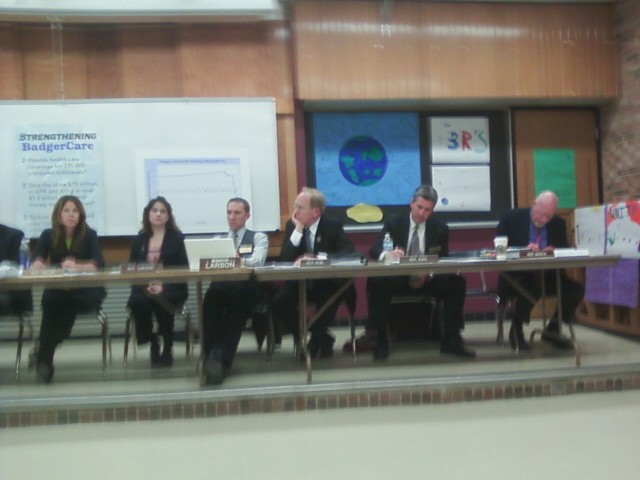
The Legislature’s Joint Finance Committee continues to vote on items in Governor Scott Walker’s $69 billion proposed budget. Here is a transcript of testimony I delivered on the Governor two-year plan for 20013 and 2014 at the Madison budget hearing held at Black Hawk Middle School in Madison on April 23, 2013. A number of Democratic State legislators were present, including Senators Miller, Larson, Risser; and Representatives Taylor, Sargent, Herbl and Kahl. About 50 members of the public were in the audience when I gave my remarks at approximately 6:30 PM. Other people were giving testimonies when I arrived. Everyone I heard either criticized the governor’s proposed K-12 school voucher plan or criticized the failure of the governor’s budget to ensure adequate health for all Wisconsin’s residents, especially its most vulnerable the low income residents.
Testimony of Michael T. Neuman, resident of Madison, Wisconsin, on Governor Walker’s Proposed 2013-14 State of Wisconsin Budget
Black Hawk Middle School, Madison
April 23, 2013
“The governors proposed budget for 2013 and 2014 fails to adequately fund 2 areas which I believe are critical for Wisconsin’s future. These are 1) education of the state’s children; and 2) Wisconsin’s contribution to global warming and responding to the global warming threat.
“To adequately address K-12 education, the budget should restore the $400 million in cuts made during the Governor Doyle administration, and the $750 million cuts made in the first year of
Governor Walker’s administration. Wisconsin’s public school programs should NOT be sacrificed fund a private school voucher program. The source of the money to restore and properly fund our public schools should not come from higher property taxes but rather from income taxes and the million of dollars that would unwisely expand the state’s highway system.
“This leads to my second major concern with the state budget, which is that it fails to address the growing threat of climate change in Wisconsin and our state’s continuing contribution to the rising concentrations of greenhouse gases in our Earth’s atmosphere from burning fossil fuels. To address this, the budget should fund a program that offers financial incentives to Wisconsinites for driving less (or not driving at all), flying less (or not flying at all), and who use less fossil fuel derived energy in the household per person, annually.
“Finally, the state should also fund a program for local governments to prepare and adapt to the changing climate caused by global warming.”
 ://>
://>
5. “An Inconvenient Truth” – the Movie – and Photo Comic of Earth’s Warming
“In 39 years, I have never written these words in a movie review, but here they are. You owe it to yourself to see this film.”
– Roger Ebert
“It doesn’t matter whether you’re a Republican or Democrat, liberal or conservative … your mind will be changed in a nanosecond.”
– Roger Friedman, FOXNEWS.com
Here you can watch An Inconvenient Truth.
Here is a photo comic about global warming:

4. Returning Air Traffic a Good Thing?
On the 6-month anniversary of Hurricane Sandy, the massive storm that hit the Eastern United States last fall and is now being blamed on global warming, U. S. lawmakers in the House of Representative and the Senate rushed a bill through the U.S. Congress last week that allowed the Federal Aviation Administration to withdraw its furloughing of many air traffic controllers and other airport workers around the country. This action removed a major bottleneck that was significantly delaying aviation travel in the U.S. last week.
The furloughs were fallout from the $85 billion in automatic-across-the-board spending cuts this spring. With passage of the bill, the FAA will move as much as $253 million within its budget to areas that will allow it to prevent the reduced operations and staffing. The spending cuts had forced the FAA to furlough 13,000 air traffic controllers beginning last week Sunday, among its total of 47,000 employees. About 40% of last week’s flight delays in the U.S. were a direct result of too few controllers in towers at airports around the country, said the FAA. The country’s commercial airlines reportedly resumed normal operations as of late Sunday night. I question whether this was really the right thing for the country to do.
Although White House press secretary Jay Carney said the President still intends to sign the bill, President Obama blasted lawmakers in his weekly address posted Saturday for insisting on spending cuts, and then maneuvering to redress the ones that applied to them: “Maybe because they fly home each weekend, the members of Congress who insisted on these cuts finally realized that they actually applied to them too,” said President Obama. “So Congress passed a temporary fix. A band aid. But these cuts are scheduled to keep falling across other parts of the government that provide vital services for the American people. And we can’t just keep putting band aids on every cut.” (huffingtonpost.com).
Meanwhile, also last week, officials from coastal communities along the Eastern seaboard sat down for the first time to discuss Hurricane Sandy consequences and how to best protect their residents from sea level rise. The meeting, which took place in New York City on Wednesday, was sponsored by the Union of Concerned Scientists (USC). The nonprofit science advocacy group released a report on sea level rise on Monday.
According to the USC report, rising sea level is what linked Sandy directly to global warming. “Coastal Cities Confront Global Warming-Induced Sea Level Rise” was also posted last Saturday. “Over the last century, the ocean off the New York coast rose 13 to 16 inches, making flooding from Sandy a lot worse”, said Elliot Negin, USC’s director of news and commentary. Hurricane Sandy triggered an estimated $60 billion in estimated losses in New York and New Jersey alone, according to the report.
“We got a glimpse of our collective future,” said Joe Vietri, director of the U.S. Army Corps of Engineers’ (COE) coastal and storm risk management program, during a press briefing. “Clearly we know climate change and sea level rise are right here. We are living it right now.”
For some participants, such as Stephen Marks, Hoboken, New Jersey’s assistant business administrator, Hurricane Sandy erased any doubts in his town about global warming. “The debate about climate change is essentially over,” said Marks, whose 2-square-mile municipality of 50,000 was overwhelmed by 500 million gallons of Hudson River water. “Hurricane Sandy settled that for, I would say, a majority of the residents of our city.”
For others, such as Broward County, Florida, Mayor Kristin Jacobs, Hurricane Sandy was just an extreme example of the same old same old. “We’ve been dealing with the effects of climate change for quite some time,” she said. Broward County, she pointed out, established a climate change “compact” with three other South Florida counties in 2009 to address chronic flooding and other global warming impacts. Based on local trends and global projections the USC says the compact — which collectively represents 5.5 million residents in three Florida counties — anticipates sea level along Florida’a coast will rise 3 to 7 inches by 2030, and 9 to 24 inches by 2060!
Vietri, who is overseeing the Army Corps of Engineers’ Hurricane Sandy study, bemoaned the fact that despite greater public awareness of climate change and sea level rise: “You still have people by the truckload moving into high hazard coastal areas”. It doesn’t make much sense, and ultimately all Americans will end up paying a good share of the total cost.
Greenhouse gas emissions from commercial airliners and other greenhouse gas sources in the U.S. are significantly adding to the warming atmosphere and seas (the latter which is also becoming more acidic due to warming), according to the U. S. Environmental Protection Agency. Yet people and businesses from all over the U.S. (as well as from most other developed countries) continue to travel using motorized fossil fuel burning technologies (planes, automobiles, trucks, trains, etc.), burn fossil fuels and electricity derived from burning fossil fuels (natural gas and coal), without paying serious attention to what the vast majority of the world’s climate scientists have been telling us for a number of years now: that global warming is now happening, that it has been going on for a number of years already, and that it is getting worse.
We are adding measurably to the growing stockpile of greenhouse gases now mounting in the earth’s atmosphere. For example, the concentration of the most abundant greenhouse gas in the atmosphere, carbon dioxide (CO2), has increased to 399 parts per million (ppm), as compared to the 350 ppm that existed in the atmosphere prior to the late 19th century, before people and industries began significantly burning fossil fuels for energy, heating, lighting, air conditioning, locomotion, air travel, shipping, auto/truck travel, etc.. Furthermore, scientists have also been saying the consequence of warming the atmosphere and oceans is more and more warming, increasing the likelyhood of more extreme weather events, potentially much worse than Hurricane Sandy and this spring’s flooding.
It should also be noted that carbon dioxide’s residence time in the atmosphere is long – roughly 100 years or more, on average, so the volume of it in the atmosphere continues to grow, even if what is emitted declines, so the less fossil fuels humans end up burning each year the better as far as reducing the global warming threat goes. Other greenhouse gas emissions from jet aircraft travel include HFCs, methane and nitrous oxide, which are all significantly more powerful warming gases than is carbon dioxide, and remain in the atmosphere for years and years. So the less flying that is done in the U.S. and elsewhere on the planet, the better we can avoid more and worsening effects such as those caused by Hurricane Sandy and the rising sea levels.
3. State of Wisconsin Losing Its Environmental Ethic
 Other states in the country use to look to Wisconsin to see how best to protect their air, water and other natural resources from human exploitation and adverse environmental impacts. After all, Wisconsin is the home of naturalist John Muir, Aldo Leopold and Senator Gaylord Nelson, today’s Earth Day founder. But things have changed in Wisconsin since the beginning of the new century.
Wisconsin’s current Governor and the heavily Republican dominated Wisconsin Legislature have placed a higher priority on such things as more highway expansion, iron ore mining, and frac sand mining, rather than adopting policies that protect our environment, such as policies that help reduce global warming or add to the state’s already existing land and water resource Stewardship Program.
For a Wisconsin Public Radio call-in hour discussion of this subject on the 43rd anniversary of Earth Day in Wisconsin, click on The Ideas Network, enter the date of April 22, and then scroll to the 3:00-4:00 pm program.
Guest: Mike Ivey, reporter for The Capitol Times. His article is called “Has Wisconsin’s Proud Pro-Environment Tradition Faded?”.
2. Watch “Do the Math” Movie

Global Warming 1/2 (Photo credit: lamazone)
In November 2012, Bill McKibben and 350.org hit the road to build a movement strong enough to change the terrifying math of the climate crisis. The Do the Math Tour was a massive success, with sold out shows in every corner of the country.
The tour is now over, but the campaign it launched is just getting started. The “Do the Math” movie was screened at house-parties and screenings across the country on April 21, 2013. At 42 minutes, it tells the story of the rising movement to change the terrifying math of the climate crisis and fight the fossil fuel industry.
View the trailer at: http://www.youtube.com/watch?v=-zfinOCgRQ0&feature=youtu.be
1. Dane Country is Planning for Climate Change
Rather than ignoring global warming as the very real problem that it is and that requires major governmental action now, Dane County is accepting the scientific reality of the problem and is preparing for the continuing threats that climate change will bring. According to Dane County Executive Joe Parisi: “we are taking a step back and looking at how the climate is changing and the types of events that are likely to happen”, he said in a Wisconsin State Journal(WSJ) article (April 14, 2013). “We’re going to assess our readiness”, he said. University of Wisconsin-Extension climate change expert David Lieble agreed: “Wisconsin has seen — and probably will continue to see — more heavy rain and flooding in spring and fall, and longer heat waves and dry spells in summer.” So Dane County has initiated a major study aimed at ensuring local government in Dane County will meet the new challenges posed by more extreme weather that climate change (global warming) will usher in.
“There have been more days with temperatures of 90 degrees or hotter, a steady decline in the length of time when lakes are frozen, and significantly higher rainfall totals along with more individual storms dumping more than 2 inches of rain”, Parisi said. The county could conclude that more cooling shelters are needed in certain area on sweltering summer days, or that lake levels need to be lowered to accommodate sudden, heavy rains, Lieble said.
Representatives from more than a dozen county government departments will be led by Dane County Emergency Management Director Charles Tubbs in what has been billed as “the first comprehensive effort of its kind” addressing Wisconsin’s changing climate, according to the WSJ report. The report is due by September, 2013.
Related articles
- WISC Editorial Agenda 2013 – Our Climate – Dane Council (channel3000.com)
- Coming up this week on ‘UPFRONT with Mike Gousha’ (wisn.com)
- Parisi creates new Dane County Climate Change Action Council (channel3000.com)
 All Things Environmental
Recent Comments