
Governor Walker’s Proposed 2015 -2017 State of Wisconsin Budget

Following are the comments I submitted by email on the governor’s proposed budget for July 1, 2015 to June 30, 2017.
Bad things can happen to good people. It happens all the time, and has occurred all throughout history. So when bad things, or threats, are predicted to occur or seem reasonably likely to occur, it’s best for one to take action, and involve others in removing the oncoming threat, before it gets realized and significant damage to life and our environment occurs.
Governor Walker’s biennial budget plan for Wisconsin for the next two years contains numerous threats to the people of Wisconsin and the state of Wisconsin’s natural resources. Some of those threats could have devastating and harmful impacts if they are allowed to occur without any attempts to prevent or ameliorate them.
Governor Walker’s budget plan as written will cause a great deal of harm for many thousands of Wisconsin’s people and their families. Some people who have worked their entire life at University of Wisconsin or UW-extension will likely lose their jobs, and the public who those people serve will lose out as well. Wisconsin’s elderly and disabled population, and families having children enrolled in Wisconsin’s excellent public school system will also suffer loses. Many hard working and dedicated school teachers and educational assistants serving special needs children will be without a job next fall if this budget is not revamped.
The governor’s budget also hurts those who watch over and protect our precious natural resources, both now and in the coming years, by cutting positions and land stewardship funds.
But really the worst thing about the governor’s budget is not what’s in it but rather what’s NOT IN IT BUT SHOULD IN IT. For example, despite Wisconsin’s aging population and increasing number of people who prefer not to drive, or who can’t drive because of the high cost of owning, maintaining and driving an automobile, the Walker budget proposes nothing new to help with mobility in the state, transit in particular. Rather, it borrows hundreds of millions of dollars to expand an already too large highway system at great environmental harm to the state, and for no good reason.
Numerous observations demonstrate that the climate of the Great Lakes Region, including Wisconsin’s climate, is changing. Average temperatures are getting warmer and extreme heat events are occurring more frequently. Total precipitation is increasing and heavy precipitation events are becoming more common. Winters are getting shorter and the duration of lake ice cover is decreasing over time. As a state, we should already be doing as much as we can to drastically cut back on our burning of fossil fuels but we seem to be doing almost the opposite. This tragedy grows in magnitude the longer it takes for our country and other countries to wean themselves off burning fossil fuels. There are many other unintended consequences of living in a fossil fuel burning dependent society.
But ironically, rather than then increasing substantially the funding of transit systems and the funding of positive financial incentive programs aimed at reducing greenhouse gas emissions and encourage walking and use of nonmotorized travel by state residents and businesses, the governor’s budget promotes more highway expansion. Instead, the state should reward those who drive less (miles), don’t fly, and minimizing their use of fossil fuel derived energy over the year. Use the money that Governor Walker’s budget borrows to fund a bigger highway system and a big new professional basketball arena instead – expenditures that not only subject state taxpayer to great financial risks but also promote adding millions more tons of greenhouse gases to the atmosphere including promoting jet airplanes flying of visiting teams and fans to the games.
Wisconsin Public Radio (part of state’s UW-extension) plans vacationing trips to Scotland and Australia, trips that not only release hundreds of millions of tons of greenhouse gases to the atmosphere but also give nothing back to the state’s own tourism businesses.
Governor Walker’s budgets include more trade promotions with foreign countries despite the fact that shipping products and working with foreign business interests similarly add millions and millions more tons of greenhouse gases to the atmosphere.
My plan would increase Wisconsin families’ and individuals’ annual income for polluting less and reducing the global warming threat, rather than adding to it. It would encourage Wisconsinites and Americans to buy from local entrepreneurs, whenever possible.
Governor Walker’s plan is to require a monthly drug test of food share (too low to begin with) recipients and proof of their having worked at least 80 hours at a place of employment before their receiving the meager food share benefits. It would do nothing to curb the rising income and employment inequalities and racial disparities in the state. The numbers of families and children living in poverty already will not be helped by Governor Walker’s budget. It is a fact that children of families living in poverty start their lives with a handicap because of many reason but the worst is that they do not receive adequate nutrition before and after they enter their school years. The governor’s budget insufficiently funds Wisconsin public schools and the families that live in poverty are disadvantaged in those schools from day one. Yet the governor’s budget does nothing to make up for previous cuts to public schools and add more financial stress for them by requiring them to pay vouchers for children attending private schools.
The budget should also refund the planned parenthood clinics the state had before Scott Walker took office. Certainly we ought not be adding to our human population pressures on the environment if we don’t have to.
Thank for the opportunity to submit my comments on the proposed state budget. For addition background on my concerns expressed here, please visit my blog at: http://www.allthingsenvironmental.com.
President Obama’s Executive Order Committing Federal Government to Cutting Its Greenhouse Gas Emissions

President Barack Obama signed an executive order on Thursday committing the federal government to cutting its own emissions 40 percent by 2025 and pledging to increase the amount of renewable energy used by federal agencies to 30 percent.
-
[This is a good addition but still not nearly enough. States and everyday Americans all have to greatly reduce the things they do that contribute to their daily and annual greenhouse gas emissions, as does the rest of the world. The U.S. still has the highest per capita GHG emissions. Forty percent of world travel by air (a large emitter of GHGs) is by American recreation and business travel pursuits. This has to change! Click on: “About this Blog” to read about how our government really could help make this happen – Power to the People]
The executive order builds on a previous administration directive to cut emissions from federal agencies 28 percent by 2020, compared with 2008 levels. “We are well on our way to meet that goal,” Brian Deese, senior adviser to the president, said in a call with reporters Thursday. “That’s what’s motivating us today to chart out a new and even more aggressive goal going forward.”
The administration is also setting a goal of cutting the per-mile emissions from the agencies’ vehicle fleet 30 percent, it said. It estimates the total commitment across the federal agencies will save taxpayers $18 billion — funds that won’t be spent on energy.
Christy Goldfuss, managing director of the Council on Environmental Quality, said that by the end of 2014, the federal government had cut emissions 17 percent since 2008, putting it well on the way to meeting Obama’s earlier goal. Much of that has come through energy efficiency improvements in federal buildings and with the installation of renewables.
As of the end of 2014, renewable energy accounted for 9 percent of the federal government’s energy use, and Thursday’s directive wants to increase that to 30 percent by 2025. The Department of Defense has set its own goal of deploying 3 gigawatts of solar energy on its installations around the world by 2025.
The federal government is the single largest energy user in the United States, Goldfuss said, with 360,000 buildings and 650,000 vehicles. “Not only is our footprint expansive, our impact is as well,” she said.
The administration also argued that the push to reduce emissions in the federal government has effects across the private sector as well. To that end, the administration also released a scorecard to track emissions from major federal contractors such as Lockheed Martin, Boeing and General Dynamics, which the administration is also calling on to make reductions.
The White House estimates that with reductions from the agency and those of private suppliers, the administration can cut greenhouse gas emissions by 26 million metric tons in the next 10 years.
“These goals will make sure the federal government is leading by example and pushing the envelope on cutting emissions,” said Deese, adding that it will “demonstrate that we are going to stay on offense in pushing our clean energy and climate change objectives.”
‘Green The Church’ Seeks To Mobilize Black Churches On Climate Change

Van Jones, founder of Green for All, is one of the leaders of a new effort to help organize black churches for action on climate change. (Photo by Chris Pizzello/Invision/AP)
Leaders of the “Green The Church” movement launched a new effort this week to help 1,000 African-American congregations take action on climate change.
Green The Church, its organizers said, “aims to bring the benefits of sustainability directly to black communities.” It includes a partnership between Green For All, the California-based environment and social justice organization, and the U.S. Green Building Council, which will work with churches on renewable energy and energy efficiency projects. It also seeks to “tap into the power of the African-American church as a moral leader and a force for social change,” through education and outreach to millions of black church-goers across the country.
“The black church has always joined hands with other faith traditions and stood on the front lines, as they did on ‘Bloody Sunday’ in Selma 50 years ago,” the Rev. Dr. Ambrose Carroll, a California-based pastor who founded Green The Church, said in a call with reporters Thursday. “So they must with climate change.”
Carroll said a lot of progress, such as efficiency retrofits and urban farming initiatives, can be made at the churches themselves. “We may not own a lot of real estate, but we do own church buildings,” he said.
The Rev. Dr. Otis Moss III, the senior pastor at Chicago’s Trinity United Church of Christ, said his church has already purchased 27 acres of land on which to build a new urban farm, housing, and health, education, and wellness centers. “It will be green from the ground up,” he said, adding that they want to promote the message that it’s “not only, ‘Say it loud, I’m black and I’m proud,’ but, ‘Say it loud, I’m green and I’m proud.'”
Green For All said it found in recent polling that three-quarters of minority voters expressed an interest in climate change and wanted to know more about it. Sixty-eight percent said they thought climate change threatens their communities.
“We get hit first and worst by everything negative in the pollution-based economy,” said Van Jones, the founder of Green For All and a current CNN contributor. Green The Church will advocate for “equal protection from the worst, and access to the best.”
By: kate.sheppard@huffingtonpost.com
Need for a Land Ethic: The Aldo Leopold Legacy

“The land ethic simply enlarges the boundaries of the community to include soils, waters, plants, and animals, or collectively: the land.”- Aldo Leopold
Published in 1949 as the finale to his book “A Sand County Almanac”, Leopold’s “land ethic” defined a new relationship between people and nature and set the stage for the modern conservation movement.
Leopold understood that ethics direct individuals to cooperate with each other for the mutual benefit of all. One of his philosophical achievements was the idea that this ‘community’ should be enlarged to include non-human elements such as soils, waters, weather, plants, and animals, “or collectively: the land.”
“That land is a community is the basic concept of ecology, but that land is to be loved and respected is an extension of ethics”, he said. This recognition, according to Leopold, implies individuals play an important role in protecting and preserving the health of this expanded definition of a community.
“A land ethic, then, reflects the existence of an ecological conscience, and this in turn reflects a conviction of individual responsibility for the health of land”, Leopold said. Central to Leopold’s philosophy is the assertion to “quit thinking about decent land use as solely an economic problem.” While recognizing the influence economics have on decisions, Leopold understood that ultimately, our economic well being could not be separated from the well being of our environment. Therefore, he believed it was critical that people have a close personal connection to the land.
“We can be ethical only in relation to something we can see, feel, understand, love, or otherwise have faith in”, he said.
Leopold’s “A Sand County Almanac” has prompted generations of people to take better notice – and care – of the natural environment. Aldo Leopold (January 11, 1887 – April 21, 1948) was the first research director at the University of Wisconsin Madison Arboretum and was closely involved in its design.
Madison Reads Leopold begins at 9:30 am at the Arboretum this Saturday, March 7, 2015 and is free and open to the public. Light refreshments will be available in the visitor center lobby. Brown-bagging is permitted but food must remain in the Visitor Center.
Madison Reads Leopold is a community celebration organized for to celebrate the life and legacy of Aldo Leopold and is sponsored by the Aldo Leopold Foundation.
The name “Aldo Leopold Weekend” has its roots in Wisconsin, where it is held annually the first full weekend of March has that official designation and Wisconsin communities across the state coordinate events that all happen at the same time. Leopold-themed events have spread far beyond the borders of Wisconsin since the event’s inception in 2000, and are now celebrated across the nation in various ways and at various times throughout the year! Events planned for the Madison celebration include a showing of the Green Fire film., an excellent documentary on the history of the environmental movement in the United States. At the Madison UW Arboretum there will also be readings from “A Sand County Almanac”, Leopold bench building workshops, round table discussions followed by hikes through the Arboretum itself. In short, lots of great things! The event in Madison is scheduled to go to 4 PM Saturday.
Wisconsin Legislature Votes to Call “Extraordinary Sessions” for Wrong Reasons

Organizing committees of both the Wisconsin Senate and Wisconsin Assembly called both houses of the Wisconsin legislature into extraordinary sessions this week to pass a “right-to-work” bill, making it illegal for employers and labor unions to charge their employees and any new employees union dues as a condition of accepting employment. The Wisconsin State Journal reported in today’s newspaper edition that the full Senate could vote on this highly charged legislation (Senate Bill 44) as early as Wednesday and the Wisconsin Assembly could vote on this legislation (AB 61) as soon as Monday.
Governor Scott Walker has said he would sign the bill into law.
The Senate and Assembly organizing committees ought have called their “extraordinary” sessions to address what the State of Wisconsin ought do to protect its citizens from global warming and climate change instead. Greenhouse gas emissions, global warming and climate change are far more significant to the future of Wisconsin than are unions charging union dues in the state.
Governor Scott Walker Punts on Taking On Climate Change in Wisconsin’s State Budget and Other Walker Administration Decisions
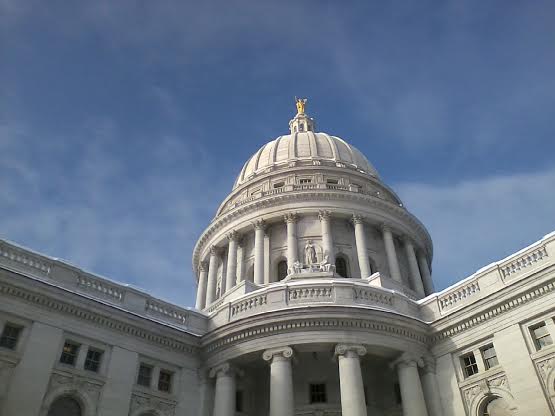
While other countries and U.S. states struggle with the deadly and extremely negative economic costs of dangerous storms made worse by warming oceans and rising sea levels caused by increasing greenhouse gases concentrations in the atmosphere, Wisconsin Governor Scott Walker has taken a pass on including anything in his two-year budget about how or to what degree the State of Wisconsin might reduce its annual greenhouse gases emissions and better adapt to the changing climate predicted for the future in Wisconsin. Governor Walker’s two-year state budget was forwarded to the Wisconsin Legislature earlier this month for adoption by July 1, 2015.
Much of what the governor’s budget proposes for the state will exacerbate the world’s chances of ever reducing climate change, or global warming, to a safe level. Scientists now say the changing climate around the world (global warming) is overwhelmingly human-caused and will be disastrous for the planet if the amounts of fossil fuels (coal, oil, natural gas) we are now burning are not significantly reduced and in a timely manner – now! – worldwide, and deforestation, over has been done over the last 100 – 150 years is stopped. Forests sequester carbon dioxide (CO2) as they grow, which is also the most abundant of the greenhouse gases emitted during fuel combustion.
While Wisconsin did experience a costly drought two years ago, and suffered through two recent killing heat waves in 1995 and 2011, the state has generally been spared from such massive destruction and loss of life as occurred in the Philippine Islands caused by Typhoon Haiyan U.S. states under hit by Hurricanes Sandy Sandy, Katrina and Ike, Hurricane Irene and increasing torrential rains and flooding around the world, heavier snowfalls, and long lasting droughts in California, other western states, and other areas around the world.
The economic costs of these catastrophes, especially those occurring in the United States, negatively effects all states in the U.S. through increased prices of goods, higher insurance rates, and the overall health of the U.S. economy.
Instead of addressing the inevitable economic and environmental effects of climate change and its causes in Wisconsin, Governor Walker instead chose to include in his two year budget proposal for the state many action items that, if enacted into law by the Wisconsin Legislature will, without question, add to the already abhorrently high human, economic and environmental costs of change climate here in Wisconsin and throughout the rest of the world. For example, Governor Walker’s two-year budget, which would begin taking effect in July 2015, expands numerous major highways in the state to increase their capacity to accommodate increased driving of cars and trucks, the vast majority of which burn fossil fuels. The governor’s budget proposes to contribute millions of dollars in state bonding to help the privately owned Milwaukee Bucks build a new arena for NBA games, games that require thousands of miles of jet travel each year for each visiting team as well as their fans and supporting personnel, adding measurably to rising volumes of greenhouse gases linked with global warming.
Furthermore, by not proposing other actions, many additional sources of greenhouse gases and pollution will continue and undoubtedly increase significantly in the next two years under the Walker administration and the current Republican legislature. Due to the lower price of crude oil, prices of fuel at the pump have dropped, leading to the purchase of less fuel efficient SUVs and trucks.
Americans and Wisconsinites need to drastically reduce their annual driving miles, and Governor Walker’s budget should have included positive financial benefits to encourage people to drive fewer and fewer miles each year, and compensate those individuals and Wisconsin families who manage to drive less miles, annually, than average – especially those individuals and families who don’t drive personal automobiles or fly airplanes (jet fuel is a fossil fuel and jets burn tons of fuel on each trip) during the year. The emission of greenhouse gases (GHGs) to the atmosphere from motorized transportation, jets, other internal combustion engines, as well as GHGs emitted from coal, oil, and natural gas burning power plants and household and business furnaces is “cumulative”, meaning the various emission of those gases accumulate in the atmosphere over time, rising to higher and higher levels of concentration in the atmosphere.
Scientists the world over have reached a level of consensus that the amount of GHGs present in the atmosphere are becoming increasingly of concern, more threatening each year that global warming worsens. Eventually, global warming could reach, or is close to reaching, its “tipping point” in the atmosphere – a level of accumulation of GHGs in the atmosphere after which the earth’s natural systems could keep adding more and more GHGs into the atmosphere, the point at which continued warming would become inevitable, regardless of what we humans do to reduce our GHG emissions. For example, as the permafrost region of the planet thaws (1/5 of earth’s surface exists in the form of permafrost), the GHG methane is released from the rotting permafrost. Methane is a much more potent GHG than CO2, and when the permafrost begins to thaw extensively, it will be releasing massive amounts of methane to the atmosphere, This would make matters much worse, because global warming would become less responsive, if responsive at all, to the amount of GHGs we humans cause to be emitted (or not to be emitted).
Positive Incentives Plan Wages Three-Prong-Attack Against Climate Change

Please refer to “About this Blog” before proceeding.
The planet Venus is on the left; Earth is on the right. Nobody wants to see Earth go the route its that its commonly called twin planet Venus took, eons ago. You see Venus once had oceans of water, too, just like Earth does. But something went very wrong on the surface of Venus (possibly it is because the Sun got hotter), which started a “runaway greenhouse effect”. The oceans of water Venus once had boiled away. As temperatures began rising ocean water converted to water vapor, also a strong greenhouse gas. The water vapor increased the effectiveness of heat trapping and accelerated the greenhouse effect, which caused the temperature at the surface to rise further, thus causing the oceans to evaporate faster, etc., etc. This type of runaway is also called a “positive feedback loop”. When the oceans were gone the atmosphere finally stabilized at a much higher temperature and at much higher density, making the planet uninhabitable.
The sobering warning for us is obvious: we have to be extremely concerned about processes such as burning of fossil fuels in large volumes that might have the potential to trigger a runaway greenhouse effect and produce on the Earth atmospheric conditions that are incapable of supporting life.
That is why it is so essential that we initiate actions now, worldwide, to curb all forms of unnecessary activity that causes the greenhouse effect in our atmosphere to strengthen (meaning an increase concentrations of greenhouse gases). Carbon dioxide (CO2), a greenhouse gas, has increased in concentration in the atmosphere from 280 parts per million (ppm) in the 1880’s to 400 ppm today – mainly the result of humans burning coal, oil. and natural gas, the combustion producing significant amounts of (invisible) CO2.
As a result, the global average annual temperature of the Earth at the surface has risen, the temperature of Earth’s oceans have been increasing and, as a result of the ice melting off of the island of Greenland, the continent of Antarctica, and water runs down the mountainous glaciers on practically all the continents, and the property of the thermal expansion of water, Earth’s oceans levels are rising.
Meanwhile, the Earth’s once solid permafrost region, which is approximately 1/5 of the Earth’s surface, is now thawing in many places, decomposing,and releasing methane to the atmosphere, a greenhouse gas 37 times as strong as CO2 in trapping heat.
Furthermore, replacement of large areas of ice and white snow surface (ice cap) on the Arctic Ocean means the open Arctic ocean water absorbs more of the radiant heat from the Sun, causing the ice and snow to melt even faster still, an so on. If it were not for the vast amounts of ice in the Arctic Ocean, the water would warm even faster.
It is essential that people and businesses, the world over, especially those in countries burning vast quantities of fossil fuels, in power generation, motorized transportation and jet travel, for human travel and shipping, find alternatives that don’t burn fossil fuels for their pursuits. Presently, citizens from the United States fly 40% more than citizens from other countries, and more U.S. citizens are buying gas guzzling SUVs and pickup trucks than more fuel efficient vehicles – because gas is “cheap” again, They remain apathetic about global warming, or are members of the “Earth is flat” society. As John Lennon once said, “apathy is it”. The Earth is also round. Above all, we need to Conserve, NOW!
Wisconsin Must Join the All Out World Effort to Fight Global Climate Change Without Delay, BEFORE Time Runs Out

Wisconsin has traditionally prided itself as being a state that “cares”. Wisconsin residents care about its wild and domestic animals, its fish, birds and butterflies; its plants, trees, and its forests; its tens of thousands of lakes, streams and rivers, and the quality of its wetlands, groundwater and air; its mighty bluffs and gorges, its remaining prairies, and the state’s overall majestic scenic beauty.
Wisconsin has traditionally had a strong manufacturing economy, a top notch agricultural industry, a public education system second to none, a world class university system, and an equally top notch private schools, colleges, and other educational institutions. Wisconsin also boasts an excellent highway, airport, and bicycle transportation system, and communities that are walking and wheelchair friendly. It has always held all visitors to the state in high regards and treated them with respect the production and sustainability of its farms, the well being of its human population, without regard for race, heritage or creed. Wisconsinites treat visitors to their state with respect and dignity,satisfaction of its visitors and transients alike, and, perhaps above all, in leaving its land, water and its economy better condition than they received it. In a nutshell, that’s a statement of Wisconsin’s traditions and value, as I have come to know them.
Wisconsin residents often boast, and rightly so, that Wisconsin was the home of such renown conservationists and humanists as John Muir, Aldo Leopold, Senator Gaylord Nelson, Midge Miller and Vel Phillips. In the 1970s, Wisconsin was emulated by other states as the state to look at for developing effective environmental protection regulations to safeguard its treasures. With Wisconsin Departmental Resource Secretary Anthony “Tony” Earl at the helm, who would later become Wisconsin’s governor, and George “Knute” Knudson as its chief naturalist, Wisconsin natural resources were in good hands.
It is no exaggeration to say that all this is at risk the longer our Wisconsin Legislature, our governor, other state legislatures and governors, and the people’s representatives in the United States Congress continue to kick the issue of excess fossil fuel burning and greenhouse gas production by Americans down the road. What we don’t need is more highway development and expansion and more airport capacity expansion that encourage even more fossil fuel burning by the public. What we don’t need is more trade with distant countries that requires more fuel for shipping and flying. What we don’t need are more coal and natural gas burning power plants and the thousands of miles of high voltage transmission lines that go with them, and not Wisconsin power companies who restructure their rates in favor of more fossil fuel burning, thus discouraging their customers from investing in solar energy panels for their homes and businesses, and having the governor’s appointed Wisconsin Public Service Commission (the PSC) “rubber stamps” the fossil-fuel-dependent utilities’ proposals.
We are wasting valuable time and money by not relying less and less on fossil fuel dependent energy, and more on either energy conservation or on conversion to solar and wind generated power, in our homes, businesses and institutions; and that we desperately need to reduce aggregate driving and flying, which rely almost exclusively on burning fossil fuels that, when subject to combustion, release large quantities of greenhouse gases, especially carbon dioxide (CO2), to the atmosphere. Most of the greenhouse gases, such as CO2, remain in the atmosphere for centuries, accumulating to increasingly more ominous concentration levels, or they get absorbed in the oceans, making the earth’s ocean water more acidic, harming the biological species in the oceans.
But scientists the world over are in agreement that the rising concentrations of greenhouse gases from significantly increased fossil fuel burning by humans since the time of the Industrial Revolution (early 1800’s) have remained in earth’s atmosphere, trapping more and more of the Sun’s radiant energy and changing it into heat energy, causing the earth’s surface to warm, melting more of the polar ice caps and mountain glaciers, causing the vast permafrost region to thaw, releasing more and more methane gas, another greenhouse gas that’s known to have 37 times the heat-trapping power of CO2.
Scientists don’t know when global warming could begin accelerating, but it could be any day now. What they do know is that there are higher concentrations of greenhouse gases in the atmosphere now to push global surface temperatures much higher than what we have experienced thus far. Time is of the essence for the world’s populations who are relying on fossil fuel burning for energy to stop adding even higher concentration levels of greenhouse gases to the atmosphere, risking setting off positive feedback mechanisms in the system that could worsen the situation and amplify the weather extremes global warming has already caused in earth’s climate.
WORT-FM Radio Show “Planet Earth: It Needs Our Help Now More Than Ever”

This past Labor Day, WORT-FM (89.9 FM), Madison (www.wortfm.org), broadcasted my proposed solution for reducing global warming & climate change. The program would offer government-provided positive financial incentives ($) to encourages people and families in Wisconsin who chose to minimize their global footprint by driving less than the average Wisconsin individual or family (or not driving at all), by not flying at all, and by using less fossil fuel derived energy during the year. The “Conserve, NOW program is further described in about this blog.
The Labor Day Access Hour show “Planet Earth: It Needs Our Help Now More Than Ever” starts with a brief introduction announcing the program followed by several songs containing lyrics applicable to the subject and further information on the program and sources of funding for carrying out. The thought is that much of the funding would eventually be paid back by reducing governmental spending on major environmentally disrupting infrastructure capacity expansions (highway developments, power plants and transmission line construction, airport runway construction and new airports), state and federally funded personnel such as highway and airport and transmission line planners and air traffic controllers. There would also be less cost and harm due to fewer motor vehicle crashes and airplane crashes due to heavier traffic.
Because it provides more income for individuals and families, it would also reduce the need for reliance on poverty assistance programs that provide food and subsidized housing, it would reduce homelessness, and by reducing these impediments, this would eliminate factors detrimental to education of young children.
Click here to listen to the show. It lasts a total of one hour.
Of course there are many other ways individuals, communities, nongovernmental organizations, business interests and others can reduce their annual global footprint in addition to driving and flying less
and using less energy derived from fossil fuels. Some of these include buying fewer consumer products most of which require fuel burning and mining or drilling in their development or use; buying locally produced products whenever possible (less energy used in transport); buying already used products and supporting organizations which only use recycled products; eating less or no meat products; supporting planned parenthood and humane societies that provide rescue animals for pets rather than buying from breeders; supporting organizations that promote reforestation not deforestation, and removal of paved surfaces and replacing them with green space, where ever feasible. Cities and businesses that attract large numbers of daily commuters should provide daily mass transit services to those locations, and the state should subsidize those municipalities who provide those services to outside-the-city locations – rather than put more even money into cement (greenhouse gas emitted in its production and application)for providing highway capacity expansion (which promotes even more driving).
The state, universities, public radio stations and other organization should stop coordinating long distance air travel trips to tourist spots around the world and events such as professional sports, actor/actress movie and music awards shows should be terminated. Major amounts of money, worldwide but especially by the U.S., should stop being funneled into fossil fuel using vehicles including most military airplanes. The U.S. should limit and eventually eliminate sending troops to foreign soils and establishing military bases and headquarters overseas.
– The Lorax
PSC’s Technical Hearings on Badger Coulee High Voltage Transmission Line

The Public Service Commission of Wisconsin is holding technical hearings this week in Madison as they assess the need and impact of the American Transmission Company (ATC) LLC and Northern States Power Company ‘s joint application to construct and operate a high voltage 345 kV electricity transmission line called Badger-Coulee line from the La Crosse area in Lacrosse County to the greater Madison area in Dane County, Wisconsin.
The Wisconsin Public Service Commission (PSC) will determine whether and where American Transmission Company (ATC) and Xcel Energy may build the line, which could encroach on as many as 556 residences, as well as forest and public lands. The transmission line is expected to cost up to $580 million.
Opponents of the project say the project is not needed and and that it would allow utilities to profit by trading energy while discouraging more cost-effective alternatives such as energy efficiency and solar power.
The PSC held five public hearings in December with the majority of those speaking voicing opposition to the project.
At the technical hearings this week, commissioners are hearing from the applicants, the PSC’s professional staff, and 25 registered intervenors.
The 3-member commission, with 2 of the 3 of the commissioners having been appointed by Governor Walker, is expected to issue a final decision in April, 2015.

Source: LacrosseTribune.com
 All Things Environmental
Recent Comments