
Black Lives Matter in Madison and Wisconsin, If they Don’t Now, THEY WILL

A new generation of human rights activists mounted a passion-filled, peaceful march in South Madison Friday, tapping the energy around race issues sweeping the country to funnel it to local issues.
“Young black men are being murdered. It is a national problem,” organizer Brandi Grayson told the crowd that gathered at the Metro bus hub at South Park Street and West Badger Road. “It is time to educate ourselves, it is time to educate our neighbors, it is time to educate our employers. It is time, my people.”
“Black Lives Matter,” was the banner slogan and rallying cry of the action led by the Young Gifted and Black Coalition, as up to 150 demonstrators marched in traffic lanes a half-mile up South Park Street to North Ave., then back to the South District Police Station on Hughes Place for short speeches, poems and chants.
The crowd’s final march took them down Park Street up to, but not onto, the ramp to the west-bound Beltline as they held a silent vigil for four-and-a-half minutes to honor Michael Brown, whose body lay for four-and-a-half hours on a street in Ferguson, Missouri, after he was fatally shot by a white police officer in August.
The local activist group emerged following a grand jury decision not to indict Darren Wilson in Brown’s killing, in response to which they organized a rally and march around the Capitol Square last week. Like other race rights actions cropping up in the latest round of public outrage over the killing of black men by white police officers, the Madison coalition turned the failure of another grand jury this week to return an indictment in the killing of Eric Garner in New York City into an opportunity to demonstrate the depth of concern over civil rights.
Demonstrations over the lack of an indictment in the Garner case continued Friday in cities across the country.
The Young Gifted and Black Coalition of Madison is clearly organizing for the long haul.
The coalition points often to the disparities in education, incarceration and other aspects of life, documented in the Race to Equity report, as proof that even absent fatal police violence against blacks, racial inequities are rife in Dane County. The group is demanding an end to plans to build a new Dane County jail, immediate release of people incarcerated for crimes of poverty and investment in community initiatives.
Leaders called on demonstrators to join a planned protest Tuesday at a Dane County Board committee hearing on a proposal to spend $8 million for a study on the need for a new jail that could cost $150 million, and to participate in a community building and planning session next Friday evening at the South Madison Public Library.
“The civil rights movement brought change, but it didn’t happen because people were sitting down,” Grayson told the crowd. “Change happened because people were committed to change and were willing to sacrifice themselves and their time.”
The crowd demonstrating Friday was mixed racially and ethnically, but overwhelmingly young. Grayson said that older civil rights advocates and those whose work is enmeshed with majority establishment organizations are stepping back to let a younger generation take the lead on protests. “They can’t say the things we can say. We can take the action in the street; hopefully they will help make the policy.”
Will Williams, a long-time activist with Vietnam Vets for Peace and other local movements, watched the march take shape from the sidelines. “Old folks need to turn the baton over,” Williams said.”We have young people with the fire who understand what going on with racism overall and with cops who are murdering black people and not being held accountable.”
A handful of other older advocates were present on the edges of the demonstration, as well such leaders on race equity matters as Floyd Rose, president of 100 Black Men of Madison, and Mayor Paul Soglin.
The demonstrators chanted as they marched: “No Justice, No Peace! No Racist Police!” When they paused at North Avenue, the gathering took on something of the feel of a revival meeting where participants were called on to raise their fists and pledge to take up the fight for human rights.
“It starts with you, it starts with you, it starts with you, it starts with you, it starts with you, it starts with you, it starts with you, it starts with you, it starts with us,” Grayson shouted, pointing to individuals in the rapt and silent crowd.
“We are here to show what solidarity looks like. You are absolutely beautiful, don’t let anyone tell you anything different,” she said. “We are conditioned to fear black men; we are conditioned to think every black person is innately violent.”
Madison Police Chief Mike Koval watched from across Park Street, noted that marching in the traffic right-of-way was an act of civil disobedience, and spoke to the protesters rights to do so. “This is the First Amendment in action. This is how it’s supposed to work,” Koval said. “And the police in a free society should be here to facilitate it. This is democracy in action.”
Outside of the police station, protesters chanted slogans punctuated by trombone blasts and heard speeches and poems, one of which named many of those killed by police and lamented: “There is not enough skin to tattoo the names…We are black lives and we matter.”
The group fell into formation for the final march down Park Street just as darkness fell. “I came out to support everyone,” said one 20-something protester. “Human rights matter.”
Governments from Around the World Meeting in Lima, Peru to Lay Foundation for Addressing Climate Change, Wisconsin Governor Scott Walker Sends U.S. EPA Letter Opposing Climate Change Regulations

Building on the groundswell of worldwide climate action, and in preparation for concluding its Framework Convention of Climate Change in Paris in 2015, the United Nations and its participating governments from around the world have begun meeting 1 December, 2014 in Lima, Peru, and scheduled to close on 12 December, 2014, to lay the foundation for an effective new, universal climate change agreement in Paris in 2015 while also raising immediate ambition to act on climate change in advance of the agreement coming into effect in 2020.
The UN’s Intergovernmental Panel on Climate Change has this year warned against rising sea levels, storms and droughts as a result of unchecked greenhouse gas emissions, and highlighted the many opportunities of taking climate action.
Last week, the UN Environment Programme underscored the need for global emissions to peak within the decade and then to rapidly decline so that the world can reach climate neutrality – also termed zero net emissions – in the second half of the century.
Christiana Figueres, Executive Secretary of the UN Climate Convention said:
“Never before have the risks of climate change been so obvious and the impacts so visible. Never before have we seen such a desire at all levels of society to take climate action. Never before has society had all the smart policy and technology resources to curb greenhouse gas emissions and build resilience. All of this means we can be confident we will have a productive meeting in Lima, which will lead to an effective outcome in Paris next year.”
Meanwhile, Wisconsin Governor Scott Walker submitted comments this week in opposition of the Environmental Protection Agency’s (EPA) Clean Power Plan, which proposes increased regulations aimed at reducing carbon dioxide emission from Wisconsin’s power plants in Wisconsin. Walker’s letter claims that the proposed regulations would have a detrimental effect on Wisconsin’s manufacturing-based economy, as well as household ratepayers.
Walker says the Wisconsin Department of Natural Resources and Public Service Commission of Wisconsin have spent months reviewing the rule and seeking input from those who would be affected since its proposal in June of this year.
Governor Walker has asked the EPA to reconsider the rule based on the impact the rule will have on the cost and reliability of electricity, not only to Wisconsin’s manufacturing sector and the 455,000 people it employs, but on every ratepayer in the state and the nation.
In Lima, governments meeting under the “Ad Hoc Work Group on the Durban Platform for Enhanced Action” (ADP) need to define the scope and the type of contributions they will provide to the Paris agreement, along with clarity on how finance, technology and capacity building will be handled.
Countries will put forward what they plan to contribute to the 2015 agreement in the form of Intended Nationally Determined Contributions (INDCs) by the first quarter of 2015, well in advance of the Paris conference in December of next year.
The Lima conference needs to provide final clarity on what the INDCs need to contain, including for developing countries who are likely to have a range of options from, for example, sector-wide emission curbs to energy intensity goals.
Ms. Figueres welcomed the leadership of the EU, the US and China, who have publically announced their post-2020 climate targets and visions.
“It is hugely encouraging that well ahead of next year’s first quarter deadline, countries have already been outlining what they intend to contribute to the Paris agreement. This is also a clear sign that countries are determined to find common ground and maximize the potential of international cooperation,” she said.
“Countries are working hard to increase emission reductions before 2020, when the Paris agreement is set to enter into effect. Pathways on how to accomplish this will also be a key issue before nations in Lima,” she added.
Governments need to work towards streamlining elements of a draft agreement for Paris 2015 and explore common ground on unresolved issues in order to achieve a balanced, well-structured, coherent draft for the next round of work on the text in February next year.
In addition to progress made to date towards a Paris agreement, the political will of countries to provide climate finance is increasingly coming to the fore.
At a recent pledging conference held in Berlin, Germany, countries made pledges towards the initial capitalization of the Green Climate Fund totaling nearly $ 9.3 billion USD. Subsequent pledges took this figure to $ 9.6 billion, so that the $ 10 billion milestone is within reach.
“This shows that countries are determined to build trust and to provide the finance that developing countries need to move forward towards decarbonizing their economies and building resilience”, Ms. Figueres said.
In the course of the 2014, governments have been exploring how to raise immediate climate ambition in areas with the greatest potential to curb emissions, ranging from renewable energy to cities.
As part of the “Lima Action Agenda”, countries will decide how to maintain and accelerate cooperation on climate change by all actors, including those flowing from the Climate Summit in September, where many climate action pledges were made.
“We have seen an amazing groundswell of momentum building this year. One of the main deliverables of the Lima conference will be ways to build on this momentum and further mobilize action across all levels of society. Society-wide action in concert with government contributions to the Paris agreement are crucial to meet the agreed goal of limiting global temperature rise to less than two degrees Celsius, and to safeguard this and future generations,” Ms. Figueres said.
As climate change impacts worsen and impact the poor and most vulnerable, governments urgently need to scale up adaptation to climate change. The conference needs to agree on how National Adaptation Plans of developing countries will be funded and turned into reality on the ground. Countries will also work to agree a work program for the Executive Committee of the Warsaw International Mechanism for Loss and Damage, and elect the members of its Executive Committee.
Governments will work to scale up and coordinate the delivery of climate finance and of the various existing funds. A focus will be on identifying ways to accelerate finance for adaptation to climate change. Governments will also recognize the initial capitalization of the GCF, which is expected to reach USD $ 10 billion by the close of the Lima conference.
Countries meeting in Lima will further work to provide support to avoid deforestation. Several developing countries are expected to submit information which would make it possible for them to obtain funding for forest protection.
Governments meeting in Lima are expected to clarify the role of carbon markets in the 2015 global agreement and set a work program for next year to design and develop operations for implementing new market mechanisms.
As part of the efforts by countries to accelerate pre-2020 climate action, the secretariat is organizing a fair 5, 8 and 9 December in Lima to showcase how action is being scaled up and how many countries and non-state actors are taking action and setting an example.


The Public Service Commission (PSC) has given verbal approval to Northeastern Wisconsin Utility’s request to raise fixed charges on customer electricity bills, and is also considering 2 other similar proposals across the state including We Energies in southeastern Wisconsin and Madison Gas & Electric Company in south central Wisconsin.
Customers of a northeastern Wisconsin utility will pay more for electricity beginning in January, after the state’s Public Service Commission voted to allow Wisconsin Public Service Corp. to hike its fixed charge.
The PSC has given verbal approval to WPS to increase the fixed electricity charge by about $9 a month, after it voted 2 to 1 in favor of the increase on Thursday.
Critics of the move, like the nonprofit group Citizens’ Utility Board, say higher fixed costs mean that someone who lives in a small apartment will pay the same monthly fee as someone who lives in a mansion.
Kira Loehr, CUB’s director and general counsel, said that in WPS’s case, the PSC also mandated that the per-kilowatt fee will go down by about $.02 per hour. Loehr believes the decision gives people no reason to cut back on useage.
“And that’s what actually incents more energy use, because as the fixed portion that you can’t do anything about increases, the variable portion does decrease a little bit, sending less of a signal to customers that the less they use the more they can save.”
WPS said the structure change was needed because of increased costs for coal, natural gas and transportation.
“I won’t say there’s no incentive to conserve energy,” said David Kyto, the company’s director of rate case process. “The fixed charge is going up and the per-kilowatt hour will go down. So there will be less of an incentive. But I still think there’ll be incentive for customers to pursue energy efficiency and conservation.”
Madison Gas and Electric, along with Milwaukee-based We Energies, are also asking the PSC for similar fixed rate hikes.
MGE is looking to raise the fixed charges on customer bills and reduce charges for the amount of electricity used — a move critics say will discourage energy conservation while hitting low-income and elderly residents the hardest.
For the typical residential customer, the fixed charge would increase from the current $10.50 to $19 if the plan is approved by the state Public Service Commission. Future increases could take the fixed charge higher, although MGE has backed off from an earlier plan to charge $69 per customer by 2017.
MGE and electric utilities nationwide are feeling cost pressures with the growth of renewable energy coupled with increased efficiencies. At the same time, MGE says it must maintain the electric system and is looking for a way to fairly spread those costs among all customers — not just those who use large amounts of power.
A variety of groups have already filed comments on the case, including the city of Madison which has hired an outside expert to argue against the MGE rate changes.
“This MGE proposal will move the city of Madison in exactly the opposite direction that the city wishes to go,” writes city consultant William Marcus, an economist for JBS Energy of West Sacramento, Calif.
Renewable energy groups have also gotten into the fray, arguing that MGE’s rate plan will stifle investment in clean energy and leave Wisconsin farther behind in that key economic sector.
“MGE’s proposed approach would push the market down a path that discourages innovation and competition at a time when other states are encouraging this type of development,” says Susan Crawford, an attorney for Wind on the Wires.
Rally organizer Don Ferber of RePower Madison says 88 percent of MGE’s electricity supply is generated by fossil fuel burning — either coal or natural gas.
“We want the company to be forward looking but they have no plans for the future and that is not a good place to be,” he said, noting rising fuel costs and potential carbon emission charges going forward.
MGE’s Kraus counters that the company is committed to its customers and plans to unveil a series of community meetings next year to focus on the key issues that have come out of the rate case.
“It will be modeled after the Community Energy Conversations we did across Dane County in the early 2000’s,” he says. [Which I personally attended and recommended my “Concern, NOW! plan but nothing became of it.]
On Thursday, October 8, 2014 the PSC had a hearing on the MGE proposal. Upward of 200 people protested the proposal and gave public testimony, the vast majority demanding the PSC reject MGE’s proposed rate restructure. [Including me.] A decision by PSC is expected before the end of the year.
Wisconsin Conserve, NOW Proposal Would Reduce the Need to Raise the Minimum Wage
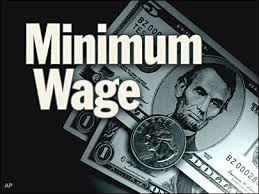
The federally required minimum wage is $7:25 per hour of work performed, which everyone agrees is insufficient to maintain a nonpoverty lifestyle in Wisconsin without government subsidies or having to work two or more jobs. Some state governments have have elected to increase the required minimum wage per hour that employers in their state must pay their employees; however, Wisconsin is not one of them.
Paying individuals and families who minimize their annual global footprint could add significantly to an individuals or family’s annual income. Depending on how successful each individual or family was at minimizing their driving mileage and flying, and minimizing their energy use in their home, they could earn up to $22,800 in a year. African-American individuals and families would be eligible to earn a higher maximum of $30,400 per year.
Although the above amounts would be the maximum one could earn by not driving a motor vehicle or flying at all throughout a year, most Wisconsinites would find it difficult to max out in the residential home heating and use of fossil fuel derived electricity, since few homes exclusively use solar or wind power. But most homes in Wisconsin could be better insulated, use less hot water, or kept a few degrees cooler (winter/spring/fall) or warmer (summer, using less air conditioning) than their residents might be use to, so they could add to their income by having to pay less in energy costs plus whatever income they might earn, by using less energy than the typical Wisconsin household of the same size.
Have you signed the petition yet?
 All Things Environmental
Recent Comments