
Wisconsin Utilities, Public Service Commission and Governor Walker Being Bad Actors in Leading Fight Against Solar Energy in Wisconsin
Once considered a Midwestern leader in clean energy development, Wisconsin is now referenced as one state where electric utilities with the backing of regulators are putting up financial roadblocks against the solar industry.
A new report in the Washington Post mentions Wisconsin along with New Mexico and Arizona as states where traditional utilities like WE Energies and Madison Gas & Electric are fighting to maintain electric sales in the face of a changing marketplace.
The story quotes from a private meeting three years ago where power company executives were told that as demand for residential solar continued to soar, traditional utilities could soon face serious problems from “declining retail sales” and a “loss of customers” to “potential obsolescence.”
“Industry must prepare an action plan to address the challenges,” warned the Edison Electric Institute, the leading industry trade association. All four of Wisconsin’s investor-owned utilities are members.
The meeting at a resort in Colorado Springs, Colorado, became “a call to arms for electricity providers in nearly every corner of the nation” wrote reporter Joby Warrick.
“Three years later, the industry and its fossil-fuel supporters are waging a determined campaign to stop a home-solar insurgency that is rattling the boardrooms of the country’s government-regulated electric monopolies,” he wrote.
Warrick’s report also makes the link between the electric utilities and the American Legislative Exchange Council, or ALEC, a nonprofit organization with financial ties to billionaire fossil fuel industrialists Charles and David Koch.
In Wisconsin last year, the state Public Service Commission approved major price increases in electric rate structures for state utilities. Utilities argued the changes were needed to cover the cost of maintaining the power plants, poles and wires in the face of slowing electric sales.
For MGE customers, fixed charges for residential electric service went from $10.50 to $19 a month.
MGE customers fought against the changes and eventually got the company to agree to a series of community listening sessions before pursuing additional fixed rate prices hikes going forward. At one point, MGE had talked about raising residential customer fixed charges to nearly $70 a month by 2017.
Meanwhile, the state Public Service Commission (PSC) of Wisconsin is facing a lawsuit from Madison-based Renew Wisconsin and the Alliance for Solar Choice of San Francisco, saying it was guilty of discrimination by passing additional fees on solar customers in the WE Energies 2014 rate case.
Gov. Scott Walker has appointed all three members of the PSC, with the naming in February of former Department of Administration secretary Mike Huebsch to the powerful regulatory agency.
Koch Industries has significant operations in Wisconsin, including Flint Hills Resources, which produces gasoline and asphalt; the C. Reiss Coal Co., which supplies coal throughout the Great Lakes region; and Georgia-Pacific, the packaging and paper firm. Georgia-Pacific’s chemical division is also a producer of proppant resin, a coating for small particles used in hydraulic fracturing.
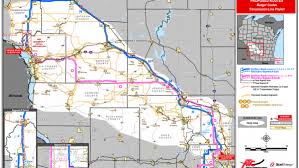
Another current decision of interest to the utility companies, the PSC, and the governor is American Transmission Company’s (ATC) and Xcel Energy’s proposed Badger-Coulee transmission line project, which stretches from the La Crosse area to Madison in Wisconsin. It is estimated 345-kilovolt, 180-mile line project will cost $580 million.
More than 200 people attended a public hearing in the Town of Holland by the PSC in December. Most of the people who testified in front of the Public Service Commission of Wisconsin voiced their opposition to the project. Some cited health concerns from massive power lines and others questioned whether it’s necessary.
Xcel Energy is one of project partners. A spokesman at the meeting, Tim Carlsgaard, said power lines need a capacity upgrade. Plus, he said, Wisconsin has a 10 percent renewable energy mandate and wind energy is the best option for the Midwest. Carlsgaard said it’s nearly impossible to develop wind energy in Wisconsin.
“Where it’s located is out in the rural areas,” Carlsgaard said. “Out in western Minnesota, southern Minnesota, parts of the Dakotas. The only way to bring that energy to the people is by building transmission lines. There are not existing lines in those areas.”
Dr. Patrice Tronstad, of Prairie View Elementary School, presented PSC administrative law Judge Michael Newmark with a poster signed by students opposing the project. The line could run right next to the Holmen school.
Onalaska Mayor Joe Chilsen said he doesn’t want the Badger-Coulee transmission line to be built at all. But, if the proposed project running from the La Crosse area to Madison is approved, he urged PSC officials not choose the route that could cut through his city. Chilsen said the power line could affect property values and aesthetically damage the city along the Mississippi River.
“This in essence kills all our future economic growth, our business growth in Onalaska,” he said. “I’m absolutely flabbergasted that this is even being considered.”
Chilsen also testified that future expansion plans for Mayo Clinic and other businesses could come to a halt if the Badger-Coulee line comes through the area.
Chilsen was one of the dozens of people who testified before two PSC commissioners: chairman Phil Montgomery and commissioner Ellen Nowak.
Commissioner Eric Callisto didn’t attend because his term is ended in February.
The now 3-person Walker appointed PSC decided last Thursday, March 26, 2015 to allow the construction of the new power line from La Crosse to Madison, over the objections by the public. Discussions and debate over the power line have lasted years, with many opposed citing environmental and aesthetic grievances. The Badger Coulee high-voltage transmission line will be built and it will follow a route from a substation near Holmen, north of La Crosse, to the Madison area, the Wisconsin Public Service Commission (PSC) decided in a unanimous preliminary vote.
Opponent group, Citizens Energy Task Force, said it is “appalled, but not surprised” by the decision, saying there was not enough study of alternatives to building another huge power line. It conceded the construction of the line is “economically driven, with the economic benefits going to utilities while ratepayers being saddled with massive unneeded debt and the health, environmental and quality-of-life consequences that come with these unsightly, unnecessary lines,” the citizen group said. Organizations that have been fighting the proposal said they are considering filing a petition for a rehearing by the PSC or challenging the validity of the PSC’s decision in circuit court.
“More than 90 units of local government tried in vain to understand why these lines are needed,” said Maureen Freedland, La Crosse County Board supervisor. “Our local planning rights have been stripped from us. The decision is a blow to our values and the way of life for our rural Wisconsin neighbors.”
The PSC is expected to issue a final order on the project within four weeks, and Wisconsin-based ATC and Minnesota-based Xcel said they will start contacting property owners on the chosen route yet this year. Construction of the line is expected to begin in 2016 and it is scheduled to go into service in 2018.
Sources: March 11, 2015, report by Mike Ivey of The Capital Times.
Reports aired on Wisconsin Public Radio.
Over Two-thirds of Americans are Cowards When it Comes to Standing Up to the Threats of Global Warming


Over two-thirds of Americans polled answered they were not concerned about global warming and climate change, according to a Gallop poll released last Wednesday and published by The Washington Times. Thirteen percent of Republicans are concerned about global warming and climate problems compared to 52 percent of Democrats polled.
A “coward” is any person who lacks the courage endure dangerous or unpleasant things. Global warming is the most dangerous natural disaster our civilization will have ever had to face and endure, and it is human-caused.
The majority of Americans worry about only one environmental issue, however. Fifty five percent are concerned about the pollution of drinking water. Next in line: 47 percent fret over lake and river pollution, air pollution (36 percent) and the loss of tropical rain forests (33 percent).
In general, Americans are more positive about the environment these days notes Gallup analyst Jeffrey Jones, with negative sentiments now at the “low end” of what the polling group has measured in the last 25 years.
“The nature of the environmental agenda may indirectly be influencing Americans’ concern. The primary focus of the environmental movement has shifted toward long-term threats like global warming – issues about which Americans tend to worry less than about more immediate threats like pollution,” writes Mr. Jones.
“Importantly, even as global warming has received greater attention as an environmental problem from politicians and the media in recent years, Americans’ worry about it is no higher now than when Gallup first asked about it in 1989”, according to Jones.
Source: From an article by Jennifer Harper in The Washington Times, Wednesday, March 25, 2015.

Governor Walker’s Proposed 2015 -2017 State of Wisconsin Budget

Following are the comments I submitted by email on the governor’s proposed budget for July 1, 2015 to June 30, 2017.
Bad things can happen to good people. It happens all the time, and has occurred all throughout history. So when bad things, or threats, are predicted to occur or seem reasonably likely to occur, it’s best for one to take action, and involve others in removing the oncoming threat, before it gets realized and significant damage to life and our environment occurs.
Governor Walker’s biennial budget plan for Wisconsin for the next two years contains numerous threats to the people of Wisconsin and the state of Wisconsin’s natural resources. Some of those threats could have devastating and harmful impacts if they are allowed to occur without any attempts to prevent or ameliorate them.
Governor Walker’s budget plan as written will cause a great deal of harm for many thousands of Wisconsin’s people and their families. Some people who have worked their entire life at University of Wisconsin or UW-extension will likely lose their jobs, and the public who those people serve will lose out as well. Wisconsin’s elderly and disabled population, and families having children enrolled in Wisconsin’s excellent public school system will also suffer loses. Many hard working and dedicated school teachers and educational assistants serving special needs children will be without a job next fall if this budget is not revamped.
The governor’s budget also hurts those who watch over and protect our precious natural resources, both now and in the coming years, by cutting positions and land stewardship funds.
But really the worst thing about the governor’s budget is not what’s in it but rather what’s NOT IN IT BUT SHOULD IN IT. For example, despite Wisconsin’s aging population and increasing number of people who prefer not to drive, or who can’t drive because of the high cost of owning, maintaining and driving an automobile, the Walker budget proposes nothing new to help with mobility in the state, transit in particular. Rather, it borrows hundreds of millions of dollars to expand an already too large highway system at great environmental harm to the state, and for no good reason.
Numerous observations demonstrate that the climate of the Great Lakes Region, including Wisconsin’s climate, is changing. Average temperatures are getting warmer and extreme heat events are occurring more frequently. Total precipitation is increasing and heavy precipitation events are becoming more common. Winters are getting shorter and the duration of lake ice cover is decreasing over time. As a state, we should already be doing as much as we can to drastically cut back on our burning of fossil fuels but we seem to be doing almost the opposite. This tragedy grows in magnitude the longer it takes for our country and other countries to wean themselves off burning fossil fuels. There are many other unintended consequences of living in a fossil fuel burning dependent society.
But ironically, rather than then increasing substantially the funding of transit systems and the funding of positive financial incentive programs aimed at reducing greenhouse gas emissions and encourage walking and use of nonmotorized travel by state residents and businesses, the governor’s budget promotes more highway expansion. Instead, the state should reward those who drive less (miles), don’t fly, and minimizing their use of fossil fuel derived energy over the year. Use the money that Governor Walker’s budget borrows to fund a bigger highway system and a big new professional basketball arena instead – expenditures that not only subject state taxpayer to great financial risks but also promote adding millions more tons of greenhouse gases to the atmosphere including promoting jet airplanes flying of visiting teams and fans to the games.
Wisconsin Public Radio (part of state’s UW-extension) plans vacationing trips to Scotland and Australia, trips that not only release hundreds of millions of tons of greenhouse gases to the atmosphere but also give nothing back to the state’s own tourism businesses.
Governor Walker’s budgets include more trade promotions with foreign countries despite the fact that shipping products and working with foreign business interests similarly add millions and millions more tons of greenhouse gases to the atmosphere.
My plan would increase Wisconsin families’ and individuals’ annual income for polluting less and reducing the global warming threat, rather than adding to it. It would encourage Wisconsinites and Americans to buy from local entrepreneurs, whenever possible.
Governor Walker’s plan is to require a monthly drug test of food share (too low to begin with) recipients and proof of their having worked at least 80 hours at a place of employment before their receiving the meager food share benefits. It would do nothing to curb the rising income and employment inequalities and racial disparities in the state. The numbers of families and children living in poverty already will not be helped by Governor Walker’s budget. It is a fact that children of families living in poverty start their lives with a handicap because of many reason but the worst is that they do not receive adequate nutrition before and after they enter their school years. The governor’s budget insufficiently funds Wisconsin public schools and the families that live in poverty are disadvantaged in those schools from day one. Yet the governor’s budget does nothing to make up for previous cuts to public schools and add more financial stress for them by requiring them to pay vouchers for children attending private schools.
The budget should also refund the planned parenthood clinics the state had before Scott Walker took office. Certainly we ought not be adding to our human population pressures on the environment if we don’t have to.
Thank for the opportunity to submit my comments on the proposed state budget. For addition background on my concerns expressed here, please visit my blog at: http://www.allthingsenvironmental.com.
Antarctica’s Melting Getting Worse

We’d heard that the Western Antarctic glacier was rapidly melting. And if it does, it could raise the word’s ocean levels 11 feet.
Now comes news that the Eastern ice sheet may be headed in that direction, too. That would release the same amount of water, giving our grand children a lot of waterfront property where there isn’t any now.
A hundred years from now, humans may remember 2014 as the year that we first learned that we may have irreversibly destabilized the great ice sheet of West Antarctica, and thus set in motion more than 10 feet of sea level rise.
Meanwhile, 2015 could be the year of the double whammy — when we learned the same about one gigantic glacier of East Antarctica, which could set in motion roughly the same amount all over again. Northern Hemisphere residents and Americans in particular should take note — when the bottom of the world loses vast amounts of ice, those of us living closer to its top get more sea level rise than the rest of the planet, thanks to the law of gravity.
The findings about East Antarctica emerge from a new paper just out in Nature Geoscience by an international team of scientists representing the United States, Britain, France and Australia. They flew a number of research flights over the Totten Glacier of East Antarctica — the fastest-thinning sector of the world’s largest ice sheet — and took a variety of measurements to try to figure out the reasons behind its retreat. And the news wasn’t good: It appears that Totten, too, is losing ice because warm ocean water is getting underneath it.
“The idea of warm ocean water eroding the ice in West Antarctica, what we’re finding is that may well be applicable in East Antarctica as well,” says Martin Siegert, a co-author of the study and who is based at the Grantham Institute at Imperial College London.
The floating ice shelf of the Totten Glacier covers an area of 90 miles by 22 miles. It it is losing an amount of ice “equivalent to 100 times the volume of Sydney Harbour every year,” notes the Australian Antarctic Division.
That’s alarming, because the glacier holds back a much more vast catchment of ice that, were its vulnerable parts to flow into the ocean, could produce a sea level rise of more than 11 feet — which is comparable to the impact from a loss of the West Antarctica ice sheet. And that’s “a conservative lower limit,” says lead study author Jamin Greenbaum, a PhD candidate at the University of Texas at Austin.
In its alignment with the land and the sea, the Totten Glacier is similar to the West Antarctic glaciers, which also feature ice shelves that slope out from the vast sheet of ice on land and extend into the water. These ice shelves are a key source of instability, because if ocean waters beneath them warm, they can lose ice rapidly, allowing the ice sheet behind them to flow more quickly into the sea.
The researchers used three separate types of measurements taken during their flights — gravitational measurements, radar and laser altimetry — to get a glimpse of what might be happening beneath the massive glacier, whose ice shelves are more than 1,600 feet thick in places. Using radar, they could measure the ice’s thickness. Meanwhile, by measuring the pull of the Earth’s gravity on the airplane in different places, the scientists were able to determine just how far below that ice the seafloor was.
The result was the discovery of two undersea troughs or valleys beneath the ice shelf — regions where the seafloor slopes downward, allowing a greater depth of water beneath the floating ice. These cavities or subsea valleys, the researchers suggest, may explain the glacier’s retreat — they could allow warmer deep waters to get underneath the ice shelf, accelerating its melting.
In this particular area of Antarctica, Greenbaum says, a warmer layer of ocean water offshore is actually deeper than the colder layers above it, because of the saltwater content of the warm water (which increases its density). And the canyons may allow that warm water access to the glacier base. “What we found here is that there are seafloor valleys deeper than the depth of the maximum temperature measured near the glacier,” Greenbaum says.
One of these canyons is three miles wide, in a region that was previously believed to simply hold ice lying atop solid earth. On the contrary, the new study suggests the ice is instead afloat.
The availability of warm water, and the observed melting, notes the study, “support the idea that the behaviour of Totten Glacier is an East Antarctic analogue to ocean-driven retreat underway in the West Antarctic Ice Sheet (WAIS). The global sea level potential of 3.5 m flowing through Totten Glacier alone is of similar magnitude to the entire probable contribution of the WAIS.”
For Richard Alley, a glaciologist at Penn State University, the new research hints at a possible solution to a question that scientists have long had about the planet’s past — and in particular the Pliocene epoch, beginning 5.3 million years ago, when sea levels were dramatically higher, by as much as 40 meters.
“The sea-level indicators from the Pliocene have suggested that an important amount of ice came out of East Antarctica into the ocean,” says Alley. “Sedimentary records offshore pointed in the same way, and recent modeling…shows the strong potential for this to have happened. This new paper adds to the evidence — the pieces are fitting together.”
One limitation of the study is that the scientists were not able to directly measure the temperature of ocean water that is reaching the glacier itself. While this could be done with robotic underwater vehicles or other methods, that wasn’t part of the study at this time. Thus, the conclusions are more focused on inferring the vulnerability of the glacier based on a number of different pieces of evidence — topped off by the fact that the glacier is, indeed, retreating.
“What we need now is a confirmation of the findings of the paper from oceanographic data, because it is one thing to find potential pathways for warm water to intrude the cavity, it is another to show that this is actually happening,” observes Eric Rignot, an Antarctica expert at the University of California, Irvine. “This paper comes short of the latter, but other research efforts are underway to get critical oceanographic information near Totten.”
For residents of the United States — and indeed, the entire Northern Hemisphere — the impact of major ice loss from Antarctica could be dire. If Antarctica loses volumes of ice that would translate into major contributions to sea level rise, that rise would not be distributed evenly around the globe. The reason is the force of gravity. Antarctica is so massive that it pulls the ocean toward it, but if it loses ice, that gravitational pull will relax, and the ocean will slosh back toward the Northern Hemisphere — which will experience additional sea level rise.
For the United States, the amount of sea level rise could be 25 percent or more than the global average.
[The U.S. has caused more global warming than any other country. Here’s how the Earth will get its revenge.]
Much as with the ocean-abutting glaciers of West Antarctica, just because a retreat has been observed — and because the entirety of the region implies a sea level rise of 11 or more feet were all ice to end up in the ocean — does not mean that we’ll see anything near that much sea level rise in our lifetimes. These processes generally are expected to play out over hundreds of years or more. They would reshape the face of the Earth – but we may never see it.
The problem, then, is more the world we’re leaving to our children and grandchildren — because once such a gigantic geophysical process begins, it’s hard to see how it comes to a halt. “With warming oceans, it’s difficult to see how a process that starts now would be reversed, or reversible, in a warming world,” Siegert says.
Update: This article was updated to correct the size of the Totten Glacier. According to Greenbaum, its floating portion (or ice shelf) is 90 miles by 22 miles in size.
The problem, then, is more the world we’re leaving to our children and grandchildren — because once such a gigantic geophysical process begins, it’s hard to see how it comes to a halt. “With warming oceans, it’s difficult to see how a process that starts now would be reversed, or reversible, in a warming world,” Siegert says.
By Chris Mooney March 16. 2015 in The Washington Post
President Obama’s Executive Order Committing Federal Government to Cutting Its Greenhouse Gas Emissions

President Barack Obama signed an executive order on Thursday committing the federal government to cutting its own emissions 40 percent by 2025 and pledging to increase the amount of renewable energy used by federal agencies to 30 percent.
-
[This is a good addition but still not nearly enough. States and everyday Americans all have to greatly reduce the things they do that contribute to their daily and annual greenhouse gas emissions, as does the rest of the world. The U.S. still has the highest per capita GHG emissions. Forty percent of world travel by air (a large emitter of GHGs) is by American recreation and business travel pursuits. This has to change! Click on: “About this Blog” to read about how our government really could help make this happen – Power to the People]
The executive order builds on a previous administration directive to cut emissions from federal agencies 28 percent by 2020, compared with 2008 levels. “We are well on our way to meet that goal,” Brian Deese, senior adviser to the president, said in a call with reporters Thursday. “That’s what’s motivating us today to chart out a new and even more aggressive goal going forward.”
The administration is also setting a goal of cutting the per-mile emissions from the agencies’ vehicle fleet 30 percent, it said. It estimates the total commitment across the federal agencies will save taxpayers $18 billion — funds that won’t be spent on energy.
Christy Goldfuss, managing director of the Council on Environmental Quality, said that by the end of 2014, the federal government had cut emissions 17 percent since 2008, putting it well on the way to meeting Obama’s earlier goal. Much of that has come through energy efficiency improvements in federal buildings and with the installation of renewables.
As of the end of 2014, renewable energy accounted for 9 percent of the federal government’s energy use, and Thursday’s directive wants to increase that to 30 percent by 2025. The Department of Defense has set its own goal of deploying 3 gigawatts of solar energy on its installations around the world by 2025.
The federal government is the single largest energy user in the United States, Goldfuss said, with 360,000 buildings and 650,000 vehicles. “Not only is our footprint expansive, our impact is as well,” she said.
The administration also argued that the push to reduce emissions in the federal government has effects across the private sector as well. To that end, the administration also released a scorecard to track emissions from major federal contractors such as Lockheed Martin, Boeing and General Dynamics, which the administration is also calling on to make reductions.
The White House estimates that with reductions from the agency and those of private suppliers, the administration can cut greenhouse gas emissions by 26 million metric tons in the next 10 years.
“These goals will make sure the federal government is leading by example and pushing the envelope on cutting emissions,” said Deese, adding that it will “demonstrate that we are going to stay on offense in pushing our clean energy and climate change objectives.”
Vanuatu Blames Global Warming as Cyclone Pam Causes Nation’s Worst Climate Disaster in Recent Memory
Report from DemocracyNow.org. March 17, 2015:
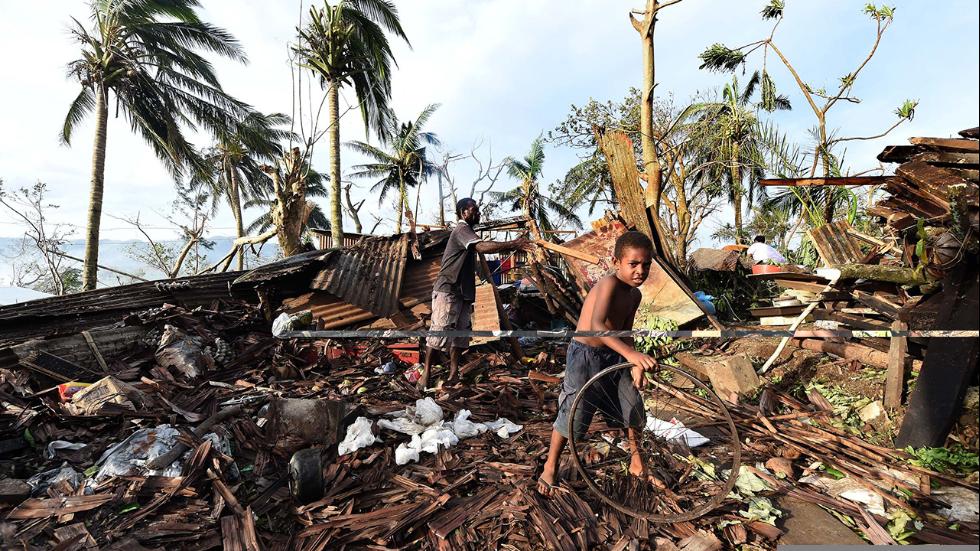
About half the population of the South Pacific Island nation of Vanuatu has been left homeless by a devastating cyclone that struck on Friday, flattening buildings, washing away roads and bridges. Cyclone Pam was a Category 5 storm comparable in strength to Typhoon Haiyan, which hit the Philippines two years ago and killed more than 6,000 people. Now aid agencies say as many as eight people were killed during Cyclone Pam, and the death toll is expected to rise as rescuers reach more far-flung areas. Vanuatu has a population of about 250,000 people and is made up of more than 80 islands.
During the storm, Vanuatu’s President Baldwin Lonsdale was in Japan attending a U.N. conference on disaster reduction. Speaking Monday before he left to return home, he said the cyclone seasons his nation had experienced are directly linked to climate change, and described the extent of the damage.
Many of the buildings and houses has been completely destroyed. More than 90 percent of the buildings have been destroyed. People still haven’t come through yet.
Disaster relief officials and relief workers are still trying to establish contact with Vanuatu’s remote islands that bore the brunt of Cyclone Pam’s winds of more than 185 miles per hour. Following are comments of the president of Vanuatu’s Red Cross, Hannington Alatoa:
“It is unknown, to the extent of the people, the number of people affected in the outer parts of the country, outside Port Vila. Agencies are estimating approximately 130 [thousand] people—that is more than half the population of the country—may have been affected by Cyclone Pam. I think that there will be a lot more when the assessment is done and the investigation is completed, because, as I said earlier, the whole country was flattened.”
Cyclone Pam also caused major damage on other Pacific islands, including Kiribati and the Solomon Islands. UNICEF says the number of children who have been displaced or affected by the cyclone may be as high as 60,000.
Vanuatu is a country made up of over 80 islands, 65 of which are inhabited. It’s in the Pacific, South Pacific Ocean. It’s probably about three hours’ flying time directly east of the east coast of Australia. So it’s a very remote place. The capital, Port Vila, has a population of around 45,000 to 50,000 people, it has a total population of about 260,000, spread out over those outer islands.
Port Vila has been badly affected. Communications are up to Port Vila, so we are able to see what is going on there. And we’re seeing sort of 80 to 90 percent of buildings damaged. And in the sort of poorer shantytown areas of Port Vila, we’re seeing massive destruction to homes. And we’re seeing significant damage to other infrastructure, such as roads being washed away by the high seas and bridges being destroyed by high rivers and as a result of flooding.
90 percent have been damaged in Port Vila. Not all of those have been flattened. So the buildings that have concrete structures are still standing, but most of those have had their roofs ripped off. So, I think, still, in terms of, actually, what I’m seeing in terms of formal figures for casualties, it’s still sitting at eight, but that’s people in central Port Vila. I still think that the figures haven’t flown through from elsewhere. And obviously we’re not yet getting information from those outer islands, where we can just imagine that the situation is going to be grave. There has been some—now, some initial, first initial assessment to Tanna island, which is the major island in the South that was directly hit, and some aerial surveillance work there, and that is painting quite a grim picture in terms of the devastation to the housing and to the infrastructure, and anecdotal reports of people saying that they are lacking, you know, food and health facilities and those sorts of things.
About half the population of the South Pacific Island nation of Vanuatu has been left homeless by a devastating cyclone that struck on Friday, flattening buildings, washing away roads and bridges. Cyclone Pam was a Category 5 storm comparable in strength to Typhoon Haiyan, which hit the Philippines two years ago and killed more than 6,000 people. Now aid agencies say as many as eight people were killed during Cyclone Pam, and the death toll is expected to rise as rescuers reach more far-flung areas. Vanuatu has a population of about 250,000 people and is made up of more than 80 islands.
During the storm, Vanuatu’s President Baldwin Lonsdale was in Japan attending a U.N. conference on disaster reduction. Speaking Monday before he left to return home, he said the cyclone seasons his nation had experienced are directly linked to climate change, and described the extent of the damage. Many of the buildings and houses has been completely destroyed. More than 90 percent of the buildings have been destroyed. People still haven’t come through yet. They still have wariness, have emotional feelings. But it will take time.
As the Pacific Island nation of Vanuatu is devastated by Cyclone Pam, 350.org co-founder Bill McKibben links the storm to global warming and responds to the new decision by the the United Nations Framework Convention on Climate Change to back the fast-growing divestment campaign to persuade investors to sell off their fossil fuel assets. This comes as University of Oxford alumni, donors and students are watching a vote set for today on whether the school will divest its endowment from the top 200 companies involved in exploring or extracting fossil fuels. McKibben also discusses news from NASA that California’s water supply could be exhausted by next year. Meanwhile, the environmentalist and former Maldives President Mohamed Nasheed has been sentenced to 13 years in prison after he was found guilty of ordering the arrest of a judge while in office. Nasheed became famous in 2009 for holding a cabinet meeting underwater to show the threat of climate change to his island nation. McKibben is the author of several books, including “Earth: Making a Life on a Tough New Planet.” 350.org has been posting updates about the situation in Vanuatu on its live blog at 350.org.
The picture is extraordinarily grim. Port Vila, the capital city and the place with most of the infrastructure, took a huge hit. But the winds were higher, the seas were higher and the infrastructure much flimsier, to begin with, on many of the outlying islands, so the picture, I’m afraid, is going to get a lot worse before it gets better.
The tragedy, the bottom-line tragedy here, as in so many other places around the world, is that Vanuatu’s development has been put back decades with this destruction of roads, bridges, hospitals, schools. This is what’s happening now around the world as people begin to kind of run on a tilted treadmill trying to develop on a disintegrating planet.
And the people in Vanuatu know exactly what the culprit is. You know, in one of the most beautiful demonstrations of the climate change era, last summer Vanuatu and 10 other Pacific Islands’ Pacific Warriors, 350’s Pacific Warriors, built indigenous traditional canoes and took them off to Newcastle in Australia, the largest coal port in the world, and used them to blockade the great coal ships in an effort to demonstrate exactly what Cyclone Pam also demonstrated—the incredible vulnerability of so many of the poorest people in the world to the rising temperatures that we’re inflicting on our one Earth.
If you’re low to the water on an island nation and the sea level starts going up, that makes everything that happens, every cyclone that comes, that much more dangerous. Even without a cyclone, in the Pacific earlier this month, the huge king tides in Kiribati flooded many, many homes and villages. Add to that things like the ongoing heating and acidification of the oceans’ waters and the concomitant erosion of coral reefs around the world. In many of these nations, coral reefs provide the best defense against a raging ocean. And that defense is breaking down everywhere. Add to that the fact that we keep seeing these super typhoons, super cyclones. You know, warm air holds more water vapor than cold. It allows, in arid areas, for more evaporation, and hence more drought. We’ll talk about California in a second. But once that water is up in the air, it’s going to come down someplace. And so, we see, from Boston, which just set yesterday the all-time record for snowfall, to places that are getting hammered by big storms, we’re seeing more and more and more devastating downpour. This is a worldwide problem. But, of course, places like Vanuatu are at the very sharpest end of the stick because they are so, so vulnerable.
Aid agencies say conditions in cyclone-ravaged Vanuatu are among the most challenging they have faced.
Relief flights – including from Australia – have begun arriving in the battered capital Port Vila after Cyclone Pam tore through on Friday, packing wind gusts of up to 320km per hour.
But workers on the ground say there’s no way to distribute supplies across the archipelago’s 80 islands, warning it will take days to reach remote villages.
The Save the Children agency says the challenges are worse than Super Typhoon Haiyan, which struck the Philippines in 2013, killing more than seven thousand people.
Up to 50 people are reported to have been killed by Cyclone Pam, which brought winds of nearly 300 kilometres per hour when it struck Vanuatu, levelling homes, smashing up boats, destroying roads and bridges, and bringing down power and phone lines.
But aid agencies say the real number is expected likely to be much higher as rescuers reach the outlying islands.
Thousands have been left homeless on the archipelago.
A Red Cross spokesman described the situation as ‘apocalyptic’ and Vanuatu’s government has declared a state of emergency.
President Baldwin Lonsdale, who happened to be at a disaster risk conference in Japan, compared the storm to a monster.
He said most houses in the capital Port Vila had been damaged or destroyed.
President Lonsdale said the impact would be ‘the very, very, very worst’ in isolated outer islands but he held out hope the number of casualties would be ‘minor’.
He had earlier made a tearful appeal for international assistance.
Aid workers were particularly concerned about the southern island of Tanna, about 200 kilometres south of the capital, Port Vila.
An official with the Australian Red Cross said an aircraft had managed to land there and confirmed ‘widespread destruction’.
‘Virtually every building that is not concrete has been flattened,’ the official said.
Witnesses in Port Vila described sea surges of up to 8m and widespread flooding.
Residents said the storm sounded like a freight train, with Port Vila left strewn with debris.
Jackson Browne sing “Walls and Bridges” song from “in the Breach” CD.
Malnourished Baby Sea Lions Washing Ashore off Southern California by the Thousands

IT BEGAN IN January. At first, there were only a few. But as the weeks went on, more sea lion pups washed ashore. The dehydrated, emaciated pups showed up on Southern California’s beaches, tucked under trucks and lifeguard towers. One was found huddled in a flower pot.
In late January, scientists surveying Channel Island sea lion rookeries reported something worrying: Pups out there were in bad shape. By early February, regional marine mammal rescue centers were concerned.
The strandings hadn’t stopped. Instead, the pace was picking up.
Now, hundreds of these little animals have been admitted to rescue centers between Santa Barbara and San Diego. For a non-El Niño year, the numbers are much too high, too early. Something is going badly wrong offshore, and no one knows what it is yet.
“We’re in the process of trying to understand what is actually causing this,” said Sharon Melin, a wildlife biologist with the National Marine Fisheries Service. “The stranding centers in Southern California are being inundated with animals. It hasn’t hit the northern centers yet.”
As of Mar. 13, 517 pups had been admitted to five Southern California rescue centers. That total is higher than the total for some entire years, said Sarah Wilkin, regional strandings coordinator with the National Oceanic and Atmospheric Administration. “And we’re only two months and a week in.”
The stranded animals are about nine months old – most were born around June 2012. At this age, sea lion pups normally weigh between 25 and 30 kilograms (55-66 pounds). The animals coming ashore weigh about half that, Melin said. She’s visited the island colonies several times recently, first in September and again in February, and noticed that the pups hadn’t gained much weight between visits. “Normally, they would have doubled their weight by February,” Melin said.
She and others suspect the pups have weaned themselves early and left their colonies. Not yet strong enough to find food on their own, they strand themselves on the mainland in a last-ditch effort to save energy and survive. Why they’re leaving home early is an open question.
By the time the pups are rescued, many are too far gone to be saved, Wilkin said. Dehydrated, emaciated, and malnourished, those who can will spend several months in a rehabilitation facility, gaining weight and nourishment before being returned to the sea.
Rescue and rehab groups in the area are struggling to keep up with the onslaught. The pace of admissions is still accelerating, Wilkin said, noting that both Los Angeles County and Orange County admissions doubled last week.
So far, Marine Animal Rescue, based in El Segundo, has rescued 170 sea lion pups, said director Peter Wallerstein. “The pups are hypothermic, dehydrated and skinny,” he said. Marine Animal Rescue brings those pups to the Marine Mammal Care Center in nearby San Pedro for treatment.
“We have admitted over 250 [pups] since January 1,” said MMCC’s director David Bard. “We normally have numbers in the teens for those animals.”
Once admitted, pups are examined, tested for disease, and started on a treatment program. Nutritional supplementation begins with clear fluids, then moves on to “gruel” – a mix of electrolytes, protein, sugar, and ground up fish – until, eventually, the pups are fed solid, fishy food. The process can take several months. “Overall, they’ve been responding very well,” Bard said, on Mar. 13. “We actually released four of them this morning.”
Right now, the San Pedro facility is caring for more than 100 pups. Down the coast, the Pacific Marine Mammal Center has more than 90. On Mar. 12, that facility declared a state of emergency after 18 rescues over two days threatened to overwhelm existing resources. Farther south in San Diego, SeaWorld reports more than 140 marine mammal rescues this year, the majority of which are California sea lions. In all of 2012, SeaWorld rescued 131 marine mammals.
“The good aspect to this is that emaciation and dehydration are something the rehab facilities are very experienced with, and doing a good job,” Wilkin said, reporting that mortality rates in the centers are relatively low, between 20 and 30 percent.
But the bad news is, the onslaught isn’t over. Peak stranding season hasn’t happened yet. Historically, most sea lion strandings occur during April and May, when pups are weaned and have to find their way on their own. “We anticipate it will only get worse in the coming months,” Melin said.
Such large numbers of strandings so early in the year are unusual, and suggest the situation offshore must be pretty grim. “When we see a big uptick like this, we know it’s bad,” Melin said. “There’s something not right. We go out to the islands.”
Melin’s September visit to San Nicolas Island revealed that pup mortality rates were around 34 percent — about what one would expect for an El Niño year. By February, the rate had risen to somewhere near 50 percent. “By the time we get around to their first birthday, mortality might be as high as 60 percent, maybe even 70 percent,” Melin said.
It’s not just last year’s pup population that’s being affected. After giving birth in June, females spend the next months nursing, foraging, and reproducing. By this point in the year, many are probably pregnant again. But when food is scarce, females will sometimes abort a pregnancy and funnel all their resources toward the already growing juvenile. “We are seeing premature pups being born, up and down the coast. A lot of pregnancies are not coming to term,” Melin said.
This means the sea lion population will take a double punch: reduced numbers of surviving pups from 2012, and fewer pups born in 2013. “It’s two years of impact from something that we don’t yet know,” Melin said. “Thankfully, it’s a healthy population. It weathers these kinds of things fairly well.”
But the cause of the mass stranding is still a mystery. Disease or an environmental perturbation affecting the food supply are the best guesses, though scientists are still in the early stages of the investigation. Next week, a team will return to San Nicolas Island and reassess the colonies there. Wilkin is working on applying to have the strandings declared “an unusual mortality event” by the National Marine Fisheries Service. That classification would free up funding and investigators, allowing scientists to move more quickly.
“If this was a disease process, you might expect it to be a little more across the board,” Wilkin said. “It does seem to be pretty targeted to that age class.”
Another possibility is that hookworms – which can infect pups until they’re about six months old – have weakened the pup population and left it susceptible to a second disease agent that is just now sweeping through. But while some pups are showing signs of having been infected with hookworms, it’s not being seen at abnormally high levels, Melin said. “It does seem more likely to be food-related,” she said.
‘Sea lions are usually pretty good at adapting.’ Warmer ocean temperatures, can affect the food supply.
Those warmer waters dampen nutrient-rich seafloor upwellings. Without cold waters and added nutrients, prey species — phytoplankton, krill, and small fish — are scarce. Animals that eat those critters, such as larger fish, sea lions and sea birds, either move with the food toward colder water, or struggle. Scarcer food means sea lion mothers have a tougher time finding a meal for their pups. They may have to swim farther, dive deeper, and stay away longer, prompting pups to wean themselves and strike out on their own in search of fish.
“It’s not that mom isn’t coming back, she’s just taking too long,” Melin said. “It takes a lot for a sea lion to leave its pups.”
After a strong El Niño event in 1997-1998, rescue centers around the state saw elevated intake numbers, similar to what’s occurring now except more broadly distributed. In spring 2009, an unpredicted halt in normal upwellings caused the food supply between Point Conception, north of Santa Barbara, and the Monterey Bay to collapse. “We had huge mortality of pups weaned that year,” Melin said. “Close to 80 percent.”
So far, this event doesn’t fit into a pattern. The strandings are localized to southern California, and this isn’t an El Niño year. At least, not really: In summer 2012, a short-lived patch of abnormally warm surface water did settle off the Southern California coast. But that’s cooled off now — and the sea lions stuck around.
“Sea lions are usually pretty good at adapting,” Melin said, noting that biologists often monitor female sea lions and use them as a gauge of ecosystem health. “If the system starts changing or becomes out of whack, they’re the one that are going to show the signs.”
There are other hints that something more systemic is amiss in the Islands, namely the nesting numbers and success of brown pelicans in the Channel Islands National Park. Pelicans, like sea lions, are top predators. Both species tend to forage for the same fish, and their numbers tend to fluctuate in tandem. In 2004 and 2005, pelicans in the islands made roughly 6,500 nest attempts, said seabird biologist Laurie Harvey of the California Institute of Environmental Studies. Last year, out of several hundred nest attempts, only five pelican chicks fledged on Anacapa Island. “That ended up being the poorest reproduction year for pelicans on the Channel Islands since 1970,” she said.
This year, though it’s still early in nesting season, pelican numbers are fairly low, with fewer than a hundred nests on Anacapa. “We think that yes, it definitely looks like it’s linked to the sea lion strandings,” Harvey said. “Sea lions and pelicans feed primarily on coastal pelagic species like anchovies and sardines. What it’s looking like is that the local availability of prey is insufficient.”
 All Things Environmental
Recent Comments