
Over Two-thirds of Americans are Cowards When it Comes to Standing Up to the Threats of Global Warming


Over two-thirds of Americans polled answered they were not concerned about global warming and climate change, according to a Gallop poll released last Wednesday and published by The Washington Times. Thirteen percent of Republicans are concerned about global warming and climate problems compared to 52 percent of Democrats polled.
A “coward” is any person who lacks the courage endure dangerous or unpleasant things. Global warming is the most dangerous natural disaster our civilization will have ever had to face and endure, and it is human-caused.
The majority of Americans worry about only one environmental issue, however. Fifty five percent are concerned about the pollution of drinking water. Next in line: 47 percent fret over lake and river pollution, air pollution (36 percent) and the loss of tropical rain forests (33 percent).
In general, Americans are more positive about the environment these days notes Gallup analyst Jeffrey Jones, with negative sentiments now at the “low end” of what the polling group has measured in the last 25 years.
“The nature of the environmental agenda may indirectly be influencing Americans’ concern. The primary focus of the environmental movement has shifted toward long-term threats like global warming – issues about which Americans tend to worry less than about more immediate threats like pollution,” writes Mr. Jones.
“Importantly, even as global warming has received greater attention as an environmental problem from politicians and the media in recent years, Americans’ worry about it is no higher now than when Gallup first asked about it in 1989”, according to Jones.
Source: From an article by Jennifer Harper in The Washington Times, Wednesday, March 25, 2015.

Governor Walker’s Proposed 2015 -2017 State of Wisconsin Budget

Following are the comments I submitted by email on the governor’s proposed budget for July 1, 2015 to June 30, 2017.
Bad things can happen to good people. It happens all the time, and has occurred all throughout history. So when bad things, or threats, are predicted to occur or seem reasonably likely to occur, it’s best for one to take action, and involve others in removing the oncoming threat, before it gets realized and significant damage to life and our environment occurs.
Governor Walker’s biennial budget plan for Wisconsin for the next two years contains numerous threats to the people of Wisconsin and the state of Wisconsin’s natural resources. Some of those threats could have devastating and harmful impacts if they are allowed to occur without any attempts to prevent or ameliorate them.
Governor Walker’s budget plan as written will cause a great deal of harm for many thousands of Wisconsin’s people and their families. Some people who have worked their entire life at University of Wisconsin or UW-extension will likely lose their jobs, and the public who those people serve will lose out as well. Wisconsin’s elderly and disabled population, and families having children enrolled in Wisconsin’s excellent public school system will also suffer loses. Many hard working and dedicated school teachers and educational assistants serving special needs children will be without a job next fall if this budget is not revamped.
The governor’s budget also hurts those who watch over and protect our precious natural resources, both now and in the coming years, by cutting positions and land stewardship funds.
But really the worst thing about the governor’s budget is not what’s in it but rather what’s NOT IN IT BUT SHOULD IN IT. For example, despite Wisconsin’s aging population and increasing number of people who prefer not to drive, or who can’t drive because of the high cost of owning, maintaining and driving an automobile, the Walker budget proposes nothing new to help with mobility in the state, transit in particular. Rather, it borrows hundreds of millions of dollars to expand an already too large highway system at great environmental harm to the state, and for no good reason.
Numerous observations demonstrate that the climate of the Great Lakes Region, including Wisconsin’s climate, is changing. Average temperatures are getting warmer and extreme heat events are occurring more frequently. Total precipitation is increasing and heavy precipitation events are becoming more common. Winters are getting shorter and the duration of lake ice cover is decreasing over time. As a state, we should already be doing as much as we can to drastically cut back on our burning of fossil fuels but we seem to be doing almost the opposite. This tragedy grows in magnitude the longer it takes for our country and other countries to wean themselves off burning fossil fuels. There are many other unintended consequences of living in a fossil fuel burning dependent society.
But ironically, rather than then increasing substantially the funding of transit systems and the funding of positive financial incentive programs aimed at reducing greenhouse gas emissions and encourage walking and use of nonmotorized travel by state residents and businesses, the governor’s budget promotes more highway expansion. Instead, the state should reward those who drive less (miles), don’t fly, and minimizing their use of fossil fuel derived energy over the year. Use the money that Governor Walker’s budget borrows to fund a bigger highway system and a big new professional basketball arena instead – expenditures that not only subject state taxpayer to great financial risks but also promote adding millions more tons of greenhouse gases to the atmosphere including promoting jet airplanes flying of visiting teams and fans to the games.
Wisconsin Public Radio (part of state’s UW-extension) plans vacationing trips to Scotland and Australia, trips that not only release hundreds of millions of tons of greenhouse gases to the atmosphere but also give nothing back to the state’s own tourism businesses.
Governor Walker’s budgets include more trade promotions with foreign countries despite the fact that shipping products and working with foreign business interests similarly add millions and millions more tons of greenhouse gases to the atmosphere.
My plan would increase Wisconsin families’ and individuals’ annual income for polluting less and reducing the global warming threat, rather than adding to it. It would encourage Wisconsinites and Americans to buy from local entrepreneurs, whenever possible.
Governor Walker’s plan is to require a monthly drug test of food share (too low to begin with) recipients and proof of their having worked at least 80 hours at a place of employment before their receiving the meager food share benefits. It would do nothing to curb the rising income and employment inequalities and racial disparities in the state. The numbers of families and children living in poverty already will not be helped by Governor Walker’s budget. It is a fact that children of families living in poverty start their lives with a handicap because of many reason but the worst is that they do not receive adequate nutrition before and after they enter their school years. The governor’s budget insufficiently funds Wisconsin public schools and the families that live in poverty are disadvantaged in those schools from day one. Yet the governor’s budget does nothing to make up for previous cuts to public schools and add more financial stress for them by requiring them to pay vouchers for children attending private schools.
The budget should also refund the planned parenthood clinics the state had before Scott Walker took office. Certainly we ought not be adding to our human population pressures on the environment if we don’t have to.
Thank for the opportunity to submit my comments on the proposed state budget. For addition background on my concerns expressed here, please visit my blog at: http://www.allthingsenvironmental.com.
Mississippi River Mayors Come Together To Consider Climate Change
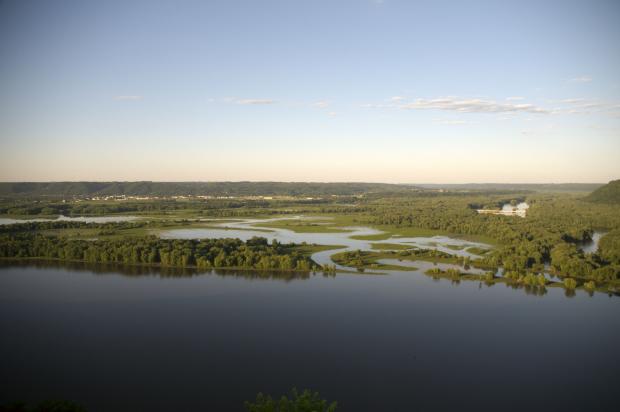
A group a mayors living along the Mississippi River has plans to collaborate with international leaders, with an eye toward playing a bigger role in global talks surrounding climate change.
Mayors with the Mississippi River Cities and Towns Initiative will be working more closely with the Netherlands, learning what actions have been taken to protect the Rhine River from climate change.
The group is also initiating discussions with people living along the Amazon, Euphrates, Yellow, Paraná, Danube, Volga, and Ganges rivers.
MRCTI director Colin Wellenkamp said the Mississippi River Valley is the most agriculturally productive zone on the planet and working with those other major food-producing regions is a necessity.
“This is not going to be not just about flooding and water management, it’s going to be about the future of our food supply,” Wellenkamp said. “Climate disruption is a major component of that and so far, that part of the conversation really hasn’t been emphasized.”
Mayors from La Crosse, Onalaska, Prairie du Chien, and Prescott are involved in the initiative, which will send a delegation of mayors to the Conference of the Parties to the United Nations Framework Convention on Climate Change, also known as COP21, later this year.
The MRCTI also recently praised sections of the president’s proposed budget for offering more funding for flooding and disasters.
President Obama proposed funding the Federal Emergency Management Agency’s Pre-Disaster Mitigation Grant program at $200 million, which is a record high.
In La Crosse, this program has been used to flood-proof and remove homes built in the city’s floodplain.
Mayor Tim Kabat and fellow members of the Mississippi River Cities and Towns Initiative met with members of Congress this week, encouraging them to maintain the funding. Kabat said the grants can save money in the long run.
“You do the investment and the project in the front end and prevent a lot of the emergency situations on the back end,” Kabat said.
Kabat said, in the future, these grants could be used to restore the city’s marsh.
The mayors also hope to see funding go up for National Flood Insurance Program Risk Mapping.
Cyclone Pam Is Just the Start
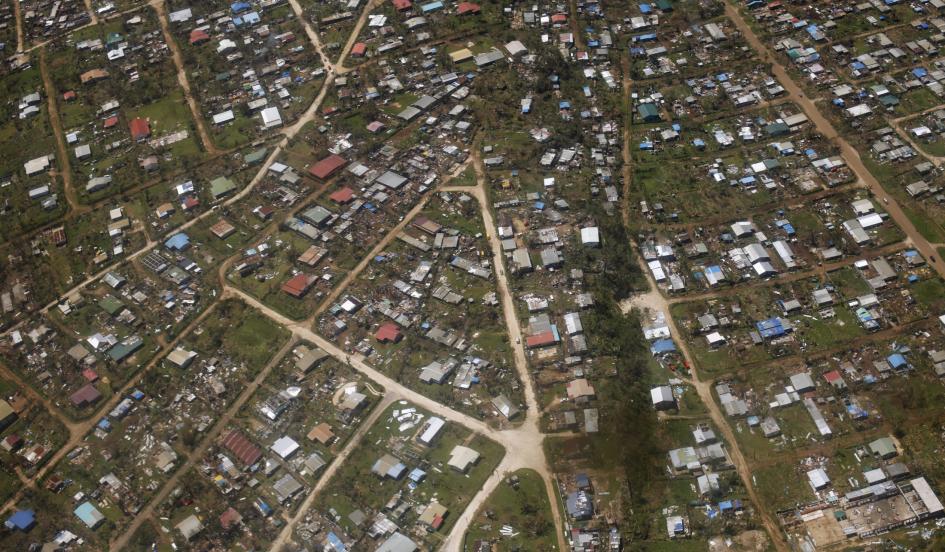
In the wake of island nation Vanuatu’s devastation by Cyclone Pam, in which 320 mile-per-hour winds killed dozens of people and destroyed 90 percent of the buildings in the capital city of Port Vila, public health experts fear that the country’s ruined infrastructure will result in mass starvation and epidemics of disease.
An aerial view of the destruction after Cyclone Pam hit Port Vila, capital city of the Pacific island nation of Vanuatu, on March 17, 2015. EDGAR SU/REUTERS
As the rate of global climate change continues to increase, such tragedies will become more and more common around the world. Vanuatu is not alone. New Yorkers, for example, received a dire warning recently from the New York City Panel on Climate Change: Sea levels and temperatures have risen dramatically over the past few decades, and that rise will only accelerate more rapidly in the coming years, putting the city at serious risk for flooding.
According to the report, mean annual temperatures have increased 3.4 degrees Fahrenheit in the past century, precipitation has increased 8 inches over the same time period, and sea levels in New York City have risen over a foot, which is twice the global rate of rising.
While these changes in temperature may seem insubstantial—none of us might notice, for example, if room temperature changed by a few degrees Fahrenheit—these changes have enormous implications for the environment and its inhabitants, particularly humans.
Take a look. Temperatures are projected to increase by nearly 6 degrees by 2050; heat waves will be more common; precipitation will increase up to 11 percent by 2050; and sea levels will rise up to 21 inches by 2050, up to 39 inches by 2080 and a worst-case situation of six feet by 2100.
As a result of climate change that has already occurred, we are now experiencing more powerful storms, resulting in more city damage. In Brooklyn, thousands of families were displaced by Hurricane Sandy, which flooded entire neighborhoods and ruined many homes, some of which have not been rebuilt. Worryingly, many experts now believe that a worse storm could occur within the next few years.
We cannot allow this to continue. The problem of global climate change requires a global solution. We must work with other nations and their people to support the development of renewable energy and to reduce emissions of carbon dioxide that contribute to drastic changes in our climate.
We already have much of the technology we will need. We have electric cars, commercially available in the United States at prices that decrease every year. We have wind turbines and solar panels, which continue to increase in capacity. None of these policies will, by itself, reverse the effects of climate change. But a flexible approach to the problem, in which we consider all of the possibilities, offers us considerable hope for the future.
This flexible approach to climate change is not a Republican or a Democratic idea. Regardless of our partisan affiliation, we all have a responsibility to protect our earth and its people, as well as a profound concern for the generations that will follow us.
Yet today there are still dinosaurs roaming the halls of Congress, who insist that we burn fossil fuels, and nothing other than fossil fuels, to produce our energy, a policy that will only exacerbate the problem.
Despite the challenges that exist, we remain optimistic. The women and men determining national policy on renewable energy and climate change are ultimately elected. If we raise our voices and organize on behalf of the broad interests of society as a whole, rather than the narrow interests of fossil fuel producers, we will influence the debate of climate change and elect leaders who are committed to this effort.
As the United Nations this year brings together representatives from every country to work toward a solution that accounts for the different needs of nations, we have a real opportunity to lead that process. President Barack Obama’s historic agreement with Taiwan and his recent trip to India, to emphasize and commit to greenhouse gas emission reductions, have the potential to provide a model for the entire world. This is an all-hands-on-deck approach to developing policies that reduce our dependence on fossil fuels and expand our capacity to create energy from renewable resources. No one is exempt.
We cannot afford delay, especially as Vanuatu-type storms become more common. With each year, the problem becomes more serious, and the range of potential solutions more limited.
We encourage you to demand action from your elected officials on this issue. We have the ability to mitigate the effects of climate change. We need only the resolve to act. Now is the time.
Yvette Clarke represents the 9th Congressional District of New York and serves on the House Energy and Commerce Committee. Dr. Michael Shank is director of media strategy at Climate Nexus and an adjunct faculty member at George Mason University’s School for Conflict Analysis and Resolution.
BY YVETTE CLARKE AND DR. MICHAEL SHANK 3/19/15
Newsweek
President Obama’s Executive Order Committing Federal Government to Cutting Its Greenhouse Gas Emissions

President Barack Obama signed an executive order on Thursday committing the federal government to cutting its own emissions 40 percent by 2025 and pledging to increase the amount of renewable energy used by federal agencies to 30 percent.
-
[This is a good addition but still not nearly enough. States and everyday Americans all have to greatly reduce the things they do that contribute to their daily and annual greenhouse gas emissions, as does the rest of the world. The U.S. still has the highest per capita GHG emissions. Forty percent of world travel by air (a large emitter of GHGs) is by American recreation and business travel pursuits. This has to change! Click on: “About this Blog” to read about how our government really could help make this happen – Power to the People]
The executive order builds on a previous administration directive to cut emissions from federal agencies 28 percent by 2020, compared with 2008 levels. “We are well on our way to meet that goal,” Brian Deese, senior adviser to the president, said in a call with reporters Thursday. “That’s what’s motivating us today to chart out a new and even more aggressive goal going forward.”
The administration is also setting a goal of cutting the per-mile emissions from the agencies’ vehicle fleet 30 percent, it said. It estimates the total commitment across the federal agencies will save taxpayers $18 billion — funds that won’t be spent on energy.
Christy Goldfuss, managing director of the Council on Environmental Quality, said that by the end of 2014, the federal government had cut emissions 17 percent since 2008, putting it well on the way to meeting Obama’s earlier goal. Much of that has come through energy efficiency improvements in federal buildings and with the installation of renewables.
As of the end of 2014, renewable energy accounted for 9 percent of the federal government’s energy use, and Thursday’s directive wants to increase that to 30 percent by 2025. The Department of Defense has set its own goal of deploying 3 gigawatts of solar energy on its installations around the world by 2025.
The federal government is the single largest energy user in the United States, Goldfuss said, with 360,000 buildings and 650,000 vehicles. “Not only is our footprint expansive, our impact is as well,” she said.
The administration also argued that the push to reduce emissions in the federal government has effects across the private sector as well. To that end, the administration also released a scorecard to track emissions from major federal contractors such as Lockheed Martin, Boeing and General Dynamics, which the administration is also calling on to make reductions.
The White House estimates that with reductions from the agency and those of private suppliers, the administration can cut greenhouse gas emissions by 26 million metric tons in the next 10 years.
“These goals will make sure the federal government is leading by example and pushing the envelope on cutting emissions,” said Deese, adding that it will “demonstrate that we are going to stay on offense in pushing our clean energy and climate change objectives.”
Vanuatu Blames Global Warming as Cyclone Pam Causes Nation’s Worst Climate Disaster in Recent Memory
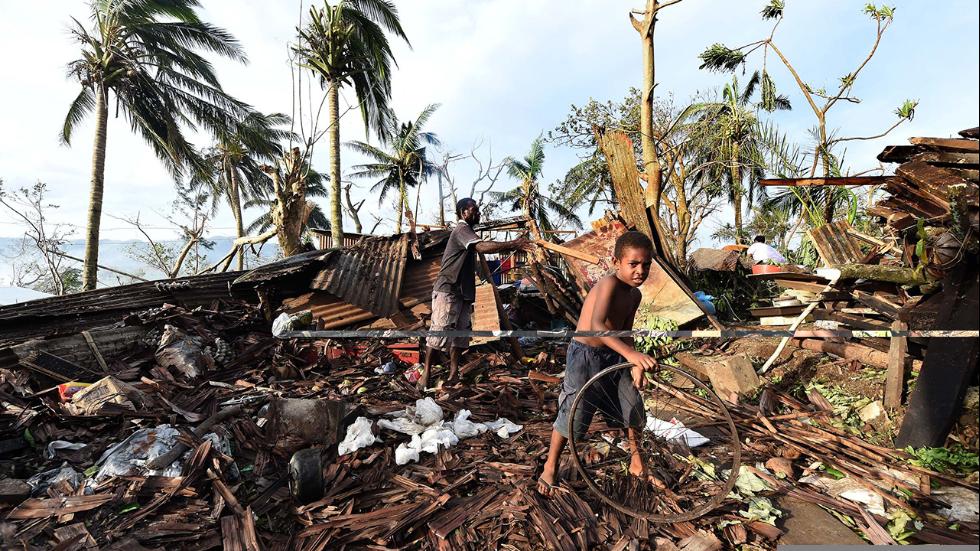
Report from DemocracyNow.org. March 17, 2015:
About half the population of the South Pacific Island nation of Vanuatu has been left homeless by a devastating cyclone that struck on Friday, flattening buildings, washing away roads and bridges. Cyclone Pam was a Category 5 storm comparable in strength to Typhoon Haiyan, which hit the Philippines two years ago and killed more than 6,000 people. Now aid agencies say as many as eight people were killed during Cyclone Pam, and the death toll is expected to rise as rescuers reach more far-flung areas. Vanuatu has a population of about 250,000 people and is made up of more than 80 islands.
During the storm, Vanuatu’s President Baldwin Lonsdale was in Japan attending a U.N. conference on disaster reduction. Speaking Monday before he left to return home, he said the cyclone seasons his nation had experienced are directly linked to climate change, and described the extent of the damage.
Many of the buildings and houses has been completely destroyed. More than 90 percent of the buildings have been destroyed. People still haven’t come through yet.
Disaster relief officials and relief workers are still trying to establish contact with Vanuatu’s remote islands that bore the brunt of Cyclone Pam’s winds of more than 185 miles per hour. Following are comments of the president of Vanuatu’s Red Cross, Hannington Alatoa:
“It is unknown, to the extent of the people, the number of people affected in the outer parts of the country, outside Port Vila. Agencies are estimating approximately 130 [thousand] people—that is more than half the population of the country—may have been affected by Cyclone Pam. I think that there will be a lot more when the assessment is done and the investigation is completed, because, as I said earlier, the whole country was flattened.”
Cyclone Pam also caused major damage on other Pacific islands, including Kiribati and the Solomon Islands. UNICEF says the number of children who have been displaced or affected by the cyclone may be as high as 60,000.
Vanuatu is a country made up of over 80 islands, 65 of which are inhabited. It’s in the Pacific, South Pacific Ocean. It’s probably about three hours’ flying time directly east of the east coast of Australia. So it’s a very remote place. The capital, Port Vila, has a population of around 45,000 to 50,000 people, it has a total population of about 260,000, spread out over those outer islands.
Port Vila has been badly affected. Communications are up to Port Vila, so we are able to see what is going on there. And we’re seeing sort of 80 to 90 percent of buildings damaged. And in the sort of poorer shantytown areas of Port Vila, we’re seeing massive destruction to homes. And we’re seeing significant damage to other infrastructure, such as roads being washed away by the high seas and bridges being destroyed by high rivers and as a result of flooding.
90 percent have been damaged in Port Vila. Not all of those have been flattened. So the buildings that have concrete structures are still standing, but most of those have had their roofs ripped off. So, I think, still, in terms of, actually, what I’m seeing in terms of formal figures for casualties, it’s still sitting at eight, but that’s people in central Port Vila. I still think that the figures haven’t flown through from elsewhere. And obviously we’re not yet getting information from those outer islands, where we can just imagine that the situation is going to be grave. There has been some—now, some initial, first initial assessment to Tanna island, which is the major island in the South that was directly hit, and some aerial surveillance work there, and that is painting quite a grim picture in terms of the devastation to the housing and to the infrastructure, and anecdotal reports of people saying that they are lacking, you know, food and health facilities and those sorts of things.
About half the population of the South Pacific Island nation of Vanuatu has been left homeless by a devastating cyclone that struck on Friday, flattening buildings, washing away roads and bridges. Cyclone Pam was a Category 5 storm comparable in strength to Typhoon Haiyan, which hit the Philippines two years ago and killed more than 6,000 people. Now aid agencies say as many as eight people were killed during Cyclone Pam, and the death toll is expected to rise as rescuers reach more far-flung areas. Vanuatu has a population of about 250,000 people and is made up of more than 80 islands.
During the storm, Vanuatu’s President Baldwin Lonsdale was in Japan attending a U.N. conference on disaster reduction. Speaking Monday before he left to return home, he said the cyclone seasons his nation had experienced are directly linked to climate change, and described the extent of the damage. Many of the buildings and houses has been completely destroyed. More than 90 percent of the buildings have been destroyed. People still haven’t come through yet. They still have wariness, have emotional feelings. But it will take time.
As the Pacific Island nation of Vanuatu is devastated by Cyclone Pam, 350.org co-founder Bill McKibben links the storm to global warming and responds to the new decision by the the United Nations Framework Convention on Climate Change to back the fast-growing divestment campaign to persuade investors to sell off their fossil fuel assets. This comes as University of Oxford alumni, donors and students are watching a vote set for today on whether the school will divest its endowment from the top 200 companies involved in exploring or extracting fossil fuels. McKibben also discusses news from NASA that California’s water supply could be exhausted by next year. Meanwhile, the environmentalist and former Maldives President Mohamed Nasheed has been sentenced to 13 years in prison after he was found guilty of ordering the arrest of a judge while in office. Nasheed became famous in 2009 for holding a cabinet meeting underwater to show the threat of climate change to his island nation. McKibben is the author of several books, including “Earth: Making a Life on a Tough New Planet.” 350.org has been posting updates about the situation in Vanuatu on its live blog at 350.org.
The picture is extraordinarily grim. Port Vila, the capital city and the place with most of the infrastructure, took a huge hit. But the winds were higher, the seas were higher and the infrastructure much flimsier, to begin with, on many of the outlying islands, so the picture, I’m afraid, is going to get a lot worse before it gets better.
The tragedy, the bottom-line tragedy here, as in so many other places around the world, is that Vanuatu’s development has been put back decades with this destruction of roads, bridges, hospitals, schools. This is what’s happening now around the world as people begin to kind of run on a tilted treadmill trying to develop on a disintegrating planet.
And the people in Vanuatu know exactly what the culprit is. You know, in one of the most beautiful demonstrations of the climate change era, last summer Vanuatu and 10 other Pacific Islands’ Pacific Warriors, 350’s Pacific Warriors, built indigenous traditional canoes and took them off to Newcastle in Australia, the largest coal port in the world, and used them to blockade the great coal ships in an effort to demonstrate exactly what Cyclone Pam also demonstrated—the incredible vulnerability of so many of the poorest people in the world to the rising temperatures that we’re inflicting on our one Earth.
If you’re low to the water on an island nation and the sea level starts going up, that makes everything that happens, every cyclone that comes, that much more dangerous. Even without a cyclone, in the Pacific earlier this month, the huge king tides in Kiribati flooded many, many homes and villages. Add to that things like the ongoing heating and acidification of the oceans’ waters and the concomitant erosion of coral reefs around the world. In many of these nations, coral reefs provide the best defense against a raging ocean. And that defense is breaking down everywhere. Add to that the fact that we keep seeing these super typhoons, super cyclones. You know, warm air holds more water vapor than cold. It allows, in arid areas, for more evaporation, and hence more drought. We’ll talk about California in a second. But once that water is up in the air, it’s going to come down someplace. And so, we see, from Boston, which just set yesterday the all-time record for snowfall, to places that are getting hammered by big storms, we’re seeing more and more and more devastating downpour. This is a worldwide problem. But, of course, places like Vanuatu are at the very sharpest end of the stick because they are so, so vulnerable.
Aid agencies say conditions in cyclone-ravaged Vanuatu are among the most challenging they have faced.
Relief flights – including from Australia – have begun arriving in the battered capital Port Vila after Cyclone Pam tore through on Friday, packing wind gusts of up to 320km per hour.
But workers on the ground say there’s no way to distribute supplies across the archipelago’s 80 islands, warning it will take days to reach remote villages.
The Save the Children agency says the challenges are worse than Super Typhoon Haiyan, which struck the Philippines in 2013, killing more than seven thousand people.
Up to 50 people are reported to have been killed by Cyclone Pam, which brought winds of nearly 300 kilometres per hour when it struck Vanuatu, levelling homes, smashing up boats, destroying roads and bridges, and bringing down power and phone lines.
But aid agencies say the real number is expected likely to be much higher as rescuers reach the outlying islands.
Thousands have been left homeless on the archipelago.
A Red Cross spokesman described the situation as ‘apocalyptic’ and Vanuatu’s government has declared a state of emergency.
President Baldwin Lonsdale, who happened to be at a disaster risk conference in Japan, compared the storm to a monster.
He said most houses in the capital Port Vila had been damaged or destroyed.
President Lonsdale said the impact would be ‘the very, very, very worst’ in isolated outer islands but he held out hope the number of casualties would be ‘minor’.
He had earlier made a tearful appeal for international assistance.
Aid workers were particularly concerned about the southern island of Tanna, about 200 kilometres south of the capital, Port Vila.
An official with the Australian Red Cross said an aircraft had managed to land there and confirmed ‘widespread destruction’.
‘Virtually every building that is not concrete has been flattened,’ the official said.
Witnesses in Port Vila described sea surges of up to 8m and widespread flooding.
Residents said the storm sounded like a freight train, with Port Vila left strewn with debris.
Jackson Browne sing “Walls and Bridges” song from “in the Breach” CD.
Wisconsin Legislature Votes to Call “Extraordinary Sessions” for Wrong Reasons

Organizing committees of both the Wisconsin Senate and Wisconsin Assembly called both houses of the Wisconsin legislature into extraordinary sessions this week to pass a “right-to-work” bill, making it illegal for employers and labor unions to charge their employees and any new employees union dues as a condition of accepting employment. The Wisconsin State Journal reported in today’s newspaper edition that the full Senate could vote on this highly charged legislation (Senate Bill 44) as early as Wednesday and the Wisconsin Assembly could vote on this legislation (AB 61) as soon as Monday.
Governor Scott Walker has said he would sign the bill into law.
The Senate and Assembly organizing committees ought have called their “extraordinary” sessions to address what the State of Wisconsin ought do to protect its citizens from global warming and climate change instead. Greenhouse gas emissions, global warming and climate change are far more significant to the future of Wisconsin than are unions charging union dues in the state.
Governor Scott Walker Punts on Taking On Climate Change in Wisconsin’s State Budget and Other Walker Administration Decisions
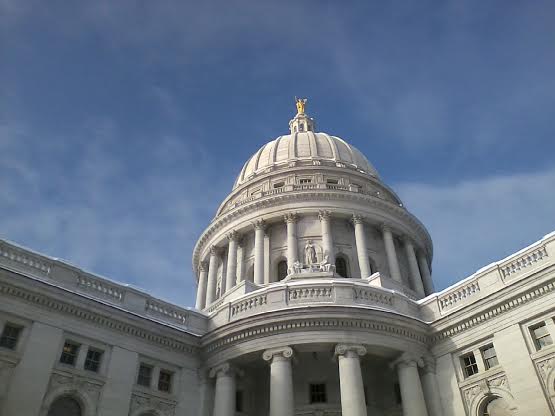
While other countries and U.S. states struggle with the deadly and extremely negative economic costs of dangerous storms made worse by warming oceans and rising sea levels caused by increasing greenhouse gases concentrations in the atmosphere, Wisconsin Governor Scott Walker has taken a pass on including anything in his two-year budget about how or to what degree the State of Wisconsin might reduce its annual greenhouse gases emissions and better adapt to the changing climate predicted for the future in Wisconsin. Governor Walker’s two-year state budget was forwarded to the Wisconsin Legislature earlier this month for adoption by July 1, 2015.
Much of what the governor’s budget proposes for the state will exacerbate the world’s chances of ever reducing climate change, or global warming, to a safe level. Scientists now say the changing climate around the world (global warming) is overwhelmingly human-caused and will be disastrous for the planet if the amounts of fossil fuels (coal, oil, natural gas) we are now burning are not significantly reduced and in a timely manner – now! – worldwide, and deforestation, over has been done over the last 100 – 150 years is stopped. Forests sequester carbon dioxide (CO2) as they grow, which is also the most abundant of the greenhouse gases emitted during fuel combustion.
While Wisconsin did experience a costly drought two years ago, and suffered through two recent killing heat waves in 1995 and 2011, the state has generally been spared from such massive destruction and loss of life as occurred in the Philippine Islands caused by Typhoon Haiyan U.S. states under hit by Hurricanes Sandy Sandy, Katrina and Ike, Hurricane Irene and increasing torrential rains and flooding around the world, heavier snowfalls, and long lasting droughts in California, other western states, and other areas around the world.
The economic costs of these catastrophes, especially those occurring in the United States, negatively effects all states in the U.S. through increased prices of goods, higher insurance rates, and the overall health of the U.S. economy.
Instead of addressing the inevitable economic and environmental effects of climate change and its causes in Wisconsin, Governor Walker instead chose to include in his two year budget proposal for the state many action items that, if enacted into law by the Wisconsin Legislature will, without question, add to the already abhorrently high human, economic and environmental costs of change climate here in Wisconsin and throughout the rest of the world. For example, Governor Walker’s two-year budget, which would begin taking effect in July 2015, expands numerous major highways in the state to increase their capacity to accommodate increased driving of cars and trucks, the vast majority of which burn fossil fuels. The governor’s budget proposes to contribute millions of dollars in state bonding to help the privately owned Milwaukee Bucks build a new arena for NBA games, games that require thousands of miles of jet travel each year for each visiting team as well as their fans and supporting personnel, adding measurably to rising volumes of greenhouse gases linked with global warming.
Furthermore, by not proposing other actions, many additional sources of greenhouse gases and pollution will continue and undoubtedly increase significantly in the next two years under the Walker administration and the current Republican legislature. Due to the lower price of crude oil, prices of fuel at the pump have dropped, leading to the purchase of less fuel efficient SUVs and trucks.
Americans and Wisconsinites need to drastically reduce their annual driving miles, and Governor Walker’s budget should have included positive financial benefits to encourage people to drive fewer and fewer miles each year, and compensate those individuals and Wisconsin families who manage to drive less miles, annually, than average – especially those individuals and families who don’t drive personal automobiles or fly airplanes (jet fuel is a fossil fuel and jets burn tons of fuel on each trip) during the year. The emission of greenhouse gases (GHGs) to the atmosphere from motorized transportation, jets, other internal combustion engines, as well as GHGs emitted from coal, oil, and natural gas burning power plants and household and business furnaces is “cumulative”, meaning the various emission of those gases accumulate in the atmosphere over time, rising to higher and higher levels of concentration in the atmosphere.
Scientists the world over have reached a level of consensus that the amount of GHGs present in the atmosphere are becoming increasingly of concern, more threatening each year that global warming worsens. Eventually, global warming could reach, or is close to reaching, its “tipping point” in the atmosphere – a level of accumulation of GHGs in the atmosphere after which the earth’s natural systems could keep adding more and more GHGs into the atmosphere, the point at which continued warming would become inevitable, regardless of what we humans do to reduce our GHG emissions. For example, as the permafrost region of the planet thaws (1/5 of earth’s surface exists in the form of permafrost), the GHG methane is released from the rotting permafrost. Methane is a much more potent GHG than CO2, and when the permafrost begins to thaw extensively, it will be releasing massive amounts of methane to the atmosphere, This would make matters much worse, because global warming would become less responsive, if responsive at all, to the amount of GHGs we humans cause to be emitted (or not to be emitted).
Positive Incentives Plan Wages Three-Prong-Attack Against Climate Change

Please refer to “About this Blog” before proceeding.
The planet Venus is on the left; Earth is on the right. Nobody wants to see Earth go the route its that its commonly called twin planet Venus took, eons ago. You see Venus once had oceans of water, too, just like Earth does. But something went very wrong on the surface of Venus (possibly it is because the Sun got hotter), which started a “runaway greenhouse effect”. The oceans of water Venus once had boiled away. As temperatures began rising ocean water converted to water vapor, also a strong greenhouse gas. The water vapor increased the effectiveness of heat trapping and accelerated the greenhouse effect, which caused the temperature at the surface to rise further, thus causing the oceans to evaporate faster, etc., etc. This type of runaway is also called a “positive feedback loop”. When the oceans were gone the atmosphere finally stabilized at a much higher temperature and at much higher density, making the planet uninhabitable.
The sobering warning for us is obvious: we have to be extremely concerned about processes such as burning of fossil fuels in large volumes that might have the potential to trigger a runaway greenhouse effect and produce on the Earth atmospheric conditions that are incapable of supporting life.
That is why it is so essential that we initiate actions now, worldwide, to curb all forms of unnecessary activity that causes the greenhouse effect in our atmosphere to strengthen (meaning an increase concentrations of greenhouse gases). Carbon dioxide (CO2), a greenhouse gas, has increased in concentration in the atmosphere from 280 parts per million (ppm) in the 1880’s to 400 ppm today – mainly the result of humans burning coal, oil. and natural gas, the combustion producing significant amounts of (invisible) CO2.
As a result, the global average annual temperature of the Earth at the surface has risen, the temperature of Earth’s oceans have been increasing and, as a result of the ice melting off of the island of Greenland, the continent of Antarctica, and water runs down the mountainous glaciers on practically all the continents, and the property of the thermal expansion of water, Earth’s oceans levels are rising.
Meanwhile, the Earth’s once solid permafrost region, which is approximately 1/5 of the Earth’s surface, is now thawing in many places, decomposing,and releasing methane to the atmosphere, a greenhouse gas 37 times as strong as CO2 in trapping heat.
Furthermore, replacement of large areas of ice and white snow surface (ice cap) on the Arctic Ocean means the open Arctic ocean water absorbs more of the radiant heat from the Sun, causing the ice and snow to melt even faster still, an so on. If it were not for the vast amounts of ice in the Arctic Ocean, the water would warm even faster.
It is essential that people and businesses, the world over, especially those in countries burning vast quantities of fossil fuels, in power generation, motorized transportation and jet travel, for human travel and shipping, find alternatives that don’t burn fossil fuels for their pursuits. Presently, citizens from the United States fly 40% more than citizens from other countries, and more U.S. citizens are buying gas guzzling SUVs and pickup trucks than more fuel efficient vehicles – because gas is “cheap” again, They remain apathetic about global warming, or are members of the “Earth is flat” society. As John Lennon once said, “apathy is it”. The Earth is also round. Above all, we need to Conserve, NOW!
Wisconsin Must Join the All Out World Effort to Fight Global Climate Change Without Delay, BEFORE Time Runs Out

Wisconsin has traditionally prided itself as being a state that “cares”. Wisconsin residents care about its wild and domestic animals, its fish, birds and butterflies; its plants, trees, and its forests; its tens of thousands of lakes, streams and rivers, and the quality of its wetlands, groundwater and air; its mighty bluffs and gorges, its remaining prairies, and the state’s overall majestic scenic beauty.
Wisconsin has traditionally had a strong manufacturing economy, a top notch agricultural industry, a public education system second to none, a world class university system, and an equally top notch private schools, colleges, and other educational institutions. Wisconsin also boasts an excellent highway, airport, and bicycle transportation system, and communities that are walking and wheelchair friendly. It has always held all visitors to the state in high regards and treated them with respect the production and sustainability of its farms, the well being of its human population, without regard for race, heritage or creed. Wisconsinites treat visitors to their state with respect and dignity,satisfaction of its visitors and transients alike, and, perhaps above all, in leaving its land, water and its economy better condition than they received it. In a nutshell, that’s a statement of Wisconsin’s traditions and value, as I have come to know them.
Wisconsin residents often boast, and rightly so, that Wisconsin was the home of such renown conservationists and humanists as John Muir, Aldo Leopold, Senator Gaylord Nelson, Midge Miller and Vel Phillips. In the 1970s, Wisconsin was emulated by other states as the state to look at for developing effective environmental protection regulations to safeguard its treasures. With Wisconsin Departmental Resource Secretary Anthony “Tony” Earl at the helm, who would later become Wisconsin’s governor, and George “Knute” Knudson as its chief naturalist, Wisconsin natural resources were in good hands.
It is no exaggeration to say that all this is at risk the longer our Wisconsin Legislature, our governor, other state legislatures and governors, and the people’s representatives in the United States Congress continue to kick the issue of excess fossil fuel burning and greenhouse gas production by Americans down the road. What we don’t need is more highway development and expansion and more airport capacity expansion that encourage even more fossil fuel burning by the public. What we don’t need is more trade with distant countries that requires more fuel for shipping and flying. What we don’t need are more coal and natural gas burning power plants and the thousands of miles of high voltage transmission lines that go with them, and not Wisconsin power companies who restructure their rates in favor of more fossil fuel burning, thus discouraging their customers from investing in solar energy panels for their homes and businesses, and having the governor’s appointed Wisconsin Public Service Commission (the PSC) “rubber stamps” the fossil-fuel-dependent utilities’ proposals.
We are wasting valuable time and money by not relying less and less on fossil fuel dependent energy, and more on either energy conservation or on conversion to solar and wind generated power, in our homes, businesses and institutions; and that we desperately need to reduce aggregate driving and flying, which rely almost exclusively on burning fossil fuels that, when subject to combustion, release large quantities of greenhouse gases, especially carbon dioxide (CO2), to the atmosphere. Most of the greenhouse gases, such as CO2, remain in the atmosphere for centuries, accumulating to increasingly more ominous concentration levels, or they get absorbed in the oceans, making the earth’s ocean water more acidic, harming the biological species in the oceans.
But scientists the world over are in agreement that the rising concentrations of greenhouse gases from significantly increased fossil fuel burning by humans since the time of the Industrial Revolution (early 1800’s) have remained in earth’s atmosphere, trapping more and more of the Sun’s radiant energy and changing it into heat energy, causing the earth’s surface to warm, melting more of the polar ice caps and mountain glaciers, causing the vast permafrost region to thaw, releasing more and more methane gas, another greenhouse gas that’s known to have 37 times the heat-trapping power of CO2.
Scientists don’t know when global warming could begin accelerating, but it could be any day now. What they do know is that there are higher concentrations of greenhouse gases in the atmosphere now to push global surface temperatures much higher than what we have experienced thus far. Time is of the essence for the world’s populations who are relying on fossil fuel burning for energy to stop adding even higher concentration levels of greenhouse gases to the atmosphere, risking setting off positive feedback mechanisms in the system that could worsen the situation and amplify the weather extremes global warming has already caused in earth’s climate.
 All Things Environmental
Recent Comments