
In U.N. Speech, Pope Francis Blasts “Selfish and Boundless Thirst for Power and Material Prosperity”
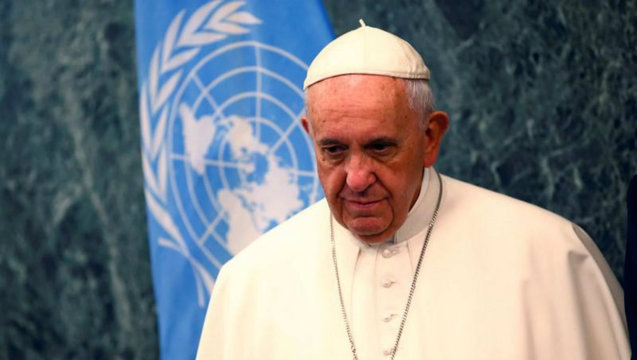
Speaking at the United Nations in New York City (NYC) today Friday, Pope Francis said: “Any harm done to the environment is harm done to humanity.” Moreover, he said: “Every creature has an intrinsic value, in its existence, its life, its beauty and its interdependence with other creatures.”
[Moreover] “We Christians, together with the other monotheistic religions, believe that the universe is the fruit of a loving decision by the Creator, who permits man respectfully to use creation for the good of his fellow men and for the glory of the Creator… he is not authorized to abuse it, much less to destroy it.”
[Furthermore] “In all religions, the environment is a fundamental good”, the pope said, adding that: [A] “selfish and boundless thirst for power and material prosperity leads both to the misuse of available natural resources and to the exclusion of the weak and disadvantaged” and that “the poorest are those who suffer most from such offenses, for three serious reasons: They are cast off by society, forced to live off what is discarded and suffer unjustly from the abuse of the environment.”
“They [the poor] are part of today’s widespread and quietly growing ‘culture of waste.'”, said Pope Francis, speaking in front of UN delegates present for his speech in NYC September 25, 2015.
Following is a transcript of the pope’s speech to the UN, compliments of Democracy NOW!:
Mr President, Ladies and Gentlemen,
Thank you for your kind words. Once again, following a tradition by which I feel honored, the Secretary General of the United Nations has invited the Pope to address this distinguished assembly of nations. In my own name, and that of the entire Catholic community, I wish to express to you, Mr Ban Ki-moon, my heartfelt gratitude. I greet the Heads of State and Heads of Government present, as well as the ambassadors, diplomats and political and technical officials accompanying them, the personnel of the United Nations engaged in this 70th Session of the General Assembly, the personnel of the various programs and agencies of the United Nations family, and all those who, in one way or another, take part in this meeting. Through you, I also greet the citizens of all the nations represented in this hall. I thank you, each and all, for your efforts in the service of mankind.
This is the fifth time that a Pope has visited the United Nations. I follow in the footsteps of my predecessors Paul VI, in1965, John Paul II, in 1979 and 1995, and my most recent predecessor, now Pope Emeritus Benedict XVI, in 2008. All of them expressed their great esteem for the Organization, which they considered the appropriate juridical and political response to this present moment of history, marked by our technical ability to overcome distances and frontiers and, apparently, to overcome all natural limits to the exercise of power. An essential response, inasmuch as technological power, in the hands of nationalistic or falsely universalist ideologies, is capable of perpetrating tremendous atrocities. I can only reiterate the appreciation expressed by my predecessors, in reaffirming the importance which the Catholic Church attaches to this Institution and the hope which she places in its activities.
The United Nations is presently celebrating its seventieth anniversary. The history of this organized community of states is one of important common achievements over a period of unusually fast-paced changes. Without claiming to be exhaustive, we can mention the codification and development of international law, the establishment of international norms regarding human rights, advances in humanitarian law, the resolution of numerous conflicts, operations of peace-keeping and reconciliation, and any number of other accomplishments in every area of international activity and endeavour. All these achievements are lights which help to dispel the darkness of the disorder caused by unrestrained ambitions and collective forms of selfishness. Certainly, many grave problems remain to be resolved, yet it is clear that, without all those interventions on the international level, mankind would not have been able to survive the unchecked use of its own possibilities. Every one of these political, juridical and technical advances is a path towards attaining the ideal of human fraternity and a means for its greater realization.
For this reason I pay homage to all those men and women whose loyalty and self-sacrifice have benefited humanity as a whole in these past seventy years. In particular, I would recall today those who gave their lives for peace and reconciliation among peoples, from Dag Hammarskjöld to the many United Nations officials at every level who have been killed in the course of humanitarian missions, and missions of peace and reconciliation.
Beyond these achievements, the experience of the past seventy years has made it clear that reform and adaptation to the times is always necessary in the pursuit of the ultimate goal of granting all countries, without exception, a share in, and a genuine and equitable influence on, decision-making processes. The need for greater equity is especially true in the case of those bodies with effective executive capability, such as the Security Council, the Financial Agencies and the groups or mechanisms specifically created to deal with economic crises. This will help limit every kind of abuse or usury, especially where developing countries are concerned. The International Financial Agencies are should care for the sustainable development of countries and should ensure that they are not subjected to oppressive lending systems which, far from promoting progress, subject people to mechanisms which generate greater poverty, exclusion and dependence.
The work of the United Nations, according to the principles set forth in the Preamble and the first Articles of its founding Charter, can be seen as the development and promotion of the rule of law, based on the realization that justice is an essential condition for achieving the ideal of universal fraternity. In this context, it is helpful to recall that the limitation of power is an idea implicit in the concept of law itself. To give to each his own, to cite the classic definition of justice, means that no human individual or group can consider itself absolute, permitted to bypass the dignity and the rights of other individuals or their social groupings. The effective distribution of power (political, economic, defense-related, technological, etc.) among a plurality of subjects, and the creation of a juridical system for regulating claims and interests, are one concrete way of limiting power. Yet today’s world presents us with many false rights and – at the same time – broad sectors which are vulnerable, victims of power badly exercised: for example, the natural environment and the vast ranks of the excluded. These sectors are closely interconnected and made increasingly fragile by dominant political and economic relationships. That is why their rights must be forcefully affirmed, by working to protect the environment and by putting an end to exclusion.
First, it must be stated that a true “right of the environment” does exist, for two reasons. First, because we human beings are part of the environment. We live in communion with it, since the environment itself entails ethical limits which human activity must acknowledge and respect. Man, for all his remarkable gifts, which “are signs of a uniqueness which transcends the spheres of physics and biology” (Laudato Si’, 81), is at the same time a part of these spheres. He possesses a body shaped by physical, chemical and biological elements, and can only survive and develop if the ecological environment is favorable. Any harm done to the environment, therefore, is harm done to humanity. Second, because every creature, particularly a living creature, has an intrinsic value, in its existence, its life, its beauty and its interdependence with other creatures. We Christians, together with the other monotheistic religions, believe that the universe is the fruit of a loving decision by the Creator, who permits man respectfully to use creation for the good of his fellow men and for the glory of the Creator; he is not authorized to abuse it, much less to destroy it. In all religions, the environment is a fundamental good (cf. ibid.).
The misuse and destruction of the environment are also accompanied by a relentless process of exclusion. In effect, a selfish and boundless thirst for power and material prosperity leads both to the misuse of available natural resources and to the exclusion of the weak and disadvantaged, either because they are differently abled (handicapped), or because they lack adequate information and technical expertise, or are incapable of decisive political action. Economic and social exclusion is a complete denial of human fraternity and a grave offense against human rights and the environment. The poorest are those who suffer most from such offenses, for three serious reasons: they are cast off by society, forced to live off what is discarded and suffer unjustly from the abuse of the environment. They are part of today’s widespread and quietly growing “culture of waste”.
The dramatic reality this whole situation of exclusion and inequality, with its evident effects, has led me, in union with the entire Christian people and many others, to take stock of my grave responsibility in this regard and to speak out, together with all those who are seeking urgently-needed and effective solutions. The adoption of the 2030 Agenda for Sustainable Development at the World Summit, which opens today, is an important sign of hope. I am similarly confident that the Paris Conference on Climatic Change will secure fundamental and effective agreements.
Solemn commitments, however, are not enough, even though they are a necessary step toward solutions. The classic definition of justice which I mentioned earlier contains as one of its essential elements a constant and perpetual will: Iustitia est constans et perpetua voluntas ius sum cuique tribuendi. Our world demands of all government leaders a will which is effective, practical and constant, concrete steps and immediate measures for preserving and improving the natural environment and thus putting an end as quickly as possible to the phenomenon of social and economic exclusion, with its baneful consequences: human trafficking, the marketing of human organs and tissues, the sexual exploitation of boys and girls, slave labor, including prostitution, the drug and weapons trade, terrorism and international organized crime. Such is the magnitude of these situations and their toll in innocent lives, that we must avoid every temptation to fall into a declarationist nominalism which would assuage our consciences. We need to ensure that our institutions are truly effective in the struggle against all these scourges.
The number and complexity of the problems require that we possess technical instruments of verification. But this involves two risks. We can rest content with the bureaucratic exercise of drawing up long lists of good proposals – goals, objectives and statistical indicators – or we can think that a single theoretical and aprioristic solution will provide an answer to all the challenges. It must never be forgotten that political and economic activity is only effective when it is understood as a prudential activity, guided by a perennial concept of justice and constantly conscious of the fact that, above and beyond our plans and programmes, we are dealing with real men and women who live, struggle and suffer, and are often forced to live in great poverty, deprived of all rights.
To enable these real men and women to escape from extreme poverty, we must allow them to be dignified agents of their own destiny. Integral human development and the full exercise of human dignity cannot be imposed. They must be built up and allowed to unfold for each individual, for every family, in communion with others, and in a right relationship with all those areas in which human social life develops – friends, communities, towns and cities, schools, businesses and unions, provinces, nations, etc. This presupposes and requires the right to education – also for girls (excluded in certain places) – which is ensured first and foremost by respecting and reinforcing the primary right of the family to educate its children, as well as the right of churches and social groups to support and assist families in the education of their children. Education conceived in this way is the basis for the implementation of the 2030 Agenda and for reclaiming the environment.
At the same time, government leaders must do everything possible to ensure that all can have the minimum spiritual and material means needed to live in dignity and to create and support a family, which is the primary cell of any social development. In practical terms, this absolute minimum has three names: lodging, labor, and land; and one spiritual name: spiritual freedom, which includes religious freedom, the right to education and other civil rights.
For all this, the simplest and best measure and indicator of the implementation of the new Agenda for development will be effective, practical and immediate access, on the part of all, to essential material and spiritual goods: housing, dignified and properly remunerated employment, adequate food and drinking water; religious freedom and, more generally, spiritual freedom and education. These pillars of integral human development have a common foundation, which is the right to life and, more generally, what we could call the right to existence of human nature itself.
The ecological crisis, and the large-scale destruction of biodiversity, can threaten the very existence of the human species. The baneful consequences of an irresponsible mismanagement of the global economy, guided only by ambition for wealth and power, must serve as a summons to a forthright reflection on man: “man is not only a freedom which he creates for himself. Man does not create himself. He is spirit and will, but also nature” (BENEDICT XVI, Address to the Bundestag, 22 September 2011, cited in Laudato Si’, 6). Creation is compromised “where we ourselves have the final word… The misuse of creation begins when we no longer recognize any instance above ourselves, when we see nothing else but ourselves” (ID. Address to the Clergy of the Diocese of Bolzano-Bressanone, 6 August 2008, cited ibid.). Consequently, the defense of the environment and the fight against exclusion demand that we recognize a moral law written into human nature itself, one which includes the natural difference between man and woman (cf. Laudato Si’, 155), and absolute respect for life in all its stages and dimensions (cf. ibid., 123, 136).
Without the recognition of certain incontestable natural ethical limits and without the immediate implementation of those pillars of integral human development, the ideal of “saving succeeding generations from the scourge of war” (Charter of the United Nations, Preamble), and “promoting social progress and better standards of life in larger freedom” (ibid.), risks becoming an unattainable illusion, or, even worse, idle chatter which serves as a cover for all kinds of abuse and corruption, or for carrying out an ideological colonization by the imposition of anomalous models and lifestyles which are alien to people’s identity and, in the end, irresponsible.
War is the negation of all rights and a dramatic assault on the environment. If we want true integral human development for all, we must work tirelessly to avoid war between nations and between peoples.
To this end, there is a need to ensure the uncontested rule of law and tireless recourse to negotiation, mediation and arbitration, as proposed by the Charter of the United Nations, which constitutes truly a fundamental juridical norm. The experience of these seventy years since the founding of the United Nations in general, and in particular the experience of these first fifteen years of the third millennium, reveal both the effectiveness of the full application of international norms and the ineffectiveness of their lack of enforcement. When the Charter of the United Nations is respected and applied with transparency and sincerity, and without ulterior motives, as an obligatory reference point of justice and not as a means of masking spurious intentions, peaceful results will be obtained. When, on the other hand, the norm is considered simply as an instrument to be used whenever it proves favorable, and to be avoided when it is not, a true Pandora’s box is opened, releasing uncontrollable forces which gravely harm defenseless populations, the cultural milieu and even the biological environment.
The Preamble and the first Article of the Charter of the United Nations set forth the foundations of the international juridical framework: peace, the pacific solution of disputes and the development of friendly relations between the nations. Strongly opposed to such statements, and in practice denying them, is the constant tendency to the proliferation of arms, especially weapons of mass distraction, such as nuclear weapons. An ethics and a law based on the threat of mutual destruction – and possibly the destruction of all mankind – are self-contradictory and an affront to the entire framework of the United Nations, which would end up as “nations united by fear and distrust”. There is urgent need to work for a world free of nuclear weapons, in full application of the non-proliferation Treaty, in letter and spirit, with the goal of a complete prohibition of these weapons.
The recent agreement reached on the nuclear question in a sensitive region of Asia and the Middle East is proof of the potential of political good will and of law, exercised with sincerity, patience and constancy. I express my hope that this agreement will be lasting and efficacious, and bring forth the desired fruits with the cooperation of all the parties involved.
In this sense, hard evidence is not lacking of the negative effects of military and political interventions which are not coordinated between members of the international community. For this reason, while regretting to have to do so, I must renew my repeated appeals regarding to the painful situation of the entire Middle East, North Africa and other African countries, where Christians, together with other cultural or ethnic groups, and even members of the majority religion who have no desire to be caught up in hatred and folly, have been forced to witness the destruction of their places of worship, their cultural and religious heritage, their houses and property, and have faced the alternative either of fleeing or of paying for their adhesion to good and to peace by their own lives, or by enslavement.
These realities should serve as a grave summons to an examination of conscience on the part of those charged with the conduct of international affairs. Not only in cases of religious or cultural persecution, but in every situation of conflict, as in Ukraine, Syria, Iraq, Libya, South Sudan and the Great Lakes region, real human beings take precedence over partisan interests, however legitimate the latter may be. In wars and conflicts there are individual persons, our brothers and sisters, men and women, young and old, boys and girls who weep, suffer and die. Human beings who are easily discarded when our only response is to draw up lists of problems, strategies and disagreements.
As I wrote in my letter to the Secretary-General of the United Nations on 9 August 2014, “the most basic understanding of human dignity compels the international community, particularly through the norms and mechanisms of international law, to do all that it can to stop and to prevent further systematic violence against ethnic and religious minorities” and to protect innocent peoples.
Along the same lines I would mention another kind of conflict which is not always so open, yet is silently killing millions of people. Another kind of war experienced by many of our societies as a result of the narcotics trade. A war which is taken for granted and poorly fought. Drug trafficking is by its very nature accompanied by trafficking in persons, money laundering, the arms trade, child exploitation and other forms of corruption. A corruption which has penetrated to different levels of social, political, military, artistic and religious life, and, in many cases, has given rise to a parallel structure which threatens the credibility of our institutions.
I began this speech recalling the visits of my predecessors. I would hope that my words will be taken above all as a continuation of the final words of the address of Pope Paul VI; although spoken almost exactly fifty years ago, they remain ever timely. “The hour has come when a pause, a moment of recollection, reflection, even of prayer, is absolutely needed so that we may think back over our common origin, our history, our common destiny. The appeal to the moral conscience of man has never been as necessary as it is today… For the danger comes neither from progress nor from science; if these are used well, they can help to solve a great number of the serious problems besetting mankind (Address to the United Nations Organization, 4 October 1965). Among other things, human genius, well applied, will surely help to meet the grave challenges of ecological deterioration and of exclusion. As Paul VI said: “The real danger comes from man, who has at his disposal ever more powerful instruments that are as well fitted to bring about ruin as they are to achieve lofty conquests” (ibid.).
The common home of all men and women must continue to rise on the foundations of a right understanding of universal fraternity and respect for the sacredness of every human life, of every man and every woman, the poor, the elderly, children, the infirm, the unborn, the unemployed, the abandoned, those considered disposable because they are only considered as part of a statistic. This common home of all men and women must also be built on the understanding of a certain sacredness of created nature.
Such understanding and respect call for a higher degree of wisdom, one which accepts transcendence, rejects the creation of an all-powerful elite, and recognizes that the full meaning of individual and collective life is found in selfless service to others and in the sage and respectful use of creation for the common good. To repeat the words of Paul VI, “the edifice of modern civilization has to be built on spiritual principles, for they are the only ones capable not only of supporting it, but of shedding light on it” (ibid.).
El Gaucho Martín Fierro, a classic of literature in my native land, says: “Brothers should stand by each other, because this is the first law; keep a true bond between you always, at every time – because if you fight among yourselves, you’ll be devoured by those outside”.
The contemporary world, so apparently connected, is experiencing a growing and steady social fragmentation, which places at risk “the foundations of social life” and consequently leads to “battles over conflicting interests” (Laudato Si’, 229).
The present time invites us to give priority to actions which generate new processes in society, so as to bear fruit in significant and positive historical events (cf. Evangelii Gaudium, 223). We cannot permit ourselves to postpone “certain agendas” for the future. The future demands of us critical and global decisions in the face of world-wide conflicts which increase the number of the excluded and those in need.
The praiseworthy international juridical framework of the United Nations Organization and of all its activities, like any other human endeavor, can be improved, yet it remains necessary; at the same time it can be the pledge of a secure and happy future for future generations. And so it will, if the representatives of the States can set aside partisan and ideological interests, and sincerely strive to serve the common good. I pray to Almighty God that this will be the case, and I assure you of my support and my prayers, and the support and prayers of all the faithful of the Catholic Church, that this Institution, all its member States, and each of its officials, will always render an effective service to mankind, a service respectful of diversity and capable of bringing out, for sake of the common good, the best in each people and in every individual.
Upon all of you, and the peoples you represent, I invoke the blessing of the Most High, and all peace and prosperity. Thank you.
Source: Democracy NOW!
The Pope Speaks to Congress about Climate Change, Refugees, Cuba & “Money that is Drenched in Blood”

Pope Francis Thursday became the first Pope to ever address a joint session of Congress. Below are some key passages from the Pope’s speech, compliments of Democracy NOW!:
On Four Great Americans
A nation can be considered great when it defends liberty as [Abraham] Lincoln did, when it fosters a culture which enables people to “dream” of full rights for all their brothers and sisters, as Martin Luther King sought to do; when it strives for justice and the cause of the oppressed, as Dorothy Day did by her tireless work, the fruit of a faith which becomes dialogue and sows peace in the contemplative style of Thomas Merton.
On Dorothy Day
In these times when social concerns are so important, I cannot fail to mention the Servant of God Dorothy Day, who founded the Catholic Worker Movement. Her social activism, her passion for justice and for the cause of the oppressed, were inspired by the Gospel, her faith, and the example of the saints.
On Refugees & Immigration
Our world is facing a refugee crisis of a magnitude not seen since the Second World War. This presents us with great challenges and many hard decisions. On this continent, too, thousands of persons are led to travel north in search of a better life for themselves and for their loved ones, in search of greater opportunities. Is this not what we want for our own children? We must not be taken aback by their numbers, but rather view them as persons, seeing their faces and listening to their stories, trying to respond as best we can to their situation. To respond in a way which is always humane, just and fraternal. We need to avoid a common temptation nowadays: to discard whatever proves troublesome. Let us remember the Golden Rule: “Do unto others as you would have them do unto you.”
On the Arms Trade
Why are deadly weapons being sold to those who plan to inflict untold suffering on individuals and society? Sadly, the answer, as we all know, is simply for money: money that is drenched in blood, often innocent blood. In the face of this shameful and culpable silence, it is our duty to confront the problem and to stop the arms trade.
On Climate Change
In Laudato Si’, I call for a courageous and responsible effort to “redirect our steps” and to avert the most serious effects of the environmental deterioration caused by human activity. I am convinced that we can make a difference and I have no doubt that the United States – and this Congress – have an important role to play. Now is the time for courageous actions and strategies, aimed at implementing a “culture of care” and “an integrated approach to combating poverty, restoring dignity to the excluded, and at the same time protecting nature.”
On Finance Capital
If politics must truly be at the service of the human person, it follows that it cannot be a slave to the economy and finance. Politics is, instead, an expression of our compelling need to live as one, in order to build as one the greatest common good: that of a community which sacrifices particular interests in order to share, in justice and peace, its goods, its interests, its social life. I do not underestimate the difficulty that this involves, but I encourage you in this effort.
On The Death Penalty
The Golden Rule also reminds us of our responsibility to protect and defend human life at every stage of its development. This conviction has led me, from the beginning of my ministry, to advocate at different levels for the global abolition of the death penalty. I am convinced that this way is the best, since every life is sacred, every human person is endowed with an inalienable dignity, and society can only benefit from the rehabilitation of those convicted of crimes. Recently my brother bishops here in the United States renewed their call for the abolition of the death penalty. Not only do I support them, but I also offer encouragement to all those who are convinced that a just and necessary punishment must never exclude the dimension of hope and the goal of rehabilitation.
On Cuba
I would like to recognize the efforts made in recent months to help overcome historic differences linked to painful episodes of the past. It is my duty to build bridges and to help all men and women, in any way possible, to do the same. When countries which have been at odds resume the path of dialogue – a dialogue which may have been interrupted for the most legitimate of reasons – new opportunities open up for all. This has required, and requires, courage and daring, which is not the same as irresponsibility.
Humanity Is ‘Racing Extinction’ (And We’re Losing)

The new documentary “Racing Extinction” goes undercover to the edge of mass extinction in the world’s darkest black markets.
“In 2009, audiences around the world were blown away by a documentary by Louie Psihoyos called “The Cove.” It showed the horrifying secret mass slaughter of dolphins in Japan and the sale of mercury-laden dolphin meat to school children. Won an Oscar. Now Psihoyos has taken his cameras global, and the picture is brutal again. Species falling into oblivion under the pressure of manmade climate change. Some hunted and torn to shreds for gills and fins. A “great extinction.” It’s a powerful call to act, and act fast.”
– Tom Ashbrook, National Public Radio’s “On Point”, aired 9-21-2015, 11:00 am – 12:00 noon, (Eastern).
New York Times: ‘Racing Extinction’ Charts the Slaughter of Vital Species – “Noting that our planet’s five major extinctions had in common a spike in carbon dioxide, Mr. Psihoyos worries that the emissions of our own age, aptly dubbed the Anthropocene, are damaging our oceans in ways that are mostly invisible. And that the devastating consequences of more direct human behaviors — like the mass slaughter of exotic marine life for food and folk medicines — are also largely overlooked.”
Bangladesh – 30 Million People Will Need to Relocate with One Meter Rise in Sea Level

Hear Beatle George Harrison perform song “Bangladesh” at the 1971 Concert for Bangladesh at Madison Square Garden, NYC, New York.
By Bangladesh Prime Minister Sheikh Hasina, 9-19-2015:
In just a few weeks, the world will adopt the 2030 Agenda for Sustainable Development. For my country, Bangladesh, the goal of combating climate change and its impacts is crucial, as we are on the frontline of this global threat.
Bangladesh is one of the most densely populated countries in the world (1,218 people per sq km), with the lowest quantity of per-capita arable land (0.05 hectares). Although we made considerable progress on the Millennium Development Goals (MDGs), climate change in the form of extreme-weather events, tidal surges, and erratic rainfall has negatively impacted agricultural production, industrial development and social structures.
This can create millions of environmental refugees, even though Bangladesh’s contribution to climate change in terms of greenhouse-gas emissions is negligible. And the situation will worsen without urgent action. Studies estimate that a meter rise in sea level would submerge one fifth of the country, displacing over 30 million people. Mass migration to cities is inevitable, impacting livelihoods, biodiversity, food, water, sanitation and basic infrastructure.
That is why we are keen to see the Sustainable Development Goals (SDGs), and the upcoming climate agreement in Paris, adopted and moving into implementation. But Bangladesh has not been sitting around waiting for the world to save us. We are fighting for our own future, albeit with limited resources and technologies.
In 2011, we amended the constitution to protect and improve the environment and preserve and safeguard natural resources, biodiversity, wetlands, forests and wildlife for present and future citizens. In line with this policy, at least eight new laws were enacted or amended since 2009 to preserve forest lands in the country. Forest coverage rose to 17.08 percent in 2014-15 from a mere seven to eight percent in 2005-06, thanks to the introduction of initiatives such as the Social Afforestation Program, which ensures people’s participation in planting and raising trees in every available space, both urban and rural. Currently, more than 120 million saplings are raised and distributed every year among the people, compared to 40 million in 2001-2006.
Bangladesh was the first developing nation to create a Climate Change Strategy and Action Plan. From 2009-2010 to 2014-15, the government allocated Tk 30.30 billion (US$ 385 million) to our climate-change trust fund. All of our activities have been targeted toward adaptation to environmental changes with a view to protecting human lives from floods and hurricanes, and protecting the environment from pollution caused by rapid urbanization and unsustainable industrialization.
There are so many examples of specific actions we undertook as part of our policy framework. We have built about four million solar-home systems in off-grid areas and 1.5 million improved cook stoves to decrease indoor air pollution.
We created the Coastal Greenbelt Project to protect the southern part of Bangladesh, which is surrounded by the Bay of Bengal, from cyclones. Dense forest covers along the coastline, particularly mangroves, form an effective buffer. By boosting this cover, we helped reduce the death toll to about 200 from the hurricanes Aila in 2009 and Mahasen in 2013 combined, compared to 140,000 in a single cyclone in 1991.
We have also made remarkable progress in food production. Bangladesh has become a food-exporting country from a food-importing country over the last six years. Our scientists have developed almost 200 varieties of crops that are resilient to changing climactic conditions and techniques to grow crops in less fertile soil. Rice production was 33.30 million metric tons in 2008-09. It was 38.34 million metric tons in 2013-14.
Despite these efforts, climate change continues to affect the lives and livelihoods of millions in our unique and active delta. This year, we experienced 50 percent more rainfall than average, inundating vast areas of the country and damaging crops. Climate change may threaten our wheat and major rice-crop (Boro) production. Studies suggest that two to three percent of our Gross Domestic Product may be wiped out because of climate change.
We cannot do it alone, which is why we need the international community to stand up for nations such as ours through the SDGs and the climate-change process. In order to address climate change, a critical balance between adaptation (adjusting to the impacts of climate change) and mitigation (reducing the scale of climate change) will have to be maintained. The pledges on reducing emissions submitted for the Paris climate meeting must be measurable and verifiable. The world should pay attention to carbon budgeting and de-carbonization pathways. For adaptation planning, adequate and predictable financing is essential.
Bangladesh has been leading by example, and we are ready to share our experiences on climate resilience with rest of the world. I hope that the United Nations Environment Program honoring me with the Champions of the Earth award this year will draw attention to Bangladesh’s efforts, which show that we can make a difference, and encourage developed nations to bring their resources to bear on the greatest challenge of our time.
NASA: Sea Level Rise of Several Feet is UNAVOIDABLE!

[Tide gauges have been used to measure sea level for more than 130 years. Satellite measurements now complement the historical record. (NASA Earth Observatory image by Joshua Stevens, based on data from the Commonwealth Scientific and Industrial Research Organization and NOAA)]
For thousands of years, sea level has remained relatively stable and human communities have settled along the planet’s coastlines. But now Earth’s seas are rising. Globally, sea level has risen about eight inches since the beginning of the 20th century and more than two inches in the last 20 years alone. According to the federal National Aeronautics and Space Administration (NASA), “all signs suggest that this rise is accelerating”.
Seas around the world have risen an average of nearly 3 inches since 1992, with some locations rising more than 9 inches due to natural variation, according to the latest satellite measurements from NASA and its partners. An intensive research effort now underway, aided by NASA observations and analysis, points to “an unavoidable rise of several feet in the future”.
“Sea level rise is a natural [physical] consequence of the warming of our planet”, states NASA’s press release dated August 26, 2015. “We know this from basic physics. When water heats up, it expands. So when the ocean warms, sea level rises. When ice is exposed to heat, it melts. And when ice on land melts and water runs into the ocean [water from unprecedented ice and snow melt off Antarctica, Greenland, land areas north of permafrost region in Northern Hemisphere, mountainous glaciers receding, worldwide] sea level rises”.
As the ocean has warmed, polar ice has melted, and porous landmasses have subsided, global mean sea level has risen by 8 inches (20 centimeters) since 1870. The rate of sea level rise is faster now than at any time in the past 2,000 years, and that rate has doubled in the past two decades.
While NASA and other agencies continue to monitor the warming of the ocean and changes to the planet’s land masses, the biggest concern is what will happen to the ancient ice sheets covering Greenland and Antarctica, which continue to send out alerts that a warming planet is affecting their stability.
NASA has been recording the height of the ocean surface from space since 1992, recording about 2.9 inches (7.4 centimeters) of sea level rise averaged for all the oceans in that 23 year period.
In 2002, NASA and the German space agency launched the Gravity Recovery and Climate Experiment (GRACE) twin satellites, capable of measuring the movement of mass, hence gravity, around Earth at intervals of every 30 days. GRACE has found that earth’s land masses move very little in a month; however, earth’s water masses move through melting, evaporation, precipitation and other processes. GRACE records these movements of water around the planet, while a new NASA network of more than 3,000 floating ocean sensors spread across the entire open ocean supplement that ocean water level data.
Observations from the new NASA ocean level data collection systems have revolutionized scientists’ understanding of contemporary sea level rise and its causes. NASA’s newest release state that: “We know that today’s sea level rise is about one-third the result of the warming of existing ocean water, with the remainder coming from melting land ice”, adding that “currently, regional differences in sea level rise are dominated by the effects of ocean currents and well known cycles, such as the Pacific Ocean’s El Niño phenomenon and the Pacific Decadal Oscillation.” But as the ice sheets located closer to the poles of the planet (which receive less direct solar radiation due to the tilting of the planet as it orbits the Sun), and the once “permanent” ice located at higher elevations around the world continues to melt as a direct result of measurably warming temperatures occurring as a direct consequence of a stronger greenhouse effect that is already unnaturally high due to human activities such as fossil fuel burning, deforestation, and paving over the earth’s still green landscape. NASA scientists now predict that the increasing meltwater resulting from the stronger greenhouse effect will overtake the formerly natural causes of regional variations of the ocean water levels and be the most significant contributor to the overall rise in sea level.
The recent advances in observing the world’s frozen regions using satellite measurements from NASA and its participating organizations have allowed scientists to accurately estimate annual ice losses from Greenland and Antarctica. Not only can they now determine how much sea level around the world is changing – as measured by satellite for the past 23 years – but they can also determine how much of the sea level rise is being caused by our warming of the earth’s biosphere, which includes both the atmosphere at or near the surface, the oceans, the land surface, and the biota (plant and animal kingdoms) that all together comprise earth’s biosphere.
GRACE’s record, spanning over the last decade, shows that the ice loss around the planet is now accelerating in Greenland and West Antarctica. The record shows Greenland has shed on average 303 gigatons of ice every year since 2004, while Antarctica has lost on average 118 gigatons of ice per year. Much of Antarctica’s ice loss has been shown to come from West Antarctica’s ice loss. Greenland’s ice loss has accelerated by 31 gigatons of ice per year, every year since 2004, while West Antarctica’s ice loss has accelerated to 28 gigatons per year.
“Given what we know now about how the ocean expands as it warms and how ice sheets and glaciers are adding water to the seas, it’s pretty certain we are locked into at least 3 feet of sea level rise and probably more,” said Steve Nerem of the University of Colorado, Boulder, and lead of NASA’s new Sea Level Change Team.
The Greenland Ice Sheet, spanning 660,000 square miles (an area almost as big as Alaska), and with a thickness at its highest point of almost 2 miles, has the potential to raise the world’s oceans by more than 20 feet. Situated in the Arctic, which is warming at twice the rate of the rest of the planet, Greenland has been shedding more ice in the summer than it gains back in the winter since 1992.
“In Greenland, everything got warmer at the same time: the air, the ocean surface, the depths of the ocean,” said Ian Joughin, a glaciologist at University of Washington. “We don’t really understand which part of that warming is having the biggest effect on the glaciers.”
What scientists do know is that warming Arctic temperatures – and a darkening surface of the Greenland ice sheet – are causing so much summer melting that it is now the dominant factor in Greenland’s contribution to sea level rise.
NASA has found that Greenland’s summer melt season now lasts 70 days longer than it did in the early 1970s. Every summer, warmer air temperatures cause melt over about half of the surface of the ice sheet – although recently, 2012 saw an extreme event where 97 percent of the ice sheet experienced melt at its top layer.
Greenland’s massive glaciers have sped up, too. Though many of the glaciers in the southeast, west and northwest of the island – an area that experienced quick thinning from 2000 to 2006 – have now slowed down, the melting rate at other areas Greenland’s massive ice sheet has not slowed. A study last year showed that the northeast Greenland ice stream had increased its ice loss rate due to warmer air temperatures.
“The early 2000s was when some big things revealed themselves, such as when we saw the fastest glacier we knew of, the Jakobshavn ice stream in Greenland, double its speed,” said Waleed Abdalati, director of the Cooperative Institute for Research in Environmental Sciences, Boulder, Colorado, and former NASA chief scientist. “The subsequent surprise was that these changes could be sustained for a decade – Jakobshavn is still going fast”, Abdalati said.
The Antarctic Ice Sheet covers nearly 5.4 million square miles, and area larger than the United States and India combined, and contains enough ice to raise the ocean level by about 190 feet. The Transantarctic Mountains split Antarctica in two major regions: West Antarctica and the much larger East Antarctica.
Though Antarctica’s contribution to sea level rise is still at less than 0.02 inches (0.5 millimeters) per year, several events over the past decade and a half have prompted experts to start warning about the possibility of more rapid changes this century.
The mountainous horn of the continent, the Antarctic Peninsula, gave one of the earliest warnings on the impact of a changing climate in Antarctica when warm air and warmer ocean temperatures led to the dramatically fast breakup of the Larsen B ice shelf in 2002. In about a month, 1,250 square miles of floating ice that had been stable for over 10,000 years were gone. In the following years, other ice shelves in the Peninsula, including the last remainder of Larsen B, collapsed, speeding up in the flow of the land lying glaciers that they were buttressing against the warming ocean.
In 2014, two studies focusing on the acceleration of the glaciers in the Amundsen Sea sector of West Antarctica showed that its collapse is currently well underway. And while one of the studies speculated that the demise of the ice overlaying West Antarctica could take as long as 200 to 1,000 years, depending on how rapidly the ocean heats up, both studies concurred that its collapse is already unstoppable, and that when it does collapse, the melt water will add up to 12 feet of sea level rise to the oceans.
The wind is also a factor in determining the timing of West Antarctica’s collapse. The “westerlies”, the winds that spin the ocean waters around Antarctica, are known to have intensified during the last decade, pushing the cold top layer away from the land, and thus allowing the warmer, deeper waters to rise and spill over the border of the continental shelf, flowing all the way back to the base of many of the ice shelves jetting out from the continent. As the ice shelves weaken from underneath, the glaciers behind them are predicted to speed up.
East Antarctica’s massive ice sheet, as vast as the lower continental U.S., remains an unknown in projections of sea level rise. Though it appears to be stable, a recent study on Totten Glacier, East Antarctica’s largest and most rapidly thinning glacier, hints otherwise. Research found two deep troughs that could lead warm ocean water to the base of the glacier and melt it in a similar way to what’s happening to the glaciers in West Antarctica. Other sectors grounded below sea level, such as the Cook Ice Shelf, Ninnis, Mertz and Frost glaciers, have also been found to be losing mass.
For the West Antarctic Ice Sheet, which largely rests on a bed that lies below sea level, the main driver of ice loss is the ocean. The waters of the Southern Ocean are layered: on top and at the bottom, the temperatures are frigid, but the middle layer is warm. The westerlies, the winds that spin the ocean waters around Antarctica, have intensified during the last decade, pushing the cold top layer away from the land. This allows the warmer, deeper waters to rise and spill over the border of the continental shelf, flowing all the way back to the base of many ice shelves. As the ice shelves weaken from underneath, the glaciers behind them speed up.
East Antarctica’s massive ice sheet, as vast as the lower continental U.S., remains the main unknown in projections of sea level rise. Though it appears to be stable, a recent study on Totten Glacier, East Antarctica’s largest and most rapidly thinning glacier, hints otherwise. The research found two deep troughs that could lead warm ocean water to the base of the glacier and melt it in a similar way to what’s happening to the glaciers in West Antarctica. Other sectors grounded below sea level, such as the Cook Ice Shelf, Ninnis, Mertz and Frost glaciers, are also losing mass.
Thanks to a Corporation-compliant Mass Media and Press in the United States: the American People, their Representatives in the Congress, and a Majority of State Legislatures and Governors in the U. S. Have Clearly Been Duped by the Many of the Fossil Fuel Dependent Industries and their Lobbyists into Not Taking Global Warming Seriously Enough

Hurricane Katrina, Late August, 2005
According to scientists who have studied and documented the causes and effects of changes in climates at various locations around the world, there has never been a time in Earth’s history during which climates around the world; ocean levels, temperatures, and chemistry; wildlife territorial changes and atmospheric properties have occurred so rapidly and so significantly as to create significant levels of concern to human the world over. The United Nations Intergovernmental Panel of Climate Change, made up of hundreds of the world’s most respected scientists predicts much more rapid global warming in the coming decades today if we humans collectively continue doing what we have done in the recent past – burning increased amounts of fossil fuels, destroying more and more forests in the name of economic “progress”, and we continue living “high on the hog” under the mantra of “business as usual”.
Volunteer host Esty Dinur of WORT-FM Community Radio Station in Madison, Wisconsin talked with climatologist Michael E. Mann and journalist John H. Richardson on the station’s “A Public Affair” Friday, August 21, 2015, from noon to 1:00 PM.
Dr. Michael E. Mann is Distinguished Professor of Meteorology at Penn State University, with joint appointments in the Department of Geosciences and the Earth and Environmental Systems Institute, and is the director of the Penn State Earth System Science Center. He is also the author of more than 180 peer reviewed and edited publications, and has published two books including Dire Predictions: Understanding Global Warming and The Hockey Stick and the Climate Wars: Dispatches from the Front Lines. He is also a co-founder of the award-winning science website RealClimate.org.
John H. Richardson is a writer and journalist for Esquire Magazine. He has also worked with The Albuquerque Tribune, The Los Angeles Daily News, Premiere Magazine, New York Magazine. He has taught at the Columbia University, the University of New Mexico, and Purchase College. He recently published an article in Esquire Magazine that looks into numerous climatologists’ research and the backlash that they received from various climate change “deniers”.
Today’s politicians in the U.S. Congress, State Legislators and governors’ offices who have continued to downplay the significance of global warming and excessive fossil fuel burning despite what has now become eminent, regrettably, deserve outright shaming, especially by children and those yet to be born into the world of global warming, climate havoc, disruption of plant and animal life, and global economic instability, overpopulation and extinction.
Listen to the entire 1-hour program.
When the End of Human Civilization Is Your Day Job
Among many climate scientists, gloom has set in. Things are worse than we think, but they can’t really talk about it.
Message to Obama on Fighting Poverty and Global Warming

Fight Poverty and Global Warming at the Same Time
I sent the following message to President Obama using Greenpeace’s petition letter as a template on Monday, August 17, 2015:
Dear President Obama,
You have declared that “No challenge poses a greater threat to future generations than climate change” and showed leadership in vetoing the Keystone XL pipeline bill. Why then, would you allow Shell to drill in Arctic waters after a Nature study declared that Arctic Oil MUST be kept in the ground to prevent catastrophic climate change?
One solution that has not been paid enough attention to is to reduce the demand for oil by offering the American public financial incentives to annually drive less (miles); avoid flying entirely, and reduce the amount of electricity they use annually in their homes. This proposal would benefit those who don’t add to the greenhouse gas burden on the atmosphere and oceans and cause other forms of pollution related to fossil fuel burning (including the need to drill and ship oil from the Arctic), who are often those in our society who need supplemental income the most to get out of poverty. Make it pay not to pollute! Right now, too many Americans are using the atmosphere as a “free” sewer to deposit their emissions from excessive burning of fossil fuels, often for recreational travel or other forms of entertainment (travel to “away” sporting events …). See proposal at http://www.allthingsenvironmental.com for more information.
Arctic oil must be left in the ground in order to avoid the catastrophic effects of climate change. The risks are simply too great to allow drilling in this fragile and important ecosystem.
See NASA’s “Vital Signs of the Planet”.
President Obama Gives Reasons Going to Arctic
President Obama:
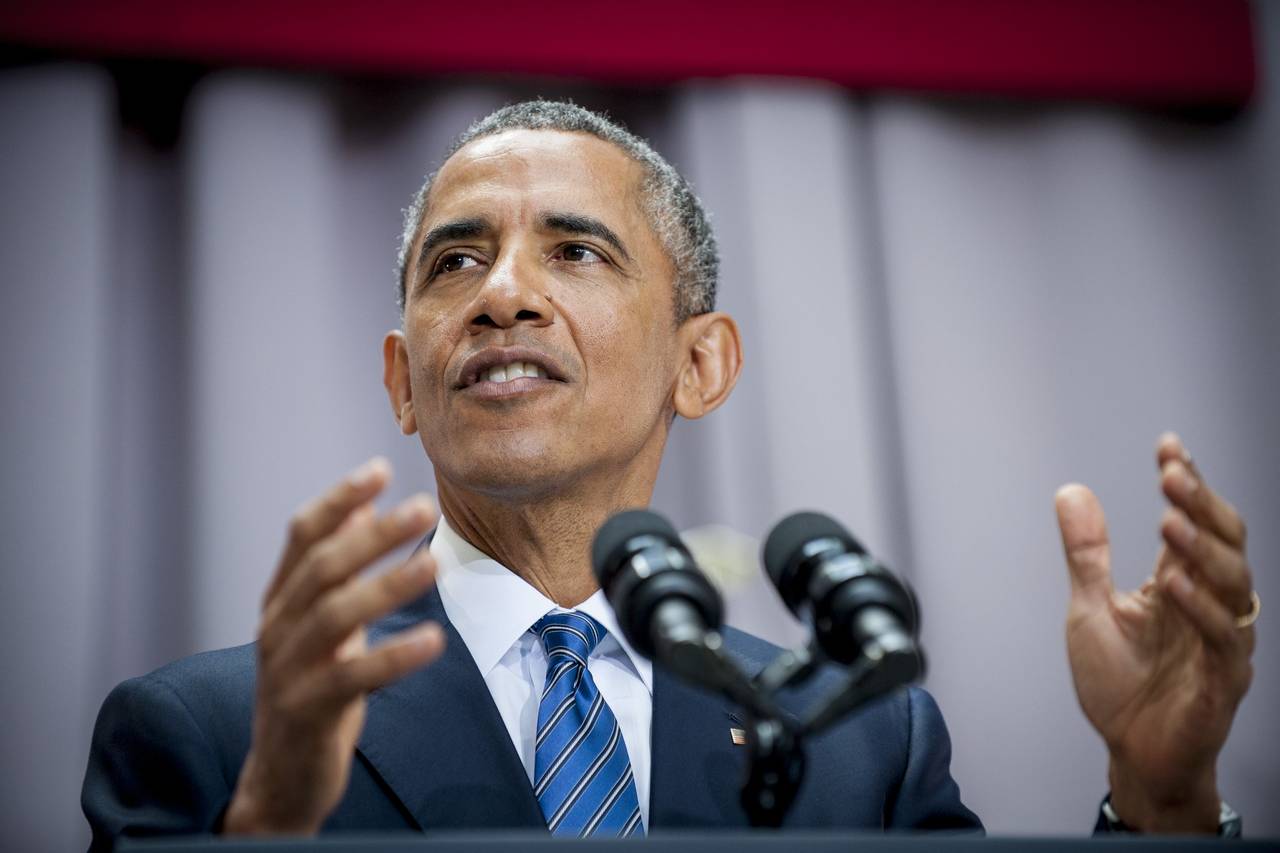
PHOTO: PETE MAROVICH/ZUMA PRESS
President Obama giving a speech at American University, August 5, Washington D.C..
Later this month, President Obama will travel to Alaska and shine a spotlight on what Alaskans in particular have come to know: Climate change is one of the biggest threats we face, it is being driven by human activity, and it is disrupting Americans’ lives right now. [White House]
Can A Global Warming Calamity Be Averted?

“Unless someone like you cares a whole awful lot,
Nothing is going to get better. It’s not.”
― Dr. Seuss, The Lorax
Global warming is often wrongly said to be a political issue. In fact, global warming is no more of a political issue than a tornado is a political issue, or an erupting volcano, or an earthquake or tsunami. These are factual occurrences that occur for known scientific reasons. As there is no debate on the existence or occurrence of these physical happenings nor should there be a need to debate the occurrence of human-caused global warming and climate change as these changes are, too, scientifically based and measured. In fact, sea level has already begun to rise from global warming, measurably. Migratory bird species are changing their patterns and timing of flight; temperature gradients for gardening around the world have changed; heat wave death tolls have risen; extreme weather has become more extreme; average monthly air temperatures at the surface have been steadily rising; dewpoint temperatures in the Midwest have exceeded precedence. Time is running out run out for acting responsibly to avert the worst outcomes possible from global warming. Alarm bells have rung. Action must be taken now, and on a grand scale, to prevent what scientists have been predicting for decades now – the catastrophic consequences of human fed global warming.
Longtime and well respected University of Wisconsin-Madison Chemistry Professor Bassam Shakhashiri recently summarized on Wisconsin Public Radio his own perceptions of the seriousness of the global warming threat and our collective responsibilities as citizens to work towards mitigating and adapting to this monumental threat as follows:
“We should have high expectation of all our government agencies and we should have high expectations of our elected officials and we should have high expectations of everyone who cares about the quality of life of where we live. We face grand challenges. Global warming is unequivocal. It’s not a matter of voting whether we will have global warming or not. It’s a matter of who we elect in the next election cycle to take responsible action to address and to solve this very, very serious and highly consequential question of climate change.
“We have elected officials from our state of Wisconsin who engage in conversations that label other people as deniers of climate change. I think it behooves us as learned individuals, as people who care about the quality of life that we have, to elect individuals to the U.S. Senate to the presidency, to our local government, who can take responsible action to mitigate and to address in responsible ways, and “responsible” is crucial, global warming. It’s not just local here. You can look at different displays of information. In the past 25 years, the plant hardening zones have been changing. Just in the past 25 years, the zone that we are in Wisconsin, is what it was 25 years ago in Florida. We have issues that relate to water quality. We have issues that relate to wellness, to health care.
“We have fabulous opportunities to make great progress in our society, and that’s why I have high expectations – always have high expectations – but I also live in the real world. We must, in the upcoming election cycle, be truly faithful to our core beliefs and to our values, so that our elected officials can act and can respond, in most good ways, to this one issue of climate change. There are other issues, too, but this is really a critical one.” [The Larry Meiller Show,Thursday, August 6, 2015, 11:00 am]
Global warming has all the marking of becoming a worldwide economic, environmental and human disaster. It could be a disaster that has no precedent in nature, at least during the time humans have been inhabiting Earth. Scientific models have demonstrated the inevitably of global warming due to our relentless burning of fossil fuels, in almost every device possible, and our continued deforestation practices, particularly in the tropics. Should global warming be allowed to continue at the current rates, the death toll from global warming effects could ultimately exceed the number of human losses from all wars, human atrocities, motor vehicle crashes, airplane crashes and worldwide epidemics.
History is repleat with examples of being “too little, too late”. U.S. President Hoover’s attempts to end the Great Depression by funding the construction of the Hoover Dam were believed by the American public as being “too little” to save the U.S. economy and “too late”. He was soundly defeated in the U.S. presidential election by Franklin Delano Roosevelt.
In medicine, if someone is sick and they do not get to a doctor until their sickness becomes fatal any remedy will be “too little, too late”.
The Obama administration’s Clean Power Plan to reduce global warming is also both too little and too late to prevent what scientists call a “runaway greenhouse effect”, as what happen on the planet Venus eons ago, making the planet’s former oceans of water boil away, due to surface atmospheric temperatures that continued to climb, unabated.
While the U.S. electrical energy power production may be the top emitting sector of greenhouse gases (GHGs) in the U.S. economy, timely and sufficiently large GHGs emissions reductions in the transportation and other GHG emitting sectors (construction industry sector, agriculture industry sector, consumer sector, export/import sectors, the military industrial complex) will nullify any gains made in the electricity production sector. This could leave the planet vulnerable for the positive GHG feedback mechanisms that contribute to more global warming to kick-in, which could cause a runaway greenhouse effect on Earth. Examples of positive feedback to more global warming of Earth include a reduced ability of the Arctic Ocean to reflect solar energy back into space (darker water absorbs more solar energy than snow and ice), causing additional heating of the oceans; melting of the permafrost region (1/5 of the earth’s surface) resulting in more methane gas (a much stronger GHG than carbon dioxide) production.
Albert Einstein once remarked: “We can’t solve problems by using the same kind of thinking we used when we created them.” Offering the public positive financial incentives to reduce actions that emit greenhouse gases, such as driving, flying and using fossil fuel created heat and electricity, could drastically reduce human caused climate change and as well as other problems created by our fossil fuel powered economy (such as oil spills, ground water pollution from petroleum waste, and natural gas explosions).
‘Godzilla El Niño’ Predicted for West Coast in Late Fall or Early Winter

The strengthening El Niño in the Pacific Ocean has the potential to become one of the most powerful on record, as warming ocean waters surge toward the Americas, setting up a pattern that could bring once-in-a-generation storms this winter to drought-parched California, the Los Angeles Times reported Thursday.
The National Weather Service’s Climate Prediction Center said Thursday that all computer models are predicting a strong El Niño to peak in the late fall or early winter. A host of observations have led scientists to conclude that “collectively, these atmospheric and oceanic features reflect a significant and strengthening El Niño.”
“This definitely has the potential of being the Godzilla El Niño,” said Bill Patzert, a climatologist with NASA’s Jet Propulsion Laboratory in La Cañada Flintridge.
Patzert said El Niño’s signal in the ocean “right now is stronger than it was in 1997,” the summer in which the most powerful El Niño on record developed.
“Everything now is going to the right way for El Niño,” Patzert said. “If this lives up to its potential, this thing can bring a lot of floods, mudslides and mayhem.”
“This could be among the strongest El Niños in the historical record dating back to 1950,” said Mike Halpert, deputy director of the Climate Prediction Center.
After the summer 1997 El Niño muscled up, the following winter gave Southern California double its annual rainfall and dumped double the snowpack in the Sierra Nevada, an essential source of precipitation for the state’s water supply, Patzert said.
The mass of warm water in the Pacific Ocean is also bigger and deeper than it was at this point in 1997, Patzert said.
Second, the so-called trade winds that normally keep the ocean waters west of Peru cool — by pushing warm water farther west toward Indonesia — are weakening.
That’s allowing warm water to flow eastward toward the Americas, giving El Niño more strength.
For this year’s El Niño to truly rival its 1997 counterpart, there still needs to be “a major collapse in trade winds from August to November as we saw in 1997,” Patzert said.
“We’re waiting for the big trade wind collapse,” Patzert said. “If it does, it could be stronger than 1997.”
There is a small chance such a collapse may not happen.
“There’s always a possibility these trade winds could surprise us and come back,” Patzert said.
Overall, the Climate Prediction Center forecast a greater-than-90% chance that El Niño will continue through this winter in the Northern Hemisphere, and about an 85% chance it will last into the early spring.
In California, officials have cautioned the public against imagining that El Niño will suddenly end the state’s chronic water challenges.
In fact, it would take an astonishing 2.5 to three times the average annual precipitation to make up for the rain and snow lost in the central Sierra mountain range over the last four years of drought, said Kevin Werner, the National Oceanic and Atmospheric Administration’s expert on climate in the western United States.
That amount far exceeds what happened in 1983, the wettest year on record for that region, when the area got 1.9 times the average annual precipitation, Werner said.
“A single El Niño year is very unlikely to erase four years of drought,” Werner said.
“The drought is not ending any time soon,” Halpert added.
California has been dry for much of the last 15 years. Even if California gets a wet winter this year, it could be followed by another severe multiyear drought.
Another problem is that the Pacific Ocean west of California is substantially warmer than it was in 1997. That could mean that though El Niño-enhanced precipitation fell as snow in early 1998, storms hitting the north could cause warm rain to fall this winter. Such a situation would not be good news “for long-term water storage in the snowpack,” said Daniel Swain, a climate scientist at Stanford University.
Drought officials prefer snow in the mountains in the winter because it slowly melts during the spring and summer and can trickle at a gentle speed into the state’s largest reservoirs in Northern California. Too much rain all at once in the mountains in the winter can force officials to flush excess water to the ocean to keep dams from overflowing.
Swain said it’s important to keep in mind that all El Niño events are different, and just because the current El Niño has the potential to be the strongest on record “doesn’t necessarily mean that the effects in California will be the same.”
“A strong El Niño is very likely at this point, namely because we’ve essentially reached the threshold already, but a wet winter is never a guarantee in California,” Swain said in an email.
“I think a good way to think about it is this: There is essentially no other piece of information that is more useful in predicting California winter precipitation several months in advance than the existence of a strong El Niño event,” Swain said. “But it’s still just one piece of the puzzle. So while the likelihood of a wet winter is increasing, we still can’t rule out other outcomes.”
 All Things Environmental
Recent Comments