
Thousands More Heat Deaths from Record Heat Wave in Pakistan on top of Neighboring India’s nearly 2,200 heat deaths.

Unclaimed heatwave victims in Karachi on June 26, 2015.
Hot and humid weather came to Karachi Pakistan just weeks after torrid temperatures caused nearly 2,200 deaths in neighboring India, raising fears that South Asia could be seeing some of the devastating effects of human-caused climate change, the Associated Press reported. The worst of the heat peaked Saturday, when the high temperature hit 112.6 degrees in Karachi; the heat index topping out at a dangerously high 121 degrees.
“The deadly heat wave that has killed several hundred people in Karachi, Pakistan, is clearly a harbinger of things to come with the changing climate,” Saleemul Huq, director of the International Center for Climate Change and Development in Bangladesh and a prominent climate scientist, told the Associated Press earlier this week.
The death toll in Pakistan’s deadliest heat wave on record now topped 1,100, causing morgues to overflow, Reuters reported Friday.
“By Friday, at least 1,150 people have died in the government-run hospitals,” said Anwar Kazmi of the Edhi Foundation, a private charity that runs a network of ambulances and morgues.
The New York Times reported the heat wave has sent more than 14,000 people into government and private hospitals in Karachi, the nation’s largest city.
The hot weather comes just weeks after torrid temperatures caused nearly 2,200 deaths in neighboring India, raising fears that South Asia could be seeing some of the devastating effects of human-caused climate change, the Associated Press reported.
Pakistan’s previous deadliest heat wave was in 1991, when 523 people died, EM-DAT, the International Disaster Database, reported.
The worst of the heat peaked Saturday, when the high temperature hit 112.6 degrees in Karachi; the heat index topping out at a dangerously high 121 degrees.
“Since the monsoon has been slower to get into northwestern India, Karachi has been tremendously dry with intense heat,” stated AccuWeather meteorologist Anthony Sagliani.
Cooling monsoon rains are likely to arrive in Pakistan by mid-July, which should mean the region won’t see any more temperatures this summer as high as were recorded last weekend, meteorologist Jeff Masters of the Weather Underground said.
The Pakistan heat wave will join this year’s heat wave in India as one of the 10 deadliest in world history.
“The deadly heat wave that has killed several hundred people in Karachi, Pakistan, is clearly a harbinger of things to come with the changing climate,” Saleemul Huq, director of the International Center for Climate Change and Development in Bangladesh and a prominent climate scientist, told the Associated Press earlier this week.
“Even if this particular event cannot be unequivocally attributed to human-induced climate change, we can certainly expect such heat waves with greater frequency in future,” he said.
There is widespread scientific consensus that climate change generally makes extreme weather events such as flooding, droughts, and heat waves much more frequent and more intense.
A major report this week from The Lancet finds that climate change significantly increases the fatal risks of these types of events. The report, which was backed by the World Health Organization, diagnosed climate change as “a medical emergency” with the power to undo 50 years of progress in global health. In a landmark document released last week, Pope Francis aimed to focus the world’s attention on the matter of how climate change impacts the poor. “Climate change is a global problem with grave implications: environmental, social, economic, political and for the distribution of goods,” he wrote. According to NOAA and NASA, this year is on track to supplant last year as the warmest year on record.
President Obama Twitting about Global Warming and Future of NBA

Goes to show most of the people who follow professional basketball aren’t aware of the treats global warming has on their sport. Gee, maybe Governor Scott Walker ought to have thought this through before encouraging the locals and state decision-makers to entering the deal for building the half-billion dollar arena in Milwaukee with the billionaires who will own the team and arena?
President Obama took to Twitter to talk about global warming after a briefing at the National Hurricane Center. Obama, using his freshly minted @POTUS Twitter handle, took questions on climate change after receiving his annual briefing on its effects at Miami’s National Hurricane Center.
But when he weighed in on the NBA Finals, Twitter lit up.
Most of Obama’s answers focused on climate change, though they got far fewer retweets.
His tweets on climate change after a briefing at the Miami National Hurricane Center were not as popular as his basketball tweets.
His tweets on climate change after a briefing at the Miami National Hurricane Center were not as popular as his basketball tweets.
“More severe weather events lead to displacement, scarcity, stressed populations; all increase likelihood of global conflict,” he said, explaining why he views climate change as a national security issue.
“The science is overwhelming but what will move Congress will be public opinion. Your voices will make them open to facts,” he said when asked how he handles “climate deniers” in Congress.
The Q&A was the first real engagement Obama had made with the public since he got the Twitter handle 10 days ago.
Flashback to Thursday, November 21, 2013, when senior representatives from four of the most influential professional sports leagues in the United States assembled at a closed door meeting of the Congressional Bicameral Committee on Climate Change. Officials from Major League Baseball, the National Football League, the National Basketball Association, and the National Hockey League, joined by a representative of the U.S. Olympic Committee, testified that worsening climate change poses risks to the future of their sport. They all described some of their league’s many environmental initiatives and, in particular, the work they do that is focused on reducing their contribution to global warming.
While November 21st is now known as an historic day in Congress because of changes made to the Senate filibuster rule, that date now also represents a watershed in our national debate about climate change: On November 21st, 2013, senior representatives from the major professional sports leagues in the United States testified before Congress for the first time about their organizations’ belief that climate change is real and, as Kathy Behrens of the NBA stated, “will only worsen if we do not address the air pollutants that are driving it.”
It is notable when senior officials from MLB, the NFL, the NBA and the NHL, all speak before a Congressional committee about the need to address climate disruption. While climate deniers in Congress and elsewhere might think they can attack the U.S. EPA or the United Nations with impunity, surely they would think twice before trying to impugn the integrity of those who lead the professional sports industry. All of the premier U.S.-based sports organizations are among the most culturally influential and highly regarded businesses in the world, and all of them, even including NASCAR, have now stated publicly that climate disruption is real and that we must act to do something about it.
Governor Walker’s Proposed 2015 -2017 State of Wisconsin Budget

Following are the comments I submitted by email on the governor’s proposed budget for July 1, 2015 to June 30, 2017.
Bad things can happen to good people. It happens all the time, and has occurred all throughout history. So when bad things, or threats, are predicted to occur or seem reasonably likely to occur, it’s best for one to take action, and involve others in removing the oncoming threat, before it gets realized and significant damage to life and our environment occurs.
Governor Walker’s biennial budget plan for Wisconsin for the next two years contains numerous threats to the people of Wisconsin and the state of Wisconsin’s natural resources. Some of those threats could have devastating and harmful impacts if they are allowed to occur without any attempts to prevent or ameliorate them.
Governor Walker’s budget plan as written will cause a great deal of harm for many thousands of Wisconsin’s people and their families. Some people who have worked their entire life at University of Wisconsin or UW-extension will likely lose their jobs, and the public who those people serve will lose out as well. Wisconsin’s elderly and disabled population, and families having children enrolled in Wisconsin’s excellent public school system will also suffer loses. Many hard working and dedicated school teachers and educational assistants serving special needs children will be without a job next fall if this budget is not revamped.
The governor’s budget also hurts those who watch over and protect our precious natural resources, both now and in the coming years, by cutting positions and land stewardship funds.
But really the worst thing about the governor’s budget is not what’s in it but rather what’s NOT IN IT BUT SHOULD IN IT. For example, despite Wisconsin’s aging population and increasing number of people who prefer not to drive, or who can’t drive because of the high cost of owning, maintaining and driving an automobile, the Walker budget proposes nothing new to help with mobility in the state, transit in particular. Rather, it borrows hundreds of millions of dollars to expand an already too large highway system at great environmental harm to the state, and for no good reason.
Numerous observations demonstrate that the climate of the Great Lakes Region, including Wisconsin’s climate, is changing. Average temperatures are getting warmer and extreme heat events are occurring more frequently. Total precipitation is increasing and heavy precipitation events are becoming more common. Winters are getting shorter and the duration of lake ice cover is decreasing over time. As a state, we should already be doing as much as we can to drastically cut back on our burning of fossil fuels but we seem to be doing almost the opposite. This tragedy grows in magnitude the longer it takes for our country and other countries to wean themselves off burning fossil fuels. There are many other unintended consequences of living in a fossil fuel burning dependent society.
But ironically, rather than then increasing substantially the funding of transit systems and the funding of positive financial incentive programs aimed at reducing greenhouse gas emissions and encourage walking and use of nonmotorized travel by state residents and businesses, the governor’s budget promotes more highway expansion. Instead, the state should reward those who drive less (miles), don’t fly, and minimizing their use of fossil fuel derived energy over the year. Use the money that Governor Walker’s budget borrows to fund a bigger highway system and a big new professional basketball arena instead – expenditures that not only subject state taxpayer to great financial risks but also promote adding millions more tons of greenhouse gases to the atmosphere including promoting jet airplanes flying of visiting teams and fans to the games.
Wisconsin Public Radio (part of state’s UW-extension) plans vacationing trips to Scotland and Australia, trips that not only release hundreds of millions of tons of greenhouse gases to the atmosphere but also give nothing back to the state’s own tourism businesses.
Governor Walker’s budgets include more trade promotions with foreign countries despite the fact that shipping products and working with foreign business interests similarly add millions and millions more tons of greenhouse gases to the atmosphere.
My plan would increase Wisconsin families’ and individuals’ annual income for polluting less and reducing the global warming threat, rather than adding to it. It would encourage Wisconsinites and Americans to buy from local entrepreneurs, whenever possible.
Governor Walker’s plan is to require a monthly drug test of food share (too low to begin with) recipients and proof of their having worked at least 80 hours at a place of employment before their receiving the meager food share benefits. It would do nothing to curb the rising income and employment inequalities and racial disparities in the state. The numbers of families and children living in poverty already will not be helped by Governor Walker’s budget. It is a fact that children of families living in poverty start their lives with a handicap because of many reason but the worst is that they do not receive adequate nutrition before and after they enter their school years. The governor’s budget insufficiently funds Wisconsin public schools and the families that live in poverty are disadvantaged in those schools from day one. Yet the governor’s budget does nothing to make up for previous cuts to public schools and add more financial stress for them by requiring them to pay vouchers for children attending private schools.
The budget should also refund the planned parenthood clinics the state had before Scott Walker took office. Certainly we ought not be adding to our human population pressures on the environment if we don’t have to.
Thank for the opportunity to submit my comments on the proposed state budget. For addition background on my concerns expressed here, please visit my blog at: http://www.allthingsenvironmental.com.

Countries in Lima, Peru Ought to Declare World War III Against Global Warming and Catestrophic Climate Change
A day after December 7, 1941, the day U.S. President Franklin Delano Roosevelt said “will live in infamy” when Imperial Japan attacked the U.S.naval base at Pearl Harbor, Hawaii, the United States entered World War II as the U.S.Congress declared against the Empire of Japan, which aimed to dominate Asia and the Pacific and was already at war with the Republic of China in 1937. World War II had already been initiated by the invasion of Poland by Germany and subsequent declarations of war on Germany by France and the United Kingdom. From late 1939 to early 1941, Germany conquered or controlled much of continental Europe, and formed the Axis alliance with Italy and Japan. In June 1941, the Axis alliance launched an invasion of the Soviet Union. Japan attacked the United States that December, European territories in the Pacific Ocean, and the Empire of Japan quickly conquered much of the Western Pacific.
But during 1944 and 1945 the Japanese suffered major reverses in mainland Asia in South Central China and Burma, while the Allies crippled the Japanese Navy and captured key Western Pacific islands and the war in Europe ended with an invasion of Germany by the Western Allies and the Soviet Union culminating in the capture of Berlin by Soviet and Polish troops and the subsequent German unconditional surrender on 8 May 1945. Following the Potsdam Declaration by the Allies on 26 July 1945, the United States dropped atomic bombs on the Japanese cities of Hiroshima and Nagasaki on 6 August and 9 August, 1945, respectively.
The Axis advance halted in 1942 when Japan lost the critical Battle of Midway, near Hawaii, and Germany was defeated in North Africa and then, decisively, at Stalingrad in the Soviet Union. In 1943, with a series of German defeats on the Eastern Front, the Allied invasion of Italy which brought about Italian surrender, and Allied victories in the Pacific, the Axis lost the initiative and undertook strategic retreat on all fronts. In 1944, the Western Allies invaded France, while the Soviet Union regained all of its territorial losses and invaded Germany and its allies.
The war in Europe ended with an invasion of Germany by the Western Allies and the Soviet Union culminating in the capture of Berlin by Soviet and Polish troops and the subsequent German unconditional surrender on 8 May 1945. With an invasion of the Japanese imminent, the possibility of additional atomic bombings, and the Soviet Union’s declaration of war on Japan and invasion of Manchuria; Japan surrendered on 15 August 1945. Thus ended the war in Asia, and the final destruction of the Axis bloc. During 1944 and 1945 the Japanese suffered major reverses in mainland Asia in South Central China and Burma, while the Allies crippled the Japanese Navy and captured key Western Pacific islands.Following the Potsdam Declaration by the Allies on 26 July 1945, the United States dropped atomic bombs on the Japanese cities of Hiroshima and Nagasaki on 6 August and 9 August respectively. With an invasion of the Japanese archipelago imminent, the possibility of additional atomic bombings, and the Soviet Union’s declaration of war on Japan and invasion of Manchuria, Japan surrendered on 15 August 1945. Thus ended the war in Asia, and the final destruction of the Axis bloc.
World War II altered the political alignment and social structure of the world. The United Nations (UN) was established to foster international co-operation and prevent future conflicts.
World War II altered the political alignment and social structure of the world. The United Nations (UN) was established to foster international co-operation and prevent future conflicts.
World War II was the most widespread war in history, it directly involved more than 100 million people from over 30 countries, and the major participants threw their entire economic, industrial and scientific capabilities behind the war effort, erasing the distinction between civilian and military resources. An estimated 50 to 85 million fatalities, including the Holocaust during which approximately 11 million civilian people, including more than 6 millions Jews, were killed. Up until, now, World War II was the deadliest conflict in human history.
Many thousands of people have already lost their lives and homes and businesses, those of their family, friends, and communities to extreme weather events brought about by the excessive collective burning of fossil fuels by humans over the last century which, coupled with excessive deforestation by humans, especially in the tropics, have resulted in unnaturally high concentrations of carbon dioxide and other greenhouse gas in the atmosphere, causing global warming, rising sea levels, a warmer and more acidic ocean and the loss of arctic sea ice and melting glaciers. The number of lives lost as a result of human-caused global warming will ultimately number in the billions, probably more. To be continued …
IPCC Releases Final Report on Global Warming and Climate Change
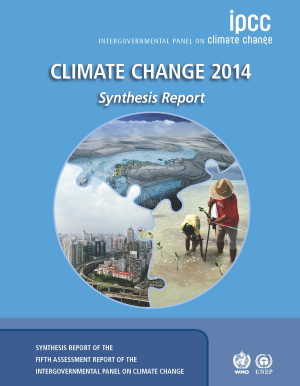
In a word: “dire” – the Intergovernmental Panel on Climate Change. The window of opportunity for doing something positive about it – closing. The time to start action on quickly reducing human causes releases of greenhouse gases – NOW!
From the Huffington Post (November 3, 2014):
COPENHAGEN, Denmark (AP) — Climate change is happening, it’s almost entirely man’s fault and limiting its impacts may require reducing greenhouse gas emissions to zero this century, the U.N.’s panel on climate science said Sunday.
The fourth and final volume of the Intergovernmental Panel on Climate Change’s giant climate assessment offered no surprises, nor was it expected to since it combined the findings of three reports released in the past 13 months.
But it underlined the scope of the climate challenge in stark terms. Emissions, mainly from the burning of fossil fuels, may need to drop to zero by the end of this century for the world to have a decent chance of keeping the temperature rise below a level that many consider dangerous.
The IPCC didn’t say exactly what such a world would look like but it would likely require a massive shift to renewable sources to power homes, cars and industries combined with new technologies to suck greenhouse gases from the atmosphere.
The report warned that failure to reduce emissions could lock the world on a trajectory with “irreversible” impact on people and the environment. Some impacts already being observed included rising sea levels, a warmer and more acidic ocean, melting glaciers and Arctic sea ice and more frequent and intense heat waves.
The science has spoken. There is no ambiguity in their message. Leaders must act. Time is not on our side,” U.N. Secretary-General Ban Ki-moon said at the report’s launch in Copenhagen.
Amid its grim projections, the report said the tools are there to set the world on a low-emissions path and break the addiction to burning oil, coal and gas which pollute the atmosphere with heat-trapping CO2, the chief greenhouse gas.
“All we need is the will to change, which we trust will be motivated by knowledge and an understanding of the science of climate change,” IPCC chairman Rajendra Pachauri said.
The IPCC was set up in 1988 to assess global warming and its impacts. The report released Sunday caps its latest assessment, a mega-review of 30,000 climate change studies that establishes with 95-percent certainty that most of the warming seen since the 1950s is man-made. The IPCC’s best estimate is that just about all of it is man-made, but it can’t say that with the same degree of certainty.
Today only a small minority of scientists challenge the mainstream conclusion that climate change is linked to human activity.
Global Climate Change, a NASA website, says 97 percent of climate scientists agree that warming trends over the past century are very likely due to human activities.
The American public isn’t as convinced. A year-old survey by Pew Research showed 67 percent of Americans believed global warming is occurring and 44 percent said the earth is warming mostly because of human activity. More recently, a New York Times poll said 42 percent of Republicans say global warming won’t have a serious impact, a view held by 12 percent of Democrats and 22 percent of independents.
Sleep-deprived delegates approved the final documents Saturday after a weeklong line-by-line review that underscored that the IPCC process is not just about science. The reports must be approved both by scientists and governments, which means political issues from U.N. climate negotiations, which are nearing a 2015 deadline for a global agreement, inevitably affect the outcome.
The rift between developed and developing countries in the U.N. talks opened up in Copenhagen over a passage on what levels of warming could be considered dangerous. After a protracted battle, the text was dropped from a key summary for policy-makers — to the disappointment of some scientists.
“If the governments are going to expect the IPCC to do their job,” said Princeton professor Michael Oppenheimer, a lead author of the IPCC’s second report, they shouldn’t “get caught up in fights that have nothing to do with the IPCC.”
The omission meant the word “dangerous” disappeared from the summary altogether. It appeared only twice in a longer underlying report compared to seven times in a draft produced before the Copenhagen session. The less loaded word “risk” was mentioned 65 times in the final 40-page summary.
“Rising rates and magnitudes of warming and other changes in the climate system, accompanied by ocean acidification, increase the risk of severe, pervasive, and in some cases irreversible detrimental impacts,” the report said.
World governments in 2009 set a goal of keeping the temperature rise below 2 degrees C (3.6 F) compared to before the industrial revolution. Temperatures have gone up about 0.8 C (1.4 F) since the 19th century.
Emissions have risen so fast in recent years that the world has used up two-thirds of its carbon budget, the maximum amount of CO2 that can be emitted to have a likely chance of avoiding 2 degrees of warming, the IPCC report said.
“This report makes it clear that if you are serious about the 2-degree goal … there is nowhere to hide,” said Alden Meyer of the Union of Concerned Scientists, an advocacy group. “You can’t wait several decades to address this issue.”
U.S. Secretary of State John Kerry said the report demands “ambitious, decisive and immediate action.”
“Those who choose to ignore or dispute the science so clearly laid out in this report do so at great risk for all of us and for our kids and grandkids,” Kerry said in a statement.
The IPCC said the cost of actions such as shifting to solar and wind power and other renewable sources and improving energy efficiency would reduce economic growth only by 0.06 percent annually.
Pachauri said that should be measured against the implications of doing nothing, putting “all species that live on this planet” at peril.
The report is meant as a scientific roadmap for the U.N. climate negotiations, which continue next month in Lima, Peru. That’s the last major conference before a summit in Paris next year, where a global agreement on climate action is supposed to be adopted.
The biggest hurdle is deciding who should do what. Rich countries are calling on China and other major developing countries to set ambitious targets; developing countries saying the rich have a historical responsibility to lead the fight against warming and to help poorer nations cope with its impacts. The IPCC avoided taking sides, saying the risks of climate change “are generally greater for disadvantaged people and communities in countries at all levels of development.”
AP: By KARL RITTER
Posted: 11/02/2014 7:35 am EST Updated: 11/03/2014 12:59 pm EST
IPCC Sounds Fresh Alarm as Fossil Fuel Interests Tighten Grip on Congress
The leading international network of climate scientists is urging a rapid shift away from fossil fuels, just as allies of coal, oil and natural gas industries in the United States appear poised to tighten their grip on Congress—where opposition to cleaner energy is already entrenched.
That outcome of Tuesday’s midterm election would spell trouble for advocates of a strong international climate accord. Treaty negotiations are supposed to pick up in the next few months and culminate in Paris just over a year from now.
This weekend, the UN’s Intergovernmental Panel on Climate Change issued a synthesis report that sums up its years-long review of the climate crisis and what to do about it. The report called for the near-complete elimination of fossil fuel-burning by the end of the century. This, it said, is what is needed to have a reasonable chance of avoiding the most severe risks of man-made changes to the world’s climate.
Nothing could be further from the agenda of Sen. Mitch McConnell of Kentucky, the coal-state Republican who on the eve of the election appears to have significantly better than even odds of becoming the next majority leader. (Though, as the IPCC might put it, until the last votes are tallied any forecast of which party will prevail deserves only “medium confidence.”)
Even if the Republicans don’t gain a majority in the Senate on Nov. 4, they are likely to gain strength in that chamber as well as in the House—an election outcome that would undermine President Obama’s entire climate agenda, not just his influence in the Paris talks.
From the Keystone XL pipeline decision and so-called “war on coal,” to a carbon tax and the very foundations of climate science, Congressional Republicans have opposed Obama on anything having to do with global warming from his first days in office.
Just last year, on the day the IPCC released one of three exhaustive treatments that formed the basis of this week’s synthesis report, McConnell co-sponsored an amendment to block the EPA from regulating fossil fuels in electric power plants, the largest single source of carbon emissions in this country.
His co-sponsor, Sen. James Inhofe of Oklahoma, offered another amendment at the same time. It would have prohibited the administration from participating in international climate negotiations “unless the U.S. offers an addendum to the latest IPCC report stating that anthropogenic climate change is a scientifically unproven theory.” Inhofe, who reportedly aspires to be chairman of the environment committee in a Republican Senate, calls the whole IPCC enterprisea “conspiracy” and “a hoax.”
Their ascent would alarm participants in the climate talks who agree with IPCC chairman, Rajendra Pachauri, that the climate crisis could be solved if action is quick and decisive. “All we need,” Pachauri said as he released the new synthesis report, “is the will to change, which we trust will be motivated by knowledge and an understanding of the science of climate change.”
Emissions must fall by 40 to 70 percent between 2010 and 2050, and then to zero by 2100, he explained at a news conference.
Those are fighting words to anyone committed to defending the coal industry in Kentucky, the oil and gas industry in Oklahoma, or campaigning in any fossil fuel stronghold—from the Marcellus shale to the Bakken light oil play. And it helps explain why the politics of carbon are a feature of so many swing elections in states like West Virginia, Colorado, Louisiana and Alaska.
The contrast between this increasingly partisan American political divide and the increasingly solid international scientific consensus could hardly be starker.
“The scientists have done their jobs and then some,” said Alden Meyer of the Union of Concerned Scientists, who has tracked the negotiations for decades. “Politicians can either dramatically reduce emissions or they can spend the rest of their careers running from climate disaster to climate disaster.”
Other environmental advocates, too, issued statements emphasizing that the synthesis report—including its summary for policymakers, expressly designed to guide them toward early action —was as significant politically as it was scientifically.
“The report is alarming and should be a wake-up call to government leaders,” said Mindy Lubber, president of Ceres, a group that encourages businesses to show leadership on climate issues. Her statement called on them to “ramp up the pressure…especially in Washington.”
“The critical missing link is the oil and gas industry, which is doing its best to thwart concrete action,” she said.
The Sierra Club’s Michael Brune aimed a jibe at the Koch brothers and their favored candidates, saying that “we don’t have any more time to coddle fossil fuel billionaires or politicians who will eschew responsibility at every corner.”
Big environmental groups have spent heavily in this campaign, too—$85 million on state and federal races, according to Daniel Weiss of the League of Conservation Voters, including $40 million on just six key Senate races. And in the closing days, they were knocking on millions of doors to bring out a green vote.
The organizations released results from a Hart Research Associates poll taken in late October in swing states suggesting that the climate issue could break in their favor.
“The survey suggests that Republican candidates are losing ground as a result of their climate science denial and opposition to climate pollution reductions,” Hart reported. “This is true among independent swing voters, and particularly among women and younger voters.”
But only about 40 percent of those surveyed said they had heard much of candidates’ views on climate. A majority had heard about energy issues, but far more about abortion, jobs and Obamacare.
NPR Guts Its Environment And Climate Reporting Team, Becomes ‘Part Of The Problem’

NPR has gutted its staff dedicated to covering environmental and climate issues. Given the nation’s and world’s renewed focus on the threat posed by unrestricted carbon pollution, this baffling move is already receiving widespread criticism from scientists and media watchers. It is “a sad commentary on the current state of our media,” as one top climatologist told me.
Katherine Bagley broke the story for InsideClimate News. She reports that earlier in 2014, NPR “had three full-time reporters and one editor dedicated” to cover environmental and climate issues within NPR’s science desk. Now, shockingly, “One remains — and he is covering it only part-time.”
NPR’s climate coverage has been fairly stagnant for years.
Climate communications expert Dr. Robert J. Brulle of Drexel said The Public Broadcasting Act of 1967 that led to the founding of NPR had as one of its goals that public broadcasting would serve as a “source of alternative telecommunications services” that would serve to “address national concerns.” This latest announcement illustrates how NPR has lost its way. The level of coverage of climate change by NPR has not served to increase public knowledge of climate change any more than any other commercial news outlet. Its coverage has returned to the levels seen around 2006. Reducing the environmental staff will further decrease its coverage of climate change. I would have thought NPR would take a proactive stance toward the coverage of climate change, given its charter to address issues of national concern. Sadly, it seems that instead of being part of the solution, NPR has now become part of the problem.
An InsideClimate News analysis of NPR pieces tagged “environment,” found that the number “has declined since January … dropping from the low 60s to mid-40s every month.”
Journalists and scientists quickly criticized NPR’s move.
Last year, climate coverage at the New York Times dropped following its closure of its own environmental desk. But the Times recently reversed course and expanded its team.
In an email to ClimateProgress, Bagley wrote “With the impacts of climate change becoming more salient, this seems like the wrong time for a news outlet to be reducing the resources or manpower it dedicates to covering this issue.” She hopes NPR ultimately ends up where the Times did: “It closed its desk, but after much criticism and data showing that its coverage declined, the paper made environment and climate a key priority again by assigning a number of new reporters to the beat.”
Michael Mann, director of the Penn State Earth System Science Center and one of the country’s top climatologists, told ClimateProgress, “This is a sad commentary on the current state of our media and, in particular, environmental reporting. Climate change is perhaps the greatest challenge we face as a civilization. Yet NPR apparently feels that it only deserves a fraction of one reporter.”
The move to shift reporters off the environment beat was driven by an interest to cover other fields more in depth, said Anne Gudenkauf, senior supervising editor of NPR’s science desk….
Gudenkauf also said she doesn’t “feel like [the environment] necessarily requires dedicated reporters” because so many other staffers cover the subject, along with their other beats.
Personally, I don’t know anyone in the media business who shares that view. Indeed, one of the reasons that Climate Progress greatly expanded its team of reporters dedicated to covering climate change last year is precisely because major MSM outlets like the Times were slashing coverage.
Yet, ironically, at the same time that the New York Times has figured out it made a mistake cutting dedicated climate reporters, NPR has made the exact same mistake.
From a report JOE ROMM, of Climate Progress, Oct.24, 2014.
 All Things Environmental
Recent Comments