
Governments from Around the World Meeting in Lima, Peru to Lay Foundation for Addressing Climate Change, Wisconsin Governor Scott Walker Sends U.S. EPA Letter Opposing Climate Change Regulations

Building on the groundswell of worldwide climate action, and in preparation for concluding its Framework Convention of Climate Change in Paris in 2015, the United Nations and its participating governments from around the world have begun meeting 1 December, 2014 in Lima, Peru, and scheduled to close on 12 December, 2014, to lay the foundation for an effective new, universal climate change agreement in Paris in 2015 while also raising immediate ambition to act on climate change in advance of the agreement coming into effect in 2020.
The UN’s Intergovernmental Panel on Climate Change has this year warned against rising sea levels, storms and droughts as a result of unchecked greenhouse gas emissions, and highlighted the many opportunities of taking climate action.
Last week, the UN Environment Programme underscored the need for global emissions to peak within the decade and then to rapidly decline so that the world can reach climate neutrality – also termed zero net emissions – in the second half of the century.
Christiana Figueres, Executive Secretary of the UN Climate Convention said:
“Never before have the risks of climate change been so obvious and the impacts so visible. Never before have we seen such a desire at all levels of society to take climate action. Never before has society had all the smart policy and technology resources to curb greenhouse gas emissions and build resilience. All of this means we can be confident we will have a productive meeting in Lima, which will lead to an effective outcome in Paris next year.”
Meanwhile, Wisconsin Governor Scott Walker submitted comments this week in opposition of the Environmental Protection Agency’s (EPA) Clean Power Plan, which proposes increased regulations aimed at reducing carbon dioxide emission from Wisconsin’s power plants in Wisconsin. Walker’s letter claims that the proposed regulations would have a detrimental effect on Wisconsin’s manufacturing-based economy, as well as household ratepayers.
Walker says the Wisconsin Department of Natural Resources and Public Service Commission of Wisconsin have spent months reviewing the rule and seeking input from those who would be affected since its proposal in June of this year.
Governor Walker has asked the EPA to reconsider the rule based on the impact the rule will have on the cost and reliability of electricity, not only to Wisconsin’s manufacturing sector and the 455,000 people it employs, but on every ratepayer in the state and the nation.
In Lima, governments meeting under the “Ad Hoc Work Group on the Durban Platform for Enhanced Action” (ADP) need to define the scope and the type of contributions they will provide to the Paris agreement, along with clarity on how finance, technology and capacity building will be handled.
Countries will put forward what they plan to contribute to the 2015 agreement in the form of Intended Nationally Determined Contributions (INDCs) by the first quarter of 2015, well in advance of the Paris conference in December of next year.
The Lima conference needs to provide final clarity on what the INDCs need to contain, including for developing countries who are likely to have a range of options from, for example, sector-wide emission curbs to energy intensity goals.
Ms. Figueres welcomed the leadership of the EU, the US and China, who have publically announced their post-2020 climate targets and visions.
“It is hugely encouraging that well ahead of next year’s first quarter deadline, countries have already been outlining what they intend to contribute to the Paris agreement. This is also a clear sign that countries are determined to find common ground and maximize the potential of international cooperation,” she said.
“Countries are working hard to increase emission reductions before 2020, when the Paris agreement is set to enter into effect. Pathways on how to accomplish this will also be a key issue before nations in Lima,” she added.
Governments need to work towards streamlining elements of a draft agreement for Paris 2015 and explore common ground on unresolved issues in order to achieve a balanced, well-structured, coherent draft for the next round of work on the text in February next year.
In addition to progress made to date towards a Paris agreement, the political will of countries to provide climate finance is increasingly coming to the fore.
At a recent pledging conference held in Berlin, Germany, countries made pledges towards the initial capitalization of the Green Climate Fund totaling nearly $ 9.3 billion USD. Subsequent pledges took this figure to $ 9.6 billion, so that the $ 10 billion milestone is within reach.
“This shows that countries are determined to build trust and to provide the finance that developing countries need to move forward towards decarbonizing their economies and building resilience”, Ms. Figueres said.
In the course of the 2014, governments have been exploring how to raise immediate climate ambition in areas with the greatest potential to curb emissions, ranging from renewable energy to cities.
As part of the “Lima Action Agenda”, countries will decide how to maintain and accelerate cooperation on climate change by all actors, including those flowing from the Climate Summit in September, where many climate action pledges were made.
“We have seen an amazing groundswell of momentum building this year. One of the main deliverables of the Lima conference will be ways to build on this momentum and further mobilize action across all levels of society. Society-wide action in concert with government contributions to the Paris agreement are crucial to meet the agreed goal of limiting global temperature rise to less than two degrees Celsius, and to safeguard this and future generations,” Ms. Figueres said.
As climate change impacts worsen and impact the poor and most vulnerable, governments urgently need to scale up adaptation to climate change. The conference needs to agree on how National Adaptation Plans of developing countries will be funded and turned into reality on the ground. Countries will also work to agree a work program for the Executive Committee of the Warsaw International Mechanism for Loss and Damage, and elect the members of its Executive Committee.
Governments will work to scale up and coordinate the delivery of climate finance and of the various existing funds. A focus will be on identifying ways to accelerate finance for adaptation to climate change. Governments will also recognize the initial capitalization of the GCF, which is expected to reach USD $ 10 billion by the close of the Lima conference.
Countries meeting in Lima will further work to provide support to avoid deforestation. Several developing countries are expected to submit information which would make it possible for them to obtain funding for forest protection.
Governments meeting in Lima are expected to clarify the role of carbon markets in the 2015 global agreement and set a work program for next year to design and develop operations for implementing new market mechanisms.
As part of the efforts by countries to accelerate pre-2020 climate action, the secretariat is organizing a fair 5, 8 and 9 December in Lima to showcase how action is being scaled up and how many countries and non-state actors are taking action and setting an example.
IPCC Releases Final Report on Global Warming and Climate Change
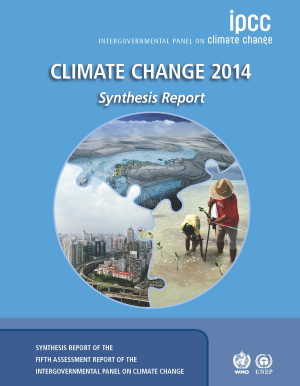
In a word: “dire” – the Intergovernmental Panel on Climate Change. The window of opportunity for doing something positive about it – closing. The time to start action on quickly reducing human causes releases of greenhouse gases – NOW!
From the Huffington Post (November 3, 2014):
COPENHAGEN, Denmark (AP) — Climate change is happening, it’s almost entirely man’s fault and limiting its impacts may require reducing greenhouse gas emissions to zero this century, the U.N.’s panel on climate science said Sunday.
The fourth and final volume of the Intergovernmental Panel on Climate Change’s giant climate assessment offered no surprises, nor was it expected to since it combined the findings of three reports released in the past 13 months.
But it underlined the scope of the climate challenge in stark terms. Emissions, mainly from the burning of fossil fuels, may need to drop to zero by the end of this century for the world to have a decent chance of keeping the temperature rise below a level that many consider dangerous.
The IPCC didn’t say exactly what such a world would look like but it would likely require a massive shift to renewable sources to power homes, cars and industries combined with new technologies to suck greenhouse gases from the atmosphere.
The report warned that failure to reduce emissions could lock the world on a trajectory with “irreversible” impact on people and the environment. Some impacts already being observed included rising sea levels, a warmer and more acidic ocean, melting glaciers and Arctic sea ice and more frequent and intense heat waves.
The science has spoken. There is no ambiguity in their message. Leaders must act. Time is not on our side,” U.N. Secretary-General Ban Ki-moon said at the report’s launch in Copenhagen.
Amid its grim projections, the report said the tools are there to set the world on a low-emissions path and break the addiction to burning oil, coal and gas which pollute the atmosphere with heat-trapping CO2, the chief greenhouse gas.
“All we need is the will to change, which we trust will be motivated by knowledge and an understanding of the science of climate change,” IPCC chairman Rajendra Pachauri said.
The IPCC was set up in 1988 to assess global warming and its impacts. The report released Sunday caps its latest assessment, a mega-review of 30,000 climate change studies that establishes with 95-percent certainty that most of the warming seen since the 1950s is man-made. The IPCC’s best estimate is that just about all of it is man-made, but it can’t say that with the same degree of certainty.
Today only a small minority of scientists challenge the mainstream conclusion that climate change is linked to human activity.
Global Climate Change, a NASA website, says 97 percent of climate scientists agree that warming trends over the past century are very likely due to human activities.
The American public isn’t as convinced. A year-old survey by Pew Research showed 67 percent of Americans believed global warming is occurring and 44 percent said the earth is warming mostly because of human activity. More recently, a New York Times poll said 42 percent of Republicans say global warming won’t have a serious impact, a view held by 12 percent of Democrats and 22 percent of independents.
Sleep-deprived delegates approved the final documents Saturday after a weeklong line-by-line review that underscored that the IPCC process is not just about science. The reports must be approved both by scientists and governments, which means political issues from U.N. climate negotiations, which are nearing a 2015 deadline for a global agreement, inevitably affect the outcome.
The rift between developed and developing countries in the U.N. talks opened up in Copenhagen over a passage on what levels of warming could be considered dangerous. After a protracted battle, the text was dropped from a key summary for policy-makers — to the disappointment of some scientists.
“If the governments are going to expect the IPCC to do their job,” said Princeton professor Michael Oppenheimer, a lead author of the IPCC’s second report, they shouldn’t “get caught up in fights that have nothing to do with the IPCC.”
The omission meant the word “dangerous” disappeared from the summary altogether. It appeared only twice in a longer underlying report compared to seven times in a draft produced before the Copenhagen session. The less loaded word “risk” was mentioned 65 times in the final 40-page summary.
“Rising rates and magnitudes of warming and other changes in the climate system, accompanied by ocean acidification, increase the risk of severe, pervasive, and in some cases irreversible detrimental impacts,” the report said.
World governments in 2009 set a goal of keeping the temperature rise below 2 degrees C (3.6 F) compared to before the industrial revolution. Temperatures have gone up about 0.8 C (1.4 F) since the 19th century.
Emissions have risen so fast in recent years that the world has used up two-thirds of its carbon budget, the maximum amount of CO2 that can be emitted to have a likely chance of avoiding 2 degrees of warming, the IPCC report said.
“This report makes it clear that if you are serious about the 2-degree goal … there is nowhere to hide,” said Alden Meyer of the Union of Concerned Scientists, an advocacy group. “You can’t wait several decades to address this issue.”
U.S. Secretary of State John Kerry said the report demands “ambitious, decisive and immediate action.”
“Those who choose to ignore or dispute the science so clearly laid out in this report do so at great risk for all of us and for our kids and grandkids,” Kerry said in a statement.
The IPCC said the cost of actions such as shifting to solar and wind power and other renewable sources and improving energy efficiency would reduce economic growth only by 0.06 percent annually.
Pachauri said that should be measured against the implications of doing nothing, putting “all species that live on this planet” at peril.
The report is meant as a scientific roadmap for the U.N. climate negotiations, which continue next month in Lima, Peru. That’s the last major conference before a summit in Paris next year, where a global agreement on climate action is supposed to be adopted.
The biggest hurdle is deciding who should do what. Rich countries are calling on China and other major developing countries to set ambitious targets; developing countries saying the rich have a historical responsibility to lead the fight against warming and to help poorer nations cope with its impacts. The IPCC avoided taking sides, saying the risks of climate change “are generally greater for disadvantaged people and communities in countries at all levels of development.”
AP: By KARL RITTER
Posted: 11/02/2014 7:35 am EST Updated: 11/03/2014 12:59 pm EST
IPCC Sounds Fresh Alarm as Fossil Fuel Interests Tighten Grip on Congress
The leading international network of climate scientists is urging a rapid shift away from fossil fuels, just as allies of coal, oil and natural gas industries in the United States appear poised to tighten their grip on Congress—where opposition to cleaner energy is already entrenched.
That outcome of Tuesday’s midterm election would spell trouble for advocates of a strong international climate accord. Treaty negotiations are supposed to pick up in the next few months and culminate in Paris just over a year from now.
This weekend, the UN’s Intergovernmental Panel on Climate Change issued a synthesis report that sums up its years-long review of the climate crisis and what to do about it. The report called for the near-complete elimination of fossil fuel-burning by the end of the century. This, it said, is what is needed to have a reasonable chance of avoiding the most severe risks of man-made changes to the world’s climate.
Nothing could be further from the agenda of Sen. Mitch McConnell of Kentucky, the coal-state Republican who on the eve of the election appears to have significantly better than even odds of becoming the next majority leader. (Though, as the IPCC might put it, until the last votes are tallied any forecast of which party will prevail deserves only “medium confidence.”)
Even if the Republicans don’t gain a majority in the Senate on Nov. 4, they are likely to gain strength in that chamber as well as in the House—an election outcome that would undermine President Obama’s entire climate agenda, not just his influence in the Paris talks.
From the Keystone XL pipeline decision and so-called “war on coal,” to a carbon tax and the very foundations of climate science, Congressional Republicans have opposed Obama on anything having to do with global warming from his first days in office.
Just last year, on the day the IPCC released one of three exhaustive treatments that formed the basis of this week’s synthesis report, McConnell co-sponsored an amendment to block the EPA from regulating fossil fuels in electric power plants, the largest single source of carbon emissions in this country.
His co-sponsor, Sen. James Inhofe of Oklahoma, offered another amendment at the same time. It would have prohibited the administration from participating in international climate negotiations “unless the U.S. offers an addendum to the latest IPCC report stating that anthropogenic climate change is a scientifically unproven theory.” Inhofe, who reportedly aspires to be chairman of the environment committee in a Republican Senate, calls the whole IPCC enterprisea “conspiracy” and “a hoax.”
Their ascent would alarm participants in the climate talks who agree with IPCC chairman, Rajendra Pachauri, that the climate crisis could be solved if action is quick and decisive. “All we need,” Pachauri said as he released the new synthesis report, “is the will to change, which we trust will be motivated by knowledge and an understanding of the science of climate change.”
Emissions must fall by 40 to 70 percent between 2010 and 2050, and then to zero by 2100, he explained at a news conference.
Those are fighting words to anyone committed to defending the coal industry in Kentucky, the oil and gas industry in Oklahoma, or campaigning in any fossil fuel stronghold—from the Marcellus shale to the Bakken light oil play. And it helps explain why the politics of carbon are a feature of so many swing elections in states like West Virginia, Colorado, Louisiana and Alaska.
The contrast between this increasingly partisan American political divide and the increasingly solid international scientific consensus could hardly be starker.
“The scientists have done their jobs and then some,” said Alden Meyer of the Union of Concerned Scientists, who has tracked the negotiations for decades. “Politicians can either dramatically reduce emissions or they can spend the rest of their careers running from climate disaster to climate disaster.”
Other environmental advocates, too, issued statements emphasizing that the synthesis report—including its summary for policymakers, expressly designed to guide them toward early action —was as significant politically as it was scientifically.
“The report is alarming and should be a wake-up call to government leaders,” said Mindy Lubber, president of Ceres, a group that encourages businesses to show leadership on climate issues. Her statement called on them to “ramp up the pressure…especially in Washington.”
“The critical missing link is the oil and gas industry, which is doing its best to thwart concrete action,” she said.
The Sierra Club’s Michael Brune aimed a jibe at the Koch brothers and their favored candidates, saying that “we don’t have any more time to coddle fossil fuel billionaires or politicians who will eschew responsibility at every corner.”
Big environmental groups have spent heavily in this campaign, too—$85 million on state and federal races, according to Daniel Weiss of the League of Conservation Voters, including $40 million on just six key Senate races. And in the closing days, they were knocking on millions of doors to bring out a green vote.
The organizations released results from a Hart Research Associates poll taken in late October in swing states suggesting that the climate issue could break in their favor.
“The survey suggests that Republican candidates are losing ground as a result of their climate science denial and opposition to climate pollution reductions,” Hart reported. “This is true among independent swing voters, and particularly among women and younger voters.”
But only about 40 percent of those surveyed said they had heard much of candidates’ views on climate. A majority had heard about energy issues, but far more about abortion, jobs and Obamacare.
Leaked Final Draft Of U.N. Climate Report Shows Dire Global Warming Predictions

 BY ARI PHILLIPS, POSTED ON OCTOBER 27, 2014
Delegates from more than 100 governments and many of the world’s top climate scientists are meeting in Copenhagen this week to finalize a report that will be used as a foundation for important upcoming climate summits. The leaked United Nations draft report, due to be published on Nov. 2nd, says climate change may have “serious, pervasive and irreversible” impacts on human society and nature.
Hopes are set on a new, post-Kyoto Protocol global climate agreement to be reached at the Paris summit at the end of 2015. There will a major climate meeting in Lima, Peru at the end of this year to help set the framework for the 2015 gathering.
“The report will be a guide for us,” Peruvian Environment Minister Manuel Pulgar-Vidal, told Reuters.
This final report is a synthesis of three comprehensive IPCC reports published over the course of the last year. Those reports focused on the physical science; impacts, adaptation and vulnerability; and mitigation. This flagship report received over 2,000 comments from government officials relating to changes to be made prior to publication.
According to a Reuters analysis, many governments want the draft to be written in a more clear and accessible manner with a focus on extreme weather events such as storms, heat waves, and floods. The U.S. wrote that the report needs to be useful for those without deep technical knowledge of climate issues.
“What about drought? Cyclones? Wildfires? Policymakers care deeply about extreme events,” the U.S. team wrote. “After all, in many ways it is how extreme events will change that will determine many of the (near-term, at least) impacts from climate change. As such, the authors should strongly consider saying more about the projected changes in extreme events.”
>U.S. commenters also wrote that the report should stress impacts on rich countries more, saying “there are very few references to the vulnerability of wealthier countries to climate change.”
The E.U. team wrote that “the key messages should contain more substance that can help guide policy makers rather than general overarching statements,” and that “the overall storyline … is sometimes not clear and still looks fragmented.”
While the report warns of the dire consequences of the continued rise of GHGs, it also says the worst impacts can still be avoided. It states that a combination of adaptation and substantial, sustained reductions in GHGs can limit climate change risks and reduce the costs and challenges of mitigation.
Over the past five years some 2,000 scientists worked on the fifth iteration of the U.N.’s Intergovernmental Panel On Climate Change’s Assessment Report. With leaders gathering to finalize the report this week, Rajendra Pachauri, chairman of the IPCC, urged world governments not to be overcome by hopelessness as they engage in negotiations.
“May I humbly suggest that policymakers avoid being overcome by the seeming hopelessness of addressing climate change,” he said. “Tremendous strides are being made in alternative sources of clean energy. There is much we can do to use energy more efficiently. Reducing and ultimately eliminating deforestation provides additional avenues for action.”
In one hopeful indication, last week leaders of the European Union agreed to cut emissions by 40 percent below 1990 levels by 2030. European leaders hope this will build momentum for when the bloc hosts the critical Paris climate summit next year, and that it will encourage other major emitters yet to make pledges — such as the U.S. and China — to rise to the occasion. Countries have until early next year to announce the targets they intend to negotiate with at the Paris summit.
While U.S. Congress Fiddles EU Agrees To Cut Greenhouse Gas Emissions

By Barbara Lewis and Alastair Macdonald
BRUSSELS, Oct 24 (Reuters) – European Union leaders struck a deal on a new target to cut carbon emissions out to 2030, calling it a new global standard but leaving critics warning that compromises had undermined the fight against climate change.
Talks in Brussels stretched into the small hours of Friday as Poland battled to spare its coal industry and other states tweaked the guideline text on global warming to protect varied economic interests, from nuclear plants and cross-border power lines to farmers whose livestock belch out polluting methane.
In the end, an overall target was agreed for the 28-nation bloc to cut its emissions of carbon in 2030 by at least 40 percent from levels in the benchmark year of 1990. An existing goal of a 20-percent cut by 2020 has already been nearly met.
EU leaders called the 40-percent target an ambitious signal to the likes of the United States and China to follow suit at a U.N. climate summit France is hosting in December next year.
“Europe is setting an example,” French President Francois Hollande said, acknowledging that it had been a hard-won compromise but calling the final deal “very ambitious.”
“Ultimately, this is about survival,” said summit chair Herman Van Rompuy, the president of the European Council.
But environmentalists had already complained that the deal could still leave the EU struggling to make the at least 80-percent cut by 2050 that its own experts say is needed to limit the rise in global average temperatures to two degrees Celsius.
Natalia Alonso of Oxfam welcomed the 40-percent goal but said: “(It) falls far too short of what the EU needs to do to pull its weight in the fight against climate change. Insufficient action like this from the world’s richest countries places yet more burden on the poorest people most affected by climate change, but least responsible for causing this crisis.”
RENEWABLE ENERGY
The European Union accounts for about a tenth of world greenhouse gas emissions and has generally done more than other major industrial powers to curb the gases blamed for global warming.
But Green campaigners said Friday’s deal signaled the EU was becoming less ambitious.
Aside from the headline emissions goals, they were disappointed by a softening in the final agreement of targets for increasing the use of solar, wind and other renewable energy sources and for improving efficiency through measures such as insulation and cleaner engines.
Diplomats said bargaining by Poland’s new prime minister Eva Kopacz, who faces an election next year, secured a complex set of financial incentives. They include free allowances in the EU system for trading carbon emissions to soften the impact of the target on Polish coal miners and the coal-fired power stations on which its 38 million people depend.
Concerns in Britain and some smaller states about additional EU regulation that might, for example, crimp a new expansion of emissions-free but controversial nuclear power, saw targets for increased use of renewable energy and for energy efficiency softened.
Van Rompuy said the two targets would be for at least 27 percent. They would also only apply across the bloc as a whole, unlike the broad 40-percent target that binds each state individually.
Renewable energy sources produce about 14 percent of the EU’s energy at present.
Brook Riley of Friends of the Earth said: “This deal does nothing to end Europe’s dependency on fossil fuels or to speed up our transition to a clean energy future. It’s a deal that puts dirty industry interests ahead of citizens and the planet.”
Some industrialists have complained that EU climate regulations risk discouraging business and investment in the bloc at a time when its faltering economy can ill afford to lose it. But others, echoed by EU officials on Friday, see changes in energy use as an opportunity to develop new industries.
Portugal and Spain succeeded in getting a harder target for the level of cross-border connections, something they had been pushing France to accept so that they could export more of their spare energy across France and to the rest of the continent.
In the middle of a confrontation with Russia over Moscow’s role in the Ukraine conflict, the EU also took the opportunity to set out strategic objectives for “energy security” – code for reducing its heavy reliance on Russian natural gas. (Additional reporting by Julia Fioretti and Jan Strupczewski; Writing by Alastair Macdonald)
Our Planet’s Primal Scream — Is Anyone Listening?
Recent headlines have sounded the alarm on the mounting impacts of climate change. Over the past few months, we have seen everything from the hottest summer on record, to historic droughts and extreme wildfires ravaging communities in California, to vanishing wildlife habitat in Alaska, to toxic algae blooming out of control and contaminating drinking water supplies in America’s heartland.
How much more do we need to know about the devastating effects of climate change before Congress takes action?
In California, the first six months of 2014 were the hottest on record, and 82 percent of the state is currently experiencing extreme drought. And the situation is expected to get worse — recently scientists predicted that 2014 will end as the hottest year ever recorded. Experts also tell us that climate change has tripled the probability that the drought-causing weather conditions will continue.
This historic drought is contributing to more frequent and intense wildfires. In the past, California’s wildfire season lasted about three months out of the year, but now it is virtually year-round, and that is straining our state’s budget.
Disturbing pictures in Alaska showed 35,000 walruses — almost all females and calves — stranded on a beach. They should have been able to use the Arctic sea ice to dive for food, but the ice is gone. Temperatures in Alaska’s North Pacific Ocean are the warmest ever recorded, and the amount of Arctic sea ice shrank to one of its lowest levels on record. According to new peer-reviewed findings, the warming waters and melting ice have also led to sea levels rising at rates unprecedented over the last 6,000 years.
In August, toxins were found in Toledo’s drinking water supply after an algae bloom formed over an intake pipe in Lake Erie. An emergency water ban was imposed to protect 500,000 Ohioans from the dangerous toxins, which can cause vomiting, diarrhea, and harm to the liver. Scientists have warned us for years that poisonous algae blooms are exacerbated by climate change.
The examples in California, Alaska, and Ohio are major wake-up calls about the damage that has already been done to our planet.
However, instead of confronting this crisis, congressional Republicans are trying to gut our clean air protections that help tackle dangerous climate change. Over the past four years, the Republican House has voted well over a 100 times to repeal the health-based standards that are the heart of the Clean Air Act, including trying to roll back the president’s authority to limit carbon pollution.
President Obama has taken important steps to address climate change, such as proposing standards to control dangerous carbon pollution from power plants. Cutting carbon pollution will also reduce many types of other air pollutants that threaten human health with respiratory illnesses like asthma. We all benefit from having clean air to breathe — it literally saves lives.
We also know that safeguarding public health, protecting the environment, and growing the economy work together. Since the passage of the Clean Air Act four decades ago, air pollution emissions have dropped 72 percent while our economy has grown substantially. During the same period, the U.S. gross domestic product grew 219 percent and total private sector jobs increased by 101 percent.
This environmental success story is now threatened by climate change deniers, because failing to address climate change now will only increase the harmful impacts and financial burden on all Americans. When our water supplies are contaminated, who pays to clean it up? When wildfires grow out of control, who pays to put them out? When record temperatures put lives at risk, who pays for community cooling centers? The American taxpayers foot the bill.
The Intergovernmental Panel on Climate Change has a report coming out early next month that is expected to once again tell us that we have a very short window to act on climate change, and scientific evidence is overwhelming that we must reduce dangerous carbon pollution before it leads to irreversible impacts for human health, food and water supplies, and vital infrastructure.
What we need is a price on carbon pollution to reflect its true costs on society. Last year, Senator Bernie Sanders and I introduced the Climate Protection Act. Our bill would establish a fee on each ton of carbon pollution emitted from the petroleum, coal, and natural gas that we produce and import. Under our bill, 60 percent of the revenue would be returned directly to taxpayers, and the remaining portion would be reinvested in promoting renewable energy, enhancing job growth in a clean energy economy, and increasing the resilience in the nation’s infrastructure.
The American people want Congress to address climate change, as poll after poll has shown. Just last month in New York, 400,000 people demonstrated their support for action on dangerous climate change.
Congress must respond to this citizen call for action. I ask colleagues on both sides of the aisle to join me in this fight. We owe it to future generations to take meaningful steps to address dangerous climate change now. There is no more time to waste.
by Sen. Barbara Boxer
 All Things Environmental
Recent Comments