
Governments from Around the World Meeting in Lima, Peru to Lay Foundation for Addressing Climate Change, Wisconsin Governor Scott Walker Sends U.S. EPA Letter Opposing Climate Change Regulations

Building on the groundswell of worldwide climate action, and in preparation for concluding its Framework Convention of Climate Change in Paris in 2015, the United Nations and its participating governments from around the world have begun meeting 1 December, 2014 in Lima, Peru, and scheduled to close on 12 December, 2014, to lay the foundation for an effective new, universal climate change agreement in Paris in 2015 while also raising immediate ambition to act on climate change in advance of the agreement coming into effect in 2020.
The UN’s Intergovernmental Panel on Climate Change has this year warned against rising sea levels, storms and droughts as a result of unchecked greenhouse gas emissions, and highlighted the many opportunities of taking climate action.
Last week, the UN Environment Programme underscored the need for global emissions to peak within the decade and then to rapidly decline so that the world can reach climate neutrality – also termed zero net emissions – in the second half of the century.
Christiana Figueres, Executive Secretary of the UN Climate Convention said:
“Never before have the risks of climate change been so obvious and the impacts so visible. Never before have we seen such a desire at all levels of society to take climate action. Never before has society had all the smart policy and technology resources to curb greenhouse gas emissions and build resilience. All of this means we can be confident we will have a productive meeting in Lima, which will lead to an effective outcome in Paris next year.”
Meanwhile, Wisconsin Governor Scott Walker submitted comments this week in opposition of the Environmental Protection Agency’s (EPA) Clean Power Plan, which proposes increased regulations aimed at reducing carbon dioxide emission from Wisconsin’s power plants in Wisconsin. Walker’s letter claims that the proposed regulations would have a detrimental effect on Wisconsin’s manufacturing-based economy, as well as household ratepayers.
Walker says the Wisconsin Department of Natural Resources and Public Service Commission of Wisconsin have spent months reviewing the rule and seeking input from those who would be affected since its proposal in June of this year.
Governor Walker has asked the EPA to reconsider the rule based on the impact the rule will have on the cost and reliability of electricity, not only to Wisconsin’s manufacturing sector and the 455,000 people it employs, but on every ratepayer in the state and the nation.
In Lima, governments meeting under the “Ad Hoc Work Group on the Durban Platform for Enhanced Action” (ADP) need to define the scope and the type of contributions they will provide to the Paris agreement, along with clarity on how finance, technology and capacity building will be handled.
Countries will put forward what they plan to contribute to the 2015 agreement in the form of Intended Nationally Determined Contributions (INDCs) by the first quarter of 2015, well in advance of the Paris conference in December of next year.
The Lima conference needs to provide final clarity on what the INDCs need to contain, including for developing countries who are likely to have a range of options from, for example, sector-wide emission curbs to energy intensity goals.
Ms. Figueres welcomed the leadership of the EU, the US and China, who have publically announced their post-2020 climate targets and visions.
“It is hugely encouraging that well ahead of next year’s first quarter deadline, countries have already been outlining what they intend to contribute to the Paris agreement. This is also a clear sign that countries are determined to find common ground and maximize the potential of international cooperation,” she said.
“Countries are working hard to increase emission reductions before 2020, when the Paris agreement is set to enter into effect. Pathways on how to accomplish this will also be a key issue before nations in Lima,” she added.
Governments need to work towards streamlining elements of a draft agreement for Paris 2015 and explore common ground on unresolved issues in order to achieve a balanced, well-structured, coherent draft for the next round of work on the text in February next year.
In addition to progress made to date towards a Paris agreement, the political will of countries to provide climate finance is increasingly coming to the fore.
At a recent pledging conference held in Berlin, Germany, countries made pledges towards the initial capitalization of the Green Climate Fund totaling nearly $ 9.3 billion USD. Subsequent pledges took this figure to $ 9.6 billion, so that the $ 10 billion milestone is within reach.
“This shows that countries are determined to build trust and to provide the finance that developing countries need to move forward towards decarbonizing their economies and building resilience”, Ms. Figueres said.
In the course of the 2014, governments have been exploring how to raise immediate climate ambition in areas with the greatest potential to curb emissions, ranging from renewable energy to cities.
As part of the “Lima Action Agenda”, countries will decide how to maintain and accelerate cooperation on climate change by all actors, including those flowing from the Climate Summit in September, where many climate action pledges were made.
“We have seen an amazing groundswell of momentum building this year. One of the main deliverables of the Lima conference will be ways to build on this momentum and further mobilize action across all levels of society. Society-wide action in concert with government contributions to the Paris agreement are crucial to meet the agreed goal of limiting global temperature rise to less than two degrees Celsius, and to safeguard this and future generations,” Ms. Figueres said.
As climate change impacts worsen and impact the poor and most vulnerable, governments urgently need to scale up adaptation to climate change. The conference needs to agree on how National Adaptation Plans of developing countries will be funded and turned into reality on the ground. Countries will also work to agree a work program for the Executive Committee of the Warsaw International Mechanism for Loss and Damage, and elect the members of its Executive Committee.
Governments will work to scale up and coordinate the delivery of climate finance and of the various existing funds. A focus will be on identifying ways to accelerate finance for adaptation to climate change. Governments will also recognize the initial capitalization of the GCF, which is expected to reach USD $ 10 billion by the close of the Lima conference.
Countries meeting in Lima will further work to provide support to avoid deforestation. Several developing countries are expected to submit information which would make it possible for them to obtain funding for forest protection.
Governments meeting in Lima are expected to clarify the role of carbon markets in the 2015 global agreement and set a work program for next year to design and develop operations for implementing new market mechanisms.
As part of the efforts by countries to accelerate pre-2020 climate action, the secretariat is organizing a fair 5, 8 and 9 December in Lima to showcase how action is being scaled up and how many countries and non-state actors are taking action and setting an example.
U.S. State Department Sued for Secretly Approving Enbridge Tar Sands Oil Pipeline

The Center for Biological Diversity reported last Wednesday that environmental and tribal groups filed a lawsuit last week against the U.S. State Department’s secretive approval of a plan to allow Enbridge company to nearly double the amount of tar sands oil in the Alberta Clipper pipeline. The approval this summer happened without public notice and without a legally required review that’s meant to protect air, water, wildlife, and public health, in spite of a previous State Department decision that any expansion of Alberta Clipper would require a federal permit.
The pipeline transports tar sands oil from Alberta, Canada through North Dakota, Minnesota and Wisconsin, passing through three tribal areas, as well as the Mississippi River, and national forest lands.
The project nearly doubles the Alberta Clipper’s capacity and would put the pipeline on par with the controversial Keystone XL pipeline project that the U.S. Senate is scheduled to vote on Tuesday. The Enbridge company project significantly increases the amount of toxic, highly polluting tar sands crude moved into the U.S.. It also represents a violation of U.S. environmental laws that protect the air and water.
“This lawsuit challenges the State Department’s illegal approval of Enbridge’s tar sands expansion plans,” Sierra Club Staff Attorney Doug Hayes told reporters on a press call last week. Rather than follow the public review process required by the National Environmental Policy Act (NEPA), the State Department instead chose to go ahead and approve the project without any public review.
The suit was filed in federal court in Minneapolis by a diverse coalition of groups including the White Earth Nation, Sierra Club, Center for Biological Diversity, Honor the Earth, the National Wildlife Federation, the Minnesota Conservation Federation, the Indigenous Environmental Network, and MN350, being represented by the Vermont Law School Environmental and Natural Resources Law Clinic. The suit aims to force Secretary of State John Kerry and the State Department to reverse its approval and ensure that a full environmental review takes place before any expansion of Alberta Clipper occurs.
“To establish the U.S. as a real international leader in tackling the climate crisis, the State Department must stop turning a blind eye to Big Oil schemes to bypass U.S. laws and nearly double the amount of corrosive, carbon-intensive tar sands crude it brings into our country,” said Sierra Club Deputy National Program Director Michael Bosse. “Enbridge has been allowed to play by their own rules for too long at the expense of our water, air, and climate, and the Sierra Club is taking legal action to stop this abuse.”
“The only thing worse than dirty oil is dirty oil backed by dirty tricks. This is the fossil fuel equivalent of money laundering,” said Kieran Suckling, executive director of the Center for Biological Diversity. “The Obama administration should be ashamed of itself for letting Enbridge illegally pump more dirty tar sands oil into the United States.”
“Honor the Earth represents Anishinaabeg people and the earth. We believe that nations should abide by their agreements, treaties, and laws. The Anishinaabeg continue to harvest and live the life the Creator gave us, within the north country, and within the treaty areas, protected and recognized under federal law, including the 1837, 1854, 1855 and 1867 treaties,” said Winona LaDuke, program director for Honor the Earth and a member of the White Earth Nation.
“We know that new oil pipelines will not bode well for the fish, the wild rice, and the medicines of this Akiing, this land. We also know that the U.S., through the State Department, should uphold its own laws and regulations, and not issue permits under the pressure of oil interests, over the interests of our country, people, and land”, she said. “Federal law requires environmental impact assessments, and the U.S. must uphold its own laws. New pipelines by the Enbridge Company and this illegal switching of lines do not serve our state or our country. We ask the U.S. State Department to uphold the law”, LaDuke said.
Keystone XL Pipeline: Lame-Duck Congress Fast-Tracks Legislation
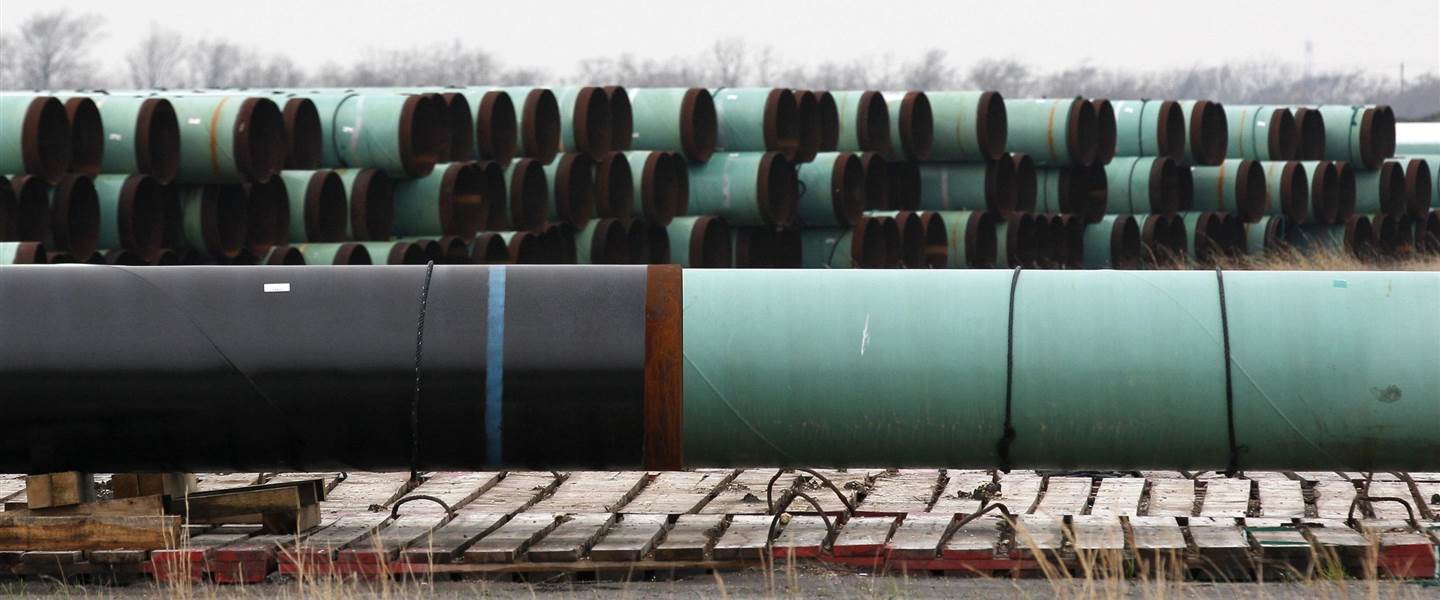
The tortuous six-year fight over a controversial proposal to funnel oil from Canada to the Gulf Coast took another turn this week after both houses of the lame-duck Congress moved to vote on the Keystone XL pipeline.
As the legislation barrels through Congress and heads to the Oval Office, President Barack Obama may soon settle one of the most politically charged debates of the decade. The White House appeared to downplay the congressional maneuvering Wednesday, saying it takes a “dim view of these kinds of legislative proposals.”
But if the Senate passes the bill as early as next Tuesday, Obama would likely be forced to either sign it into law or veto it. He has said the project needs his approval because it crosses an international border.
Enbride Company Balks at Dane County’s Request for Extra Spill Safeguards Around Expansion of Tar Sands Crude Oil Pipeline

Dane County officials want Enbridge Energy to buy insurance or a performance bond that would guarantee availability of cleanup money in the event of a spill of the tar sands petroleum from its pipeline and pumping station near Marshall.
Officials are worried about a repeat of a 2010 spill that fouled 35 miles of Michigan’s Kalamazoo River and led to an ongoing cleanup effort with an estimated price tag of $1.21 billion.
But the Calgary-based company is insisting that local governments can’t require financial guarantees because pipeline safety is regulated exclusively by federal law.
Enbridge is tripling the capacity of its Line 61, which runs from Superior to the Illinois border, by adding horsepower to 12 pumping stations, including one in the town of Medina near Marshall in the northeast part of the county.
The county Zoning and Land Regulation Committee meets Tuesday to consider the conditions it will place on a permit Enbridge needs to do the work.
Committee chairman Patrick Miles said he’s not sure what the committee will do given the risk of a costly court battle over a demand for insurance or bonding.
He acknowledged that the federal government would be in charge of ensuring cleanup but said the county could play a role.
“If they have some financial surety committed to a cleanup, it would give some comfort that if they go belly up or run out of resources or go bankrupt, there’s some resources for a cleanup,” Miles said.
Miles said he shares the concerns of environmental advocates about the climate change implications of expanding pipeline capacity and the relatively high energy cost of extracting tar sands oil, but he sees no way to address those things in the county permit approval process.
Enbridge said it has never accepted the kind of financial condition county staff included as an option for the proposed permit at Miles’ request. The company has already received local permits for upgrading the other 11 pumping stations, and none of the communities asked for financial assurances, said spokeswoman Becky Haase.
However, the company has already made one special allowance for the Dane County site. At the request of the town of Medina, Enbridge agreed to build a bermed spill containment area twice the size of those in other communities, Haase said. The structure will be designed to hold 2.1 million gallons, the amount that would be released in a 60-minute spill at the increased flow rate, she said.
Enbridge agreed to the condition in the town permit as a “good neighbor” gesture, Haase said.
Containment structures at the other 11 sites will be expanded to accommodate higher flow, but they’ll still have only a 30-minute capacity, she said.
Pipeline safety regulations are governed by federal law, and local governments are forbidden from adding their own, county attorney David Gault said. However, federal law leaves open the possibility for local regulation on cleaning up spills, including bonds or insurance, Gault said.
Amy Back, Enbridge senior legal counsel, in an Oct. 14 letter to the county, disagreed. She wrote that any regulation of an interstate pipeline such as the Enbridge line is “preempted by federal law and therefore is not a permissible condition of approval.”
The pump station improvements will mean Line 61 will be able to carry an average 1.2 billion barrels of tar sands petroleum a day starting next year, Haase said. The oil originates in western Canada and North Dakota. The pipeline cuts across Wisconsin on its way to Gulf Coast refineries.
The Sierra Club Wisconsin chapter is concerned that there’s been insufficient government oversight and that pipelines might not stand up to increased pressure from the new pumps.
Conservation program director Elizabeth Ward faulted the state Department of Natural Resources for failing to conduct an environmental assessment, but the agency maintains it approved the planned higher capacity before the pipe was installed in 2007.
The company paid $3.6 million in federal fines as a result of the 2010 Kalamazoo River spill near Marshall, Michigan, the largest oil pipeline failure in U.S. history.
The cleanup remains incomplete, but the company has revamped its safety procedures, Haase said.
The Michigan spill released an estimated 840,000 gallons of thick crude into a wetland that drains to the river. The cleanup has been complicated because the oil stuck to sand, sticks and debris churned up by heavy rains, Haase said. Oil usually floats on water, but the debris carried it down to the riverbed making cleanup more difficult, she said.
Enbridge president Mark Maki said that after the spill, the company increased its insurance liability coverage to $700 million, short of the $1.21 billion cleanup cost.
“If you go back over our history, the Marshall incident was without question really a confluence of a number of very, very difficult and bad events in terms of what it cost ultimately,” Maki said in a Nov. 3 earnings call. “So we just don’t see a lot of value in insuring for another Marshall.”
In an SEC filing, the company indicated it expected around $40 million in fines from the U.S. Environmental Protection Agency for violations of the Clean Water Act.
The Michigan spill occurred because start-up of pumps weakened and then ruptured a section of pipe, Haase said. The company control center in Edmonton, Alberta, which monitors all the company’s lines, misread signals showing a pressure drop in the line, she said.
Operators restarted pumps a number of times believing there was a bubble in the line. The spill went on for 17 hours and three work shifts before it was shut down.
Haase said the control center operates under tighter protocols and the company has invested $4.4 billion in safety and maintenance since the spill. “I’d love to say I guarantee it won’t ever happen again, but I can’t say that,” Haase said.
By Steven Verburg, Madison Newspapers Inc.
To view tar sands mining impacts, see Neil Young’s performance of the “Mother Earth” video at the close of “About this Blog”.
IPCC Releases Final Report on Global Warming and Climate Change
In a word: “dire” – the Intergovernmental Panel on Climate Change. The window of opportunity for doing something positive about it – closing. The time to start action on quickly reducing human causes releases of greenhouse gases – NOW!
From the Huffington Post (November 3, 2014):
COPENHAGEN, Denmark (AP) — Climate change is happening, it’s almost entirely man’s fault and limiting its impacts may require reducing greenhouse gas emissions to zero this century, the U.N.’s panel on climate science said Sunday.
The fourth and final volume of the Intergovernmental Panel on Climate Change’s giant climate assessment offered no surprises, nor was it expected to since it combined the findings of three reports released in the past 13 months.
But it underlined the scope of the climate challenge in stark terms. Emissions, mainly from the burning of fossil fuels, may need to drop to zero by the end of this century for the world to have a decent chance of keeping the temperature rise below a level that many consider dangerous.
The IPCC didn’t say exactly what such a world would look like but it would likely require a massive shift to renewable sources to power homes, cars and industries combined with new technologies to suck greenhouse gases from the atmosphere.
The report warned that failure to reduce emissions could lock the world on a trajectory with “irreversible” impact on people and the environment. Some impacts already being observed included rising sea levels, a warmer and more acidic ocean, melting glaciers and Arctic sea ice and more frequent and intense heat waves.
The science has spoken. There is no ambiguity in their message. Leaders must act. Time is not on our side,” U.N. Secretary-General Ban Ki-moon said at the report’s launch in Copenhagen.
Amid its grim projections, the report said the tools are there to set the world on a low-emissions path and break the addiction to burning oil, coal and gas which pollute the atmosphere with heat-trapping CO2, the chief greenhouse gas.
“All we need is the will to change, which we trust will be motivated by knowledge and an understanding of the science of climate change,” IPCC chairman Rajendra Pachauri said.
The IPCC was set up in 1988 to assess global warming and its impacts. The report released Sunday caps its latest assessment, a mega-review of 30,000 climate change studies that establishes with 95-percent certainty that most of the warming seen since the 1950s is man-made. The IPCC’s best estimate is that just about all of it is man-made, but it can’t say that with the same degree of certainty.
Today only a small minority of scientists challenge the mainstream conclusion that climate change is linked to human activity.
Global Climate Change, a NASA website, says 97 percent of climate scientists agree that warming trends over the past century are very likely due to human activities.
The American public isn’t as convinced. A year-old survey by Pew Research showed 67 percent of Americans believed global warming is occurring and 44 percent said the earth is warming mostly because of human activity. More recently, a New York Times poll said 42 percent of Republicans say global warming won’t have a serious impact, a view held by 12 percent of Democrats and 22 percent of independents.
Sleep-deprived delegates approved the final documents Saturday after a weeklong line-by-line review that underscored that the IPCC process is not just about science. The reports must be approved both by scientists and governments, which means political issues from U.N. climate negotiations, which are nearing a 2015 deadline for a global agreement, inevitably affect the outcome.
The rift between developed and developing countries in the U.N. talks opened up in Copenhagen over a passage on what levels of warming could be considered dangerous. After a protracted battle, the text was dropped from a key summary for policy-makers — to the disappointment of some scientists.
“If the governments are going to expect the IPCC to do their job,” said Princeton professor Michael Oppenheimer, a lead author of the IPCC’s second report, they shouldn’t “get caught up in fights that have nothing to do with the IPCC.”
The omission meant the word “dangerous” disappeared from the summary altogether. It appeared only twice in a longer underlying report compared to seven times in a draft produced before the Copenhagen session. The less loaded word “risk” was mentioned 65 times in the final 40-page summary.
“Rising rates and magnitudes of warming and other changes in the climate system, accompanied by ocean acidification, increase the risk of severe, pervasive, and in some cases irreversible detrimental impacts,” the report said.
World governments in 2009 set a goal of keeping the temperature rise below 2 degrees C (3.6 F) compared to before the industrial revolution. Temperatures have gone up about 0.8 C (1.4 F) since the 19th century.
Emissions have risen so fast in recent years that the world has used up two-thirds of its carbon budget, the maximum amount of CO2 that can be emitted to have a likely chance of avoiding 2 degrees of warming, the IPCC report said.
“This report makes it clear that if you are serious about the 2-degree goal … there is nowhere to hide,” said Alden Meyer of the Union of Concerned Scientists, an advocacy group. “You can’t wait several decades to address this issue.”
U.S. Secretary of State John Kerry said the report demands “ambitious, decisive and immediate action.”
“Those who choose to ignore or dispute the science so clearly laid out in this report do so at great risk for all of us and for our kids and grandkids,” Kerry said in a statement.
The IPCC said the cost of actions such as shifting to solar and wind power and other renewable sources and improving energy efficiency would reduce economic growth only by 0.06 percent annually.
Pachauri said that should be measured against the implications of doing nothing, putting “all species that live on this planet” at peril.
The report is meant as a scientific roadmap for the U.N. climate negotiations, which continue next month in Lima, Peru. That’s the last major conference before a summit in Paris next year, where a global agreement on climate action is supposed to be adopted.
The biggest hurdle is deciding who should do what. Rich countries are calling on China and other major developing countries to set ambitious targets; developing countries saying the rich have a historical responsibility to lead the fight against warming and to help poorer nations cope with its impacts. The IPCC avoided taking sides, saying the risks of climate change “are generally greater for disadvantaged people and communities in countries at all levels of development.”
AP: By KARL RITTER
Posted: 11/02/2014 7:35 am EST Updated: 11/03/2014 12:59 pm EST
IPCC Sounds Fresh Alarm as Fossil Fuel Interests Tighten Grip on Congress
The leading international network of climate scientists is urging a rapid shift away from fossil fuels, just as allies of coal, oil and natural gas industries in the United States appear poised to tighten their grip on Congress—where opposition to cleaner energy is already entrenched.
That outcome of Tuesday’s midterm election would spell trouble for advocates of a strong international climate accord. Treaty negotiations are supposed to pick up in the next few months and culminate in Paris just over a year from now.
This weekend, the UN’s Intergovernmental Panel on Climate Change issued a synthesis report that sums up its years-long review of the climate crisis and what to do about it. The report called for the near-complete elimination of fossil fuel-burning by the end of the century. This, it said, is what is needed to have a reasonable chance of avoiding the most severe risks of man-made changes to the world’s climate.
Nothing could be further from the agenda of Sen. Mitch McConnell of Kentucky, the coal-state Republican who on the eve of the election appears to have significantly better than even odds of becoming the next majority leader. (Though, as the IPCC might put it, until the last votes are tallied any forecast of which party will prevail deserves only “medium confidence.”)
Even if the Republicans don’t gain a majority in the Senate on Nov. 4, they are likely to gain strength in that chamber as well as in the House—an election outcome that would undermine President Obama’s entire climate agenda, not just his influence in the Paris talks.
From the Keystone XL pipeline decision and so-called “war on coal,” to a carbon tax and the very foundations of climate science, Congressional Republicans have opposed Obama on anything having to do with global warming from his first days in office.
Just last year, on the day the IPCC released one of three exhaustive treatments that formed the basis of this week’s synthesis report, McConnell co-sponsored an amendment to block the EPA from regulating fossil fuels in electric power plants, the largest single source of carbon emissions in this country.
His co-sponsor, Sen. James Inhofe of Oklahoma, offered another amendment at the same time. It would have prohibited the administration from participating in international climate negotiations “unless the U.S. offers an addendum to the latest IPCC report stating that anthropogenic climate change is a scientifically unproven theory.” Inhofe, who reportedly aspires to be chairman of the environment committee in a Republican Senate, calls the whole IPCC enterprisea “conspiracy” and “a hoax.”
Their ascent would alarm participants in the climate talks who agree with IPCC chairman, Rajendra Pachauri, that the climate crisis could be solved if action is quick and decisive. “All we need,” Pachauri said as he released the new synthesis report, “is the will to change, which we trust will be motivated by knowledge and an understanding of the science of climate change.”
Emissions must fall by 40 to 70 percent between 2010 and 2050, and then to zero by 2100, he explained at a news conference.
Those are fighting words to anyone committed to defending the coal industry in Kentucky, the oil and gas industry in Oklahoma, or campaigning in any fossil fuel stronghold—from the Marcellus shale to the Bakken light oil play. And it helps explain why the politics of carbon are a feature of so many swing elections in states like West Virginia, Colorado, Louisiana and Alaska.
The contrast between this increasingly partisan American political divide and the increasingly solid international scientific consensus could hardly be starker.
“The scientists have done their jobs and then some,” said Alden Meyer of the Union of Concerned Scientists, who has tracked the negotiations for decades. “Politicians can either dramatically reduce emissions or they can spend the rest of their careers running from climate disaster to climate disaster.”
Other environmental advocates, too, issued statements emphasizing that the synthesis report—including its summary for policymakers, expressly designed to guide them toward early action —was as significant politically as it was scientifically.
“The report is alarming and should be a wake-up call to government leaders,” said Mindy Lubber, president of Ceres, a group that encourages businesses to show leadership on climate issues. Her statement called on them to “ramp up the pressure…especially in Washington.”
“The critical missing link is the oil and gas industry, which is doing its best to thwart concrete action,” she said.
The Sierra Club’s Michael Brune aimed a jibe at the Koch brothers and their favored candidates, saying that “we don’t have any more time to coddle fossil fuel billionaires or politicians who will eschew responsibility at every corner.”
Big environmental groups have spent heavily in this campaign, too—$85 million on state and federal races, according to Daniel Weiss of the League of Conservation Voters, including $40 million on just six key Senate races. And in the closing days, they were knocking on millions of doors to bring out a green vote.
The organizations released results from a Hart Research Associates poll taken in late October in swing states suggesting that the climate issue could break in their favor.
“The survey suggests that Republican candidates are losing ground as a result of their climate science denial and opposition to climate pollution reductions,” Hart reported. “This is true among independent swing voters, and particularly among women and younger voters.”
But only about 40 percent of those surveyed said they had heard much of candidates’ views on climate. A majority had heard about energy issues, but far more about abortion, jobs and Obamacare.
Leaked Final Draft Of U.N. Climate Report Shows Dire Global Warming Predictions

 BY ARI PHILLIPS, POSTED ON OCTOBER 27, 2014
Delegates from more than 100 governments and many of the world’s top climate scientists are meeting in Copenhagen this week to finalize a report that will be used as a foundation for important upcoming climate summits. The leaked United Nations draft report, due to be published on Nov. 2nd, says climate change may have “serious, pervasive and irreversible” impacts on human society and nature.
Hopes are set on a new, post-Kyoto Protocol global climate agreement to be reached at the Paris summit at the end of 2015. There will a major climate meeting in Lima, Peru at the end of this year to help set the framework for the 2015 gathering.
“The report will be a guide for us,” Peruvian Environment Minister Manuel Pulgar-Vidal, told Reuters.
This final report is a synthesis of three comprehensive IPCC reports published over the course of the last year. Those reports focused on the physical science; impacts, adaptation and vulnerability; and mitigation. This flagship report received over 2,000 comments from government officials relating to changes to be made prior to publication.
According to a Reuters analysis, many governments want the draft to be written in a more clear and accessible manner with a focus on extreme weather events such as storms, heat waves, and floods. The U.S. wrote that the report needs to be useful for those without deep technical knowledge of climate issues.
“What about drought? Cyclones? Wildfires? Policymakers care deeply about extreme events,” the U.S. team wrote. “After all, in many ways it is how extreme events will change that will determine many of the (near-term, at least) impacts from climate change. As such, the authors should strongly consider saying more about the projected changes in extreme events.”
>U.S. commenters also wrote that the report should stress impacts on rich countries more, saying “there are very few references to the vulnerability of wealthier countries to climate change.”
The E.U. team wrote that “the key messages should contain more substance that can help guide policy makers rather than general overarching statements,” and that “the overall storyline … is sometimes not clear and still looks fragmented.”
While the report warns of the dire consequences of the continued rise of GHGs, it also says the worst impacts can still be avoided. It states that a combination of adaptation and substantial, sustained reductions in GHGs can limit climate change risks and reduce the costs and challenges of mitigation.
Over the past five years some 2,000 scientists worked on the fifth iteration of the U.N.’s Intergovernmental Panel On Climate Change’s Assessment Report. With leaders gathering to finalize the report this week, Rajendra Pachauri, chairman of the IPCC, urged world governments not to be overcome by hopelessness as they engage in negotiations.
“May I humbly suggest that policymakers avoid being overcome by the seeming hopelessness of addressing climate change,” he said. “Tremendous strides are being made in alternative sources of clean energy. There is much we can do to use energy more efficiently. Reducing and ultimately eliminating deforestation provides additional avenues for action.”
In one hopeful indication, last week leaders of the European Union agreed to cut emissions by 40 percent below 1990 levels by 2030. European leaders hope this will build momentum for when the bloc hosts the critical Paris climate summit next year, and that it will encourage other major emitters yet to make pledges — such as the U.S. and China — to rise to the occasion. Countries have until early next year to announce the targets they intend to negotiate with at the Paris summit.
Earth’s About to Lose What Little Chance It Had – Unless We Act Now!
Who’s Gonna Stand Up
Neil Young’s Who’s Gonna Stand Up (and Save the Earth)
Protect the wild, tomorrow’s child
Protect the land from the greed of man
Take down the dams, stand up to oil
Protect the plants, and renew the soil
Who’s gonna stand up and save the earth?
Who’s gonna say that she’s had enough?
Who’s gonna take on the big machine?
Who’s gonna stand up and save the earth?
This all starts with you and me
Damn the dams, save the rivers
Starve the takers and feed the givers
Build a dream, save the world
We’re the people know as earth
Who’s gonna stand up and save the earth?
Who’s gonna say that she’s had enough?
Who’s gonna take on the big machine?
Who’s gonna stand up and save the earth?
This all starts with you and me
Ban fossil fuel, draw the line
Before we build, one more pipeline
Ban fracking now, save the waters
And build a life, for our sons and daughters
Who’s gonna stand up and save the earth?
Who’s gonna say that she’s had enough?
Who’s gonna take on the big machine?
Who’s gonna stand up and save the earth?
This all starts with you and me
Who’s gonna stand up
Who’s gonna stand up
Who’s gonna stand up
Who’s gonna stand up
Who’s gonna stand up
Who’s Gonna Stand Up (and Save the Earth)?
(full orchestra & choir version)
Start here. Sign “Conserve NOW Petition to President Obama, U.S. Congress, Wisconsin Governor Walker and Wisconsin Legislature to Enact and Fund Climate Change Legislation” (September 16th post on this blog) or;
I’ve also started the petition “U.S. Congress: Enact and Fund Legislation to Pay Families and Individuals who Use Less Fossil Fuel Energy Annually on Changeorg
Will you take 30 seconds to sign it right now? Here’s the link:
Here’s why it’s important:
Using money that now goes to subsidize the fossil fuel industries (coal, oil, natural gas), instead offer that money to those who limit their driving, flying and household use of fossil fuel devived energy. This would helpslow global warming and sea level rises and would negate the need for raising the minimum wage and foodstamps.
You can sign my petition by clicking here.
.
Thanks
U.S. Congress Needs to Take Action to Slow Climate Change and Ensure Public Saftey
Julia Pierson, a 30-year veteran of the Secret Service agency who became director in 2013, was forced to resign under pressure as director Wednesday after breaches of White House security that resulted in nobody getting hurt and no damage to property.

The U.S. Congress has 535 members: 435 Representatives and 100 Senators. The One Hundred Thirteenth United States Congress first met in Washington, D.C. on January 3, 2013, and is scheduled to end on January 3, 2015. Widespread public dissatisfaction with the institution has increased in recent years, and some commentators have ranked it among the worst in United States congressional history. According to a Gallup Poll released in August 2014, the 113th Congress had the highest disapproval rating of any Congress since 1974, when data first started being collected: 83% of Americans surveyed said that they disapproved of the job Congress was doing, while only 13% said that they approved.
So why aren’t we forcing some of these folks to resign?
A New York Times/CBS News poll found that nearly half of Americans believe that global warming is causing a serious impact now, while about 60 percent said that protecting the environment should be a priority “even at the risk of curbing economic growth.”
Fifty-four percent of those surveyed said that global warming is caused by human activity. This, the New York Times notes, is the “highest level ever recorded by the national poll.”
Those results echo those of another survey conducted by the Chicago Council on Global Affairs, which found that more than 70 percent of Americans believe climate change is either a critical or an important threat “to the vital interests” of the country, while more than 80 percent said that combating climate change is either a “very important” or “somewhat important” goal for the U.S.
The survey also found that 50 percent of the American public believe that the government is not doing enough to address the problem of climate change. According to poll makers, this is an increase of five percentage points from 2012 poll results.
Dealing appropriately with reducing causes of global warming and insuring protection of citizens from climate change is government responsibility. But this Congress (and the Congresses preceding it) have failed to act on it, as have many states, Wisconsin included. They all ought consider resignation for their failure to enact legislation to slow global warming and ensure the America public is protected from climate change.
Picture – 35,000 walruses are swarming Alaska’s shore — because their sea ice is vanishing

New images captured by NOAA aerial surveys of the Alaska coast on September 27 show an estimated 35,000 walruses ashore near Point Lay. (Corey Arrardo / NOAA/NMFS/AFSC/NMML)
.
“We can easily forgive a child who is afraid of the dark; the real tragedy of life is when men are afraid of the light.”
― Plato
Airlines Make Big Profits But the Federal Government Pays Many of their Costs and the Atmosphere Receives the Airplane Pollution

In a story last month published in USA Today (7/24/2014), “Several airlines announce record profits“, American Airlines, which was in bankruptcy court last year and merged with U.S. Airways in December, announced the company’s first dividend since 1980, based on record quarterly profits of $1.5 billion.
United Airlines, the only major U.S. airline to lose money in the first quarter, announced second-quarter income of $919 million, an increase of 51% from the same period a year earlier.
Southwest Airlines, the largest carrier of U.S. passengers which began its first international flights July 1, also reported record quarterly net income of $485 million or 70 cents per diluted share, which beat analysts’ expectations of 61 cents. Southwest is offering workers a one-time bonus of $200 each to thank them. And JetBlue Airways announced its 17th consecutive quarter of profitability.
The next time you hop on a plane to go on an exotic vacation, or to give an important presentation at some far off land or distant conference, or go on an unnecessary (or necessary) business trip, or fly to see the Olympics, the Super Bowl, the Rose Bowl, or maybe just go pay a visit to someone you haven’t seen for awhile, know that the ticket price is really just a fraction of the “true” cost of traveling by jet airplane.
Over the past five years, the Obama administration has repeatedly called for cutting fossil fuel subsidies in the form of tax breaks and other incentives. But the amount of money the federal government forfeits through subsidies has increased steadily over that time period, reaching $18.5 billion last year, according to a new report from the environmental group Oil Change International.
That total is up from $12.7 billion in 2009, largely because oil and gas production has increased in the United States. Next year, domestic oil production is expected to reach the highest level since 1972. The Obama administration regularly touts its “all of the above” energy strategy, which includes increased oil and gas production.
The Oil Change report includes a variety of subsidies in its accounting, including tax breaks, incentives for production on federal lands (such as royalty fees that haven’t been adjusted in 25 years) and tax deductions for clean-up costs. And if state subsidies for oil, gas and coal production are also included, the total value climbs to $21.6 billion for 2013.
A 2011 study by the consulting firm Management Information Services, Inc. (MISI) estimated the total historical federal subsidies for various energy sources over the years 1950–2010 in the U.S.. The study found that oil, natural gas, and coal received $369 billion, $121 billion, and $104 billion (2010 dollars), respectively, or 70% of total energy subsidies over that period. Oil, natural gas, and coal benefited most from percentage depletion allowances and other tax-based subsidies, but oil also benefited heavily from regulatory subsidies such as exemptions from price controls and higher-than-average rates of return allowed on oil pipelines.
In September 2009, Obama and other G20 leaders pledged to phase out fossil fuel subsidies to help curb global warming. Obama also called for eliminating subsidies in 2012 and 2013. And the administration’s 2015 budget proposal again calls for a major cut to fossil fuel subsidies.
But Congress so far hasn’t acted to cut the subsidies. The report argues that as long as those incentives remain in place, the federal government is “essentially rewarding companies for accelerating climate change.”
“We’re spending more taxpayer dollars every year to fund fossil fuels that we can’t afford to burn, according to climate science,” said Steve Kretzmann, executive director of Oil Change International. “Subsidizing fossil fuels at this point is climate denial.” [article by Kate Sheppard, “Federal Government Still Spending Billions To Subsidize Fossil Fuels”, Huffington Post, 7/9/2014]
Essential Air Service (EAS) is a U.S. government program enacted to guarantee that small communities in the United States, which, prior to deregulation, were served by certificated airlines, maintained commercial service. Its aim is to maintain a minimal level of scheduled air service to these communities that otherwise would not be profitable. This came in response to the Airline Deregulation Act, passed in 1978, which gave U.S. airlines almost total freedom to determine which markets to serve domestically and what fares to charge for that service.[1] The program is codified at 49 U.S.C. §§ 41731–41748.
The United States Department of Transportation (DOT) subsidizes airlines to serve rural communities across the country that otherwise would not receive any scheduled air service. As of November 1, 2013, the Essential Air Service subsidized 160 communities, of which 43 were in Alaska, whose guidelines for service are separate and distinct from the rest of the country. The decision as to what degree of subsidized service a community requires is made based on identifying a specific hub for the community and from there determining the number of trips, seats, and type of aircraft that are necessary to reach that hub.
The budget for EASs increased from $131.5 million in 2011 to $214 million in 2012 to $234 million in 2013 and to $241 million in 2014.
The true cost of flying includes the consequences of burning the fossil fuels which end up in the earth’s atmosphere. Consider also the uses of the land, wetlands or other uses that the airport and its runways and taxiways that your plane uses must have replaced and the other impacts the airport and its uses have on the surrounding environment. Finally, consider the costs and materials that are obtained for building the airport and airliners and the impacts of the many service vehicles operating at each airport and the impact of their emissions on the environment, too. Also consider the impacts of mining, drilling, and transport of fuel to the airport, possible fuel pipeline construction, and the potential for fuel spills, contamination of land and water resources, and the potential for fuel explosions associated with operation of the airport, transportation of the fuel, as well as the possible environmental effects associated with manufacturing airliners like the one you are flying that regularly use the airport. Most of these types of impacts are very real and can impose significant negative consequences to people, animal life and our environment but seldom do they have any recognized monetary cost thus they they go unpaid for by those who profit from the public’s use of the airplanes and the airport.
Ignorance, or purposefully ignoring negative, nonmonetary environmental effects of flying to exotic locations may seem blissful, at first; but when the environmental effects of millions of people doing the same things, but when many millions of people are flying daily, at different locations throughout the world yet in the same atmosphere are considered collectively, and over time, the consequences upon our atmosphere and therefore our planet can be very significant, dangerous and ultimately catastrophic, especially when combined with the billions of other sources of fossil fuel burning being done irrefutably caused our planet and oceans to warm, causing sea level rise, and ocean acidification, and increased severity of extreme weather events, ignorant over the cause and effect of burning fossil fuels and global warming is not only dangerous but foolhardy.
Yes, those jet airplanes and propeller driven airplanes burn significant volumes of fossil fuels every day in the world, in flight, taking-off and landing, thereby adding significantly to the increasing concentration of of the gas “carbon dioxide” (CO2) and other greenhouse gases that end up in the Earth’s atmosphere, daily, thus contributing to the increasingly grave rate of global warming.
Data from a Milwaukee Journal Sentinel article by Joe Taschler of the Journal Sentinel Aug. 9, 2014
“Airlines seeing friendlier skies as profits rise
Airlines may be making record profit again but who is realy paying for most of the cost?
Airlines are making money again, with U.S. carriers reporting record profits for the second quarter of this year, but don’t look for them to use that money to add flights or upgrade service.
Where airlines once burned through cash the way a jumbo jet burns fuel, these days they are content to stay in a financial holding pattern.
The profits are either given back to investors, in the form of dividends or stock buybacks, or used for expansion, said Jay Sorensen, president of IdeaWorks, a Shorewood airline industry consulting firm.
“I don’t think the latter is going to happen, in terms of expansion,” he said. “Airline management is going to push back against that because that’s what got them into trouble in the first place.”
Southwest Airlines CEO Gary Kelly all but said as much in a July 24 conference call to discuss the company’s second quarter earnings.
“Right now, the demand is very strong and it is balanced very nicely with the supply of seats,” Kelly said. “We’re going to manage our growth very carefully so that we don’t upset that balance.”
Southwest, the market share leader at Milwaukee’s Mitchell International Airport, reported record second-quarter profit of $465 million and set records for full planes and passenger fare per mile. Revenue rose 8%. In July, the airline’s planes were 86.7% full.
Those numbers certainly are strong, but the recent past continues to haunt airlines, leaving them gun-shy about spending money.
“The only other thing that I think needs to be mentioned here is that we’ve lived through a brutal decade where every balance sheet in the industry was stressed and most went bankrupt. So you just can’t extrapolate 2014 into infinity,” Kelly said.
“We do want to make sure that we err on the side, financially, of being conservative and being very well prepared for the unpredictable,” he added. “The unpredictable’s happened a lot to us in 43 years.”
More service cuts
Among other carriers, American Airlines, only eight months removed from bankruptcy, said it will pay its first dividend in 34 years, a cash payout of 10 cents per share.
American reported net income of $864 million in the second quarter. Excluding special charges related to taxes and bankruptcy and merger costs, the profit was $1.5 billion, a quarterly record for the carrier.
So will it put any of that money into additional services? No. Actually, it’s cutting some in-flight meals.
The carrier, in the process of merging with US Airways, will stop serving free meals to first-class and business-class passengers on flights shorter than 2 hours and 45 minutes, beginning Sept. 1.
American now serves full meals on flights longer than two hours. The change is being made as part of the US Airways merger and is meant to keep consistent policies between the two airlines.
The airlines will continue to serve snacks such as fig bars, pretzels, fruit and cookies on shorter flights. Passengers in the economy sections can buy meals on flights longer than 2 hours and 45 minutes.
“We have to make sure our customers have a consistent experience, no matter what airline they choose,” American Airlines spokesman Casey Norton said.
Making up ground
To be fair, American is doing things to bolster its business using the profits it earned in the quarter.
The carrier will spend more than $2.8 billion on debt and aircraft lease prepayments, $1 billion to buy back shares and pay $600 million toward additional pension contributions.
All of those moves make sense.
“When you run an organization that was bankrupt or operating with poor financial results, it becomes threadbare. They need to make capital investments. They need to consider salary increases or profit-sharing increases,” Sorensen said.
“Hallelujah, they are making money,” he added. “They need it.”
Still, the timing of the meal service cutbacks was poor.
“That’s not the message that should be given right now,” Sorensen said. “The message should be that, ‘We are profitable. We are maintaining or improving the product for the consumer.'”
Four carriers, Southwest, Delta, American/US Airways and United, control more than 80% of the domestic airline market. All four serve Milwaukee.
With so much of the industry concentrated with a few carriers, it hasn’t made attracting new service to Mitchell any easier.
Attracting more air service is a top priority for Mitchell management, Harold Mester, public relations manager for the airport, said in an email.
“We meet with airlines on a regular basis, including frequently hosting airline executives in Milwaukee. We also invest significant resources into promoting Milwaukee as a cost-effective alternative for air carriers looking to serve the Chicago market,” he said.
The airport also has an air service incentive program to help offset the costs of new or expanded service from Milwaukee, he added.
Still, the airport has made some gains. “We now have year-round nonstop service to Seattle, San Francisco and Los Angeles, which were previously served on a seasonal basis,” Mester said.
Southwest is adding service to Cancun, and Frontier recently added some Florida service.
Adjusting to a new order
The Milwaukee County owned and operated airport is adjusting to the new order in the airline industry and its status of no longer being a major airline hub.
“Milwaukee’s air service is resetting in the wake of the airline industry’s new business model that parked feeder planes and moved to full-size mainline jets,” Mester said.
That new model also means that, if planes aren’t full, they won’t be flying a particular route for long.
It’s the butts-in-seats model. If there are not enough butts, the seats go away.
At Southwest, for example, trips flown in July were 113,099, down 3.7% from 117,402 in July 2013. Year to date, the airline’s trips flown as of July was 740,080, a 5% drop from 779,508 in 2013.
“Air service is largely ‘use it or lose it,'” Mester said. “Growth in population, employment, industry, commerce, conventions and tourism are the biggest factors that create demand and result in more air service.”
Industry watchers don’t expect things to change much.
“The industry is happy to bask in the glow of making money for once,” Sorensen said.
While touting green technology, and lobbying the federal government on environmental policy, Sergey Brin, Larry Page, and Eric Schmidt have put 3.4 million miles on their private jets in recent years, polluting the atmosphere with 100 million pounds of carbon dioxide. Their trips, according to flight log data I analyzed, included single-day jaunts and brief corporate meetings, but also what appear to be hundreds of exotic vacation destinations.
Perhaps someone should introduce them to Google Hangouts?
Few Americans would care that a successful tech company with substantial travel demands and nearly $60 billion in revenue over the past year maintains a fleet of private jets that guzzle fuel by the millions of gallons. But Google uses campaign contributions to strong-arm federal lawmakers into hamstringing everyone else with restrictive environmental regulations, while Google execs cavalierly jet off to exotic vacation spots around the globe on the taxpayers’ dime.
In a story by Justin Bachman, 7/23/2013, Bloomberg News lays out the arguments being made to get Uncle Sam out of the business of directing airplanes. This debate is hardly new, although the meat cleaver Congress took to the federal budget in January has given the proposal new impetus and appears to have made leaders of the labor union, the National Air Traffic Controllers Association, ready to discuss fundamental changes.
STORY: Some Air Traffic Controllers Watch Over Empty Skies
The Federal Aviation Administration cut $637 million from its $16 billion budget this fiscal year as a result of the sequester and faces similar cuts in the year beginning Oct. 1. In April, the traveling public felt the first effects of the reduced funding with furloughs hitting some 50,000 FAA employees and touching off about 2,300 flight delays. Days later, after heavy press coverage and outrage from airlines, Congress passed legislation allowing the agency to transfer funds to end the furloughs.
The basic change would be to fund traffic control not with taxes but through a “fee for flight”—a twist on the medical profession’s fee-for-service model—collected by a government corporation or a public-private partnership of some sort. About two-thirds of the costs of operating the U.S. air-traffic system derive from excise taxes on airline tickets and jet fuel, Bloomberg News reported. And with appropriations from Congress serving as the basis of long-term capital projects, the FAA’s ability to complete a transformation to a satellite-based routing system—as well as other large, capital-intensive efforts—has been called into question.
“The idea that you pay for $20 billion dollar infrastructure projects out of annual operating cash flow is nuts,” Robert Poole Jr., a co-founder of the libertarian Reason Foundation and a long-term advocate of moving ATC out of the federal government, said at the June conference. “You wouldn’t run any business that way.”
STORY: The GOP Plan to Get Air Traffic Safety on the Cheap
Dozens of countries, including Australia, Canada, and Germany, have relinquished the management of flight traffic to various private and public-private organizations in a bid to increase efficiency, lower costs, and boost safety. Funding air traffic control through fees also allows the agency in charge to issue bonds and pay for large projects, Poole has argued. Many of those agencies even enjoy investment-grade credit ratings.
There’s also the matter of public safety and bragging rights: For decades, the U.S. has boasted the safest air traffic system, and some foresee that title being supplanted by other nations that operate their airspaces differently. Others, however, argue that controllers should be government employees and that privatization could compromise safety. “I do know that the current system is broken and this conversation needs to start to happen,” Rinaldi said.
The federal budget sequester may advance an old proposal that was once broadly unthinkable: privatizing the U.S. air traffic control system.
In a story today that’s well worth reading for anyone who flies, Bloomberg News lays out the arguments being made to get Uncle Sam out of the business of directing airplanes. This debate is hardly new, although the meat cleaver Congress took to the federal budget in January has given the proposal new impetus and appears to have made leaders of the labor union, the National Air Traffic Controllers Association, ready to discuss fundamental changes.
“My organization has pivoted,” Paul Rinaldi, president of the controllers union, said at a symposium in June on modernizing air traffic control in response to the deep budget cuts. “If we do not mature, have this discussion, find a way to sustainably fund this system properly so that we can modernize it, we are going to fall way behind the world.” (A video of the panel discussion on FAA funding can be viewed here.) The union has not advocated any particular approach or called for air traffic control to be privatized, hoping instead to foster a wider, public discussion of the issue.
Wisconsin DNR Denies Candidate for Governor and State Legislator’s Appeal of Enbridge Oil Storage Tanks at Superior, WI
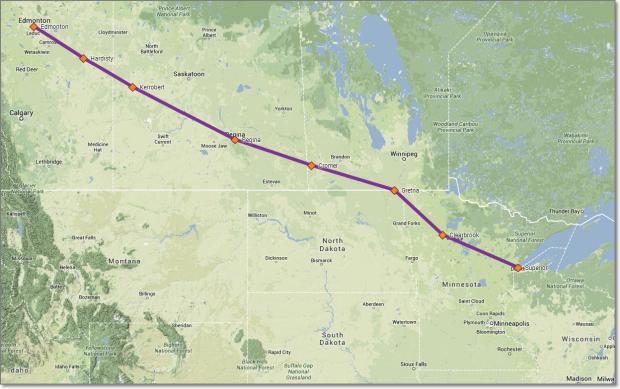
Above is the Canadian route used to pump tar-sands-derived oil from the tar sand mines of Alberta, Canada to the city of Superior, Wisconsin, a 1,000 mile route. Enbridge Energy company received a permit to build three 1/2 million gallons of oil capacity tanks earlier this summer, according to a report by Mike Simonson of Wisconsin Public Radio (WPR).
The city of Superior, Wisconsin is located adjacent the City of Duluth, Minnesota, which are both commercial harbors located on the southwestern shore of Lake Superior, the largest fresh water lake in the world and upper most of the world’s chain of 5 Great Lakes. The permit for the massive tanks is the last legal hurdle the Enbridge Company is required to complete before embarking on its project to expand the capacity of the pipelines that will transport up to 1.5 million gallons of dirty, heavy crude oil through the state of Wisconsin on Enbridge’s “Southern Access” pipeline.
From Superior, Enbridge Energy’s already built Southern Access 42-inch pipeline, built in 2006 (DNR determined that no environmental impact Statement or contested case hearing would be required for the project) the pipeline goes southeast from Superior, diagonally through the center of Wisconsin, then all the way south through Rock County and into Illinois. Enbridge officials claim they intend to TRIPLE THE CAPACITY OF THE PIPELINE BY UPGRADING, OR BUILDING 17 PUMPING STATIONS along the way.
The Wisconsin DNR last month turned down an appeal of a recently issued DNR air permit for the project which had been filed by state Rep. Brett Hulsey (D-Madison), a candidate for Wisconsin governor in 2015.
According to a report on Madison’s independent news radio program, “In Our Backyard” (WORT-FM), Hulsey said when he filed his appeal that it was only the first step he planned to take in challenging the permit, and that if they were not pleased with DNR’s action, “we could go to state or federal court from there” to stop the project. Hulsey’s said he is most concerned with the quality of the pipeline and the history of the company operating it: “my concern again is they’re trying to expand this pipeline [capacity], run this dirty tar sand oil through it, and the pipeline wasn’t designed for that.”
Hulsey also said Enbrige has a “horrible” record of pollution spills across Wisconsin and Michigan, “and honestly based on their record they’re not qualified to run a two-car parade”, he said. “I want DNR to ensure there are spill plans to protect people along the route.”
The three half-million barrel tanks are being built to hold tar sands oil from Alberta and the Bakken oil fields in North Dakota, where fracking is used to access the oil from wells. Enbridge Energy, located out of Houston Texas, is required to obtain an air quality permit from the state for the project.
Last Tuesday, the DNR denied Hulsey’s appeal, saying his argument had nothing to do with the air quality permit issued for the tank construction. Additionally, a second petition was denied to Peter Bormuth, a man from Jackson, Mich., who like Hulsey contended that Enbridge Energy has a record of pipeline leaks (which it does). Bormuth also said the tanks violate the public trust doctrine over navigable waterways like Lake Superior and the Nemadji River. The DNR called Bormouth’s argument too general of an allegation, according to Simonson’s report.
The DNR got more than 200 letters and 3,400 emails during the comment period, “many” of those opposed the air quality permit for the tanks, Simonson said.
The DNR approved a permit for Enbridge to build the three massive oil storage tanks in Superior in early June of this year. The pipeline company said the tanks will be complete in two years,
Sierra Club John Muir Chapter Conservation Program director Elizabeth Ward said it was important for the DNR and Enbrige Energy to look at the big picture of the tar sands and climate change. She said the DNR wasn’t listening to the public, and that it was also ignoring the dangers a pipeline spill could pose.
“We know that by increasing pressure in the tar sands pipeline, the likelihood of a rupture is greater,” said Ward. “So that warrants a full environmental impact statement and assessment by the DNR. But instead, the DNR chose to do this piecemeal permitting, really leaving the public out of the process”, Simonson quoted Ward as saying.
Groups and some local governments are still after state officials to take a closer look at the proposed expansion of an oil pipeline that’s buried under much of Wisconsin.
Dave Spitzer, of the group 350 Madison, said some counties in the state are also asking for a more comprehensive state review.
Ben Callan, of the DNR, recently issued a wetlands permit for five of the Enbridge Energy pump stations. Callan said current law doesn’t require a new assessment beyond what that DNR did eight years ago.
Callan said he understands counties are raising concerns, but he said the federal government has oversight over pipeline capacity and safety.
Enbridge officials have hired a former Republican state cabinet secretary to try to keep its Line 61 expansion flowing smoothly.
Hulsey said Bakken oil is dirty and expensive. He said storing it will emit benzene and other carcinogenic fumes, as well as allow more of the crude to flow through Wisconsin pipelines.
“Actually the real proposal is to use less oil,” said Hulsey. “My clean energy jobs plan invests $700 million in our state facilities to use less energy.”
Enbridge Energy spokeswomen said her company was “surprised” by the level of public interest, that the tanks are important, “but not exactly as controversial as something like the Keystone Pipeline”, she said.
Enbridge Energy is planning a $7 billion upgrade to their existing pipeline, which runs from the Canadian oil tar sands to Superior. Environmental groups compare this with the stalled Keystone XL pipeline in size and scope.
The expansion would replace a 47-year-old pipeline from Hardisty, Alberta to Superior, Wisconsin. Enbridge Energy spokeswoman Lorraine Little says the 1,000-mile long line would almost double the carrying capacity from the Alberta oil [tar] sands region to Superior.
Wisconsin Sierra Club John Muir Chapter President Shahla Werner said after a million gallon spill into Kalamazoo River in 2010, this Enbridge Energy line is as potentially hazardous as the higher profile Keystone pipeline, which is still waiting for approval from the U.S. State Department in Washington DC.
“The public should not just be concerned about Keystone and it’s not just about the impacts in Canada. It’s a real risk to our Great Lakes region and to Lake Superior,” Werner said.
Enbridge Energy notified its stockholders last December that they’re going to proceed with a $2.5 billion pipeline expansion, Simonson reported on WPR. “It’ll run 600 miles from the booming North Dakota Bakken Oil Fields to their Superior facility”, he said.
“Five years ago, the Bakken oil sands produced 200,000 barrels of light crude oil a day. Now it’s up to 700,000 barrels a day and is expected to reach 1.2 million barrels a day in the next five years. Enbridge Energy can pipe 225,000 gallons of that crude oil a day to Superior and points south to Chicago, Detroit and Toledo”, his report added.
Enbridge Energy Partners spokeswoman Lorraine Little told Simonson this expansion, dubbed “Sandpiper,” would more than double their capacity from North Dakota, “Because of that increasing supply of availability, you’ve got refineries in other parts of the U.S. who are interested in taking that light crude oil”. So these projects really represent moving the oil where the refineries are.
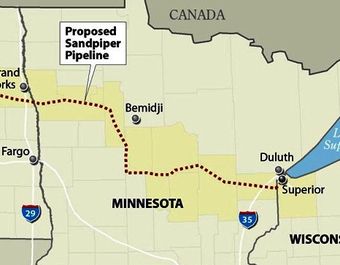
Little said this pipeline project, along with increased oil [tar] sands production, will shift supply from Middle Eastern and South America to North America, “So you might think of it a bit as re-piping America. The Sandpiper pipeline could be in service by early 2016.
“They’re increasing the capacity of the line by 360,000 barrels a day and they’re changing the type of oil so that it can carry both light and tar sands oil,” Werner said. “So they’re changing the product. Sierra Club’s been working on blocking tar sands expansion for a long time.” Excavation and production of tar sands to make it into oil involves large quantities of fossil fuel burning for heating it on the front end, before the dirty oil is made thin enough to flow in the pipelines.
 All Things Environmental
Recent Comments