
The Pope Speaks to Congress about Climate Change, Refugees, Cuba & “Money that is Drenched in Blood”

Pope Francis Thursday became the first Pope to ever address a joint session of Congress. Below are some key passages from the Pope’s speech, compliments of Democracy NOW!:
On Four Great Americans
A nation can be considered great when it defends liberty as [Abraham] Lincoln did, when it fosters a culture which enables people to “dream” of full rights for all their brothers and sisters, as Martin Luther King sought to do; when it strives for justice and the cause of the oppressed, as Dorothy Day did by her tireless work, the fruit of a faith which becomes dialogue and sows peace in the contemplative style of Thomas Merton.
On Dorothy Day
In these times when social concerns are so important, I cannot fail to mention the Servant of God Dorothy Day, who founded the Catholic Worker Movement. Her social activism, her passion for justice and for the cause of the oppressed, were inspired by the Gospel, her faith, and the example of the saints.
On Refugees & Immigration
Our world is facing a refugee crisis of a magnitude not seen since the Second World War. This presents us with great challenges and many hard decisions. On this continent, too, thousands of persons are led to travel north in search of a better life for themselves and for their loved ones, in search of greater opportunities. Is this not what we want for our own children? We must not be taken aback by their numbers, but rather view them as persons, seeing their faces and listening to their stories, trying to respond as best we can to their situation. To respond in a way which is always humane, just and fraternal. We need to avoid a common temptation nowadays: to discard whatever proves troublesome. Let us remember the Golden Rule: “Do unto others as you would have them do unto you.”
On the Arms Trade
Why are deadly weapons being sold to those who plan to inflict untold suffering on individuals and society? Sadly, the answer, as we all know, is simply for money: money that is drenched in blood, often innocent blood. In the face of this shameful and culpable silence, it is our duty to confront the problem and to stop the arms trade.
On Climate Change
In Laudato Si’, I call for a courageous and responsible effort to “redirect our steps” and to avert the most serious effects of the environmental deterioration caused by human activity. I am convinced that we can make a difference and I have no doubt that the United States – and this Congress – have an important role to play. Now is the time for courageous actions and strategies, aimed at implementing a “culture of care” and “an integrated approach to combating poverty, restoring dignity to the excluded, and at the same time protecting nature.”
On Finance Capital
If politics must truly be at the service of the human person, it follows that it cannot be a slave to the economy and finance. Politics is, instead, an expression of our compelling need to live as one, in order to build as one the greatest common good: that of a community which sacrifices particular interests in order to share, in justice and peace, its goods, its interests, its social life. I do not underestimate the difficulty that this involves, but I encourage you in this effort.
On The Death Penalty
The Golden Rule also reminds us of our responsibility to protect and defend human life at every stage of its development. This conviction has led me, from the beginning of my ministry, to advocate at different levels for the global abolition of the death penalty. I am convinced that this way is the best, since every life is sacred, every human person is endowed with an inalienable dignity, and society can only benefit from the rehabilitation of those convicted of crimes. Recently my brother bishops here in the United States renewed their call for the abolition of the death penalty. Not only do I support them, but I also offer encouragement to all those who are convinced that a just and necessary punishment must never exclude the dimension of hope and the goal of rehabilitation.
On Cuba
I would like to recognize the efforts made in recent months to help overcome historic differences linked to painful episodes of the past. It is my duty to build bridges and to help all men and women, in any way possible, to do the same. When countries which have been at odds resume the path of dialogue – a dialogue which may have been interrupted for the most legitimate of reasons – new opportunities open up for all. This has required, and requires, courage and daring, which is not the same as irresponsibility.
Pope Francis Calls on U.S. to Combat Climate Change & Build a “Truly Tolerant and Inclusive” Society

WEDNESDAY, SEPTEMBER 23, 2015
In his first U.S. speech, Pope Francis urged the United States to help tackle climate change at a “critical moment of history” and called on Americans to build a truly tolerant and inclusive society:
TRANSCRIPT
POPE FRANCIS: Mr. President,
I am deeply grateful for your welcome in the name of all Americans. As the son of an immigrant family, I am happy to be a guest in this country, which was largely built by such families. I look forward to these days of encounter and dialogue, in which I hope to listen to, and share, many of the hopes and dreams of the American people.
During my visit I will have the honor of addressing Congress, where I hope, as a brother of this country, to offer words of encouragement to those called to guide the nation’s political future in fidelity to its founding principles. I will also travel to Philadelphia for the Eighth World Meeting of Families, to celebrate and support the institutions of marriage and the family at this, a critical moment in the history of our civilization.
Mr. President, together with their fellow citizens, American Catholics are committed to building a society which is truly tolerant and inclusive, to safeguarding the rights of individuals and communities, and to rejecting every form of unjust discrimination. With countless other people of good will, they are likewise concerned that efforts to build a just and wisely ordered society respect their deepest concerns and their right to religious liberty. That freedom remains one of America’s most precious possessions. And, as my brothers, the United States Bishops, have reminded us, all are called to be vigilant, precisely as good citizens, to preserve and defend that freedom from everything that would threaten or compromise it.
Mr. President, I find it encouraging that you are proposing an initiative for reducing air pollution. Accepting the urgency, it seems clear to me also that climate change is a problem which can no longer be left to a future generation. When it comes to the care of our “common home”, we are living at a critical moment of history. We still have time to make the changes needed to bring about “a sustainable and integral development, for we know that things can change” (Laudato Si’, 13). Such change demands on our part a serious and responsible recognition not only of the kind of world we may be leaving to our children, but also to the millions of people living under a system which has overlooked them. Our common home has been part of this group of the excluded which cries out to heaven and which today powerfully strikes our homes, our cities and our societies. To use a telling phrase of the Reverend Martin Luther King, we can say that we have defaulted on a promissory note and now is the time to honor it.
We know by faith that “the Creator does not abandon us; he never forsakes his loving plan or repents of having created us. Humanity still has the ability to work together in building our common home” (Laudato Si’, 13). As Christians inspired by this certainty, we wish to commit ourselves to the conscious and responsible care of our common home.
The efforts which were recently made to mend broken relationships and to open new doors to cooperation within our human family represent positive steps along the path of reconciliation, justice and freedom. I would like all men and women of good will in this great nation to support the efforts of the international community to protect the vulnerable in our world and to stimulate integral and inclusive models of development, so that our brothers and sisters everywhere may know the blessings of peace and prosperity which God wills for all his children.
Mr. President, once again I thank you for your welcome, and I look forward to these days in your country. God bless America!
Source: Democracy NOW!
Bangladesh – 30 Million People Will Need to Relocate with One Meter Rise in Sea Level

Hear Beatle George Harrison perform song “Bangladesh” at the 1971 Concert for Bangladesh at Madison Square Garden, NYC, New York.
By Bangladesh Prime Minister Sheikh Hasina, 9-19-2015:
In just a few weeks, the world will adopt the 2030 Agenda for Sustainable Development. For my country, Bangladesh, the goal of combating climate change and its impacts is crucial, as we are on the frontline of this global threat.
Bangladesh is one of the most densely populated countries in the world (1,218 people per sq km), with the lowest quantity of per-capita arable land (0.05 hectares). Although we made considerable progress on the Millennium Development Goals (MDGs), climate change in the form of extreme-weather events, tidal surges, and erratic rainfall has negatively impacted agricultural production, industrial development and social structures.
This can create millions of environmental refugees, even though Bangladesh’s contribution to climate change in terms of greenhouse-gas emissions is negligible. And the situation will worsen without urgent action. Studies estimate that a meter rise in sea level would submerge one fifth of the country, displacing over 30 million people. Mass migration to cities is inevitable, impacting livelihoods, biodiversity, food, water, sanitation and basic infrastructure.
That is why we are keen to see the Sustainable Development Goals (SDGs), and the upcoming climate agreement in Paris, adopted and moving into implementation. But Bangladesh has not been sitting around waiting for the world to save us. We are fighting for our own future, albeit with limited resources and technologies.
In 2011, we amended the constitution to protect and improve the environment and preserve and safeguard natural resources, biodiversity, wetlands, forests and wildlife for present and future citizens. In line with this policy, at least eight new laws were enacted or amended since 2009 to preserve forest lands in the country. Forest coverage rose to 17.08 percent in 2014-15 from a mere seven to eight percent in 2005-06, thanks to the introduction of initiatives such as the Social Afforestation Program, which ensures people’s participation in planting and raising trees in every available space, both urban and rural. Currently, more than 120 million saplings are raised and distributed every year among the people, compared to 40 million in 2001-2006.
Bangladesh was the first developing nation to create a Climate Change Strategy and Action Plan. From 2009-2010 to 2014-15, the government allocated Tk 30.30 billion (US$ 385 million) to our climate-change trust fund. All of our activities have been targeted toward adaptation to environmental changes with a view to protecting human lives from floods and hurricanes, and protecting the environment from pollution caused by rapid urbanization and unsustainable industrialization.
There are so many examples of specific actions we undertook as part of our policy framework. We have built about four million solar-home systems in off-grid areas and 1.5 million improved cook stoves to decrease indoor air pollution.
We created the Coastal Greenbelt Project to protect the southern part of Bangladesh, which is surrounded by the Bay of Bengal, from cyclones. Dense forest covers along the coastline, particularly mangroves, form an effective buffer. By boosting this cover, we helped reduce the death toll to about 200 from the hurricanes Aila in 2009 and Mahasen in 2013 combined, compared to 140,000 in a single cyclone in 1991.
We have also made remarkable progress in food production. Bangladesh has become a food-exporting country from a food-importing country over the last six years. Our scientists have developed almost 200 varieties of crops that are resilient to changing climactic conditions and techniques to grow crops in less fertile soil. Rice production was 33.30 million metric tons in 2008-09. It was 38.34 million metric tons in 2013-14.
Despite these efforts, climate change continues to affect the lives and livelihoods of millions in our unique and active delta. This year, we experienced 50 percent more rainfall than average, inundating vast areas of the country and damaging crops. Climate change may threaten our wheat and major rice-crop (Boro) production. Studies suggest that two to three percent of our Gross Domestic Product may be wiped out because of climate change.
We cannot do it alone, which is why we need the international community to stand up for nations such as ours through the SDGs and the climate-change process. In order to address climate change, a critical balance between adaptation (adjusting to the impacts of climate change) and mitigation (reducing the scale of climate change) will have to be maintained. The pledges on reducing emissions submitted for the Paris climate meeting must be measurable and verifiable. The world should pay attention to carbon budgeting and de-carbonization pathways. For adaptation planning, adequate and predictable financing is essential.
Bangladesh has been leading by example, and we are ready to share our experiences on climate resilience with rest of the world. I hope that the United Nations Environment Program honoring me with the Champions of the Earth award this year will draw attention to Bangladesh’s efforts, which show that we can make a difference, and encourage developed nations to bring their resources to bear on the greatest challenge of our time.
Message to Obama on Fighting Poverty and Global Warming

Fight Poverty and Global Warming at the Same Time
I sent the following message to President Obama using Greenpeace’s petition letter as a template on Monday, August 17, 2015:
Dear President Obama,
You have declared that “No challenge poses a greater threat to future generations than climate change” and showed leadership in vetoing the Keystone XL pipeline bill. Why then, would you allow Shell to drill in Arctic waters after a Nature study declared that Arctic Oil MUST be kept in the ground to prevent catastrophic climate change?
One solution that has not been paid enough attention to is to reduce the demand for oil by offering the American public financial incentives to annually drive less (miles); avoid flying entirely, and reduce the amount of electricity they use annually in their homes. This proposal would benefit those who don’t add to the greenhouse gas burden on the atmosphere and oceans and cause other forms of pollution related to fossil fuel burning (including the need to drill and ship oil from the Arctic), who are often those in our society who need supplemental income the most to get out of poverty. Make it pay not to pollute! Right now, too many Americans are using the atmosphere as a “free” sewer to deposit their emissions from excessive burning of fossil fuels, often for recreational travel or other forms of entertainment (travel to “away” sporting events …). See proposal at http://www.allthingsenvironmental.com for more information.
Arctic oil must be left in the ground in order to avoid the catastrophic effects of climate change. The risks are simply too great to allow drilling in this fragile and important ecosystem.
See NASA’s “Vital Signs of the Planet”.
Can A Global Warming Calamity Be Averted?

“Unless someone like you cares a whole awful lot,
Nothing is going to get better. It’s not.”
― Dr. Seuss, The Lorax
Global warming is often wrongly said to be a political issue. In fact, global warming is no more of a political issue than a tornado is a political issue, or an erupting volcano, or an earthquake or tsunami. These are factual occurrences that occur for known scientific reasons. As there is no debate on the existence or occurrence of these physical happenings nor should there be a need to debate the occurrence of human-caused global warming and climate change as these changes are, too, scientifically based and measured. In fact, sea level has already begun to rise from global warming, measurably. Migratory bird species are changing their patterns and timing of flight; temperature gradients for gardening around the world have changed; heat wave death tolls have risen; extreme weather has become more extreme; average monthly air temperatures at the surface have been steadily rising; dewpoint temperatures in the Midwest have exceeded precedence. Time is running out run out for acting responsibly to avert the worst outcomes possible from global warming. Alarm bells have rung. Action must be taken now, and on a grand scale, to prevent what scientists have been predicting for decades now – the catastrophic consequences of human fed global warming.
Longtime and well respected University of Wisconsin-Madison Chemistry Professor Bassam Shakhashiri recently summarized on Wisconsin Public Radio his own perceptions of the seriousness of the global warming threat and our collective responsibilities as citizens to work towards mitigating and adapting to this monumental threat as follows:
“We should have high expectation of all our government agencies and we should have high expectations of our elected officials and we should have high expectations of everyone who cares about the quality of life of where we live. We face grand challenges. Global warming is unequivocal. It’s not a matter of voting whether we will have global warming or not. It’s a matter of who we elect in the next election cycle to take responsible action to address and to solve this very, very serious and highly consequential question of climate change.
“We have elected officials from our state of Wisconsin who engage in conversations that label other people as deniers of climate change. I think it behooves us as learned individuals, as people who care about the quality of life that we have, to elect individuals to the U.S. Senate to the presidency, to our local government, who can take responsible action to mitigate and to address in responsible ways, and “responsible” is crucial, global warming. It’s not just local here. You can look at different displays of information. In the past 25 years, the plant hardening zones have been changing. Just in the past 25 years, the zone that we are in Wisconsin, is what it was 25 years ago in Florida. We have issues that relate to water quality. We have issues that relate to wellness, to health care.
“We have fabulous opportunities to make great progress in our society, and that’s why I have high expectations – always have high expectations – but I also live in the real world. We must, in the upcoming election cycle, be truly faithful to our core beliefs and to our values, so that our elected officials can act and can respond, in most good ways, to this one issue of climate change. There are other issues, too, but this is really a critical one.” [The Larry Meiller Show,Thursday, August 6, 2015, 11:00 am]
Global warming has all the marking of becoming a worldwide economic, environmental and human disaster. It could be a disaster that has no precedent in nature, at least during the time humans have been inhabiting Earth. Scientific models have demonstrated the inevitably of global warming due to our relentless burning of fossil fuels, in almost every device possible, and our continued deforestation practices, particularly in the tropics. Should global warming be allowed to continue at the current rates, the death toll from global warming effects could ultimately exceed the number of human losses from all wars, human atrocities, motor vehicle crashes, airplane crashes and worldwide epidemics.
History is repleat with examples of being “too little, too late”. U.S. President Hoover’s attempts to end the Great Depression by funding the construction of the Hoover Dam were believed by the American public as being “too little” to save the U.S. economy and “too late”. He was soundly defeated in the U.S. presidential election by Franklin Delano Roosevelt.
In medicine, if someone is sick and they do not get to a doctor until their sickness becomes fatal any remedy will be “too little, too late”.
The Obama administration’s Clean Power Plan to reduce global warming is also both too little and too late to prevent what scientists call a “runaway greenhouse effect”, as what happen on the planet Venus eons ago, making the planet’s former oceans of water boil away, due to surface atmospheric temperatures that continued to climb, unabated.
While the U.S. electrical energy power production may be the top emitting sector of greenhouse gases (GHGs) in the U.S. economy, timely and sufficiently large GHGs emissions reductions in the transportation and other GHG emitting sectors (construction industry sector, agriculture industry sector, consumer sector, export/import sectors, the military industrial complex) will nullify any gains made in the electricity production sector. This could leave the planet vulnerable for the positive GHG feedback mechanisms that contribute to more global warming to kick-in, which could cause a runaway greenhouse effect on Earth. Examples of positive feedback to more global warming of Earth include a reduced ability of the Arctic Ocean to reflect solar energy back into space (darker water absorbs more solar energy than snow and ice), causing additional heating of the oceans; melting of the permafrost region (1/5 of the earth’s surface) resulting in more methane gas (a much stronger GHG than carbon dioxide) production.
Albert Einstein once remarked: “We can’t solve problems by using the same kind of thinking we used when we created them.” Offering the public positive financial incentives to reduce actions that emit greenhouse gases, such as driving, flying and using fossil fuel created heat and electricity, could drastically reduce human caused climate change and as well as other problems created by our fossil fuel powered economy (such as oil spills, ground water pollution from petroleum waste, and natural gas explosions).
Arena Deal Is A “Pig in a Poke” for Milwaukee, Others Too

The National Basketball Association (NBA) said the Milwaukee Bucks must have a new arena by 2017 or the city risks losing the team to another state. Enter Governor Scott Walker.
Gov. Scott Walker negotiated the deal in July with the current Bucks owners – billionaire hedge funds managers Wesley Edens and Marc Lasry, who jointly purchased a majority interest in the team from former senator Herbert Kohl – and senator Kohl.
The team is currently valued at $600 million. In a bipartisan vote last month, the Wisconsin Legislature approved a bill authorizing $250 million in state and local public financing for the Milwaukee Bucks arena. Governor Walker signed the bill into law on Wednesday, August 12, setting up a vote on the $500 million public/private project at a City of Milwaukee Common Council meeting on the proposal in September.
Walker’s signing of the bill commits the State of Wisconsin’s taxpayers to paying at least half of the dollar cost of the massive new arena over the next 20 years, discouraging the NBA from moving the team out of Milwaukee.
Opponents have said the public’s money would benefit the team’s already wealthy owners and is not a good use of public funds. The state’s financial commitment to keeping the Bucks in Milwaukee comes on the heels of controversial state cuts to spending on transportation infrastructure along with a $250 million cut of the University of Wisconsin System’s budget and historic earlier cuts to the state’s public K-12 education system. The state’s commitment to fund the arena was perceived by many Wisconsinites as a slap in the face to Wisconsin’s dwindling number of middle class families and its increasing number of low income families. The governor has not been shy in showing his disdain for those who advocate for a higher minimum wage in Wisconsin – presently $7.25/hour, or the same as the federal minimum wage – and his budget approval of cuts to other social programs in Wisconsin which help the state’s disabled and low income populations.
Walker claimed Wisconsin needed to keep the team and its stream of income taxes in the state. “It’s cheaper to keep them,” he said repeatedly to reporters on Wednesday..
The Bucks deal includes $250 million in contributions from the state, city and county of Milwaukee, and a special arena and entertainment district. The other half of the arena is being paid by Edens, Lasry and Kohl.
State, city and county residents will ultimately pay $400 million on the arena when accounting for $174 million in interest over 20 years, with any construction cost overruns and maintenance expenses being the responsibility of the team.
Of the principal coming from taxpayers for the arena, $47 million would come from the City of Milwaukee, which must agree to provide for a parking structure and tax incremental financing.
The rest — $203 million — would come from: bonds issued by an arena and entertainment district and paid off by state taxpayers; a $4 million decrease in Milwaukee County’s state aid over the next 20 years; and the increase of a ticket surcharge and the extension of existing local hotel room, rental car, and food and beverage taxes being collected by the Wisconsin Center District.
Walker included $220 million in state borrowing for the arena in the budget he proposed in February.
But his fellow Republicans who control the Legislature took the measure out of the budget and reworked the deal with some input from Democrats.
Not factored into this analysis is the total number of tons of carbon dioxide (C02) and other greenhouse gases that will be emitted to the atmosphere by jet travel by other NBA teams traveling to Milwaukee, Wisconsin, nor the tons of C02 and other greenhouse gases emitted by the jets carrying the Bucks to distant locations over the next 20 years to play basketball. Nor does the agreement factor in the costs to the environment of paving roads and Wisconsin’s landscape to accommodate more travelers to the arena for games and other events and their emissions. Presently, travelers and the airlines and associated companies are getting a “free lunch” from everyone who might be affected by those emissions, to say nothing about the cost to the public of funding the Federal Aviation Administration’s air traffic controllers, who mainly benefit people who can afford to fly commercially or privately.
Part of this post are taken from a 8/12/15 story of by Mary Spicuzza, Jason Stein and Crocker Stephenson of the Journal Sentinel.

Pope Urging the U.N. Take Very Strong Stand on Climate Change in Paris in December

In front of a Vatican-hosted conference of mayors from major world cities and governors, Pope Francis on Jul 21, 2015 urged the United Nations to take a “very strong stand” on climate change at a landmark summit this year in Paris on global warming.
The pope spoke at a Vatican-hosted conference of mayors and governors from major world cities who signed a declaration urging global leaders to take bold action at the U.N. summit, saying it may be the last chance to tackle human-induced global warming.
“I have a great hopes in the Paris summit,” he said. “I have great hopes that a fundamental agreement is reached. The United Nations needs to take a very strong stand on this.”
Last month, the pope issued an encyclical on climate change, the first ever dedicated to the environment. The call to his church’s 1.2 billion members could spur the world’s Catholics to lobby policymakers on ecology issues and climate change.
The Vatican conference linked climate change and modern slavery because, according to an introductory paper, “global warming is one of the causes of poverty and forced migration”.
Francis, speaking in unprepared comments in Spanish to the group at the end of the first day, said he hoped the Paris summit would address “particularly how it (climate change) affects the trafficking of people.”
The conference is the Vatican’s latest attempt to influence the Paris summit in December, the purpose of which is to reach a global agreement to combat climate change after past failures.
Mayors from South America, Africa, the United States, Europe and Asia signed a declaration stating that the Paris summit “may be the last effective opportunity to negotiate arrangements that keep human-induced warming below 2 degrees centigrade.”
Leaders should come to a “bold agreement that confines global warming to a limit safe for humanity while protecting the poor and the vulnerable…,” the declaration, which the pope also signed, reads.
High-income countries should help finance the cost of climate-change mitigation in low-income countries, it says.
In a rejection of so-called climate-change deniers, the declaration says: “Human-induced climate change is a scientific reality, and its effective control is a moral imperative for humanity.”
On Tuesday morning, California Governor Edmund “Jerry” Brown, whose state is suffering a severe drought, urged mayors to “fight the propaganda” of big business interests that deny that climate change is human induced.
“We have fierce opposition and blind inertia and that opposition is well-financed,” Brown said.
New York Mayor Bill de Blasio called Pope Francis “the most powerful voice on this earth for those whose voice is not being heard,” and added: “He did not convene us here to accept the status quo but to indict it”.
De Blasio announced that New York City would commit to reduce carbon emissions by 40 percent by 2030 on top of a previous commitment to reduced them by 80 percent by 2050.
Tony Chammany, the mayor of Kochi, India, said coastal areas were already feeling the effects of rising sea levels. “It is now or never, there may never be a replay,” he said.
Original by Philip Pullella
Reuters
Vatican Conference Linked Climate Change and Modern Slavery

Democracy Now:
Following the publication of Pope Francis’ encyclical on climate change, a major conference on climate change was held at the Vatican. Speakers included our guest, Naomi Klein, author of “This Changes Everything: Capitalism vs. the Climate.” We speak to Klein about her trip to the Vatican and the importance of the pope’s message – not only on climate change, but the global economy.
TRANSCRIPT
This is a rush transcript. Copy may not be in its final form.
AMY GOODMAN: Our guest is Naomi Klein, journalist, best-selling author. Her most recent book is This Changes Everything: Capitalism vs. the Climate, out today in paperback. A documentary film directed by Avi Lewis based on This Changes Everything will be released in the fall.
Naomi, you have recently returned from the Vatican. Can you describe that experience? What were you doing there?
NAOMI KLEIN: So I was there at a conference that was convened by Cardinal Peter Turkson. And Cardinal Peter Turkson is—has been doing a lot of the speaking on the encyclical. It wasn’t convened by Francis, just to set that record straight. It was convened by the Cardinal Turkson’s office and also by the organization representing Catholic development agencies. And it was part of the rollout for the climate change encyclical. The organizers described what they were doing as building a megaphone for the encyclical, because they understand that it’s words on a page unless there are groups of people around the world who are amplifying that message in various ways. So there were people from around the world.
There were people there, for instance, from Brazil, who were talking about how the movements there that have been fighting large dams, oil drilling, fighting for more just transit, are going to be putting huge resources behind popularizing the climate change encyclical, buying radio ads, producing videos, creating teaching materials for every chapter of the encyclical, and really using it as an organizing tool. That was one of the things I was really struck by while I was there, was just how ready particularly the movements in Latin America are to operationalize the encyclical, if you will.
And they also talked about not wanting it to be domesticated, was a phrase I heard a lot, domesticated by the church. You know, there’s a way in which you can just take this document that is, you know, almost 200 pages and just take out the safest parts of it—you know, “Oh, we’re against climate change, and we all need to kind of hold hands.” But, in fact, if you read the document, it’s very clear in calling for a different economic model, and it’s a challenge to what Pope Francis calls our throwaway culture. So they want to make sure that the parts of the encyclical that really do represent the deepest challenge to our current economic system and represent the most hope for the people who are excluded from the benefits of that economic system are really highlighted.
NERMEEN SHAIKH: Well, last month, Pope Francis went on a tour of South America in his first foreign trip after unveiling the historic encyclical urging climate action. In Ecuador, he reiterated his call for social justice and environmental preservation.
POPE FRANCIS: [translated] The goods of the Earth are meant for everyone. And however much someone may parade his property, it has a social mortgage. In this way, we move beyond purely economic justice, based on commerce, toward social justice, which upholds the fundamental human right to a dignified life. The tapping of natural resources, which are so abundant in Ecuador, must not be concerned with short-term benefits.
NERMEEN SHAIKH: That was Pope Francis speaking in Ecuador. Naomi Klein, could you talk—you’ve mentioned in the past the significance of the pope’s origins in Argentina and the particular form that Catholicism took in Latin America. Could you talk about the significance of that and the kind of turn that you witnessed at the Vatican in the focus of this new pope and the church under his leadership?
NAOMI KLEIN: Sure, Nermeen. Yeah, it was definitely striking that a lot of the people who are real players in the Vatican right now come from the Global South. As you mentioned, Pope Francis is from Argentina, and he is the first pope from the Global South. And Cardinal Turkson is originally from Ghana and is talked about as potentially going to be the first African pope. And you see the influence. There are a lot of people who have a history with liberation theology around this pope. He doesn’t come from that particular tradition, but there’s clearly an influence, because before he became pope, he worked with the Latin American Council of Bishops, which—you know, the form of Catholicism in Latin America is one that is more influenced by indigenous cosmology than perhaps in North America, and definitely in Europe, precisely because the genocide of indigenous people in Latin America was far less complete.
So, the first phrase of the encyclical, the first paragraph of the encyclical quotes Francis of Assisi, referring to the Earth as “sister” and as “mother,” and then goes on to talk about Francis—Francis of Assisi, not Pope Francis—and it’s significant that Pope Francis chose the name Francis, the first pope in history to choose that as his name—how we ministered to plants and animals, and saw them as his brothers and sisters. And obviously, in there, you have echoes of indigenous cosmologies that see all of creation as our relations. And while I was at the Vatican, I did ask and, before and afterwards, talked to different theologians about whether there is any precedent for a pope talking—using this language of Mother Earth so prominently, and nobody could think of a single example of this. So, I think what is significant about it is that it is very much a rebuke to the worldview that humans have been put on Earth to dominate and subjugate nature. That is very clear in the encyclical. And the major theme of the encyclical is the theme of interdependence.
You also mentioned—or you played that clip where Francis talks about natural resources as being something that everybody has a right to. And this, of course, is a challenge to a pretty basic principle of private property under capitalism, that if you buy it, it’s yours to do with whatever you want. And that’s something else that’s very strong in the encyclical, is the idea of the commons, that the atmosphere is a commons, that water is a right. And I do think that you can see the influence of Pope Francis’s many years in Argentina. You know, he ministered in the outskirts of Buenos Aires, and that’s somewhere where I spent some time doing reporting and filmmaking. And the outskirts of Buenos Aires, they have had one of the most catastrophic experiences with water privatization, where a French water company came in and put in the pipes, but then refused to put in the sewers. So every time it rains, there are these huge floods, and there’s even cases of bodies being washed up in the streets and in people’s basements, so—which is simply to say he knows of which he speaks. I mean, he has seen a very brutal form of deregulated capitalism introduced in the Southern Cone of Latin America, and he also understands that this is a form of capitalism that, in that part of the world, was imposed with tremendous violence.
AMY GOODMAN: Naomi Klein, as we wrap up, very quickly, the pope is coming to the United States in September, but before that, he will go to Cuba first. Can you talk about the significance of the Cuba trip, and then, within the presidential race here, the pope landing in the United States?
NAOMI KLEIN: Well, I think the timing of this trip is obviously going to be very awkward for several Republican candidates who are Catholic and understand that this is a very, very popular pope. He’s particularly popular among Latinos, and that’s a really coveted voting bloc. So, you know, picking a fight with this pope is not a very smart political move if you’re running for office right now.
And I met somebody while I was—I can’t use his name, because it was just—it wasn’t an interview situation. But I met a fairly prominent Catholic, while I was at the Vatican, from the United States, from a major U.S. organization, who said, “The holy father isn’t doing us any favors by going to Cuba first,” by which he meant that there are a lot of people talking about how this pope is sort of a closet socialist, and by going to Cuba first, he was reinforcing that narrative. So I think for conservative Republican Catholics, the fact that this pope is going to Cuba first, but also because he has said such critical things about deregulated capitalism and everything he’s saying about climate change, is putting them into, frankly, uncharted territories. They really don’t know how to navigate these waters.
AMY GOODMAN: It’s President Obama’s birthday today. Do you have any particular birthday wishes for him?
NAOMI KLEIN: Amy, I had no idea. Thanks for telling me. And I wish him a very happy birthday.
AMY GOODMAN: Naomi Klein, we want to thank you for being with us, journalist, best-selling author. Her most recent book is called This Changes Everything: Capitalism vs. the Climate. It’s out in paperback today. And she’s got a documentary film coming out. It’s directed by Avi Lewis, based on This Changes Everything. It’s out in the fall. She also, together with Avi Lewis, made The Take, about Argentina. Her past books, No Logo and The Shock Doctrine: The Rise of Disaster Capitalism.
Democracy Now Interviews Naomi Klein Re: EPA’s (Obama’s) Power Plan CO2 Emissions Regulations
Democracy Now:
As scientists warn 2015 is on pace to become the Earth’s hottest year on record, President Obama has unveiled his long-awaited plan to slash carbon emissions from U.S. power plants. Under new Environmental Protection Agency regulations, U.S. power plants will be required to cut emissions by 32 percent from 2005 levels by 2030. In addition, new power plants will be required to be far cleaner, which could effectively prevent any new coal plants from opening. But does the plan go far enough? We speak to Naomi Klein, author of the best-selling book, “This Changes Everything: Capitalism vs. the Climate,” which is out in paperback today.
TRANSCRIPT
This is a rush transcript. Copy may not be in its final form.
NERMEEN SHAIKH: As scientists warn 2015 is on pace to become the Earth’s hottest year on record, President Obama has unveiled his long-awaited plan to slash carbon emissions from U.S. power plants. During a speech at the White House, Obama said no challenge poses a greater threat to future generations than a changing climate.
PRESIDENT BARACK OBAMA: Climate change is no longer just about the future that we’re predicting for our children or our grandchildren; it’s about the reality that we’re living with every day, right now. The Pentagon says that climate change poses immediate risks to our national security. While we can’t say any single weather event is entirely caused by climate change, we’ve seen stronger storms, deeper droughts, longer wildfire seasons. Charleston and Miami now flood at high tide. Shrinking ice caps forced National Geographic to make the biggest change in its atlas since the Soviet Union broke apart. Over the past three decades, nationwide asthma rates have more than doubled, and climate change puts those Americans at greater risk of landing in the hospital. As one of America’s governors has said, we’re the first generation to feel the impact of climate change and the last generation that can do something about it. And that’s why I committed the United States to leading the world on this challenge, because I believe there is such a thing as being too late.
AMY GOODMAN: Under new Environmental Protection Agency regulations, U.S. power plants will be required to cut emissions by 32 percent from the 2005 levels by 2030. In addition, new power plants will be required to be far cleaner, which could effectively prevent any new coal plants from opening. President Obama defended the regulations, which are expected to be challenged in court.
PRESIDENT BARACK OBAMA: Right now our power plants are the source of about a third of America’s carbon pollution. That’s more pollution than our cars, our airplanes and our homes generate combined. That pollution contributes to climate change, which degrades the air our kids breathe. But there have never been federal limits on the amount of carbon that power plants can dump into the air. Think about that. We limit the amount of toxic chemicals like mercury and sulfur and arsenic in our air or our water, and we’re better off for it. But existing power plants can still dump unlimited amounts of harmful carbon pollution into the air. For the sake of our kids and the health and safety of all Americans, that has to change. For the sake of the planet, that has to change.
NERMEEN SHAIKH: As President Obama spoke, the impacts of extreme weather could be seen across the globe. In California, more than 9,000 firefighters are battling more than 21 active wildfires. In Japan, temperatures topped 95 degrees on Monday for a record fourth day in a row. Heat records are also being broken across the Middle East. In one Iranian city, the heat index reached 164 degrees last week. Temperatures have been regularly topping 120 degrees in Baghdad and other Iraqi cities.
Meanwhile, a group of scientists, including former NASA scientist James Hansen, have warned that sea levels could rise as much as 10 feet before the end of the century unless greenhouse gas emissions are drastically reduced. The rise would make cities such as London, New York and Shanghai uninhabitable.
AMY GOODMAN: To talk more about climate change and President Obama’s plan to cut emissions, we’re joined by Naomi Klein, author of the best-selling book, This Changes Everything: Capitalism vs. the Climate, which is out in paperback today. She recently spoke at a Vatican climate change summit organized by Pope Francis. Naomi Klein joins us from Washington, D.C.
Naomi, welcome. Your assessment first of President Obama’s plan that he unveiled yesterday at the White House?
NAOMI KLEIN: Well, good morning, Amy. It’s great to be with you, and Nermeen.
So I think that what we’re seeing from Obama is a really good example of what a climate leader sounds like. You know, everything he’s saying is absolutely true about the level of threat, about the fact that this is not a threat for future generations, it is a threat unfolding right now around the world, including in the United States. It’s a threat that is about people’s daily health, with asthma levels, and also about the safety of entire cities, huge coastal cities. So he’s doing a very good job of showing us what a climate leader sounds like. But I’m afraid we’ve got a long way to go before we see what a climate leader acts like, because there is a huge gap between what Obama is saying about this threat, about it being the greatest threat of our time, and indeed this being our last window in which we can take action to prevent truly catastrophic climate change, but the measures that have been unveiled are simply inadequate.
I mean, if we look at what kind of emission reductions this is going to deliver, we’re—you know, when you talk about emission reductions, we don’t look at just one sector, just at electricity generation; you have to look at the economy as a whole. And what climate scientists are telling us is that relatively wealthy countries, like the United States, if we are going to stay within our carbon budget and give ourselves a chance of keeping warming below two degrees Celsius, which is already very dangerous but is what the United States negotiated, under Obama—when they went to Copenhagen in 2009, they agreed to keep temperatures below two degrees warming, and, in fact, we’re still on track for more like four degrees warming—if we were to stay below two degrees, we would need to be cutting emissions by around 8 to 10 percent a year. Those are numbers from the Tyndall Centre on Climate Research in Manchester. And this plan would lower emissions in the United States by around 6 percent overall—I’m not just talking about the power sector, but overall emissions by 6 percent by 2030. So compare what we should be doing—8 to 10 percent a year—with 6 percent by 2030. That’s the carbon gap, and it’s huge.
NERMEEN SHAIKH: And so, Naomi Klein, in your view, why did President Obama choose to focus so much on the power sector and not on other equally important sectors?
NAOMI KLEIN: Well, look, it is an incredibly important sector, as he says. It’s just that we have to do it all. And I think that this should be seen as a victory for the grassroots social movements that have been fighting dirty coal plants in their backyards, and the clean coal—the campaign that the Sierra Club has led over years now to shut down hundreds of coal plants. So this should be claimed, I think, as a grassroots victory. This phase of the plan is better than the last draft, in some ways, in that it’s less of a gift to the natural gas sector and has more supports for renewables. It also has more supports for low-income communities for energy efficiency. It’s inadequate, but it’s still better than the last draft. There are parts of the plan that are worse than the last draft, because of pressure from industry and from states that are very reliant on coal.
But that’s at—you know, the problem is not that this plan itself is bad. If this was announced in Obama’s first year in office, I would be the first to celebrate this and say, “OK, great. So now let’s bring on a carbon tax. Let’s prevent leasing of new oil and gas and coal on public lands. You know, let’s do the rest of the package. Let’s have huge investments in public transit, and we’ll really be on our way.” But at the end of his two terms in office, or coming near the end, you know, frankly, this does not buy a climate legacy. It’s not enough, because it isn’t in line with science, and it also isn’t in line with technology. I mean, the team at Stanford University under Mark Jacobson is telling us that we could get to 100 percent renewables, powering our entire economy with renewables, in two decades. So, if the scientists are telling us we need to do it, and the engineers are telling us we can do it, then all that’s missing are the politicians willing to introduce the bold policies that will make it happen. And that’s what we’re missing still.
AMY GOODMAN: Naomi Klein, during his speech Monday, President Obama also talked about his visit to the Arctic at the end of the month.
PRESIDENT BARACK OBAMA: I’ll also be the first American president to visit the Alaskan Arctic, where our fellow Americans have already seen their communities devastated by melting ice and rising oceans, the impact on marine life. We’re going to talk about what the world needs to do together to prevent the worst impacts of climate change before it’s too late.
AMY GOODMAN: So that’s President Obama. Can you talk about what’s happening in the Arctic and the activism that’s going on, from Portland, Oregon, to Seattle, Washington, to prevent what President Obama has allowed—drilling in the Arctic?
NAOMI KLEIN: Well, it’s extraordinary, actually, that he would be announcing this now, because what the world needs to do to save the Arctic, for starters, is to declare a moratorium on Arctic drilling. And the U.S. could be leading that effort, bringing together all Arctic nations to agree that this is untouchable, this is a no-go zone. And because that leadership is not there, and because indeed Obama has—is opening up the Arctic to drilling for the first time—we know that Shell has drilling rigs there right now, that they began the very preliminary stages of drilling on Thursday—and because his administration has failed to provide leadership on such a basic issue, I mean, Amy, it is the definition of insanity, it would seem to me, to be drilling in the Arctic for oil that is only available because Arctic ice is melting and it’s now passable and ships are able to go there and do this.
The CEO of Shell, a few days ago, talked about how they are expecting to find oil underneath that melting ice that is an even bigger deposit than there is off the Gulf of Mexico. He described it as a huge play, but more significantly, he described it as a long-term play. It’s unfortunate that the oil and gas industry describes all of this, you know, in the language of games, because obviously it’s not a game, but they call it a play. And he says that they don’t expect this to be in production until 2030. I mean, that is really striking, because by 2030 we should be really winding down our reliance on existing oil and gas infrastructure, not ramping up and opening up whole new fossil fuel frontiers.
And so this is what I mean about how Obama does not deserve to be called a climate leader simply because he has introduced what is a pretty good plan for cutting emissions from coal-fired power plants. I’m not saying that’s not important. It’s a step in the right direction. But simultaneously, he’s taking some significant steps in the wrong direction with Arctic drilling, with—you know, he’s overseen an explosion of fracking for gas. He’s still waffling on the Keystone XL pipeline. You know, he’s opened up new offshore oil and gas leases. So, you know, when you take one step in the right direction and five steps in the wrong direction, you’re going in the wrong direction. You’re not going in the right direction. And we have to be honest about this, despite the fact that he’s under huge fire from the coal lobby right now.
AMY GOODMAN: This issue of the activists who have been trying to stop the drilling—
NAOMI KLEIN: Yeah.
AMY GOODMAN: —that the Obama administration has provided license for—I mean, what was it? Forty people—
NAOMI KLEIN: Yeah, in Portland.
AMY GOODMAN: Forty people were—40 people were hanging from the bridge. You had all these kayaktivists outside. Can you talk about how it is he can announce—as they are all being taken away, as activists are charged for doing the activism they do, he’s announcing he’s going to the Arctic.
NAOMI KLEIN: Well, you know, frankly, if we want to look for climate leaders, climate leaders are the people who rappelled down from that bridge in Portland. Climate leaders are the people who have been taking to their kayaks in Portland, in Seattle, you know, 21-year-olds who have been trying to stop Arctic drilling with their bodies, they feel so passionately about this. People stayed on that bridge, hanging from that bridge, in order to block Shell’s icebreaker, for 40 hours, and they did so despite the fact that Shell had gone to the courts and got an injunction and they were being threatened with huge fines. That is real leadership. That is real, moral action, standing up in the face of huge amounts of money and power and might-makes-right logic.
And we’ve seen this all over the Pacific Northwest. It’s one of the ironies of the extreme energy era that we’ve been living in this past decade or so, where North America has been in the midst of this extreme energy frenzy, with fracking, mountaintop removal and tar sands oil. In order to get this stuff out, it’s required that the oil and gas and coal companies build all kinds of new infrastructure in the Pacific Northwest, which is the part of the United States that is probably most environmentally aware, even militant. It’s where a lot of the tree sits began. You know, you think about Portland and the history of anti-logging activism, tree sits. In that part of the world, there are a lot of people with deep history in this kind of activism. And Shell, I think, you know, just in order—just logistically, in order to get to the Arctic, they needed to use various ports in the Pacific Northwest as a parking lot for their machinery and also to get repairs done. And, you know, the Pacific Northwest has given them a very, very, very hostile welcome and made it clear that they don’t want to be a gateway to this, frankly, suicidal action of drilling in the Arctic.
AMY GOODMAN: Just to be clear, to clarify this point, explaining what the activists were doing, the Greenpeace activists spending 40 hours suspending from a bridge in order to block the icebreaking ship commissioned by Shell from leaving for the Arctic, hundreds of activists gathering on the bridge in kayaks in efforts to stop Shell’s plans to drill in the remote Chukchi Sea. They did temporarily stop the ship—
NAOMI KLEIN: Yeah.
AMY GOODMAN: —but then, ultimately, the ship made its way and is now making its way to the Arctic.
NAOMI KLEIN: They stopped the ship for 40 hours. And, you know, I think sometimes this can be seen as a sort of a stunt or a token action, but it really isn’t. You know, I was speaking with Annie Leonard, the executive director of Greenpeace, yesterday, and the really significant part of this is that there is a very small window when it is possible to do this drilling for Shell, because the period where the Arctic is sufficiently ice-free is just a few months. They have until late September to do this. So every day that they’re delayed is one less day when they’re able to look for this deposit that they claim is going to be a game-changing play. So this is more than token activism. Anything that slows them down is really significant. And these really are heroes.
AMY GOODMAN: And Hillary Clinton and President Obama’s position on Keystone XL?
NAOMI KLEIN: Well, Hillary, first of all, she was asked about drilling in the Arctic, and she said she was skeptical of it, which some people claimed as, you know, it was Hillary coming out against Arctic drilling. I think it’s Hillary understanding that this is a very unpopular position. But just saying that you’re skeptical or have doubts, which is another phrase she used, is not anything that she can be held accountable to. That’s language that is slippery enough to get a glacier through, Amy. It’s not a straight-up “no.” She’s also refused to comment, as you mentioned, on the Keystone XL pipeline.
And let me say, you know, Hillary Clinton’s plan, green energy plan, that she unveiled a few days ago—we’re going to get more details soon—is surprisingly bold. There’s parts of this that the plan really gets right, in terms of the speed with which she’s promising to roll out renewable energy. She’s getting the yes part of this equation pretty close to right, in the sense that we need supports for renewable energy. But it’s not enough, because if you look at a country like Germany, they have introduced a bold plan to support renewable energy, and in fact Germany now has what Hillary Clinton is promising she would do in the U.S., which is it has 30 percent of its electricity coming from renewables, but Germany’s emissions are not going down fast enough, and in some years they’ve even gone up. And that’s because in Germany that yes to renewable energy hasn’t been accompanied by a no to fossil fuels. They’ve allowed a continued mining at very high rates of dirty coal, of lignite coal, the dirtiest coal on the market, and they just export it, if they don’t have a market for it in the U.S.
And, you know, this is the problem with Hillary. She is willing to say yes to green technology, green jobs, but she is showing no signs of being willing to say no to the oil and gas lobby, which we know is funding her campaign significantly. So, as secretary of state, we know that there was quite a revolving door between the oil and gas lobby and her people at State and on her previous campaign staff. And I think there’s real reason for concern about whether or not she would be willing to stand up to the oil and gas lobby on Keystone, on Arctic drilling, on any of these other issues.
Congressional Action or Inaction on Impacts of Climate Change on Undeveloped Countries?

If carbon dioxide (CO2) was as visible as the colors of Old Glory, the color of the sky would be predominantly red, white and blue. That’s because over the last 100+ years, the United States has contributed more CO2 to the atmosphere (now considered a pollutant since additional CO2 adds to the atmosphere’s “greenhouse effect”) than any other of the world’s countries, including China.
None of the CO2 and other greenhouse gases emitted to the atmosphere from fuel burning the world over escapes the atmosphere to become outerspace; rather, it becomes part of the mix of gases already present tin the atmosphere for hundreds of years, making for an ever stronger greenhouse effect over time. And because the heat is latent in its expression, the warming effect of the combined total of all additional greenhouse gases emitted to the atmosphere during the first 15 years of the current century has not been fully realized. The warming effects of the first 15 years of this century are mostly the result of increased fuel burning in motor vehicles and jet air travel the period 1970 – 2000, along with burning coal and natural gas in electricity providing power plants.
Although China has recently surpassed the U.S. in estimated annual CO2 emissions, the U.S. is still considered the world’s largest historical emitter of CO2. The CO2 concentration in the atmosphere is important since any additional CO2 released to the atmosphere by fossil fuel burning adds to the strength of atmosphere’s greenhouse effect over time, adding to what would otherwise be a background concentration level of roughly 250 parts per million (ppm) in the atmosphere, the CO2 level present in the atmosphere prior to the initiation of wide spread fossil fuel burning which started during the Industrial Revolution. The presently now new globally averaged level of 400 ppm in the atmosphere is higher than at any other time in Earth’s history when humans were documented as being present. This is why the undeveloped countries of the world believe the United States has a special obligation to help their people cope with the impacts of the changing climate on them.
Next week, the Senate Appropriations Committee will consider the U.S. commitment to the Green Climate Fund for vulnerable people impacted by climate change. Are one of your senators on the congressional Appropriations Committee?
Pope Francis pointed out in his encyclical on ecology that it is the world’s poor who are bearing the brunt of climate impacts. As Americans, and as people of faith, we are obliged to advocate for those whose lives and livelihoods are threatened, and who cannot advocate for themselves.
The Green Climate Fund was conceived to help poor and vulnerable countries adapt to the unavoidable impacts of climate change like changing weather patterns, sea level rise, and extreme weather events while building more resilient societies. More than 30 countries have pledged $10.2 billion to get the fund up and running. President Obama has pledged $3 billion from the U.S., and requested the first installment of $500 million in this year’s budget. The U.S. Senate needs to deliver on that promise!
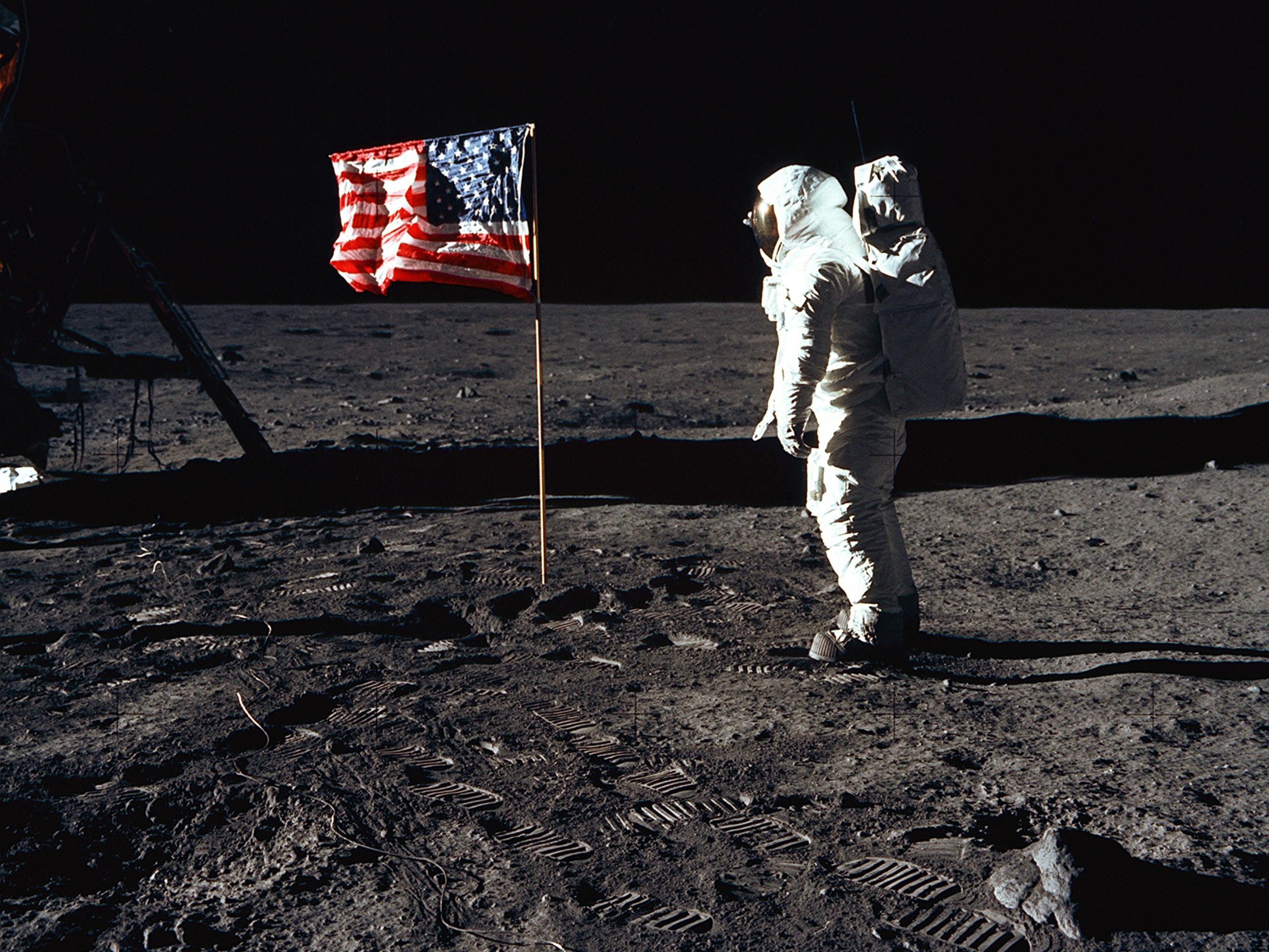
Old Glory saluted by first man on the moon.
 All Things Environmental
Recent Comments