
Vanuatu Blames Global Warming as Cyclone Pam Causes Nation’s Worst Climate Disaster in Recent Memory
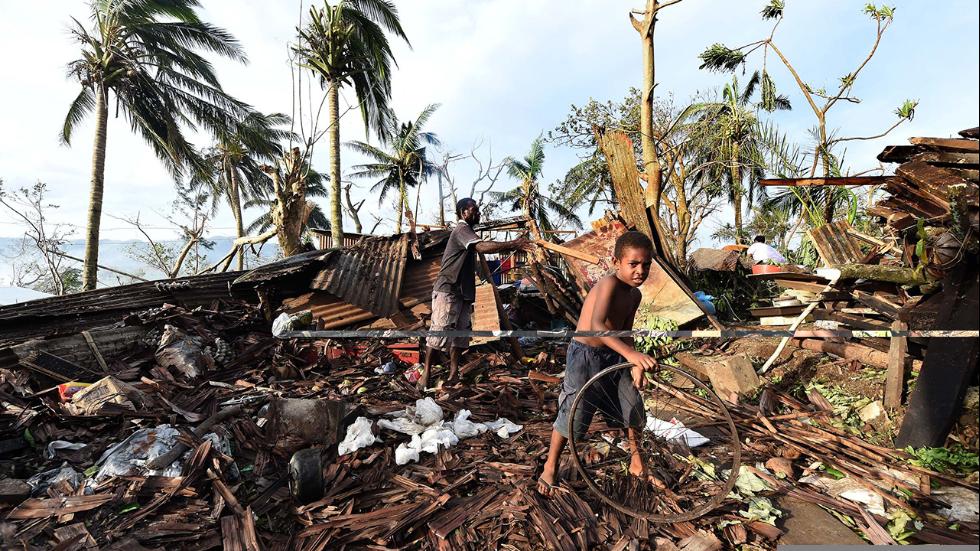
Report from DemocracyNow.org. March 17, 2015:
About half the population of the South Pacific Island nation of Vanuatu has been left homeless by a devastating cyclone that struck on Friday, flattening buildings, washing away roads and bridges. Cyclone Pam was a Category 5 storm comparable in strength to Typhoon Haiyan, which hit the Philippines two years ago and killed more than 6,000 people. Now aid agencies say as many as eight people were killed during Cyclone Pam, and the death toll is expected to rise as rescuers reach more far-flung areas. Vanuatu has a population of about 250,000 people and is made up of more than 80 islands.
During the storm, Vanuatu’s President Baldwin Lonsdale was in Japan attending a U.N. conference on disaster reduction. Speaking Monday before he left to return home, he said the cyclone seasons his nation had experienced are directly linked to climate change, and described the extent of the damage.
Many of the buildings and houses has been completely destroyed. More than 90 percent of the buildings have been destroyed. People still haven’t come through yet.
Disaster relief officials and relief workers are still trying to establish contact with Vanuatu’s remote islands that bore the brunt of Cyclone Pam’s winds of more than 185 miles per hour. Following are comments of the president of Vanuatu’s Red Cross, Hannington Alatoa:
“It is unknown, to the extent of the people, the number of people affected in the outer parts of the country, outside Port Vila. Agencies are estimating approximately 130 [thousand] people—that is more than half the population of the country—may have been affected by Cyclone Pam. I think that there will be a lot more when the assessment is done and the investigation is completed, because, as I said earlier, the whole country was flattened.”
Cyclone Pam also caused major damage on other Pacific islands, including Kiribati and the Solomon Islands. UNICEF says the number of children who have been displaced or affected by the cyclone may be as high as 60,000.
Vanuatu is a country made up of over 80 islands, 65 of which are inhabited. It’s in the Pacific, South Pacific Ocean. It’s probably about three hours’ flying time directly east of the east coast of Australia. So it’s a very remote place. The capital, Port Vila, has a population of around 45,000 to 50,000 people, it has a total population of about 260,000, spread out over those outer islands.
Port Vila has been badly affected. Communications are up to Port Vila, so we are able to see what is going on there. And we’re seeing sort of 80 to 90 percent of buildings damaged. And in the sort of poorer shantytown areas of Port Vila, we’re seeing massive destruction to homes. And we’re seeing significant damage to other infrastructure, such as roads being washed away by the high seas and bridges being destroyed by high rivers and as a result of flooding.
90 percent have been damaged in Port Vila. Not all of those have been flattened. So the buildings that have concrete structures are still standing, but most of those have had their roofs ripped off. So, I think, still, in terms of, actually, what I’m seeing in terms of formal figures for casualties, it’s still sitting at eight, but that’s people in central Port Vila. I still think that the figures haven’t flown through from elsewhere. And obviously we’re not yet getting information from those outer islands, where we can just imagine that the situation is going to be grave. There has been some—now, some initial, first initial assessment to Tanna island, which is the major island in the South that was directly hit, and some aerial surveillance work there, and that is painting quite a grim picture in terms of the devastation to the housing and to the infrastructure, and anecdotal reports of people saying that they are lacking, you know, food and health facilities and those sorts of things.
About half the population of the South Pacific Island nation of Vanuatu has been left homeless by a devastating cyclone that struck on Friday, flattening buildings, washing away roads and bridges. Cyclone Pam was a Category 5 storm comparable in strength to Typhoon Haiyan, which hit the Philippines two years ago and killed more than 6,000 people. Now aid agencies say as many as eight people were killed during Cyclone Pam, and the death toll is expected to rise as rescuers reach more far-flung areas. Vanuatu has a population of about 250,000 people and is made up of more than 80 islands.
During the storm, Vanuatu’s President Baldwin Lonsdale was in Japan attending a U.N. conference on disaster reduction. Speaking Monday before he left to return home, he said the cyclone seasons his nation had experienced are directly linked to climate change, and described the extent of the damage. Many of the buildings and houses has been completely destroyed. More than 90 percent of the buildings have been destroyed. People still haven’t come through yet. They still have wariness, have emotional feelings. But it will take time.
As the Pacific Island nation of Vanuatu is devastated by Cyclone Pam, 350.org co-founder Bill McKibben links the storm to global warming and responds to the new decision by the the United Nations Framework Convention on Climate Change to back the fast-growing divestment campaign to persuade investors to sell off their fossil fuel assets. This comes as University of Oxford alumni, donors and students are watching a vote set for today on whether the school will divest its endowment from the top 200 companies involved in exploring or extracting fossil fuels. McKibben also discusses news from NASA that California’s water supply could be exhausted by next year. Meanwhile, the environmentalist and former Maldives President Mohamed Nasheed has been sentenced to 13 years in prison after he was found guilty of ordering the arrest of a judge while in office. Nasheed became famous in 2009 for holding a cabinet meeting underwater to show the threat of climate change to his island nation. McKibben is the author of several books, including “Earth: Making a Life on a Tough New Planet.” 350.org has been posting updates about the situation in Vanuatu on its live blog at 350.org.
The picture is extraordinarily grim. Port Vila, the capital city and the place with most of the infrastructure, took a huge hit. But the winds were higher, the seas were higher and the infrastructure much flimsier, to begin with, on many of the outlying islands, so the picture, I’m afraid, is going to get a lot worse before it gets better.
The tragedy, the bottom-line tragedy here, as in so many other places around the world, is that Vanuatu’s development has been put back decades with this destruction of roads, bridges, hospitals, schools. This is what’s happening now around the world as people begin to kind of run on a tilted treadmill trying to develop on a disintegrating planet.
And the people in Vanuatu know exactly what the culprit is. You know, in one of the most beautiful demonstrations of the climate change era, last summer Vanuatu and 10 other Pacific Islands’ Pacific Warriors, 350’s Pacific Warriors, built indigenous traditional canoes and took them off to Newcastle in Australia, the largest coal port in the world, and used them to blockade the great coal ships in an effort to demonstrate exactly what Cyclone Pam also demonstrated—the incredible vulnerability of so many of the poorest people in the world to the rising temperatures that we’re inflicting on our one Earth.
If you’re low to the water on an island nation and the sea level starts going up, that makes everything that happens, every cyclone that comes, that much more dangerous. Even without a cyclone, in the Pacific earlier this month, the huge king tides in Kiribati flooded many, many homes and villages. Add to that things like the ongoing heating and acidification of the oceans’ waters and the concomitant erosion of coral reefs around the world. In many of these nations, coral reefs provide the best defense against a raging ocean. And that defense is breaking down everywhere. Add to that the fact that we keep seeing these super typhoons, super cyclones. You know, warm air holds more water vapor than cold. It allows, in arid areas, for more evaporation, and hence more drought. We’ll talk about California in a second. But once that water is up in the air, it’s going to come down someplace. And so, we see, from Boston, which just set yesterday the all-time record for snowfall, to places that are getting hammered by big storms, we’re seeing more and more and more devastating downpour. This is a worldwide problem. But, of course, places like Vanuatu are at the very sharpest end of the stick because they are so, so vulnerable.
Aid agencies say conditions in cyclone-ravaged Vanuatu are among the most challenging they have faced.
Relief flights – including from Australia – have begun arriving in the battered capital Port Vila after Cyclone Pam tore through on Friday, packing wind gusts of up to 320km per hour.
But workers on the ground say there’s no way to distribute supplies across the archipelago’s 80 islands, warning it will take days to reach remote villages.
The Save the Children agency says the challenges are worse than Super Typhoon Haiyan, which struck the Philippines in 2013, killing more than seven thousand people.
Up to 50 people are reported to have been killed by Cyclone Pam, which brought winds of nearly 300 kilometres per hour when it struck Vanuatu, levelling homes, smashing up boats, destroying roads and bridges, and bringing down power and phone lines.
But aid agencies say the real number is expected likely to be much higher as rescuers reach the outlying islands.
Thousands have been left homeless on the archipelago.
A Red Cross spokesman described the situation as ‘apocalyptic’ and Vanuatu’s government has declared a state of emergency.
President Baldwin Lonsdale, who happened to be at a disaster risk conference in Japan, compared the storm to a monster.
He said most houses in the capital Port Vila had been damaged or destroyed.
President Lonsdale said the impact would be ‘the very, very, very worst’ in isolated outer islands but he held out hope the number of casualties would be ‘minor’.
He had earlier made a tearful appeal for international assistance.
Aid workers were particularly concerned about the southern island of Tanna, about 200 kilometres south of the capital, Port Vila.
An official with the Australian Red Cross said an aircraft had managed to land there and confirmed ‘widespread destruction’.
‘Virtually every building that is not concrete has been flattened,’ the official said.
Witnesses in Port Vila described sea surges of up to 8m and widespread flooding.
Residents said the storm sounded like a freight train, with Port Vila left strewn with debris.
Jackson Browne sing “Walls and Bridges” song from “in the Breach” CD.
Pete Seeger’s “My Rainbow Race” – His Award Winning Environmental Song

I hadn’t heard many of Pete Seeger’s songs over the years, not having followed folk music as intensely as I have followed rock and roll music. I knew he sang with Woody Guthrie, who wrote and made “This Land is Your Land”. I knew he was always an activist fighting for unions, social justice, civil rights, and environmental causes later in his life. So when I heard that he died, I tuned into http://www.WORTFM.org community radio, because I knew they would be playing many of his songs. I knew that, because I remember when John Lennon was killed in 1980 in NYC, I was listening to WORT when it was announced. It was sad, it was quiet for awhile, and then it was NON-STOP John Lennon and Beatles music the rest of the night on the radio for me. No commercials and very little other talk as well. But I digress. Anyway, of course they were playing Pete Seeger – “If I had a Hammer“.
Recently, I checked out a Seeger CD at the library simply called “Pete”. The music was recorded in the 1960’s. It had a song called “My Rainbow Race” which caught my attention. I read the liner notes from Pete Seeger on the booklet that came with the CD and he said he wrote the song in response to seeing and ad for people to submit song lyrics and the songwriter whose lyrics were chosen the winner would win an all expenses paid trip to Japan. Unfortunately, his song (“My Rainbow race”) didn’t win because he never heard back but he was glad he wrote the song anyway because he included it in his concerts the following 20 years!
Pete Seeger (May 3, 1919 – January 27, 2014) was inducted into the Rock and Roll Hall of Fame in 1996. He is credited with reviving and ensuring the survival of folk music. With the possible exception of Woody Guthrie, Seeger is the greatest influence on folk music of the last century. Born in New York City, he was the son of musicologist Charles Seeger. He took up the banjo in his teens and in 1938, at the age of 19, assisted noted folk archivist and field recorder Alan Lomax on his song-collecting trips through the American South. He soon began performing on banjo, guitar and vocals. In 1940, he formed a highly politicized folk trio, the Almanac Singers, which recorded union songs and antiwar anthems. They toured the country, performing at union halls for gas money, and recorded three albums. Woody Guthrie joined in 1941.
The Almanac Singers broke up with the advent of World War II. After a short stint in the army, Seeger formed the Weavers in 1948. They were a popular concert attraction who were at one point America’s favorite singing group. Their best-known numbers include such singalongs as “The Roving Kind,” “On Top of Old Smoky,” “Kisses Sweeter than Wine,” “Goodnight Irene” and “Wimoweh” (a.k.a. “The Lion Sleeps Tonight”). Their popularity cut across all boundaries. As American poet Carl Sandberg attested, “The Weavers are out of the grassroots of America. When I hear America singing, the Weavers are there.”
During the communist witch-hunts of the early Fifties, however, the Weavers were blacklisted, resulting in canceled concert dates and the loss of their recording contract with Decca Records. Under congressional subpoena to testify before the House Un-American Activities Committee, Seeger asserted his First Amendment rights, scolding the committee, “I am not going to answer any questions as to my associations, my philosophical or my religious beliefs, or how I voted in any election or any of these private affairs. I think these are very improper questions for any American to be asked.” Unlike many entertainers and writers who careers were ruined in the McCarthy era, Seeger stood his ground and persevered – even though he was sent to jail, albeit briefly, for defending his beliefs.
After leaving the Weavers in 1959, Seeger was signed to Columbia Records. He recorded prolifically for the label. His popularity hit a new peak with We Shall Overcome, a live album recorded at Carnegie Hall that is estimated to have sold half a million copies. Seeger is responsible for such folk standards as “If I Had a Hammer” (originally written by Seeger and Lee Hays of the Weavers as “The Hammer Song”) and “Where Have All the Flowers Gone.” Seeger’s one dalliance with the pop charts came in 1964, when his version of folksinger Malvina Reynolds’ exercise in suburban mockery, “Little Boxes,” reached #70. Seeger’s songs were also popularized by others, principally Peter, Paul and Mary (“If I Had a Hammer,” “Where Have All the Flowers Gone”) and the Byrds (“Turn! Turn! Turn!,” “The Bells of Rhymney”).
Though he had objected to Dylan’s use of electric instruments at the Newport Folk Festival in July 1965, Seeger himself recorded with electric guitarist Danny Kalb (of the Blues Project) two years later on his album Waist Deep in the Big Muddy and Other Love Songs. Seeger, with his outspoken commitment to the peace movement, often wrote directly or metaphorically of the Vietnam war in the Sixties. A tireless champion of causes, Seeger has devoted himself to environmental issues, particularly the cleanup of his beloved Hudson River.
In Seeger’s capable hands, from the Forties to the present day, a concert isn’t regarded as a one-way proceeding but a group singalong. Indeed, Seeger’s gently assertive insistence that his audience sing out can be read as a larger metaphor for the necessary involvement of citizens to insure the healthy functioning of democracy in America. Seeger has recorded and performed tirelessly throughout his career, honoring the folksingers’ timeless commitment to spread the word and involve an audience. “My ability lies in being able to get a crowd to sing along with me,” he said in a 1971 interview. “When I get upon a stage, I look on my job as trying to tell a story. I use songs to illustrate my story and dialogue between songs to carry the story forward.”
Pete Seeger passed away on January 27, 2014. He was 94.
One blue sky above us, one ocean lapping all our shore
One earth so green and round, who could ask for more?
And because I love you I’ll give it one more try
To show my rainbow race, it’s too soon to die
Some folks want to be like an ostrich
Bury their heads in the sand
Some hope that plastic dreams
Can unclench all those greedy hands
Some hope to take the easy way
Poisons, bombs, they think we need ’em
Don’t you know you can’t kill all the unbelievers?
There’s no shortcut to freedom
One blue sky above us, one ocean lapping all our shore
One earth so green and round, who could ask for more?
And because I love you I’ll give it one more try
To show my rainbow race, it’s too soon to die
Go tell, go tell all the little children
Tell all the mothers and fathers too
Now’s our last chance to learn to share
What’s been given to me and you
One blue sky above us, one ocean lapping all our shore
One earth so green and round, who could ask for more?
And because I love you I’ll give it one more try
To show my rainbow race, it’s too soon to die
One blue sky above us, one ocean lapping all our shore
One earth so green and round, who could ask for more?
Woody Guthrie – This Land is Your land
Friends of Woody Guthrie sing This Land is Your Land
Emperor Walker Wearing No Clothes When It Comes to Wisconsin’s Natural Resources

Actually, this emperor has no clothes.
Wisconsin citizens have got to realize that Wisconsin’s governor has not had the best interests of the state at heart when it comes to natural resources issues, including the effects of rising greenhouse gas concentrations in the atmosphere’s significance to Wisconsin’s natural, economic and human resources in the absence of timely action by their governmental officials.
This politician looks only ahead to the next election. Our part-time governor has his attention turned to Iowa, New Hampshire and any road leading to Washington, D.C.
His tracks are the proposed budget that will leave scars on the state.
For a state with the legacy of people like Aldo Leopold, John Muir, Gaylord Nelson, and Warren Knowles, it is an embarrassment that Gov. Walker would submit a budget that:
• Strips the Natural Resources board of its authority, making it advisory only to the DNR – leaving all decisions up to the DNR secretary;
• Eliminates 18 research scientists from the DNR Sciences Services Bureau;
• Eliminates environmental education programs;
• Places a moratorium on land buying through the Stewardship Fund.
The problem is that politicians care about money brought into their campaigns, and getting re-elected.
That is why the Natural Resources Board was established originally: to keep natural resources governance at arm’s length from politicians. The NRB (citizens who in the past came together to put natural interests foremost), can make decisions taking into account biological and sociological information.
The NRB was also charged with hiring a DNR secretary, but Tommy Thompson and Jim Doyle looked to their self-interest and changed a system that worked well since 1927.
Now Scott Walker has manipulated the system, put politicians in charge of the DNR, silenced scientists, and changed agency priorities from natural resource protection to job creation.
How long can people who hunt, fish, trap, bird watch, hike, camp, and enjoy the state’s scenery, sit on their hands while the governor trashes our state?
Source: original article by Tim Eisele, Wisconsin Outdoor News, February 28, 2015
Note: “Emperor’s New Clothes” is an old children’s story by Hans Christian Andersen about an emperor who pays a lot of money for some new magic clothes which can only be seen by wise people. The clothes do not really exist, but the emperor does not admit he cannot see them, because he does not want to seem stupid. Everyone else pretends to see the clothes too, until a child shouts, “The Emperor has no clothes on!”
Need for a Land Ethic: The Aldo Leopold Legacy

“The land ethic simply enlarges the boundaries of the community to include soils, waters, plants, and animals, or collectively: the land.”- Aldo Leopold
Published in 1949 as the finale to his book “A Sand County Almanac”, Leopold’s “land ethic” defined a new relationship between people and nature and set the stage for the modern conservation movement.
Leopold understood that ethics direct individuals to cooperate with each other for the mutual benefit of all. One of his philosophical achievements was the idea that this ‘community’ should be enlarged to include non-human elements such as soils, waters, weather, plants, and animals, “or collectively: the land.”
“That land is a community is the basic concept of ecology, but that land is to be loved and respected is an extension of ethics”, he said. This recognition, according to Leopold, implies individuals play an important role in protecting and preserving the health of this expanded definition of a community.
“A land ethic, then, reflects the existence of an ecological conscience, and this in turn reflects a conviction of individual responsibility for the health of land”, Leopold said. Central to Leopold’s philosophy is the assertion to “quit thinking about decent land use as solely an economic problem.” While recognizing the influence economics have on decisions, Leopold understood that ultimately, our economic well being could not be separated from the well being of our environment. Therefore, he believed it was critical that people have a close personal connection to the land.
“We can be ethical only in relation to something we can see, feel, understand, love, or otherwise have faith in”, he said.
Leopold’s “A Sand County Almanac” has prompted generations of people to take better notice – and care – of the natural environment. Aldo Leopold (January 11, 1887 – April 21, 1948) was the first research director at the University of Wisconsin Madison Arboretum and was closely involved in its design.
Madison Reads Leopold begins at 9:30 am at the Arboretum this Saturday, March 7, 2015 and is free and open to the public. Light refreshments will be available in the visitor center lobby. Brown-bagging is permitted but food must remain in the Visitor Center.
Madison Reads Leopold is a community celebration organized for to celebrate the life and legacy of Aldo Leopold and is sponsored by the Aldo Leopold Foundation.
The name “Aldo Leopold Weekend” has its roots in Wisconsin, where it is held annually the first full weekend of March has that official designation and Wisconsin communities across the state coordinate events that all happen at the same time. Leopold-themed events have spread far beyond the borders of Wisconsin since the event’s inception in 2000, and are now celebrated across the nation in various ways and at various times throughout the year! Events planned for the Madison celebration include a showing of the Green Fire film., an excellent documentary on the history of the environmental movement in the United States. At the Madison UW Arboretum there will also be readings from “A Sand County Almanac”, Leopold bench building workshops, round table discussions followed by hikes through the Arboretum itself. In short, lots of great things! The event in Madison is scheduled to go to 4 PM Saturday.
Wisconsin Legislature Votes to Call “Extraordinary Sessions” for Wrong Reasons

Organizing committees of both the Wisconsin Senate and Wisconsin Assembly called both houses of the Wisconsin legislature into extraordinary sessions this week to pass a “right-to-work” bill, making it illegal for employers and labor unions to charge their employees and any new employees union dues as a condition of accepting employment. The Wisconsin State Journal reported in today’s newspaper edition that the full Senate could vote on this highly charged legislation (Senate Bill 44) as early as Wednesday and the Wisconsin Assembly could vote on this legislation (AB 61) as soon as Monday.
Governor Scott Walker has said he would sign the bill into law.
The Senate and Assembly organizing committees ought have called their “extraordinary” sessions to address what the State of Wisconsin ought do to protect its citizens from global warming and climate change instead. Greenhouse gas emissions, global warming and climate change are far more significant to the future of Wisconsin than are unions charging union dues in the state.
Positive Incentives Plan Wages Three-Prong-Attack Against Climate Change

Please refer to “About this Blog” before proceeding.
The planet Venus is on the left; Earth is on the right. Nobody wants to see Earth go the route its that its commonly called twin planet Venus took, eons ago. You see Venus once had oceans of water, too, just like Earth does. But something went very wrong on the surface of Venus (possibly it is because the Sun got hotter), which started a “runaway greenhouse effect”. The oceans of water Venus once had boiled away. As temperatures began rising ocean water converted to water vapor, also a strong greenhouse gas. The water vapor increased the effectiveness of heat trapping and accelerated the greenhouse effect, which caused the temperature at the surface to rise further, thus causing the oceans to evaporate faster, etc., etc. This type of runaway is also called a “positive feedback loop”. When the oceans were gone the atmosphere finally stabilized at a much higher temperature and at much higher density, making the planet uninhabitable.
The sobering warning for us is obvious: we have to be extremely concerned about processes such as burning of fossil fuels in large volumes that might have the potential to trigger a runaway greenhouse effect and produce on the Earth atmospheric conditions that are incapable of supporting life.
That is why it is so essential that we initiate actions now, worldwide, to curb all forms of unnecessary activity that causes the greenhouse effect in our atmosphere to strengthen (meaning an increase concentrations of greenhouse gases). Carbon dioxide (CO2), a greenhouse gas, has increased in concentration in the atmosphere from 280 parts per million (ppm) in the 1880’s to 400 ppm today – mainly the result of humans burning coal, oil. and natural gas, the combustion producing significant amounts of (invisible) CO2.
As a result, the global average annual temperature of the Earth at the surface has risen, the temperature of Earth’s oceans have been increasing and, as a result of the ice melting off of the island of Greenland, the continent of Antarctica, and water runs down the mountainous glaciers on practically all the continents, and the property of the thermal expansion of water, Earth’s oceans levels are rising.
Meanwhile, the Earth’s once solid permafrost region, which is approximately 1/5 of the Earth’s surface, is now thawing in many places, decomposing,and releasing methane to the atmosphere, a greenhouse gas 37 times as strong as CO2 in trapping heat.
Furthermore, replacement of large areas of ice and white snow surface (ice cap) on the Arctic Ocean means the open Arctic ocean water absorbs more of the radiant heat from the Sun, causing the ice and snow to melt even faster still, an so on. If it were not for the vast amounts of ice in the Arctic Ocean, the water would warm even faster.
It is essential that people and businesses, the world over, especially those in countries burning vast quantities of fossil fuels, in power generation, motorized transportation and jet travel, for human travel and shipping, find alternatives that don’t burn fossil fuels for their pursuits. Presently, citizens from the United States fly 40% more than citizens from other countries, and more U.S. citizens are buying gas guzzling SUVs and pickup trucks than more fuel efficient vehicles – because gas is “cheap” again, They remain apathetic about global warming, or are members of the “Earth is flat” society. As John Lennon once said, “apathy is it”. The Earth is also round. Above all, we need to Conserve, NOW!
Wisconsin Must Join the All Out World Effort to Fight Global Climate Change Without Delay, BEFORE Time Runs Out

Wisconsin has traditionally prided itself as being a state that “cares”. Wisconsin residents care about its wild and domestic animals, its fish, birds and butterflies; its plants, trees, and its forests; its tens of thousands of lakes, streams and rivers, and the quality of its wetlands, groundwater and air; its mighty bluffs and gorges, its remaining prairies, and the state’s overall majestic scenic beauty.
Wisconsin has traditionally had a strong manufacturing economy, a top notch agricultural industry, a public education system second to none, a world class university system, and an equally top notch private schools, colleges, and other educational institutions. Wisconsin also boasts an excellent highway, airport, and bicycle transportation system, and communities that are walking and wheelchair friendly. It has always held all visitors to the state in high regards and treated them with respect the production and sustainability of its farms, the well being of its human population, without regard for race, heritage or creed. Wisconsinites treat visitors to their state with respect and dignity,satisfaction of its visitors and transients alike, and, perhaps above all, in leaving its land, water and its economy better condition than they received it. In a nutshell, that’s a statement of Wisconsin’s traditions and value, as I have come to know them.
Wisconsin residents often boast, and rightly so, that Wisconsin was the home of such renown conservationists and humanists as John Muir, Aldo Leopold, Senator Gaylord Nelson, Midge Miller and Vel Phillips. In the 1970s, Wisconsin was emulated by other states as the state to look at for developing effective environmental protection regulations to safeguard its treasures. With Wisconsin Departmental Resource Secretary Anthony “Tony” Earl at the helm, who would later become Wisconsin’s governor, and George “Knute” Knudson as its chief naturalist, Wisconsin natural resources were in good hands.
It is no exaggeration to say that all this is at risk the longer our Wisconsin Legislature, our governor, other state legislatures and governors, and the people’s representatives in the United States Congress continue to kick the issue of excess fossil fuel burning and greenhouse gas production by Americans down the road. What we don’t need is more highway development and expansion and more airport capacity expansion that encourage even more fossil fuel burning by the public. What we don’t need is more trade with distant countries that requires more fuel for shipping and flying. What we don’t need are more coal and natural gas burning power plants and the thousands of miles of high voltage transmission lines that go with them, and not Wisconsin power companies who restructure their rates in favor of more fossil fuel burning, thus discouraging their customers from investing in solar energy panels for their homes and businesses, and having the governor’s appointed Wisconsin Public Service Commission (the PSC) “rubber stamps” the fossil-fuel-dependent utilities’ proposals.
We are wasting valuable time and money by not relying less and less on fossil fuel dependent energy, and more on either energy conservation or on conversion to solar and wind generated power, in our homes, businesses and institutions; and that we desperately need to reduce aggregate driving and flying, which rely almost exclusively on burning fossil fuels that, when subject to combustion, release large quantities of greenhouse gases, especially carbon dioxide (CO2), to the atmosphere. Most of the greenhouse gases, such as CO2, remain in the atmosphere for centuries, accumulating to increasingly more ominous concentration levels, or they get absorbed in the oceans, making the earth’s ocean water more acidic, harming the biological species in the oceans.
But scientists the world over are in agreement that the rising concentrations of greenhouse gases from significantly increased fossil fuel burning by humans since the time of the Industrial Revolution (early 1800’s) have remained in earth’s atmosphere, trapping more and more of the Sun’s radiant energy and changing it into heat energy, causing the earth’s surface to warm, melting more of the polar ice caps and mountain glaciers, causing the vast permafrost region to thaw, releasing more and more methane gas, another greenhouse gas that’s known to have 37 times the heat-trapping power of CO2.
Scientists don’t know when global warming could begin accelerating, but it could be any day now. What they do know is that there are higher concentrations of greenhouse gases in the atmosphere now to push global surface temperatures much higher than what we have experienced thus far. Time is of the essence for the world’s populations who are relying on fossil fuel burning for energy to stop adding even higher concentration levels of greenhouse gases to the atmosphere, risking setting off positive feedback mechanisms in the system that could worsen the situation and amplify the weather extremes global warming has already caused in earth’s climate.
Higher Sea Level Projections Required Along U.S. Coasts
President Barack Obama issued an executive order on Friday,January 30, 2015, directing federal, state and local agencies to incorporate projections for sea level rise in planning and construction along the coasts.
The new Federal Flood Risk Management Standard requires that all federally funded projects located in floodplains, including buildings and roads, be built to withstand flooding. The requirement, the White House said in a release Friday, would “reduce the risk and cost of future flood disasters” and “help ensure federal projects last as long as intended.”
“It is the policy of the United States to improve the resilience of communities and Federal assets against the impacts of flooding,” the order states. “These impacts are anticipated to increase over time due to the effects of climate change and other threats. Losses caused by flooding affect the environment, our economic prosperity, and public health and safety, each of which affects our national security.”
According to the National Oceanic and Atmospheric Administration (NOAA), the U.S. can expect to see up to two feet of sea level rise by the end of the century, largely due to climate change. Warmer temperatures are causing thermal expansion in the oceans, as well as the melting of sea ice, which is pushing sea levels higher globally. A study from the U.S. Geological Survey found that half of the U.S. coastline is at high or very high risk of impacts due to sea level rise.
This is a significant shift, as agencies have typically used historic information on sea level and flooding for planning, rather than future projections. The order directs agencies to use the “best-available, actionable hydrologic and hydraulic data and methods that integrate current and future changes in flooding based on climate science” when evaluating what is in the flood plain. They also have the option of building 2 feet above current base flood elevations for “non-critical” infrastructure and 3 feet above for “critical” infrastructure, or building to the standard of the 500-year flood (a flood with an estimated 0.2 percent chance of happening in any given year).
The Task Force on Climate Preparedness and Resilience released a set of recommendations last November, and establishing this type of guideline was among them. Most coastal regions of the United States will see 30 or more days of flooding by 2050 as a result of sea level rise, according to NOAA predictions.
NOAA’s researchers looked at the anticipated frequency of what the National Weather Service considers nuisance flooding, which are floods that are 1 to 2 feet over the regular local high tide and are enough to cause problems but not pose active threats to human life. Some areas of the U.S. are already seeing increased flooding, the researchers said, and it’s only going to get worse.
“Coastal communities are beginning to experience sunny-day nuisance or urban flooding, much more so than in decades past. This is due to sea level rise,” William Sweet, an oceanographer at NOAA’s Center for Operational Oceanographic Products and Services and the report’s coauthor, said in a statement. “Unfortunately, once impacts are noticed, they will become commonplace rather quickly.”
The research was published in the American Geophysical Union’s peer-reviewed online journal Earth’s Future. The projections are based on data from NOAA tidal stations with at least a 50-year continuous record. Warming global temperatures cause thermal expansion of the oceans and also melt ice sheets, leading to sea level rise. The researchers also note that while much of the rise is fueled by climate change, there are parts of the country where the land is sinking as well, adding to the challenge.
The low-end expectations for sea level rise from the researchers’ analysis project a 1.5 feet increase by 2100. Sweet said that within 30 to 40 years even that low-end projection would increase flooding in many areas “to a point requiring an active and potentially costly response.” And by the end of the century, Sweet said, “there will be near-daily nuisance flooding in most of the locations that we reviewed.” The high-end projections of sea level rise they looked at would put the increase much higher, at 4 feet.
Among the places that can expect flooding sooner rather than later, according to the study: Boston, New York City, Philadelphia, Baltimore, the District of Columbia, San Diego and San Francisco.
Obama’s 2015 State of the Union Speech Shows U.S. Lacks Adequate and Timely Climate Change Plan

President Barack Obama said in his 2015 State of the Union speech last Monday that his first duty as Commander-in-Chief is to defend the United States of America. Presumably, he meant defend our country against foreign aggressors attempting to inflict military harm to our citizens, properties, infrastructures and country as a whole.
President Obama also said in that “as Americans, we have a profound commitment to justice”.
He also stated that “for all that we’ve endured; for all the grit and hard work required to come back; for all the tasks that lie ahead, know this: The shadow of crisis has passed, and the State of the Union is strong.”
But the shadow of crisis Barack was speaking about was clearly an economic one, not the shadow of the global warming and accompanying environmental crisis. In fact, our current and future climate is at least as important, if not more so, then our economy. We nor any other countries would have much of an economy at all if Earth’s temperatures started to rapidly accelerate, in response to our continued loading of the atmosphere with greenhouse gases. Our country needs to take much more forceful and immediate actions to limit our daily emissions. We are causing a great injustice to the rest of the world and to all succeeding generations if we don’t. But that is what will result if we don’t start reducing our emissions by taking unprecedented actions. We will need to reduce our greenhouse gas emissions to as close to zero as we can get them.
Barack Obama said this in his speech: “And no challenge — no challenge — poses a greater threat to future generations than climate change.” For those needed convincing, he elaborated as follows:
“2014 was the planet’s warmest year on record. Now, one year doesn’t make a trend, but this does — 14 of the 15 warmest years on record have all fallen in the first 15 years of this century.”
“I’ve heard some folks try to dodge the evidence by saying they’re not scientists; that we don’t have enough information to act. Well, I’m not a scientist, either. But you know what — I know a lot of really good scientists at NASA, and NOAA, and at our major universities. The best scientists in the world are all telling us that our activities are changing the climate, and if we do not act forcefully, we’ll continue to see rising oceans, longer, hotter heat waves, dangerous droughts and floods, and massive disruptions that can trigger greater migration, conflict, and hunger around the globe. The Pentagon says that climate change poses immediate risks to our national security. We should act like it.”
He then talked about his accomplishments so far on the climate change front:
“That’s why, over the past six years, we’ve done more than ever before to combat climate change, from the way we produce energy, to the way we use it. That’s why we’ve set aside more public lands and waters than any administration in history. And that’s why I will not let this Congress endanger the health of our children by turning back the clock on our efforts. I am determined to make sure American leadership drives international action. In Beijing, we made an historic announcement — the United States will double the pace at which we cut carbon pollution, and China committed, for the first time, to limiting their emissions. And because the world’s two largest economies came together, other nations are now stepping up, and offering hope that, this year, the world will finally reach an agreement to protect the one planet we’ve got.”
But it is questionable whether such an agreement at this late stage of the game – the first Climate Summit was held in Rio de Janeiro, Brazil, in 1992 – 24 years ago can be enough to return to sustainability. Greenhouse gases accumulate in the atmosphere over time; they don’t just dissipate and vanish.
Barack closed out his speech with:
“Looking to the future instead of the past. Making sure we match our power with diplomacy, and use force wisely. Building coalitions to meet new challenges and opportunities. Leading — always — with the example of our values. That’s what makes us exceptional. That’s what keeps us strong. And that’s why we must keep striving to hold ourselves to the highest of standards — our own.”
“My only agenda for the next two years is the same as the one I’ve had since the day I swore an oath on the steps of this Capitol — to do what I believe is best for America.”
“I want our actions to tell every child, in every neighborhood: your life matters, and we are as committed to improving your life chances as we are for our own kids.”
“I want future generations to know that we are a people who see our differences as a great gift, that we are a people who value the dignity and worth of every citizen — man and woman, young and old, black and white, Latino and Asian, immigrant and Native American, gay and straight, Americans with mental illness or physical disability.”
“I want them to grow up in a country that shows the world what we still know to be true: that we are still more than a collection of red states and blue states; that we are the United States of America.”
“My fellow Americans, we too are a strong, tight-knit family. We, too, have made it through some hard times. Fifteen years into this new century, we have picked ourselves up, dusted ourselves off, and begun again the work of remaking America. We’ve laid a new foundation. A brighter future is ours to write. Let’s begin this new chapter — together — and let’s start the work right now.”
“Thank you. God bless you. (Applause.) God bless this country we love. Thank you.”
The shadow of earth’s global warming crisis has not passed; it will be with all of us for a very long time; but with grit, hard work, ingenuity, by everyone, it may be overcome. We must be determined enough to turn the clock back on the greenhouse effect. Unless all of us care a whole awful lot, and start changing our ways, global warming will continue to worsen. Earth could ultimately become unlivable, for any kind of life.
Human Activities Adding to the Greenhouse Effect and Global Warming
It is of the utmost importance to the continued sustainability of life on earth that humans reduce the amount of greenhouse gases they cause to be emitted to the atmosphere to the minimum amount possible, over their lifetime, because greenhouse gases emitted to the atmosphere have a cumulative effect, meaning they increase in force by successive additions, resulting in a stronger greenhouse effect when those greenhouse gases combine with past, present, and future emissions, and cause the earth’s surface to warm, its polar cap and Antarctica ice to melt, as do Greenland and mountainous glacial ice, causing ocean water levels to rise, and the world ecology to be disrupted.
Full text of President Obama’s 2015 State of the Union Speech
Confirmed: 2014 Was Earth’s Hottest Year on Record
Ever since the horrendous loss of life, property and the desolation caused by Hurricane Katrina, which ravaged New Orleans and much of the Gulf of Mexico’s northern coastal lands and inland states in the U.S., and caused many deaths and injuries over the last few days of August 2005, people everywhere have become increasingly concerned about global warming causing more violent storms and causing other kinds of extreme weather (floods, droughts, heat waves), with the effects worsening and becoming more pronounced over time. For example, the gas carbon dioxide (CO2), which is a powerful GHG (and is invisible so we don’t see it) is emitted to the atmosphere in large quantities whenever large quantities of fossil fuels – such as coal, oil and natural gas – are combusted for heating or energy. CO2’s concentration level in the atmosphere has grown in magnitude from 280 parts per million (ppm) in the atmosphere during the 1800’s to 400 ppm in 2014, a 42% increase. Other GHGs have also accumulated along with rising CO2 concentrations, and their combined accumulated effect has caused the earth’s climate to change, now noticeably so, and mostly for the worse. Much of the change so far has been in the form of worsening extreme weather, such as stronger storms, heavier downpours and flooding, rising seas and warming surface waters. Other areas might be experiencing, hotter, longer and more deadly heat waves, and horrendous drought, such as the drought that has been taken place in the Southwestern U.S. over much of the last several years.
Hurricane Katrina, Hurricane Sandy, Super Typhoon Haiyan, severe rainfall and numerous tornadoes – all likely fueled by a warmer than normal atmosphere and warmer ocean water (plus the higher sea level) – are examples of what we can expect seeing more of in the future, if a moratorium were put in place worldwide today. [Hurricane Katrina was the deadliest and most destructive Atlantic tropical cyclone of the 2005 Atlantic hurricane season. It is U.S.’s costliest natural disaster, as well as one of the five deadliest hurricanes to hit U.S. land. At least 1,833 people died in the hurricane and subsequent floods and total property damage from Hurricane Katrina was estimated at $108 billion.] Greenhouse gas would continue to rise regardless of actions, increasing the costs, damages, human and animal lives lost due to the more hostile earth of the future. But things could get 10 times worse, and occur sooner if no action is taken. And things will get unbelievably bad the less we take action now to reduce overall GHGs added to the atmosphere, ever month.
Scientifically speaking, the greenhouse gases in the atmosphere keep our planet warm by absorbing and emitting radiation from the Sun through the process called the “greenhouse effect”. Without them, planet earth would be in a permanent frozen state, devoid of life. While a certain amount of some GHGs such as CO2 are necessary for life to prosper on earth, over the past few hundred years, humans have been adding to volume of GHGs in the atmosphere by increasing amounts, resulting primarily as a byproduct of their burning immense of fossil fuels, by extensive deforestation, and by their creation of immense amounts of methane from waste products, many from human waste disposal practices and from animal production and waste disposal. A melting permafrost region, which amounts to a fifth of the earth’s surface, is likely also contributing GHGs from anaerobic digestion.
The shear number of humans: billions of people who contribute only minor amounts of GHGs to the earth’s greenhouse effect because of the undeveloped nature of their economies, their lack of motorized travel, electricity, meat production, and consumption of foreign goods that require fossil fuel burning for shipment; and the millions who currently continue to cause the emission of billions of tons of greenhouse gases to our atmosphere, as if our atmosphere were just one large sewer, requiring no user fees for those who make massive GHG deposits over their lifetime.
As a result, the earth’s atmosphere is subject to what economist Garret Hardin called “the tragedy of the commons”. The tragedy of the commons occurs in situations in which multiple individuals, acting independently and rationally and in their own self-interest (in this case, burning fossil fuels in cars, airplanes, boats, buying products requiring mining, drilling, motorized transport, clear cutting…) ultimately deplete a shared limited resource (in this case, our atmosphere) even though it has become clear that it is not in anyone’s long-term interest, particularly for all future earth inhabitants, for this to happen. Ecologists and environmentalists often use the phrase “there is no free lunch” when people ignore the reality of the tragedy of the commons, and often expect Government to place limits on the activities that will otherwise lead to tragic consequences.
The year 2014 ranks as Earth’s warmest since 1880, according to two separate analyses by NASA and National Oceanic and Atmospheric Administration (NOAA) scientists released last Friday (Jan. 16). The 10 warmest years in the instrumental record, with the exception of 1998, have now occurred since 2000. This trend continues a long-term warming of the planet, according to an analysis of surface temperature measurements by scientists at NASA’s Goddard Institute of Space Studies (GISS) in New York.
In an independent analysis of the raw data, NOAA scientists also found 2014 to be the warmest on record. “NASA is at the forefront of the scientific investigation of the dynamics of the Earth’s climate on a global scale,” said John Grunsfeld, associate administrator for the Science Mission Directorate at NASA Headquarters in Washington. “The observed long-term warming trend and the ranking of 2014 as the warmest year on record reinforces the importance for NASA to study Earth as a complete system, and particularly to understand the role and impacts of human activity.”
Since 1880, Earth’s average surface temperature has warmed by about 1.4 degrees Fahrenheit (0.8 degrees Celsius), a trend that is largely driven by the increase in carbon dioxide and other human emissions into the planet’s atmosphere. The majority of that warming has occurred in the past three decades.
“This is the latest in a series of warm years, in a series of warm decades.
While the ranking of individual years can be affected by chaotic weather patterns, the long-term trends are attributable to drivers of climate change that right now are dominated by human emissions of greenhouse gases,” said GISS Director Gavin Schmidt.
While 2014 temperatures continue the planet’s long-term warming trend, scientists still expect to see year-to-year fluctuations in average global temperature caused by phenomena such as El Niño or La Niña. These phenomena warm or cool the tropical Pacific and are thought to have played a role in the flattening of the long-term warming trend over the past 15 years. However, 2014’s record warmth occurred during an El Niño-neutral year.
The GISS analysis incorporates surface temperature measurements from 6,300 weather stations, ship- and buoy-based observations of sea surface temperatures, and temperature measurements from Antarctic research stations. This raw data is analyzed using an algorithm that takes into account the varied spacing of temperature stations around the globe and urban heating effects that could skew the calculation. The result is an estimate of the global average temperature difference from a baseline period of 1951 to 1980.
RELEASE 15-01 – NASA, NOAA Find 2014 Warmest Year in Modern Record
 All Things Environmental
Recent Comments