
President Obama’s Executive Order Committing Federal Government to Cutting Its Greenhouse Gas Emissions

President Barack Obama signed an executive order on Thursday committing the federal government to cutting its own emissions 40 percent by 2025 and pledging to increase the amount of renewable energy used by federal agencies to 30 percent.
-
[This is a good addition but still not nearly enough. States and everyday Americans all have to greatly reduce the things they do that contribute to their daily and annual greenhouse gas emissions, as does the rest of the world. The U.S. still has the highest per capita GHG emissions. Forty percent of world travel by air (a large emitter of GHGs) is by American recreation and business travel pursuits. This has to change! Click on: “About this Blog” to read about how our government really could help make this happen – Power to the People]
The executive order builds on a previous administration directive to cut emissions from federal agencies 28 percent by 2020, compared with 2008 levels. “We are well on our way to meet that goal,” Brian Deese, senior adviser to the president, said in a call with reporters Thursday. “That’s what’s motivating us today to chart out a new and even more aggressive goal going forward.”
The administration is also setting a goal of cutting the per-mile emissions from the agencies’ vehicle fleet 30 percent, it said. It estimates the total commitment across the federal agencies will save taxpayers $18 billion — funds that won’t be spent on energy.
Christy Goldfuss, managing director of the Council on Environmental Quality, said that by the end of 2014, the federal government had cut emissions 17 percent since 2008, putting it well on the way to meeting Obama’s earlier goal. Much of that has come through energy efficiency improvements in federal buildings and with the installation of renewables.
As of the end of 2014, renewable energy accounted for 9 percent of the federal government’s energy use, and Thursday’s directive wants to increase that to 30 percent by 2025. The Department of Defense has set its own goal of deploying 3 gigawatts of solar energy on its installations around the world by 2025.
The federal government is the single largest energy user in the United States, Goldfuss said, with 360,000 buildings and 650,000 vehicles. “Not only is our footprint expansive, our impact is as well,” she said.
The administration also argued that the push to reduce emissions in the federal government has effects across the private sector as well. To that end, the administration also released a scorecard to track emissions from major federal contractors such as Lockheed Martin, Boeing and General Dynamics, which the administration is also calling on to make reductions.
The White House estimates that with reductions from the agency and those of private suppliers, the administration can cut greenhouse gas emissions by 26 million metric tons in the next 10 years.
“These goals will make sure the federal government is leading by example and pushing the envelope on cutting emissions,” said Deese, adding that it will “demonstrate that we are going to stay on offense in pushing our clean energy and climate change objectives.”
Lawmakers Calling for Stricter Rules for Trains Hauling Volatile Crude Oil to Ensure Public Safety
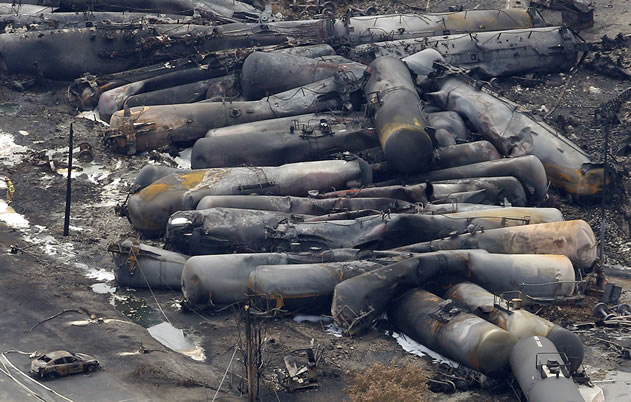
The wreckage after an oil train derailed and exploded in Lac-Mégantic, Quebec in July 2013.
When residents in the Quebec town of Lac-Mégantic describe the scene after an oil-train derailed and then exploded there last July, they say the burning petroleum was like a wall of fire, or a river of fire. The blaze, which burned for 36 hours, sent flames and smoke hundreds of feet into the air. At one point, the fire was pulling in so much oxygen that nearby trees were whipping about as if in a tropical storm. Several blocks from the blast site leaves turned an orange-red color from the overwhelming heat. It was early summer, but they looked like autumn foliage.
The explosions and fire destroyed some 40 buildings and killed 47 people, most of whom were enjoying live music at a popular cafe. Wooden homes along the lakeshore burned from the inside out as fire erupted out of water pipes, drains, and sewers. A 48-inch storm pipe that runs from the train yard to the nearby Chaudière River became a conduit for the petroleum, spewing flames and oil more than half a mile into the water. “It looked like a Saturn V rocket,” says Robert Mercier, director of environmental services in Lac-Mégantic. Manhole covers on the Boulevard des Veterans exploded as columns of fire shot into the air.
By the time the fire had been contained, the soil surrounding the blast site was a layer of grey ash. “It was like being on the moon,” says Sylvaine Perreault, an emergency responder who arrived early Saturday morning. “It was all dust.”
On Friday, July 5, a 79-car train carrying petroleum from North Dakota’s Bakken oil fields had been parked for the night on a modest but steady incline in the town of Nantes, seven miles outside of Lac-Mégantic. The sole engineer employed to secure the train and responsible for applying handbrakes in some of the cars left his shift at 11:25 p.m. At 11:30 p.m. a 911 call was made reporting a fire on one of the locomotives. Twelve firefighters from the town of Nantes arrived, along with two track-maintenance employees from Montreal, Maine & Atlantic, the company operating the train. They extinguished the fire and left the scene. Just before 1:00 a.m. the train began to roll down the incline. It eventually reached a speed of more than 60 miles per hour before it careened off the track toward the Musi Café nightclub and exploded.
Rejean Campagna, a 73-year-old Lac-Mégantic native, was awoken by the sound of the train screeching past his apartment and then of steel piling on steel. “As if somebody had a big drum of steel and was hammering on it with a sledgehammer right beside my window,” he told me. The train tracks are a scant 200 feet away from Campagna’s front window, and when he opened the blinds the first thing he saw was a large ball of fire. “It grew and grew and grew and then it mushroomed.”
Campagna and his wife, Claudette Lapointe, grabbed their pillboxes and cell phones and fled. The hood of their car was so hot that he couldn’t touch it. (According to Mercier, the heat could be felt for more than a mile.) From a safe distance, about a quarter-mile away, they watched as the town burned. In the early morning hours a steady rain began to fall. The surface of Campagna’s umbrella was so warm that when the drops of water bounced off it they sent spirals of steam into the night. If not for the rain, Campagna says, the whole town would have been destroyed. “The rain saved us,” he says.
Lapointe lost two cousins. Campagna knew everyone who lived in the homes along the lake, some of whom also died. Roger Paquette, a 61-year-old friend of Campagna’s, could not be awoken in time. “Neighbors tried to wake him up, but the back of his house was already on fire,” he says. “All of these people never had a chance to get out of their homes, so swift was the flow of fire.”
Lac-Mégantic residents had little warning they were in danger. Few residents interviewed for this article knew that millions of gallons of highly flammable light crude oil were passing through their lakeside village nearly every day. When it comes to transporting oil by rail, the railroad industry and oil and gas companies operate in near total secrecy, with little federal oversight or regulation to ensure public safety.
The oil moving through Lac-Mégantic was mislabeled – classified as packing group III instead of packing group II or I, which refer to more dangerous substances with lower flashpoints. A hazardous-materials inspection team issued safety warnings in 2011 and 2012, but no changes have been made to tank cars since then. Inspections of loading facilities in the Bakken oil fields conducted in October 2011 and June 2012 found that there were shortages of suitable rail cars; those in use were often being overloaded; and, because of the many different companies involved in transferring and shipping the oil, compliance was difficult to enforce. According to those inspection documents, which were obtained by NBC News shortly after the Lac-Mégantic accident, shippers were regularly using tank cars that did not meet industry specifications. “The pressure to ship those cars was more than the risk of failure in transportation or discovery by FRA [Federal Railroad Administration],” the inspectors noted. They also said the oil was extremely flammable and warned truck drivers and inspectors to take special precautions. “Fire retardant clothing, and grounded equipment, truck and rail cars are mandatory due to the high flammability of the crude and possibility of static discharge.”
The criminal investigation into the accident in Lac-Mégantic, which has focused on the question of whether the brakes were properly secured, was completed in late March. Charges had not been issued, though they were anticipated, when this story went to press.
Even as federal regulators discuss new safety measures – updating or retrofitting the standard petroleum tank cars, reducing train speeds near towns, and performing spot inspections of oil trains – oil trains continue to roll through towns and cities across the United States and Canada. In the last six years the quantity of oil being shipped by rail across North America has increased dramatically. Most of that increase comes from the recently tapped shale oil fields in North Dakota. The Bakken formation is now producing more than one million barrels of crude oil a day, and more than 60 percent of that is shipped by rail. According to the American Association of Railroads, there were 9,500 rail cars carrying crude oil in 2008. Last year there were more than 400,000.[Story from Earth Island Journal.]
In the wake of several recent rail disasters, lawmakers in Wisconsin and Minnesota are calling for new measures to improve oil train safety.
U.S. Sen. Tammy Baldwin and Rep. Ron Kind on Monday sent a letter urging President Barack Obama to impose new rules governing trains hauling volatile crude oil, like one that exploded after derailing near Galena, Ill.Lawmakers calling for new oil train rules
The Department of Transportation has proposed new rules, including new tank car standards, better classification for liquid petroleum products, route risk assessment planning for railroads and reduced speed limits for oil trains.
But the White House did not act by the Jan. 15 statutory deadline to release final rules. Kind and Baldwin asked the president to issue the final rules — with additional safety measures.
“It is time for you to take action,” the Wisconsin Democrats wrote in their letter to Obama. “We believe that recent accidents make clear the need for rules stronger than those originally proposed.”
They requested rules that would require shippers to stabilize oil — by taking out explosive gases like propane and butane — before it is transported as well as stricter safety standards for the tank cars that haul it.
Two recent derailments — in Galena and in West Virginia — involved cars built to the new safety standards proposed by the DOT.
Kind and Baldwin also called for lower speed limits and enhanced braking on trains carrying flammable materials and for increased transparency about the shipment of oil.
In Minnesota, two state lawmakers plan to unveil an oil train safety initiative Tuesday.
House Deputy Minority Leader Paul Marquart, DFL-Dilworth, and Rep. Frank Hornstein, DFL-Minneapolis, are proposing rail crossing enhancements along with a plan to make railroads pay for public safety improvements.
Citizen’s Group Challenges Wisconsin Department of Natural Resource’s Permit to Burlington Northern Santa Fe Railway Allowing Railway Expansion

A BNSF Railway freight train loaded with crude oil burns near the Illinois Wisconsin border last week near Galena, Illinois.
As crude oil trains rumble through Wisconsin, the Wisconsin Department of Natural Resources (DNR), responsible for issuing permits for bridges over navigable water, has been challenged by “Citizens Acting for Rail Safety” for its recently permitted rail expansion in the La Crosse River marsh.
Following a fiery train derailment last week in Galena, Illinois, near the Wisconsin border, the Department of Natural Resources is facing a legal challenge over its permit to allow wetland filling and building a bridge to facilitate more crude oil shipments through the state.
With help from the nonprofit Midwest Environmental Advocates, members of the group Citizens Acting for Rail Safety filed a petition for judicial review in La Crosse County Circuit Court asking a judge to block a wetland permit and to require the DNR to complete a more thorough environmental review of the project.
The DNR last month granted BNSF a permit to fill 7.2 acres of the marsh and build a bridge over the river as part of a plans to add about four miles of new tracks through the city of La Crosse between Farnam and Gillette streets.
At the root of their concerns are the growing number of trains hauling highly explosive crude oil from North Dakota, such as the 105-car train that derailed last Thursday near Galena, Ill., causing at least five cars to burst into flames.
That fire continued to burn until Sunday morning, according to the Environmental Protection Agency, which is overseeing the response and monitoring the nearby Galena and Mississippi rivers for potential contamination.
“The marsh project being considered is one of a series of projects intended to facilitate even more traffic flow,” said Ralph Knudson, one of the petitioners. “An Environmental Impact Statement would compel a thorough look at all aspects of construction and operation of rail lines for opportunities to minimize risk and protect the marsh environment and public assets.”
DNR water management specialist Carrie Olson previously said the department decided against a full EIS because her two-month review of BNSF’s permit application covered most of the same ground.
But Sarah Williams, staff attorney for Midwest Environmental Advocates, said that does not comply with the state’s Environmental Policy Act.
The petition says the agency did not take into account the environmental and public safety risks associated with the derailment of a train carrying hazardous materials, the disturbance to neighbors from increased train traffic and the incremental impact of continuing to fill in the marsh, which has been reduced over the years to about half its original size.
It also questions the transparency of the review process.
Knudson wondered whether anyone would have known about a Jan. 7 public hearing — attended by more than 150 people — had the citizens groups not publicized it, according to a report by Chris Hubbuch of the Lacrosse Tribune.
While the DNR posted a legal notice of the meeting, the agency did not send out a press release.
“Our strategy here is just to really have our public service agencies — in this case the DNR — be as accountable as possible for what their mission is, and to be as open as possible about their process,” he said.
BNSF’s La Crosse project is one of 13 planned upgrades the railroad is making to its route along the Mississippi River between the Twin Cities and the Illinois border.
BNSF says the La Crosse upgrade will ease delays at each end of what is the area’s only section of single track. Opponents say it will lead to increased train traffic, a position supported by the railroad’s permit applications.
The marsh project is still awaiting a permit from the U.S. Army Corps of Engineers, which is still considering BNSF’s application. State and federal lawmakers have joined the call for a comprehensive study known as an Environmental Impact Statement.
The citizens also petitioned the DNR for an internal review of the permitting process. In each case, the DNR and BNSF will now have an opportunity to respond before any ruling.
The suit says the DNR did not conduct a full environmental impact statement when it granted the permit to Burlington Northern Santa Fe Railway (BNSF) for a second set of tracks through the La Crosse River Marsh.
More than 40 oil trains now rumble through the state each week from North Dakota, many with more than 100 tank cars, some passing through Sauk, Columbia and Jefferson counties.
Petitioners are asking the La Crosse County Circuit Court to reverse a permit granted last month and force the DNR to do a more thorough analysis under the Wisconsin Environmental Policy Act (WEPA), a 1972 law that required sound decision-making by state agencies.
“As we have seen with recent derailments like the one that happened in Galena, last Thursday, today’s rail traffic is much riskier than a few years ago,” said Ralph Knudson of Citizens Acting for Rail Safety in a statement. “The marsh project being considered is one of a series of projects intended to facilitate even more traffic flow.”
Changes to NR Chapter 150 in 2014 now allow the state to meet requirements of WEPA without doing an environmental assessment. This change in state law allowed the bridge and wetland permit to go forward with a minimum amount of public review, according to the Madison offices of Midwest Environmental Advocates, which is assisting the citizen’s group.
“Compliance with WEPA isn’t just a paper exercise or a box to check,” said MEA attorney Sarah Williams.
The lawsuit notes a series of risks with the expansion of rail traffic through the La Crosse marsh.
They include:
• the threat of a more train derailments with increased shipments of hazardous materials
• impact on nesting bald eagles
• noise and air pollution for neighbors living near the tracks
• filling of the La Crosse River Marsh, which has already been reduced to half its original size by previous developments.
Meanwhile, Sen. Tammy Baldwin (D-Wis) and Rep. Ron Kind (D-Wis) on Monday issued a joint statement calling for the Obama Administration to take immediate action to address oil train safety. The U.S. Department of Transportation was to have finalized new rules to address oil tank car safety but has missed a Jan. 15 deadline.
The statement noted that just a few years ago it was rare to see an oil train in Wisconsin but today more than 40 oil trains a week pass through the state, many with 100 or more tank cars.
“The danger facing Wisconsin communities located near rail lanes has materialized quickly,” the statement said. “It is clear that the increase in oil moving on the rails has corresponded with an uptick in oil train derailments.”
Wisconsin Legislature Votes to Call “Extraordinary Sessions” for Wrong Reasons
Organizing committees of both the Wisconsin Senate and Wisconsin Assembly called both houses of the Wisconsin legislature into extraordinary sessions this week to pass a “right-to-work” bill, making it illegal for employers and labor unions to charge their employees and any new employees union dues as a condition of accepting employment. The Wisconsin State Journal reported in today’s newspaper edition that the full Senate could vote on this highly charged legislation (Senate Bill 44) as early as Wednesday and the Wisconsin Assembly could vote on this legislation (AB 61) as soon as Monday.
Governor Scott Walker has said he would sign the bill into law.
The Senate and Assembly organizing committees ought have called their “extraordinary” sessions to address what the State of Wisconsin ought do to protect its citizens from global warming and climate change instead. Greenhouse gas emissions, global warming and climate change are far more significant to the future of Wisconsin than are unions charging union dues in the state.
Positive Incentives Plan Wages Three-Prong-Attack Against Climate Change

Please refer to “About this Blog” before proceeding.
The planet Venus is on the left; Earth is on the right. Nobody wants to see Earth go the route its that its commonly called twin planet Venus took, eons ago. You see Venus once had oceans of water, too, just like Earth does. But something went very wrong on the surface of Venus (possibly it is because the Sun got hotter), which started a “runaway greenhouse effect”. The oceans of water Venus once had boiled away. As temperatures began rising ocean water converted to water vapor, also a strong greenhouse gas. The water vapor increased the effectiveness of heat trapping and accelerated the greenhouse effect, which caused the temperature at the surface to rise further, thus causing the oceans to evaporate faster, etc., etc. This type of runaway is also called a “positive feedback loop”. When the oceans were gone the atmosphere finally stabilized at a much higher temperature and at much higher density, making the planet uninhabitable.
The sobering warning for us is obvious: we have to be extremely concerned about processes such as burning of fossil fuels in large volumes that might have the potential to trigger a runaway greenhouse effect and produce on the Earth atmospheric conditions that are incapable of supporting life.
That is why it is so essential that we initiate actions now, worldwide, to curb all forms of unnecessary activity that causes the greenhouse effect in our atmosphere to strengthen (meaning an increase concentrations of greenhouse gases). Carbon dioxide (CO2), a greenhouse gas, has increased in concentration in the atmosphere from 280 parts per million (ppm) in the 1880’s to 400 ppm today – mainly the result of humans burning coal, oil. and natural gas, the combustion producing significant amounts of (invisible) CO2.
As a result, the global average annual temperature of the Earth at the surface has risen, the temperature of Earth’s oceans have been increasing and, as a result of the ice melting off of the island of Greenland, the continent of Antarctica, and water runs down the mountainous glaciers on practically all the continents, and the property of the thermal expansion of water, Earth’s oceans levels are rising.
Meanwhile, the Earth’s once solid permafrost region, which is approximately 1/5 of the Earth’s surface, is now thawing in many places, decomposing,and releasing methane to the atmosphere, a greenhouse gas 37 times as strong as CO2 in trapping heat.
Furthermore, replacement of large areas of ice and white snow surface (ice cap) on the Arctic Ocean means the open Arctic ocean water absorbs more of the radiant heat from the Sun, causing the ice and snow to melt even faster still, an so on. If it were not for the vast amounts of ice in the Arctic Ocean, the water would warm even faster.
It is essential that people and businesses, the world over, especially those in countries burning vast quantities of fossil fuels, in power generation, motorized transportation and jet travel, for human travel and shipping, find alternatives that don’t burn fossil fuels for their pursuits. Presently, citizens from the United States fly 40% more than citizens from other countries, and more U.S. citizens are buying gas guzzling SUVs and pickup trucks than more fuel efficient vehicles – because gas is “cheap” again, They remain apathetic about global warming, or are members of the “Earth is flat” society. As John Lennon once said, “apathy is it”. The Earth is also round. Above all, we need to Conserve, NOW!
Wisconsin Must Join the All Out World Effort to Fight Global Climate Change Without Delay, BEFORE Time Runs Out

Wisconsin has traditionally prided itself as being a state that “cares”. Wisconsin residents care about its wild and domestic animals, its fish, birds and butterflies; its plants, trees, and its forests; its tens of thousands of lakes, streams and rivers, and the quality of its wetlands, groundwater and air; its mighty bluffs and gorges, its remaining prairies, and the state’s overall majestic scenic beauty.
Wisconsin has traditionally had a strong manufacturing economy, a top notch agricultural industry, a public education system second to none, a world class university system, and an equally top notch private schools, colleges, and other educational institutions. Wisconsin also boasts an excellent highway, airport, and bicycle transportation system, and communities that are walking and wheelchair friendly. It has always held all visitors to the state in high regards and treated them with respect the production and sustainability of its farms, the well being of its human population, without regard for race, heritage or creed. Wisconsinites treat visitors to their state with respect and dignity,satisfaction of its visitors and transients alike, and, perhaps above all, in leaving its land, water and its economy better condition than they received it. In a nutshell, that’s a statement of Wisconsin’s traditions and value, as I have come to know them.
Wisconsin residents often boast, and rightly so, that Wisconsin was the home of such renown conservationists and humanists as John Muir, Aldo Leopold, Senator Gaylord Nelson, Midge Miller and Vel Phillips. In the 1970s, Wisconsin was emulated by other states as the state to look at for developing effective environmental protection regulations to safeguard its treasures. With Wisconsin Departmental Resource Secretary Anthony “Tony” Earl at the helm, who would later become Wisconsin’s governor, and George “Knute” Knudson as its chief naturalist, Wisconsin natural resources were in good hands.
It is no exaggeration to say that all this is at risk the longer our Wisconsin Legislature, our governor, other state legislatures and governors, and the people’s representatives in the United States Congress continue to kick the issue of excess fossil fuel burning and greenhouse gas production by Americans down the road. What we don’t need is more highway development and expansion and more airport capacity expansion that encourage even more fossil fuel burning by the public. What we don’t need is more trade with distant countries that requires more fuel for shipping and flying. What we don’t need are more coal and natural gas burning power plants and the thousands of miles of high voltage transmission lines that go with them, and not Wisconsin power companies who restructure their rates in favor of more fossil fuel burning, thus discouraging their customers from investing in solar energy panels for their homes and businesses, and having the governor’s appointed Wisconsin Public Service Commission (the PSC) “rubber stamps” the fossil-fuel-dependent utilities’ proposals.
We are wasting valuable time and money by not relying less and less on fossil fuel dependent energy, and more on either energy conservation or on conversion to solar and wind generated power, in our homes, businesses and institutions; and that we desperately need to reduce aggregate driving and flying, which rely almost exclusively on burning fossil fuels that, when subject to combustion, release large quantities of greenhouse gases, especially carbon dioxide (CO2), to the atmosphere. Most of the greenhouse gases, such as CO2, remain in the atmosphere for centuries, accumulating to increasingly more ominous concentration levels, or they get absorbed in the oceans, making the earth’s ocean water more acidic, harming the biological species in the oceans.
But scientists the world over are in agreement that the rising concentrations of greenhouse gases from significantly increased fossil fuel burning by humans since the time of the Industrial Revolution (early 1800’s) have remained in earth’s atmosphere, trapping more and more of the Sun’s radiant energy and changing it into heat energy, causing the earth’s surface to warm, melting more of the polar ice caps and mountain glaciers, causing the vast permafrost region to thaw, releasing more and more methane gas, another greenhouse gas that’s known to have 37 times the heat-trapping power of CO2.
Scientists don’t know when global warming could begin accelerating, but it could be any day now. What they do know is that there are higher concentrations of greenhouse gases in the atmosphere now to push global surface temperatures much higher than what we have experienced thus far. Time is of the essence for the world’s populations who are relying on fossil fuel burning for energy to stop adding even higher concentration levels of greenhouse gases to the atmosphere, risking setting off positive feedback mechanisms in the system that could worsen the situation and amplify the weather extremes global warming has already caused in earth’s climate.
Black Lives Matter in Madison and Wisconsin, If they Don’t Now, THEY WILL

A new generation of human rights activists mounted a passion-filled, peaceful march in South Madison Friday, tapping the energy around race issues sweeping the country to funnel it to local issues.
“Young black men are being murdered. It is a national problem,” organizer Brandi Grayson told the crowd that gathered at the Metro bus hub at South Park Street and West Badger Road. “It is time to educate ourselves, it is time to educate our neighbors, it is time to educate our employers. It is time, my people.”
“Black Lives Matter,” was the banner slogan and rallying cry of the action led by the Young Gifted and Black Coalition, as up to 150 demonstrators marched in traffic lanes a half-mile up South Park Street to North Ave., then back to the South District Police Station on Hughes Place for short speeches, poems and chants.
The crowd’s final march took them down Park Street up to, but not onto, the ramp to the west-bound Beltline as they held a silent vigil for four-and-a-half minutes to honor Michael Brown, whose body lay for four-and-a-half hours on a street in Ferguson, Missouri, after he was fatally shot by a white police officer in August.
The local activist group emerged following a grand jury decision not to indict Darren Wilson in Brown’s killing, in response to which they organized a rally and march around the Capitol Square last week. Like other race rights actions cropping up in the latest round of public outrage over the killing of black men by white police officers, the Madison coalition turned the failure of another grand jury this week to return an indictment in the killing of Eric Garner in New York City into an opportunity to demonstrate the depth of concern over civil rights.
Demonstrations over the lack of an indictment in the Garner case continued Friday in cities across the country.
The Young Gifted and Black Coalition of Madison is clearly organizing for the long haul.
The coalition points often to the disparities in education, incarceration and other aspects of life, documented in the Race to Equity report, as proof that even absent fatal police violence against blacks, racial inequities are rife in Dane County. The group is demanding an end to plans to build a new Dane County jail, immediate release of people incarcerated for crimes of poverty and investment in community initiatives.
Leaders called on demonstrators to join a planned protest Tuesday at a Dane County Board committee hearing on a proposal to spend $8 million for a study on the need for a new jail that could cost $150 million, and to participate in a community building and planning session next Friday evening at the South Madison Public Library.
“The civil rights movement brought change, but it didn’t happen because people were sitting down,” Grayson told the crowd. “Change happened because people were committed to change and were willing to sacrifice themselves and their time.”
The crowd demonstrating Friday was mixed racially and ethnically, but overwhelmingly young. Grayson said that older civil rights advocates and those whose work is enmeshed with majority establishment organizations are stepping back to let a younger generation take the lead on protests. “They can’t say the things we can say. We can take the action in the street; hopefully they will help make the policy.”
Will Williams, a long-time activist with Vietnam Vets for Peace and other local movements, watched the march take shape from the sidelines. “Old folks need to turn the baton over,” Williams said.”We have young people with the fire who understand what going on with racism overall and with cops who are murdering black people and not being held accountable.”
A handful of other older advocates were present on the edges of the demonstration, as well such leaders on race equity matters as Floyd Rose, president of 100 Black Men of Madison, and Mayor Paul Soglin.
The demonstrators chanted as they marched: “No Justice, No Peace! No Racist Police!” When they paused at North Avenue, the gathering took on something of the feel of a revival meeting where participants were called on to raise their fists and pledge to take up the fight for human rights.
“It starts with you, it starts with you, it starts with you, it starts with you, it starts with you, it starts with you, it starts with you, it starts with you, it starts with us,” Grayson shouted, pointing to individuals in the rapt and silent crowd.
“We are here to show what solidarity looks like. You are absolutely beautiful, don’t let anyone tell you anything different,” she said. “We are conditioned to fear black men; we are conditioned to think every black person is innately violent.”
Madison Police Chief Mike Koval watched from across Park Street, noted that marching in the traffic right-of-way was an act of civil disobedience, and spoke to the protesters rights to do so. “This is the First Amendment in action. This is how it’s supposed to work,” Koval said. “And the police in a free society should be here to facilitate it. This is democracy in action.”
Outside of the police station, protesters chanted slogans punctuated by trombone blasts and heard speeches and poems, one of which named many of those killed by police and lamented: “There is not enough skin to tattoo the names…We are black lives and we matter.”
The group fell into formation for the final march down Park Street just as darkness fell. “I came out to support everyone,” said one 20-something protester. “Human rights matter.”
Countries in Lima, Peru Ought to Declare World War III Against Global Warming and Catestrophic Climate Change
A day after December 7, 1941, the day U.S. President Franklin Delano Roosevelt said “will live in infamy” when Imperial Japan attacked the U.S.naval base at Pearl Harbor, Hawaii, the United States entered World War II as the U.S.Congress declared against the Empire of Japan, which aimed to dominate Asia and the Pacific and was already at war with the Republic of China in 1937. World War II had already been initiated by the invasion of Poland by Germany and subsequent declarations of war on Germany by France and the United Kingdom. From late 1939 to early 1941, Germany conquered or controlled much of continental Europe, and formed the Axis alliance with Italy and Japan. In June 1941, the Axis alliance launched an invasion of the Soviet Union. Japan attacked the United States that December, European territories in the Pacific Ocean, and the Empire of Japan quickly conquered much of the Western Pacific.
But during 1944 and 1945 the Japanese suffered major reverses in mainland Asia in South Central China and Burma, while the Allies crippled the Japanese Navy and captured key Western Pacific islands and the war in Europe ended with an invasion of Germany by the Western Allies and the Soviet Union culminating in the capture of Berlin by Soviet and Polish troops and the subsequent German unconditional surrender on 8 May 1945. Following the Potsdam Declaration by the Allies on 26 July 1945, the United States dropped atomic bombs on the Japanese cities of Hiroshima and Nagasaki on 6 August and 9 August, 1945, respectively.
The Axis advance halted in 1942 when Japan lost the critical Battle of Midway, near Hawaii, and Germany was defeated in North Africa and then, decisively, at Stalingrad in the Soviet Union. In 1943, with a series of German defeats on the Eastern Front, the Allied invasion of Italy which brought about Italian surrender, and Allied victories in the Pacific, the Axis lost the initiative and undertook strategic retreat on all fronts. In 1944, the Western Allies invaded France, while the Soviet Union regained all of its territorial losses and invaded Germany and its allies.
The war in Europe ended with an invasion of Germany by the Western Allies and the Soviet Union culminating in the capture of Berlin by Soviet and Polish troops and the subsequent German unconditional surrender on 8 May 1945. With an invasion of the Japanese imminent, the possibility of additional atomic bombings, and the Soviet Union’s declaration of war on Japan and invasion of Manchuria; Japan surrendered on 15 August 1945. Thus ended the war in Asia, and the final destruction of the Axis bloc. During 1944 and 1945 the Japanese suffered major reverses in mainland Asia in South Central China and Burma, while the Allies crippled the Japanese Navy and captured key Western Pacific islands.Following the Potsdam Declaration by the Allies on 26 July 1945, the United States dropped atomic bombs on the Japanese cities of Hiroshima and Nagasaki on 6 August and 9 August respectively. With an invasion of the Japanese archipelago imminent, the possibility of additional atomic bombings, and the Soviet Union’s declaration of war on Japan and invasion of Manchuria, Japan surrendered on 15 August 1945. Thus ended the war in Asia, and the final destruction of the Axis bloc.
World War II altered the political alignment and social structure of the world. The United Nations (UN) was established to foster international co-operation and prevent future conflicts.
World War II altered the political alignment and social structure of the world. The United Nations (UN) was established to foster international co-operation and prevent future conflicts.
World War II was the most widespread war in history, it directly involved more than 100 million people from over 30 countries, and the major participants threw their entire economic, industrial and scientific capabilities behind the war effort, erasing the distinction between civilian and military resources. An estimated 50 to 85 million fatalities, including the Holocaust during which approximately 11 million civilian people, including more than 6 millions Jews, were killed. Up until, now, World War II was the deadliest conflict in human history.
Many thousands of people have already lost their lives and homes and businesses, those of their family, friends, and communities to extreme weather events brought about by the excessive collective burning of fossil fuels by humans over the last century which, coupled with excessive deforestation by humans, especially in the tropics, have resulted in unnaturally high concentrations of carbon dioxide and other greenhouse gas in the atmosphere, causing global warming, rising sea levels, a warmer and more acidic ocean and the loss of arctic sea ice and melting glaciers. The number of lives lost as a result of human-caused global warming will ultimately number in the billions, probably more. To be continued …
A Guide to the Lima Climate Change Talks

Representatives from more than 190 nations are meeting for talks in Lima, Peru (Dec. 1 – Dec. 14) to hammer out the draft of the first truly global pact to avoid the worst effects of climate change. The ultimate goal: signing a treaty a year from now in Paris. If successful, it would be the world’s most complex and encompassing treaty ever devised. The last attempt was in 2009 at the Copenhagen climate talks.
We already face significant and widespread climate change risks from the carbon pollution that has been accumulating in our atmosphere and oceans since the Industrial Revolution. Thanks largely to emissions from burning fossil fuels, the Earth is on pace to have its hottest year ever recorded, and warming of at least 1.5 degrees Celsius above pre-industrial levels is already locked in, according to a new World Bank report. Countries agreed to limit warming to 2 degrees, a level assumed to be relatively safe. Without steep cuts in fossil fuel use, people around the world will likely face catastrophic and irreversible repercussions by 2030 or 2040. In human terms, that’s about when today’s babies finish college.
Key Dates:
Dec 1–12, 2014—Negotiations in Lima, Peru
March 31, 2015—The target date for countries to present their plans for curbing climate change.
Nov. 30 – Dec. 11, 2015—Negotiations in Paris, where countries hope to sign an historic climate treaty.
The United States, China and the European Union are responsible for about half of the world’s climate changing emissions, so their actions have a huge impact.
India, as a rapidly growing source of harmful emissions, has to make a quicker shift to low-emission energy for any climate treaty to work. The country has not announced what it’s willing to do as part of the climate accord.
The developing countries bloc (LMDC) represents half the world’s population and most of the world’s poor. It’s a powerful counter-force to the United States and other wealthy nations. The group, which includes China, India, Pakistan, Saudi Arabia and more than 20 others, has pushed the U.S. and Europe to make much larger emissions cuts and to provide substantial funding and technological assistance to its member nations.
The big-money crowd, which includes global corporations, the World Bank, the International Monetary Fund and other international financial institutions, will be influential because they hold sway over many economies and the global flow of cash. That makes them key players in financing the global energy transition and in funneling aid to poor countries that need help adapting to climate change.
The World Resources Institute, Friends of the Earth, Oxfam and many other major environmental and social justice groups are important non-institutionalized voices and some are deeply involved in trying to shape a balanced and workable treaty.
A growing contingent of investment groups, foundations and major corporations, all of them with substantial funds at their disposal, is pushing for unequivocal action on climate change and making the argument that climate action is an opportunity not economic punishment.
For years, a split between rich and poor nations dimmed hopes at UN climate talks. Broadly put: Poorer countries want wealthier ones to promise deeper cuts in carbon emissions, and they want sufficient cash to kick start climate action they can’t afford. At Lima, it’s the same story. Here are the big issues countries must solve:
What’s a fair way to divide the costs and investments needed to limit greenhouse gas emissions and help countries adapt to climate change? Emission reductions and climate aid contributions are meant to be based on relative responsibility for climate change—but views differ on how to translate a “fair share” approach into concrete pledges from individual countries. There’s also ongoing tension over whether the treaty should increase its focus on adaptation, possibly by including pledges of financial and technological aid to help nations adapt to climate change effects that can’t be avoided.
How should island and poorer nations be compensated for the devastation they are already experiencing from climate change caused by other nations? The Philippines and many others want such “loss and damage” funds to be provided for in the treaty, while the U.S. and others have objected to that.
Should the climate treaty commitments be binding or voluntary? The United States, for example, wants the pact to be non-binding, while the Europe Union and developing countries want an enforceable treaty.
Should the world put a price on carbon through an international carbon-trading system to create a stronger incentive to shift away from fossil fuels.
The talks gained momentum after the United States, China and the European Union—all major polluters —made encouraging emission-reduction pledges ahead of the Lima talks. Some saw the fact that the U.S. and China announced their actions together as a sign that the two countries would not end up in a face-off during negotiations.
Others also found hope in the almost $10 billion in initial pledges for the Green Climate Fund, considered a critical factor in convincing developing nations to offer ambitious emission limits.
India could render the treaty ineffective if it opts to make an uninspired pledge toward limiting carbon emissions, or if it continues its aggressive build-out of new coal-fired power plants.
Countries rich in fossil fuels—Australia, OPEC nations, Russia and Canada—could block any effort that would reduce demand for their oil, gas and coal.
Least-developed nations or the Like-Minded Developing Countries could lose faith in the treaty talks, especially if they believe their needs and views are being given short shrift by developed nations, or if they think wealthy nations are not making commitments commensurate with their role in causing climate change. If that happens, the Lima conference could end with major issues unresolved, putting a Paris accord in jeopardy.
Fast for the Climate—A global demonstration on the first day of every month where people refuse to eat as a show of solidarity for people affected by climate change. On Dec. 1, the first day of climate talks in Lima, it was declared the world’s largest fast for the climate. Pacific Islanders—who face widespread destruction from rising seas—were heavily represented, with most residents of tiny Tuvalu participating, organizers said. Dec. 1 also marked the beginning of a tag-team fast, where climate leaders around the world take turns fasting for a day until the Paris talks next December.
Fossil of the Day—This shaming award from Climate Action Network International, first presented at climate talks in 1999, is bestowed on countries deemed to have done their “best” to block progress during negotiations. In Lima so far, the award has thus far been given to Australia, Austria, Belgium and Ireland for not contributing to the Green Climate Fund to help poorer nations; to Japan, for using climate funds to build coal plants in developing countries; to Switzerland for opposing legally binding finance commitments and warning that the issue could derail the treaty; to Australia, for opposing separate compensation for climate-related loss and damage (from extra-fierce typhoons, for example).
People’s Summit on Climate Change—A parallel event from Dec. 1-12 to remind negotiators that a global climate accord must respect the rights and wishes of citizens and social organizations. It’s a forum focused on climate justice, deforestation, social movements, farming, climate finance and other topics.
Light for Lima prayer vigil—A global, multi-faith prayer vigil illuminated by solar lamps to remind negotiators that the people are watching and praying for action on climate change. Digital vigil began Dec. 1, worldwide.
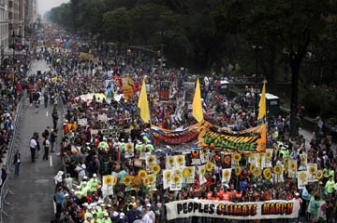
People’s March—A Dec. 10 protest march organized by the activist group Avaaz through the streets of Lima for “International Climatic Justice and Defense of Life Day.” The day is also International Human Rights Day.
Source: Elizabeth Douglass, Inside Climate News, Dec 6, 2014
Governments from Around the World Meeting in Lima, Peru to Lay Foundation for Addressing Climate Change, Wisconsin Governor Scott Walker Sends U.S. EPA Letter Opposing Climate Change Regulations

Building on the groundswell of worldwide climate action, and in preparation for concluding its Framework Convention of Climate Change in Paris in 2015, the United Nations and its participating governments from around the world have begun meeting 1 December, 2014 in Lima, Peru, and scheduled to close on 12 December, 2014, to lay the foundation for an effective new, universal climate change agreement in Paris in 2015 while also raising immediate ambition to act on climate change in advance of the agreement coming into effect in 2020.
The UN’s Intergovernmental Panel on Climate Change has this year warned against rising sea levels, storms and droughts as a result of unchecked greenhouse gas emissions, and highlighted the many opportunities of taking climate action.
Last week, the UN Environment Programme underscored the need for global emissions to peak within the decade and then to rapidly decline so that the world can reach climate neutrality – also termed zero net emissions – in the second half of the century.
Christiana Figueres, Executive Secretary of the UN Climate Convention said:
“Never before have the risks of climate change been so obvious and the impacts so visible. Never before have we seen such a desire at all levels of society to take climate action. Never before has society had all the smart policy and technology resources to curb greenhouse gas emissions and build resilience. All of this means we can be confident we will have a productive meeting in Lima, which will lead to an effective outcome in Paris next year.”
Meanwhile, Wisconsin Governor Scott Walker submitted comments this week in opposition of the Environmental Protection Agency’s (EPA) Clean Power Plan, which proposes increased regulations aimed at reducing carbon dioxide emission from Wisconsin’s power plants in Wisconsin. Walker’s letter claims that the proposed regulations would have a detrimental effect on Wisconsin’s manufacturing-based economy, as well as household ratepayers.
Walker says the Wisconsin Department of Natural Resources and Public Service Commission of Wisconsin have spent months reviewing the rule and seeking input from those who would be affected since its proposal in June of this year.
Governor Walker has asked the EPA to reconsider the rule based on the impact the rule will have on the cost and reliability of electricity, not only to Wisconsin’s manufacturing sector and the 455,000 people it employs, but on every ratepayer in the state and the nation.
In Lima, governments meeting under the “Ad Hoc Work Group on the Durban Platform for Enhanced Action” (ADP) need to define the scope and the type of contributions they will provide to the Paris agreement, along with clarity on how finance, technology and capacity building will be handled.
Countries will put forward what they plan to contribute to the 2015 agreement in the form of Intended Nationally Determined Contributions (INDCs) by the first quarter of 2015, well in advance of the Paris conference in December of next year.
The Lima conference needs to provide final clarity on what the INDCs need to contain, including for developing countries who are likely to have a range of options from, for example, sector-wide emission curbs to energy intensity goals.
Ms. Figueres welcomed the leadership of the EU, the US and China, who have publically announced their post-2020 climate targets and visions.
“It is hugely encouraging that well ahead of next year’s first quarter deadline, countries have already been outlining what they intend to contribute to the Paris agreement. This is also a clear sign that countries are determined to find common ground and maximize the potential of international cooperation,” she said.
“Countries are working hard to increase emission reductions before 2020, when the Paris agreement is set to enter into effect. Pathways on how to accomplish this will also be a key issue before nations in Lima,” she added.
Governments need to work towards streamlining elements of a draft agreement for Paris 2015 and explore common ground on unresolved issues in order to achieve a balanced, well-structured, coherent draft for the next round of work on the text in February next year.
In addition to progress made to date towards a Paris agreement, the political will of countries to provide climate finance is increasingly coming to the fore.
At a recent pledging conference held in Berlin, Germany, countries made pledges towards the initial capitalization of the Green Climate Fund totaling nearly $ 9.3 billion USD. Subsequent pledges took this figure to $ 9.6 billion, so that the $ 10 billion milestone is within reach.
“This shows that countries are determined to build trust and to provide the finance that developing countries need to move forward towards decarbonizing their economies and building resilience”, Ms. Figueres said.
In the course of the 2014, governments have been exploring how to raise immediate climate ambition in areas with the greatest potential to curb emissions, ranging from renewable energy to cities.
As part of the “Lima Action Agenda”, countries will decide how to maintain and accelerate cooperation on climate change by all actors, including those flowing from the Climate Summit in September, where many climate action pledges were made.
“We have seen an amazing groundswell of momentum building this year. One of the main deliverables of the Lima conference will be ways to build on this momentum and further mobilize action across all levels of society. Society-wide action in concert with government contributions to the Paris agreement are crucial to meet the agreed goal of limiting global temperature rise to less than two degrees Celsius, and to safeguard this and future generations,” Ms. Figueres said.
As climate change impacts worsen and impact the poor and most vulnerable, governments urgently need to scale up adaptation to climate change. The conference needs to agree on how National Adaptation Plans of developing countries will be funded and turned into reality on the ground. Countries will also work to agree a work program for the Executive Committee of the Warsaw International Mechanism for Loss and Damage, and elect the members of its Executive Committee.
Governments will work to scale up and coordinate the delivery of climate finance and of the various existing funds. A focus will be on identifying ways to accelerate finance for adaptation to climate change. Governments will also recognize the initial capitalization of the GCF, which is expected to reach USD $ 10 billion by the close of the Lima conference.
Countries meeting in Lima will further work to provide support to avoid deforestation. Several developing countries are expected to submit information which would make it possible for them to obtain funding for forest protection.
Governments meeting in Lima are expected to clarify the role of carbon markets in the 2015 global agreement and set a work program for next year to design and develop operations for implementing new market mechanisms.
As part of the efforts by countries to accelerate pre-2020 climate action, the secretariat is organizing a fair 5, 8 and 9 December in Lima to showcase how action is being scaled up and how many countries and non-state actors are taking action and setting an example.
 All Things Environmental
Recent Comments