
Media Reports The World Will Enter A ‘Mini Ice Age’ In The 2030s; Actually, It’s the Reverse That’s the Real Truth!

U.K. tabloids, conservative media, and others are (mis)reporting that the Earth will enter a “mini ice age” in the 2030s. In fact, not only is the story wrong, the reverse is actually true.
The Earth is headed toward an imminent speed-up in global warming, as many recent studies have made clear, like this June study by NOAA. Indeed, a March study, entitled “Near-term acceleration in the rate of temperature change,” makes clear that a stunning acceleration in the rate of global warming is around the corner — with Arctic warming rising 1°F per decade by the 2020s!
Also, right now, we appear to be in the midst of a long-awaited jump in global temperatures. Not only was 2014 the hottest year on record, but 2015 is in the process of blowing that record away. On top of that, models say a massive El Niño is growing, as USA Today reported last week. Since El Niños tend to set the record for the hottest years (since the regional warming adds to the underlying global warming trend), if 2015/2016 does see a super El Niño then next year may well crush the record this year sets.
Whatever near-term jump we see in the global temperatures is thus likely to be followed by an accelerating global warming trend — one that would utterly overwhelm any natural variations such as a temporary reduction in solar intensity. A recent study concluded that “any reduction in global mean near-surface temperature due to a future decline in solar activity is likely to be a small fraction of projected anthropogenic warming.”
That’s true even for one as big as the Maunder Minimum, which was linked to the so-called Little Ice Age.
The “Little Ice Age” is a term used to cover what appears to have been two or three periods of modest cooling in the northern hemisphere between 1550 and 1850.
I know you are shocked, shocked to learn that unreliable climate stories appear in U.K. tabloids, the conservative media, and those who cite them without actually talking to leading climate scientists. Often there is a half truth underlying such stories, but in this case it is more like a nano-truth.
Last week, in Llandudno, north Wales, the Royal Astronomical Society (RAS) held Cyfarfod Seryddiaeth Cenedlaethol 2015 — the “National Astronomy Meeting 2015″ (in case you don’t speak Welsh). An RAS news release had this startling headline, “Irregular Heartbeat Of The Sun Driven By Double Dynamo.”
Okay, that wasn’t the startling part. This was: “Predictions from the model suggest that solar activity will fall by 60 per cent during the 2030s to conditions last seen during the ‘mini ice age’ that began in 1645.”
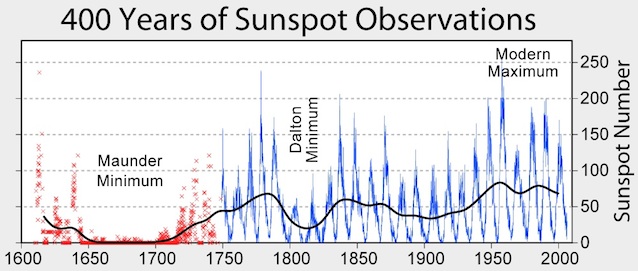
Ah, but the word choice was confusing. We’re not going to have temperature “conditions” last seen during the Little Ice Age. If this one study does turn out to be right, we’d see solar conditions equivalent to the Maunder Minimum in the 2030s.
This won’t cause the world to enter a mini ice age — for three reasons:
The Little Ice Age turns out to have been quite little.
What cooling there was probably was driven more by volcanoes than the Maunder Minimum.
The warming effect from global greenhouse gases will overwhelm any reduction in solar forcing, even more so by the 2030s.
So how little was the Little Ice Age?
The most comprehensive reconstruction of the temperature of the past 2000 years done so far, the “PAGES 2k project,” concluded that “there were no globally synchronous multi-decadal hot or cold intervals that define a worldwide Medieval Warm Period or Little Ice Age.”

Green dots show the 30-year average of the new PAGES 2k reconstruction. The red curve shows the global mean temperature, according HadCRUT4 data from 1850 onwards. In blue is the original hockey stick of Mann, Bradley and Hughes (1999 ) with its uncertainty range (light blue). Graph by Klaus Bitterman.
The Little Ice Age was little in duration and in geographic extent. It was an “Age” the way Pluto is a planet.
Writing on Climate Progress, climatologist Stefan Rahmstorf noted the researchers “identify some shorter intervals where extremely cold conditions coincide with major volcanic eruptions and/or solar minima (as already known from previous studies).”
That brings us to the second point: The latest research finds that what short-term cooling there was during the Little Ice Age was mostly due to volcanoes, not the solar minimum. As “Scientific American” explained in its 2012 piece on the LIA, “New simulations show that several large, closely spaced eruptions (and not decreased solar radiation) could have cooled the Northern Hemisphere enough to spark sea-ice growth and a subsequent feedback loop.” The period associated with the LIA “coincide with two of the most volcanically active half centuries in the past millennium, according to the researchers.”
The cooling effect from the drop in solar activity during even a Maunder Minimum is quite modest. Environmental scientist Dana Nuccitelli discussed the literature underscoring that point in a U.K. Guardian post from the summer of 2013, the last time the “Maunder Minimum” issue popped up.
That brings us to the third point: Whatever cooling the Little Ice Age saw as result of the Maunder Minimum, it pales in comparison to the warming we are already experiencing — let alone the accelerated warming projected by multiple studies. That’s clear even in Pages 2k reconstruction above.
Just last month “Nature Communications” published a study called, “Regional climate impacts of a possible future grand solar minimum.” This found that, “any reduction in global mean near-surface temperature due to a future decline in solar activity is likely to be a small fraction of projected anthropogenic warming.” As with the Little Ice Age, any significant effects are likely to be regional in nature — and, of course, temporary, since a grand solar minimum typically lasts only decades.
So, no, the Daily Mail is quite wrong when it trumpets, “Scientists warn the sun will ‘go to sleep’ in 2030 and could cause temperatures to plummet.”
In actuality, what is going to happen in the business-as-usual emissions scenario (RCP8.5) is closer to “rate of change” of warming.
Original story by Joe Romm on Climate Progress
Thousands More Heat Deaths from Record Heat Wave in Pakistan on top of Neighboring India’s nearly 2,200 heat deaths.

Unclaimed heatwave victims in Karachi on June 26, 2015.
Hot and humid weather came to Karachi Pakistan just weeks after torrid temperatures caused nearly 2,200 deaths in neighboring India, raising fears that South Asia could be seeing some of the devastating effects of human-caused climate change, the Associated Press reported. The worst of the heat peaked Saturday, when the high temperature hit 112.6 degrees in Karachi; the heat index topping out at a dangerously high 121 degrees.
“The deadly heat wave that has killed several hundred people in Karachi, Pakistan, is clearly a harbinger of things to come with the changing climate,” Saleemul Huq, director of the International Center for Climate Change and Development in Bangladesh and a prominent climate scientist, told the Associated Press earlier this week.
The death toll in Pakistan’s deadliest heat wave on record now topped 1,100, causing morgues to overflow, Reuters reported Friday.
“By Friday, at least 1,150 people have died in the government-run hospitals,” said Anwar Kazmi of the Edhi Foundation, a private charity that runs a network of ambulances and morgues.
The New York Times reported the heat wave has sent more than 14,000 people into government and private hospitals in Karachi, the nation’s largest city.
The hot weather comes just weeks after torrid temperatures caused nearly 2,200 deaths in neighboring India, raising fears that South Asia could be seeing some of the devastating effects of human-caused climate change, the Associated Press reported.
Pakistan’s previous deadliest heat wave was in 1991, when 523 people died, EM-DAT, the International Disaster Database, reported.
The worst of the heat peaked Saturday, when the high temperature hit 112.6 degrees in Karachi; the heat index topping out at a dangerously high 121 degrees.
“Since the monsoon has been slower to get into northwestern India, Karachi has been tremendously dry with intense heat,” stated AccuWeather meteorologist Anthony Sagliani.
Cooling monsoon rains are likely to arrive in Pakistan by mid-July, which should mean the region won’t see any more temperatures this summer as high as were recorded last weekend, meteorologist Jeff Masters of the Weather Underground said.
The Pakistan heat wave will join this year’s heat wave in India as one of the 10 deadliest in world history.
“The deadly heat wave that has killed several hundred people in Karachi, Pakistan, is clearly a harbinger of things to come with the changing climate,” Saleemul Huq, director of the International Center for Climate Change and Development in Bangladesh and a prominent climate scientist, told the Associated Press earlier this week.
“Even if this particular event cannot be unequivocally attributed to human-induced climate change, we can certainly expect such heat waves with greater frequency in future,” he said.
There is widespread scientific consensus that climate change generally makes extreme weather events such as flooding, droughts, and heat waves much more frequent and more intense.
A major report this week from The Lancet finds that climate change significantly increases the fatal risks of these types of events. The report, which was backed by the World Health Organization, diagnosed climate change as “a medical emergency” with the power to undo 50 years of progress in global health. In a landmark document released last week, Pope Francis aimed to focus the world’s attention on the matter of how climate change impacts the poor. “Climate change is a global problem with grave implications: environmental, social, economic, political and for the distribution of goods,” he wrote. According to NOAA and NASA, this year is on track to supplant last year as the warmest year on record.
President Obama Twitting about Global Warming and Future of NBA

Goes to show most of the people who follow professional basketball aren’t aware of the treats global warming has on their sport. Gee, maybe Governor Scott Walker ought to have thought this through before encouraging the locals and state decision-makers to entering the deal for building the half-billion dollar arena in Milwaukee with the billionaires who will own the team and arena?
President Obama took to Twitter to talk about global warming after a briefing at the National Hurricane Center. Obama, using his freshly minted @POTUS Twitter handle, took questions on climate change after receiving his annual briefing on its effects at Miami’s National Hurricane Center.
But when he weighed in on the NBA Finals, Twitter lit up.
Most of Obama’s answers focused on climate change, though they got far fewer retweets.
His tweets on climate change after a briefing at the Miami National Hurricane Center were not as popular as his basketball tweets.
His tweets on climate change after a briefing at the Miami National Hurricane Center were not as popular as his basketball tweets.
“More severe weather events lead to displacement, scarcity, stressed populations; all increase likelihood of global conflict,” he said, explaining why he views climate change as a national security issue.
“The science is overwhelming but what will move Congress will be public opinion. Your voices will make them open to facts,” he said when asked how he handles “climate deniers” in Congress.
The Q&A was the first real engagement Obama had made with the public since he got the Twitter handle 10 days ago.
Flashback to Thursday, November 21, 2013, when senior representatives from four of the most influential professional sports leagues in the United States assembled at a closed door meeting of the Congressional Bicameral Committee on Climate Change. Officials from Major League Baseball, the National Football League, the National Basketball Association, and the National Hockey League, joined by a representative of the U.S. Olympic Committee, testified that worsening climate change poses risks to the future of their sport. They all described some of their league’s many environmental initiatives and, in particular, the work they do that is focused on reducing their contribution to global warming.
While November 21st is now known as an historic day in Congress because of changes made to the Senate filibuster rule, that date now also represents a watershed in our national debate about climate change: On November 21st, 2013, senior representatives from the major professional sports leagues in the United States testified before Congress for the first time about their organizations’ belief that climate change is real and, as Kathy Behrens of the NBA stated, “will only worsen if we do not address the air pollutants that are driving it.”
It is notable when senior officials from MLB, the NFL, the NBA and the NHL, all speak before a Congressional committee about the need to address climate disruption. While climate deniers in Congress and elsewhere might think they can attack the U.S. EPA or the United Nations with impunity, surely they would think twice before trying to impugn the integrity of those who lead the professional sports industry. All of the premier U.S.-based sports organizations are among the most culturally influential and highly regarded businesses in the world, and all of them, even including NASCAR, have now stated publicly that climate disruption is real and that we must act to do something about it.
Who’s to Blame For the Unintended Consequences and Costs of Burning Fossil Fuel?
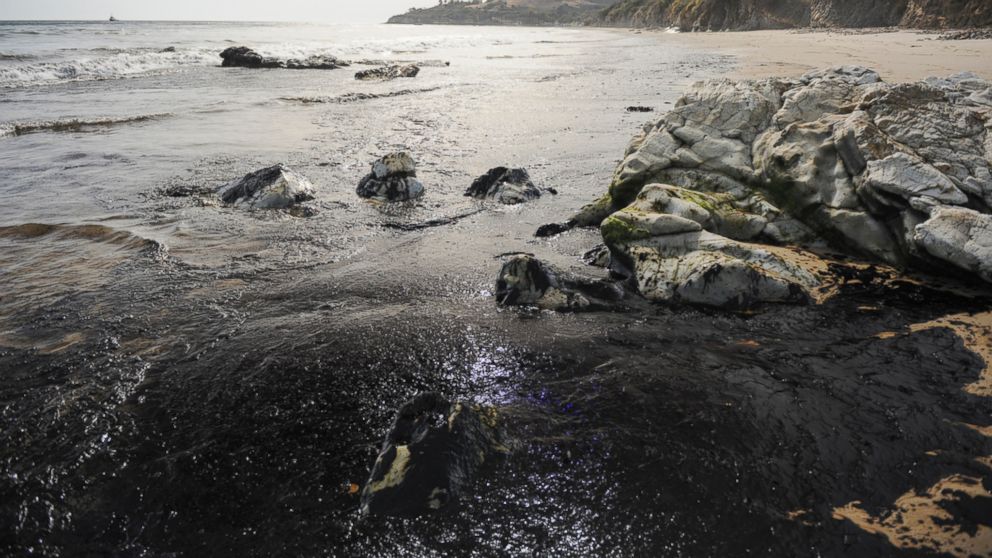
In addition to the monumental environmental and economic injustices of global warming on our current and future civilization, caused by the emissions of greenhouse gases from autos, power plants, military and recreational vehicles, etc., in addition to the deforestation of the tropics which has occurred over the past 100+ years, there have been additional spillover cost and environmental damage, for example the 105,000 gallons of oil that leaked from an onshore pipeline along California’s coastline near Santa Barbara this week; the damage caused by trains carrying combustible oil exploding in various parts of the U.S. and Canada; the damage from earthquakes caused by fracking for oil and gas in the state of Oklahoma and Texas and the release of methane gas at the well site; the damage caused by frac sand mining, the damage, injury and death from motor vehicle operation crashes and the emissions of greenhouse gases and small harmful-to-human-health particles from the the operation of motor vehicles; the laying of more unneeded highway pavement in the country, the impacts of mining for metals and energy impacts required to build more automobiles, and the greenhouse gas releases from what the New York Times suggests is American’s biggest carbon sin – jet flying, to say nothing about the habitat destruction for airports and runways/taxiways, the strip mining and transport of coal and waste product at power plants, the stringing of transmission lines across the landscape, and the soot, sulfur dioxide and mercury released to the air by power plants that end up in our lakes, contaminating the fish.
U.S. consumers must share a large portion of the blame, since without the consumer’s “need” to fly, drive and electrify and heat their homes, factories and places of recreation by burning fossil fuels, Earth’s coal, oil and gas would remain safely in the ground.
The number of environmental “bads” from our use of fossil fuels is nearly endless.
Climate Change: Are We Doing Enough?
Was the Titanic Unsinkable? Earth Day 2015 has come and gone. There was no reason to post anything to celebrate it.
State of Wisconsin Board of Commissioners of Public Lands Bans Staff from Discussing Global Warming and Climate Change
 Former Wisconsin governor and U.S. senator Gaylord Nelson at Gaylord Nelson State Park in Madison in 2001. Photo: Tom Lynn, Milwaukee Journal Sentinel.
According to a report published in the Wisconsin State Journal April 9, 2015, Wisconsin’s 3-member Board of Commissioners of Public Lands passed a measure Tuesday, April 7th, by a 2-1 margin, that bans the staff of from “on-the-job discussion or work related to climate change”.
Reference to climate change had already been removed from agency’s website in response to previous complaints from one board member, state Treasurer Matt Adamczyk, according to the report. Adamczyk is a Wisconsin Republican who recently sought to dismiss the commission’s executive secretary, Tia Nelson, who is the daughter of former Wisconsin United States Senator and Earth Day founder, Gaylord Nelson, after he learned she served as a co-chairwomen on former Democratic Governor Jim Doyle’s Global Warming Task Force in 2007 and 2008.
The other board member who voted yes to the ban — Attorney General Brad D. Schimel – said he voted with Adamczyk to ban the staff from further work on climate change because he views it as “political activity”, and not connected to the board’s duties. The report said Adamczyk stated that he is bothered by Nelson’s service on the task force because it had “nothing to do with the board’s business”, which is to manage forest land and help maintain certain state-owned forest land and help finance local government. Tia Nelson, who directs the commission’s eight member staff, declined to comment saying she didn’t want to say anything that would inflame the situation, according to the report.
The third member of the board, Wisconsin’s Secretary of State Douglas La Follette, said Adamczyk “is a “climate denier” who is out to get Nelson”, the Journal report stated.
Gaylord Nelson (June 4, 1916 – July 3, 2005) was born in Clear Lake, Wisconsin, and served several terms as a United States senator and two terms as governor. He is best known as the founder of Earth Day, which launched a new wave of environmental activism in the U.S. and abroad. He would not have been pleased with this action, which has occurred by a state committee under Governor Scott Walker’s watch.
Wisconsin Must Join the All Out World Effort to Fight Global Climate Change Without Delay, BEFORE Time Runs Out

Wisconsin has traditionally prided itself as being a state that “cares”. Wisconsin residents care about its wild and domestic animals, its fish, birds and butterflies; its plants, trees, and its forests; its tens of thousands of lakes, streams and rivers, and the quality of its wetlands, groundwater and air; its mighty bluffs and gorges, its remaining prairies, and the state’s overall majestic scenic beauty.
Wisconsin has traditionally had a strong manufacturing economy, a top notch agricultural industry, a public education system second to none, a world class university system, and an equally top notch private schools, colleges, and other educational institutions. Wisconsin also boasts an excellent highway, airport, and bicycle transportation system, and communities that are walking and wheelchair friendly. It has always held all visitors to the state in high regards and treated them with respect the production and sustainability of its farms, the well being of its human population, without regard for race, heritage or creed. Wisconsinites treat visitors to their state with respect and dignity,satisfaction of its visitors and transients alike, and, perhaps above all, in leaving its land, water and its economy better condition than they received it. In a nutshell, that’s a statement of Wisconsin’s traditions and value, as I have come to know them.
Wisconsin residents often boast, and rightly so, that Wisconsin was the home of such renown conservationists and humanists as John Muir, Aldo Leopold, Senator Gaylord Nelson, Midge Miller and Vel Phillips. In the 1970s, Wisconsin was emulated by other states as the state to look at for developing effective environmental protection regulations to safeguard its treasures. With Wisconsin Departmental Resource Secretary Anthony “Tony” Earl at the helm, who would later become Wisconsin’s governor, and George “Knute” Knudson as its chief naturalist, Wisconsin natural resources were in good hands.
It is no exaggeration to say that all this is at risk the longer our Wisconsin Legislature, our governor, other state legislatures and governors, and the people’s representatives in the United States Congress continue to kick the issue of excess fossil fuel burning and greenhouse gas production by Americans down the road. What we don’t need is more highway development and expansion and more airport capacity expansion that encourage even more fossil fuel burning by the public. What we don’t need is more trade with distant countries that requires more fuel for shipping and flying. What we don’t need are more coal and natural gas burning power plants and the thousands of miles of high voltage transmission lines that go with them, and not Wisconsin power companies who restructure their rates in favor of more fossil fuel burning, thus discouraging their customers from investing in solar energy panels for their homes and businesses, and having the governor’s appointed Wisconsin Public Service Commission (the PSC) “rubber stamps” the fossil-fuel-dependent utilities’ proposals.
We are wasting valuable time and money by not relying less and less on fossil fuel dependent energy, and more on either energy conservation or on conversion to solar and wind generated power, in our homes, businesses and institutions; and that we desperately need to reduce aggregate driving and flying, which rely almost exclusively on burning fossil fuels that, when subject to combustion, release large quantities of greenhouse gases, especially carbon dioxide (CO2), to the atmosphere. Most of the greenhouse gases, such as CO2, remain in the atmosphere for centuries, accumulating to increasingly more ominous concentration levels, or they get absorbed in the oceans, making the earth’s ocean water more acidic, harming the biological species in the oceans.
But scientists the world over are in agreement that the rising concentrations of greenhouse gases from significantly increased fossil fuel burning by humans since the time of the Industrial Revolution (early 1800’s) have remained in earth’s atmosphere, trapping more and more of the Sun’s radiant energy and changing it into heat energy, causing the earth’s surface to warm, melting more of the polar ice caps and mountain glaciers, causing the vast permafrost region to thaw, releasing more and more methane gas, another greenhouse gas that’s known to have 37 times the heat-trapping power of CO2.
Scientists don’t know when global warming could begin accelerating, but it could be any day now. What they do know is that there are higher concentrations of greenhouse gases in the atmosphere now to push global surface temperatures much higher than what we have experienced thus far. Time is of the essence for the world’s populations who are relying on fossil fuel burning for energy to stop adding even higher concentration levels of greenhouse gases to the atmosphere, risking setting off positive feedback mechanisms in the system that could worsen the situation and amplify the weather extremes global warming has already caused in earth’s climate.
Thousands Protest Governor Brown’s Allowing Fracking for Fossil Fuels in Oakland, California

Several thousand demonstrators turned out in Oakland Saturday for a protest against hydraulic fracturing in California. The controversial technique, also known as fracking, uses high pressure water and chemicals to harvest oil and natural gas.
The demonstration was one of the largest public against fracking recently, and it was held in Governor Jerry Brown’s home town of Oakland for a reason. Environmentalists are taking aim at Governor Brown who used to be a political darling of the movement in his first tour as governor in the 1970’s.
Event organizers say Governor Brown’s administration has given a green light to oil companies to drill in California. The state is the third highest oil producer in the country.
Fracking has recently gained more interest after records analyzed by the Associated Press found that California regulators allowed oil companies to re-inject hydraulic fracturing fluids back into federally protected aquifers.
People from across the state converged in Oakland for this event.
“I came up by bus this morning. And I’m doing this because I believe in a future for all human life and all life on earth, and I believe it’s time for us to create a whole other way of being human,” said Cindy Dixon of Paso Robles.
During a news conference Friday, Governor Brown challenged protesters when he said they, along with most other Californians are still getting around on gas guzzling cars, trucks and buses.
Gas prices have been falling dramatically in the last six months, in part because of increased oil drilling in the United States. But it’s also because newer cars are more fuel efficient, and countries like Saudi Arabia have continued to pump oil despite a worldwide oil glut.
Source: ABC News – Oakland
Little Support For Suing EPA Over Carbon Emissions

Wisconsin Public Radio reported results of a new poll this month that finds that nationally, only one-tenth of the public wants their state to file a lawsuit over a federal plan aimed at reducing carbon emissions from coal-burning power plants.
Governor Scott Walker said in his State of the State Address Wisconsin is planning to sue the Environmental Protection Agency (EPA). “Top-down regulations and mandates from the federal government get in the way of innovation and growth in Wisconsin and states like ours. Therefore, I am working with our new Attorney General to prepare a lawsuit challenging the newly proposed federal energy regulations”, Walker said.
However pollster Barry Rabe of the University of Michigan says most people don’t support state lawsuits against federal EPA on global warming emission from power plant electricity providers.
The EPA proposal cuts emissions at coal-fired power plants and a move with major implications for Wisconsin, because coal generates more than half the state’s electricity.
The mandate cuts power plant emissions – the largest source of carbon dioxide (CO2) emission in the U.S. nationwide by 25% by 2030. Climate change, once considered an issue for a distant future, has moved firmly into the present,” the report said. “Summers are longer and hotter, and extended periods of unusual heat last longer than any living American has ever experienced, according to the World Health Organization.
MLK Tribute – “Preserving Our Climate for Children and Humanity”

In honor of Dr. Martin Luther King Jr. and to celebrate his birthday, I am posting a tribute to him that I wrote and distributed on February 2, 2002. I am posting it here today for the same reason as then – to honor Dr. Martin Luther King Jr., and to celebrate his birthday (his exact birthday is January 15). After all, where would we be had Martin Luther King Jr. never been born?
Dr. King worked and died for the cause of freedom; he fought to end racism and do away with poverty and war but by peaceful means only, never by violence, even knowing his speaking out for these causes would likely ultimately cost him his life.
Dr. King would no doubt agree with humanitarian, environmentalist, and antiwar/nonviolent singer-songwriter Jackson Browne, who says on his newest album “Standing In The Breach”, in the song Walls and Doors : “There can be freedom only when nobody owns it”.
Preserving Our Climate for Children and Humanity (February 2, 2002)
Dr. Martin Luther King Jr. was a strong advocate for positive change for all people, especially children. Continued global warming will make the world we all share a much more hostile place for all people, especially today’s children who have a full life ahead of them. It will take a worldwide effort to stop global warming, and we owe it to children everywhere to do all we can before it becomes an irreversible, worldwide catastrophe.
My proposal is that we ALL petition our governments (with letters, petition, phone calls…) to reduce greenhouse gas emissions by adopting programs that REWARD PEOPLE AND FAMILIES WHO USE LESS ENERGY – by DRIVING LESS, FLYING LESS and USING LESS fossil fuel derived energy in their HOMES.
MLK once said: “We are prone to judge success by the index of our salaries or the size of our automobiles, rather than by the quality of our service and relationship to humanity.” We can serve humanity better by consuming less fossil fuel (gasoline, jet fuel, coal, natural gas and oil) by driving less, flying less and using less energy in our homes. Our children and their children will thank us for that.
 All Things Environmental
Recent Comments