
Surprise! Lawmakers and Gov. Scott Walker Rid High-Capacity Well Law of Groundwater Cumulative Impacts Requirement Challenges to WDNR Permits

Starting this Monday, July 7, 2014, Wisconsin residents can no longer challenge state Department of Natural Resources permits for a high-capacity well if state officials failed to look at what the well might do to overall groundwater in the area, according to a Wisconsin Public Radio report by Chuck Quirmbach, July 1, 2014.
Wisconsin lawmakers and Gov. Scott Walker got rid of the cumulative impacts challenge when they passed the state budget a year ago. The new language covering the hi-cap wells — often used by water-intensive industries — takes effect on Tuesday.
This change comes much to the dismay of Amber Meyer Smith of the group Clean Wisconsin.
“Really, property owners are losing their ability to protect their property,” Smith said. “More and more people, especially in the central area of the state that are facing huge problems from over-pumping of groundwater due to neighboring industry and other high-capacity wells.They’re just going to lose one more tool in their toolbox to protect their own access to water, for their wells, for drinking water, for access to their favorite lakes and rivers and streams.”
DNR officials can still look at the cumulative impact on all the wells in an area, but if the agency doesn’t do so, challenges to the permit are now limited.
A spokesperson for Assembly Speaker Robin Vos didn’t respond to a request for comment, but has told other media that the new legal language protects the DNR by taking the judicial branch out of the permitting process.
Some environmentalists haven’t ruled out taking the new limits to court.
Moon Landing, Meeting Current Needs, Ensuring Earth Remains Sustainable
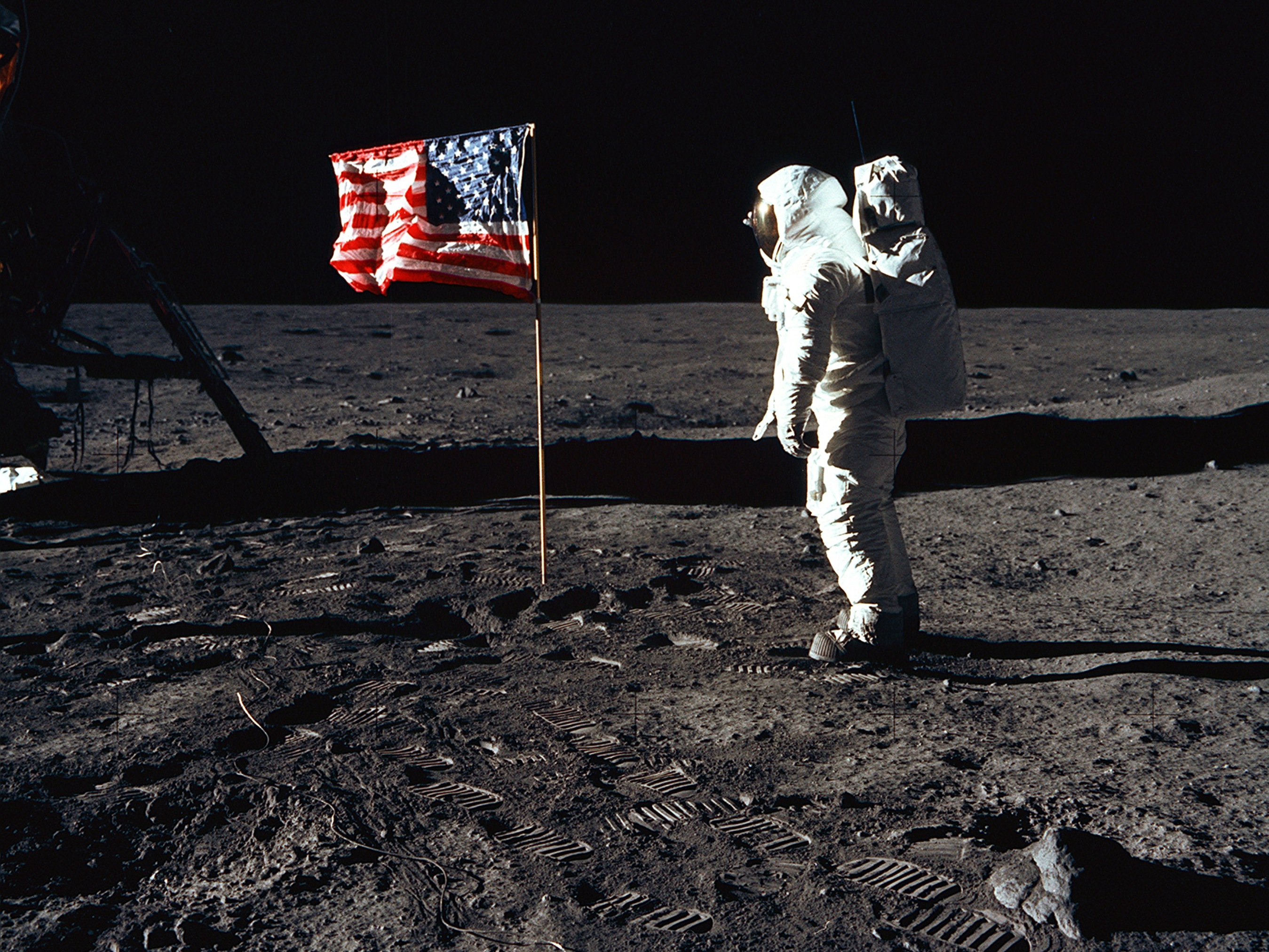
Apollo 11 moon landing. Astronaut Edwin E. “Buzz” Aldrin Jr. poses for a photograph beside the U.S. flag. Photo taken by Neil Armstrong.
We put a man on the moon 45 years ago. Apollo 11 was the spaceflight that landed the first humans on the Moon on July 20, 1969. Six hours later, U.S. Astronaut Neil Armstrong became the first human being to step down onto the lunar surface, on July 21. As he stepped down from the space ship onto the surface, Armstrong declared “one small step for (a) man, one giant leap for mankind.” Astronaut Buzz Aldrin followed and spent slightly less than six hours on the Moon’s surface. Astronaut Michael Collins piloted the command spacecraft alone in lunar orbit until Armstrong and Aldrin returned to the space ship for the trip back to Earth. They returned to Earth and landed in the Pacific Ocean on July 24. That’s the last time the United States set out to accomplish something really big in the world – something that had never been done before – and it succeeded, with flying colors!
Happy 4th of July to all!
We proclaimed ourselves to be a nation by publishing the Declaration of Independence on July 4, 1776.
THE DECLARATION OF INDEPENDENCE
“When in the course of human events, it becomes necessary for one people to dissolve the political bands which have connected them with another, and to assume among the powers of the earth, the separate and equal station to which the Laws of Nature and of Nature’s God entitle them, a decent respect to the opinions of mankind requires that they should declare the causes which impel them to the separation.
We hold these truths to be self-evident, that all men are created equal, that they are endowed by their Creator with certain unalienable Rights, that among these are Life, Liberty and the pursuit of Happiness, That to secure these rights, Governments are instituted among Men, deriving their just powers from the consent of the governed, That whenever any Form of Government becomes destructive of these ends, it is the Right of the People to alter or to abolish it, and to institute new Government, laying its foundation on such principles and organizing its powers in such form, as to them shall seem most likely to effect their Safety and Happiness….”
THE PLEDGE OF ALLEGIANCE TO THE FLAG
We have been citing “The Pledge of Allegiance” since it was formally adopted by our representatives in the U.S. Congress in 1942. It reads as follows: “I pledge of Allegiance to the Flag of the United States of America, and to the Republic for which it stands, one Nation under God, indivisible, with liberty and justice for all”.
The Pledge of Allegiance was written by Francis Julius Bellamy, who wrote it as a young man while traveling in Massachusetts. He submitted it to a patriotic circular he became aware of called “Youth’s Companion”. “The Pledge” was published in the circular on September 8, 1892. Following its publication, Bellamy described his reasons for writing it and for its “careful wording”:
“It began as an intensive communing with salient points of our national history, from the Declaration of Independence; with the makings of the Constitution; with the meaning of the Civil War; with the aspiration of the people…”. “The true reason for reciting allegiance to the Flag is … to make it clear that we are “One Nation” – the One Nation which the Civil War was fought to prove. To make that One Nation idea clear, we must specify that it is indivisible, as Webster and Lincoln used to repeat in their great speeches.”
Francis Julius Bellamy was born on May 18, 1855 in Mount Morris, NY. He became a First Baptist Church minister and married Harriet Benton in Newark, NY in 1881, raised two sons, and spent most of the last years of his life living and working in Tampa, FL where he died on August 28, 1931 at the age of 76.
Now, in 2014, few U.S. citizens and others living in the U.S. and abroad seem satisfied with where the United States of America stands in the world on many issues of concern. Wars are still raging on, with or without U.S. involvement it seems everywhere, and U.S. soldiers, foreign civilians, foreign soldiers, and even young children are dying, or being maimed, needlessly.
Billions of people in the world live in poverty, including millions of U.S. citizens and non U.S. citizen and young children living in the U.S.. Yet we hear in the media that there are more millionaires now in the United States than ever before, and that income inequality in the U.S. has reached an all-time high, especially adversely affecting African-American and Latino youth populations in the U.S. the most. Yet it seems clear the majority of our representatives in the U.S. Congress, and the men and women serving in our state Legislature, and Governor Scott Walker, must be content with the deplorable situation this country finds itself in in spite of the above ideals embodied in our country’s broad declarations.
And while this injustice continues to take place in America and in Wisconsin, [“Injustice anywhere is a threat to justice everywhere”, said Dr. Martin Luther King, Jr. in his “Letter from a Birmingham Jail”, dated 16 April 1963], human-caused global warming of our planet’s atmosphere and oceans and the resulting climate catastrophes, [California’s long-standing drought and high wildfire numbers; Hurricane Katrina devastation; Midwest flooding; Hurricane Sandy; Supertyphoon Haiyan …] which many credible scientists have said are linked to a warming climate and oceans, are evidence enough that we ought as society begin to act in major ways to begin significantly reducing our collective greenhouse gas emissions to the urgent degree that what’s happening to our planet now demands. Because the crisis that is emerging worldwide is the result of decades and even centuries of a collectively massive amount of fossil fuels being burned, and therefore equally massive volumes of greenhouse gases being released to the atmosphere from the combustion – combustion of oil, natural gas, diesel fuel, and coal in power plants, jet engines, automobiles, trucks, ships, motorized recreational and work-related equipment, generators, food processing facilities, and other transportation and recreational devises, mostly by those who can afford it, as well as increases in emissions of other potent greenhouse gases (eg. methane releases from natural gas pipes and oil drilling and fracking activities, where they are allowed), and the positive feedback releases resulting from a warming planet even more (thawing rotting permafrost region from warming temperature releases powerful greenhouse gas methane in larger and larger quantities, resulting in even more warming, even more thawing and rotting permafrost, and so on…; it is essential that we act now before it’s too late.
This problem should not be viewed as insolvable. However, the likely impacts should be planned for and ample adaptation measures taken by all. In doing this, we can be guided by the words of President John F. Kennedy spoken on September 12, 1962 before a crowd of 35,000 people in the football stadium at Rice University in Houston, Texas:
“We choose to go to the moon in this decade and do the other things, not because they are easy, but because they are hard, because that goal will serve to organize and measure the best of our energies and skills, because that challenge is one that we are willing to accept, one we are unwilling to postpone, and one which we intend to win, and the others, too.”

As Albert Einstein said: “The significant problems we face today cannot be solved at the same level of thinking we were at when we created them.” Click on “About this Blog” to read about a socially just approach aimed at reducing greenhouse gas emissions while at the same time reducing economic inequality and poverty for people and families in the U.S. who demonstrate they burn significantly fewer fossil fuels over the course of a year than the average American.
This type of program (Conserve, NOW!) is doable and could be funded from reductions in capacity expansion of highways bridges, airports, power plants and major transmission lines, since the need (economic demand) for these costly and environmentally damaging tax-payer financed boondoggle projects would be reduced as a result of decreased use of fossil fuel derived energy by the public in driving cars, jet travel, home heating, electricity use, etc.. If need be, a carbon tax could also be applied to all fossil fuel combustion, no matter the use, to generate additional revenues for offering financial incentives to the everyone in the U.S. to reduce activities they engage in that require fuel burning.
In an April 23, 2013 interview with Space.com contributor Elizabeth Howell, Astronaut Eugene Cernan, who became the last man to walk on the Moon (in December 1972), shared his thoughts on how the Apollo missions achieved such grand success: “When Kennedy challenged us to go to the moon we didn’t know beans about it. “I was just a young lieutenant flying out in the West Pacific off aircraft carriers, and at that time I believed – and I think most other people did too – that they were asking us to do something that was impossible. And then all of a sudden we got involved – all of us. And the rest is history. Don’t tell me I can’t do it: I think that’s the America I grew up in.”
As Cernan prepared to climb up the lunar ladder for the last time on the Apollo 17 mission, the last maned spaceflight mission to the Moon, he paused and spoke these words:
“As I take man’s last step from the surface, back home for some time to come – but we believe not too long into the future – I’d like to just (say) what I believe history will record. That America’s challenge of today has forged man’s destiny of tomorrow. And, as we leave the Moon at Taurus–Littrow, we leave as we came and, God willing, as we shall return, with peace and hope for all mankind. Godspeed the crew of Apollo 17.”
He and his crewmates returned to Earth on Dec. 19, 1972.
The cost of not proceeding with any major Congressionally approved program to massively conserve on burning fossil fuels, NOW, will surely ultimately be astronomical. The costs will not only skyrocket, ending up in the trillions of dollars, and but the number of human and other animal lives lost will likely end up in the billions, all because we already have and we are continuing to burn unsafe quantity levels of fossil fuels, which is now scientifically linked to rising atmospheric greenhouse gas accumulations, rising surface and ocean temperatures, worldwide, and which is also scientifically linked to ultra-extreme weather climate disasters, such as the one presently being experienced at Okinawa, Japan. What more will it take for our government officials in the U.S. to begin taking appropriate scale actions?
Obama Wrongly Promotes Tourism to U.S. by Other Countries

It’s a fact: The water levels of the earth’s oceans are rising. It’s a fact: the oceans are becoming more acidic due to rising concentrations of atmospheric carbon dioxide in the water. It is also a fact the increasing water acidity is creating intolerable conditions for many ocean species. Ecological and biological systems everywhere are likely to be severely impacted.
Sustaining life (and living) will become more difficult on Future Planet Earth. If we continue our ecologically reckless burning of fossil fuels, even at the level we burn them now, the next children to see daylight are doomed. So are the rest of them that follow.
Everyone knows people who can afford to fly to vacation trips over seas and routinely take them pollute the air and add the warming of the planet. Why shouldn’t they pay a heftier cost?
Why should those avoid taking planes trips and thus put fewer greenhouse gas into the atmosphere be rewarded for helping to preserve our climate? The tipping point – of “positive global warming feedbacks”, such as more methane releases by the increasing thawing of the permafrost region; and increasing solar radiation absorption (heating) of the Arctic ocean waters due to white snow replacement with Arctic water which it darker, more sunlight-absorbing has already been reached in several biological/physical relationships. Once those tipping points are are reached, it will be exceeding difficult to reverse the trends. Global warming could take on the characteristics U.S. Secretary of State John Kerry recently described as: “the world’s most fearsome weapon of mass destruction”, and moreover that “the science of climate change is leaping out at us like a scene from a 3D movie… It’s warning us; it’s compelling us to act” (Kerry).
Now President Obama is saying we need to attract more foreign tourists to our shores, because foreign tourists bring lots of money to spend in our country. But they don’t fly here on their own power! Flying long distances by jets burns huge quantities of fossil fuels, emitting millions of tons of carbon dioxide and other greenhouse gas high in the atmosphere, where they are less likely to remain for centuries and not get sequestered back into the biosphere.
President John F. Kennedy once famously said: “Ask not what your country can do for you; ask what you can do for your country.”
Not many Americans these days must be thinking about the meaning of those words. So many Americans in particular take round-trip flights by jet to far away places, yearly, which requires the burning immense amounts of fossil fuels, especially in take-off and cruising very long distances.
The World Soccer Cup is three weeks away. The distance from Madison to Brazil World Cup is 4,612 miles. One shutters to think about how many planes will be flying to Brazil and back so their passengers can see the game in person.
But President Obama has made a case for attracting more foreign visitors and helping the sectors of our economy that cater to tourist purchases, increasingly bringing more money into the United States. “When it comes to tourism, we have a great product to sell,” Obama said in New York last week. “Nothing says ‘Made in America’ better than the Empire State Building or the Hoover Dam.”
Earlier Thursday, Obama signed a presidential memorandum giving his homeland security and commerce secretaries four months to come up with a plan to streamline the entry process and reduce wait times. He also asked the departments to work with the 15 largest U.S. airports, following steps taken by Dallas-Fort Worth and Chicago international airports to cut wait times so tourists aren’t delayed.
Obama acted two years ago to speed the processing of tourist visas for visitors from China and Brazil. On Thursday, Obama tackled the flip side of the problem: long waits for processing at U.S. airports and other ports of entry once tourists arrive. Fewer people will be discouraged from flying to the U.S. for vacation that way.
Before departing for upstate New York, Obama met with 20 travel and tourism industry CEOs and senior executives, including Arne Sorenson of Marriott International, Mark Hoplamazian of Hyatt Hotels and Roger Dow of the U.S. Travel Association.
Madison is 7,000 miles from China. Yet the Governor of Wisconsin (Scott Walker) and ones before him (Doyle) promoted visits and trade with China, as if the two were next door neighbors! The petroleum companies are laughing all the way to their Swiss bank accounts!
A prime example here in Wisconsin is Wisconsin Public Radio (WPR) and Wisconsin Public Television (WPT) are sponsoring round-trip vacations for anyone who’s willing to pay them to arrange flights to Hawaii, Ireland, the Mediterranean, and New York City this year. More trips are being planned to other exotic places, as well. In addition to those people not spending their money to help out our state’s economy, those excursions contribute to the many tons of greenhouse gases from the jet airliners flying those tourists to their destinations and back to the Badger State over the course of those flights. I have informed WPR that flying by jet is without question the worst thing individuals can do if their goal is to minimize their greenhouse gas emissions. It appears they care only about making money off these excursions and care little or not at all about the perils of a warming planet they are helping to cause by arranging these exotic trips. It’s shameful.
The next time you hop on a plane to go on an exotic vacation, or to give an important presentation at some far off land or worldwide conference, or go on a “required” business trip, or maybe just fly to the Olympics, the Super Bowl, the Rose Bowl, or maybe just go visit grandma, don’t just consider the cost of flight in dollars and cents. Please consider the “real” costs of such flights, including the substantial negative effects on our entire planet including the atmosphere of millions upon millions of similar airplanes flying all throughout the Earth every year, including the many military aircraft, as well.
Yes, those jet airplanes and propeller driven airplanes burn significant volumes of fossil fuels every day in the world, in flight, taking-off and landing, thereby adding significantly to the increasing accumulation of the gas “carbon dioxide” (CO2) and other greenhouse gases that end up in the Earth’s atmosphere, daily, thus contributing to the increasingly grave rate of global warming of the earth, including the warming and acidification of the earth’s vast oceans.
EARTH DAY ACTIONS – Madison, Wisconsin, and Washington DC

Madison, Wisconsin
As part of an organizing action of Global Climate Convergence and Wisconsin Wave, University of Wisconsin students, professors, teachers and other members of Madison area community marched down Madison’s State Street on the 44th Earth Day, Tuesday, April 22, 2014, with the purpose being to add to the public’s growing awareness and concern regarding the grave environmental threats and social injustices going on around them. The continuing and reckless mining and overuse of the earth’s valuable natural resources, often primarily for the profit of a few, was a common theme expressed at the march in posters and verbal forms. There was an overriding concern about the overuse of fossil fuels, metals, sand and gravel, to the great harm being inflicted upon the earth’s clean water and limited atmosphere, which are showing signs everywhere that they have reached the limit of sustainability for all of the earth’s future populations.
As reported in a April 23 article by Dana Kampa in The Daily Cardinal, titled “Madison environmental, social justice advocates converged on Earth Day” to “Protect our Water–Reject the Mines and Pipelines!”, mining in Wisconsin was cited as one of several significant environmental issues the protesters voiced concerned about.
Wisconsin used to be an environmental leader. It was the home of naturalist and writer Aldo Leopold; it was the first state in the country to ban the use of DDT as a pesticide on farmland; and it was the birthplace and home of U.S. Senator Gaylord Nelson, who founded Earth Day in 1970 and was instrumental in waking up the nation’s awareness of the damaging ecological, health and economic costs of air and water pollution and the need for tough federal and state laws and regulations to minimize it. The State of Wisconsin did just that in the decades that followed, maintaining and protecting its natural resources throughout the decades that followed.
But natural resource protection in Wisconsin took an about face in Wisconsin in November 2010 with the election of Republican Governor Scott Walker. After passage of a bill into law that allows for significant environmental degradation from ore mining in the state, an environmentally sensitive area of northern Wisconsin could ultimately become the home of the world’s largest open-pit iron ore mine. Wisconsin’s once strong environmental laws and regulations have been weakened, and environmentally conscious people throughout the state are rising up and taking notice.
The mine is proposed to be built by Gogebic Taconite and is currently undergoing review for development in the Penokee Hills, despite the fact that the mine would destroy a vast, water-rich ecosystem that President John F. Kennedy in 1963 called “a central and significant portion of the freshwater assets of this country” after his visit there.
The $1.5 billion mine would initially be close to four miles long, up to a half-mile wide and nearly 1,000 feet deep, but it could be extended as long as 21 miles. It lies in the headwaters of the Bad River, which flows into Lake Superior, the largest freshwater lake in the world. Six miles downstream from the site is the reservation of the Bad River Band of Lake Superior Chippewa, whose livelihood is threatened by the mine. Environmentally conscious citizens of Wisconsin are protesting, as evidenced by the Earth Day march in Madison.
The protesters also voiced strong concerns for the overall degradation being inflicted on Wisconsin’s landscape by frac sand mining, as well as the human health concerns which occur over time when people breath in silica sand fragments, and the noise and dust from the various digging, processing and trucking of the sand from the mining sites to drilling sites, located out-of-state, mostly in North Dakota. But student marchers also expressed major concerns about the overall future and well-being of the entire planet earth, as its oceans are warming, becoming more acid, while sea levels are arising, from melting ice and snow on land masses and due to the thermal expansion that occurs when water warms, and as the air at the surface continues its record warming. The adverse effects on people and animals from the increasing weather extremes associated with the warming (longer and more dangerous heat waves, worse flooding in some areas and larger areas of drought in others; more and higher coastal flooding with stronger and stronger storms); in other words, more devastation of human and animal life and real estate as the earth continues to heat up. Property and life insurance rates the world over are rising as a result.
The protesters began the march at Madion’s Monona Terrace building, which is Madison’s Convention Center (designed by architect Frank Lloyd Wright), and marched past the Wisconsin’s State Capitol Building, and then down State Street, where they convened at the UW campus Library Mall.
At the mall, several speakers referenced the latest projections made by the Intergovernmental Panel on Climate Change (IPCC), citing numerous examples of recent environmentally injurious governmental decisions of late, not just by our own state senators and representatives in the Wisconsin Legislature, but by current Wisconsin Republican Governor Scott Walker.
As most Wisconsinites know, Wisconsin has tens of thousands of individual and families living in poverty in the state, most who have been been able to just barely get by on the low income jobs they’ve been working up to now. Yet just this last November, the U.S. Congress voted to end the 2009 Recovery Act’s modest monetary increase in food share benefits (food stamps), by its failing to continue funding the Supplemental Nutrition Assistance Program (SNAP) benefits for poor individuals and families, cutting the funding source of the food budget for many thousands of Wisconsin individuals, families and their children on November 1, 2013. This action by our Congress resulted in a benefit cut for nearly every household receiving food share benefits. For families of three, the cuts amounted to $29 a month — November 2013 through September 2014, totaling a $319 for families of three for that period.
The Center on Budget and Policy Priorities said that the cut amounted to “a serious loss, especially in light of the very low amount of basic SNAP benefits available”, and that “without the Recovery Act’s boost, SNAP benefits will average less than $1.40 per person per meal in 2014”. Unfortunately, it is individuals and families eligible for receiving SNAP funding – a large percentage who are Blacks of African and American descent who live in Milwaukee or Dane (Madison area) counties, as well as many thousands of rural preschool age children, and minority families who have children enrolled in public elementary, middle or high schools throughout Wisconsin – who were hurt the most by the November 2013 federal SNAP program cut. Studies show these are the times of human life that are most essential for the child to receive proper nutrition – when their bodies demand the largest amount of good food to grow properly and function well while in school as well as play. When children of any race are deprived of good, nutritious food in their preschool and school age years they are more likely to be more anxious and distracted in school and elsewhere, and they are thus more prone to act in ways get them into trouble in school and elsewhere.
Studies show that when deprived of good, nutritious food at a very young age (2 – 6 years of age), any child, regardless of their race or ethnicity, will be impaired for life as those years are key in proper brain development. When family poverty results in these young children being fed less than nutritious food, or not enough food, during the ages of 2 to 6 years of age, it saddles these young children with impaired mental capabilities, making it more difficult for them to succeed when they enter school, and ultimately reduces their ability to compete for good grades and reduces their chances of succeeding in school and the work place, which can increase their risk of getting into trouble with the authorities and land in prison. To generate this sequence of events for children of families having limited income, in a country as wealthy as the U.S., is an American tragedy of intolerable proportions. Yet, inflationary food pricing brought on by likely global-warming-caused drought in large portions of the western United States, southwestern California in particular, over the past 3 years, and the harsh political decisions affecting Wisconsin’s poor families by our Wisconsin political representative have made this situation worse, especially for the large African-American and Latino populations living in and around Wisconsin’s two largest urban areas – Milwaukee and Dane Counties in particular.
Many who marched this Earth Day (Tuesday) in Madison claimed that they were totally outraged by the fact our own U.S. Representatives and Senators in the Congress have hugely shirked their responsibilities as government employees and public office holders by their continued refusal to initiate or act on legislation to significantly bring down annual U.S. emissions of greenhouse gases (GHG) to the atmosphere, both by each individual state, as well as the country as a whole, and fund the development of community strategies to adapt existing and needed infrastructure to handle higher flood waters and drier and hotter condition affecting water supply and air conditioning during heat waves for those who can’t afford it; while creating alert systems and emergency response networking as extreme weather events become more extreme and potentially deadly,as is predicted in the coming decades due to human-caused global warming.
Not only is there now clear evidence of global warming, nearly everywhere, but studies also show the warming is likely to accelerate, the longer countries, such as the high carbon dioxide emitting, or those projected to become high annual greenhouse gas emitters: United States, Canada, China; India; Australia; European counties; Southeast Asia countries, Brazil, and many of the more prosperous South and Central American countries that rely heavily on the tremendous greenhouse gas emitting aviation industry, as well as the many countries having large numbers of military transport vehicles, ships and aircraft and who them on a regular basis, for training purposes and in war, and the very lucrative cruise and airline tourist industries, all who continue to fail at drastically cutting their annual GHG emissions, to the detriment of future decades.
Scientists the world over have already essentially issued a RED ALERT and sounded the alarm bells on the looming state, national and worldwide threats that are now becoming reality as rapid global warming becomes reality. Economists have reported that major industries which depend greatly on a stable climate are unlikely to prosper when they begin to experience heavy losses as they already have because of increasingly severe droughts, unusually fast and heavy rainfalls causing terrible flooding.
It is a fact that every time someone on the planet burns fossil fuels, whether the fuel is gasoline that gets burned up in a car or a lawn mower, ATV, boat jet ski, snowmobile; or if its diesel fuel for running a truck, train, bus or generator, or whether its aviation (jet) fuel from a plane; or natural gas, oil, propane or any other fuel source burned in one’s furnace; more carbon dioxide is emitted into the atmosphere, where it mixes with the other GHG’s already present in the atmosphere.
During their march down State Street in Madison, participants chanted phrases such as “keep the oil in the soil, keep the coal in the hole,” “people power, not corporate power” and “beat back the frack attack, we’re gonna say no mine, GTAC” to promote their individual and collective goals.
Trudi Jenny, a 350 Madison member, said she thought the main message of the march was to “protect our waters.” She said she opposes climate disruption and pipelines.
“We hope that [people attending the rally] learn to become active in the climate change arena,” Jenny said.
Jenny also said she hopes people will write to their congresspeople about creating legislation to keep the planet healthy, promote a carbon tax and oppose a pipeline coming through Minnesota, and support divestment from fossil fuel industries.
Madison Action for Mining Alternatives member Carol Buelow said frack sand mines need more regulation, and bills altering iron mining regulation need to be repealed.
“I think people need to pay attention to the threats to our environment and do what they can to stop them,” Buelow said. “[Iron and frack sand mining] are very destructive to the environment, and they’re very poorly regulated, if at all. The state is doing a totally inadequate job of protecting the environment.”
Environmental advocate Brandi Browskowski-Durow, a public school teacher and University of Wisconsin-Madison School of Education graduate student, said she wants to see more environmental education in schools.
Browskowski-Durow added one of her biggest concerns about the frack sand mining industry is the development of silicosis, which is the accumulation of fine sand in the lungs.
“Right now, [the government is] allowing permits to be more lenient, especially in Wisconsin, and that’s not going to be good for future generations,” Browskowski-Durow said.
Self-described “raging granny” Rebecca Alwin said she thought the rally was a convergence of issues and uniting of progressive groups.
“Raging grannies typically don’t like walking this far, but I’ve got my good walking shoes on,” Alwin said.
Multiple peace marshals walked with the group to help the large group comply with the law and stay safe around traffic.
After the march, several speakers voiced their environmental concerns in a rally.
Federation of United Tribes spokesperson Larry Littlegeorge said he would like to see a complete stop to sand mine construction. He said he got involved when he heard about the potential creation of a 5,000-acre sand mine.
Littlegeorge connected his current concerns to Andrew Jackson’s Indian Removal Act moving all Native Americans west of the Mississippi River.
“Now in 2014, we have another forced removal,” Littlegeorge said. “The Federation of United Tribes is commissioned by the elders and their beliefs to stand up and be accountable for the rights of Mother Earth and for the people who are not in harmony and balance with one another.”
Speakers then led a traditional Native American dance, encouraging people to join hands in a line that eventually converged in the center of Library Mall.
350 Madison spokesperson Beth Esser addressed climate change policy for future generations, specifically her children at the rally.
“Like every parent out there, I want so many wonderful things for their future, but most importantly, I want a healthy, vibrant planet for them to live on,” Esser said. “The time has come to move beyond changing light bulbs.”
Esser also spoke of the fossil fuel divestment program on UW-Madison campus.
“If it is wrong to wreck the planet, surely it is wrong to benefit financially from doing so,” Esser said. “Together, we can put people, planet and peace over profit.”
Finally, Carl Whiting spoke of the No Keystone XL Pledge of Resistance’s opposition to building a pipeline through the Midwest to transport crude oil with civil disobedience.
“It’s high time we all got together, celebrating our collective vision for a healthy planet and flexing our collective muscle,” Whiting said. “All of us here are deeply concerned about the future, and rightly so.”
A rally coordinator said despite the smaller-than-expected turnout, the positive energy of the crowd was encouraging and empowering.
More Info:
For more information about the Global Climate Convergence in Wisconsin, go to https://wisconsinwave.org/global-climate-convergence-wisconsin-0
Regarding Earth Day news in Washington DC, USA Today journalist Paul Singer, who gives weekly reports to Wisconsin Public Radio’s “Central Times” show on Congressional activities, said nothing special for Earth Day was happening there, and that Earth Day is seldom celebrated in the nation’s capital, as it is perceived mostly as an celebration only by Democrats.
Our Children’s Future is being Sabotaged by the Failure of U.S. Congress and Wisconsin Politicians to Act NOW to Reduce Greenhouse Gases

Things have gone real bad for our natural and human environment in Wisconsin, and especially for poor Black children in the state, under the governorship of Scott Walker. There may still be time to fix things, but scientists the world over say now that “major action is needed and fast” – from everyday people, from all businesses, and especially from all current and acting government officials. It is morally wrong for them not to act now, both meaningfully and without delay, for the sake of today’s children. It is they who will face the brunt of global warming impacts as this century progresses.
The effects of rising greenhouse gas concentration level in the atmosphere are latent and slow to develop. But once they do – and they are beginning to do that now – those effects are long-lasting. Decades and centuries, not just years. And more warming also creates chain reactions, producing positive feedbacks that lead to more warming;for example, reducing snow and ice cover at the poles leads to a reduction in albedo (reflection of Sun’s rays back out to space). Because less of the Sun’s radiation is reflected, more is absorbed by the darker (than snow) ocean, thus warming the ocean waters, which causes more snow and ice on the ocean to melt, reducing albedo at the poles even more, warming the water even more and so on. This has already been measured as happening now.
Another example of the positive feedbacks of more warming is that the Permafrost region, which covers one-fifth of the earth’s surface, is now thawing. The thawing of eons of organic material in the Permafrost causes the production and release of methane gas, which is another greenhouse gas (in addition to carbon dioxide and several others) that has 37-times the heat absorbing power of carbon dioxide in the earth atmosphere. This will add to the warming that is already occurring. Add the additional warming will cause even more methane to be released by the thawing Permafrost region. And so on. This dangerous compounding and reoccurring effect has already started as well.
It’s time to Conserve, Now! – for all children living today, and especially for those who follow them. Maybe by that time humans will find a way to safely combat the warming temperatures and rising oceans. But there is much yet that has to happen. The latest reports from the Intergovernmental Panel on Climate Change are out, and farming and consumption as practiced in the U.S. must change in many ways. Researchers say climate change has already cut yields of wheat and corn, reducing gains achieved by better farming technology. Meat and dairy production consumes vast amount of fossil fuel derived energy, and animal waste adds more methane to the atmosphere.
Making matters worse, world population is expected to hit nine billion by 2050. The world’s population needs to be reduced, not allowed to grow more rapidly. To do that, aid and education will need to be given to countries having out of control population explosions. We are morally obligated to help them on this for the sake of all humanity. Future and distant future populations need to be given a chance. To achieve that, all the world’s countries need to drastically reduce all activities causing the most greenhouse gases to be emitted by their people and industries, while everyone should be encouraging activities that will sequester greenhouse gases from the atmosphere (growing plants and trees, primarily). Some of this is starting now and such initiatives should be amplified in number and be heavily financed by countries that have historically deforested the world while burning up the most fossil fuels.
There should be only a minimum number of fossil fuel development projects developed, and only the most clean and energy efficient fuel should be taken from the earth for combustion. The goal should be to obtain as much power from wind, solar and and renewable energies as possible.

Pope Francis: People and Political Leaders Have Responsibility to Protect the Earth, Including the Natural and Human Environment

Pope Francis is presently the official head of the Roman Catholic Church. He chose to name himself “Francis”, after St. Francis of Assisi, the patron saint of the environment. Pope Francis states that protecting creation is a fundamental part of the Catholic church’s mission. He elaborates on the responsibility of people and political leaders having the responsibility protect the earth, including reducing emissions that cause climate change, poverty and destruction of the natural and human environment. See quoted material below. Also provided below are quotes from Pope Francis’s two immediate predecessors, Pope Benedict XVI, who served as Pope from 2005 to 2013, and Pope John II, who was the pope for 27 years and who died in 2005. political leaders to meet their responsibilities on the climate change challenge:
“Even if ‘nature is at our disposition’, all too often we do not ‘respect it or consider it a gracious gift which we must care for and set at the service of our brothers and sisters, including future generations’. Here too what is crucial is responsibility on the part of all in pursuing, in a spirit of fraternity, policies respectful of this earth which is our common home. I recall a popular saying: ‘God always forgives, we sometimes forgive, but when nature – creation – is mistreated, she never forgives!’. We have also witnessed the devastating effects of several recent natural disasters. In particular, I would mention once more the numerous victims and the great devastation caused in the Philippines and other countries of South-East Asia as a result of Super Typhoon Haiyan.”
 a
a
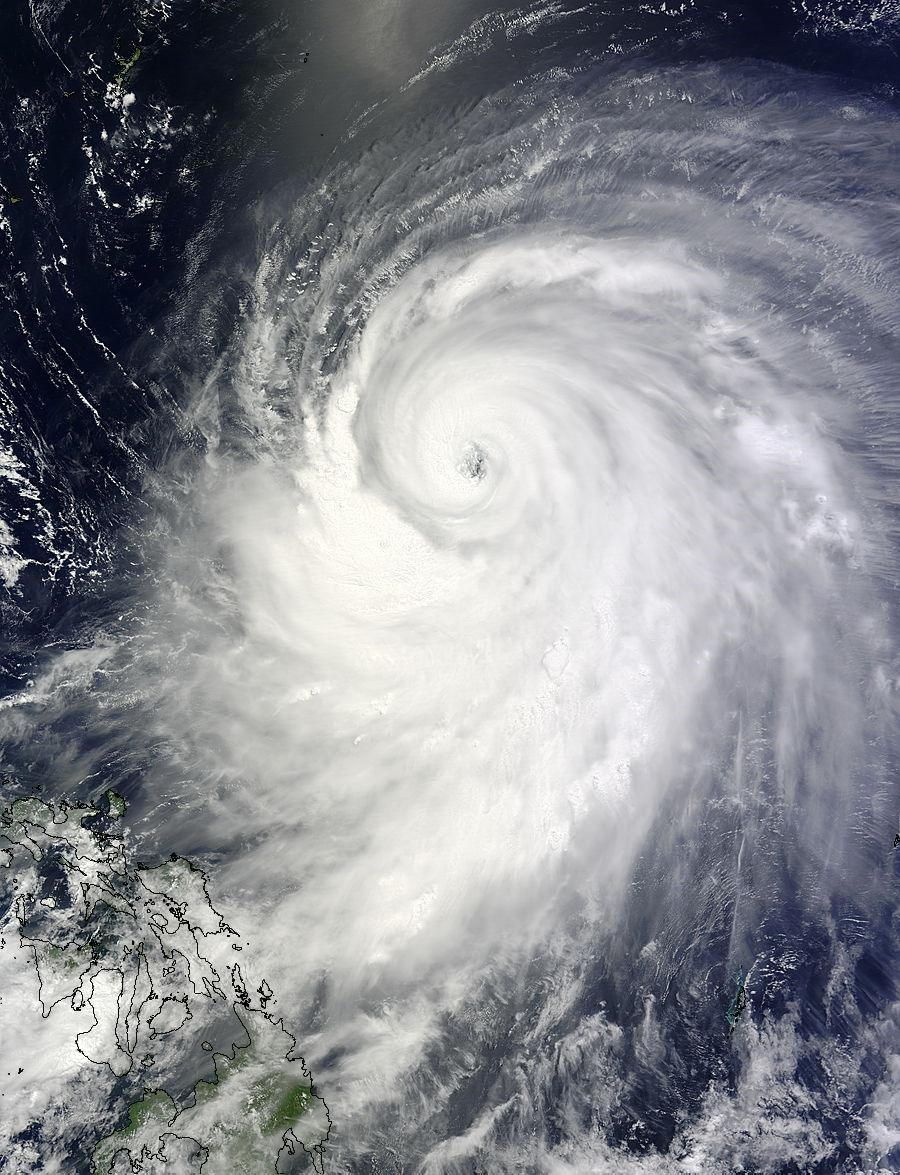
Super Typhoon Haiyan was the deadliest storm in modern meteorological record keeping, killing 6,000 people, with 2,000 people still missing. It was the strongest tropical cyclone ever recorded as making landfall as it crossed land directly at the Central Philippines on November 7-8, 2013, and proceeded to create havoc on the other S-E Asia countries. Three months after Super Typhoon Haiyan devastated the Philippines, the destruction and relief struggles are still apparent for the Filipinos. With media coverage having proceeded on to other issues, the Philippine community still needs massive financial help from the outside world.
According to the United Nations Office for the Coordination of Humanitarian Affairs, $78.7 million is still needed in food security assistance and more than $132 million is needed for emergency shelter. 100% of a donation to the Salvation Army for the relief effort in Tacloban goes directly to the people of Philippines.
Super Typhoon Haiyan displaced an estimated four million people in the Philippines. The problems actually get worse for many people, they don’t get better.
A documentary is available online. Watch it here: http://www.savn.tv/campaign/view/1150
“Man is not in charge today, money is in charge, money rules. God our Father did not give the task of caring for the earth to money, but to us, to men and women: we have this task! Instead, men and women are sacrificed to the idols of profit and consumption: it is the “culture of waste.” If you break a computer it is a tragedy, but poverty, the needs, the dramas of so many people end up becoming the norm… in so many parts of the world there are children who have nothing to eat, that’s not news, it seems normal. It cannot be this way! Yet these things become the norm: that some homeless people die of cold on the streets is not news. In contrast, a ten point drop on the stock markets of some cities, is a tragedy”.
“We are called not only to respect the natural environment, but also to show respect for, and solidarity with, all the members of our human family. These two dimensions are closely related; today we are suffering from a crisis which is not only about the just management of economic resources, but also about concern for human resources, for the needs of our brothers and sisters living in extreme poverty, and especially for the many children in our world lacking adequate education, health care and nutrition. Consumerism and a “culture of waste” have led some of us to tolerate the waste of precious resources, including food, while others are literally wasting away from hunger. I ask all of you to reflect on this grave ethical problem in a spirit of solidarity grounded in our common responsibility for the earth and for all our brothers and sisters in the human family.”
“Please, I would like to ask all those who have positions of responsibility in economic, political and social life, and all men and women of goodwill: let us be “protectors” of creation, protectors of God’s plan inscribed in nature, protectors of one another and of the environment. Let us not allow omens of destruction and death to accompany the advance of this world!”
POPE BENEDICT XVI
“I wish to reflect today upon the relationship between the Creator and ourselves as guardians of his creation. In so doing I also wish to offer my support to leaders of governments and international agencies who soon will meet at the United Nations to discuss the urgent issue of climate change. The
Earth is indeed a precious gift of the Creator who, in designing its intrinsic order, has given us guidelines that assist us as stewards of his creation. Precisely from within this framework, the Church considers that matters concerning the environment and its protection are intimately linked with integral human development. [There is] a pressing moral need for renewed solidarity not only between countries but also between individuals, since the natural environment is given b God to everyone, and so our use of it entails a personal responsibility towards humanity as a whole, particularly towards the poor and towards future generations…How important it is then, that the international community and individual governments send the right signals to their citizens and succeed in countering harmful ways of treating the environment! The protection of the environment, and the safeguarding of resources and of the climate, oblige all leaders to act jointly, respecting the law and promoting solidarity with the weakest regions of the world.” (December 8, 2007)
“My dear friends, God’s creation is one and it is good. The concerns for non-violence, sustainable development, justice and peace, and care for our environment are of vital importance for humanity.” (Speaking at World Youth Day, June 2008)
“At a time of world food shortage, of financial turmoil, of old and new forms of poverty, of disturbing climate change, of violence and deprivation which force many to leave their homelands in search of a less precarious form of existence, of the ever-present threat of terrorism, of growing fears over the future, it is urgent to rediscover grounds for hope. Let no one draw back from this peaceful battle that has been launched by Christ’s Resurrection. For as I said earlier, Christ is looking for men and women who will help him to affirm his victory using his own weapons: the weapons of justice and truth, mercy, forgiveness and love”. (Easter 2009)
POPE JOHN PAUL II
“The gradual depletion of the ozone layer and the related ‘greenhouse effect’ has now reached crisis proportions as a consequence of industrial growth, massive urban concentrations and vastly increased energy needs. Industrial waste, the burning of fossil fuels, unrestricted deforestation, the use of certain types of herbicides, coolants and propellants: all of these are known to harm the atmosphere and environment. The resulting meteorological and atmospheric changes range from damage to health to the possible future submersion of low-lying lands.”
“Faced with the widespread destruction of the environment, people everywhere are coming to understand that we cannot continue to use the goods of the earth as we have in the past. The public in general as well as political leaders are concerned about this problem, and experts from a wide range of disciplines are studying its causes. Moreover, a new ecological awareness is beginning to emerge which, rather than being downplayed, ought to be encouraged to develop into concrete programs and initiatives.
“The most profound and serious indication of the moral implications underlying the ecological problem is the lack of respect for life evident in many of the patterns of environmental pollution. Often, the interests of production prevail over concern for the dignity of workers, while economic interests take priority over the good of individuals and even entire peoples. In these cases, pollution or environmental destruction is the result of an unnatural and reductionist vision which at times leads to a genuine contempt for man.
“On another level, delicate ecological balances are upset by the uncontrolled destruction of animal and plant life or by a reckless exploitation of natural resources. It should be pointed out that all of this, even if carried out in the name of progress and well-being, is ultimately to mankind’s disadvantage.”
“Respect for life, and above all for the dignity of the human person, is the ultimate guiding norm for any sound economic, industrial or scientific progress.”
“The complexity of the ecological question is evident to all. There are, however, certain underlying principles, which, while respecting the legitimate autonomy and the specific competence of those involved, can direct research towards adequate and lasting solutions. These principles are essential to the building of a peaceful society; no peaceful society can afford to neglect either respect for life or the fact that there is an integrity to creation.
“Theology, philosophy and science all speak of a harmonious universe, of a “cosmos” endowed with its own integrity, its own internal, dynamic balance. This order must be respected. The human race is called to explore this order, to examine it with due care and to make use of it while safeguarding its integrity.
“On the other hand, the earth is ultimately a common heritage, the fruits of which are for the benefit of all. In the words of the Second Vatican Council, “God destined the earth and all it contains for the use of every individual and all peoples”. This has direct consequences for the problem at hand. It is manifestly unjust that a privileged few should continue to accumulate excess goods, squandering available resources, while masses of people are living in conditions of misery at the very lowest level of subsistence. Today, the dramatic threat of ecological breakdown is teaching us the extent to which greed and selfishness – both individual and collective – are contrary to the order of creation, an order which is characterized by mutual interdependence.
“The concepts of an ordered universe and a common heritage both point to the necessity of a more internationally coordinated approach to the management of the earth’s goods. In many cases the effects of ecological problems transcend the borders of individual States; hence their solution cannot be found solely on the national level. Recently there have been some promising steps towards such international action, yet the existing mechanisms and bodies are clearly not adequate for the development of a comprehensive plan of action. Political obstacles, forms of exaggerated nationalism and economic interests – to mention only a few factors – impede international cooperation and long-term effective action.
“The need for joint action on the international level does not lessen the responsibility of each individual State. Not only should each State join with others in implementing internationally accepted standards, but it should also make or facilitate necessary socio-economic adjustments within its own borders, giving special attention to the most vulnerable sectors of society. The State should also actively endeavur within its own territory to prevent destruction of the atmosphere and biosphere, by carefully monitoring , among other things, the impact of new technological or scientific advances. The State also has the responsibility of ensuring that its citizens are not exposed to dangerous pollutants or toxic wastes. The right to a safe environment is ever more insistently presented today as a right that must be included in an updated Charter of Human Rights.
“Modern society will find no solution to the ecological problem unless it takes a serious look at its life style. In many parts of the world society is given to instant gratification and consumerism while remaining indifferent to the damage which these cause. As I have already stated, the seriousness of the ecological issue lays bare the depth of man’s moral crisis. If an appreciation of the value of the human person and of human life is lacking, we will also lose interest in others and in the earth itself. Simplicity, moderation and discipline, as well as a spirit of sacrifice, must become a part of everyday life, lest all suffer the negative consequences of the careless habits of a few.
“An education in ecological responsibility is urgent: responsibility for oneself, for others, and for the earth. This education cannot be rooted in mere sentiment or empty wishes. Its purpose cannot be ideological or political. It must not be based on a rejection of the modern world or a vague desire to return to some “paradise lost” . Instead, a true education in responsibility entails a genuine conversion in ways of thought and behavior. Churches and religious bodies, non-governmental and governmental organizations, indeed all members of society, have a precise role to play in such education. The first educator, however, is the family, where the child learns to respect his neighbor and to love nature….The relationship between a good aesthetic education and the maintenance of a healthy environment cannot be overlooked.
“Today the ecological crisis has assumed such proportions as to be the responsibility of everyone. As I have pointed out, its various aspects demonstrate the need for concerted efforts aimed at establishing the duties and obligations that belong to individuals, peoples, States and the international community. This not only goes hand in hand with efforts to build true peace, but also confirms and reinforces those efforts in a concrete way. When the ecological crisis is set within the broader context of the search for peace within society, we can understand better the importance of giving attention to what the earth and its atmosphere are telling us: namely, that there is an order in the universe which must be respected, and that the human person, endowed with the capability of choosing freely, has a grave responsibility to preserve this order for the well-being of future generations. I wish to repeat that the ecological crisis is a moral issue.
“Even men and women without any particular religious conviction, but with an acute sense of their responsibilities for the common good, recognize their obligation to contribute to the restoration of a healthy environment. All the more should men and women who believe in God the Creator, and who are thus convinced that there is a well-defined unity and order in the world, feel called to address the problem. Christians, in particular, realize that their responsibility within creation and their duty towards nature and the Creator are an essential part of their faith. As a result, they are conscious of a vast field of ecumenical and inter-religious cooperation opening up before them.
“At the conclusion of this Message, I should like to address directly my brothers and sisters in the Catholic Church, in order to remind them of their serious obligation to care for all of creation. The commitment of believers to a healthy environment for everyone stems directly from their belief in God the Creator, from their recognition of the effects of original and personal sin, and from the certainty of having been redeemed by Christ. Respect for life and for the dignity of the human person extends also to the rest of creation, which is called to join man in praising God.
“In 1979, I proclaimed Saint Francis of Assisi as the heavenly Patron of those who promote ecology. He offers Christians an example of genuine and deep respect for the integrity of creation. As a friend of the poor who was loved by God’s creatures, Saint Francis invited all of creation – animals, plants, natural forces, even Brother Sun and Sister Moon – to give honor and praise to the Lord. The poor man of Assisi gives us striking witness that when we are at peace with God we are better able to devote ourselves to building up that peace with all creation which is inseparable from peace among all peoples.
“It is my hope that the inspiration of Saint Francis will help us to keep ever alive a sense of “fraternity” with all those good and beautiful things which Almighty God has created. And may he remind us of our serious obligation to respect and watch over them with care, in light of that greater and higher fraternity that exists within the human family.”(8 December 1989 – from the Vatican, Rome – World Day of Peace Message, January 1990)
Source: http://catholicclimatecovenant.org/
”
California May Finally Get Rain
The National Weather Service (NWS) reports that every square mile of California is in some state of drought, and almost 15% of the state, mostly in central California’s agricultural heartland, is in the most extreme state of exceptional drought. Rainfall in some of the most populated parts of the state has been all but nonexistent since July 1; San Francisco had just 5.85 inches of rain, about 35% of what’s normal for that location, and Los Angeles had just 1.2 inches of rain, less than 10% of what it normally gets for that period of the year.
Snowpack in the Sierra Nevada basin – the water bank for much of California – is way below average. By every count, California is in a truly historic drought that will cost the state and the country billions of dollars. Food prices are beginning to rise across the U.S., reflecting the effects of California’s drought.
The NWS projects that this week a pair of Pacific storms are expected to bring as much as 2 inches of rain to the coast, and several feet of snow to the Sierra Nevadas.
Still, despite the fact that Los Angeles could receive more rain this week than it has in nearly eight months, the drought will be far from over. Even with the storms that are predicted, much of California will still be way below average for precipitation this time of year.
11. Fracking Mining Threatens Western Wisconsin, our Country and World

Flattening The Hilltoppers? Frac Sand Mine is Proposed Near Wisconsin School. More than 100 frac sand mines and processing facilities, like this one outside of Bloomer, Wis., have cropped up across the state over the last few years.
Everyone who used natural gas (methane) to warm their home or place of business last year in the county should also read this excellent series on the wide-reaching impacts of the “fracking” (fracturing) industry in Wisconsin. The facts are clear: while the increasingly plentiful supplies natural gas and oil from newly fractured drilling well sites in North Dakota have been a boon of sorts especially to the nearby communities, the large quantities of sand excavated in Wisconsin and shipped to North Dakota for fracturing the drilling wells (sand is injected into the wells with mining fluids, adding pressure, resulting in fracturing the surrounding shale rock, which then frees up the methane from the surrounding shale) is creating havoc in many Western Wisconsin communities. The money that is ultimately made from selling the natural gas and oil produced by the North Dakota wells and sold throughout the U.S. often results in a windfall to the oil and natural gas industry and to the land owners. However, the operations from this industry also often result in the creation of many different kinds of effects, mainly negative, both to Western Wisconsin communities and the country and world as a whole.
The effects on the local communities and the environment in general come in the form of noise and air pollution at the drilling and sand mining sites, the permanent scarring and loss of habitat on the land, bluff, or mountain tops altered by the mining of the sand; and the air pollution emissions and noise created along the trucking routes, as well as the ground and surface water pollution at the drilling well sites, the sand mining sites, the sand processing sites, and the used frac sand disposal sites.
Of course there are also much broader negative effects of the continued growth of the fracing industry in the U.S. and elsewhere. The addition fuel mined and ultimately burned for heat or energy production is adding millions more tons of greenhouse gases to our atmosphere and oceans. Every cubit foot of natural gas that is burned releases .12 cubic tons carbon dioxide to the atmosphere, where it will remain upwards of one hundred years. This is adding to the mounting billions of tons more greenhouse (heat trapping) gases in that are present in our atmosphere, above and beyond the amounts that were present in the atmosphere when humans first began burning huge quantities of fossil fuels (coal, oil and natural gas) in a big way during the Industrial Revolution. The level of greenhouse gas concentrations in our atmosphere have presently reached historically high levels, which reputable global warming scientists the world over say poses a very real and dangerous threat to all of humanity.
For example, the most voluminous of the greenhouse gases – carbon dioxide – reached the milestone of 400 parts per million twice in the past three weeks. That level is already too high, say the overwhelming majority of the world’s scientists, and the result has been grave consequences, including injury or death to millions of people, especially families and individuals living within the world’s coastal cities where strong hurricanes come ashore. They have been impacted as the result of increased storm activities associated with warming and rising seas (ocean levels are rising from the expanding warmer water in the ocean and from new sources of ocean water, such as the water originating on lands from previously year-round-frozen glaciers – for example ice packs in Greenland, high mountain tops, and melt waters from Antarctica. Moreover, the oceans are also 30% more acidic than pre-Industrial Revolution times, which has adversely impacted some ocean species with significant fishing losses, losses of marine life and coral reefing destruction. Scientists predict that, by the end of this century, this will have a devastating impact on our plant, with many more deadly heat waves, higher humidity, massive coastal as well as inland flooding, more powerful storms, everywhere, more rain in the off season but longer and more widespread drought during the growing season, and more widespread insect infestations, due to fewer cold snaps that formerly limited the poleward movement of such species.
These broader effects are the likely impacts of higher than natural emissions of greenhouse gases from human-caused activities, which are proven to be resulting from historically high burning of fossil fuels (most notably coal, oil and natural gas). In the frac sand mining processes, greenhouse gases are emitted in using energy to excavate and deliver large volumes of sand from Western Wisconsin to the North Dakota drilling well sites, delivering the gas and ultimately resulting from emissions from burning the final product in the form of carbon dioxide, the most abundant og the greenhouse gases in the earth’s atmosphere. The concentration level in the atmosphere hit 400 parts per million twice in the last three weeks and is the highest concentration level of carbon dioxide in the atmosphere in over 2,5 million years, which occurred when the oceans were 60-80 feet higher than they are now.
8. NOAA: Greenhouse Gas Carbon Dioxide Reaches Milestone of 400 PPM in Earth’s Atmosphere
On May 9, the daily mean concentration of carbon dioxide in the atmosphere of Mauna Loa, Hawaii, surpassed 400 parts per million (ppm) for the first time since measurements began in 1958. Independent measurements made by both NOAA and the Scripps Institution of Oceanography have been approaching this level during the past week. It marks an important milestone because Mauna Loa, as the oldest continuous carbon dioxide (CO2) measurement station in the world, is the primary global benchmark site for monitoring the increase of this potent heat-trapping gas.
Carbon dioxide pumped into the atmosphere by fossil fuel burning and other human activities is the most significant greenhouse gas (GHG) contributing to climate change. Its concentration has increased every year since scientists started making measurements on the slopes of the Mauna Loa volcano more than five decades ago. The rate of increase has accelerated since the measurements started, from about 0.7 ppm per year in the late 1950s to 2.1 ppm per year during the last 10 years.
“That increase is not a surprise to scientists,” said NOAA senior scientist Pieter Tans, with the Global Monitoring Division of NOAA’s Earth System Research Laboratory in Boulder, Colo. “The evidence is conclusive that the strong growth of global CO2 emissions from the burning of coal, oil, and natural gas is driving the acceleration.”
Before the Industrial Revolution in the 19th century, global average CO2 was about 280 ppm. During the last 800,000 years, CO2 fluctuated between about 180 ppm during ice ages and 280 ppm during interglacial warm periods. Today’s rate of increase is more than 100 times faster than the increase that occurred when the last ice age ended.
It was researcher Charles David Keeling of the Scripps Institution of Oceanography, UC San Diego, who began measuring carbon dioxide at Mauna Loa in 1958, initiating now what is known as the “Keeling Curve.” His son, Ralph Keeling, also a geochemist at Scripps, has continued the Scripps measurement record since his father’s death in 2005.
“There’s no stopping CO2 from reaching 400 ppm,” said Ralph Keeling. “That’s now a done deal. But what happens from here on still matters to climate, and it’s still under our control. It mainly comes down to how much we continue to rely on fossil fuels for energy.”
NOAA scientists with the Global Monitoring Division have made around-the-clock measurements there since 1974. Having two programs independently measure the greenhouse gas provides confidence that the measurements are correct.
Moreover, similar increases of CO2 are seen all over the world by many international scientists. NOAA, for example, which runs a global, cooperative air sampling network, reported last year that all Arctic sites in its network reached 400 ppm for the first time. These high values were a prelude to what is now being observed at  http://http://www.esrl.noaa.gov/gmd/ccgg/trends/weekly.html”>Mauna Loa, a site in the subtropics, this year. Sites in the Southern Hemisphere will follow during the next few years. The increase in the Northern Hemisphere is always a little ahead of the Southern Hemisphere because most of the emissions driving the CO2 increase take place in the north.
Once emitted, CO2 added to the atmosphere and oceans remains for thousands of years. Thus, climate changes forced by CO2 depend primarily on cumulative emissions, making it progressively more and more difficult to avoid further substantial climate change.
5. “An Inconvenient Truth” – the Movie – and Photo Comic of Earth’s Warming
“In 39 years, I have never written these words in a movie review, but here they are. You owe it to yourself to see this film.”
– Roger Ebert
“It doesn’t matter whether you’re a Republican or Democrat, liberal or conservative … your mind will be changed in a nanosecond.”
– Roger Friedman, FOXNEWS.com
Here you can watch An Inconvenient Truth.
Here is a photo comic about global warming:

 All Things Environmental
Recent Comments