
27 Large Wildfires Burn 180,000 Acres – and Counting – Across the Western United States

27 large wildfires are burning across the West
More than 8,400 firefighters across the West battled dozens of wildfires Thursday that forced thousands of local residents to pack up families, pets and personal treasures to flee the advancing blazes.
Twenty-seven large fires were burning nearly 180,000 acres, the National Interagency Fire Center reported, as the region continued to pay a steep price for a recent, record-smashing heat wave that combined with low humidity and wind to create a perfect storm for wildfires.
AccuWeather Meteorologist Ryan Adamson warned that hot and dry weather through the weekend will only exacerbate wildfire danger.
“The only relief Mother Nature will offer will be at night when winds diminish and the relative humidity rises slightly,” he said.
More than 4,200 square miles have burned so far this year, almost the size of Connecticut. The number represents an alarming 30% more than 2016’s total year-to-date, and 2016 was an above-average year.
Read more:
‘Big Bang Theory’ star Johnny Galecki’s house destroyed in Calif. wildfire
High winds could worsen America’s largest active wildfire
It takes a camp: Small cities emerge on edge of wildfires
National Interagency Fire center spokeswoman Robyn Broyles blamed the big burn numbers on a very active spring fire season in the Southern Plains followed by the heat, wind and lightning the Southwest has experienced.
In Arizona, the Goodwin Fire about 100 miles north of Phoenix was one of six large fires burning across the state. Dewey-Humboldt resident Terry Thompson squeezed five people, four dogs and two cats into a 2005 Jeep Liberty not long after his wife, Angie, picked up the phone to hear the recorded evacuation notice.
Like hundreds of others displaced or left on edge by the 21,000-acre wildfire, the Thompsons had to keep ahead of the blaze, which was listed as just 1% contained early Thursday.
“I’m still in shock,” Terry Thompson said. Angie Thompson grabbed some keepsakes on their way out the door: “photos, photo albums, our safe. Oh, and baby shoes. Bronze baby shoes.”
Authorities lifted the evacuation order Thursday for the 1,400 residents of Thayer, but thousands in other communities remained out of their homes. The Information Center for the Goodwin Fire warned that for the next couple days the fire had a “high spread potential … with southwest winds of 15-20 mph and gusts up to 30.”
Gov. Doug Ducey, who declared a state of emergency, visited the scene and met with responders Thursday.
The fire follows more than a week of record-setting high temperatures across much of the West. Phoenix set a string of daily records last week and reached 119 degrees one day. Temps have eased, but summer remains summer — this week’s daily highs have been a more seasonal 108 degrees.
The nation’s largest fire, the Brian Head Fire, has been burning for almost two weeks in southwestern Utah, 250 miles south of Salt Lake City. The fire had consumed more than 50,000 acres early Thursday and was 10% contained.
There was good news for some locals when the town manager in Brian Head announced that an evacuation order was scheduled to be lifted Friday — just in time for a holiday weekend celebration that won’t include fireworks.
Some area communities won’t be so lucky, but Brian Head Town Manager Bret Howser said power was restored and Internet and phone repairs were expected to be completed sometime Friday.
“We invite everybody to come share in our Independence Day celebrations, thank the brave firefighters, help our local businesses recover and see how beautiful Brian Head still is!” Howser said in a Facebook post.
The news was also brighter near Burbank, Calif., where scores of homes were ordered evacuated Wednesday ahead of a small but fierce wildfire. Firefighters quickly gained control of the blaze, and the evacuation order was lifted hours later.
Contributing: Scott Craven and Ronald J. Hansen, The Arizona Republic
Story by John Bacon,USA TODAY,June 29, 2017
Source:
With Global Warming Now Spinning Out Of Control, Caused Mainly by World’s Continuing and Growing Reliance on Energy Derived from Burning Earth’s Ancient Stores of Fossil Fuel

Fossil fuel comes in many form and has many, many uses. The biggest problem impacting the climate occurs when it (coal, natural gas and oil or refined petroleum/petroleum products) in heating plants, homes and businesses, and in commercial and recreational transportation (cars, trucks, buses, airplanes and jets, trains and ships) as well as in road building, excavation and other means of development, including pipeline construction for moving water, oil, and other liquids; and expanding conducting trade with distant countries.
The residuals from these activities – carbon dioxide (CO2), methane, nitrous oxide, other invisible gases – which are “freely” discharged or emitted to the atmosphere, are now known to be accumulating or building up in the atmosphere and oceans to scientifically unquestionable dangerous levels, so much so that calling it a worldwide problem of epic proportions, or a threat to humankind’s existence comparable to a worldwide nuclear catastrophe, has become to many people as no exaggeration anymore.
Every passing day results in a new record volume of the greenhouse “heat-trapping” gases, all of which are continuing to accumulate to higher volume levels (concentrfations), way much faster than nature can transform back into fossil fuels.
Seven things every human ought know (and not forget!) about how we are causing the climate to change and what it means for Earth’s future.
Arctic Council Affirms Need for International Action Against Climate Change

Foreign ministers from Arctic nations meeting this week in Fairbanks, Alaska, concluded their meeting “noting the entry into force of the Paris agreement on climate change and its implementation, and reiterating the need for global action to reduce both long-lived greenhouse gases and short-lived climate pollutants.”
Called the Fairbanks Declaration, the document says the leaders signed it “recognizing that activities taking place outside the Arctic region, including activities occurring in Arctic states, are the main contributors to climate change effects and pollution in the Arctic, and underlining the need for action at all levels”
The U.S.’ Secretary of State Rex Tillerson signed the document, which affirms the need for international action against climate change. In addition to the U.S. and Sweden, the other council nations are Russia, Canada, Denmark, Finland, Norway and Iceland. The council also includes six indigenous groups and formal observers from non-Arctic countries.
No part of the world is warming faster than the Arctic.
Summer sea ice regularly shrinks to record lows, coastlines are eroding and wildfires are getting worse. Even the frozen tundra, a critical natural storage tank for carbon emissions, is no longer so frozen. Scientists reported this week that it is warming so rapidly that it now is emitting more carbon than it captures.
Sea ice extent has shrunk to record lows this year and will likely continue to do so, a March 2017 NASA report shows.
Doomsday Clock on Auto Pilot?

The events causing the annihilation human and all other forms of life on Earth [the Apocalypse] may have already been set in motion.
Global sea level rise could happen at nearly twice the rate previously projected by the U.N. Intergovernmental Panel on Climate Change, even under the best scenario, according to a new report from the Arctic Council’s Arctic Monitoring Assessment Program (AMAP).
References
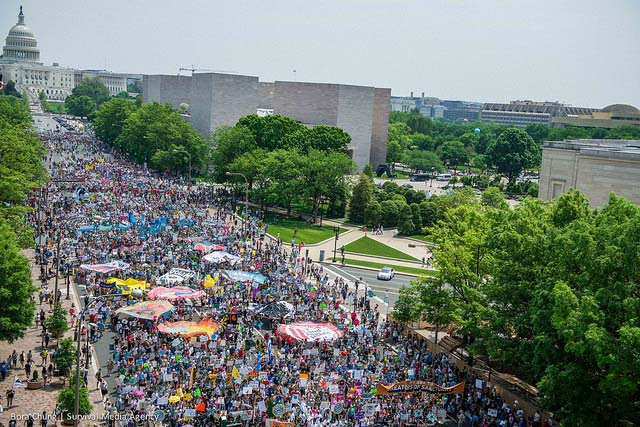
Thousands Gather in DC to Save World’s Climate

Many thousands of humans marching to save Earth’s climate from too much fossil fuel burning.
Outdoor Report for March 9, 2017, By the Wisconsin Department of Natural Resources: “Early Ice-out and Early Wildfire Season

While Wisconsin Governor Scott Walker and his fellow Republicans in the state Legislature, the U.S. Congress, republican governors other U.S. states, plus the president himself, continue to not blame human activities fueled by fossil fuel burning as the cause of the currently accelerating rates of global temperature rises, the record high rates of sea level rise, the acidifying of the planet’s oceans, along with the famine refuge causing droughts in Africa and the Middle East, and the historic melting of ice and snow at the poles and the relentlessly melting of mountainous glaciers, caused mostly by:
excavating, processing and transporting coal, natural gas, auto, truck and ship motor fuels, jet fuel, especially fuels derived from processing and delivering Alberta, Canada, tar sands) and many other human activities that result in large scale emissions of greenhouse gas emissions: cement making, paving forests, meat production, poor waste disposal practices, sports competitions which require long distance travel by teams and fans and awards ceremonies, conventions and conferences that require people to travel long distances, and buying products from long distance markets (requiring distance travel (i.e., not buying local, … the continuing of what the global warming scientists determined to be the “business as usual” practices (above) is slowly but increasing getting worse and worse – with no end in site. Today’s children and those yet to be born will curse us all for this. Mark my words.
March 9, 2017 Wisconsin Department of Natural Resources’ Outdoor Report (partial) follows:
Early ice-out and early wildfire season:
Snow is now gone from most areas of the state, with the exception of the far north, where a few inches remain in wooded areas. Very strong winds this week have taken ice out of many lakes in the south, including Monona and Mendota, which tied its record for second earliest opening — nearly a month earlier than average.
The high winds and loss of snow cover have also led to an early spring wildfire season, with more than 30 acres burning this week, including one fire near Eau Claire that resulted in the evacuation of some homes, but was contained before it burned any structures….
Authors of New UW and UCLA Collaborative Study: Global Warming To Increase Storm Intensity And Rain Volume

(Above) A section of Wisconsin Highway 13 is washed out after heavy rains, south of Highbridge in Ashland, Wis., on July 12. Jeff Peters / AP
Climate scientists have been telling us for awhile now in Wisconsin to get ready for warmer, wetter weather. As things heat up, more water is evaporated into the atmosphere, more energy is added to the system, and you get more rain. Last month, the author’s of a new collaborative study involving climatologists at UCLA and mathematicians at the University of Wisconsin said, in a radio interview with WORT-FM’s Brian standing, who is the host of the station’s Monday morning 8 O’Clock Buzz show, that Wisconsin, as well most other regions of the U.S., can expect much more rain as the atmosphere continues to warm directly resulting from rising greenhouse gas (GHGs) accumulations in the atmosphere over time, which are scientifically known to result from heavier rainfalls and more of them in the coming years, linked to the continuing buildup of human activity generated GHGs (from coal and natural gas burning in power plants, homes, businesses, etc,; and petroleum product burning in automobiles, trucks, jet liners, etc.) in our atmosphere under today’s “business as usual” economic forecast.
Prior to this study, scientists had not predicted the actual accumulation of rain in predicted future storms, measuring instead the increasing strength of storms under continuing global warming with rising GHG accumulations in the atmosphere. Under this study, the authors said a 100-year flood in Wisconsin and most other regions of the U.S. would be more likely to occur in 50 years or less years unless we change our ways, and that the 100-year flood would have a significantly greater volume of total rainfall accumulation than previous years, which has important implications for infrastructure capacities and locating residential, community and business developments.
Brian Standing spoke on February 27, 2017, with Professor David Neelin of the University of California Los Angeles Department of Atmospheric Science and with Professor Sam Stechmann at the University of Wisconsin Madison’s Department of Mathematics who collaborated on the study.
Hear interview and donate?) at WORT-FM.org.
Famine Caused by Climate Change Everybody’s Problem, Not Just the Problem of the Suffering Countries

The above map shows where food supplies are most at risk from climate change. The most vulnerable nations – mostly in Africa and Southeast Asia – are also those currently experiencing the highest levels of hunger.
Famine has been formally declared in parts of South Sudan, the United Nations said Monday, 20 February, warning that some 100,000 people are facing starvation there, and 1 million people are classified as being on the brink of famine.
Climate change presents the single biggest threat to development, and its widespread, unprecedented impacts disproportionately burden the poorest and most vulnerable. Urgent action to combat climate change and minimize its disruptions is integral to the successful implementation of sustainable development goals, according to the United Nations.
“Famine has become a tragic reality in parts of South Sudan and our worst fears have been realised,” said Serge Tissot, the Food and Agriculture Organization (FAO) Representative in South Sudan, in a news release issued jointly with the United Nations Children’s Fund (UNICEF) and the World Food Programme (WFP).
“Many families have exhausted every means they have to survive,” he stated, explaining that these people are predominantly farmers who have lost their livestock, even their farming tools.
Climate change and weather-related disasters have increased the vulnerability of food supplies across the world, resulting in rising levels of hunger. Millions of lives are at risk due to climate related disasters and, as the World Food Programme notes, it is those living in the developing world who are most vulnerable. Assisting 80 million people in around 80 countries each year, the World Food Programme (WFP) is the leading humanitarian organization fighting hunger worldwide, delivering food assistance in emergencies and working with communities to improve nutrition and build resilience.
A formal famine declaration means people have already started dying of hunger.Famine has become a tragic reality in parts of South Sudan.The three UN agencies warned that urgent action is needed to prevent more people from dying of hunger.

Like it or not, ALL people living on this planet today, regardless of their location, share a mutual responsibility for alleviating this situation – either in the form of financial or personal assistance; or in assuring their individual, family, business, community, region, state and nation’s greatly curtail their reduction of greenhouse gases that lead to global warming,the tremendous injustices of climate change and rising sea levels, stronger storms, longer droughts, and more severe and longer lasting heat wave with more humidity, which can only be impacted by their burning of greatly fewer quantities of fossil fuels than they are now causing to be burned in travel (automobiles, truck, jet travel, others); heating, lighting, air conditioning, using electricity generated by fuel burning; purchasing of products depended on heavy use of fossil fuel burning, either in production or in transport. or creating costly byproducts requiring further injustices in time.

 All Things Environmental
Recent Comments