
Call for Action on Climate Change by Renown Chemistry Professors’ Bell and Shakhashiri

In the March 17, 2014 Issue of Chemical and Engineering News, Volume 92 Issue 11, two renown educational scientists decided to co-author an editorial in the prestigious magazine to alert the public and politicians about the facts, causes, implications, and yes, the danger of unmitigated acceleration of greenhouse gases in the atmosphere and the need for immediate action to stem the growing changes to the earth’s climate. Their names are Jerry A. Bell and Bassam Z. Shakhashiri .
Dr. Bell is an emeritus professor in the department of chemistry at Simmons College, Boston, and chair of the American Chemical Society’s Presidential Working Group on Climate Science. After deciding on a career in science, Bell earned a bachelor’s degree in Chemistry followed by a PhD in Chemistry, both from Harvard University. During his time at Harvard, he worked as volunteer tutoring students in math and science.
Dr. Bell went on to hold teaching and research positions at colleges across the country, including UW-Madison, the University of California-Riverside, Brandeis University and Simmons College. He served at the National Science Foundation as director of the Division for Teacher Preparation and Enhancement (1984-1986), as director of the UW-Madison Institute for Chemical Education (1986-1989). He was director for Science, Mathematics, and Technology Education Programs at the American Association for the Advancement of Science (1992-1999), and was a senior scientist with the Education Division at the American Chemical Society (1999-2009) where he continues to serve as a consultant. He is widely recognized for his outstanding contributions to science education by many major awards including the ACS George C. Pimentel Award in Chemical Education (2000), the ACS James Flack Norris in Chemistry Education (1992) and the Chemical Manufacturers Catalyst Award (1977), and he travels to Wisconsin to work on programs of the Wisconsin Initiative for Science Literacy (WISL), founded by Dr. Shakashiri in 2002 who serves as its director. Bells work on behalf of the WISL in the Washington, DC area includes activities with educational groups and laboratory research in the chemistry department at the University of Maryland-College Park.He lives in Silver Springs, MD, with his wife, Mary Ann.
Bassam Z. Shakhashiri is the first holder of the William T. Evjue Distinguished Chair for the Wisconsin Idea at UW-Madison. He is well known internationally for his effective leadership in promoting excellence in science education at all levels, and for his development and use of demonstrations in the teaching of chemistry in classrooms as well as in less formal settings, such as museums, convention centers, shopping malls and retirement homes. The Encyclopedia Britannica sites him as the “dean of lecture demonstrators in America.” His scholarly publications, including the multi-volume series, Chemical Demonstrations: A Handbook for Teachers of Chemistry, are models of learning and instruction that have been translated into several languages. He is an advocate for policies to advance knowledge and to use science and technology to serve society. He promotes the exploration and establishment of links between science, the arts and the humanities, and the elevation of discourse on significant societal issues related to science, religion, politics, the economy, and ethics. Professor Shakhashiri was the 2012 president of the American Chemical Society, and will serve a one-year term as immediate past president in 2013.
A native of (Anfe, El-Koura) Lebanon, Professor Shakhashiri is the son of the late Dr. Zekin A. Shakhashiri, a pioneer in public health at the American University of Beirut, and the late Adma N. Shakhashiri, an alumna of what is now Lebanese American University. The Shakhashiris — father, mother, son and two daughters, Amal and Maha — came to the United States in 1957 when Bassam was 17 years old with one year of college (at the American University of Beirut) behind him. He completed undergraduate work at Boston University (Class of ’60) with an A. B. degree in chemistry, served as a teaching fellow at Bowdoin College for one academic year and then earned M.Sc. and Ph.D. degrees in chemistry at the University of Maryland (’64 and ’68, respectively).
After a year of post-doctoral research and two years as a junior member of the chemistry faculty at the University of Illinois-Urbana, Professor Shakhashiri joined the faculty of the UW-Madison in 1970, a position he still holds. In 1977 he became the founding chair of the UW System Undergraduate Teaching Improvement Council, now called the Office of Professional and Instructional Development. In 1983 he founded the Institute for Chemical Education (ICE) and served as its first director. His work with ICE inspired the establishment of the Center for Biology Education, the Merck Institute for Science Education, the Miami University (of Ohio) Center for Chemical Education, the Sacred Heart University SMART Center, and others. In 2002 he founded the Wisconsin Initiative for Science Literacy (WISL) and continues to serve as its director.
From 1984 to 1990 Professor Shakhashiri served as Assistant Director of the National Science Foundation (NSF) for Science and Engineering Education. As the NSF chief education officer he presided over the rebuilding of all the NSF efforts in science and engineering education after they had been essentially eliminated in the early 1980’s. His leadership and effectiveness in developing and implementing national programs in science and engineering education have helped set the annual NSF education budget at its current level of over $900 million. His NSF strategic plan launched the systemic initiatives and most of the other NSF education programs of the last two decades.
Professor Shakhashiri has given over 1400 invited lectures and presentations in North America, Europe, Asia, Australia, the Middle East and South America. He has been featured in newspapers, magazines, national and local radio and television; these include the New York Times, Washington Post, Newsweek, Time, the German-language Business Week, NBC Nightly News, National Public Radio, CNN, and the Larry King show. He appears as a regular guest on the Ideas Network of Wisconsin Public Radio.
Professor Shakhashiri is the recipient of over 35 awards, including Outstanding Lecturer of the Year in General Chemistry, University of Illinois (1969 and 1970), the 1977 Kiekhofer Distinguished Teaching Award from UW-Madison, and the 1979 Manufacturing Chemists Association Catalyst Award. He is the youngest recipient of two of the American Chemical Society’s (ACS) most coveted recognitions — the James Flack Norris Award for Outstanding Achievement in the Teaching of Chemistry (1983) and the ACS George Pimentel Award in Chemical Education (1986); he has been a member of the ACS since 1962. In 1982 he was given the Ron Gibbs Award of the Wisconsin Society of Science Teachers for “outstanding contributions to science education at the local, regional, national, and international levels.” In 1987, he was cited for distinguished public service by the District of Columbia Science Education Association, the National Science Teachers Association, the South Carolina Academy of Science, and the Boston University General Alumni Association.
He received the 2002 American Association for the Advancement of Science (AAAS) Award for Public Understanding of Science and Technology, “for his tireless efforts to communicate science to the general public, and especially children.” In 2004 he was inducted into the Hall of Fame of the national chemistry fraternity Alpha Chi Sigma. In 2005 he received the Madison Metropolitan School District Distinguished Service Award for a Citizen, the Chemical Pioneer Award from the American Institute of Chemists, the ACS Helen M. Free Award for Public Outreach for “lifelong accomplishments and for explaining and demonstrating science with charisma and passion.”In 2006 he received the Rotary Senior Service Award from the Rotary Club of Madison. In 2007 he received the National Science Board Public Service Award and was cited for “extraordinary contributions to promote science literacy and cultivate the intellectual and emotional links between science and the arts for the public.” In 2008 he received the inaugural Emerson Science Advocacy Medal from the University of Nevada-Las Vegas and was cited for “distinguished, sustained, and lasting contributions in the development of the sciences.”
Professor Shakhashiri is an elected fellow of the South Carolina Academy of Science, the Alabama Academy of Science, the New York Academy of Science, and the Wisconsin Academy of Sciences, Arts and Letters. He is the recipient of honorary doctoral degrees from George Washington University, Illinois State University, Ripon College, University of Colorado, Grand Valley State University, University of South Carolina and Lebanese American University. He is a national and international consultant to government agencies, academic institutions, industry, and private foundations on policy and practice matters related to science and to education at all levels. Professor Shakhashiri and his wife, June, live in Madison.
In the March 17, 2014 Issue of Chemical and Engineering News, Volume 92 Issue 11, the two renown educational and chemical scientists decided to join forces and co-author an editorial about the urgent need for climate action. A reproduction of that editorial follows.
“Action On Climate Change”
By Jerry A. Bell, Bassam Z. Shakhashiri
In Chemical and Engineering News
Atmospheric concentrations of carbon dioxide, methane, and other greenhouse gases are increasing. The well-known greenhouse effect caused by these gases traps solar energy, warming Earth’s atmosphere, land, and oceans and melting its ice. Thermal expansion of ocean water and liquid from melting land ice are raising sea levels, and dissolution of more carbon dioxide is lowering ocean pH. These observed changes are largely caused by human activities. The burning of fossil fuels drove the Industrial Revolution, which enormously raised the standard of living of much of the world, but it is also changing the climate.
Large increases in the amount of energy in Earth’s climate system of necessity produce changes, such as more water vapor in the air and more intense storms. The extent of these effects is not yet well characterized. But, as the system gains more energy, climate changes are likely to be larger and more lifestyle disruptive. Because the increasing amounts of greenhouse gases are responsible for the buildup of energy in the climate system, actions to reduce emission of these gases are needed now.
Actions by individuals and society as a whole, which includes scientific professional organizations such as the American Chemical Society (ACS), are required. Individuals, for example, can use more efficient lighting and appliances, make greater use of public transportation, drive low-emission vehicles, teleconference more and travel less, support efforts to mitigate the undesired consequences of climate change, and encourage government representatives to do the same. ACS has implemented approaches such as these in its headquarters buildings, which have been awarded platinum certification by the Leadership in Energy & Environmental Design (LEED) program of the U.S. Green Building Council.
Chemists and other scientists can reinforce their knowledge of climate science by using the ACS Climate Science Toolkit. The tool kit provides scientists with the background and incentive to engage others in discourse on the issues raised by climate change and the need to take action. Individual actions have small effects on energy consumption, but inaction has zero effect.
Individuals acting collectively—that is, society working through the social contract—can implement even more effective measures to mitigate climate change. But because the effects of collective action are larger and may affect individuals differently, these actions are more controversial, even when based on sound scientific and economic principles. An example of such a measure is a revenue-neutral carbon tax imposed at the source—the wellhead, mine, or port of entry. As the cost of the carbon is passed along, individuals have an incentive to lower their carbon footprint. As they do so, the value of their share of the tax proceeds that are distributed is maximized, and overall energy use and greenhouse gas emissions are reduced. In practice, the political will of the collective is required to enact any such approach, as is agreement that continued climate change will result in the severe consequences that climate scientists expect.
A responsibility of ACS is to further support and fortify its members in their efforts to communicate the science and effects of climate change. ACS has done this with its Climate Science Challenge Grants that local sections have received. ACS must continue to promote the ACS policy on global climate change developed by the Committee on Environmental Improvement and approved by the ACS Board of Directors. The policy provides credibility for members as they interact with others, including elected representatives, about the consequences of climate change. ACS should energize its members and affirm its commitment as a leader among scientific professional associations to advocate for local, national, and international actions that reduce the effects of climate change for the benefit of Earth and its people.
Chemical & Engineering News
ISSN 0009-2347
Copyright © 2014 American Chemical Society

Despite the excellent presentation of the facts and the implications by these renown scientists, our U.S. Congress, state Legislatures and governors, and the governments of other countries have been taken little or no timely action to meaningfully attack the source of this growing world calamity.
Putting off expensive measures to curb climate change will only cost the United States more in the long run. “Each decade we delay acting results in an added cost of dealing with the problem of an extra 40 percent,” said Jason Furman, chairman of Obama’s Council of Economic Advisers.”We know way more than enough to justify acting today,” Furman told reporters, drawing her conclusions from 16 recent economic studies that modeled the costs of climate change. The report was being released as the U.S. Environmental Protection Agency held public hearings on its plan to cut carbon emissions from power plants – the centerpiece of Obama’s climate action plan, in June 2014.
It’s not just the Obama administration that has been issuing these dire projections to detail the likely results of continuing the status quo of “business as usual” societal practices.
In June, a bipartisan report commissioned by former New York City Mayor Michael Bloomberg, former U.S. Treasury Secretary Henry Paulson and environmentalist Tom Steyer forecast a multibillion-dollar price tag for climate costs, such as property losses from storms, declining crop yields and soaring power bills during heatwaves. Their jointly prepared report Risky Business found the U.S. faces significant economic risks from climate change. Former HHS Sec. Donna Shalala and Johns Hopkins Dean Emeritus Dr. Alfred Sommer: “Imagine if we experienced multiple Chicago heat waves every summer, in cities all across the country. That is the direction we are headed unless we change course and take strong, decisive action to curb climate change.” “Everything that is challenging about producing more food for a world that is more populous, more urban and more affluent becomes more so when faced with a changing climate”, said Greg Page, executive chairman of Cargill Inc., the company headquartered in suburban Minneapolis that provides food, agriculture, financial and industrial products and services throughout the world in his article “Agriculture must engage in climate change discussion” in the August 10, 2014 Des Moines Register. We’ve already seen what climate change has brought to the most populous state in the country: California.
The following is by Ian James, The (Palm Springs, Calif.) Desert Sun (in USA Today)
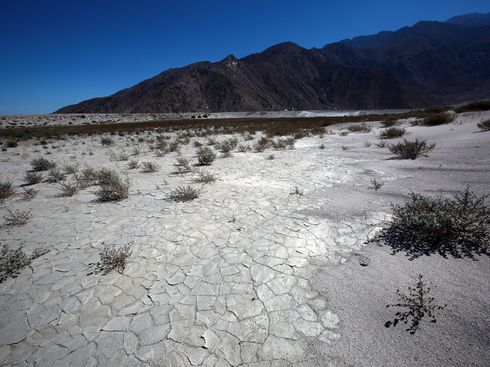 Cracks spread across the dry bed of parched percolation pond one at the Whitewater Groundwater Replenishment Facility near Palm Springs on Wednesday. / Crystal Chatham/The Desert Sun
In California, record heat is adding to extreme drought. The first half of 2014 was by far the hottest in California in 120 years of record-keeping, and that heat is exacerbating one of the most devastating droughts in state history along with massive, too numerous to count major wildfires.
Month after month, the red and burgundy patches on the California drought map have been spreading, with 82 percent of the state now classified as being in “extreme” or “exceptional” drought on the U.S. Drought Monitor website.
Reservoirs have been shrinking, aquifers have been declining, and an estimated 5 percent of the state’s irrigated farmland, from the Central Valley to Southern California, has been left dry and withering.
The increasingly dire water situation across California is being compounded by unusual heat. Long-term weather records maintained by the National Climatic Data Center show that California had its warmest January-June period since record-keeping began in 1895, with the average temperature 4.6 degrees Fahrenheit above average and more than 1 degree warmer than the previous record, set in 1934. July figures have yet to be released.
“In the business of climate science, this is a shattering of a record,” said Jonathan Overpeck, a professor of geosciences and co-director of the University of Arizona’s Institute of the Environment. “We are fairly certain that the unusual warmth is mostly due to human-caused global warming.”
For climate scientists, it can be difficult to trace the influence of climate change in the weather patterns of a year or two. But after decades with average temperatures on the rise, Overpeck said the extraordinary heat during this drought makes it a “global warming drought” that is indicative of the hotter dry spells expected in the future.
While California and the West is naturally prone to drought and have experienced long-lasting mega-droughts in the past, scientists say the long-term trend of rising average temperatures is now packing an extra punch. Hotter temperatures worsen droughts by reducing mountain snowpack and causing more evaporation from streams and reservoirs. Heat also draws more moisture from plants and the soil, and increases the amounts of water needed to irrigate crops and vegetation.
Meteorologist Richard Heim, a drought expert with the National Climatic Data Center in Asheville, North Carolina, said he has been amazed as high temperature records have been blown away this year in California.
“I’m just, ‘Wow,’ looking at these trends. Can it get any worse? Well, the models say yeah,” Heim said. “But how much more can we take as a society, as individual people? And how much more of this can the infrastructure and policies that have been put in place to deal with this at the state level, federal level, local level, how much more of this can you guys take?”
High pressure turns up heat
The main weather feature behind the drought and record temperatures has been a persistent high-pressure ridge over the West and the eastern Pacific Ocean. It has been called the “Ridiculously Resilient Ridge” since Stanford University graduate student Daniel Swain coined that term on his California Weather Blog last year, and the ridge has been keeping storms away from the region.
There is also a two-way relationship between the drought and heat, Heim explained. While the hotter temperatures are contributing to drier conditions, those same dry conditions are in turn amplifying the higher temperatures a bit. This occurs because dry ground tends to heat up faster than wet ground, adding more heat to the air.
In Sacramento as well as Washington, lawmakers have been debating measures that proponents say are aimed at coping with the drought and helping the West become more resilient to face growing water scarcity.
Sen. Barbara Boxer, D-Rancho Mirage, for instance, has recently backed legislation focused on addressing the drought and the impacts of climate change.
“As far back as 1995, climate scientists have predicted that increasing global temperatures would lead to more severe droughts in some regions of the world. We know that climate change is linked to the type of intense, record-breaking droughts that we are experiencing in California,” Boxer said by email. “The intensity and frequency of droughts will continue to worsen unless we take steps to address climate change by reducing carbon pollution.”
In addition to promoting President Barack Obama’s plan to reduce carbon emissions from power plants, Boxer touted the recently-passed Water Resources Reform and Development Act, which she said will help California respond to the deepening drought. The law will enable communities to obtain financing for projects such as water recycling, desalination and repairs of old water infrastructure.
Boxer, who leads the Environment and Public Works Committee, recently introduced another bill that would back local investments in water recycling and groundwater management, expand grants and rebates for water conservation, invest in water-related research, and create an open water data system. She said the measure would “help local communities take steps to become better prepared for drought.”
El Nino reprieve unlikely
Earlier this year, predictions of an El Nino raised hopes that a strong warming of the tropical Pacific could lead to drought-ending rains in California and the West. But in the past week, the National Weather Service updated its forecast and said the chance of an El Nino forming has decreased from about 80 percent to 65 percent during the fall and early winter.
State Climatologist Michael Anderson said, however, that an El Nino wouldn’t necessarily mean relief because both the wettest year and the driest year in the past 60 years were El Nino years.
“For Northern California, El Nino by itself is not a strong predictor,” Anderson said. “So we’ll have to look elsewhere.”
One wet winter could go a long way toward refilling many of the state’s dwindling reservoirs. But the depletion of the state’s aquifers is a much deeper problem.
“It will probably take a number of wet years,” Anderson said, “to make up some of the groundwater deficits that have been incurred.”
Groundwater vanishing
In many areas of California and the Southwest, groundwater levels have been declining for years as water has been heavily pumped for farmland and expanding development. The drought has added significantly to those strains.
In a new study, NASA and UC Irvine scientists used satellite data to track changes in the Colorado River Basin and determined that since late 2004, the region has lost nearly 53 million acre-feet of water. That’s almost double the volume of water that can be held in Lake Mead, the nation’s largest reservoir. The researchers also found that more than three-quarters of the water extracted was groundwater.
“That really forces you to raise your eyebrows and think about how long we can keep doing this, how long we can keep depleting groundwater at that rate,” said Jay Famiglietti, senior water scientist at NASA’s Jet Propulsion Laboratory and one of the study’s authors.
Famiglietti said the era of abundant water is clearly over in the West, and that the rapid declines of many aquifers point to a need for better management and additional studies to determine how much groundwater remains.
“We can see that we’re using a lot of it and so now we need to figure out how much is left,” Famiglietti said. “We need to do these explorations that need to be done – as if it were oil.”
Dramatic declines in the level of Lake Mead offer a glimpse of larger changes in water supplies taking place underground and across the region. The reservoir last month dropped to a record low, driven down by a 14-year drought that scientists say is one of the most severe to hit the Colorado River in more than 1,200 years. The lake, which supplies water to about 25 million people in three states, now stands about 39 percent full.
Rising costs
In the Central Valley, the heart of California’s $45 billion agriculture industry, water tables have declined dramatically for years – in some areas so much that the ground has been sinking by nearly 1 foot a year. And in times of drought, farms have been relying more heavily on groundwater to make up for diminished flows of water from the Sierra Nevada and the Sacramento-San Joaquin River Delta.
A recent study by the UC Davis Center for Watershed Sciences estimated that the drought is costing the state $2.2 million this year, including $1.5 billion in direct costs to agriculture. That includes losses of farm revenues as well as higher costs to pump water.
Those costs are likely to gradually climb as the drought persists. And with aquifers declining in many areas, there have been increasing calls for regulation of groundwater.
Unlike nearly all other Western states, California doesn’t have a statewide program for managing groundwater. The lack of statewide oversight has meant that owners of private wells can often pump as much as they wish, while some local water districts have permitted their aquifers to decline dramatically.
State lawmakers are now considering groundwater proposals that would strengthen local management procedures while giving the state new authority to step in when necessary as a “backstop” to safeguard water supplies.
Republican and Democratic lawmakers have also been debating proposals for a state water bond to go before voters. An $11.1 billion water bond is on the November ballot, but Gov. Jerry Brown has instead called for a “no-frills” $6 billion plan that would support projects ranging from water recycling to water efficiency improvements. Some of the money would also go to projects to protect and restore water habitats.
Water restrictions
As the drought persists, the effects on wildlife are also likely to grow more severe. Already, researchers in some parts of Southern California have been finding that birds of prey such as hawks seem to be reproducing less because they are finding less to eat.
“We’ve been seeing raptors that have not been breeding successfully, some of them showing signs of starvation, and that’s an indicator,” said Michael Lynes, director of public policy for the National Audubon Society in California.
The latest Monthly Drought Outlook from the National Weather Service predicts that in the coming weeks, the drought will likely persist or intensify across California and much of the West, with the heat also continuing. That will probably lead to increasing calls from the state and local water districts for Californians to cut back on water use.
The State Water Resources Control Board last month announced mandatory water restrictions, barring the washing of driveways and yard watering that creates runoff, among other things, and calling for fines of up to $500.
The state also instructed local agencies to activate water shortage contingency plans and restrict outdoor watering. Drought-plagued California set the record for the warmest first seven months of the year since records began there in 1895. The National Climatic Data Center found that the statewide average temperature was 60.9 degrees Fahrenheit, which was 4.6 degrees Fahrenheit above average.
This beat the previous record warm January-to-July period by 1.4 degrees Fahrenheit, which is a huge margin in the climate data world, where records are often set or missed by tenths of a degree.
Cracked earth is visible on what used to be the bottom of the Camanche Reservoir on August 8, 2014 in Ione, California. As the severe drought in California continues to worsen, the majority of the State’s major reservoirs are at or below 50 percent of capacity.
Global Warming Deniers are the Real Hoaxers

I never thought I’d have to make this post, 14 years into the 21st century. It’s been fourteen-years since I began saying it was all but certain rising concentration of the greenhouse gases, particularly carbon dioxide, will threaten life on our planet unless we take major and significant actions to reduce our annual emissions. It’s been virtually proven now, unfortunately.
It’s been fourteen years since I began warning my families, friends, community, co-workers, governmental representatives, church members, pastors, anyone who would listen. I also started writing newspaper editors, calling on state legislators, along with working in the local group “Preserve Our Climate”, and making phone calls on Wisconsin Public Radio talk shows, and occasionally National Public Radio, about the perils of global warming and climate change.
Yet the seem to be far too few folks, including members of Congress, most Wisconsin Legislators and Governor Walker, as well as most other countries outside the U.S., who are concerned enough about the injustices of passing on worsening climate change misery to future generations to act now to change things.
One would think that Wisconsin Public Radio (WPR) would have had the moral courage to listen to the many credible scientists it has had as guests on it’s radio talk shows over the last 14 years who were advocating for large scale greenhouse gas reductions. Instead, WPR continues to encourage their listeners to sign up for long distance WPR vacation travel trips, to Hawaii, Southern France, Germany and the like, which result in vast quantities of greenhouse gases being released to our atmosphere, over the objections of environmental advocates like myself who have been requesting they stop sponsoring such trips. It would be better if WPR instead encouraged their Wisconsin listeners to spend their vacation money in Wisconsin, not only reducing the negative impacts to the atmosphere, but also helping Wisconsin businesses prosper, rather than the foreign businesses catering to Wisconsin tourists.
Even worse, our State of Wisconsin plans to sponsor more business trips to Asia this August, going to Indonesia and Singapore, to lead to even more trips in the future by commercial airlines and shipping of goods. Even President Obama is encouraging the U.S. Congress to approve of fast-tracking the Trans Pacific Partnership treaty, which will encourage even more motorized travel to distant places.
Thirty-five percent of the world’s greenhouse gas emissions from human activities originate from burning oil and its refined products in jets, ships, boats, trucks, cars, trains, buses, etc..
Following are statements from experts “in the know” about the science, climate, physics and other fields they have excelled in those area which required solid understanding of the consequences of massive increases of greenhouse gas:
Global Climate Change: A Plea by the U.S. Conference of Catholic Bishops for Dialogue, Prudence, and the Common Good

Global Climate Change A Plea For Dialogue Prudence And The Common Good
A Statement of the United States Conference of Catholic Bishops
June 15, 2001
The text for Global Climate Change: A Plea for Dialogue, Prudence, and the Common Good originated from the Domestic and International Policy Committees and was prepared in consultation with the bishops’ Committee on Doctrine and the Committee on Science and Human Values. The document was approved for publication by the full body of United States Catholic bishops at their June 2001 General Meeting and has been authorized by the undersigned.
Msgr. William P. Fay
General Secretary
USCCB
Introduction
As people of faith, we are convinced that “the earth is the Lord’s and all it holds” (Ps 24:1). Our Creator has given us the gift of creation: the air we breathe, the water that sustains life, the fruits of the land that nourish us, and the entire web of life without which human life cannot flourish. All of this God created and found “very good.” We believe our response to global climate change should be a sign of our respect for God’s creation.
The continuing debate about how the United States is responding to questions and challenges surrounding global climate change is a test and an opportunity for our nation and the entire Catholic community. As bishops, we are not scientists or public policymakers. We enter this debate not to embrace a particular treaty, nor to urge particular technical solutions, but to call for a different kind of national discussion. Much of the debate on global climate change seems polarized and partisan. Science is too often used as a weapon, not as a source of wisdom. Various interests use the airwaves and political process to minimize or exaggerate the challenges we face. The search for the common good and the voices of poor people and poor countries sometimes are neglected.
At its core, global climate change is not about economic theory or political platforms, nor about partisan advantage or interest group pressures. It is about the future of God’s creation and the one human family. It is about protecting both “the human environment” and the natural environment. 1 It is about our human stewardship of God’s creation and our responsibility to those who come after us. With these reflections, we seek to offer a word of caution and a plea for genuine dialogue as the United States and other nations face decisions about how best to respond to the challenges of global climate change.
The dialogue and our response to the challenge of climate change must be rooted in the virtue of prudence. While some uncertainty remains, most experts agree that something significant is happening to the atmosphere. Human behavior and activity are, according to the most recent findings of the international scientific bodies charged with assessing climate change, contributing to a warming of the earth’s climate. Although debate continues about the extent and impact of this warming, it could be quite serious (see the sidebar “The Science of Global Climate Change”). Consequently, it seems prudent not only to continue to research and monitor this phenomenon, but to take steps now to mitigate possible negative effects in the future.
As Catholic bishops, we seek to offer a distinctively religious and moral perspective to what is necessarily a complicated scientific, economic, and political discussion. Ethical questions lie at the heart of the challenges facing us. John Paul II insists, “We face a fundamental question which can be described as both ethical and ecological. How can accelerated development be prevented from turning against man? How can one prevent disasters that destroy the environment and threaten all forms of life, and how can the negative consequences that have already occurred be remedied?” 2
Because of the blessings God has bestowed on our nation and the power it possesses, the United States bears a special responsibility in its stewardship of God’s creation to shape responses that serve the entire human family. As pastors, teachers, and citizens, we bishops seek to contribute to our national dialogue by examining the ethical implications of climate change. We offer some themes from Catholic social teaching that could help to shape this dialogue, and we suggest some directions for the debate and public policy decisions that face us. We do so with great respect for the work of the scientists, diplomats, business and union representatives, developers of new technologies, environmental leaders, and policymakers who have been struggling with the difficult questions of climate change for many years.
While our own growing awareness of this problem has come in part from scientific research and the public debate about the human contribution to climate change, we are also responding to the appeals of the Church in other parts of the world. Along with Pope John Paul II, church leaders in developing countries—who fear that affluent nations will mute their voices and ignore their needs—have expressed their concerns about how this global challenge will affect their people and their environment. We also hear the call of Catholic youth and other young people to protect the environment.
Therefore, we especially want to focus on the needs of the poor, the weak, and the vulnerable in a debate often dominated by more powerful interests. Inaction and inadequate or misguided responses to climate change will likely place even greater burdens on already desperately poor peoples. Action to mitigate global climate change must be built upon a foundation of social and economic justice that does not put the poor at greater risk or place disproportionate and unfair burdens on developing nations.
Scientific Knowledge and the Virtue of Prudence
As Catholic bishops, we make no independent judgment on the plausibility of “global warming.” Rather, we accept the consensus findings of so many scientists and the conclusions of the Intergovernmental Panel on Climate Change (IPCC) as a basis for continued research and prudent action (see the sidebar: The Science of Global Climate Change). Scientists engaged in this research consistently acknowledge the difficulties of accurate measurement and forecasting. Models of measurement evolve and vary in reliability. Researchers and advocates on all sides of the issue often have stakes in policy outcomes, as do advocates of various courses of public policy. News reports can oversimplify findings or focus on controversy rather than areas of consensus. Accordingly, interpretation of scientific data and conclusions in public discussion can be difficult and contentious matters.
Responsible scientific research is always careful to recognize uncertainty and is modest in its claims. Yet over the past few decades, the evidence of global climate change and the emerging scientific consensus about the human impact on this process have led many governments to reach the conclusion that they need to invest time, money, and political will to address the problem through collective international action.
The virtue of prudence is paramount in addressing climate change. This virtue is not only a necessary one for individuals in leading morally good lives, but is also vital to the moral health of the larger community. Prudence is intelligence applied to our actions. It allows us to discern what constitutes the common good in a given situation. Prudence requires a deliberate and reflective process that aids in the shaping of the community’s conscience. Prudence not only helps us identify the principles at stake in a given issue, but also moves us to adopt courses of action to protect the common good. Prudence is not, as popularly thought, simply a cautious and safe approach to decisions. Rather, it is a thoughtful, deliberate, and reasoned basis for taking or avoiding action to achieve a moral good.
In facing climate change, what we already know requires a response; it cannot be easily dismissed. Significant levels of scientific consensus—even in a situation with less than full certainty, where the consequences of not acting are serious—justifies, indeed can obligate, our taking action intended to avert potential dangers. In other words, if enough evidence indicates that the present course of action could jeopardize humankind’s well-being, prudence dictates taking mitigating or preventative action.
This responsibility weighs more heavily upon those with the power to act because the threats are often greatest for those who lack similar power, namely, vulnerable poor populations, as well as future generations. According to reports of the IPCC, significant delays in addressing climate change may compound the problem and make future remedies more difficult, painful, and costly. On the other hand, the impact of prudent actions today can potentially improve the situation over time, avoiding more sweeping action in the future.
Climate Change and Catholic Social Teaching
God has endowed humanity with reason and ingenuity that distinguish us from other creatures. Ingenuity and creativity have enabled us to make remarkable advances and can help us address the problem of global climate change; however, we have not always used these endowments wisely. Past actions have produced both good works and harmful ones, as well as unforseen or unintended consequences. Now we face two central moral questions:
How are we to fulfill God’s call to be stewards of creation in an age when we may have the capacity to alter that creation significantly, and perhaps irrevocably?
How can we as a “family of nations” exercise stewardship in a way that respects and protects the integrity of God’s creation and provides for the common good, as well as for economic and social progress based on justice?
Catholic social teaching provides several themes and values that can help answer these questions.
The Universal Common Good
Global climate is by its very nature a part of the planetary commons. The earth’s atmosphere encompasses all people, creatures, and habitats. The melting of ice sheets and glaciers, the destruction of rain forests, and the pollution of water in one place can have environmental impacts elsewhere. As Pope John Paul II has said, ” We cannot interfere in one area of the ecosystem without paying due attention both to the consequences of such interference in other areas and to the well being of future generations.” 3 Responses to global climate change should reflect our interdependence and common responsibility for the future of our planet. Individual nations must measure their own self-interest against the greater common good and contribute equitably to global solutions.
Stewardship of God’s Creation and the Right to Economic Initiative and Private Property
Freedom and the capacity for moral decision making are central to what it means to be human. Stewardship—defined in this case as the ability to exercise moral responsibility to care for the environment—requires freedom to act. Significant aspects of this stewardship include the right to private initiative, the ownership of property, and the exercise of responsible freedom in the economic sector. Stewardship requires a careful protection of the environment and calls us to use our intelligence “to discover the earth’s productive potential and the many different ways in which human needs can be satisfied.” 4
We believe economic freedom, initiative, and creativity are essential to help our nation find effective ways to address climate change. The United States’ history of economic, technological innovation, and entrepreneurship invites us to move beyond status quo responses to this challenge. In addition, the right to private property is matched by the responsibility to use what we own to serve the common good. Our Catholic tradition speaks of a “social mortgage” on property and, in this context, calls us to be good stewards of the earth. 5 It also calls us to use the gifts we have been given to protect human life and dignity, and to exercise our care for God’s creation.
True stewardship requires changes in human actions—both in moral behavior and technical advancement. Our religious tradition has always urged restraint and moderation in the use of material goods, so we must not allow our desire to possess more material things to overtake our concern for the basic needs of people and the environment. Pope John Paul II has linked protecting the environment to “authentic human ecology,” which can overcome “structures of sin” and which promotes both human dignity and respect for creation. 6 Technological innovation and entrepreneurship can help make possible options that can lead us to a more environmentally benign energy path. Changes in lifestyle based on traditional moral virtues can ease the way to a sustainable and equitable world economy in which sacrifice will no longer be an unpopular concept. For many of us, a life less focused on material gain may remind us that we are more than what we have. Rejecting the false promises of excessive or conspicuous consumption can even allow more time for family, friends, and civic responsibilities. A renewed sense of sacrifice and restraint could make an essential contribution to addressing global climate change.
Protecting the Environment for Future Generations
The common good calls us to extend our concern to future generations. Climate change poses the question “What does our generation owe to generations yet unborn?” As Pope John Paul II has written, “there is an order in the universe which must be respected, and . . . the human person, endowed with the capability of choosing freely, has a grave responsibility to preserve this order for the well-being of future generations.” 7
Passing along the problem of global climate change to future generations as a result of our delay, indecision, or self-interest would be easy. But we simply cannot leave this problem for the children of tomorrow. As stewards of their heritage, we have an obligation to respect their dignity and to pass on their natural inheritance, so that their lives are protected and, if possible, made better than our own.
Population and Authentic Development
Population and climate change should be addressed from the broader perspective of a concern for protecting human life, caring for the environment, and respecting cultural norms and the religious faith and moral values of peoples. Population is not simply about statistics. Behind every demographic number is a precious and irreplaceable human life whose human dignity must be respected.
The global climate change debate cannot become just another opportunity for some groups—usually affluent advocates from the developed nations—to blame the problem on population growth in poor countries. Historically, the industrialized countries have emitted more greenhouse gases that warm the climate than have the developing countries. Affluent nations such as our own have to acknowledge the impact of voracious consumerism instead of simply calling for population and emissions controls from people in poorer nations.
A more responsible approach to population issues is the promotion of “authentic development,” which represents a balanced view of human progress and includes respect for nature and social well-being. 8 Development policies that seek to reduce poverty with an emphasis on improved education and social conditions for women are far more effective than usual population reduction programs and far more respectful of women’s dignity. 9
We should promote a respect for nature that encourages policies fostering natural family planning and the education of women and men rather than coercive measures of population control or government incentives for birth control that violate local cultural and religious norms.
Caring for the Poor and Issues of Equity
Working for the common good requires us to promote the flourishing of all human life and all of God’s creation. In a special way, the common good requires solidarity with the poor who are often without the resources to face many problems, including the potential impacts of climate change. Our obligations to the one human family stretch across space and time. They tie us to the poor in our midst and across the globe, as well as to future generations. The commandment to love our neighbor invites us to consider the poor and marginalized of other nations as true brothers and sisters who share with us the one table of life intended by God for the enjoyment of all.
All nations share the responsibility to address the problem of global climate change. But historically the industrial economies have been responsible for the highest emissions of greenhouse gases that scientists suggest are causing the warming trend. Also, significant wealth, technological sophistication, and entrepreneurial creativity give these nations a greater capacity to find useful responses to this problem. To avoid greater impact, energy resource adjustments must be made both in the policies of richer countries and in the development paths of poorer ones.
Most people will agree that while the current use of fossil fuels has fostered and continues to foster substantial economic growth, development, and benefits for many, there is a legitimate concern that as developing countries improve their economies and emit more greenhouse gases, they will need technological help to mitigate further atmospheric environmental harm. Many of the poor in these countries live in degrading and desperate situations that often lead them to adopt environmentally harmful agricultural and industrial practices. In many cases, the heavy debt burdens, lack of trade opportunities, and economic inequities in the global market add to the environmental strains of the poorer countries. Developing countries have a right to economic development that can help lift people out of dire poverty. Wealthier industrialized nations have the resources, know-how, and entrepreneurship to produce more efficient cars and cleaner industries. These countries need to share these emerging technologies with the less-developed countries and assume more of the financial responsibility that would enable poorer countries to afford them. This would help developing countries adopt energy-efficient technologies more rapidly while still sustaining healthy economic growth and development. 10 Industries from the developed countries operating in developing nations should exercise a leadership role in preserving the environment.
No strategy to confront global climate change will succeed without the leadership and participation of the United States and other industrial nations. But any successful strategy must also reflect the genuine participation and concerns of those most affected and least able to bear the burdens. Developing and poorer nations must have a genuine place at the negotiating table. Genuine participation for those most affected is a moral and political necessity for advancing the common good.
The Public Policy Debate and Future Directions
Catholic social teaching calls for bold and generous action on behalf of the common good. “Interdependence,” as Pope John Paul II has written, “must be transformed into solidarity. . . . Surmounting every type of imperialism and determination to preserve their own hegemony, the stronger and richer nations must have a sense of moral responsibility for the other nations, so that a real international system may be established which will rest on the foundation of the equality of all peoples and on the necessary respect for their legitimate differences.” 11
The common good is built up or diminished by the quality of public debate. With its scientific, technological, economic, political, diplomatic, and religious dimensions, the challenge of global climate change may be a basic test of our democratic processes and political institutions. We respect the inquiry and dialogue which has been carried forward by a wide variety of scientists, diplomats, policy makers, and advocates, not only in the United States but around the world. These efforts should not be demeaned or distorted by disinformation or exaggeration. Serious dialogue should not be jeopardized by public relations tactics that fan fears or pit nations against one another. Leaders in every sector should seek to build a scientifically based consensus for the common good; avoid merely representing their own particular interests, industries, or movements; and act responsibly to protect future generations and the weak.
In the past decade, a continuing process of international diplomacy has led to agreements on principles and increasingly on procedures. In 1992, more than 160 nations, including the United States, ratified the first international treaty on global climate change at Earth Summit in Rio de Janeiro, Brazil, which was known as the United Nations Framework Convention on Climate Change (UNFCCC). In 1997, parties to the UNFCCC including the United States negotiated the Kyoto Protocol, which established mandatory emission reduction targets, market-based procedures for meeting those targets, and timetables for industrialized nations.
Without endorsing the specifics of these agreements and processes, we Catholic bishops acknowledge the development of these international negotiations and hope they and other future efforts can lead to just and effective progress. However, serious deliberations must continue to bring about prudent and effective actions to ensure equity among nations.
As an act of solidarity and in the interest of the common good, the United States should lead the developed nations in contributing to the sustainable economic development of poorer nations and to help build their capacity to ease climate change. Since our country’s involvement is key to any resolution of these concerns, we call on our people and government to recognize the seriousness of the global warming threat and to develop effective policies that will diminish the possible consequences of global climate change. We encourage citizens to become informed participants in this important public debate. The measures we take today may not greatly moderate climate change in the near future, but they could make a significant difference for our descendants.
We also hope that the United States will continue to undertake reasonable and effective initiatives for energy conservation and the development of alternate renewable and clean-energy resources. New technologies and innovations can help meet this challenge. While more needs to be done to reduce air pollution, through the use of improved technologies and environmental entrepreneurship, the United States has made significant environmental gains over the last several decades. Our hope is that these technologies along with other resources can be shared with developing countries.
Within the United States, public policy should assist industrial sectors and workers especially impacted by climate change policies, and it should offer incentives to corporations to reduce greenhouse gas emissions and assistance to workers affected by these policies.
We encourage all parties to adopt an attitude of candor, conciliation, and prudence in response to serious, complex, and uncertain challenges. We hope the continuing dialogue within and among the diverse disciplines of science, economics, politics, and diplomacy will be guided by fundamental moral values: the universal common good, respect for God’s creation, an option for the poor, and a sense of intergenerational obligation. Since religious values can enrich public discussion, this challenge offers opportunities for interfaith and ecumenical conversation and cooperation.
Finally, we wish to emphasize the need for personal conversion and responsibility. In our pastoral reflection Renewing the Earth, we wrote the following:
Grateful for the gift of creation . . . we invite Catholics and men and women of good will in every walk of life to consider with us the moral issues raised by the environmental crisis. . . . These are matters of powerful urgency and major consequence. They constitute an exceptional call to conversion. As individuals, as institutions, as a people, we need a change of heart to preserve and protect the planet for our children and for generations yet unborn. 12 Each of us should carefully consider our choices and lifestyles. We live in a culture that prizes the consumption of material goods. While the poor often have too little, many of us can be easily caught up in a frenzy of wanting more and more—a bigger home, a larger car, etc. Even though energy resources literally fuel our economy and provide a good quality of life, we need to ask about ways we can conserve energy, prevent pollution, and live more simply.
Conclusion
Our national debate over solutions to global climate change needs to move beyond the uses and abuses of science, sixty-second ads, and exaggerated claims. Because this issue touches so many people, as well as the planet itself, all parties need to strive for a civil and constructive debate about U.S. decisions and leadership in this area.
As people of religious faith, we bishops believe that the atmosphere that supports life on earth is a God-given gift, one we must respect and protect. It unites us as one human family. If we harm the atmosphere, we dishonor our Creator and the gift of creation. The values of our faith call us to humility, sacrifice, and a respect for life and the natural gifts God has provided. Pope John Paul II reminds us in his statement The Ecological Crisis: A Common Responsibility that “respect for life and for the dignity of the human person extends also to the rest of creation, which is called to join man in praising God.” 13 In that spirit of praise and thanksgiving to God for the wonders of creation, we Catholic bishops call for a civil dialogue and prudent and constructive action to protect God’s precious gift of the earth’s atmosphere with a sense of genuine solidarity and justice for all God’s children.
Sidebar
The Science of Global Climate Change
The photographs from the Apollo missions show earth glowing in the stillness of space like a blue-white opal on black velvet. Cool and beautiful, it hurries along in the Sun’s gravitational embrace. The earth is our home, our whole wide world.
Our enfolding blanket of air, our atmosphere, is both the physical condition for human community and its most compelling symbol. We all breathe the same air. Guarding the integrity of the atmosphere—without which complex life could not have evolved on this planet—seems like common sense. Yet a broad consensus of modern science is that human activity is beginning to alter the earth’s atmospheric characteristics in serious, perhaps profound ways. For the past century, researchers have been gathering and verifying data that reveal an increase in the global average temperature. Until recently, scientists could not say with great confidence whether or not this phenomenon was in any way the result of human activity or entirely the result of natural changes over time.
To deal with the difficulty of making precise measurements and arriving at definite conclusions, the World Meteorological Organization and the United Nations Environment Programme established the Intergovernmental Panel on Climate Change (IPCC) to seek a clear explanation of the causes and possible impacts of this global climate change. 14 Because of the large number of scientists involved in the IPCC and its process of consultation, its reports are considered widely as offering the most authoritative scientific perspectives on the issue. IPCC’s findings have met with general—but because of remaining uncertainties, not complete—agreement within the wider scientific community.
In 1996, the IPCC issued its Second Assessment Reports, which summarized the current state of knowledge. The first of these reports concluded that ” the balance of evidence suggests that there is a discernible human influence on global climate.” 15 The Third Assessment Reports, approved in early 2001, found even stronger evidence and concluded, ” most of the observed warming over the last 50 years is likely to have been due to the [human-induced] increase in greenhouse gas concentrations” (italics added). 16
The IPCC offers convincing evidence that there exists if not a clear and present danger then a clear and future one, and that coming changes will affect all aspects of the environment and societal well-being. Based on measurements taken over both land and sea, the global average surface-air temperature has increased by about one degree Fahrenheit since 1860, building up as the Industrial Revolution was hitting full stride. While this is hardly a frightening increase for a particular geographic location, the temperature change is global in extent, so one must read it against the background of the earth’s average temperature during historic times. According to IPCC, the rate and duration of warming in the twentieth century appears to be the largest in the last one thousand years. The twentieth century also experienced precipitation increases in mid- and high-northern latitudes; drier conditions in the subtropics; decreases in snow cover, mountain glaciers, and Arctic sea ice; and a rise of four to eight inches in mean sea level. 17
The “greenhouse effect,” though complex in detail, is simple enough in outline. Not considering the internal heating due to radioactive decay and volcanism, the earth draws its thermal energy from the Sun. Atmospheric gases form a protective cover that makes our planet hospitable to life, transmitting visible light, blocking out harmful high-energy radiation like ultraviolet rays, and keeping temperatures comfortable by moderating the escape of heat into space. However, the precise mix of these gases is quite delicate, and changing that mix alters the atmosphere’s properties. An increase in the relative abundance of the greenhouse gases (carbon dioxide, methane, chlorofluorocarbons, tropospheric ozone, and nitrous oxide) causes the earth to trap more of the Sun’s heat, resulting in what is called “global warming.” Since the beginning of the industrial period, the IPCC reports, the concentration of the principal greenhouse gas, carbon dioxide, has increased by 30 percent and is now greater than at any time in the past 20 million years. 18 The presence of methane (150 percent increase) and nitrous oxide (16 percent increase) is also growing. The result is the small but alarming temperature rise science has detected. 19
What causes greenhouse gases to accumulate in the atmosphere? Emissions from cars and trucks, industry and electric plants, and businesses and homes are the largest part of the answer, although other factors such as deforestation contribute. The Industrial Revolution was built on furnaces and engines burning fossil fuels (coal, natural gas, oil, and such derived products as gasoline and heating oil). These fossil fuels now power the U.S. and global economy. Although some of the smoke particles and other pollutants (such as sulfur dioxide) now streaming from chimneys and tailpipes can actually cool the earth if they take an aerosol form, the great bulk of our emissions are contributing a warming influence. Reflecting upon studies completed since its last report in 1996, the IPCC says, “There is new and stronger evidence that most of the warming observed over the last 50 years is attributable to human activities.” 20
Whatever the extent, severity, or geographical distribution of global warming impacts, the problem is expected to disproportionately affect the poor, the vulnerable, and generations yet unborn. Projected sea level rises could impact low-lying coastal areas in densely populated nations of the developing world. Storms are most likely to strain the fragile housing infrastructure of the poorest nations. The migration of diseases could further challenge the presently inadequate health care systems of these same nations. Droughts or floods, it is feared, will afflict regions already too often hit by famine, hunger, and malnutrition. Because the number of days with high heat and humidity are likely to increase, heat stress impacts will also increase, especially among the elderly, the sick, children, and the poor. 21
The scientific reports of the IPCC portray the long-term challenge global climate change poses. Its findings, while not complete, are widely accepted in the scientific community. In June 2001, the National Academy of Sciences released a report, prepared at the request of President Bush, summarizing a prestigious panel’s understanding of global climate change and an assessment of the work of the International Panel on Climate Change. The panel said that “greenhouse gases are accumulating in the Earth’s atmosphere as a result of human activities. . . .” It also found that “we cannot rule out that some significant part of these changes are also a reflection of natural variability. . . . Because there is considerable uncertainty in current understanding of how the climate system varies naturally and reacts to emissions of greenhouse gases and aerosols, current estimates of the magnitude of future warming should be regarded as tentative and subject to future adjustments (either upward or downward). . . .” The report noted that while the full implications of climate change remain unknown, the panel “generally agrees with the assessment of human-caused change presented in the IPCC Working Group I scientific report.” 22
John Paul II, On the Hundredth Anniversary of Rerum Novarum (Centesimus Annus) (Washington, D.C.: United States Conference of Catholic Bishops, 1991), no. 38.
John Paul II, “International Solidarity Needed to Safeguard Environment,” Address by the Holy Father to the European Bureau for the Environment, L’Osservatore Romano (June 26, 1996).
John Paul II, The Ecological Crisis: A Common Responsibility (Washington, D.C.: United States Conference of Catholic Bishops, 1990), no. 6.
John Paul II, On the Hundredth Anniversary of Rerum Novarum (Centesimus Annus) (Washington, D.C.: United States Conference of Catholic Bishops, 1991), no. 32.
John Paul II, On Social Concern (Sollicitudo Rei Socialis) (Washington, D.C.: United States Conference of Catholic Bishops, 1988), no. 42.
John Paul II, On the Hundredth Anniversary of Rerum Novarum, no. 38.
John Paul II, “The Exploitation of the Environment Threatens the Entire Human Race,” address to the Vatican symposium on the environment (1990), in Ecology and Faith: The Writings of Pope John Paul II, ed. Sr. Ancilla Dent, OSB (Berkhamsted, England: Arthur James, 1997), 12.
John Paul II, On Social Concern, ch. four. This chapter of the encyclical gives a more complete definition of the concept of authentic development.
Second Vatican Council, Pastoral Constitution on the Church in the Modern World (Gaudium et Spes), nos. 50-51, in Austin Flannery, ed., Vatican Council II: The Conciliar and Post Conciliar Documents, new rev. ed., 1st vol. (Northport, N.Y.: Costello Publishing, 1996).
See also treatment of this topic in Stewardship: A Disciple’s Response (Washington, D.C.: United States Conference of Catholic Bishops, 1993), 27.
Ibid., no. 39.
United States Conference of Catholic Bishops, Renewing the Earth: An Invitation to Reflection and Action on Environment in Light of Catholic Social Teaching (Washington, D.C.: United States Conference of Catholic Bishops, 1992), 3. See also treatment of this theme in Stewardship: A Disciple’s Response, 46.
John Paul II, The Ecological Crisis, no. 16.
To date, the IPCC’s work represents the most authoritative estimates and prognosis of current and future climate change data. This statement utilizes the following Second and Third Assessment Reports by the IPCC: 1996a: Climate Change 1995: The Science of Climate Change. Contribution of Working Group I to the Second Assessment Report of the Intergovernmental Panel on Climate Change, eds. J. T. Houghton, L. G. Meira Filho, B. A. Callander, N. Harris, A. Kattenberg, and K. Maskell (Cambridge and New York: Cambridge University Press). 1996b: Climate Change 1995: Impacts, Adaptations and Mitigation of Climate Change: Scientific-Technical Analyses. Contribution of Working Group II to the Second Assessment Report of the Intergovernmental Panel on Climate Change, eds. R. T. Watson, M. C. Zinyowera, and R. H. Moss (Cambridge and New York: Cambridge University Press). 1996c: Climate Change 1995: Economic and Social Dimensions of Climate Change. Contribution of Working Group III to the Second Assessment Report of the Intergovernmental Panel on Climate Change, eds. J. P. Bruce, Hoesund Kee, and E. F. Haites (Cambridge and New York: Cambridge University Press). 1996d: The IPCC Second Assessment Synthesis of Scientific-Technical Information Relevant to Interpreting Article 2 of the UN Framework Convention on Climate Change (Geneva: World Meteorological Organization/United Nations Environment Programme). 2001a: Climate Change 2001: The Scientific Basis, eds. J. T. Houghton, Y. Ding, D. J. Griggs, M. Noguer, P. van der Linden, X. Dai, K. Maskell, and C. Johnson (Cambridge and New York: Cambridge University Press). 2001b: Climate Change 2001: Impacts, Adaptation, and Vulnerability, eds. J. McCarthy, O. Canziani, N. Leary, D. Dokken, and K. White (Cambridge and New York: Cambridge University Press). 2001c: Climate Change 2001: Mitigation, eds. O. Davidson, B. Metz, R. Swart, and J. Pan (Cambridge and New York: Cambridge University Press).
IPCC, 1996a, 5.
IPCC, Climate Change 2001: The Scientific Basis, 10.
Ibid., ch. two.
Ibid., 7.
Ibid.
Ibid., 10.
IPCC, Climate Change 2001: Impacts, Adaptation, and Vulnerability.
National Academy of Science, Climate Change Science: An Analysis of Some Key Questions (Washington, D.C., June 7, 2001).
 All Things Environmental
Recent Comments