
Another Global Warming Trend: Tornadoes in Swarms
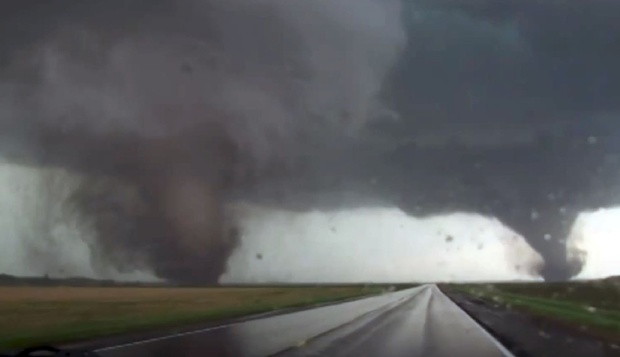
October 16, 2014
Tornado Swarms Increasing In U.S.: NOAA Study Tracks Deadly Storms
 “>Read more.
WASHINGTON (Reuters) – Tornadoes in the United States are increasingly coming in swarms rather than as isolated twisters, according to a study by U.S. government meteorologists published on Thursday that illustrates another trend toward extreme weather emerging in recent years.
According to a study published by government meteorologists in the journal Science on Thursday, tornadoes are increasingly coming in swarms, meaning on the days a tornado hits, it is far more likely that several more — possibly dozens — will occur that same day.
Researchers looked at tornado activity over the past 60 years and found that although the number of the deadly storms occurring each year had remained relatively steady, since the mid 1990s they have been more likely to come in swarms over fewer days per year rather than as isolated tornadoes spread throughout the season.
On the list of the 10 single days with the most tornadoes since 1954, eight have occurred since 1999, including five since 2011. That year alone had days with 115, 73, 53 and 52 twisters.
The meteorologist who led the study, Harold Brooks of the U.S. National Oceanic and Atmospheric Administration’s National Severe Storms Laboratory in Norman, Oklahoma, said emergency management agencies and insurers should be prepared to deal more often with days with lots of tornado damage.
The study analyzed the official U.S. tornado database for the six-decade period ending last year, excluding twisters below Category F1, with wind speeds of 73-112 mph (117-180 kph), on the Enhanced Fujita Tornado Intensity Scale.
Some experts have blamed weather intensity seen in recent years on global climate change they attribute to human activities. This study did not, however, offer a conclusion as to a cause.
“Knowing that the climate now has changed from that of the 1970s makes for a circumstantial argument in favor of a changing climate playing at least some role in the tornado changes,” said meteorologist Patrick Marsh of NOAA’s Storm Prediction Center.
“There are indications that heavy rainfall events are occurring with greater frequency globally, and given a warmer climate, this makes sense,” added Storm Prediction Center meteorologist Greg Carbin.
But “any trend in tornado events is much more difficult to discern,” Carbin added.
The average number of days annually with at least 20 tornadoes has more than doubled since the 1970s to upwards of five days per year in the past decade. For days with at least 30 tornadoes, there has been an average of three per year in the past decade, compared to 0.6 days per year in the 1970s.
Records for both the most and fewest tornadoes over a 12-month period have come in the past five years, with 1,050 from June 2010 to May 2011 and 236 tornadoes from May 2012 to April 2013. May is the month with the most tornado activity, followed by June and April.
Tornadoes, rapidly spinning columns of air usually spawned by rotating thunderstorms, can be among the most violent weather events. They have been reported on every continent except Antarctica but most often hit a U.S. region covering the Great Plains and parts of the Midwest and South.
Tornadoes can cause extensive loss of life and property damage like the May 2011 twister in Joplin, Missouri, that killed about 160 people and wrecked thousands of homes.
(Reporting by Will Dunham, editing by G Crosse)
Earth’s About to Lose What Little Chance It Had – Unless We Act Now!
Who’s Gonna Stand Up
Neil Young’s Who’s Gonna Stand Up (and Save the Earth)
Protect the wild, tomorrow’s child
Protect the land from the greed of man
Take down the dams, stand up to oil
Protect the plants, and renew the soil
Who’s gonna stand up and save the earth?
Who’s gonna say that she’s had enough?
Who’s gonna take on the big machine?
Who’s gonna stand up and save the earth?
This all starts with you and me
Damn the dams, save the rivers
Starve the takers and feed the givers
Build a dream, save the world
We’re the people know as earth
Who’s gonna stand up and save the earth?
Who’s gonna say that she’s had enough?
Who’s gonna take on the big machine?
Who’s gonna stand up and save the earth?
This all starts with you and me
Ban fossil fuel, draw the line
Before we build, one more pipeline
Ban fracking now, save the waters
And build a life, for our sons and daughters
Who’s gonna stand up and save the earth?
Who’s gonna say that she’s had enough?
Who’s gonna take on the big machine?
Who’s gonna stand up and save the earth?
This all starts with you and me
Who’s gonna stand up
Who’s gonna stand up
Who’s gonna stand up
Who’s gonna stand up
Who’s gonna stand up
Who’s Gonna Stand Up (and Save the Earth)?
(full orchestra & choir version)
Start here. Sign “Conserve NOW Petition to President Obama, U.S. Congress, Wisconsin Governor Walker and Wisconsin Legislature to Enact and Fund Climate Change Legislation” (September 16th post on this blog) or;
I’ve also started the petition “U.S. Congress: Enact and Fund Legislation to Pay Families and Individuals who Use Less Fossil Fuel Energy Annually on Changeorg
Will you take 30 seconds to sign it right now? Here’s the link:
Here’s why it’s important:
Using money that now goes to subsidize the fossil fuel industries (coal, oil, natural gas), instead offer that money to those who limit their driving, flying and household use of fossil fuel devived energy. This would helpslow global warming and sea level rises and would negate the need for raising the minimum wage and foodstamps.
You can sign my petition by clicking here.
.
Thanks
All Good Things Need Not Come to an End

Demonstrators make their way down New York’s Sixth Avenue on Sunday.
PHOTOGRAPH BY JASON DECROW, AP
Last week was quite a week for U.S. advocates of protecting the environment. Four hundred thousand of them, including people of all ages, cultures and locations (people from all 50 States), joined together and marched through the streets of New York City, the country’s’s most populous city otherwise known as “The Big Apple”. Their reason for making the trip (many chose to endure long bus rides) was to demonstrate to the world and their county’s political leaders, and in no uncertain terms, their deep and growing concern with the increasing amounts of “greenhouse gases”, most notably carbon dioxide (CO2) which has 42% higher concentration levels in the atmosphere now than in pre-industrial times, before the widespread burning of fossil fuels for energy, which releases predominantly CO2 gas as an invisible byproduct. The greenhouse gases in the atmosphere have historically kept the planet warm by absorbing the Sun’s radiant energy and trapping it near the surface. However, too many of them being added to the atmosphere causes what is commonly known now as “global warming”, which causes ice and snow to melt at the poles and mountainous glaciers, and ultimately leads to rising and warming ocean waters that are more acidic (a certain percentage of CO2 is absorbed in the oceans). Global warming also causes more extreme weather events (a warmer atmosphere is more volatile), including heavier rainfalls and flooding, stronger storms, hotter and longer heat waves, worse drought and related problems (such as buckling highways and dwindling water supplies).
“Our citizens keep marching,” U.S. President Barack Obama said in his Tuesday address, acknowledging the protest. “We cannot pretend we do not hear them. We have to answer the call.”
Despite the biggest and most diverse climate march ever – one having almost 400,000 people, including people from every state of the Union marching through the streets of New York City in a huge show of strength in advance of last week’s United Nations General Meeting, it’s back to “business as usual” in the USA this week.
Global warming deniers, who flat-out refuse to believe rising greenhouses gas emissions from fossil fuel burning the last two centuries are affecting the atmosphere, the oceans, plants, wildlife, the weather and people; and that the effects are likely to grow stronger in intensity and thus in damage as the world adds to the aggregate amount of greenhouse gases emitted to the atmosphere, cannot deny the fact that the poor and middle class in the U.S. and the rest of the world will be the ones who suffer the greater effects from global warming. Those who are at the top of the economic ladder in the U.S., many who refuse to pay their fair share of U.S. taxes to help poor individuals and families yet purposely deny the existence of global warming are all now likely breathing a huge sigh of relief.
Last week’s groundswell of the people’s demands and concern for urgent action is now past history for them. They survived the four-hundred thousand people from all over the country marching through NYC Sunday, September 21, demanding action be taken by government and business to slow the global warming – already causing brutal climate change impacts throughout the globe and the country; they survived Wall Street being flooded with protesters Monday, September 22, that brought Wall Streets Financial District to a grinding halt over the course of a day-long sit-in by environmental activists; they survived any action by the U.S. Congress which adjourned after last week for the year.
“We can easily forgive a child who is afraid of the dark; the real tragedy of life is when men are afraid of the light.”
― Plato
U.S. Congress Needs to Take Action to Slow Climate Change and Ensure Public Saftey

Julia Pierson, a 30-year veteran of the Secret Service agency who became director in 2013, was forced to resign under pressure as director Wednesday after breaches of White House security that resulted in nobody getting hurt and no damage to property.
The U.S. Congress has 535 members: 435 Representatives and 100 Senators. The One Hundred Thirteenth United States Congress first met in Washington, D.C. on January 3, 2013, and is scheduled to end on January 3, 2015. Widespread public dissatisfaction with the institution has increased in recent years, and some commentators have ranked it among the worst in United States congressional history. According to a Gallup Poll released in August 2014, the 113th Congress had the highest disapproval rating of any Congress since 1974, when data first started being collected: 83% of Americans surveyed said that they disapproved of the job Congress was doing, while only 13% said that they approved.
So why aren’t we forcing some of these folks to resign?
A New York Times/CBS News poll found that nearly half of Americans believe that global warming is causing a serious impact now, while about 60 percent said that protecting the environment should be a priority “even at the risk of curbing economic growth.”
Fifty-four percent of those surveyed said that global warming is caused by human activity. This, the New York Times notes, is the “highest level ever recorded by the national poll.”
Those results echo those of another survey conducted by the Chicago Council on Global Affairs, which found that more than 70 percent of Americans believe climate change is either a critical or an important threat “to the vital interests” of the country, while more than 80 percent said that combating climate change is either a “very important” or “somewhat important” goal for the U.S.
The survey also found that 50 percent of the American public believe that the government is not doing enough to address the problem of climate change. According to poll makers, this is an increase of five percentage points from 2012 poll results.
Dealing appropriately with reducing causes of global warming and insuring protection of citizens from climate change is government responsibility. But this Congress (and the Congresses preceding it) have failed to act on it, as have many states, Wisconsin included. They all ought consider resignation for their failure to enact legislation to slow global warming and ensure the America public is protected from climate change.
Picture – 35,000 walruses are swarming Alaska’s shore — because their sea ice is vanishing

New images captured by NOAA aerial surveys of the Alaska coast on September 27 show an estimated 35,000 walruses ashore near Point Lay. (Corey Arrardo / NOAA/NMFS/AFSC/NMML)
.
“We can easily forgive a child who is afraid of the dark; the real tragedy of life is when men are afraid of the light.”
― Plato
Conserve NOW Petition to President Obama, U.S. Congress, Wisconsin Governor Walker and Wisconsin Legislature to Enact and Fund Climate Change Legislation

PETITION TO: U.S. PRESIDENT OBAMA, U.S. CONGRESS, WISCONSIN GOVERNOR SCOTT WALKER, WISCONSIN STATE LEGISLATURE
Title of petition: “Pay Individuals and Families, Annually, for Maintaining a Smaller Global Footprint”
(Sign petition here.)
Enact and Fund Legislation to Annually Pay Families and Individuals who Record a Smaller Global Footprint Each Year.
People would voluntarily apply to a “Minimize My Global Footprint” program, and work towards (1) minimizing the number of miles they drive their vehicle(s) in a year. The families and individuals who record the fewest number of driving miles in a year’s time, as recorded on their vehicle(s) odometers (illegal to modify in Wisconsin), or if they do no driving at all over the year, would earn the most money for their “low global footprint of driving”; (2) people who choose not to fly by an airplane anywhere during that year (flying emits the largest global impact due to the long distances traveled) would earn the maximum amount of money allowed for their “zero global footprint of flying” that year; and (3) people who minimize their household use of fossil-fuel-derived electricity and/or heating (by installing solar panels, installing more efficient windows, replacing light bulbs with LED lights, adding more insulation, or turning the heat down in winter and up in summer, or using less hot water) or obtaining their energy from wind turbines, would earn the “minimum household energy use global footprint”.
Depending on how successful each individual or family was at minimizing their driving mileage and flying, and minimizing their energy use in their home, they could earn up to $22,800 in a year. African-American individuals and families would be eligible to earn a higher maximum of $30,400 per year. (For tables identifying lower amounts, see “Conserve, NOW” at: http://www.allthingsenvironmental.com and multiply by four.)
or:
Conserve Now ex sum
Conserve NOW!1.doc; Final
As with practically every new major governmental initiative, there would undoubtedly be some “bugs” to work out. But “TIME IS OF THE ESSENCE “when it comes to reducing our aggregate annual emissions of greenhouse gases to our atmosphere, because, at 400+ parts per million (ppm) carbon dioxide (CO2), we have already far exceeded the natural concentration level of those gases (eg. 350 ppm CO2) in the atmosphere that scientists claim to be “safe” for the planet. Continuing to pave over the landscape with Portland cement and bituminous asphalt, for the purpose of expanding highways and building more freeways and bridges to accommodate more motor vehicle driving, and adding more airplane runways to accommodate more flying by everyone, is totally unsustainable for the preservation of our planet for life in the future.
In fact, NOTHING is more URGENT than for everyone to SIGNIFICANTLY REDUCE their activities THAT BURN LARGE QUANTITIES OF FOSSIL FUELS (and emit tons more greenhouse gases to the atmosphere, where they remain upwards of 100 years. One way to do this is to fly less (or not at all), and drive less, or not at all, by using more sustainable modes of transportation (such as bicycling, walking, using mass transit), and by conserving on fossil fuel burning in their home, or by using less electricity (that which is generated by burning of fossil fuels; i.e. solar and wind powered electricity not counted).
Unfortunately, our planet is already exhibiting the damaging impacts of having excessive concentrations of greenhouse gases in its atmosphere. The climate has already changed in many places: heat records have been broken, massive flooding has occurred, oceans are rising and becoming more acidic, extreme drought and massive wildfires has cost the nation billions of dollars – all will worsen with more global warming
Another problem this proposal aims to address is the clearly grotesque disparities between the top and lowest annual income levels in the U.S., especially for African American families. Some say the low income levels of African American families and individuals in the U.S. is rooted in the U.S. government’s condoned enslavement of African Americans on plantations in America for close to 400 years (40 generations), until finally being outlawed by President Lincoln’s Emancipation Proclamation. The government’s order provided the slaves with their freedom but failed to require or cover payment of financial reparations to the African Americans for their long period of enslavement (close to 40 generations of slavery!); hence, the increase in annual financial incentives for African American families and individuals to reduce greenhouse emissions.
In short, the U.S. Congress, President Obama, state Legislatures and our governors should, without delay, go to work and adopt this revolutionary new approach to addressing global warming and the inequalities that remain within the American economy, while only touching the surface of the reparations that really ought to be made to present day African Americans, for nearly 400 years of slavery of their ancestors. Our current political leaders need to show the courage that millions of American’s soldier exhibited in World Wars I & II, and all the many other wars where American soldiers put themselves in harm’s way and adopt this proposal into law.
The prognosis for Planet Earth and all life forms that exist on it is getting increasingly dire by each day we fail to have political action to slow global warming and prepare for the increasingly bad effects of global warming. We need a new paradigm to counter global warming which is the now is widely accepted as reality and our fault.
The effects of increasing global warming are overwhelmingly negative and severe, cause massive negative environmental changes, and continuing global warming will create environmental, social, and economic havoc that would not otherwise occur. This proposal needs to be fast-tracked in the Congress, not only to provide supplemental income for families demonstrating their small global footprints annually, and annually thereafter. The alternative of “no action”, which has continued to be employed by our governmental officials in Washington D.C. and by our state Legislature, is that catastrophic global warming effects will not only continue but worsen, and the effects are, for all intents and purposes, irreversible.
Money for this program could come from a variety of sources. First, Congress should use the billions of dollars ($18.5 billion in 2013) that subsidize U.S. fossil fuel industries (coal, oil, natural gas) and instead use those funds to pay incentives to the public who apply to this program, and minimize their global footprint. Hopefully, this will help slow global warming in time and reduce the current rate of sea level rise. The rate of changes in the climate that have already been set in motion (drought in California and Guatemala, ice melting at poles, mountain glaciers receding) might at least be slowed but we must act now.
Our economy and public health would be expected to improve with the full implementation of this program, and while the primary purpose of the program is to slow climate change, the benefits of not using as much coal, natural gas and oil will help the environment by reducing the need for additional infrastructure for providing fossil fuels, such as pipelines carrying dirty crude oil from the tar sand region of Canada and other negative environmental impact developments. There would need to be less flammable products transported by rail. The air would get cleaner with less coal being burned and fewer car and jet airplanes emissions. The additional income would help families presently struggling from having insufficient family and individual income, due to the low minimum wages in the U.S., reductions in monthly food shares, having children with disabilities that require extra money and discrimination in employment. Income disparities have never been higher in the U.S.. Transit systems and pedestrian and bicycling infrastructure is needed in many communities for people who choose not to own and use cars. Madison, Wisconsin, for example, has had a long history of building for travel without cars and serves as a model for promoting non fossil fuel transportation, year round.
Adoption of this program would help all individuals and families that conserve energy and preserve our environment.
The funds could come from a multiple sources of sources not just the fossil fuel industry. The airline industry is heavily subsidized by the U.S.Federal Aviation Administration, despite the fact that a large percentage of American don’t fly at all during the year. The National Air Traffic Controllers Association has more than 15,000 FAA-employed controllers, The FAA has an operation budget of $16 billion. Groups such as the National Business Aviation Association, a Washington-based trade group for corporate flight departments, have opposed any arrangement requiring fees. Of course they do, its in their own best interest. But is it in the interests of all Americans and the future of the planet to reduce global warming caused by too much fossil fuel burning.
Follow – Up to Labor Day WORT Radio Show: “Plant Earth -It Needs our Help Now More The Ever”

I broadcast my second show on finding a solution to the global warming and income disparity problems this past Labor Day Monday, September 1, on the weekly “Access Hour”, 7-8 pm, on Madison, Wisconsin’s WORT-FM at 89.9 (HD) radio station. With the friendly assistance of Access Hour engineer Ken Rineer, I was able to provide what I hope listener found to be an informational and enjoyable listening experience, on a problem of serous consequence to the habitability of our planet in the future. If you missed the Labor Day show, for the next 60-days, anyone in the world having access to the Internet can listen to the archived show from WORT-FM September 2, 2014 here.
Those who wish to sign a petition for the U.S. Congress and state governors and Legislatures to petition the government to enact legislation to provide positive monetary incentives to individual and families who minimize their global footprint can sign the petition here.
Conserve, NOW! Planet Earth Needs Our Help Now More Than Ever

On this Labor Day (September 1, 2014) Community Radio Station WORT-FM, 89.9 will broadcast a special program on its weekly show “The Access Hour”, from 7:00 to 8:00 PM. The Labor Day show is called: “Planet Earth: It Needs Our Help Now More Than Ever!”. The show can be heard live on radio in the listening area – south central Wisconsin including Madison, Wisconsin where it originates. The show can also be listened to anywhere in the world at http://www.wortfm.org. All earthlings are invited to listen in then, or on the archive of the WORTFM.org website at their convenience.
The program will consist of both music and dialog, appropriate to issues that confront many of us and those important to all of us and future generations.
Accordingly, I have initiated a petition drive to demand our federal and state legislative leaders to take immediate and major actions that will jointly confront these issues. If you wish to read and sign the petition, please do so. It’s sorely needed. Please send me an email to MTNeuman@gmail.com requesting it and I’ll forward the link to use for signing the petition.
The program being advanced advocating is designed to minimize our fossil burning before it’s too late, by telling our government to establish a program that provides positive financial incentives – supplemental income – for all individuals and families who burn less fuel annually: (1) by driving less or no miles (more $ for not at all); (2) by not flying in that year; and (3) by using less fossil fuel derived energy in heating, cooling and using electricity derived from burning fossil fuel in the year than the average household in a year. Money can be earned by doing (1), more by doing (2) and even more by doing (3), yearly,
Money used to finance this program could come from a number sources:
1) Money the U.S. Department of Transportation and states SAVE (billions of dollars) by not paving even more lanes of highways and bridges on the landscape with cement and asphalt (both require fossil fuel burning) to accommodate more driving of motor vehicles;
2) Money the U.S. Federal Aviation Administration would SAVE (more billions of dollars) by requiring the commercial airlines pay air flight controllers, instead of the federal government (U.S. citizens) providing these employees for the exclusive financial interests of commercial airlines and aviation fuel suppliers.
3) Money from levying a tax on all carbon emitted by electrical power generation plants in the U.S. which burn fossil fuels (more billions of dollars), and emitted by the transportation sector (jets, cars, motorcycles, trucks, trains and buses, work vehicles and fossil fueled equipment, and recreational vehicles, including but not limited to ATVs, motor boats, snowmobiles, jet skis).
4) Money from other extravagant federal expenditures, such as the billions of dollars paid to private defense contractors, at home and abroad, and also the billions of dollars of subsidies the U.S. government (American taxpayers) presently awards to the fossil fuel industry (coal, oil, natural gas) operating in the U.S..
Only individuals and families in the U.S. who conserve energy (emit fewer greenhouse gases) by driving less (or no) miles; by not flying; and by using less fossil fuel derived energy in their home during a year would earn the REWARDS.
More detailed information on this proposal can be viewed on the Conserve, NOW! post of August 16. 2014.
Airlines Make Big Profits But the Federal Government Pays Many of their Costs and the Atmosphere Receives the Airplane Pollution

In a story last month published in USA Today (7/24/2014), “Several airlines announce record profits“, American Airlines, which was in bankruptcy court last year and merged with U.S. Airways in December, announced the company’s first dividend since 1980, based on record quarterly profits of $1.5 billion.
United Airlines, the only major U.S. airline to lose money in the first quarter, announced second-quarter income of $919 million, an increase of 51% from the same period a year earlier.
Southwest Airlines, the largest carrier of U.S. passengers which began its first international flights July 1, also reported record quarterly net income of $485 million or 70 cents per diluted share, which beat analysts’ expectations of 61 cents. Southwest is offering workers a one-time bonus of $200 each to thank them. And JetBlue Airways announced its 17th consecutive quarter of profitability.
The next time you hop on a plane to go on an exotic vacation, or to give an important presentation at some far off land or distant conference, or go on an unnecessary (or necessary) business trip, or fly to see the Olympics, the Super Bowl, the Rose Bowl, or maybe just go pay a visit to someone you haven’t seen for awhile, know that the ticket price is really just a fraction of the “true” cost of traveling by jet airplane.
Over the past five years, the Obama administration has repeatedly called for cutting fossil fuel subsidies in the form of tax breaks and other incentives. But the amount of money the federal government forfeits through subsidies has increased steadily over that time period, reaching $18.5 billion last year, according to a new report from the environmental group Oil Change International.
That total is up from $12.7 billion in 2009, largely because oil and gas production has increased in the United States. Next year, domestic oil production is expected to reach the highest level since 1972. The Obama administration regularly touts its “all of the above” energy strategy, which includes increased oil and gas production.
The Oil Change report includes a variety of subsidies in its accounting, including tax breaks, incentives for production on federal lands (such as royalty fees that haven’t been adjusted in 25 years) and tax deductions for clean-up costs. And if state subsidies for oil, gas and coal production are also included, the total value climbs to $21.6 billion for 2013.
A 2011 study by the consulting firm Management Information Services, Inc. (MISI) estimated the total historical federal subsidies for various energy sources over the years 1950–2010 in the U.S.. The study found that oil, natural gas, and coal received $369 billion, $121 billion, and $104 billion (2010 dollars), respectively, or 70% of total energy subsidies over that period. Oil, natural gas, and coal benefited most from percentage depletion allowances and other tax-based subsidies, but oil also benefited heavily from regulatory subsidies such as exemptions from price controls and higher-than-average rates of return allowed on oil pipelines.
In September 2009, Obama and other G20 leaders pledged to phase out fossil fuel subsidies to help curb global warming. Obama also called for eliminating subsidies in 2012 and 2013. And the administration’s 2015 budget proposal again calls for a major cut to fossil fuel subsidies.
But Congress so far hasn’t acted to cut the subsidies. The report argues that as long as those incentives remain in place, the federal government is “essentially rewarding companies for accelerating climate change.”
“We’re spending more taxpayer dollars every year to fund fossil fuels that we can’t afford to burn, according to climate science,” said Steve Kretzmann, executive director of Oil Change International. “Subsidizing fossil fuels at this point is climate denial.” [article by Kate Sheppard, “Federal Government Still Spending Billions To Subsidize Fossil Fuels”, Huffington Post, 7/9/2014]
Essential Air Service (EAS) is a U.S. government program enacted to guarantee that small communities in the United States, which, prior to deregulation, were served by certificated airlines, maintained commercial service. Its aim is to maintain a minimal level of scheduled air service to these communities that otherwise would not be profitable. This came in response to the Airline Deregulation Act, passed in 1978, which gave U.S. airlines almost total freedom to determine which markets to serve domestically and what fares to charge for that service.[1] The program is codified at 49 U.S.C. §§ 41731–41748.
The United States Department of Transportation (DOT) subsidizes airlines to serve rural communities across the country that otherwise would not receive any scheduled air service. As of November 1, 2013, the Essential Air Service subsidized 160 communities, of which 43 were in Alaska, whose guidelines for service are separate and distinct from the rest of the country. The decision as to what degree of subsidized service a community requires is made based on identifying a specific hub for the community and from there determining the number of trips, seats, and type of aircraft that are necessary to reach that hub.
The budget for EASs increased from $131.5 million in 2011 to $214 million in 2012 to $234 million in 2013 and to $241 million in 2014.
The true cost of flying includes the consequences of burning the fossil fuels which end up in the earth’s atmosphere. Consider also the uses of the land, wetlands or other uses that the airport and its runways and taxiways that your plane uses must have replaced and the other impacts the airport and its uses have on the surrounding environment. Finally, consider the costs and materials that are obtained for building the airport and airliners and the impacts of the many service vehicles operating at each airport and the impact of their emissions on the environment, too. Also consider the impacts of mining, drilling, and transport of fuel to the airport, possible fuel pipeline construction, and the potential for fuel spills, contamination of land and water resources, and the potential for fuel explosions associated with operation of the airport, transportation of the fuel, as well as the possible environmental effects associated with manufacturing airliners like the one you are flying that regularly use the airport. Most of these types of impacts are very real and can impose significant negative consequences to people, animal life and our environment but seldom do they have any recognized monetary cost thus they they go unpaid for by those who profit from the public’s use of the airplanes and the airport.
Ignorance, or purposefully ignoring negative, nonmonetary environmental effects of flying to exotic locations may seem blissful, at first; but when the environmental effects of millions of people doing the same things, but when many millions of people are flying daily, at different locations throughout the world yet in the same atmosphere are considered collectively, and over time, the consequences upon our atmosphere and therefore our planet can be very significant, dangerous and ultimately catastrophic, especially when combined with the billions of other sources of fossil fuel burning being done irrefutably caused our planet and oceans to warm, causing sea level rise, and ocean acidification, and increased severity of extreme weather events, ignorant over the cause and effect of burning fossil fuels and global warming is not only dangerous but foolhardy.
Yes, those jet airplanes and propeller driven airplanes burn significant volumes of fossil fuels every day in the world, in flight, taking-off and landing, thereby adding significantly to the increasing concentration of of the gas “carbon dioxide” (CO2) and other greenhouse gases that end up in the Earth’s atmosphere, daily, thus contributing to the increasingly grave rate of global warming.
Data from a Milwaukee Journal Sentinel article by Joe Taschler of the Journal Sentinel Aug. 9, 2014
“Airlines seeing friendlier skies as profits rise
Airlines may be making record profit again but who is realy paying for most of the cost?
Airlines are making money again, with U.S. carriers reporting record profits for the second quarter of this year, but don’t look for them to use that money to add flights or upgrade service.
Where airlines once burned through cash the way a jumbo jet burns fuel, these days they are content to stay in a financial holding pattern.
The profits are either given back to investors, in the form of dividends or stock buybacks, or used for expansion, said Jay Sorensen, president of IdeaWorks, a Shorewood airline industry consulting firm.
“I don’t think the latter is going to happen, in terms of expansion,” he said. “Airline management is going to push back against that because that’s what got them into trouble in the first place.”
Southwest Airlines CEO Gary Kelly all but said as much in a July 24 conference call to discuss the company’s second quarter earnings.
“Right now, the demand is very strong and it is balanced very nicely with the supply of seats,” Kelly said. “We’re going to manage our growth very carefully so that we don’t upset that balance.”
Southwest, the market share leader at Milwaukee’s Mitchell International Airport, reported record second-quarter profit of $465 million and set records for full planes and passenger fare per mile. Revenue rose 8%. In July, the airline’s planes were 86.7% full.
Those numbers certainly are strong, but the recent past continues to haunt airlines, leaving them gun-shy about spending money.
“The only other thing that I think needs to be mentioned here is that we’ve lived through a brutal decade where every balance sheet in the industry was stressed and most went bankrupt. So you just can’t extrapolate 2014 into infinity,” Kelly said.
“We do want to make sure that we err on the side, financially, of being conservative and being very well prepared for the unpredictable,” he added. “The unpredictable’s happened a lot to us in 43 years.”
More service cuts
Among other carriers, American Airlines, only eight months removed from bankruptcy, said it will pay its first dividend in 34 years, a cash payout of 10 cents per share.
American reported net income of $864 million in the second quarter. Excluding special charges related to taxes and bankruptcy and merger costs, the profit was $1.5 billion, a quarterly record for the carrier.
So will it put any of that money into additional services? No. Actually, it’s cutting some in-flight meals.
The carrier, in the process of merging with US Airways, will stop serving free meals to first-class and business-class passengers on flights shorter than 2 hours and 45 minutes, beginning Sept. 1.
American now serves full meals on flights longer than two hours. The change is being made as part of the US Airways merger and is meant to keep consistent policies between the two airlines.
The airlines will continue to serve snacks such as fig bars, pretzels, fruit and cookies on shorter flights. Passengers in the economy sections can buy meals on flights longer than 2 hours and 45 minutes.
“We have to make sure our customers have a consistent experience, no matter what airline they choose,” American Airlines spokesman Casey Norton said.
Making up ground
To be fair, American is doing things to bolster its business using the profits it earned in the quarter.
The carrier will spend more than $2.8 billion on debt and aircraft lease prepayments, $1 billion to buy back shares and pay $600 million toward additional pension contributions.
All of those moves make sense.
“When you run an organization that was bankrupt or operating with poor financial results, it becomes threadbare. They need to make capital investments. They need to consider salary increases or profit-sharing increases,” Sorensen said.
“Hallelujah, they are making money,” he added. “They need it.”
Still, the timing of the meal service cutbacks was poor.
“That’s not the message that should be given right now,” Sorensen said. “The message should be that, ‘We are profitable. We are maintaining or improving the product for the consumer.'”
Four carriers, Southwest, Delta, American/US Airways and United, control more than 80% of the domestic airline market. All four serve Milwaukee.
With so much of the industry concentrated with a few carriers, it hasn’t made attracting new service to Mitchell any easier.
Attracting more air service is a top priority for Mitchell management, Harold Mester, public relations manager for the airport, said in an email.
“We meet with airlines on a regular basis, including frequently hosting airline executives in Milwaukee. We also invest significant resources into promoting Milwaukee as a cost-effective alternative for air carriers looking to serve the Chicago market,” he said.
The airport also has an air service incentive program to help offset the costs of new or expanded service from Milwaukee, he added.
Still, the airport has made some gains. “We now have year-round nonstop service to Seattle, San Francisco and Los Angeles, which were previously served on a seasonal basis,” Mester said.
Southwest is adding service to Cancun, and Frontier recently added some Florida service.
Adjusting to a new order
The Milwaukee County owned and operated airport is adjusting to the new order in the airline industry and its status of no longer being a major airline hub.
“Milwaukee’s air service is resetting in the wake of the airline industry’s new business model that parked feeder planes and moved to full-size mainline jets,” Mester said.
That new model also means that, if planes aren’t full, they won’t be flying a particular route for long.
It’s the butts-in-seats model. If there are not enough butts, the seats go away.
At Southwest, for example, trips flown in July were 113,099, down 3.7% from 117,402 in July 2013. Year to date, the airline’s trips flown as of July was 740,080, a 5% drop from 779,508 in 2013.
“Air service is largely ‘use it or lose it,'” Mester said. “Growth in population, employment, industry, commerce, conventions and tourism are the biggest factors that create demand and result in more air service.”
Industry watchers don’t expect things to change much.
“The industry is happy to bask in the glow of making money for once,” Sorensen said.
While touting green technology, and lobbying the federal government on environmental policy, Sergey Brin, Larry Page, and Eric Schmidt have put 3.4 million miles on their private jets in recent years, polluting the atmosphere with 100 million pounds of carbon dioxide. Their trips, according to flight log data I analyzed, included single-day jaunts and brief corporate meetings, but also what appear to be hundreds of exotic vacation destinations.
Perhaps someone should introduce them to Google Hangouts?
Few Americans would care that a successful tech company with substantial travel demands and nearly $60 billion in revenue over the past year maintains a fleet of private jets that guzzle fuel by the millions of gallons. But Google uses campaign contributions to strong-arm federal lawmakers into hamstringing everyone else with restrictive environmental regulations, while Google execs cavalierly jet off to exotic vacation spots around the globe on the taxpayers’ dime.
In a story by Justin Bachman, 7/23/2013, Bloomberg News lays out the arguments being made to get Uncle Sam out of the business of directing airplanes. This debate is hardly new, although the meat cleaver Congress took to the federal budget in January has given the proposal new impetus and appears to have made leaders of the labor union, the National Air Traffic Controllers Association, ready to discuss fundamental changes.
STORY: Some Air Traffic Controllers Watch Over Empty Skies
The Federal Aviation Administration cut $637 million from its $16 billion budget this fiscal year as a result of the sequester and faces similar cuts in the year beginning Oct. 1. In April, the traveling public felt the first effects of the reduced funding with furloughs hitting some 50,000 FAA employees and touching off about 2,300 flight delays. Days later, after heavy press coverage and outrage from airlines, Congress passed legislation allowing the agency to transfer funds to end the furloughs.
The basic change would be to fund traffic control not with taxes but through a “fee for flight”—a twist on the medical profession’s fee-for-service model—collected by a government corporation or a public-private partnership of some sort. About two-thirds of the costs of operating the U.S. air-traffic system derive from excise taxes on airline tickets and jet fuel, Bloomberg News reported. And with appropriations from Congress serving as the basis of long-term capital projects, the FAA’s ability to complete a transformation to a satellite-based routing system—as well as other large, capital-intensive efforts—has been called into question.
“The idea that you pay for $20 billion dollar infrastructure projects out of annual operating cash flow is nuts,” Robert Poole Jr., a co-founder of the libertarian Reason Foundation and a long-term advocate of moving ATC out of the federal government, said at the June conference. “You wouldn’t run any business that way.”
STORY: The GOP Plan to Get Air Traffic Safety on the Cheap
Dozens of countries, including Australia, Canada, and Germany, have relinquished the management of flight traffic to various private and public-private organizations in a bid to increase efficiency, lower costs, and boost safety. Funding air traffic control through fees also allows the agency in charge to issue bonds and pay for large projects, Poole has argued. Many of those agencies even enjoy investment-grade credit ratings.
There’s also the matter of public safety and bragging rights: For decades, the U.S. has boasted the safest air traffic system, and some foresee that title being supplanted by other nations that operate their airspaces differently. Others, however, argue that controllers should be government employees and that privatization could compromise safety. “I do know that the current system is broken and this conversation needs to start to happen,” Rinaldi said.
The federal budget sequester may advance an old proposal that was once broadly unthinkable: privatizing the U.S. air traffic control system.
In a story today that’s well worth reading for anyone who flies, Bloomberg News lays out the arguments being made to get Uncle Sam out of the business of directing airplanes. This debate is hardly new, although the meat cleaver Congress took to the federal budget in January has given the proposal new impetus and appears to have made leaders of the labor union, the National Air Traffic Controllers Association, ready to discuss fundamental changes.
“My organization has pivoted,” Paul Rinaldi, president of the controllers union, said at a symposium in June on modernizing air traffic control in response to the deep budget cuts. “If we do not mature, have this discussion, find a way to sustainably fund this system properly so that we can modernize it, we are going to fall way behind the world.” (A video of the panel discussion on FAA funding can be viewed here.) The union has not advocated any particular approach or called for air traffic control to be privatized, hoping instead to foster a wider, public discussion of the issue.
Conserve, NOW: Goverment Would Pay Families and Individuals to Limit Their Annual Greenhouse Gas Emissions
 <a
<a

I wrote this proposal in November 2000, after my twin brother, Pat, and I had first become concerned about the seriousness and scientific evidence surrounding the issue of global warming. Pat was a senior employee at the National Oceanic and Atmospheric Administration’s (NOAA) National Weather Service’s (NWS) Midwest Regional Office located in Chanhassen, Minnesota, and was assigned to forecast snow melt and flooding levels for rivers, lakes and stream in Wisconsin, Iowa, Minnesota and North Dakota. Prior to working for the NWS’s Midwest Regional Office, Pat worked for the NWS’s Kansas City office for a number of years.
I worked for the Wisconsin Departmental Resources Natural (DNR) in several different capacities from 1974 to 2008 and in 2000 was the DNR’s environmental liaison coordinator for Wisconsin Department of Transportation long range plans and proposed highway construction projects. Both Pat and I decided it was important to let others know of our concerns, in particular our employers, who we agreed should both be informing the public of the problems of a continuously warming environment, how it might impact future public and private human and natural resources, what the Government should be doing now to better incorporate the likely reality of global warming into its plans and policies for the future, and what might be done to reduce the causes behind it.
To view my currently proposed “Conserve, NOW plan, which I delivered to the Wisconsin Legislature at a public hearing at the State Capitol in February 2014, read on. A threefold expansion of the 2000 plan has now become necessary due to a continuing reluctance of our governmental representatives in Wisconsin, the U. S. and other countries, as well as ourselves, to take the necessary actions to meaningfully reduce our additions to the growing quantities of global warming gases in our atmosphere and the oceans.
My proposed Conserve NOW program would be administered by Government (preferably at the state level), and it would not discriminate on the basis of color, creed, physical or mental ability, sex or sexual orientation, age, nationality or an individual’s or family’s level of income. Participation would be voluntary, and there would be ample sources of money to fund it, with the overall purpose being to minimize the county’s greenhouse gas emissions from fossil fuel burning – in transportation; electricity use and household heating – yearly. Due to the worsening income inequality in this city, state and nation, which has undoubtedly adversely affected our African-American population the hardest, African-Americans should be eligible for up to 4 times the original per person suggested in the 2000 Conserve, NOW proposal each year, as reparation for slavery, which is clearly long overdue and still woefully inadequate.
Under this revision, African-Americans would be eligible to earn a maximum of $30,400 per year rather than the otherwise applicable maximum of $22,800 per year ($22,800 would still be the maximum available as a positive financial incentive to reduce greenhouse gas emission and other cost for all others that are not of African-American descent) – provided they don’t drive, fly or use fossil fuel-derived energy in their home during the designated year of their voluntary enrollment.
At the same time, as part of my responsibilities working for the DNR, I was responsible for assessing the environmental impacts of transportation alternatives proposed by the Wisconsin Department of Transportation (DOT) to address the mounting highway congestion that was expected on Wisconsin’s highway system for the oncoming decades. Predictably, and based on its projected and so-called “need” to accommodate the increase in projected driving, the DOT would accordingly nearly always propose solutions to congested highway and freeways that would add lanes of concrete and right-of-ways at the expense of the loss of productive agricultural lands, environmentally sensitive wetlands, prairies and woodlands, many times building the entire expanded highway segment around communities, as well as leaving the old highway through the communities in place. In some cases, the expanded highway system would create additional demands on the newly constructed highways, resulting in increased traffic, more air emissions (including greenhouse gas from fossil fuel burning) from the increased traffic, as well as the emissions resulting from grading the land and manufacturing cement and asphalt laid to create the new highway lanes and interchanges. Of course all these options necessitated the “investment” of billion of dollars of the public’s money into the highway system, with most of the money paid to private road and bridge building and consulting companies to build the new lanes of highways and wider or new bridges. The Wisconsin DOT thus predicted there would continue to be an increased need for more and more lanes of highways, throughout the state, and that the “needs” for the continuously expanded highway system would continue to grow. requiring that an even larger quantity of the state’s dwindling acres or agricultural land, wetlands, prairies and forests. I said to the DOT and highway and bridge construction representative that this assumption of continuous growth in the state’s highway system was unsustainable, both from a financial as well as from an environmental standpoint, and that they had to change things. I offered my plan for changing things to them at a systems planning meeting in December 1999.
I said I had developed a transportation plan that, instead of continuously expanding the highway system, the instead would direct the State of Wisconsin to offer financial incentives to Wisconsinites who drove fewer miles on the state’s highway system over the year. I said that, assuming enough Wisconsinites participated in the rewards program, and signed up for the reduced driving (or no driving) program, that there doing that would reduce the traffic on the highway system by a sufficient amount to save the money that would have otherwise gone into building the many new and costly highways, freeways and bridges that the construction industry wanted to see the Wisconsin Legislature and the Wisconsin DOT fund to them. I argued that not only would my reduced-driving strategy result in fewer lanes of steel, cement and asphalt needing to be laid on the Wisconsin landscape, at a considerable and perhaps unsustainable amount of public financial cost, but also the financial and natural resource costs of the resources lost to the highway construction (such as prime agricultural land, wetlands, woodlands and prairies, as well as the wildlife species dependent on those), the the potentially human costs of increased volumes of particulates and greenhouse gases and other emissions that would result from the increase in motorized use of the new highways in Wisconsin each year. Under my proposal, fewer miles would be driven on the stat’s highways over time, assuming Wisconsinite’s followed through by reducing or eliminating their need to drive on the state’s highway system during the year, thus making them eligible to receive their annual low-driving rebate.
I decided to add a similar approach to reduce the number of airline miles traveled in a year by each person, since aircraft emissions also cause significant amounts of greenhouse gas emissions from Wisconsin. Finally, I included an incentive for individuals and families to use less fossil fuel derived energy in their home, per capita, and to reward those individual and families who used lower energy amounts over the year with annual rebates.
I sent copies of my proposal (Conserve, NOW!) to all my elected governmental officials at the time, and I met with my two elected state legislators to ask them them if this was something they would like to support it. Unfortunately, I received no legislative support for the proposal, as well as no indication of support by the governor of the idea.
Now we have lost 14 years of fighting global warming because no action was taken to reduce greenhouse gases from the state in a significant way, and the amount of paved highways and airport runways has continued to grow;. Reducing compounding and rising greenhouse gas concentration in the atmosphere back to a safe level (350 ppm carbon dioxide (CO2), for example) will be that much more difficult now as a large majority of the greenhouse gases have projected lifespans exceeding hundreds of years. Worse yet, the greenhouse gas “Methane”, which is also called natural gas, while it burns cleaner and more efficiently than coal, the process of burning it produces more carbon dioxide, and that which escapes un-burned, is 37 times more powerful as a greenhouse gas when it is released to the atmosphere as methane.
The country is now seeing a boom in mining for natural gas as a result of the new technology of frac mining of shale at many locations in the U.S.. This kind of natural gas mining can also result in the release of methane (not burned) to the atmosphere. The unintended consequences of increased frac sand mining and processing in the U.S. upon local communities, and the additional emissions of greenhouse gases and other particles of combustion to the atmosphere from frac sand and water transport, and the eventual distribution of the natural gas to the eventual user, may also be significant. (For a more detailed discussion of natural gas mining in the U.S., please see the December 2012 and March 2013 issues of the National Geographic magazine.)
Unfortunately, the U.S. government and its states and municipalities lag behind many countries of the world (such as Denmark and Germany) in widely implementing technologies and government policies that result in reduced-fossil fuel burning by its people, municipalities, and industries. Rather than build and/or fund large scale solar, wind or other emerging renewable energies, our government continues to fund more new multi-lane highway projects, new airport runways and modern airline terminal projects. It’s publicly funded high speed rail projects are extremely expensive, and the trains still rely on heavily on the burning of fossil fuels for locomotion. Ultimately, these projects and subsidies will deplete our public budgets and worse. They will add to the immense global warming burden we know we are now imposing on all our world’s future generations, and have been for some time now.
Most U.S. communities are lacking in having sound land use policies that reduce the need for people to do long-distance commuting to their place of work or doing other business. Our U.S. government and states all fail to offer financial incentives that would otherwise encourage people of the U.S. to reduce their heavy reliance on expensive, heavy ecological footprint causing and excessively subsidized airplane flying, highway travel and rail transit. Our U.S. federal government also provides massive public subsidies to the fossil fuel industries in the U.S., which only serves to encourage more and more fossil fuel burning and faster global warming because it keeps the price of those fuels artificially low than it otherwise would have been had it not been for the subsidies. dump massive amounts (millions of tons) of very potent greenhouse gases into the earth’s atmosphere from fossil fuel burning, annually, which, together with the increasingly large volumes of greenhouse gases that are being released to the atmosphere as a result of “positive global warming feed backs” – which occur naturally in the earth’s systems – such as the melting going on at the North polar ice cap that results in a less reflective snow cap being replaced by darker ocean water, which absorbs more sunlight energy, and thereby causes the oceans’ water to warm and expand. In addition, the sea level is rising as a result of the melting of thousands and thousands of cubic miles of snow and ice that are located on land surfaces which were once in a permanently frozen condition but are now melting ever more rapidly (eg. Greenland ice sheet, Antarctica and the vast majority of the earth’s glaciers and mountain tops such as Mount Kilimanjaro, Africa’s highest mountain.
The combustion of fossil fuels such as gasoline, jet fuel and diesel oil to transport people and goods is the second largest source of carbon dioxide (CO2) emissions from human activity in the U.S., accounting for about 31% of total U.S. CO2 emissions and 26% of all U.S. greenhouse gas emissions in 2011. This includes transportation sources such as highway vehicles, air travel, marine transportation, and rail.
In lieu of not receiving funds elsewhere, my proposed solution would be for our Government: (1) to levee a carbon tax on burning the burning of all fossil fuels – gasoline, jet fuel, natural gas, diesel fuel, fuel oil, etc., and electricity produce in burning coal and natural gas, and using other things that, when used, (eg. free-on from air conditioning sources) result in the release greenhouse gases to the atmosphere; and then (2) to take all that money that is collected from these sources and use that money to fund a program that REWARDS individuals and families via giving annual rebates to individual and families who add only minor amounts of greenhouse gases to the atmosphere, by their minimal (or no) annual driving, flying, and consumption of heating fuel and electricity that is generated from burning fossil fuels.
Measuring annual driving, flying and use of energy over the year would be done through car and truck odometers and home/business the FAA, and electric country metering.This program would solve a lot of other problems (global warming, highway congestion, air pollution, fossil fuel supplies and development and transportation and possibly urban sprawl), in addition to the food crisis situation. Legislation that increases the price we all have to pay for carbon-based fuels would encourage us to better insulate our homes and businesses, drive more efficient cars and use fewer products depended on the burning of fossil fuels. It might even encourage some of us to drive and fly less, activities which require the large scale burning of fossil fuels in the aggregate in this country.
Revenue collected from the added price (tax) on carbon fuels should be returned to households. In particular, this money should be awarded back to those members of the public who drive and fly less miles, annually, and who use less energy that is derived from fossil fuel burning energy in their homes over a year. Enacting such legislation would ensure the public is on board with this approach and is also well aware of its importance – which is to slow down the warming of our climate. Our legislators should enact this plan into law as soon as possible. Other states and countries should then ideally follow suit. We all need to be working toward the goal of reducing our carbon emissions and other known greenhouse gases before our climate gets completely out of wack!
Call for Action on Climate Change by Renown Chemistry Professors’ Bell and Shakhashiri

In the March 17, 2014 Issue of Chemical and Engineering News, Volume 92 Issue 11, two renown educational scientists decided to co-author an editorial in the prestigious magazine to alert the public and politicians about the facts, causes, implications, and yes, the danger of unmitigated acceleration of greenhouse gases in the atmosphere and the need for immediate action to stem the growing changes to the earth’s climate. Their names are Jerry A. Bell and Bassam Z. Shakhashiri .
Dr. Bell is an emeritus professor in the department of chemistry at Simmons College, Boston, and chair of the American Chemical Society’s Presidential Working Group on Climate Science. After deciding on a career in science, Bell earned a bachelor’s degree in Chemistry followed by a PhD in Chemistry, both from Harvard University. During his time at Harvard, he worked as volunteer tutoring students in math and science.
Dr. Bell went on to hold teaching and research positions at colleges across the country, including UW-Madison, the University of California-Riverside, Brandeis University and Simmons College. He served at the National Science Foundation as director of the Division for Teacher Preparation and Enhancement (1984-1986), as director of the UW-Madison Institute for Chemical Education (1986-1989). He was director for Science, Mathematics, and Technology Education Programs at the American Association for the Advancement of Science (1992-1999), and was a senior scientist with the Education Division at the American Chemical Society (1999-2009) where he continues to serve as a consultant. He is widely recognized for his outstanding contributions to science education by many major awards including the ACS George C. Pimentel Award in Chemical Education (2000), the ACS James Flack Norris in Chemistry Education (1992) and the Chemical Manufacturers Catalyst Award (1977), and he travels to Wisconsin to work on programs of the Wisconsin Initiative for Science Literacy (WISL), founded by Dr. Shakashiri in 2002 who serves as its director. Bells work on behalf of the WISL in the Washington, DC area includes activities with educational groups and laboratory research in the chemistry department at the University of Maryland-College Park.He lives in Silver Springs, MD, with his wife, Mary Ann.
Bassam Z. Shakhashiri is the first holder of the William T. Evjue Distinguished Chair for the Wisconsin Idea at UW-Madison. He is well known internationally for his effective leadership in promoting excellence in science education at all levels, and for his development and use of demonstrations in the teaching of chemistry in classrooms as well as in less formal settings, such as museums, convention centers, shopping malls and retirement homes. The Encyclopedia Britannica sites him as the “dean of lecture demonstrators in America.” His scholarly publications, including the multi-volume series, Chemical Demonstrations: A Handbook for Teachers of Chemistry, are models of learning and instruction that have been translated into several languages. He is an advocate for policies to advance knowledge and to use science and technology to serve society. He promotes the exploration and establishment of links between science, the arts and the humanities, and the elevation of discourse on significant societal issues related to science, religion, politics, the economy, and ethics. Professor Shakhashiri was the 2012 president of the American Chemical Society, and will serve a one-year term as immediate past president in 2013.
A native of (Anfe, El-Koura) Lebanon, Professor Shakhashiri is the son of the late Dr. Zekin A. Shakhashiri, a pioneer in public health at the American University of Beirut, and the late Adma N. Shakhashiri, an alumna of what is now Lebanese American University. The Shakhashiris — father, mother, son and two daughters, Amal and Maha — came to the United States in 1957 when Bassam was 17 years old with one year of college (at the American University of Beirut) behind him. He completed undergraduate work at Boston University (Class of ’60) with an A. B. degree in chemistry, served as a teaching fellow at Bowdoin College for one academic year and then earned M.Sc. and Ph.D. degrees in chemistry at the University of Maryland (’64 and ’68, respectively).
After a year of post-doctoral research and two years as a junior member of the chemistry faculty at the University of Illinois-Urbana, Professor Shakhashiri joined the faculty of the UW-Madison in 1970, a position he still holds. In 1977 he became the founding chair of the UW System Undergraduate Teaching Improvement Council, now called the Office of Professional and Instructional Development. In 1983 he founded the Institute for Chemical Education (ICE) and served as its first director. His work with ICE inspired the establishment of the Center for Biology Education, the Merck Institute for Science Education, the Miami University (of Ohio) Center for Chemical Education, the Sacred Heart University SMART Center, and others. In 2002 he founded the Wisconsin Initiative for Science Literacy (WISL) and continues to serve as its director.
From 1984 to 1990 Professor Shakhashiri served as Assistant Director of the National Science Foundation (NSF) for Science and Engineering Education. As the NSF chief education officer he presided over the rebuilding of all the NSF efforts in science and engineering education after they had been essentially eliminated in the early 1980’s. His leadership and effectiveness in developing and implementing national programs in science and engineering education have helped set the annual NSF education budget at its current level of over $900 million. His NSF strategic plan launched the systemic initiatives and most of the other NSF education programs of the last two decades.
Professor Shakhashiri has given over 1400 invited lectures and presentations in North America, Europe, Asia, Australia, the Middle East and South America. He has been featured in newspapers, magazines, national and local radio and television; these include the New York Times, Washington Post, Newsweek, Time, the German-language Business Week, NBC Nightly News, National Public Radio, CNN, and the Larry King show. He appears as a regular guest on the Ideas Network of Wisconsin Public Radio.
Professor Shakhashiri is the recipient of over 35 awards, including Outstanding Lecturer of the Year in General Chemistry, University of Illinois (1969 and 1970), the 1977 Kiekhofer Distinguished Teaching Award from UW-Madison, and the 1979 Manufacturing Chemists Association Catalyst Award. He is the youngest recipient of two of the American Chemical Society’s (ACS) most coveted recognitions — the James Flack Norris Award for Outstanding Achievement in the Teaching of Chemistry (1983) and the ACS George Pimentel Award in Chemical Education (1986); he has been a member of the ACS since 1962. In 1982 he was given the Ron Gibbs Award of the Wisconsin Society of Science Teachers for “outstanding contributions to science education at the local, regional, national, and international levels.” In 1987, he was cited for distinguished public service by the District of Columbia Science Education Association, the National Science Teachers Association, the South Carolina Academy of Science, and the Boston University General Alumni Association.
He received the 2002 American Association for the Advancement of Science (AAAS) Award for Public Understanding of Science and Technology, “for his tireless efforts to communicate science to the general public, and especially children.” In 2004 he was inducted into the Hall of Fame of the national chemistry fraternity Alpha Chi Sigma. In 2005 he received the Madison Metropolitan School District Distinguished Service Award for a Citizen, the Chemical Pioneer Award from the American Institute of Chemists, the ACS Helen M. Free Award for Public Outreach for “lifelong accomplishments and for explaining and demonstrating science with charisma and passion.”In 2006 he received the Rotary Senior Service Award from the Rotary Club of Madison. In 2007 he received the National Science Board Public Service Award and was cited for “extraordinary contributions to promote science literacy and cultivate the intellectual and emotional links between science and the arts for the public.” In 2008 he received the inaugural Emerson Science Advocacy Medal from the University of Nevada-Las Vegas and was cited for “distinguished, sustained, and lasting contributions in the development of the sciences.”
Professor Shakhashiri is an elected fellow of the South Carolina Academy of Science, the Alabama Academy of Science, the New York Academy of Science, and the Wisconsin Academy of Sciences, Arts and Letters. He is the recipient of honorary doctoral degrees from George Washington University, Illinois State University, Ripon College, University of Colorado, Grand Valley State University, University of South Carolina and Lebanese American University. He is a national and international consultant to government agencies, academic institutions, industry, and private foundations on policy and practice matters related to science and to education at all levels. Professor Shakhashiri and his wife, June, live in Madison.
In the March 17, 2014 Issue of Chemical and Engineering News, Volume 92 Issue 11, the two renown educational and chemical scientists decided to join forces and co-author an editorial about the urgent need for climate action. A reproduction of that editorial follows.
“Action On Climate Change”
By Jerry A. Bell, Bassam Z. Shakhashiri
In Chemical and Engineering News
Atmospheric concentrations of carbon dioxide, methane, and other greenhouse gases are increasing. The well-known greenhouse effect caused by these gases traps solar energy, warming Earth’s atmosphere, land, and oceans and melting its ice. Thermal expansion of ocean water and liquid from melting land ice are raising sea levels, and dissolution of more carbon dioxide is lowering ocean pH. These observed changes are largely caused by human activities. The burning of fossil fuels drove the Industrial Revolution, which enormously raised the standard of living of much of the world, but it is also changing the climate.
Large increases in the amount of energy in Earth’s climate system of necessity produce changes, such as more water vapor in the air and more intense storms. The extent of these effects is not yet well characterized. But, as the system gains more energy, climate changes are likely to be larger and more lifestyle disruptive. Because the increasing amounts of greenhouse gases are responsible for the buildup of energy in the climate system, actions to reduce emission of these gases are needed now.
Actions by individuals and society as a whole, which includes scientific professional organizations such as the American Chemical Society (ACS), are required. Individuals, for example, can use more efficient lighting and appliances, make greater use of public transportation, drive low-emission vehicles, teleconference more and travel less, support efforts to mitigate the undesired consequences of climate change, and encourage government representatives to do the same. ACS has implemented approaches such as these in its headquarters buildings, which have been awarded platinum certification by the Leadership in Energy & Environmental Design (LEED) program of the U.S. Green Building Council.
Chemists and other scientists can reinforce their knowledge of climate science by using the ACS Climate Science Toolkit. The tool kit provides scientists with the background and incentive to engage others in discourse on the issues raised by climate change and the need to take action. Individual actions have small effects on energy consumption, but inaction has zero effect.
Individuals acting collectively—that is, society working through the social contract—can implement even more effective measures to mitigate climate change. But because the effects of collective action are larger and may affect individuals differently, these actions are more controversial, even when based on sound scientific and economic principles. An example of such a measure is a revenue-neutral carbon tax imposed at the source—the wellhead, mine, or port of entry. As the cost of the carbon is passed along, individuals have an incentive to lower their carbon footprint. As they do so, the value of their share of the tax proceeds that are distributed is maximized, and overall energy use and greenhouse gas emissions are reduced. In practice, the political will of the collective is required to enact any such approach, as is agreement that continued climate change will result in the severe consequences that climate scientists expect.
A responsibility of ACS is to further support and fortify its members in their efforts to communicate the science and effects of climate change. ACS has done this with its Climate Science Challenge Grants that local sections have received. ACS must continue to promote the ACS policy on global climate change developed by the Committee on Environmental Improvement and approved by the ACS Board of Directors. The policy provides credibility for members as they interact with others, including elected representatives, about the consequences of climate change. ACS should energize its members and affirm its commitment as a leader among scientific professional associations to advocate for local, national, and international actions that reduce the effects of climate change for the benefit of Earth and its people.
Chemical & Engineering News
ISSN 0009-2347
Copyright © 2014 American Chemical Society

Despite the excellent presentation of the facts and the implications by these renown scientists, our U.S. Congress, state Legislatures and governors, and the governments of other countries have been taken little or no timely action to meaningfully attack the source of this growing world calamity.
Putting off expensive measures to curb climate change will only cost the United States more in the long run. “Each decade we delay acting results in an added cost of dealing with the problem of an extra 40 percent,” said Jason Furman, chairman of Obama’s Council of Economic Advisers.”We know way more than enough to justify acting today,” Furman told reporters, drawing her conclusions from 16 recent economic studies that modeled the costs of climate change. The report was being released as the U.S. Environmental Protection Agency held public hearings on its plan to cut carbon emissions from power plants – the centerpiece of Obama’s climate action plan, in June 2014.
It’s not just the Obama administration that has been issuing these dire projections to detail the likely results of continuing the status quo of “business as usual” societal practices.
In June, a bipartisan report commissioned by former New York City Mayor Michael Bloomberg, former U.S. Treasury Secretary Henry Paulson and environmentalist Tom Steyer forecast a multibillion-dollar price tag for climate costs, such as property losses from storms, declining crop yields and soaring power bills during heatwaves. Their jointly prepared report Risky Business found the U.S. faces significant economic risks from climate change. Former HHS Sec. Donna Shalala and Johns Hopkins Dean Emeritus Dr. Alfred Sommer: “Imagine if we experienced multiple Chicago heat waves every summer, in cities all across the country. That is the direction we are headed unless we change course and take strong, decisive action to curb climate change.” “Everything that is challenging about producing more food for a world that is more populous, more urban and more affluent becomes more so when faced with a changing climate”, said Greg Page, executive chairman of Cargill Inc., the company headquartered in suburban Minneapolis that provides food, agriculture, financial and industrial products and services throughout the world in his article “Agriculture must engage in climate change discussion” in the August 10, 2014 Des Moines Register. We’ve already seen what climate change has brought to the most populous state in the country: California.
The following is by Ian James, The (Palm Springs, Calif.) Desert Sun (in USA Today)
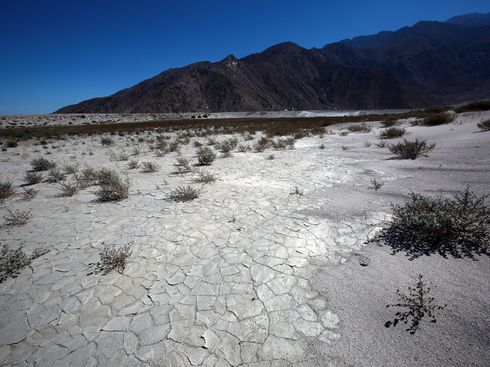 Cracks spread across the dry bed of parched percolation pond one at the Whitewater Groundwater Replenishment Facility near Palm Springs on Wednesday. / Crystal Chatham/The Desert Sun
In California, record heat is adding to extreme drought. The first half of 2014 was by far the hottest in California in 120 years of record-keeping, and that heat is exacerbating one of the most devastating droughts in state history along with massive, too numerous to count major wildfires.
Month after month, the red and burgundy patches on the California drought map have been spreading, with 82 percent of the state now classified as being in “extreme” or “exceptional” drought on the U.S. Drought Monitor website.
Reservoirs have been shrinking, aquifers have been declining, and an estimated 5 percent of the state’s irrigated farmland, from the Central Valley to Southern California, has been left dry and withering.
The increasingly dire water situation across California is being compounded by unusual heat. Long-term weather records maintained by the National Climatic Data Center show that California had its warmest January-June period since record-keeping began in 1895, with the average temperature 4.6 degrees Fahrenheit above average and more than 1 degree warmer than the previous record, set in 1934. July figures have yet to be released.
“In the business of climate science, this is a shattering of a record,” said Jonathan Overpeck, a professor of geosciences and co-director of the University of Arizona’s Institute of the Environment. “We are fairly certain that the unusual warmth is mostly due to human-caused global warming.”
For climate scientists, it can be difficult to trace the influence of climate change in the weather patterns of a year or two. But after decades with average temperatures on the rise, Overpeck said the extraordinary heat during this drought makes it a “global warming drought” that is indicative of the hotter dry spells expected in the future.
While California and the West is naturally prone to drought and have experienced long-lasting mega-droughts in the past, scientists say the long-term trend of rising average temperatures is now packing an extra punch. Hotter temperatures worsen droughts by reducing mountain snowpack and causing more evaporation from streams and reservoirs. Heat also draws more moisture from plants and the soil, and increases the amounts of water needed to irrigate crops and vegetation.
Meteorologist Richard Heim, a drought expert with the National Climatic Data Center in Asheville, North Carolina, said he has been amazed as high temperature records have been blown away this year in California.
“I’m just, ‘Wow,’ looking at these trends. Can it get any worse? Well, the models say yeah,” Heim said. “But how much more can we take as a society, as individual people? And how much more of this can the infrastructure and policies that have been put in place to deal with this at the state level, federal level, local level, how much more of this can you guys take?”
High pressure turns up heat
The main weather feature behind the drought and record temperatures has been a persistent high-pressure ridge over the West and the eastern Pacific Ocean. It has been called the “Ridiculously Resilient Ridge” since Stanford University graduate student Daniel Swain coined that term on his California Weather Blog last year, and the ridge has been keeping storms away from the region.
There is also a two-way relationship between the drought and heat, Heim explained. While the hotter temperatures are contributing to drier conditions, those same dry conditions are in turn amplifying the higher temperatures a bit. This occurs because dry ground tends to heat up faster than wet ground, adding more heat to the air.
In Sacramento as well as Washington, lawmakers have been debating measures that proponents say are aimed at coping with the drought and helping the West become more resilient to face growing water scarcity.
Sen. Barbara Boxer, D-Rancho Mirage, for instance, has recently backed legislation focused on addressing the drought and the impacts of climate change.
“As far back as 1995, climate scientists have predicted that increasing global temperatures would lead to more severe droughts in some regions of the world. We know that climate change is linked to the type of intense, record-breaking droughts that we are experiencing in California,” Boxer said by email. “The intensity and frequency of droughts will continue to worsen unless we take steps to address climate change by reducing carbon pollution.”
In addition to promoting President Barack Obama’s plan to reduce carbon emissions from power plants, Boxer touted the recently-passed Water Resources Reform and Development Act, which she said will help California respond to the deepening drought. The law will enable communities to obtain financing for projects such as water recycling, desalination and repairs of old water infrastructure.
Boxer, who leads the Environment and Public Works Committee, recently introduced another bill that would back local investments in water recycling and groundwater management, expand grants and rebates for water conservation, invest in water-related research, and create an open water data system. She said the measure would “help local communities take steps to become better prepared for drought.”
El Nino reprieve unlikely
Earlier this year, predictions of an El Nino raised hopes that a strong warming of the tropical Pacific could lead to drought-ending rains in California and the West. But in the past week, the National Weather Service updated its forecast and said the chance of an El Nino forming has decreased from about 80 percent to 65 percent during the fall and early winter.
State Climatologist Michael Anderson said, however, that an El Nino wouldn’t necessarily mean relief because both the wettest year and the driest year in the past 60 years were El Nino years.
“For Northern California, El Nino by itself is not a strong predictor,” Anderson said. “So we’ll have to look elsewhere.”
One wet winter could go a long way toward refilling many of the state’s dwindling reservoirs. But the depletion of the state’s aquifers is a much deeper problem.
“It will probably take a number of wet years,” Anderson said, “to make up some of the groundwater deficits that have been incurred.”
Groundwater vanishing
In many areas of California and the Southwest, groundwater levels have been declining for years as water has been heavily pumped for farmland and expanding development. The drought has added significantly to those strains.
In a new study, NASA and UC Irvine scientists used satellite data to track changes in the Colorado River Basin and determined that since late 2004, the region has lost nearly 53 million acre-feet of water. That’s almost double the volume of water that can be held in Lake Mead, the nation’s largest reservoir. The researchers also found that more than three-quarters of the water extracted was groundwater.
“That really forces you to raise your eyebrows and think about how long we can keep doing this, how long we can keep depleting groundwater at that rate,” said Jay Famiglietti, senior water scientist at NASA’s Jet Propulsion Laboratory and one of the study’s authors.
Famiglietti said the era of abundant water is clearly over in the West, and that the rapid declines of many aquifers point to a need for better management and additional studies to determine how much groundwater remains.
“We can see that we’re using a lot of it and so now we need to figure out how much is left,” Famiglietti said. “We need to do these explorations that need to be done – as if it were oil.”
Dramatic declines in the level of Lake Mead offer a glimpse of larger changes in water supplies taking place underground and across the region. The reservoir last month dropped to a record low, driven down by a 14-year drought that scientists say is one of the most severe to hit the Colorado River in more than 1,200 years. The lake, which supplies water to about 25 million people in three states, now stands about 39 percent full.
Rising costs
In the Central Valley, the heart of California’s $45 billion agriculture industry, water tables have declined dramatically for years – in some areas so much that the ground has been sinking by nearly 1 foot a year. And in times of drought, farms have been relying more heavily on groundwater to make up for diminished flows of water from the Sierra Nevada and the Sacramento-San Joaquin River Delta.
A recent study by the UC Davis Center for Watershed Sciences estimated that the drought is costing the state $2.2 million this year, including $1.5 billion in direct costs to agriculture. That includes losses of farm revenues as well as higher costs to pump water.
Those costs are likely to gradually climb as the drought persists. And with aquifers declining in many areas, there have been increasing calls for regulation of groundwater.
Unlike nearly all other Western states, California doesn’t have a statewide program for managing groundwater. The lack of statewide oversight has meant that owners of private wells can often pump as much as they wish, while some local water districts have permitted their aquifers to decline dramatically.
State lawmakers are now considering groundwater proposals that would strengthen local management procedures while giving the state new authority to step in when necessary as a “backstop” to safeguard water supplies.
Republican and Democratic lawmakers have also been debating proposals for a state water bond to go before voters. An $11.1 billion water bond is on the November ballot, but Gov. Jerry Brown has instead called for a “no-frills” $6 billion plan that would support projects ranging from water recycling to water efficiency improvements. Some of the money would also go to projects to protect and restore water habitats.
Water restrictions
As the drought persists, the effects on wildlife are also likely to grow more severe. Already, researchers in some parts of Southern California have been finding that birds of prey such as hawks seem to be reproducing less because they are finding less to eat.
“We’ve been seeing raptors that have not been breeding successfully, some of them showing signs of starvation, and that’s an indicator,” said Michael Lynes, director of public policy for the National Audubon Society in California.
The latest Monthly Drought Outlook from the National Weather Service predicts that in the coming weeks, the drought will likely persist or intensify across California and much of the West, with the heat also continuing. That will probably lead to increasing calls from the state and local water districts for Californians to cut back on water use.
The State Water Resources Control Board last month announced mandatory water restrictions, barring the washing of driveways and yard watering that creates runoff, among other things, and calling for fines of up to $500.
The state also instructed local agencies to activate water shortage contingency plans and restrict outdoor watering. Drought-plagued California set the record for the warmest first seven months of the year since records began there in 1895. The National Climatic Data Center found that the statewide average temperature was 60.9 degrees Fahrenheit, which was 4.6 degrees Fahrenheit above average.
This beat the previous record warm January-to-July period by 1.4 degrees Fahrenheit, which is a huge margin in the climate data world, where records are often set or missed by tenths of a degree.
Cracked earth is visible on what used to be the bottom of the Camanche Reservoir on August 8, 2014 in Ione, California. As the severe drought in California continues to worsen, the majority of the State’s major reservoirs are at or below 50 percent of capacity.
 All Things Environmental
Recent Comments