
Wisconsin DNR Denies Candidate for Governor and State Legislator’s Appeal of Enbridge Oil Storage Tanks at Superior, WI
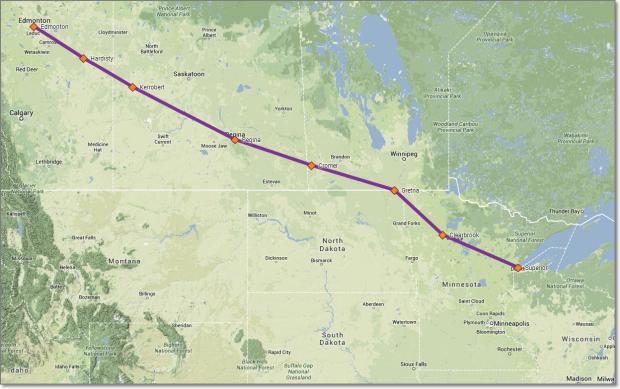
Above is the Canadian route used to pump tar-sands-derived oil from the tar sand mines of Alberta, Canada to the city of Superior, Wisconsin, a 1,000 mile route. Enbridge Energy company received a permit to build three 1/2 million gallons of oil capacity tanks earlier this summer, according to a report by Mike Simonson of Wisconsin Public Radio (WPR).
The city of Superior, Wisconsin is located adjacent the City of Duluth, Minnesota, which are both commercial harbors located on the southwestern shore of Lake Superior, the largest fresh water lake in the world and upper most of the world’s chain of 5 Great Lakes. The permit for the massive tanks is the last legal hurdle the Enbridge Company is required to complete before embarking on its project to expand the capacity of the pipelines that will transport up to 1.5 million gallons of dirty, heavy crude oil through the state of Wisconsin on Enbridge’s “Southern Access” pipeline.
From Superior, Enbridge Energy’s already built Southern Access 42-inch pipeline, built in 2006 (DNR determined that no environmental impact Statement or contested case hearing would be required for the project) the pipeline goes southeast from Superior, diagonally through the center of Wisconsin, then all the way south through Rock County and into Illinois. Enbridge officials claim they intend to TRIPLE THE CAPACITY OF THE PIPELINE BY UPGRADING, OR BUILDING 17 PUMPING STATIONS along the way.
The Wisconsin DNR last month turned down an appeal of a recently issued DNR air permit for the project which had been filed by state Rep. Brett Hulsey (D-Madison), a candidate for Wisconsin governor in 2015.
According to a report on Madison’s independent news radio program, “In Our Backyard” (WORT-FM), Hulsey said when he filed his appeal that it was only the first step he planned to take in challenging the permit, and that if they were not pleased with DNR’s action, “we could go to state or federal court from there” to stop the project. Hulsey’s said he is most concerned with the quality of the pipeline and the history of the company operating it: “my concern again is they’re trying to expand this pipeline [capacity], run this dirty tar sand oil through it, and the pipeline wasn’t designed for that.”
Hulsey also said Enbrige has a “horrible” record of pollution spills across Wisconsin and Michigan, “and honestly based on their record they’re not qualified to run a two-car parade”, he said. “I want DNR to ensure there are spill plans to protect people along the route.”
The three half-million barrel tanks are being built to hold tar sands oil from Alberta and the Bakken oil fields in North Dakota, where fracking is used to access the oil from wells. Enbridge Energy, located out of Houston Texas, is required to obtain an air quality permit from the state for the project.
Last Tuesday, the DNR denied Hulsey’s appeal, saying his argument had nothing to do with the air quality permit issued for the tank construction. Additionally, a second petition was denied to Peter Bormuth, a man from Jackson, Mich., who like Hulsey contended that Enbridge Energy has a record of pipeline leaks (which it does). Bormuth also said the tanks violate the public trust doctrine over navigable waterways like Lake Superior and the Nemadji River. The DNR called Bormouth’s argument too general of an allegation, according to Simonson’s report.
The DNR got more than 200 letters and 3,400 emails during the comment period, “many” of those opposed the air quality permit for the tanks, Simonson said.
The DNR approved a permit for Enbridge to build the three massive oil storage tanks in Superior in early June of this year. The pipeline company said the tanks will be complete in two years,
Sierra Club John Muir Chapter Conservation Program director Elizabeth Ward said it was important for the DNR and Enbrige Energy to look at the big picture of the tar sands and climate change. She said the DNR wasn’t listening to the public, and that it was also ignoring the dangers a pipeline spill could pose.
“We know that by increasing pressure in the tar sands pipeline, the likelihood of a rupture is greater,” said Ward. “So that warrants a full environmental impact statement and assessment by the DNR. But instead, the DNR chose to do this piecemeal permitting, really leaving the public out of the process”, Simonson quoted Ward as saying.
Groups and some local governments are still after state officials to take a closer look at the proposed expansion of an oil pipeline that’s buried under much of Wisconsin.
Dave Spitzer, of the group 350 Madison, said some counties in the state are also asking for a more comprehensive state review.
Ben Callan, of the DNR, recently issued a wetlands permit for five of the Enbridge Energy pump stations. Callan said current law doesn’t require a new assessment beyond what that DNR did eight years ago.
Callan said he understands counties are raising concerns, but he said the federal government has oversight over pipeline capacity and safety.
Enbridge officials have hired a former Republican state cabinet secretary to try to keep its Line 61 expansion flowing smoothly.
Hulsey said Bakken oil is dirty and expensive. He said storing it will emit benzene and other carcinogenic fumes, as well as allow more of the crude to flow through Wisconsin pipelines.
“Actually the real proposal is to use less oil,” said Hulsey. “My clean energy jobs plan invests $700 million in our state facilities to use less energy.”
Enbridge Energy spokeswomen said her company was “surprised” by the level of public interest, that the tanks are important, “but not exactly as controversial as something like the Keystone Pipeline”, she said.
Enbridge Energy is planning a $7 billion upgrade to their existing pipeline, which runs from the Canadian oil tar sands to Superior. Environmental groups compare this with the stalled Keystone XL pipeline in size and scope.
The expansion would replace a 47-year-old pipeline from Hardisty, Alberta to Superior, Wisconsin. Enbridge Energy spokeswoman Lorraine Little says the 1,000-mile long line would almost double the carrying capacity from the Alberta oil [tar] sands region to Superior.
Wisconsin Sierra Club John Muir Chapter President Shahla Werner said after a million gallon spill into Kalamazoo River in 2010, this Enbridge Energy line is as potentially hazardous as the higher profile Keystone pipeline, which is still waiting for approval from the U.S. State Department in Washington DC.
“The public should not just be concerned about Keystone and it’s not just about the impacts in Canada. It’s a real risk to our Great Lakes region and to Lake Superior,” Werner said.
Enbridge Energy notified its stockholders last December that they’re going to proceed with a $2.5 billion pipeline expansion, Simonson reported on WPR. “It’ll run 600 miles from the booming North Dakota Bakken Oil Fields to their Superior facility”, he said.
“Five years ago, the Bakken oil sands produced 200,000 barrels of light crude oil a day. Now it’s up to 700,000 barrels a day and is expected to reach 1.2 million barrels a day in the next five years. Enbridge Energy can pipe 225,000 gallons of that crude oil a day to Superior and points south to Chicago, Detroit and Toledo”, his report added.
Enbridge Energy Partners spokeswoman Lorraine Little told Simonson this expansion, dubbed “Sandpiper,” would more than double their capacity from North Dakota, “Because of that increasing supply of availability, you’ve got refineries in other parts of the U.S. who are interested in taking that light crude oil”. So these projects really represent moving the oil where the refineries are.
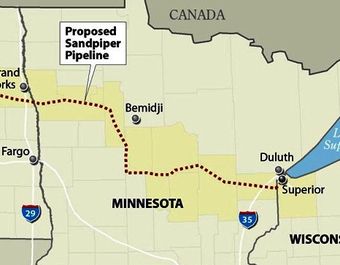
Little said this pipeline project, along with increased oil [tar] sands production, will shift supply from Middle Eastern and South America to North America, “So you might think of it a bit as re-piping America. The Sandpiper pipeline could be in service by early 2016.
“They’re increasing the capacity of the line by 360,000 barrels a day and they’re changing the type of oil so that it can carry both light and tar sands oil,” Werner said. “So they’re changing the product. Sierra Club’s been working on blocking tar sands expansion for a long time.” Excavation and production of tar sands to make it into oil involves large quantities of fossil fuel burning for heating it on the front end, before the dirty oil is made thin enough to flow in the pipelines.
CAP’s Climate Guide to Governors In the United States

Climate denial runs rampant in the halls of Congress, with over 58 percent of congressional Republicans refusing to accept the reality of basic climate science. A new analysis from the
Center of American Progress (CAP) War Room room reveals that half of America’s Republican governors agree with the anti-science caucus of Congress.
Fifteen out of twenty nine sitting Republican governors openly deny climate science despite the overwhelming level of scientific consensus and enormous cost to taxpayers. None of the country’s Democratic governors have made public statements denying climate change.
Order is not all alphabetical. Wisconsin is listed last, although the current governor of Wisconsin, Scott Walker, has not stated he is in denial of global warming, it’s just that he hasn’t proposed any state actions to reduce greenhouse gases emissions to the atmosphere from burning fossil fuels in the State of Wisconsin.
CALIFORNIA
Governor Jerry Brown (D)
California Governor Jerry Brown (D) has made climate change a primary focus of his administration as he enforces AB 32, the state’s cap-and-trade system. In 2013, he signaled he would not wait for Congress to act on climate by joining the leaders of Oregon, Washington, and British Columbia in signing the Pacific Coast Action Plan on Climate and Energy, which aims to unite their efforts in combating climate change. He also signed a Memorandum of Understanding with China’s top climate negotiator that pledges to work together on sharing low-carbon strategies and create joint ventures on clean energy technologies. In order to expand renewable energy, Brown signed pioneer legislation that allows customers of the state’s three largest utilities to purchase up to 100 percent clean energy. He’s also signed multiple clean energy bill packages into law and expanded the Renewable Portfolio Standard to make California’s standard among the most aggressive in the country. While he has signed legislation into law that allows fracking in California, the law imposes strict regulations on the oil and gas industry, including requiring companies to disclose which chemicals they use in the fracking process. Governor Brown is running for re-election in 2014.
CONNECTICUT
Governor Dan Malloy (D)
Connecticut Governor Dan Malloy (D) believes climate change is one of the most challenging and pressing issues of our time. As Governor, he created the Connecticut Shoreline Resiliency Fund, a low-interest loan program for state residents who are subject to coastal flooding and would like to elevate their homes. He signed into law the nation’s first full-scale clean energy finance bank to increase private investment in renewables and expanded Connecticut’s Renewable Portfolio Standard to help move the state away from dirtier fuels. Governor Malloy is running for re-election in 2014.
DELAWARE
Governor Jack Markell (D)
As Governor of Delaware, Jack Markell (D) has been outspoken about his acceptance of mainstream climate science. When commenting on the aftermath of Superstorm Sandy, Markell said, “There are still people who may say this storm or that storm is not related to general climate change. I can tell you when we had a number of communities flooded out in Delaware…and when you have leading scientists talk about the linkage between climate change and that flooding, people are in a position where they may more be receptive to listen.” Markell has worked to expand renewable energy in the state, signing into law a Clean Energy Jobs package that expanded Delaware’s Renewable Portfolio Standard and strengthened the solar net metering program. Along with the Governor Martin O’Malley of Maryland, Markell asked the federal government to contract for future offshore wind energy in order to help start the offshore wind energy manufacturing industry in the Mid-Atlantic region.
HAWAII
Governor Neil Abercrombie (D)
“Being the only island state in the country, we are especially vulnerable to climate change and are on the frontlines of impacts like sea level rise,” said Hawaii Governor Neil Abercrombie (D) when he signed legislation into law to establish an interagency committee to develop a sea-level rise vulnerability and adaptation report. While Hawaii was already one of the most attractive markets for solar power, the governor signed legislation into law in 2013 to establish a green infrastructure financing program, which allows residents to invest in clean energy. Abercrombie also praised the president’s new Clean Power Plan to reduce carbon pollution from coal-fired power plants. Governor Abercrombie is running for re-election in 2014.
MARYLAND
Governor Martin O’Malley (D)
Governor Martin O’Malley (D) stated that he believes climate change is real. He signed into law legislation that cut the state’s carbon pollution by 25 percent by 2020. “For our prosperity, for our current and future generations, and for the health of our State, which is so vulnerable to rising sea levels, we must take action on climate change now — not later.” He boosted Maryland’s Renewable Portfolio Standard, enacted an initiative to create 100,000 new green jobs, and signed the EmPOWER Maryland Energy Efficiency Act that established targets on energy consumption. In 2013, the Maryland House of delegates handed O’Malley one of his most desired legislative victories — enactment of a bill that would fund the development of a wind farm in federal waters off the coast of Maryland. O’Malley later vetoed a bill that would have “effectively killed” the wind farm from being developed and has also reached out with Delaware Governor Markell to ask the federal government to buy future offshore wind energy. Governor O’Malley is term-limited and cannot seek re-election in 2014.
MASSACHUSETTS
Governor Deval Patrick (D)
While speaking at a college graduation ceremony, Governor Deval Patrick (D) highlighted the National Climate Assessment, how climate change is already effecting New England, and went on to lay out the steps Massachusetts has taken over the 15 years to cut carbon emissions, invest in clean energy, and adapt to climate change. He then proposed something big — “Massachusetts should finally end all reliance on conventional coal generation.” He called for a “future free of fossil fuels” and hopes to drop coal in four years. As governor, he has allocated funding for measures to protect the state against sea level rise and destructive storms, signed one of the most aggressive greenhouse gas emission targets for any single state, and boosted renewable energy enough for the state to achieve its 10-year goal four years early in 2013. Governor Patrick is eligible to seek a third term but has stated he will not run for re-election in 2014.
MINNESOTA
Governor Mark Dayton (D)
Governor Mark Dayton (D) agrees the climate is changing and having impacts on Minnesota. Minnesota Public Radio reported that in response to a question about climate change, Dayton said the state’s strategy should include an eventual elimination of coal-burning power plants as Minnesota needs to move toward less-polluting sources of energy, such as wind and solar. He said the availability and price of natural gas makes it possible to set a goal of getting rid of coal as a source of electricity. In 2013, Dayton signed an economic development bill that contained several powerful incentives for solar development in the state. Governor Dayton is running for re-election in 2014.
NEW HAMPSHIRE
Governor Maggie Hassan (D)
Governor Maggie Hassan (D) has said “the science behind climate change is incontrovertible,” and in 2013, signed two bills into law to help lessen the impact of climate change in New Hampshire. The bills aim to give more power to state and local governments to prepare coastal communities for sea-level rise, and include the creation of a new Coastal Risk and Hazard Commission. She also signed into law two bills that strengthen New Hampshire’s participation in the Regional Greenhouse Gas Initiative (RGGI) by lowering the carbon pollution cap for power plants. Governor Hassan is running for re-election in 2014.
NEW YORK
Governor Andrew Cuomo (D)
In an op-ed, Governor Andrew Cuomo (D) said that climate denial is distracting us from addressing its inarguable effects. In the aftermath of Superstorm Sandy, Governor Cuomo outlined a plan on how New York could start to prepare for the impacts of climate change by investing federal disaster aid on items like high-tech weather stations and seals for entrances to subway stations. He announced more than 1,000 projects that will better prepare the state for storms, which includ rebuilding tidal wetlands, upgrading the electrical grid, and buying homes that are at a high risk of flooding. He has also proposed revised rules to further reduce pollution from power plants by lowering the emissions cap under the nine-state Regional Greenhouse Gas Initiative (RGGI). In February 2014, Cuomo announced the opening of the New York Green Bank, which will “stimulate private sector financing and accelerate the transition to a more cost-effective, resilient and clean energy system.” He also launched the NY-Sun Initiative, which aims to double the amount of customer-sited solar power installed annually. Cuomo has committed $1 billion to the program over 10 years. Governor Cuomo is running for re-election in 2014.
OREGON
Governor John Kitzhaber (D)
Governor John Kitzhaber (D) has called climate change a “central issue of our time.” In 2013, he signaled he would not wait for Congress to act on climate by joining the leaders of California, Washington, and British Columbia in signing the Pacific Coast Action Plan on Climate and Energy, which aims to unite their efforts in combating climate change. Kitzhaber signed a bill into law that preserved the state’s successful Renewable Portfolio Standard (RPS) and in 2012, created a 10-Year Energy Action Plan to boost renewable fuels and reduce greenhouse gas pollution. After realizing he would not be able to convince the legislature to keep Oregon’s clean-fuels program, he ordered a stricter fuel requirement to move forward anyway. He also put himself at odds with the president when he challenged the administration’s policy of supporting increases of exports of American coal because of the consequences it would have on climate change. Governor Kitzhaber is running for re-election in 2014.
RHODE ISLAND
Governor Lincoln Chafee (D)
Governor Lincoln Chafee (D) signed an executive order in early 2014 to create the Rhode Island Executive Climate Change Council (ECCC) — “I am establishing the Council because for too long there has been strong evidence and scientific consensus that manmade greenhouse gases will have profound effects on global climate, weather patterns and ocean conditions; effects that the state cannot afford to ignore,” Governor Chafee said. “Rhode Island must act boldly to position the state as a national leader in climate adaptation with a comprehensive approach that will benefit our communities and businesses.” The council will advise the governor on best practices to ensure the state continues to be a leader in developing strategies to combat the impacts of climate change. A few months later, the legislature passed a bill making the council permanent, and Chafee signed it. In order to support clean energy, Chafee’s office has announced grants to support energy efficiency and renewable energy projects and made significant investments in offshore wind developments. Governor Chafee is eligible for re-election in 2014 but has decided to retire.
VERMONT
Governor Peter Shumlin (D)
“We will not join the others in the denial, in the pretend, in the ‘let business happen as usual,’ because our kids and our grandkids mean more to us than our own greed,” Governor Shumlin (D) said in 2011. “And we’re going to get off oil and move forward as quickly as we know how.” Governor Shumlin has worked to expand solar net metering, signed into law the nation’s first ban on fracking, and has openly stated his opposition to the Keystone XL pipeline. Governor Shumlin is running for re-election in 2014.
WASHINGTON
Governor Jay Inslee (D)
Governor Jay Inslee (D) has said the science is clear — climate change is happening and the state of Washington has already experienced negative economic impacts. As his first official act as governor, he wrote a letter to a clean energy company inviting it to relocate to Washington. In 2013, he joined the leaders of California, Oregon, and British Columbia in signing the Pacific Coast Action Plan on Climate and Energy, which aims to unite their efforts in combating climate change. Signaling he would not wait for Congress to act, Inslee signed an executive order in early 2014 that creates a task force on reducing carbon pollution and directs it to design a “cap-and-market” program to meet emission reduction goals. The directive also orders state agencies to eventually eliminate the use of coal, spur development and the use of renewable energy, and develop a “smart building program” to increase energy efficiency. Inslee also asked the Obama administration to review the climate change consequences of leasing and exporting Western coal, saying it will be the “largest decision we will be making as a state from a carbon pollution standpoint.”
ARKANSAS
Governor Mike Beebe (D)
“Global warming is a growing concern that requires study and action on both state and federal levels,” said Governor Mike Beebe (D) when he announced the Governor’s Commission on Global Warming in 2007. The Commission studies how climate change will have an impact on Arkansas. He has since suggested the need for balance between environmental concerns and economic interests, and that a unilateral approach to climate change would be fruitless. Beebe has been a big supporter of wind power and has spoken out against Congress for failing to extend the Production Tax Credit for wind electricity. Governor Beebe is term-limited and cannot seek re-election in 2014.
COLORADO
Governor John Hickenlooper (D)
Colorado Governor Hickenlooper has a record of flip-flopping on his climate science beliefs. In 2010, he said he didn’t think the scientific community had decided that climate change is as catastrophic as so many people think, and in 2013, he seemed to accept the science more, though still showed some doubt: “Every study I’ve seen, climate change is happening. I’m not saying it absolutely is, but if climate change is happening, every study I’ve seen puts Colorado in what’s called a rain shadow, so not only does it get warmer, so we get less snowpack, but we’re going to get less water.” Hickenlooper did spearhead efforts and signed into law first-of-their-kind limits on methane — a potent climate pollutant — from oil and gas production. As a former petroleum geologist, he’s been a big supporter of the oil and gas industry in Colorado. He appointed an industry campaign donor to oversee the oil industry. In 2012, he appeared in paid advertising supporting the Colorado Oil and Gas Association, an industry lobby and trade group which has a history of fighting health and safety standards. He has even drank fracking fluid to prove there was no risk to human health. Hickenlooper has also developed a troubling record of opposing protections for at-risk wildlife in oil and gas producing areas, including the lesser prairie chicken, the Gunnison sage grouse, and the Greater sage grouse. Despite his close ties with the fossil fuel industry, Hickenlooper has been a proponent of renewable electricity, and signed a bill that doubled the renewable power target for rural electric cooperatives. Governor Hickenlooper is running for re-election in 2014.
ILLINOIS
Governor Pat Quinn (D)
Illinois Governor Pat Quinn (D) agrees there is a link between people and climate change. In response to the EPA’s proposed Clean Power Plan for coal-fired power plants, Governor Quinn said, “I commend President Obama for confronting this critical issue. Illinois has seen the devastating impacts of severe weather first-hand with 11 natural disasters over the past five years. Moving toward a cleaner, more reliable and resilient energy system will bring significant benefits to our communities and our state.” In 2013, Governor Quinn signed legislation into law to regulate fracking, which was seen as the nation’s strictest for oil and gas drilling. Illinois is the nation’s fifth-largest producer of coal and the governor has cheered the state’s record coal exports. While he has signed legislation to boost the coal industry, including allowing the coal industry to mine in the state’s largest park, he has also vetoed legislation that would have moved forward with a coal gasification plant slated for an already heavily polluted area of Southeastern Chicago. Governor Quinn is running for re-election in 2014.
IOWA
Governor Terry Branstad (R)
Republican Governor Terry Branstad believes that climate change is happening but has expressed hesitation on acting. “We need to recognize this climate change issue is a global issue,” he told to Politico. “We also need to respect as we try to deal with that on an international basis the need for our country to be competitive and be able to attract good-quality, high-paying jobs. I think we’ve got to be open at looking at all kinds of things we can do to be energy independent and also keep our energy costs reasonably low,” he added. As governor, he has been a big proponent of the state’s burgeoning wind industry, even reprimanding fellow Republicans who are against supporting the industry. Along with North Dakota, Iowa now uses wind power for more than 25 percent of its total electricity production, the most in the nation. Yet with regard to the president’s plan to regulate carbon pollution from existing coal-fired power plants, a spokesman for the governor said he is concerned the EPA’s “latest unilateral, ideological action” will hurt Iowa consumers and cost jobs. Governor Branstad is running for re-election in 2014.
KENTUCKY
Governor Steven L. Beshear (D)
“My administration recognizes the need to address greenhouse gas emissions from all sources and has supported a diversified energy portfolio, including measures to improve energy efficiency, expand use of renewables, and promote carbon capture and storage and other low-carbon technologies,” said Governor Steven Beshear (D). In 2013, he created the Kentucky Energy and Environment Cabinet, which will develop a plan to address climate change. He stood up to climate deniers and signed into law Next Generation Science Standards, which provide standards for science education that include the teaching of climate science and evolution. While he has been outspoken about acting on climate, Beshear joined six other governors in urging the president to drop proposed EPA rules to limit carbon pollution from coal plants.
MICHIGAN
Governor Rick Snyder (R)
Governor Rick Synder (R) ran on a strong conservation platform, earning him a 2010 endorsement from the Michigan League of Conservation Voters (LCV). A spokesman for the governor said the administration is convinced climate change is real, but also showed some doubt on why it occurs: “People may not agree about why climate change is happening, but it is certainly affecting Michigan.” The governor spoke out against a 2012 ballot measures that would have required the state’s utilities to generate 25 percent of their electricity from renewable sources by 2025, saying he had concerns about the financial viability of using wind, solar, hydropower, and biomass to meet Michigan’s energy needs. Towards the end of 2013, the governor indicated that his goal is to have a more comprehensive energy plan in place by 2015 that includes a reduction in coal-fired power and an increase in fracking and renewable energy. Michigan LCV issued a Midterm Report Card for 2011-2012 and gave Snyder a “C” rating, saying they’ve seen both positive and negative policies adopted by his administration. Governor Snyder is running for re-election in 2014.
MISSOURI
Governor Jay Nixon (D)
Speaking on CNN’s Crossfire, Governor Jay Nixon (D) said, “Well, first of all we need to accept the science of climate change and understand we’ve got to change the world. And we all have a joint responsibility to do things to make that better.” In early 2014, Nixon signed an executive order launching the development of a comprehensive energy policy for Missouri. The Democratic governor has also endorsed the Keystone XL pipeline.
MONTANA
Governor Steve Bullock (D)
Governor Steve Bullock said climate change is real: “In Montana, whether you’re a farmer, whether you’re a fisherman … you know that the climate is changing and we need to do something about it.” Governor Bullock has opposed any federal pollution limits on fracking, arguing states are capable of regulating the oil and gas industry, and endorsed the Keystone XL pipeline, which would greatly exacerbate carbon pollution. He has also defended the state’s Renewable Energy Standard and signed legislation into law that would expand renewables in the state.
NEVADA
Governor Brian Sandoval (R)
Asked if he believes climate scientists that humans are the main drivers of climate change, Governor Brian Sandoval (R) told Real Clear Politics, “I’m not qualified to answer that question.” He added, “Let me tell you what we’ve done, without getting to whether it’s human-caused or whatever that may be.” Sandoval signed legislation into law that shifts the state away from coal by eliminating “800 megawatts of coal-fired power generation…[and] mandates 350 megawatts of renewable energy development,” according to the Las Vegas Sun. In the interview with Real Clear Politics, he also expressed that the state will be ready to meet the new EPA standards for existing coal-fired power plants. Sandoval also signed into law a bill aimed at studying an unconstitutional plan to seize federal public lands in Nevada for state management, an idea that that is well outside the mainstream among Western voters. Governor Sandoval is running for re-election in 2014.
NEW JERSEY
Governor Chris Christie (R)
Governor Chris Christie (R) flip-flopped on climate change throughout his tenure as governor. In 2011, he acknowledged the effects humans have on climate change, but in 2013, he rejected the notion that Hurricane Sandy’s damage was worsened by climate change. A New Jersey appeals court ruled that the governor illegally withdrew the state from the Regional Greenhouse Gas Initiative (RGGI) back in 2011, a Northeast cap-and-trade program that aims to collectively reduce carbon pollution from power plants. He also broke from other Northeast states and did not join the lawsuit to defend the EPA’s cross-state air pollution rules. His administration has been accused of going to extraordinary lengths to secure approval for a controversial gas pipeline that would benefit a top Christie political operative who was also enmeshed in the George Washington Bridge scandal. The governor has signed legislation into law that increased the number of solar renewable energy credits that electric utilities must buy. In 2010, Christie signed into law a bill that aims to facilitate offshore wind power, but his administration has recently been accused of stalling the projects.
OHIO
Governor John Kasich (R)
“I am a believer — my goodness I am a Republican — I happen to believe there is a problem with climate change. I don’t want to overreact to it, I can’t measure it all, but I respect the creation that the Lord has given us and I want to make sure we protect it,” Governor John Kasich (R) said at an energy conference hosted by The Hill. In 2012, he pushed a major rewrite of Ohio’s energy policies that in his words, accounted for newly accessible shale gas and embraced Ohio’s renewable energy and efficiency targets as “vital to the state’s economy.” In June 2014, he signed a bill passed by the state legislature that would freeze the Renewable Energy Standard, despite its popularity among Ohioans and industry. In 2011, he also signed a bill 70 percent of Ohioans opposed that opened up state parks and other public lands to drilling and fracking. Governor Kasich is running for re-election in 2014.
VIRGINIA
Governor Terry McAuliffe (D)
“The first big decision is to accept climate change is real,” Governor Terry McAuliffe (D) said. “I believe humans contribute to climate change. I think it’s pretty much settled. I think the impacts are felt today.” The governor plans to reactivate a climate change commission to advise him on how to protect Virginia, as the Hampton Roads area has been named the second-most vulnerable place to sea-level rise in the nation. In response to the economic struggles the coal industry has deal with in the Commonwealth, McAuliffe said carbon capture and sequestration (CCS) technology was the answer, calling jobs in CCS-equipped coal plants the “jobs of the future.” He is the only Democrat to join a coalition of governors supporting efforts to open the outer continental shelf to oil and gas exploration.
ALABAMA
Governor Robert Bentley (R)
Governor Robert Bentley (R) hasn’t taken a strong position on climate in the past few years, but in 2010 he said, “Now, carbon emissions, I do think, probably play a role in climate changes. I do scientifically agree with that and I do think we have to look for ways to reduce carbon emissions.” In 2012, Bentley declined to say why he signed a bill banning the UN Agenda 21 Sustainability Program, making Alabama the first state to ban the environmental treaty aimed at increasing sustainable living despite the fact it has no force of law in the United States. Bentley has joined a coalition of governors supporting efforts to open the outer continental shelf to oil and gas exploration and in 2014, he expressed interest in his State of the State speech to develop the state’s highly polluting tar sands oil. Governor Bentley is running for re-election in 2014.
ALASKA
Governor Sean Parnell (R)
While Alaska Governor Sean Parnell (R) agrees that climate change is occurring and that “both human and natural elements, like volcanic eruptions, are responsible,” he has actively blocked efforts to combat climate change, even dismantling a state climate panel that former Governor Sarah Palin (R) established to develop ways “Alaskans can save energy and reduce their greenhouse gas emissions.” In 2010, the state of Alaska, along with trade groups like the Chamber of Commerce, filed a lawsuit challenging the EPA’s ability to regulate greenhouse gas emissions, which Parnell called “federal overreach.” More recently, Parnell touted a lawsuit filed by Alaska to allow drilling in polar bear habitats, calling it “disappointing and disturbing” that the Obama administration does not want to look for oil in the polar bear breeding ground. A former ConocoPhillips executive, Parnell has long represented Big Oil’s interest in Alaska. In 2012, he met with CEO’s of Exxon Mobil, BP, and ConocoPhillips for a meeting the AP called “virtually unheard-of,” to develop a strategy for promoting oil development in the state. He has also sought to open the Arctic National Wildlife Refuge (ANWR) for drilling and has called on the Obama administration to approve the Keystone XL pipeline. Governor Parnell is running for re-election in 2014.
LOUISIANA
Governor Bobby Jindal (R)
Louisiana Governor Bobby Jindal (R) has never said if he believes the science that climate change is real, here, and due to human activities. ClimateProgress reached out for a comment, but did not immediately hear back from the governor’s office. Jindal has demanded the EPA rescind its determination that greenhouse gases endanger public health and welfare. The New Orleans Times-Picayune reported that in his letter he said the agency was attempting to avoid proper review of new rules by Congress and public input into the rules. A long-time ally of the oil and gas industry, Governor Jindal signed a bill that would kill a New Orleans area flood authority’s lawsuit against 97 oil and gas companies. Three former Louisiana governors, State Attorney General Buddy Caldwell, more than 100 legal experts, and a number of environmental groups and state politicians urged Louisiana Gov. Bobby Jindal not to sign the bill, which could undermine other lawsuits against oil and gas interests in Louisiana, including claims against BP over its 2010 Gulf of Mexico disaster. Last year, environmental groups pointed out that Jindal had received more than $1 million from oil and gas companies and executives in state election campaigns between 2003 and 2013.
MISSISSIPPI
Governor Phil Bryant (R)
Governor Phil Bryant (R) has never said if he believes climate change science. ClimateProgress reached out for a comment, but did not immediately hear back from the governor’s office. Bryant wrote to President Obama urging him to back off from an April 2012 Environmental Protection Agency proposed rule that would set a limit on 1,000 pounds of carbon dioxide released for every megawatt of power generated by coal fired power plants, according to BussinessWeek. He also joined a coalition of governors supporting efforts to open the outer continental shelf to oil and gas exploration.
NEBRASKA
Governor Dave Heineman (R)
Governor Dave Heineman (R) has never said whether he believes scientists that climate change is occurring or if humans contributes to it. ClimateProgress reached out for a comment, but a spokeswoman for Governor Heineman did not respond to the question. Heineman cancelled a controversial legislative study on the effects of climate change in Nebraska, saying the work would be duplicative of a study done by the University of Nebraska-Lincoln. He approved a revised route for the Keystone XL pipeline, which supporters have said would avoid the environmentally-sensitive Sand Hills region of Nebraska. However, a Nebraska District Court Judge declared a rule that gave Heineman the power to approve pipeline routes unconstitutional. The governor has appealed that decision. Governor Heineman is term-limited and cannot seek re-election in 2014.
NORTH DAKOTA
Governor Jack Dalrymple (R)
North Dakota Governor Jack Dalrymple (R) has never stated whether he believes climate change is underway. ClimateProgress reached out for a comment, but did not immediately hear back from the governor’s office. Dalrymple has been outspoken about his opposition to limits on carbon pollution, stating: “The president’s plan [to reduce carbon pollution] means higher energy costs for consumers and businesses, weakened U.S. competiveness in global markets and increased unemployment at a time when the economy is still struggling.” In a state that relies on coal for 87 percent of its electricity generation, the governor has emphasized his concerns that coal plants are being singled out.
SOUTH CAROLINA
Governor Nikki R. Haley (R)
Governor Nikki Haley (R) has never stated if she believes climate change is underway. ClimateProgress reached out for a comment, but did not immediately hear back from the governor’s office. Haley has criticized the EPA’s rule to cut carbon emissions from existing power plants, saying, “This is exactly what we don’t need. This is exactly what hurts us. You can’t mandate utility companies which, in turn, raises the cost of power. That’s what’s going to keep jobs away. That’s what’s going to keep companies away.” She added that officials in Washington “stay out of the way,” according to The Charleston Post and Courier. The South Carolina Department of Natural Resources also kept quiet a report by a team of state scientists that outlined serious concerns about the damage the state will suffer due to climate change. Governor Haley is running for re-election in 2014.
TENNESSEE
Governor Bill Haslam (R)
Governor Bill Haslam (R) has never stated if he believes climate change science. ClimateProgress reached out for a comment, but did not immediately hear back from the governor’s office. EcoWatch reported that Haslam is an oilman that stands to profit from petroleum and gas development in the state: “The Haslam family of Knoxville, Tennessee has amassed a fortune from the business, Pilot Travel Centers, which the family founded in 1958. The family merged the business with Flying J in 2001 and the Haslam family continues to run the company out of Knoxville. In 2012, the Haslam family purchased Western Petroleum and Maxum Petroleum. Both companies are among the nation’s major suppliers of fuel to the gas drilling and fracking operations in the U.S. The Haslam family will also start installing natural gas fueling pump stations to some of the corporation’s fueling stations. In 2013, they plan to have 100 truck stops capable of fueling 18-wheelers with liquefied natural gas.” Though he weakly protested the veto-proof passage of a bill that would permit climate denial to be taught in schools, he has yet to make any major state-level pushes to address climate change. Governor Haslam is running for re-election in 2014.
WEST VIRGINIA
Governor Earl Ray Tomblin (D)
Governor Earl Ray Tomblin (D) has not said if he believes climate scientists that human-induced climate change is real and happening now. ClimateProgress reached out for a comment, but did not immediately hear back from the governor’s office. He has, however, spoken out against standards that will help combat climate change and its impacts. He has long said the White House is waging a “war on coal” and met with Obama administration officials prior to the release of federal Clean Power Plan to urge the EPA to be flexible. Despite the EPA’s promise to allow flexibility for states, the governor spoke out at a press conference against the rule, saying it was “outrageous” and that the state’s “worst fears were realized.” Coal is one of West Virginia’s primary economic resources. Tomblin also sued the EPA over its denial of new mountain top removal mining permits in the Appalachian region, stating the EPA had “overstepped its bound.”
ARIZONA
Governor Jan Brewer (R)
A climate-denier, Governor Jan Brewer (R) said, “Everybody has an opinion on it, you know, and I probably don’t believe that it’s man-made. I believe that, you know, that weather and certain elements are controlled maybe by different things.” In 2010, she signed a bill that bars new state rules or regional agreements to reduce greenhouse gases unless the legislature approves. In 2011, Brewer opted out of the Western Climate Initiative, a multi-state attempt to limit greenhouse gases, despite recognizing that their greenhouse gas pollution was expected to rise. A spokesman for the governor said she objects to the president’s Clean Power Plan, saying the EPA has overstepped its authority. As governor, she has worked to expand renewables in the state, particularly solar energy. She also vetoed a bill that would turn over 25 million acres of public lands to the state, which was consistent with Arizona voters views. Governor Brewer is term-limited and cannot seek re-election in 2014.
FLORIDA
Rick Scott (R)
In 2010, Governor Rick Scott (R) was asked if he accepts climate science. He said “no … I have not been convinced.” Asked what he needs to convince him, “Something more convincing than what I’ve read.” He still dodges the question by stating “I’m not a scientist” and hasn’t been vocal in addressing sea level rise since the National Climate Assessment came out in May 2014. He denied requests from the New York Times to be interviewed on the subject, but told WPBF there was “absolutely” work being done on the state level to protect Florida from the effects of climate change. Gov. Scott’s beachfront property is in the path of sea level rise projections in the state, putting the governor in “one of the most vulnerable positions” in regards to rising waters, the Tampa Bay Times reported. The governor’s $9.2 million Naples mansion sits about 200 feet away from the ocean and a foot above sea level, and the sea on his stretch of beach has risen about 8 or 9 inches over the last century. Governor Scott is seeking re-election in 2014.
GEORGIA
Governor Nathan Deal (R)
Governor Nathan Deal (R) previously served in the House of Representatives, where he filed a “climategate” petition against the EPA finding that greenhouse gases endanger public health and welfare. Rep. Deal, along with energy companies, industry front groups, and other Republican politicians, sued the EPA in an attempt to block the agency from limiting greenhouse gases. Their argument was that climate science is a hoax. As governor, he has never stated his position on climate change. ThinkProgress reached out for a comment, but did not immediately hear back from the governor’s office. Deal said he is wary of requiring utilities to expand solar power and that green energy comes with trade-offs on reliability and cost. Governor Deal is seeking re-election in 2014.
IDAHO
Governor C.L. “Butch” Otter (R)
In a letter addressing the president’s climate change plan, Governor C.L. “Butch” Otter said: “And while the degree and extent to which carbon emissions play a role in climate change is still debatable, the fact that Idaho is significantly impacted by the federal government’s actions and inactions is not.” The Salt Lake Tribune reported that Governor Otter “…complained about the federal government’s doublespeak on energy. He blamed vehicle fuel-efficiency standards for devastating wildfires, carbon emissions from those fires, declining transportation-tax revenues in the states, and for ruining salmon runs.” Governor Otter is running for re-election in 2014.
INDIANA
Governor Mike Pence (R)
When asked if he accepts climate change science, Governor Mike Pence (R) responded, “I don’t know that that is a resolved issue in science today…just a few years ago we were talking about global warming. We haven’t seen a lot of warming lately. I remember back in the 70’s we were talking about the coming ice age.” He has also been outspoken in opposing the Clean Power Plan, saying the president’s proposal to cap carbon from fossil-fuel power plants will have a “detrimental impact” on Indiana and cause electricity price spikes. Governor Pence also refused to either sign or veto a bill that would end Indiana’s state-wide energy efficiency program, which by default, became law.
KANSAS
Governor Sam Brownback (R)
Kansas Governor Sam Brownback (R) has flip-flopped on his acceptance of climate science. In 2007, as a U.S. Senator, he said that “we need to reduce the amount of CO2 in the atmosphere,” but in 2009 he embraced the “climategate” scandal, writing in a letter with fellow Republicans that climate science research is “driven more by a political agenda than a quest for truth.” As governor, he has not stated if he accepts climate science. ClimateProgress reached out for a comment, but did not immediately hear back from the governor’s office. Before the EPA even released their rule to reduce carbon pollution from existing power plants, Gov. Brownback signed a bill that asserts Kansas will make its own decisions about how to handle carbon pollution. The bill-signing ceremony took place at a local coal plant. In response to the president’s Clean Power Plan, Brownback said, “This is more of the Obama administration’s war against middle America.” The governor has supported the wind industry, defending attacks on the state’s Renewable Energy Standard and praising the extension of the federal Production Tax Credit. Hailing from the same state as the Koch brothers, Brownback has received financial support from the oil and gas giants for his entire career. Governor Brownback is running for re-election in 2014.
MAINE
Governor Paul LePage (R)
Maine Governor Paul LePage (R) is one of the most outspoken climate deniers, and has said that “scientists are divided on the subject.” During LePage’s tenure, he has argued that Maine could potentially benefit from the effects of climate change, vetoed legislation that would help the state prepare for extreme weather, blocked a bipartisan bill to expand solar power, and has attempted to dramatically reduce the state’s renewable energy standards to benefit large corporations. He also tried to sneak through a proposal that would exempt the state from certain anti-smog regulations, undoing protections that have been in place for almost 25 years. Following a critical series of articles in three Maine newspapers on the administration’s work to undermine environmental protections, LePage’s office cut off those papers’ access to administration officials. A spokeswoman told them they would no longer respond to requests, even for public documents, because the newspaper’s parent company “made it clear that it opposed this administration.” Governor LePage is running for re-election in 2014.
NEW MEXICO
Governor Susana Martinez (R)
“I’m not sure the science completely supports that,” is Governor Susana Martinez’s (R) view on climate change science. Responding to the New Mexico Independent in 2010, she revealed that she thinks the science of climate change is an “ideological debate.” While he is no longer serving, Martinez appointed a well-known climate denier to head the state’s Energy, Minerals and Natural Resources Department. Upon taking office, she also immediately repealed the state’s regulation requiring an annual 3 percent cut in greenhouse gas pollution, saying it was a burden on industry, and stopped regulations to keep oil and gas drilling waste out of groundwater that frequently supplies drinking water. Martinez did veto a provision that would have spent New Mexico taxpayers’ money on an ill-conceived study of whether the state should seize federal public lands. Governor Martinez is running for re-election in 2014.
NORTH CAROLINA
Governor Pat McCrory (R)
In a 2008 interview, then gubernatorial candidate Pat McCrory (R) was asked if he believes climate change science. His response was that “some things are out of control” and that “it’s in God’s hands.” Since then, he has admitted the climate is changing, but still shows some doubt on how much is human-caused. Since he became governor in 2013, there have been drastic changes to the state agencies responsible for addressing climate change, including the Department of Energy and Natural Resources (DENR). The Asheboro and Randolph Courier-Tribune reported, “DENR had previously made climate change a key component in its 2009-13 strategic plan. That plan included launching a climate change initiative and forming a climate change steering committee. The strategic plan cited a ‘fierce urgency’ for dealing with climate change. But with the election of Republican Gov. Pat McCrory in 2012, new leadership was also installed at many state agencies, including DENR. A DENR employee who worked on the Interagency Leadership Team plan, ‘Climate Ready North Carolina,’ was reassigned to new duties when the current administration took over, and she said she didn’t know who might be working on climate change.” Since that article was published in July 2013, DENR has removed links and documents containing information about climate change from its website. McCrory has also been very outspoken about his desire to open up more land and even the coast of North Carolina, a popular tourist destination that fuels the coastal economy, to drilling operations. He joined a coalition of governors that support drilling in the outer continental shelf and signed a law that lifts the state’s moratorium on fracking permits.
OKLAHOMA
Governor Mary Fallin (R)
Before her 2013 “State of the State” speech, Governor Mary Fallin (R) was asked by reporters about climate change and whether the current drought in Oklahoma is evidence that change is occurring. She replied, “It’s just nature itself and the patterns that flow and so we’re going to continue to pray for rain in the state of Oklahoma and hope we that we get some relief.” The Raleigh News and Observer also reported Fallin said Sen. Jim Inhofe (R-OK) has lent “a voice of logic on climate change.” Inhofe is one of the most outspoken climate science deniers, even writing a book on the subject. In early 2014, Fallin signed a bill that would charge Oklahoma residents an additional fee if they produce their own energy through solar panels or small wind turbines, standing up for the utilities over consumers. Citing concerns for ratepayers, the governor also criticized a plan by the EPA to reduce regional haze and control pollution at three Oklahoma power plants: “It is frustrating and disappointing that the EPA continues to move forward with a federal plan that will raise costs for ratepayers and utility companies, leave less money in the pockets of Oklahomans and push our economy in the wrong direction. The EPA’s plan could drive utility rates significantly higher in the next five years, something that many citizens cannot afford, especially during a recession.” Governor Fallin is running for re-election in 2014.
PENNSYLVANIA
Governor Tom Corbett (R)
Governor Tom Corbett (R) questions the science behind climate change: “I think some people believe that it is clearly evident and it’s coming very, very quickly. I think there are others who are equally qualified that disagree with that. It’s a subject of debate.” In 2011, Corbett withdrew the state of Pennsylvania from the legal defense of the EPA’s endangerment finding for greenhouse gases. While he did implement a climate action plan, it was criticized as inadequate because it fails to set greenhouse gas reduction goals and fails to incentive renewable energy, according to an op-ed by Rep. Greg Vitali (D) in the Lebanon Daily News. The governor has cut funding for climate change research, has appointed climate science deniers to his administration, and has eliminated bipartisan programs that focused on renewable energy and conservation. Instead, he has moved his focus to natural gas production and the booming fracking industry in Pennsylvania. Despite coming under fire for pollution from drilling, Corbett handed authority of some of the state’s most critical environmental decisions to C. Alan Walker, a Pennsylvania energy executive who has fought against environmental protections and donated $184,000 to Corbett’s campaign efforts. The governor also made false job claims on behalf of the fracking industry, has been accused of trying to confuse the public with an environmentally friendly fracking agreement, and has called to lift the ban on oil and gas drilling in state parks and forests. Governor Corbett is running for re-election in 2014.
SOUTH DAKOTA
Governor Dennis Daugaard (R)
“I am skeptical about the science that suggests global warming is man-caused or can be corrected by man-made efforts. It’s a complex world we live in,” Governor Dennis Daugaard (R) said in 2010. He has helped increase oil and gas production in South Dakota and supports the use of hydraulic fracturing, also known as ‘‘fracking.’’ Governor Daugaard is running for re-election in 2014.
TEXAS
Governor Rick Perry (R)
Governor Rick Perry (R) has repeatedly questioned the science behind climate change — “I think we’re seeing almost weekly, or even daily, scientists that are coming forward and questioning the original idea that man-made global warming is what is causing the climate to change.” Perry, along with energy companies, industry front groups, and other conservative politicians, sued the EPA in an attempt to block the agency from regulating climate pollution. Their argument was that climate science is a hoax. Under Perry, Texas has led the nation in carbon emissions and is home to five of the ten worst mercury emitting power plants in the country. The governor has called the EPA a “den of activists,” and in response to the Clean Power Plan, the governor said it was “the most direct assault yet on the energy providers that employ thousands of Americans.” He has criticized the administration’s delay of the Keystone XL pipeline and speaking at a trade association funded by BP, Perry called the 2010 BP oil catastrophe an “act of God” and his solution to the nation’s economic ills: “more oil drilling.” Governor Perry is eligible to seek a fourth term but has stated he will not run for re-election in 2014.
UTAH
Governor Gary R. Herbert (R)
In 2009, Governor Gary Herbert (R) said, “I’ve heard people argue on both sides of the issue, people I have a high regard for. People say man’s impact is minimal, if at all, so it appears to me the science is not necessarily conclusive,” on his acceptance of climate science. Herbert signed a clearly unconstitutional measure passed by the state legislature asserting that Utah can lay claim to 30 million acres of federal lands within the state’s borders and appropriating $3 million in scarce state funds to fight that hopeless battle in court. He has also brought a lawsuit to gain state control of 12,000 miles of “roads” that cross federal parks, monuments, wilderness areas and red rock wonderlands managed by the federal Department of Interior — many of which are nothing but cow paths and nearly invisible trails. In his 2014 “State of the State” address, the governor promised to speed the transition to Tier 3 vehicle and fuel standards, a move that “would lower the sulfur content of gasoline from 30 parts per million to 10 parts per million and require cleaner-burning emission controls on all new vehicles.” Herbert also asked the state air quality board to limit wood burning in high air pollution areas, and said he would require less auto travel and more mass transit travel by state employees.
WYOMING
Governor Matthew Mead (R)
Governor Matthew Mead (R) is a climate science denier: “As we flew in a snowstorm tonight I was thinking about global warming,” Mead joked. “I think the world generally accepts this phenomenon. I’m skeptical. In part, I’m skeptical because I think people need to be skeptical when it comes to where we are in science.” He’s called efforts to curb greenhouse gas emissions a “war on coal” and criticized the EPA rule to cut carbon pollution from existing power plants. He has also emphasized the limitations of renewable energy sources: “Renewables aren’t going to get you there,” he said. “The reason I don’t think we should [have a state renewable policy] is because, as the nation’s largest exporter of energy, I think that it should be more voluntary.” It’s not surprising he is a fossil fuel booster, as he presides over a state that ranks #1 in coal production, #5 in natural gas production, and #8 in crude oil production. Wyoming was also the first state to reject new national science education standards after Mead approved a state budget that blocked them. That decision was based in part on lawmakers’ concerns that the standards teach climate change as a scientifically-accepted occurrence. Finally, Mead spoke at an event hosted by the American Legislative Exchange Council, a conservative group known for making model legislation that has been used to target renewable energy standards. Governor Mead is running for re-election in 2014.
WISCONSIN
Governor Scott Walker (R)
Governor Walker (R) has never said if he believes climate change is occurring. ClimateProgress reached out for a comment, but did not immediately hear back from the governor’s office. The Milwaukee Journal Sentinel reported that little has been done to combat climate change under his administration. “After an intense focus on climate change under Democratic Gov. Jim Doyle, Republican Gov. Scott Walker and the GOP-controlled Legislature have devoted little attention to such issues… Shortly after taking office in 2011, Walker canceled plans to burn renewable biomass at the University of Wisconsin-Madison.” He has spoken to the Heartland Institute, a conservative think tank that denies climate science, and has tried to ban wind-powered energy from Wisconsin and exacerbate the state’s dependence on out of state coal. Governor Walker is running for re-election in 2014.
Effective as of 1 July 2014
SOURCE: The Center for American Progress

Future Americans Citizens Will Curse Us All for Not Acting to Slow Global Warming in a Timely Manner
Our current government officials in the U.S. Senate, the House of Representatives, the Wisconsin Senate and Assembly, and Governor Scott Walker, and essentially everybody else, who continue burning unnecessarily large quantities of fossil fuels, thus adding fuel more rapid global warming, must now be considered morally culpable. The evidence that we humans are causing the earth and its oceans to warm, and to deteriorate, dangerously so, is now irrefutable. Our predecessors will have every reason to condemn us for the condition we are leaving Earth for them.
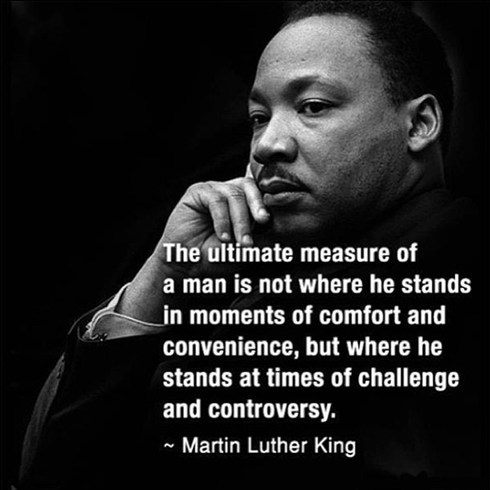
Following is a quote from Dr. Martin Luther King Jr. that would seem applicable to our failing to take timely action, now, to slow global warming:
1) “We are now faced with the fact that tomorrow is today. We are confronted with the fierce urgency of now. In this unfolding conundrum of life and history, there “is” such a thing as being too late. This is no time for apathy or complacency. This is a time for vigorous and positive action.”
But he’s also claimed to have said this: 2) “We are faced with the fact, my friends, that tomorrow is today. Procrastination is still the thief of time. Over the bleached bones and jumbled residues of numerous civilizations are written the pathetic words ‘Too Late’.”
I personally prefer version #1 over version #2. Which version do you prefer? I hope everyone else chooses version #1, too; however, I see very little evidence for them doing that, especially our politicians in the U.S. Congress and Wisconsin Legislature.
Driven by Climate Change, Algae Blooms Behind Ohio Water Scare Are New Normal

A massive algae bloom in 2011 turned Lake Erie into pea soup.
PHOTOGRAPH BY PETER ESSICK, NATIONAL GEOGRAPHIC
Jane J. Lee
National Geographic
PUBLISHED AUGUST 4, 2014
The toxic algae bloom in Lake Erie that provoked last weekend’s tap water ban in Toledo, Ohio—where nearly half a million people were told not to use water for drinking, cooking, or bathing—is a preview of similar problems to come around the world, scientists say, thanks in part to climate change.
Northwest Ohio’s water ban was lifted Monday morning, but experts say harmful algal blooms that can turn tap water toxic and kill wildlife are becoming more common in coastal oceans and in freshwater across the United States and around the globe.
A toxic algae bloom killed record numbers of manatees in Florida early last year. Another bloom put a record number of marine mammals into California rehabilitation centers earlier this year. (See “Record Number of Seals and Sea Lions Rescued in California.”) They can also result in massive fish kills.
The blooms produce toxins that can cause neurological problems like paralysis and seizures in people, though such effects have been best documented in marine mammals and birds.
“Some of [the increase in blooms] can be attributed to global climate change,” said Timothy Davis, a research ecologist specializing in harmful algal blooms with the National Oceanic and Atmospheric Administration’s (NOAA) Great Lakes Environmental Research Laboratory in Ann Arbor, Michigan.
The algae and bacteria responsible for blooms, including the one that created Toledo’s tap water mess—a type of bacteria known as Microcystis—need warm temperatures and the nutrients phosphorus and nitrogen to grow. Microcystis is a kind of cyanobacteria, often mistakenly referred to as blue-green algae.
Climate change is creating warming waters in many parts of the world, including the Great Lakes. Global warming is also boosting storm intensities in some parts of the world, which can increase the terrestrial runoff that supplies the nutrients that feed algae blooms. (Read about our “fertilized world” in National Geographic magazine.)
The nitrogen and phosphorous in the runoff come from leaky septic tanks and from fertilizers used on farms and lawns.
Lake Erie’s shallow depths—it’s the shallowest of the Great Lakes, with an average depth of 62 feet (19 meters)—also contributed to this year’s algae blooms, said Eric Anderson, a physical oceanographer with NOAA’s Great Lakes Environmental Research Laboratory. The western basin, the location of the current algae bloom, is even shallower, with an average depth of less than 26 feet (8 meters).
The Great Lakes ice extent last winter was the second largest on record, Anderson said, with ice covering Lake Erie well into April. But because Lake Erie is so shallow, water temperatures were able to recover quickly. ” Average surface water temperature in the lake has rebounded to within 1.68 degrees of the average of the last ten years,” he said.
Toxins from algal blooms are of particular concern to water managers around Lake Erie, said Anderson.
Strong winds can drive blooms at the water’s surface down into the depths of the lake, where water intake pipes can draw contaminated water into systems serving municipalities, he said.
It’s unclear whether that happened in Toledo. Samples from other plants that also draw their water from Lake Erie lacked the microcystin toxin that prompted Toledo’s tap water ban, raising questions about how the toxins got into the city’s water.
Not every algae bloom produces toxins. Some kinds of Microcystis blooms—like the one in Lake Erie—produce toxins, while others don’t.
About half of the Microcystis blooms around the world aren’t toxic, said Davis, but “it looks like climate change might be driving these blooms to more toxic strains.” Researchers are still trying to figure out why that may be happening.
Toxic algal blooms can seriously impact the health and economies of coastal and lakeside communities. The microcystin that was found in Toledo’s water can cause vomiting, nausea, dizziness, diarrhea, or numbness.
When these blooms run out of steam and die, bacteria feasting on the decaying matter can suck almost all the oxygen out of the water. This can result in another ecological problem: “dead zones,” or areas of the ocean devoid of life.
Increases in algae blooms are also expanding dead zones around the world. The Gulf of Mexico hosted one last summer about the size of Connecticut. (See “World’s Largest Dead Zone Suffocating Sea.”)
It doesn’t take very long for aquatic systems like Lake Erie to get thrown off balance, Davis said. But it will take patience and long-term management to get the lake healthy again.
“The biggest thing that people need to be aware of is that there’s no short-term solution,” he said. “Our lakes and coastal systems are out of balance.”
So is the climate.
Divest from Fossil Fuel Industry or Suffer the Consequences
The following text is written by Lisa Neff and Published in Wisconsin Gazette.com, July 24,2014:
Over the Barrel
Activists champion efforts to divest from fossil-fuel industry.

Meet Planet Enemy No. 1: The fossil-fuel industry.
And meet the new sheriff in town: The growing movement to divest ownership of fossil-fuel stock.
The divestment concept is not without precedent. In the 1980s, people around the world withdrew support from companies — and more than a few artists — who did business with South Africa. The campaign spread from college campuses and eventually 155 campuses, 80 municipalities, 25 states and 19 nations took economic action against the apartheid regime. Archbishop Desmond Tutu has said the end of apartheid would not have come without international pressure, specifically “the divestment movement of the 1980s.”
Today, the Nobel Peace-Prize winner has called for an “anti-apartheid style boycott of the fossil fuel industry.”
Christiana Figueres, executive secretary of the United Nations Framework Convention on Climate Change, also endorsed the movement in a speech in May at St. Paul’s Cathedral in London.
“The scientific data on climate change is overwhelming, the experience of the affected overpowering. The few who still deny the science and argue for inaction of course have the right to hide their face in the sand, but the sand is warming rapidly, and they will soon have to face their children,” Figueres said.
She had praise for others: the institutional investors moving capital away from fossil fuels, the parties involved in the development of a “fossil free” investment index, the creation of a global finance lab in London and the activists in the campus and church campaigns driving divestment from fossil fuel assets.
Commitments to change
That movement, according to GoFossilFree.org, has resulted in commitments to the going fossil-free campaign from 11 colleges and universities, 37 faith-based groups, 26 foundations, two counties and 28 cities. Included on the commitment list are the First Unitarian Society of Milwaukee; Dane County, believed to be the first county in the United States to support the fossil-fuel movement; and Bayfield and Madison, among the first cities in the U.S. to adopt divestment resolutions.
Monona could join the league. The city sustainability committee unanimously approved a proposed resolution earlier this month that the city council is expected to take up this summer. The resolution, which doesn’t go as far as activists had hoped, would set as priorities the reduction of fossil-fuel consumption in municipal operations and the education of residents and business owners about “the importance of reducing carbon emissions from fossil fuels.” The resolution also suggests a variety of ways to work toward that goal,” including shareholder advocacy, fossil fuels divestment and reinvestment in renewable energy.
“I’m very proud of Monona for taking this step to not only acknowledge the reality of climate change but to take action on reducing its own fossil fuel use,” stated Monona resident Beth Esser. She’s co-coordinator of 350 Madison, an environmental action group at the forefront of the movement in the state.
Esser added, “This resolution solidifies the city’s commitment to addressing the harsh realities of our need to quit using fossil fuels if we want to preserve a livable future for our children and our grandchildren.”
Fossil-free advocates also are campaigning throughout the University of Wisconsin system, on the campuses of private schools such as Carthage College and Lawrence University, and for changes in the state retirement fund.
Campaigners in some cases want a pledge that institutions or foundations will freeze any new investment in fossil-fuel assets and divest within five years. Others are promoting resolutions to support the cause, which received a nod from President Barack Obama in mid-June, when he told graduates at the University of California-Irvine, “You need to invest in what helps, and divest from what harms.”
Do the math
Divestment advocates maintain that math is crucial to the argument for going fossil free. The fossil fuel industry has enough coal, oil and gas reserves to produce, if burned, 2,795 gigatons of CO2, according to the Carbon Tracker Initiative, a team of London financial analysts. That’s five times more CO2 than can be released to maintain 2 degrees of warming. And most governments agree that any warming above 2 degrees Celsius would be unsafe.
“The fossil-fuel industry’s business model is built on using up reserves that should not be used. We cannot invest in this recklessness,” said Gregory Ercherd, who is involved in the fossil-free movement in Portland, Oregon. “We have moral, ethical obligations to divest from fossil fuels.”
“And we have a spiritual obligation,” added Ercherd, observing the surge in support for the movement this summer among religious institutions. The Unitarian Universalist General Assembly voted to divest. The University of Dayton in Ohio became the first Catholic institution to join the movement. Quaker, Lutheran, Presbyterian and Episcopal denominations have voted to divest. And, in early July, the Central Committee of the World Council of Churches, a fellowship of more than 300 churches in 150 countries, endorsed divestment.
“This is a remarkable moment for the 590 million Christians in its member denominations: a huge percentage of humanity says today ‘this far and no further,’” McKibben said after the vote.
Serene Jones is president of the Union Theological Seminary in New York City, which is committed to divesting its $108.4 endowment of fossil fuel funds. She said earlier this month, “Scripture tells us that all of the world is God’s precious creation, and our place within it is to care for and respect the health of the whole. As a seminary dedicated to social justice, we have a critical call to live out our values in the world. Climate change poses a catastrophic threat, and as stewards of God’s creation we simply must act.”
Portfolio for the planet
“There’s no threat greater than the unchecked burning of fossil fuels,” according to Bill McKibben, leader of the environmental grassroots movement known as 350.org.
“The (fossil-fuel) industry alone, holds the power to change the physics and chemistry of our planet, and they’re planning to use it,” he wrote.
Earlier this year, 350.org and two asset management firms — Green Century Capital Management and Trillium Asset Management — released a guide people through divesting.
“Since fossil fuel corporations are determined to burn their carbon reserves, which are five times the amount that scientists say our planet can safely absorb, there is a growing concern that investors may face a ‘carbon-bubble’ if carbon restrictions are put into place,” said Leslie Samuelrich, president of Green Century Capital. “With so many unknowns in the future, why not avoid the widely reported possible risk of stranded assets?”
“Actions taken by individuals and municipalities to transition away from fossil fuels send an important message to industry and political leaders and encourage further efforts regionally nationally,” said Adam Gundlach, a Monona resident and fossil-free advocate. “The transition becomes a reality with each decision we make and each step we take toward a sustainable existence.”
Some other resourse on the Web:
350.org: http://350.org
GoFossilFree: http://gofossilfree.org
350 Madison: http://350madison.wordpress.com
Green Century: http://greencentury.com
Fossil-free faq
WHAT IS DIVESTMENT? It is the opposite of an investment. It is getting rids of stocks, bonds, investment funds.
WHAT DOES THE DIVESTMENT MOVEMENT WANT? For institutional leaders to freeze any new investment in fossil fuel companies and to divest from direct ownership and any commingled funds that include fossil fuel public equities.
HOW CAN DIVESTING IMPACT MULTI-BILLION DOLLAR COMPANIES? The top 500 university endowments hold nearly $400 billion. Plus, there are state pension funds, as well as investments from churches, synagogues and mosques.
INVESTING IS ABOUT MAKING MONEY. IS DIVESTING RISKY? Fossil fuel companies, presently, are extremely profitable. But they also can be risky investments — energy markets are volatile and their business models rest on emitting more carbon into the atmosphere than civilization can handle.
Connect with the reporter.
White House Issues Bold Climate Change Warning

The White House said Tuesday in releasing a report meant to bolster a series of actions President Barack Obama has proposed to address global warming that putting off expensive measures to curb climate change will only cost the United States more in the long run.
“Each decade we delay acting results in an added cost of dealing with the problem of an extra 40 percent,” said Jason Furman, chairman of Obama’s Council of Economic Advisers. “We know way more than enough to justify acting today,” Furman told reporters.
The report drew its conclusions from 16 economic studies that modeled the costs of climate change. It was released as the U.S. Environmental Protection Agency holds public hearings on its plan to cut carbon emissions from power plants – the centerpiece of Obama’s climate action plan.
Last month, a bipartisan report commissioned by former New York City Mayor Michael Bloomberg, former U.S. Treasury Secretary Henry Paulson and environmentalist Tom Steyer forecast a multibillion-dollar price tag for climate costs, such as property losses from storms, declining crop yields and soaring power bills during heatwaves.
At a Senate budget committee hearing on Tuesday examining the costs of not addressing climate change, Republican Senator Jeff Sessions said the United States must also weigh the consequences of acting on climate.
Because of the estimated 3 degree rise in Earth’s temperature, the U.S. government is instilling mandates now to avoid paying $150 billion annually because of climate change damage.
The battle with climate change has already resulted in 200 municipalities being named in a class-action lawsuit initiated by Farmers Insurance Group for “failure to prepare for climate change.”
Michael Gerrad, director of the Center for Climate Change Law at Columbia University, said “one could easily imagine architects and engineers being accused of professional malpractice for designing structures that don’t withstand foreseeable climate-related events.”
In 2013, former New York Mayor Michael Bloomberg proposed a $20 billion dollar project to combat climate change and the threat of rising sea levels with the construction of flood gates and levees.
At the time, Bloomberg said : “Whether you believe climate change is real or not is beside the point. The bottom line is: We can’t run the risk.”
San Francisco Mayor Ed Lee added cities need to become “climate change friendly”. Construction needs to withstand extreme weather, power needs to be rerouted during outages, and cities need to be protected from flooding and provide assistance to their residents in moving out of badly affected areas.
In the report entitled, “Risky Business”, climate change is viewed as a catalyst of a coming financial crisis.
Contributor Hank Paulson, former Secretary of the US Treasury and CEO of Goldman Sachs said: “The good news is if we act immediately we can avoid the very worst outcomes. So a huge takeaway here is that taking a cautious approach, waiting for more information, a business as usual approach, is actually radical risk taking. It is very important that government and business act soon.”
Hopefully, those actions will be taken sooner rather than later.
Sources: HuffingtonPost.com and Investigative Headline News for July 29, 2014
June 2014 was Earth’s Warmest on Record
The National Oceanic and Atmospheric Administration (NOAA) reports that June was the earth’s warmest June in 134 years of records, following a month of May that was also the hottest on record. The records are feeding anticipation that 2014 could become the warmest year on record, according to The Washington Post’s Angela Fritz, the Deputy Weather Editor.
In no month on record have ocean temperatures deviated more from normal than June, .
The oceans achieved this record warmth prior to the declaration of El Nino, which would signal substantial warming of the tropical Pacific. Should the Pacific achieve El Nino conditions, it would push ocean temperatures even higher.
The superlative that everyone has their eye on is warmest year on record, which 2014 could challenge. Compared to the top five warmest years on record, 2014 ranks third year-to-date and is on an upward trajectory. If El Nino kicks in, it would likely increase the global temperature average toward the end of the year, and would make 2014 a viable candidate for warmest on record, says NOAA. The Climate Prediction Center is maintaining a 70 percent chance that an El Nino event will develop in 2014.
There is overall consensus that Earth is breaking temperature records. All of the past five Junes have ranked among the top 10 warmest on record, according to the report. June 2014 was the 38th consecutive June and 352nd straight month of above average temperature. The June heat was felt across the globe, with record warmth being felt in Greenland, northern South America, eastern and central Africa, and southeast Asia. New Zealand also recorded its warmest June since records began in 1909.
According to NOAA’s National Snow and Ice Data Center, the rate of sea ice loss in the second half of June was the second fastest on record. “In general there has been a trend over the satellite data record towards earlier melt onset in the Arctic. Melt usually now begins an average of 7 days earlier than in the late 1970s and early 1980s, or at a rate of about 2 days earlier per decade. However, in regions such as the Kara and Barents seas, melt has begun on average 5 to 7 days per decade earlier, totaling 18 to 25 days earlier since 1979, helping to foster earlier development of open water in those regions”.
California Up in Flames — Global-Warming-Induced Climate Change the Likely Cause

“With California mired in its worst drought on record, it was only a matter of time before something, or someone, sparked more fires in the tinder that now covers the state”, says Eric Zerkel of The Weather Channel. Now firefighters just hope that they can contain the latest round of blazes before more homes and livelihoods are lost.
The Sand Fire, sparked July 25 by a vehicle that drove over dry brush, has already claimed 17 structures, including 10 homes, in an area to the east of Sacramento, California. The fire, fueled by hot, dry, windy conditions ballooned to around 4,000 acres and was 35 percent contained Sunday, in an area five miles north of the town of Plymouth, California, despite a show of force by firefighters.
Nearly 1,500 firefighters, along with aircraft, battled the flames as they encroached upon the community of River Pines Estates in Amador County, California. More than 500 homes in the community were evacuated Saturday under the lingering threat from the fire.
“The fire’s moving in and around homes in the area,” Lynn Tolmachoff, a spokesperson for the California Department of Forestry and Fire Protection, told the Associated Press. “The leading edge is bumping up against residences as we speak.”
According to weather.com meteorologist Ari Sarsalari, the forecast might not help firefighters contain the inferno.
“Unfortunately there’s no rain in the forecast for the area over the next several days, with temperatures approaching triple digits,” said Sarsalari. “The good news is that winds have died down, which could aid containment efforts.”
Another 200 people were evacuated in Yosemite National Park when a new fire developed Saturday afternoon, scorching 2,100-plus acres of terrain around the Foresta, California, community, the Fresno Bee reports. All 45 homes in Foresta were included within the evacuation order as the blaze moved northeast toward the community.
The cause of the fire is under investigation. However, one resident in the area told the Fresno Bee that they heard “an electric line shorting” and shortly thereafter spotted the flames from the fire.
Both fires come on the heels of the announcement of the full containment of the Bully Fire, which scorched more than 12,500 acres of Shasta County, California, land over a 15 day period. Earlier this year at least 10 wildfires broke out in the San Diego area, burning at least 47 homes along with businesses and an apartment complex.
And with California’s record-setting drought only worsening and triple digit temperatures, more disastrous fires seem inevitable for the state.
All Good Things Don’t Have to Come to and End

Unfortunately, our government officials in the U.S. Congress are acting like kangaroos by continuing with their “business as usual” policies and programs which not only underestimate the current existence and future calamity of more global warming, but they continue to subsidize it by giving tax relief to the already rich fossil fuel industry.
The current cost of this years climate change is reflected by the numerous areas of drought and massive wildfires occurring in many western U.S. states:
Arizona (6)
California (2)
Colorado (2)
Idaho (2)
Nevada (3)
Oregon (15)
Utah (5)
Washington (4)
The Carlton Complex fire in the state of Washington, the largest wildfire in the state’s history is a collection of four fires burning in north-central Washington since July 14. Nearly 3,000 firefighters from around the U.S. are working to contain the blaze, which has already burned up more than 150 homes. Another fire near the city of Leavonworth, Washington, has burned 12,000 acres and has 1,000 firefighters working to contain the blaze the scene.
The National Interagency Fire Center predicts above normal fire potential in August, for most of California, Nevada, Oregon, Washington and Idaho.
As the world heats up, Australia on July 17 became the first country to repeal a carbon tax.
According to an article by Julia Baird of The New York Times, posted by St. Paul’s Star Tribune on July 25, 2014, the deputy leader of the Greens Party, Adam Bandt, said it was “the Australian Parliament’s asbestos moment, our tobacco moment – when we knew what we were doing was harmful, but went ahead and did it anyway.”
The tax, or carbon-pricing mechanism, had defined three elections, destabilized three Australian prime ministers and dominated public debate in for eight years. Finally, the leader of the center-right Liberal Party, Tony Abbott, fought the last election on a pledge to “ax the tax.” Abbott is famous for his fitness and his muscular approach. As a student at Oxford, he won a “blue” at boxing for the university and was known for his all-out, flailing attacks. When the carbon pricing scheme was cast in law in 2011, he vowed to lead a “people’s revolt” and “fight this tax every second of every minute of every day.” It worked.
His political success was not, in fact, a result of the failure of the policy. The scheme was, in at least the most important sense, working, since emissions were declining. The initial public opposition was fading. But the Labor government that introduced it had failed to sell the policy. Critics portrayed it as an onerous burden that would hurt businesses and cost households, instead of one that would cut pollution and ensure a more secure future for our children. It was the misleading old cliché – the economy versus the environment – but politicians staked their careers on it, and won.
In 2010, the Labor prime minister, Julia Gillard, said she would look at carbon-pricing proposals, but also promised, “There will be no carbon tax under the government I lead.” Then, under pressure to form a minority government, she made a deal with the Greens and agreed to legislate a carbon price: a tax by any other name.
The heat, anger and vitriol directed at her as a leader – and as Australia’s first woman to be prime minister – coalesced around the promise and the tax. It grew strangely nasty. She was branded by a right-wing shockjock as “Ju-Liar,” a moniker she struggled to shake. The political cynicism surrounding the carbon tax certainly reduced Gillard’s political capital, but it was a perceived lack of conviction in the policy itself that damaged the pricing scheme’s credibility.
Business leaders opposed what Abbott called a “useless, destructive tax,” even though just 0.02 percent of Australia’s 3 million businesses were affected (the top 500 polluters). But Australia is one of the world’s biggest producers of coal, and the industry is worth about $60 billion and supports an estimated 200,000 jobs. A powerful triumvirate campaigned against the law: mining companies, the conservative coalition parties and Rupert Murdoch’s newspapers. A study found that 82 percent of articles on the carbon tax in News Corporation’s Australian papers were negative.
Gillard now believes she made a crucial error in framing. After losing office in June 2013, she wrote: “I erred by not contesting the label ‘tax’ for the fixed price period of the emissions trading scheme I introduced.” With Labor plummeting in the polls, her leadership was challenged and she lost the vote to the party’s previous leader, Kevin Rudd. (Rudd’s victory was short-lived; less than three months later, he was defeated in the general election by Abbott.) “I made the wrong choice,” Gillard ruefully conceded, “and, politically, it hurt me terribly.”
Opposition to the carbon tax trailed off after Gillard’s ouster, and public concern about climate change has grown. A recent poll found that almost two-thirds of Australians believe there should be carbon pricing for major emitters, but 42 percent agreed with the repeal of the tax (against 36 percent who did not). We did, after all, elect a government that promised to ax it. So we’re a hot mess of contradictions.
Abbott’s claim that households will be better off by 550 Australian dollars, or $520, a year following the repeal has been greeted with skepticism. Electricity prices did go up after carbon pricing came in, but this was mostly because of investment in infrastructure. Consumers are likely to see no effect now – unless they’re paying less simply because they’re using less electricity. An Australian National University study reported that carbon dioxide emissions from the power generation sector had been cut by 1 to 2 percent as a result of the tax.
So carbon pricing was working, yet the law was repealed. Now Australia has no clear climate policy, even though Abbott says climate change is occurring and he takes it “very seriously.”
What’s clear is that Australia has proved again that politicians rarely choose to take the lead on tackling climate change. When the public is conflicted, our leaders too often whip up fear, and reason and evidence go out the window. The shame is that when the tax was axed, so were the facts.
Meanwhile, our U.S. Congress has one more week to go until it takes a month long break in August. It is unlikely to pass any legislation that shows it’s up to the task of leading any fight against global warming. But it should know that the time to act is running short; it needs to act now, and show its citizens and citizens of other countries that the U.S. has the courage to join in on the fight against global warming. Maybe if the U.S. had acted more responsibly to the growing threats associated with global warming, Australia would not have repealed its tax on carbon?
Seen Any Monarch Butterflies Lately?

I did, yesterday, but I had to go to Olbrich Botanical Gardens “Blooming Butterflies” event in Madison to see them.
It use to be that every year, hundreds of millions of monarch butterflies would about now be on their way on what is believed to be the world’s longest insect migration, traveling between the length of North America and central Mexico – some 3,000 miles.
Yet the great monarch migration is in peril, a victim of rampant herbicide use in faraway corn and soybean fields, extreme weather, a tiny microbial pathogen and deforestation. Monarch butterfly populations are plummeting. The dense colonies of butterflies on central Mexican peaks were far smaller this past winter than ever before.
Scientists say Mexico’s monarch butterfly colonies, as many as several million butterflies in one acre, are on the cusp of disappearing. If the species were to vanish, one of the few creatures emblematic of all North America, a beloved insect with powerhouse stamina that even school kids can easily identify, would be gone.
“We see these things as so delicate. But if they migrate a distance of some 2,000 miles, from Canada all the way down to Mexico, they are pretty tough,” said Craig Wilson, a scientist at Texas A University, in a recent article in The Kansas City Star by Tim Johnson.
Scientists who are studying the monarchs’ decline cite many possible reasons, but they’re focusing now on one major one: the decline in the United States of milkweed, a lowly broadleaf plant that’s widely treated as a weed to be eradicated, doused with herbicides in farmlands and along highway shoulders. Milkweed is most common in the high-grass prairies of the Canadian and U.S. Midwest but its 70 varieties also grow along the Atlantic and Pacific coasts, in the Caribbean and elsewhere.
Monarchs can’t survive without milkweed.
Female monarchs lay eggs on milkweed. When they hatch, the larvae grow into caterpillars that feed on the milkweed’s leaves. Those leaves contain a poison that inoculates the monarchs from their predators. The caterpillars then form chrysalises and emerge as butterflies.
Over the past decade, U.S. fields containing milkweed have declined sharply. Orley “Chip” Taylor, a monarch expert at the University of Kansas, calls the loss “massive.”
“We’ve lost something like 24 million acres because of conversion of land to cropland. That’s an area the size of Indiana,” he said.
The advent of genetically modified corn and soybean varieties that can withstand herbicides has added to that loss. Now farmers employ glyphosate herbicides, such as Monsanto’s Roundup, that kill weeds with a vengeance. It’s had a huge impact on milkweed, which before could grow among crops or at the edges of fields.
“The crops survive but any weeds, including milkweed, don’t,” Wilson said.
Faced with vast reductions in milkweed, the size of the colonies of monarchs escaping northern winters has shrunk radically in central Mexico.
Nearly two decades ago, in the winter of 1996-97, dense monarch colonies covered 44.9 acres of oyamel fir forest. In the 2013-14 winter, the colonies covered only 1.7 acres, a plunge of nearly 44 percent from the previous year. The trend seems inexorable, experts said.
“We must turn the tide for monarchs,” said Omar Vidal, the president of WWF-Mexico, a branch of the Switzerland-based World Wide Fund for Nature.
Most monarchs live only a little more than a month. But one generation each year lives seven or eight months, long enough to migrate to central Mexico before winter sets in, where the butterflies settle into a semi-dormant state, often clustering around the same fir trees as their forebears, perhaps drawn by chemical cues. In the spring, the monarchs return to the north, where they lay eggs on milkweed and die, giving way to a new generation.
Other factors may be hurting the monarch population, including extreme conditions associated with climate change. A debilitating protozoan parasite, known in scientific shorthand as OE, also has exploded since 2002 and now affects 10 to 15 percent of monarchs, said Sonia Altizer, an ecologist at the University of Georgia who’s studied monarchs for two decades.
While the dwindling monarch colonies worry scientists, who fear they may also be a warning of other environmental crises, in this region of Mexico the decline threatens people’s livelihood. Butterfly tourism has grown since scientists first came across the dense winter colonies in 1975.
Indigenous people had long known of the butterflies. The Purepecha people called the monarchs the “souls of the departed” because their arrival in early November coincided with festivals honoring the dead.
Taylor has been instrumental in the Monarch Waystation program, which encourages people to recolonize areas as small as their yards with milkweed to serve as stopping points for migrating butterflies. More than 7,500 “Waystations“ now exist, including 400 in Texas alone, and boosters urge federal and state governments to let milkweed grow undisturbed along highways rather than mow it down.
Despite decades of scientific study, mystery still surrounds the monarch, including how it migrates to the same fir patch colonized by earlier generations.
Some experts worry about a variation of “the butterfly effect,” the concept coined by Edward Norton Lorenz, an American meteorologist and pioneer of chaos theory, who suggested that the flapping of a butterfly’s wings could trigger a hurricane on the other side of the globe weeks later.
That theory of interdependence now seems turned on its head. The question today is: What occurs when the monarch stops flapping its wings?
“If monarchs are in trouble _ and they are a really robust species _ you can practically be assured that there are a number of species like pollinators and birds that also are in trouble because they rely on the same habitats as monarchs,” Altizer said.
Many scientists are concerned about the eastern population of monarchs, which spend summer east of the Rocky Mountains. This group is occurring in ever smaller numbers, and its survival may be threatened by a series of natural disasters in the Mexican wintering grounds, as well as by reduced acreage of milkweed plants in their summer home, according to Natural Geographic’s website.
 All Things Environmental
Recent Comments