
Governments Everywhere Should Ban ALL Future Oil Drilling – ASAP

The Obama Administration is right now assessing whether to permit commercial oil companies’ to do offshore drilling for oil in the Atlantic and Arctic Oceans.
Why is our government wasting the nation’s dwindling middle and lower incomes after taxes (rich folk seldom pay taxes to the U.S. Government) on assessing whether to allow oil drilling in the oceans? That is LUDICROUS!
Not only is drilling for oil in the oceans ill-advised (certainly they must not have forgotten BP’s massive oil spill disaster in the Gulf of Mexico which occurred 6 years ago in 2010?), the public’s burning of all that extra oil (a fossil fuel) could make the world’s best climate change predictor’s WORST GLOBAL WARMING NIGHTMARE FOR THE EARTH NOT ONLY COME TRUE BUT BE HERE SOONER!
Considering all the changes which have already begun occurring and expected to accelerate in future years to the earth’s climate, its massive but shrinking (rapidly) ice sheets, the rises in sea temperatures, acidity and continuing rises in the elevation of the oceans everywhere, and the increasingly costly and dangerous (stronger storms) submerging populous shoreland areas in the U.S. and elsewhere, the Obama and other nation’s administrations, worldwide, ought be considering permanent BANS ON ALL OIL DRILLING – BOTH LAND AND SEA – AS SOON AS POSSIBLE!
“The economy is a wholly owned subsidiary of the environment, not the other way around.” – Gaylord Nelson

Gaylord Nelson at Wisconsin’s Governor Nelson State Park (undated photo)
Fly Like An Eagle (The Steve Miller Band)

Naomi Klein: “We’re out of time on climate change. And Hillary Clinton helped get us here.”

Naomi Klein shared her latest conclusions on how close Earth is to the “tipping point” on global warming and climate change in an April 7, 2016 opinion piece in The Guardian.com, and Presidential Candidate Hillary Clinton actions that have made things worse, not better.
Unfortunately, there are so many other federal and state politicians, virtually all so-called public and commercial-funded media sources, and others who have also “helped” us get where we are now –some have even shown they understood and were aware of the significance of the problem being created (oil industry, possibly auto, truck and airline industries, highway, bridge and airport building industries, coal mining industry, possibly others) yet, almost unbelievably, chose to continue selling the fuel despite knowing the the significance and potential for calamity for current and future generations.
The path to achieving sustainability on Earth for humans and most other species living on our planet is, unfortunately, rapidly narrowing. It could soon close, say the great many of IPCC climate scientists, and as a result jeopardizing the lives of children living today and in the future. Indeed, there are far too many people in the U.S. and most other developed countries who have not seen fit to overcome their dependence on fossil fuels for activities such as driving motor vehicles, flying jetliners, using products and services made more readily available because of subsidized fuel costs, conserving energy in their homes and mansions, and their choice of a lifestyle which is grossly overdependent on the burning fossil fuels in spite of the now widely accepted crisis which the president of the United States appropriately calls “urgent”.
In short, our continuing with our “business as usual” economy – one centered around the philosophy that we should “eat, drink and be merry” now, while throwing caution to the wind; a philosophy that we can eat our cake and still have it for tomorrow – is unfairly going to saddle the children of today and tomorrow with a planet that is, for all intents and purposes, dying, and thus less likely to sustain life in the not too distant future.
When you place a large kettle of cold water on a hot stove burner, one would not expect to see the water immediately come to a boil. It would take several minutes of heating for the water to reach the boiling point of 212 degrees F.. So it is with adding more greenhouse gases to the volumes of such gases already present in the atmosphere. At some point, scientists predicted the surface waters of Earth’s oceans would begin to show warming. Such warming has now been measured, along with the increase in sea level from thermal expansion and the melting of glaciers, worldwide. The warming of the oceans is increasing, ever so slowly because of the tremendous volume of water the Earth’s 5 oceans, but increasing at a faster rate with the continuing accumulation of more and more atmospheric greenhouse gases, which are cumulative over time
Clearly, our burning such vast quantities of fossil fuels in transportation and for electricity today, while paying nothing for the great harm being inflicted on future generations, is a monumental injustice. The damage being created by the present and recently passed generation’s fuel burning activities is undoubtedly huge and devastating to future societies and animal life – stronger and more deadly storms, worse flooding, longer droughts, hotter heat waves, and impairments to water and other life-sustaining resources and infrastructure. Calling this anything other than a crime against humanity seems too kind. The human and economic cost linked to people and animals who will be more exposed to degraded living conditions and more dangerous weather extremes is very real and predictable. Those of our society set on continuing to uphold the status quo of “business as usual”, as our earth continues to warm under the blanket of a thicker greenhouse gas laden atmosphere have chosen the wrong path.
Naomi Klein is an award-winning journalist, syndicated columnist and author of the international bestsellers, This Changes Everything: Capitalism vs The Climate (2014), The Shock Doctrine: The Rise of Disaster Capitalism (2007) and No Logo (2000). Each book has been translated into over 25 languages worldwide. She is a contributing editor for Harper’s and reporter for Rolling Stone, and writes a regular column for The Nation and The Guardian that is syndicated internationally by The New York Times Syndicate. Additionally, her writing has appeared in The New York Times, The Washington Post, Newsweek, The Los Angeles Times, The Globe and Mail, El Pais, L’Espresso and The New Statesman, among many other publications.
Naomi is a member of the board of directors for 350.org, a global grassroots movement to solve the climate crisis. She is a Puffin Foundation Writing Fellow at The Nation Institute and a former Miliband Fellow at the London School of Economics. In 2004, her reporting from Iraq for Harper’s won the James Aronson Award for Social Justice Journalism. In 2014 she received the International Studies Association’s IPE Outstanding Activist-Scholar award and in 2015 she received The Izzy Award honoring outstanding achievement in independent journalism and media. She holds an honorary Doctor of Civil Laws from the University of King’s College, Nova Scotia. (Photo by Kourosh Keshiri.)
With a Forecast of Sea Level Rising 5-6 Feet Under “Business-as-Usual” Conditions, Media and Others Ought Ask Presidential Contenders What Steps the Country and Its People Ought Be Taking to Reduce this Major Threat to Humanity!

The latest study in the prestigious Journal Nature predicts the world’s oceans will rise 5 or 6 feet by the end of this century without major changes to end fossil fuel burning – NOW! We are causing irreparable harm to the earth’s climate and its physical and biological systems – including warming and acidification of the oceans as well as rising sea levels – processes that have already begun and will not be possible to reverse even if humans stop burning fossil fuels today.
So all we can do is slow the rate of change and help those most likely to be affected to prepare for the worst. It’s the least we can do.
The League of Conservation Voters has a continually updated report “In Own Words” on each remaining 2016 presidential candidates’ past statements on climate change . Non of the candidates statements reflect the study on sea level rise released last week.
Enbridge Pipeline Public Hearing Wednesday in Madison

The State of Wisconsin, which has already issued a Wisconsin Department of Natural Resources permit to the Enbridge Company to increase the capacity of its pipeline across Wisconsin, to transport up to 1.2 million barrels of tar sands oil a day, will hold a contested case hearing on March 23, 2016, in the hearing room at the Wisconsin Division of Hearings and Appeals, 505 University Avenue, Suite 201, Madison, WI, at 9:00 am.
The tar sands oil, some of which is already being pumped through the pipeline, originates from the tar sands mines located in Alberta, Canada where the product is processed, is also believed to contain significant quantities of flammable additives which make the product fluid so that it can be pumped through the pipeline. The fluid of additives is then returned to the processing site in Alberta, Canada via an adjacent pipeline for reuse.
Wisconsin Department of Natural Resources to Hold Four Public Informational Hearings on its Proposed General Permits on Nonmetallic (Including Frac Sand) Mining Operations

On March 16, the Department of Natural Resources released the public notice for the reissuance of the following two WPDES Nonmetallic Mining Operations general permits:
Nonmetallic Mining Operations (Non-Industrial Sand and Other Aggregates), WPDES General Permit No. WI-A046515-6: This general permit covers nonmetallic mining operations defined under Standard Industrial Classification (SIC) Code 1400 to 1499, except SIC Code 1446 (Industrial Sand). Typical operations covered under this general permit include mining and processing of construction sand, gravel, stone, rock and other aggregate.
Nonmetallic Mining Operations for Industrial Sand Mining and Processing, WPDES General Permit No. WI-B046515-6: This general permit covers nonmetallic mining operations defined under SIC Code 1446, Industrial Sand.
WPDES General Permit Nos. WI-A046515-6 and WI-B046515-6 authorize and regulate discharges of storm water and process wastewater from operations whose primary income-producing activity is nonmetallic mining. The proposed general permits and fact sheet are available on the WPDES permits on public notice webpage.
In late March and early April, the DNR will hold four public informational hearings on the proposed general permits. See the public notice for more details.
Unseasonably Warm Weather in Wisconsin

Below is the Wisconsin Department of Natural Resources’ (DNR) Outdoor Report summary for March 10, 2016. However, conspicuous by absence is any mention that Wisconsin’s unusually warm weather this month is at all related to human activities that cause climate change. Some of the many sources of fossil and other fuel combustion that emit greenhouse gases to the atmosphere in Wisconsin include: fossil fuel burning in highway motor vehicles (gasoline and diesel oil); jet aircraft (refined oil/jet fuel); electric power producing plants (primarily coal, and natural gas – methane); natural gas burning for heating homes, buildings, churches and other buildings, recreational utility vehicles; road construction vehicles; in cement and asphalt manufacturing; in snowmobiles, boats, motor vehicles used in tractors and other agricultural machinery, in lawn mowing, in logging, and in other miscellaneous motorized products that burn fuel. Other greenhouse gas emissions may come from mining operations including sand and gravel mining and mining for metals, and from animal livestock propagation for food sales.
Despite the findings and recommendations from the United Nations’ Intergovernmental Panel on Climate Change (IPCC), which concludes the climate change problem is “urgent”, as does President Obama, Wisconsin’s Republican Governor Scott Walker and the state’s Republican lawmakers have refused to even hold a citizen hearing regarding the growing threat of climate change, not just to Wisconsin’s future economy, but also the quality of life future residents and visitor to Wisconsin will be provided, as well as the threats of a changing climate to animal and plant life in Wisconsin for generations to come.
Unseasonably warm weather melts snow cover, slows maple tapping efforts
Wisconsin has experienced some unseasonably warm weather in the last week with daytime temperatures in the 50s and 60s and even a low 70 reported in Milwaukee. The warm weather has melted most of the snow cover statewide, with just snow surviving in some forested areas of the Northwoods. Snowmobile and cross-country ski trails are now closed statewide and most will remain so even if the state does experience a late season snowfall.
State park and forest trails that were groomed for skiing are now open again to hiking, but most properties are reporting that rail-trail, mountain bike and horse trails are closed, as conditions are soft and muddy and use of trails in these conditions can cause significant damage to trail surfaces.
With the general inland game fish season now closed except on those waters open to game fishing year-round, only a few panfish anglers have been venturing out, but ice conditions are rapidly deteriorating and many shorelines in southern and central Wisconsin are opening up, making access difficult and dangerous.
Most anglers on Green Bay are removing fishing shelters prior to this Sunday’s deadline as waters are rapidly opening up. Anglers were out in high numbers around Sturgeon Bay last weekend with many limits for whitefish reported. Anglers were open water fishing the Fox River at Voyageur Park for walleye but success rates have been low, though with the warmer weather that is expect this to change.
Raccoon, skunk, muskrat, mink, and opossum activity has increased as temperatures have increased and snow has departed. Wild turkeys have been strutting and starting their spring courtship. Flocks are breaking up and the large groups of toms and jakes have already decreased in size as they establish their spring pecking order.
With the warm weather and south winds there has been a significant increase in spring migrants sighted this week, including red-winged blackbirds, killdeer, robins, song sparrows, swamp sparrows, bluebirds, turkey vultures and more. Other early migrants returning to breeding territories include American woodcock, great blue herons and eastern meadowlarks. There was a heavy waterfowl migration across the southern half of the state, including common goldeneyes, all three mergansers, green-winged teal, pintail, wood ducks, and many others. Greater white-fronted geese are moving through in numbers, as are large flocks of Canada geese and occasional cackling, snow, and Ross’s geese. Canada geese are staking out territory and will begin nesting soon. Sandhill cranes are courting and dancing. Bald eagles are incubating eggs and some great horned owls already have chicks.
Maple syrup season has gotten off to a very slow start due to mild temperatures, especially overnight lows staying above freezing. One producer placed out 670 taps late last week and harvested 370 gallons of sap on Monday. The 10-day forecast does not show any significant changes to overnight lows. The concern is that trees will bud out soon resulting in an early end of the season.
A number of observers reported seeing leopard frogs, spring peepers have been heard in the south and salamanders were active with the warm temperatures. Unfortunately the warm weather has also brought out reports from shed hunters and maple tappers finding the first ticks crawling around on them.
Lake Temperature Data Over Decades Show Warming
Large, increasing methane emissions from northern lakes:
Methane is increasing in the atmosphere, but many sources are poorly understood. Lakes at high northern latitudes are such a source. However, this may change with a new study published in Nature Geoscience. By compiling previously reported measurements made at a total of 733 northern water bodies — from small ponds formed by beavers to large lakes formed by permafrost thaw or ice-sheets — researchers are able to more accurately estimate emissions over large scales.
“The release of methane from northern lakes and ponds needs to be taken seriously. These waters are significant, contemporary sources because they cover large parts of the landscape. They are also likely to emit even more methane in the future,” says Martin Wik, PhD student at the Department of Geological Sciences and Bolin Centre for Climate Research, Stockholm University, who led the study.
With climate warming, particularly at high northern latitudes, longer ice-free seasons in combination with permafrost thaw is likely to fuel methane release from lakes, potentially causing their emissions to increase 20-50 precent before the end of this century. Such a change would likely generate a positive feedback on future warming, causing emissions to increase even further.
“This means that efforts to reduce human induced warming are even more urgent in order to minimize this type of feedback of natural greenhouse gas emissions. In a sense, every reduction in emissions from fossil fuels is a double victory,” says David Bastviken, Professor at Tema Environmental Change, Linköping University.
Source: January 4, 2016 – Stockholm University, ScienceDaily.com.
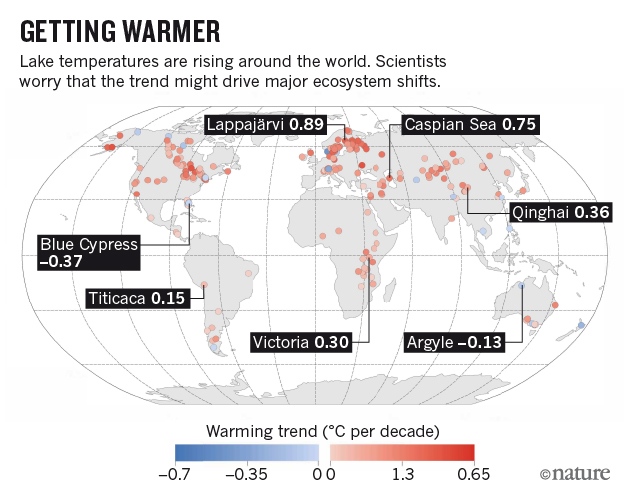
Climate change is rapidly warming lakes around the world, threatening freshwater supplies and ecosystems, according to a study spanning six continents.
The study is the largest of its kind and the first to use a combination of satellite temperature data and long-term ground measurements. A total of 235 lakes, representing more than half of the world’s freshwater supply, were monitored for at least 25 years. The research, published in Geophysical Research Letters, was announced today at the American Geophysical Union meeting.
The study, which was funded by NASA and the National Science Foundation, found lakes are warming an average of 0.61 degrees Fahrenheit (0.34 degrees Celsius) each decade. That’s greater than the warming rate of either the ocean or the atmosphere, and it can have profound effects, the scientists say.
Algal blooms, which can ultimately rob water of oxygen, are projected to increase 20 percent in lakes over the next century as warming rates increase. Algal blooms that are toxic to fish and animals would increase by 5 percent. If these rates continue, emissions of methane, a greenhouse gas 25 times more powerful than carbon dioxide on 100-year time scales, will increase 4 percent over the next decade.
“Society depends on surface water for the vast majority of human uses,” said co-author Stephanie Hampton, director of Washington State University’s Center for Environmental Research, Education and Outreach in Pullman. “Not just for drinking water, but manufacturing, for energy production, for irrigation of our crops. Protein from freshwater fish is especially important in the developing world.”
The temperature of water influences a host of its other properties critical to the health and viability of ecosystems. When temperature swings quickly and widely from the norm, life forms in a lake can change dramatically and even disappear.
“‘These results suggest that large changes in our lakes are not only unavoidable, but are probably already happening,” said lead author Catherine O’Reilly, associate professor of geology at Illinois State University, Normal. Earlier research by O’Reilly has seen declining productivity in lakes with rising temperatures.
Temperature increases close to or above the average .61 degrees F rise were seen in some of the world’s most popular waters, including Lake Tahoe (+.97 F by hand, +1.28 by satellite), the Dead Sea (+1.13 F), two reservoirs serving New York City, Seattle’s Lake Washington (+.49 F), and the Great Lakes Huron (+1.53 F by hand, +.79 by satellite), Michigan (+.76 F by hand, +.36 by satellite), Ontario (+.59 F) and Superior (+2.09 F by hand measurement, +1.44 F by satellite).
Study co-author Simon Hook, science division manager at NASA’s Jet Propulsion Laboratory in Pasadena, Calif., said satellite measurements provide a broad view of lake temperatures over the entire globe. But they only measure surface temperature, while hand measurements can detect temperature changes throughout a lake. Also, while satellite measurements go back 30 years, some lake measurements go back more than a century.
“Combining the ground and satellite measurements provides the most comprehensive view of how lake temperatures are changing around the world,” he said.
The researchers said various climate factors are associated with the warming trend. In northern climates, lakes are losing their ice cover earlier, and many areas of the world have less cloud cover, exposing their waters more to the sun’s warming rays.
Previous work by Hook using satellite data indicated that many lake temperatures were warming faster than air temperature and that the greatest warming was observed at high latitudes, as seen in other climate warming studies. This new research confirmed those observations, with average warming rates of 1.3 degrees Fahrenheit (0.72 degrees Celsius) per decade at high latitudes.
Warm-water, tropical lakes may be seeing less dramatic temperature increases, but increased warming of these lakes can still have large negative impacts on fish. That can be particularly important in the African Great Lakes, where fish is an important source of food.
“We want to be careful that we don’t dismiss some of these lower rates of change,” said Hampton. “In warmer lakes, those temperature changes can be really important. They can be just as important as a higher rate of change in a cooler lake.”
In general, the researchers write, “The pervasive and rapid warming observed here signals the urgent need to incorporate climate impacts into vulnerability assessments and adaptation efforts for lakes.”
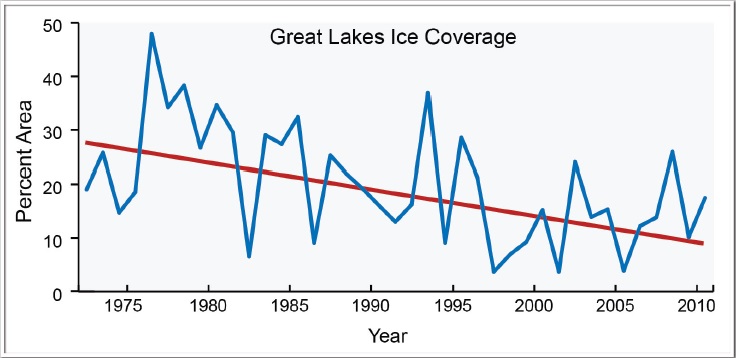
The Great Lakes are some of the world’s fastest warming lakes.
The decline of Great Lakes ice cover over the past several decades is contributing significantly to the rate of increase of summer water temperature, the study said.
The data also shows the world’s lakes are warming faster than the air around the lakes.
The study, published in the Geophysical Research Letters, finds that Lake Superior is warming the fastest of any of the Great Lakes.
The downside to warming waters is a more rapidly changing Great Lakes ecology. Warmer waters can negatively effect some native Great Lakes species, and increase invasive species.
Lake Superior is warming at a rate of 2.1°F per decade, according to the study.
Northern Lake Michigan is warming 0.4°F per decade, while southern Lake Michigan is warming at 0.76°F.
Northern Lake Huron is warming faster than southern Lake Huron. Northern Lake Huron is warming at a rate of 1.5°F and southern Lake Huron .79°F.
Lake Ontario is warming at .59°F per decade.
Lake Erie has been the slowest to warm at 0.15°F per decade.
The study looked at data from 1985 to 2009. It used satellite data, and actual water and air temperature measurements from buoys on the Great Lakes.
One would think the water would warm at the same rate as the air above it. The study showed this is not the case. Great Lakes water temperatures are actually rising about 50 percent faster than the overlying air temperatures.
An increasing number of ice-free days on each Great Lake are a major culprit in the warming, the study said. Lack of ice causes summer stratification of the water to occur earlier in the summer. Once summer stratification occurs, Great Lakes waters can warm faster on the surface.
Summer stratification means the water is warmer on the top surface of a lake, and then gets colder in gradually deeper water. This stratification develops during the spring and early summer. Coming out of winter, the surface water is coldest, and maybe ice covered, and the water gets warmer as you go to deeper depths. The temperature pattern then flip-flops heading into summer.
An older study found that this summer stratification is occurring nearly 14 days earlier in the last 27 years.
Although 2.1°F warming over a decade may not sound like a lot, that’s a 4.5°F water temperature rise on Lake Superior since 1979.
The study exemplifies the interdisciplinary work of WSU’s Grand Challenges, areas of research addressing some of society’s most complex issues. The study is also in keeping with the theme of the challenge “Sustainable Resources: Food, Energy, and Water,” which will develop strategies that link optimized agricultural practices, water management, and energy production.
Sources:
Washington State University – reported in ScienceDaily.com
Mark Torregrossa | mtorregr@mlive.com
150-year global ice record reveals major warming trend
September 7, 2000 By Brian Mattmiller
Sources as diverse as newspaper archives, transportation ledgers and religious observances, scientists have amassed lake and river ice records spanning the Northern Hemisphere that show a steady 150-year warming trend.
The study, which includes 39 records of either freeze dates or breakup dates from 1846 to 1995, represents one of the largest and longest records of observable climate data ever assembled. University limnologist John Magnuson led a team of 13 co-authors who contributed to the report, to be published in the Sept. 8 issue of the journal Science.
Sites ranges from Canada, Europe, Russia and Japan. Of those, 38 indicate a consistent warming pattern. The average rate of change over the 150-year period was 8.7 days later for freeze dates; and 9.8 days earlier for breakup dates. A smaller collection of records going well past 150 years also show a warming trend, at a slower rate.
“We think this is a very robust observation: It is clearly getting warmer in the Northern Hemisphere,” says Magnuson. “The importance of these records is that they come from very simple, direct human observations, making them very difficult to refute in any general way.”
Magnuson says the observational nature of the study is “both its strength and its weakness,” and the results do not offer specific proof that greenhouse gases are driving the warming trend. However, the findings are consistent with computer-generated models that have been developed to estimate climate change from greenhouse gases over a 125-year time period, he says.
The findings also correspond to an air temperature increase of 1.8 degrees Celsius over the past 150 years. A temperature change of 0.2 degrees Celsius typically translates to a one-day change in ice-on and ice-off dates.
Freeze dates were defined in the study as the observed period the lake or river was completely ice-covered; the breakup date was defined as the last ice breakup observed before the summer open-water phase.
Ice records have valuable attributes for climate researchers, Magnuson says. They can be gathered across a wide range of the globe, and in areas traditionally without weather stations. Their primary weakness is that early observers did not document the methods used.
“Of course, 10,000 years ago the Midwest was covered by ice, so we know it’s getting warmer,” he says. “What’s troubling and scary to people is that these rates in recent decades are so much faster.”
Climate models have predicted a doubling of total greenhouse gases in the next 30 years or so, a change that could potentially move the climate boundaries for fish and other organisms northward by about 300 miles, approximately the length of the state of Wisconsin, Magnuson says.
The records in this study are part of a decade-long project led by Magnuson and the UW–Madison Center for Limnology to build a database of lake and river ice records from around the world. The project was supported by the National Science Foundation’s Long-Term Ecological Research program, which emphasizes tracking and understanding global changes.
“It’s kind of a new science, you might call it network science,” Magnuson says. “We reached out to colleagues around the world and asked for these records. It turned out some people had very rich stores of data.”
The records in this study represent the longest and most intact of 746 records collected through the project. Some individual records are of astonishing lengths, with one dating back to the 9th century, another to the 15th century and two more to the early 1700s.
For example, Lake Suwa in Japan has a record dating back to 1443 that was kept by holy people of the Shinto religion. The religion had shrines on either side of the lake. Ice cover was recorded because of the belief that ice allowed deities on either side of the lake — one male, one female — to get together.
Lake Constance, a large lake on the border of Germany and Switzerland, has a peculiar record dating back to the 9th century. Two churches, one in either country, had a tradition of carrying a Madonna figure across the lake to the alternate church each year it froze.
Two other long records come from Canada’s Red and McKenzie rivers, which date back to the early 1700s and were kept because ice cover and open water were critical to the fur trade. Records from Grand Traverse Bay and Toronto Harbor, both on the shores of the Great Lakes, reflect their prominence as shipping ports.
Other records included in the study are from lakes Mendota, Monona and Geneva from Wisconsin; lakes Detroit and Minnetonka from Minnesota; lakes Oneida from New York and Moosehead from Maine; Lake Kallavesi from Finland; and the Angara River and Lake Baikal from eastern Russia.
Another finding in the study, based on the 184 ice records from 1950 to 1995, showed the variability in freeze and breakup dates increased in the last three decades. Magnuson says it might be related to intensification of global climate drivers such as the El Nino /La Nina effects in the Pacific Ocean.
Magnuson says the ecological effects of global warming are only beginning to be studied. But studies already exist that have shown the northern ranges of some butterflies and birds have been extending northward.
Source: University of Wisconsin – Madison
Read Dr. Seuss’s Book, “The Lorax”, to Celebrate Dr. Seuss’s Birthday,n or Better Yet – Read it to a Child or Friend

March 2nd is Dr. Seuss’s birthday, he would be 112 this year. While he is no longer with us, his legacy lives on in the pages of his books. A book that all parents might want to read to their children is Dr. Seuss’s “The Lorax”. It’s message is most applicable to finally being recognized environmental crisis of global warming and climate change, which continues to worsen.
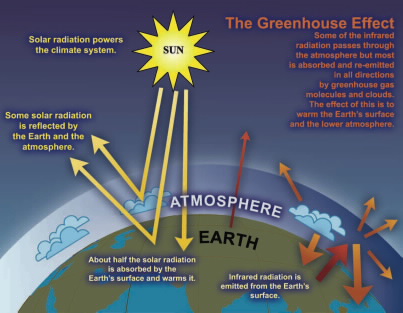
Children should know we humans have already saturated Earth’s atmosphere with the residuals from excessive burning of earth’s fuels, the effect of which, together with the cutting down of the carbon dioxide sequestering tropical rain forest, has lead to an unhealthy and unnatural buildup of carbon dioxide and other greenhouse gases in Earth’s atmosphere, which means that more of the Sun’s radiant heat is being trapped near Earth’s surface, which has already caused destabilized the earth’s climate systems, to the suffering and harm to many living species, including millions and ultimately billions of the human population, in areas which have experienced major and significant changes in weather events, more severe storms and flooding in some areas, but not enough rain for others.
Long before saving the earth became a global concern, Dr. Seuss, speaking through his character the Lorax, warned against mindless progress and the danger it posed to the earth’s natural beauty.
A boy living in a polluted town visits a strange isolated man called the Once-ler “at the far end of town where the Grickle-grass grows… [on] the Street of the Lifted Lorax”, who never appears fully in illustrations; only his arms are shown. The boy pays the Once-ler fifteen cents, a nail, and the shell of a great-great-great grandfather snail to explain why the area is in such a run-down state. The Once-ler explains to the boy (shown in flashback) how he once arrived in a beautiful, pristine valley containing happy, playful fauna (Brown Bar-ba-loots, Swomee Swans, and Humming Fish) that spent their days romping around blissfully among “Truffula trees”. The Once-ler proceeded to cut down the Truffula trees to gather raw material to knit “Thneeds,” a ridiculously versatile invention of his, “which everyone needs”. Thneeds could be used as a shirt, a sock, a glove, a hat, a carpet, a pillow, a sheet, a curtain, a seat cover, and countless other things.
By cutting down the tree, he summoned the titular Lorax to appear from the stump of a Truffula tree. He “speaks for the trees, for the trees have no tongues” and warned the Once-ler of the consequences of cutting down the truffula trees, but the Once-ler ignored him, instead contacting all his relatives to help him with his business.
The Once-ler’s small shop soon grew into a factory and new equipment was made to keep up with the demand for more Thneeds, and signs of damage to the Truffula Forest became evident to the Lorax. The Lorax first complained to the Once-ler that the Truffula trees, being chopped down, were also the food source of the Bar-ba-Loots, who are now facing a terrible food shortage and a disease called “the Crummies because of gas and no food in their tummies.” To save them, the Lorax sent them off to find another food source. At first, the Once-ler only showed a little remorse, but still focused on expanding his business.
Soon, the Once-ler’s Thneed-making business expanded tenfold and now used delivery trucks to take out the shipments. The Lorax eventually came back complaining to the Once-ler that the factories were belching out so much “smogulous smoke” that it was giving the Swomee Swans sore throats, leaving them unable to sing. After the Lorax sent them off, he also complained to the Once-ler about his machinery making a goo by-product called “Gluppity Glup” and “Shloppity Shlop,” and how it was being dumped into the ponds where the Humming Fish live, leaving them unable to hum and forcing the Lorax to send them away too.
The Once-ler, disgruntled by this, still dismissed the Lorax’s pleadings and declared his intention to keep “biggering” his operations, but at that very moment, the “The very last Truffula tree of them all” falls. Without raw materials, his factory shut down; without the factory, his relatives left. Then the Lorax, silently, with one “very sad, sad backward glance”, lifted himself by the seat of his pants and flew away through the clouds.
The Once-ler lingered on in his crumbling residence, living in seclusion and remorse, while pondering over a message the Lorax left behind: a stone slab etched with the word “Unless”. In the present, he now realizes what the Lorax meant. He tells the boy, “Unless someone like you cares a whole awful lot, nothing is going to get better. It’s not.” The Once-ler then gives the boy the last Truffula seed and tells him to plant it, saying that if the boy grows a whole forest of the trees and keeps them protected from logging, “the Lorax, and all of his friends may come back.”
A Day to Remember – February 29, 2016
I could not allow this day – Feb. 29 – to pass without comment. Leap year – a year having an extra day in February – occurs only every four years.
So, is that good or bad?
It’s not good, in fact it’s DISASTROUS, because yet ANOTHER day, and year, and decade has gone by while our elected officials in the State of Wisconsin Legislature, and the U.S. Congress, and the population of our state and country, refuse to take the threat, and now reality, of global warming caused by too much fossil fuel burning – in cars, trucks, airplanes, electric power producing plants that burn fossil fuels, seriously, despite alarming increases in sea levels.
Too much fuel burning primarily coal, methane (natural gas), and oil products, have been burned by humans over the past decades and centuries for the energy that has been produced, resulting in the emission and accumulation of elevated concentrations of “greenhouse gases” in earth’s atmosphere, resulting in global warming, the rise in the elevation levels of earth’s oceans, due to the melting of the earth’s Arctic and Antarctic Circle’s land ice and snow, the shrinking of earth’s mountainous glaciers, a thawing of the earth’s permafrost region (one-fifth of the earth’s land surface), causing a warming, expansion, and acidification of earth’s oceans, leading to a dangerous rise in sea level.
The warming is already wreaking of havoc on earth’s biological systems, including humans, most notably in poorer, tropical countries, many of which are already experiencing grave losses due to extreme weather events, such as drought, heat waves and severe storms, along with unprecedented flooding, all of which had been scientifically predicted well over a century ago!
The warming has been compounded by the increasing loss of vegetation, particularly the loss of the tropical rainforests, which had been naturally sequestering carbon dioxide from the atmosphere, but not anymore, by the ones which have been replaced by other forms of development or money producing mono-culture agriculture.
Global warming from human causes is not rocket science, despite what the flat earth believers may still be claiming. However, saying that human-caused global warming is not occurring, because it has not been “proven” to be happening – as of this February 29, 2016, is utterly preposterous, and those who claim human-caused global warming is not happening are either fools or worse yet – liars.
CBS News Special: “Earth Day – A Question of Survival”, with News Anchor Walter Cronkite
The first Earth Day in the United States was held on April 22, 1970. CBS-TV aired it as a 13-part CBS news special. It was a time when the vast majority of Americans generally counted on the major television network news anchors to accurately inform them of the important news of the day, and CBS’s Walter Cronkite was considered the most honest of them all. National news reporting was viewed as having no relationship whatsoever to money provided by networks’ sponsors, and instead was information that viewers could count on as being accurate and true concerning the national events and threats that were occurring in the country and what American viewers would want to know to keep themselves well informed of the country’s news. While Madison’s Gaylord Nelson Institute at the University of Wisconsin states that the CBS news report which aired that night didn’t do justice to much of the participation in the events that were held on the first Earth Day in 1970, the fact that it documented many of the other people concerns that Americans had about the state of the environment in 1970 is worth noting.
The first earth day came about because people were really fed-up with the undeniable pollution of the waters, air and land around them, some even getting sick, while others feared things were likely to get worse and worse because the pollution was getting worse and worse. The following ten years of federal and state law making and enforcement to prevent the continued degradation of U.S. drinking and surface waters, air in the U.S., wetlands and land protection, too, led many to later call the decade of the 1970s “the environmental decade”.
This was also a time of great concern because of the large amount of the country’s money was going for military purposes in fighting the Vietnam War, money which could have gone to keeping the county’s important natural resources clean and healthy, and improving living conditions in “the urban ghettos” including homes for the homeless. A “teach in” was being held across the United States by anti-war advocates at the same time when Senator Gaylord Nelson from Wisconsin came up with the idea of having a similar day set aside for a teach-in about the need for change to ensure a healthy future for the planet, including the nation’s people who were suffering in the ghettos. View all 13 parts of the CBS’s special news report, anchored by Walter Cronkite, of the first Earth Day here.
This CBS special news report for Earth Day is well worth the investment of everyone’s time viewing it, or reading the transcript of the report. A similar degree of response is what is needed now to prevent an even worse and tragic consequence of human and animal life lost and suffering as we continue to add more and more quantities of greenhouse gases to the atmosphere by continuing to burn vast quantities of fossil fuel, for electric power generation, heating and long distance or daily travel requiring oil burning, and many countries continuing to pave over the landscape with concrete, and most every country suffers from a lack of an appropriate adaptation plan in the likely case now that the worse of the climate extremes will ultimately result, and that the inundation of the world’s currently most populous coastal cities will also result, and that many island nations will require resettlement, as the ones that are presently livable are predicted to become submerged completely if major and significant change is not made soon by the most highly developed countries. Our U.S. Congress continuing its refusal to enact laws to reduce greenhouse gas emissions, let alone refusing to alert the American people of the grave unfortunate results of ignoring all climate experts’ warnings means that it’s almost certain the worst predictions are ultimately likely to occur from our lawmakers’ inaction, and the similar expected inaction by many other countries that might otherwise follow our lead, and the paving of the remaining green space on the planet, is unconscionable. If our political office holders are not interested in doing this for us living here today, they should not leave the full burden of living on our likely inhospitable planet to fall on today’s and tomorrow’s children, including those who reside here, as well as elsewhere.
 All Things Environmental

Recent Comments