
Americans Are Driving and Flying at Unprecedented Levels, Adding to the Growing Accumulation of Greenhouse Gases that are Fueling Global Warming

Americans are driving more than ever before, adding to the growing amount of greenhouse gases in the atmosphere each time they get behind the wheel and start up the ignition. Newly released data from the U.S. Department of Transportation shows the estimated motor vehicle miles traveled on all the nation’s highways, roads and streets reached a new high in April 2015, the latest month data is available.
The more miles they drive, the more pounds of carbon dioxide their vehicle emits, adding to the already considered dangerous and growing volume of greenhouse gases in the atmosphere. Approximately 20 pounds of carbon dioxide (CO2) are produced from burning a gallon of gasoline and 22 pounds of CO2 are produced by burning a gallon of diesel fuel.
As if this weren’t bad enough, U.S. airlines (burning jet fuel, another fossil fuel) reported a seasonally-adjusted all-time monthly highs in passenger enplanements, Revenue Passenger-Miles (RPMs) and Available Seat-Miles (ASMs). Systemwide passenger enplanements in April (65.4 million) exceeded the previous record the previous month – March 2015 – by 0.4 percent. Systemwide RPMs in April – 73.8 billion – exceeded the previous systemwide RPMs in March 2015 by 0.4 percent.[U.S. DOT Bureau of Transportation Statisitics]
Air travel has been reported as America’s “biggest carbon sin”. It just got bigger! Shame, shame ….
Why Have Our Commercial and Public Media (TV, Radio, Newspapers, Magazines, Online Sources) and Officials in Federal and State Government in the United States Not Sounded the ALARM Yet on Continued Global Warming and Climate Change?


The following is a summary of a 2008 international conference entitled: “ENVIRONMENT: FROM GLOBAL WARNINGS TO MEDIA ALERT” that was held October 10 and 11, 2008, in Venice, Italy. The purpose of the conference was to challenge the international media to improve public understanding of the impact of climate change. Journalists and news executives from 29 countries representing six continents attended the conference which was held by the international World Political Forum (WPF).
Unfortunately, now almost five years after this conference was held, commercial and corporation funded TV and radio media in these United States continue to purposefully ignore said challenge by not sounding the alarm on the global warming world catastrophe in the making, as do many U.S. publicly elected government officials in federal and state government, leaving the at large public in the U.S. as confused as ever over whether human activities such as fossil fuel burning: in power plants that produce electricity; in home and business heating (natural gas; oil; propane; electric baseboard); in motor vehicle travel and product shipping, via trucks, ships, pipelines (fueling lift stations), in airplanes and in trains; and in cement making and paving the landscape (fuel burning in earth moving equipment). Another significant contributor to the growing global warming crisis is continued deforestation, worldwide, and especially the deforestation of the tropics, where previously large reductions in of carbon dioxide (CO2) were being taken out of the air by the vegetation there – through the process of photosynthesis. Less green vegetation on Earth means increasing buildup of CO2 in the atmosphere and oceans, adding to warmer global temperatures. Methane gas (unburned natural gas) that is released from oil wells, livestock, and rotting biological matter (permafrost thawing) compound the problem that is resulting in what the scientific community has called “a potentially very dangerous situation for all humanity and life on Earth and lasting far into the future. Reason is that many positive (lead to more warming) feedbacks . One such warming feedback is the loss of Earth’s albedo, where a reduction in the area of snow-covered land, ice caps, glaciers or sea ice has a compounding effect on the initial warming. As the loss of “white” snow and ice cover (the albedo) continues, the amount of solar energy absorbed by the ocean increases, leading to more warming, which reduces the albedo on the planet even more, which causes more warming, and so on. A small amount of snow melt exposes darker ground which absorbs more radiation, leading to more snowmelt.
The effect is most vividly demonstrated by the decline in Arctic sea ice in recent decades.

As humans are continuing to do things that add more heat-trapping greenhouse gases (GHGs) to the Earth’s atmosphere, the result is that climates all around Earth have been measurably and significantly changing, mostly to the detriment of humans and animal life.
The global warming that has already taken place has caused Earth’s ocean levels to rise – due to thermal expansion from increasing water temperatures and from melting glaciers on Greenland, Antarctica, and Earth’s numerous mountain ranges.
Ocean water acidification has already taken place (a 33% increase) which has already lead to significant environmental, economic, and social cost. These effects of expected to continue unabated which is expected to worsen in time, with projected increases in monetary losses, damage, and loss of human and animal life due to worse and worse “natural” disasters.
As examples of recent catastrophes suspected to have been made worse as a likely direct consequence of rising average global temperatures (global warming): in 2015 heat waves in India and Pakistan killed 1,400 and 2,500 people; in 2013, the thirtieth named storm of the 2013 Pacific typhoon season, Typhoon Haiyan — known as Typhoon Yolanda in the Philippines – with an estimated one-minute sustained winds of 315 km/h (196 mph; 170 kn), making the typhoon the strongest tropical cyclone ever observed based on one-minute sustained wind speed and the deadliest typhoon hitting the Philippines in recorded modern history, killing 6,300 people in that country alone (dozens of fatalities from the storm were also reported in Taiwan, China and Vietnam) and according to United Nation’s officials, about 11 million people were adversely impacted by the storm with many left homeless and an economic cost in the billions of dollars; in 2012, Hurricane Sandy, which remains the largest Atlantic hurricane on record (as measured by diameter, with winds spanning 1,100 miles (1,800 km)) is estimated to have caused monetary damages of over $68 billion and killed at least 233 people along its path on the eastern U S. seaboard including New Jersey and New York; and in 2005, Hurricane Katrina, the fifth hurricane of the 2005 Atlantic hurricane season, was not only the costliest “natural” disaster in the history of the United States. Total property damage from Hurricane Katrina was estimated at $108 billion; the hurricane and subsequent flooding took 1,833 human lives and an undetermined number of domesticated and wild animal lives.
Yet today, incredibly – almost six years later – there remain deniers of human-caused global warming and climate change, including our State of Wisconsin’s own U.S. Senator Ron Johnson, as well as announced U.S. presidential candidate and our current governor, Scott Walker, who continue to spread the false message that Earth’s climates have not been shown to have changed as a result of human activities, to the delight of corporations that are financially benefiting from continued and more fossil fuel burning, which releases carbon dioxide gas, the most abundant of the greenhouse gases, which compounds from year to year in the atmosphere and Earth’s oceans, leading to monumental negative consequences for humanity and other life forms on Earth.
WPF’s President Mikhail Gorbachev, the eighth and last leader of the Soviet Union and General Secretary of the Communist Party of the Soviet Union from 1985 until 1991 when the party was dissolved, chaired the conference at which participants reached a consensus that the problem of climate change is “URGENT”.
“Time is running out,” Mr. Gorbachev said in his closing remarks. “The most efficient way to tackle the urgent environmental problems facing our planet is transparency, in which the media have a vital role to play. This means global glasnost.”
Climate experts and media delegates approved a declaration calling for higher standards of reporting on strategic options to avert irreversible damage to the Earth’s eco-systems.
Stressing the importance of well-informed public opinion, the declaration set out the following main recommendations:
– The media have the central role in ensuring that politicians, corporations, non-governmental organisations and scientists keep the general public informed about the latest facts and policy options regarding climate change. Civil society formation and action are essential components in deliberation on this issue.
– Journalists have a responsibility to improve their knowledge and skills in order to be able effectively to question government policy-makers, to distinguish facts from opinion or advocacy, and to evaluate scientific arguments from an independent viewpoint.
– Journalists and civil society should redouble their efforts to combat restrictive measures by governments on journalists reporting on their deficiencies in fighting environmental degradation or in informing the public about the dangers of climate change.
– Journalists should avail themselves of existing international databanks of validated statistics and scientific research on climate change.
– Scientists need to acquire improved communications skills to explain their findings in accessible terms and to build relationships of trust with the media.
– Media proprietors should be prepared to invest more resources in investigative reporting to allow specialist journalists to carry out serious and objective coverage of complex issues, based on a thorough understanding of good science.
– Editors should provide more space for in-depth treatment of environmental issues, not just on-line but in print and on air, and encourage innovative approaches that will grab the attention of the audience in a responsible, independent and non-sensational manner.
– Journalism training organisations should develop ever more sophisticated exercises to improve reporters’ skills in explaining complex scientific arguments. An international network should be created to share information about the availability of training courses and the development of new training models.
The Conference concluded on a positive note, declaring: “There is, however, cause for optimism if we act now. Numerous positive solutions to the global environmental change proposed by science and made possible by innovations in technology, the potential inherent in global civil society organization and by citizens’ groups everywhere in the world; and contributions from socially responsible business leaders can make it possible for us to provide for a decent and full life for all, and for generations to come, within the limits of our planet’s resources.”
Congressional Action or Inaction on Impacts of Climate Change on Undeveloped Countries?

If carbon dioxide (CO2) was as visible as the colors of Old Glory, the color of the sky would be predominantly red, white and blue. That’s because over the last 100+ years, the United States has contributed more CO2 to the atmosphere (now considered a pollutant since additional CO2 adds to the atmosphere’s “greenhouse effect”) than any other of the world’s countries, including China.
None of the CO2 and other greenhouse gases emitted to the atmosphere from fuel burning the world over escapes the atmosphere to become outerspace; rather, it becomes part of the mix of gases already present tin the atmosphere for hundreds of years, making for an ever stronger greenhouse effect over time. And because the heat is latent in its expression, the warming effect of the combined total of all additional greenhouse gases emitted to the atmosphere during the first 15 years of the current century has not been fully realized. The warming effects of the first 15 years of this century are mostly the result of increased fuel burning in motor vehicles and jet air travel the period 1970 – 2000, along with burning coal and natural gas in electricity providing power plants.
Although China has recently surpassed the U.S. in estimated annual CO2 emissions, the U.S. is still considered the world’s largest historical emitter of CO2. The CO2 concentration in the atmosphere is important since any additional CO2 released to the atmosphere by fossil fuel burning adds to the strength of atmosphere’s greenhouse effect over time, adding to what would otherwise be a background concentration level of roughly 250 parts per million (ppm) in the atmosphere, the CO2 level present in the atmosphere prior to the initiation of wide spread fossil fuel burning which started during the Industrial Revolution. The presently now new globally averaged level of 400 ppm in the atmosphere is higher than at any other time in Earth’s history when humans were documented as being present. This is why the undeveloped countries of the world believe the United States has a special obligation to help their people cope with the impacts of the changing climate on them.
Next week, the Senate Appropriations Committee will consider the U.S. commitment to the Green Climate Fund for vulnerable people impacted by climate change. Are one of your senators on the congressional Appropriations Committee?
Pope Francis pointed out in his encyclical on ecology that it is the world’s poor who are bearing the brunt of climate impacts. As Americans, and as people of faith, we are obliged to advocate for those whose lives and livelihoods are threatened, and who cannot advocate for themselves.
The Green Climate Fund was conceived to help poor and vulnerable countries adapt to the unavoidable impacts of climate change like changing weather patterns, sea level rise, and extreme weather events while building more resilient societies. More than 30 countries have pledged $10.2 billion to get the fund up and running. President Obama has pledged $3 billion from the U.S., and requested the first installment of $500 million in this year’s budget. The U.S. Senate needs to deliver on that promise!
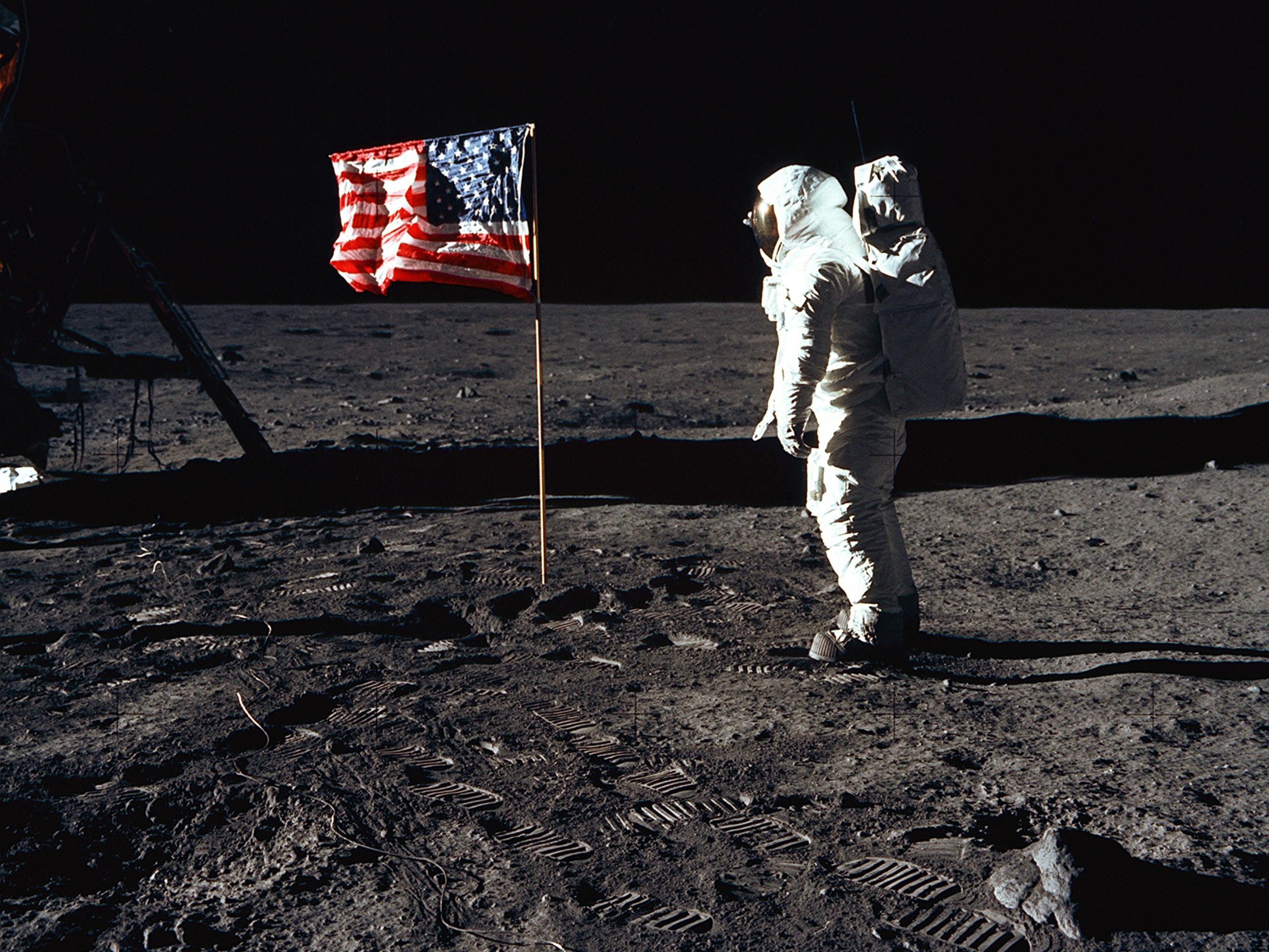
Old Glory saluted by first man on the moon.
Global Warming Deniers and All Fossil Fuel Users: You Are Collectively Putting Us All in Very Grave Danger!
Scientists:
2015 Still On Pace as Hottest Year On Record
The first five months of 2015 topped the warmest such period on record for the globe, according to a pair of recently released independent analyses from government scientists. Meanwhile, a third, separate analysis from the Japanese Meteorological Agency similarly found May 2015 to be the globe’s hottest May, topping May 2014 in records dating to 1891.
Global temperatures January-May 2015 exceeded 2010’s as the warmest first five months of any year, according to the National Aeronautics and Space Administration’s (NASA’s) Goddard Institute for Space Studies.
The National Oceanic and Atmospheric Administration’s (NOAA’s) National Climatic Data Center noted that the first five months of 2015 nudged ahead of January-May 2010 by 0.09 degrees Celsius.
Record warm sea-surface temperatures in the northeast and equatorial Pacific Ocean, as well as areas of the western North Atlantic Ocean and Barents Sea north of Scandinavia contributed to the record warm January-May 2015, according to a recently released NOAA data set. The record global average warmth in the first five months of 2015 follows the record annual average global temperatures of all of 2014.
NASA’s analysis found the most pronounced warm anomalies in May 2015 were over the higher latitudes of the northern hemisphere in two zones. One stretched from northern and central Russia into the Kara Sea, Barents Sea, northern Scandinavia westward toward northeast Greenland. Another was centered over northeast Alaska, and Canada’s Yukon and Northwest Territories stretching into the Beaufort Sea.
Record May warmth was also observed in parts of equatorial South America, southern Africa and The Middle East, according to NOAA. Spain tallied its second warmest May on record. Meanwhile, the heat wave death toll in India in the latter part of May topped 2,300, as was reported in a blog posting here last month that also reported on the death toll of Pakistan’s heat wave last month.
In fact, no U.S. corporation-funded major public media (T.V. or radio, including ABC, NBC, CBS, FOX and NPR) devoted any of their prime time broadcasting in Madison, WI to this story. This is not surprising, of course, knowing that all the major media networks in the U.S., both public and private, as well as many U.S. politicians who claim they represent the public, depend heavily on monetary sources from the major automobile, trucking, airline and fossil fuel providers/refiners/distributors and fossil fuel related industries.
Nine of the ten warmest years in NASA’s 134-year database have occurred this century, with the exception of 1998, which featured the tail end of one of the strongest El Ninos on record.
The last year NASA’s data set of global average temperatures was cooler than average global was 1976.
- The last cooler-than-average month was over 21 years ago, February 1994. In the 449 months from January 1978 through May 2015, only 11 months have been cooler than average, according to the NASA data set.
NOAA says nine of 10 warmest 12-month periods have taken place over the past two years. This 12-month record for the globe has been either tied or broken each month from January to April 2015.
France to see worse heat wave than occurred in 2003 when thousands of people died. France’s southwestern Gironde region sweltered under 107-degree F. heat a day after Cordoba in Southern Spain recorded nearlt 111 degree temperatures.
For noncorporatized REAL news, see news schedule at WORT-FM Community Radio – Madison, Wisconsin, and Democracy NOW!.
The Capital Times’ Editorial Board Agrees: Pope Francis Right to Ring Alarm Bells on Climate Change

Madison Capital Newspaper’s Editorial Board of The Capital Times endorsed Pope Francis’ June 18 Encyclical on Climate Change last week, citing the pope’s recommendation for “cultural revolution” to correct what the pope also said is a “structurally perverse” economic system, exploiting the poor to benefit the rich, turning Earth into an “immense pile of filth”, the pope said.
The following appeared verbatim in The Cap Times’ newspaper and on Madison .com on June 24, 2015 as an opinion and commentary of The Cap Time’s Editorial Board:
Pope Francis is Absolutely Right about Climate Change
“I would like to enter a dialogue with all people about our common home,” writes Pope Francis in the remarkable encyclical on climate change that he has addressed to “every person living on this planet.”
The pope will bring that dialogue to the United States in September and, to our view, he cannot arrive soon enough. Francis is adding to the debate about environmental challenges and responses a sense of urgency that has, for the most part, been missing from the discussions of climate change among the political and economic elites in the United States.
“Doomsday predictions can no longer be met with irony or disdain,” explains the Catholic leader, who argues that the scientific and practical proof of global warming is as undeniable as it is unsettling.
“The Earth, our home, is beginning to look more and more like an immense pile of filth,” Francis argues. “In many parts of the planet, the elderly lament that once beautiful landscapes are now covered with rubbish.”
The pope’s message must be heard in the United States — especially in Washington, especially on Wall Street — as it challenges the superstitions and fantastical thinking of those who still try to deny the human role in creating climate change. And in addressing the crisis.
Some of the deniers are so out of touch with reality that they do not understand what the pope is talking about. Rick Santorum, a clueless conservative who is waging another doomed-to-fail campaign for the Republican presidential nomination, rejected the new encyclical with a bizarre announcement that the pope should “leave science to the scientists.”
Santorum has company in the reality-free zone. A supposedly more serious contender for the Republican nomination, former Florida Gov. Jeb Bush, who like Santorum is Catholic, says, “I don’t get economic policies from my bishops or my cardinals or my pope. I think religion ought to be about making us better as people and less about things that end up getting into the political realm.”
Bush’s fellow front-runner for the Republican presidential nod, Scott Walker, has what Mother Jones magazine refers to as an “inglorious history of anti-environmentalism” in Wisconsin, where the governor recently refused to join a chorus of objection to a move by the Republican-controlled state Board of Commissioners of Public Lands to bar its staffers from engaging in official discussions about climate change. (No thanks to Walker, that idiotic policy was subsequently changed.) And when Americans for Prosperity, the right-wing group funded by the Koch brothers, asked politicians to sign a document devised to restrict government action to address climate change, Walker signed the pledge “to oppose any legislation relating to climate change that includes a net increase in government revenue.”
The ignorance revealed in the statements and actions of political careerists like Santorum, Bush and Walker is such that they may be beyond redemption — at least as regards the climate change debate. They do not seem to understand that the pope is relying on science; Janos Pasztor, the U.N. assistant secretary-general for climate change, says of the pope’s stance: “We have a situation in which science and religion are totally aligned.” Nor do they seem to understand that Francis is not taking a political stand; he is making a moral statement that recognizes an environmental and social circumstance that is denied only by those who persist in placing politics above the facts.
“We are not faced with two separate crises, one environmental and the other social, but rather one complex crisis which is both social and environmental,” writes Francis.
That crisis is “aggravated,” the pope explains, “by a model of development based on the intensive use of fossil fuels.” But it is made worse by indifference of political and economic elites to the condition of those who are already being harmed by climate change, especially the poor who cannot retreat from the disasters that are already playing out and that will grow worse without a radical change of course.
Instead of recognizing that the poor will be the first and the most harmed victims of the environmental catastrophe that is in the making, corporate-aligned political and economic elites in the United States are so neglectful that, the pope writes, “when all is said and done, (the poor) frequently remain on the bottom of the pile.”
Ultimately, of course, we will all be on the bottom of the pile — unless our political and economic responses to climate charge are altered.
Polling shows that, despite massive misinformation campaigns financed by fossil-fuel companies and self-interested billionaires, the American people are beginning to recognize this reality. According to CNN, more than 70 percent of Americans believe the planet is growing warmer, while roughly half now attribute that warming to human causes.
The politicians may resist for a bit longer, but the people are ready for honest leadership on the environmental and economic issues that are arising in an age of considerable climate change. They are ready to ask, as Pope Francis does, “What kind of world do we want to leave to those who come after us, to children who are now growing up?” They are ready for the insight that says, again as the pope does, “The question not only concerns the environment in isolation; the issue cannot be approached piecemeal.”
What the pope proposes is more than mere awareness, however.
Francis seeks action — a “bold cultural revolution” that “(rejects) a magical conception of the market, which would suggest that the problems can be solved simply by an increase in the profits of companies or individuals.”
The pope is absolutely right when he argues that the “invisible forces of the market” will not steer us out of the ditch into which market fundamentalists have steered the planet and its people. But enlightened thinking about the environment along with new approaches to the economy will. This is the promise, and the possibility, that Pope Francis will bring to the United States.
Thousands More Heat Deaths from Record Heat Wave in Pakistan on top of Neighboring India’s nearly 2,200 heat deaths.

Unclaimed heatwave victims in Karachi on June 26, 2015.
Hot and humid weather came to Karachi Pakistan just weeks after torrid temperatures caused nearly 2,200 deaths in neighboring India, raising fears that South Asia could be seeing some of the devastating effects of human-caused climate change, the Associated Press reported. The worst of the heat peaked Saturday, when the high temperature hit 112.6 degrees in Karachi; the heat index topping out at a dangerously high 121 degrees.
“The deadly heat wave that has killed several hundred people in Karachi, Pakistan, is clearly a harbinger of things to come with the changing climate,” Saleemul Huq, director of the International Center for Climate Change and Development in Bangladesh and a prominent climate scientist, told the Associated Press earlier this week.
The death toll in Pakistan’s deadliest heat wave on record now topped 1,100, causing morgues to overflow, Reuters reported Friday.
“By Friday, at least 1,150 people have died in the government-run hospitals,” said Anwar Kazmi of the Edhi Foundation, a private charity that runs a network of ambulances and morgues.
The New York Times reported the heat wave has sent more than 14,000 people into government and private hospitals in Karachi, the nation’s largest city.
The hot weather comes just weeks after torrid temperatures caused nearly 2,200 deaths in neighboring India, raising fears that South Asia could be seeing some of the devastating effects of human-caused climate change, the Associated Press reported.
Pakistan’s previous deadliest heat wave was in 1991, when 523 people died, EM-DAT, the International Disaster Database, reported.
The worst of the heat peaked Saturday, when the high temperature hit 112.6 degrees in Karachi; the heat index topping out at a dangerously high 121 degrees.
“Since the monsoon has been slower to get into northwestern India, Karachi has been tremendously dry with intense heat,” stated AccuWeather meteorologist Anthony Sagliani.
Cooling monsoon rains are likely to arrive in Pakistan by mid-July, which should mean the region won’t see any more temperatures this summer as high as were recorded last weekend, meteorologist Jeff Masters of the Weather Underground said.
The Pakistan heat wave will join this year’s heat wave in India as one of the 10 deadliest in world history.
“The deadly heat wave that has killed several hundred people in Karachi, Pakistan, is clearly a harbinger of things to come with the changing climate,” Saleemul Huq, director of the International Center for Climate Change and Development in Bangladesh and a prominent climate scientist, told the Associated Press earlier this week.
“Even if this particular event cannot be unequivocally attributed to human-induced climate change, we can certainly expect such heat waves with greater frequency in future,” he said.
There is widespread scientific consensus that climate change generally makes extreme weather events such as flooding, droughts, and heat waves much more frequent and more intense.
A major report this week from The Lancet finds that climate change significantly increases the fatal risks of these types of events. The report, which was backed by the World Health Organization, diagnosed climate change as “a medical emergency” with the power to undo 50 years of progress in global health. In a landmark document released last week, Pope Francis aimed to focus the world’s attention on the matter of how climate change impacts the poor. “Climate change is a global problem with grave implications: environmental, social, economic, political and for the distribution of goods,” he wrote. According to NOAA and NASA, this year is on track to supplant last year as the warmest year on record.
Republican Brewhaha on Wisconsin Highway Funding Symptomatic of Larger Problem

Wisconsin Governor Scott Walker’s proposed borrowing plan for highway construction the next two years has finally hit the skids! GOP lawmakers said as much in a letter to the governor yesterday. Not only is the governor’s proposed $1.3 billion transportation borrowing plan too high, said the 33 Assembly Republicans who signed the letter, but also any reduction to $800 million must include reductions in the massive Milwaukee area freeway projects already under construction.
The Republicans lawmakers, who are in the majority in both houses of the Wisconsin Legislature, are negotiating among themselves over the reduction in bonding to $800 million according to a story in the Milwaukee Journal Sentinel website Monday.
Allthingsenvironmental emailed the Republican dominated Joint Finance way last March after the governor’s proposed biennial budget for 2015-17 hit the streets sending them the following message:
So it’s not just the governor’s highway plan part of the 2-year budget that’s unsustainable. It’s virtually everything Scott Walker has done as governor, starting January 2010 with his Act 10 that destroyed collective bargaining in public employee unions, having appeared out of the blue.
Meanwhile, as probable presidential candidate Scot Walker heads his way to yet another Wisconsin taxpayer funded speaking engagement, this time in California, the brewhaha simmering among his fellow Republicans is beginning to reach the boiling point. One has to wonder how many frequent flyer miles the governor and his security people have racked up over the past 5 years? A lot? Yes, but undoubtedly not even close to the millions of tons of greenhouse gases his jets, autos and motorcycles have emitted to the atmosphere for the next generation to be burdened with.
Pope Calls for Swift Actions to Save the Planet from Environmental Ruin
“The pace of consumption, waste and environmental change has so stretched the planet’s capacity that our contemporary lifestyle, unsustainable as it is, can only precipitate catastrophe”.
Pope Francis, June 18, 2015
In his long-awaited encyclical on the environment and climate change publicly released last week, Pope Francis called for swift action to save the planet from environmental ruin, urging world leaders to hear “the cry of the Earth and the cry of the poor.” He called for a change of lifestyle in rich countries steeped in a “throwaway” consumer culture, and an end to “obstructionist attitudes” that sometimes put profit before the common good. Pope Francis said protecting the planet is a moral and ethical “imperative” for believers and nonbelievers alike that should supersede political and economic interests.
A major theme of the encyclical is the disparity between rich and poor. “We fail to see that some are mired in desperate and degrading poverty, with no way out, while others have not the faintest idea of what to do with their possessions, vainly showing off their supposed superiority and leaving behind them so much waste which, if it were the case everywhere, would destroy the planet,” he said.
“Our house is going to ruin, and that harms everyone, especially the poorest. Mine is therefore an appeal for responsibility, based on the task that God has given to man in creation: “till and keep the garden” in which he was placed. I invite everyone to accept with open hearts this document, which follows the church’s social doctrine”, the pope said.
In a transcript of the pope’s encyclical on the DemocracyNow.org website, Pope Francis said protecting the planet is a moral and ethical imperative, for believers and nonbelievers alike, that should supersede political and economic interests. He also dismissed those who argue that technology will solve all environmental problems and that global hunger and poverty will be resolved simply by market growth.
A major theme of the encyclical is the disparity between rich and poor. “We fail to see that some are mired in desperate and degrading poverty, with no way out, while others have not the faintest idea of what to do with their possessions, vainly showing off their supposed superiority and leaving behind them so much waste which, if it were the case everywhere, we destroy the planet.”
Climate change is already happening, and its effects have already been disastrous on the poorest countries and the poorest people, who don’t have the means to defend themselves from it. They are also part of the human population who have the least responsibility for what is happening, being that they consume less fossil fuels.
Author Naomi Klein said on Democracy Now Thursday that “this encyclical, we can’t overstate the importance of it, the impact that it will have. It’s hard to respond to a document that runs close to 200 pages, when it was just released in non-draft form a few hours ago. We’re all still digesting it, Amy. But it is very clear that a door has just been opened, and a gust of wind is blowing through, where it is now possible to say some very powerful truths about the real implications of climate change, really the root causes.”
“And I think a lot of the discussion about the encyclical in the U.S. media cycle has focused and will continue to focus on the impact on Republicans and on climate deniers, many of whom are Catholic. And it is certainly a challenge to that demographic in the United States, because the pope is coming out so clearly on the side of climate science in saying this is real and this is happening. But I think that it’s too easy to say that this is just a challenge to Rick Santorum and Jeb Bush. Frankly, it is also a challenge to Hillary Clinton and Barack Obama and to large parts of the green movement, because it is a rebuke of slow action. It very specifically says that climate denial is not just about denying the science, it’s also about denying the urgency of the science. The document is very strong in condemning delays, half-measures, so-called market solutions. It very specifically criticizes carbon markets, the carbon offsetting, as an inadequate measure that will encourage speculation and rampant consumption.
“And I think probably the most significant part of it, the big picture, is the foregrounding of the culture of frenetic consumption in the wealthy world and among the wealthy. And this is really significant, because I think large parts of the climate change discussion tries to have it all ways and say, “No, we’ll just have green growth. We’ll just have—we’ll consume green products.” And, you know, this goes a lot deeper than that and says, no, we need to get at the underlying values that are feeding this culture of frenetic consumption that is entirely unsustainable.”
In the encyclical, the pope states that: “In a corrupt culture, we can’t believe that laws will be enough to change behaviors that affect the environment.” Naomi Kline responds: Well, I think, when he’s referring to corruption, I believe he’s referring to the influence of polluting companies, of multinational corporations, which he also goes after in the encyclical. And I think this is one of the most significant things about the document. One might expect of a religious document about climate change to erase difference, right? to say, “Well, we’re all in this together,” and certainly it talks about the Earth as our common home. But it also recognizes explicitly the power dynamics in capitalism, which is to say that there are forces within the system that are actively working against change. And that is probably what he’s referring to when he’s talking about how there may be laws, but the laws aren’t enforced. And, you know, indeed the laws are also inadequate, which is also addressed in the document, and it has some very specific calls for another level of environmental law, which is a part of the document that I haven’t been able to look at, you know, closely enough.
And another thing I have to say is, you know, I am—I have accepted this invitation to speak at a conference which is about digging more deeply into the document, because there’s an understanding that it does take time to digest a document of this length, this multilayered, and it requires that kind of deeper analysis. And I think that this intervention, five months ahead of U.N. climate conference in Paris, is tremendously significant. It’s going to push political leaders to go further. It’s going to be a tool for social movements.
A lot of the language of the climate justice movement has just been adopted by the pope—I mean, even of phrases like “ecological debt.” The pope is talking about the debt that the wealthy world owes to the poor. I mean, this is a framing that comes originally from Ecuador, from the movement against drilling in the Amazon. And, you know, this is a phrase that was never heard in mainstream circles until just now, actually. I mean, I’ve never seen such a mainstream use of that term.
So, it is very important in that way. But, I mean, I have to say, on a personal level, that as thrilled as I am that the Vatican is leading in this way and that this pope is leading in this way and bringing together the fight against poverty with the fight to act on climate change, that doesn’t mean that there’s a complete merger between the climate justice movement and the Vatican here. I mean, obviously there are huge differences that remain over issues like marriage equality, reproductive rights and freedom, to name just a few.”
Nathan Schneider, columnist with the Catholic weekly, America, who has been covering Catholic engagement with climate change, talks about what the encyclical means for the Catholic community and the number of languages it’s been released in and how large the document is: “Well, this is really the first Third World encyclical. You know, this is coming from a pope who was shaped in really significant ways by economic crises during the Cold War in Argentina and being in the middle of a battleground between the First and Second World powers. It was drafted by a cardinal from Ghana. So this is coming from the side of the world that we don’t normally hear from. And it’s very much in line with things that popes have been saying for decades, you know, going back to Paul VI, then John Paul II, Benedict XVI. So, a lot of the content is actually not so new for Catholics, but the emphasis and that—the language of climate debt, the language—the recognition that there is a divide here between the rich countries and the poor. And this is a cry from the developing world, from what has been labeled the Third World, for change.”
“The pope is calling here for us to change how we live, how we—what we do with our resources. You know, this is not just moving from one kind of consumerism to another. This is a kind of spiritual renewal and also a material renewal, that—in which we turn ourselves toward an economy that’s sustainable, that’s life-giving, both for humanity and the rest of the world.”
Source: Democracynow.org
Baking in Alaska: Anchorage is hotter than Los Angeles

Temperatures in Alaska’s biggest city hit 83 degrees on Monday and Tuesday, records for both calendar days and just two degrees shy of the June record set in 1969. Temperatures could again hit 80 on Wednesday. In Los Angeles, temperatures on Monday and Tuesday didn’t crack 80.
The normal high for Anchorage is just 63 degrees, as measured between 1981 and 2010, according to the National Weather Service.
Despite this heat wave, cooler-than-normal temperatures in the first 10 days of the month means it probably won’t go down as one of the hottest Junes on record for much of the state. Contributing to the warmer weather in recent years have been sea surface temperatures far above normal as well as earlier melting of winter ice.
Alaska glaciers sending 75 billion tons of water into sea each year.
Alaska: Card Street Fire blazes on the Kenai Peninsula

10 P.M. THURSDAY UPDATE:
The fire burning near Card Street in Sterling grew 33 percent throughout Thursday to more than 12,000 acres, according to Division of Forestry spokesman Tim Lowry.
However, the fire continues to spread eastward and away from nearby homes. Firefighters on the ground and in the air are focusing their attention on protecting structures.
Heading into the evening, there are an estimated 2,000 firefighters in the state and 55 active fires large and small.
That puts the number of fires this season at 286, which have scorched a small-for-Alaska 89,820 acres overall, Lowry said: “We’ll probably get over 100,000 tonight,” he added.
2:30 P.M. THURSDAY UPDATE:
Evacuations have been lifted for subdivisions from the Feuding Lane and Kenai Keyes intersections, the Kenai Peninsula Borough says.
“Kenai Keyes SOUTH to the Kenai River remains evacuated status,” a spokeswoman wrote. “Please use caution when returning to your residence.”
It was a message that residents were hoping for. According to the Division of Forestry today, the subdivisions that were threatened by the now-9,000-acre Card Street Fire appear to be out of the danger zone.
The decision to turn back on the power to homeowners in the Kenai Keyes area is expected about 6 p.m. tonight.
That’s the good news. The fire also remains the top priority wildfire in the United States and has destroyed at least 11 buildings. While most structures are protected, firefighters are now focusing on making sure the flames do not jump the highway.
Some evacuation orders are still in effect on the road to Kenai Keyes, while crews continue to make sure there are no hot spots.
Fire officials have estimated the cost of fighting the wildfire at $1.06 million as of this morning.
— Nikki Carvajal & Tulsi Patil
 All Things Environmental
Recent Comments