
Major Global Warming Upheaval Already Underway
National Public Radio: “The United Nations International Panel on Climate Change (IPCC): “major action is needed and fast”. The IPCC’s latest report to the United Nation presents an ominous threat for the entire world by the end of the century, and many of those threats are already well in the development phase .
.
“The report clearly shows that adaptation is an option only if efforts to mitigate greenhouse gas emissions are strengthened substantially. Without mitigation, the impacts of climate change will be devastating.” – Wolfgang Cramer
“Conserve, NOW 3” Program Needed to Promote Environmental Justice and Income Equality in the U.S.

More to come … Start by reading Feb.7, 2014 Testimony to Wisconsin State Assembly Committee
“… There’s no Planet B …”
 What does sustainability look like? Those who tuned in to WORT’s FM radio station’s “THE ACCESS HOUR” last night (Monday at 7:00 – 8:00 pm) at 89.9 FM (also available to listen to live at http://www.WORTFM.org, or through the WORTFM.org archives), would have a pretty good inkling of what sustainable living is truly all about, and why it is especially URGENT that all of us begin practicing it, NOW, since in the words of one of last year’s speakers, “there’s no planet B”.
On Monday, March 24, 2014, Madison, Wisconsin’s listener sponsored radio station, WORT-FM, aired on its “The Public Access Hour” program a show in which climate change educator and WORT volunteer Kermit Hovey interviewed a number of the presenters and participants who had attended last year’s Sustainability Summit in Milwaukee, Wisconsin. The quotes on this post come from the March 24th Public Access Hour show.
This year’s Sustainability Summit is called “Conserving the Future Together” and is being held in Milwaukee on March 26-28, 2014. See http://www.sustainabilitysummit.us for more information.
Last Monday’s access hour show began with Kermit Hovey interviewing Milwaukee Area Technical College’s (MATC) educator George Stone, who was the 2013 and this year’s Sustainability Summit director. In response to Hovey’s question on how he would define “sustainability”, Stone answered:
“Well, A hundred years ago, in the era of Teddy Roosevelt, we called it “conservation”. I think basically that’s what it is. And when I think of sustainability I’m not thinking primarily about sustainable financial resources, or that sort of thing, I’m thinking of the sustainability of natural resources. You know the basic necessities of life, food, water, and that requires soil for the food, all kind of the materials that Mother Earth supplies, for our advanced civilization, they’re in limited supply, we live on a finite planet, with a growing population, we need to be wise – wise use – we need to be wise and frugal in the way that we use these resources, and adopting the Native American philosophy of inter generational justice: let’s say we have a responsibility to future generations -many of the Nations consider 7 generations in the future. So that’s sustainability. It’s our moral responsibility – and I might say, parenthetically, I consider that all human activity has a moral dimension – it’s our moral responsibility to pass on a planet, and habitats on this planet, to future generations that are as close as possible to what we’ve enjoyed. Plundering the earth, and destroying for our own excess, is not justifiable.
“So sustainability I think is an expression of that in the sense that there is a moral responsibility to future generations. James Hansen, our keynote speaker today, refers to it as “inter-generational justice”. That’s my idea of “sustainability”.”
Climate scientist Michael Mann: “… there’s only one planet, right? And if we screw it up, there’s no planet “B”, and so there couldn’t be anything more important in our lives especially when we think about the sort of world we want to leave for our children and grandchildren, what could be more important than trying to find a way to live sustainably, so that we don’t leave a degraded planet for future generations?”
Go to the archives for “The Public Access Hour” for March 24, 2014 at http://www.wortfm.org for the full interview by Kermit Hovey with Michael Mann along with other speakers and participants.
Will Today’s Children Be Left in the Lurch on Future Planet Earth?

What will Earth’s climate in the future be like? Today’s children will have no choice but to spend the majority of their time in whatever we leave them.
As anyone today who pays even the slightest bit of attention to what 98% of world scientists have been warning us, the consequences of our unprecedented and continued combustion of massive quantities of the earth’s fossil fuels – primarily in transportation, heating and electricity use – over the past several centuries will likely be dire.
The continuing build up of more and more greenhouse gases in our atmosphere (and oceans) from too much fossil fuel burning will likely leave our planet as a sickening place for today’s children, or children to be, to live.
The earth’s atmosphere will trap more radiation thus more heat from the Sun, making weather storm systems much more potent and deadly than those of today.
The water levels of the earth’s oceans will continue rising, warming and the oceans will become more acidic, causing intolerable conditions for many of our oceans’ species. Ecological and biological systems everywhere are likely to be severely impacted. Sustaining life (and living) will become more difficult on Future Planet Earth. If we continue our ecologically reckless burning of fossil fuels, even at the level we burn them now, today’s children and future children will have to pay the price of that overindulgence. The way we are living now is unsustainable, and how long our present day Earth will remain hospitable for human beings and animals to live is limited. Many known “positive global warming feedbacks”, such as more methane releases by the increasing thawing of the permafrost region; and increasing solar radiation absorption (heating) of the Arctic ocean waters due to replacement of its snow and ice cover with its darker, more sunlight-absorbing, sea water are quite probably already kicking in. Once those feedback systems approach their maximum, global warming could take on the characteristics U.S. Secretary of State John Kerry recently described as: “the world’s most fearsome weapon of mass destruction”, and moreover that “the science of climate change is leaping out at us like a scene from a 3D movie… It’s warning us; it’s compelling us to act” (Kerry).
President John F. Kennedy once famously said: “Ask not what your country can do for you; ask what you can do for your country.”
Not many Americans these days must be thinking about the meaning of those words as so many in particular take round-trip flights by jet to far away places, yearly, which requires the burning immense amounts of fossil fuels, especially in take-off and cruising very long distances.
A prime example here in Wisconsin is Wisconsin Public Radio (WPR) and Wisconsin Public Television (WPT) are sponsoring round-trip vacations for anyone who’s willing to pay them to arrange flights to Hawaii, Ireland, the Mediterranean, and New York City this year. More trips are being planned to other exotic places, as well. In addition to those people not spending their money to help out our state’s economy, those excursions contribute to the many tons of greenhouse gases from the jet airliners flying those tourists to their destinations and back to the Badger State over the course of those flights. I have informed WPR that flying by jet is without question the worst thing individuals can do if their goal is to minimize their greenhouse gas emissions. It appears they care only about making money off these excursions and care little or not at all about the perils of a warming planet they are helping to cause by arranging these exotic trips. It’s shameful.
Global Warming Likely to Hurt Wisconsin Agriculture

Agriculture has been a critical dimension of Wisconsin from early settlement and the logging era, through industrialization, and remains an important economic, social and cultural component of the Dairy State. Wisconsin ranks first nationally in cheese production, and second for milk and butter production. Yet Wisconsin is also second in milk cows, oats, carrots, and sweet corn used in processing. It remains the national leader in processed snap beans, cranberries, corn for silage, mink pelts and milk goats. It is also among the top five states for important agricultural commodities such as potatoes, maple syrup, mint for oil, and cucumbers for pickles.
Continue global warming is predicted to bring increases in both the frequency and the severity of droughts and floods, resulting in increased challenges for Wisconsin farmers and livestock operations. Warmer water temperatures are also likely to cause the habitat ranges of many fish species to shift and disruption of ecosystems already stressed by human activity. Overall, climate change in Wisconsin resulting from global warming will make it more difficult to grow crops, raise animals, and catch fish in the same ways and places as in the past.
Changes in the frequency and severity of droughts and floods could pose challenges for farmers and ranchers. Meanwhile, warmer water temperatures are likely to cause the habitat ranges of many fish species to shift, which could disrupt ecosystems. Overall, climate change could make it more difficult to grow crops, raise animals, and catch fish in the same ways and same places as we have done in the past.
Heat waves, which are projected to increase under climate change, could directly threaten livestock. A number of states have each reported losses of more than 5,000 animals from just one heat wave. Heat stress affects animals both directly and indirectly. Over time, heat stress can increase vulnerability to disease, reduce fertility, and reduce milk production.
Drought may threaten pasture and feed supplies. Drought reduces the amount of quality forage available to grazing livestock. Some areas could experience longer, more intense droughts, resulting from higher summer temperatures and reduced precipitation. For animals that rely on grain, changes in crop production due to drought could also become a problem.
Climate change may increase the prevalence of parasites and diseases that affect livestock.The earlier onset of spring and warmer winters could allow some parasites and pathogens to survive more easily. In areas with increased rainfall, moisture-reliant pathogens could thrive.
Increases in carbon dioxide (CO2) may increase the productivity of pastures, but may also decrease their quality. Increases in atmospheric CO2 can increase the productivity of plants on which livestock feed. However, studies indicate that the quality of some of the forage found in pasture lands decreases with higher CO2. As a result, livestock would need to eat more to get the same nutritional benefits.
The negative effects of climate change will be exacerbated by continuing declines in the acreage of Wisconsin farmland. Wisconsin lost more than 620,000 acres of farmland from 2007 to 2012, a 4% decrease according to the Census of Agriculture, which is conducted every five years by the U.S. Department of Agriculture. Likely causes of these declines are urban sprawl development, enabled by federal, state and local highway expansions which replace vegetation and topsoil with heat-absorbing Portland cement or asphalt in order to facilitate continued growth in motor vehicle driving (more fossil fuel burning) and more employment and profits for the construction and bridge building industry.
Sources: U.S. EPA; U. S. Department of Agriculture; Wisconsin Initiative on Climate Change Impact
Pope Francis: People and Political Leaders Have Responsibility to Protect the Earth, Including the Natural and Human Environment
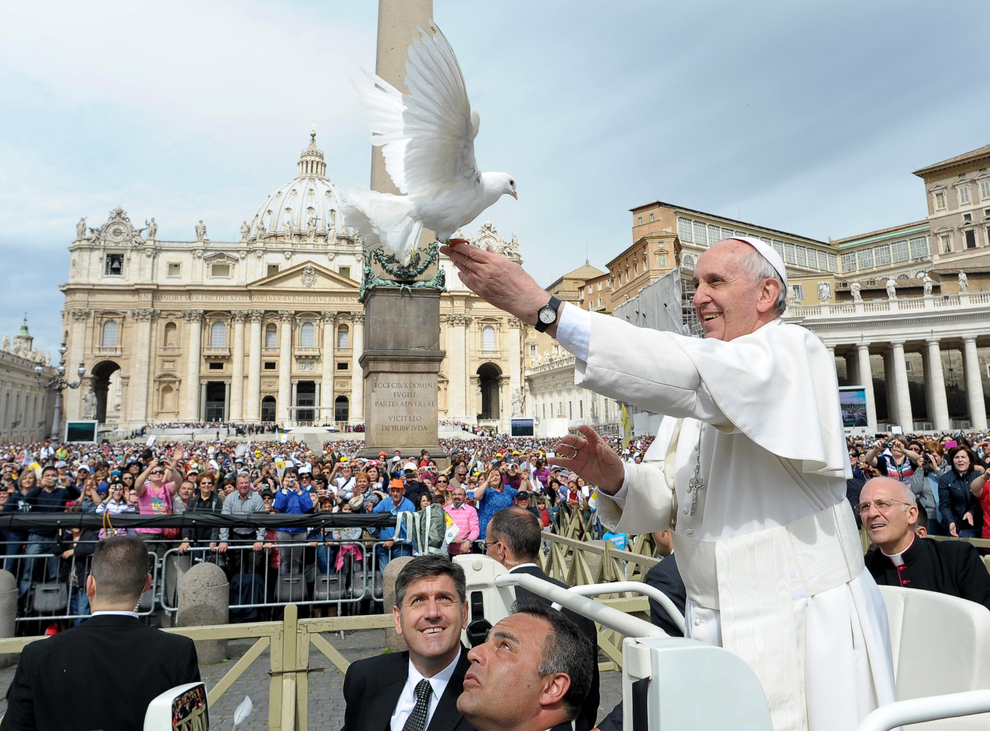
Pope Francis is presently the official head of the Roman Catholic Church. He chose to name himself “Francis”, after St. Francis of Assisi, the patron saint of the environment. Pope Francis states that protecting creation is a fundamental part of the Catholic church’s mission. He elaborates on the responsibility of people and political leaders having the responsibility protect the earth, including reducing emissions that cause climate change, poverty and destruction of the natural and human environment. See quoted material below. Also provided below are quotes from Pope Francis’s two immediate predecessors, Pope Benedict XVI, who served as Pope from 2005 to 2013, and Pope John II, who was the pope for 27 years and who died in 2005. political leaders to meet their responsibilities on the climate change challenge:
“Even if ‘nature is at our disposition’, all too often we do not ‘respect it or consider it a gracious gift which we must care for and set at the service of our brothers and sisters, including future generations’. Here too what is crucial is responsibility on the part of all in pursuing, in a spirit of fraternity, policies respectful of this earth which is our common home. I recall a popular saying: ‘God always forgives, we sometimes forgive, but when nature – creation – is mistreated, she never forgives!’. We have also witnessed the devastating effects of several recent natural disasters. In particular, I would mention once more the numerous victims and the great devastation caused in the Philippines and other countries of South-East Asia as a result of Super Typhoon Haiyan.”
 a
a
Super Typhoon Haiyan was the deadliest storm in modern meteorological record keeping, killing 6,000 people, with 2,000 people still missing. It was the strongest tropical cyclone ever recorded as making landfall as it crossed land directly at the Central Philippines on November 7-8, 2013, and proceeded to create havoc on the other S-E Asia countries. Three months after Super Typhoon Haiyan devastated the Philippines, the destruction and relief struggles are still apparent for the Filipinos. With media coverage having proceeded on to other issues, the Philippine community still needs massive financial help from the outside world.
According to the United Nations Office for the Coordination of Humanitarian Affairs, $78.7 million is still needed in food security assistance and more than $132 million is needed for emergency shelter. 100% of a donation to the Salvation Army for the relief effort in Tacloban goes directly to the people of Philippines.
Super Typhoon Haiyan displaced an estimated four million people in the Philippines. The problems actually get worse for many people, they don’t get better.
A documentary is available online. Watch it here: http://www.savn.tv/campaign/view/1150
“Man is not in charge today, money is in charge, money rules. God our Father did not give the task of caring for the earth to money, but to us, to men and women: we have this task! Instead, men and women are sacrificed to the idols of profit and consumption: it is the “culture of waste.” If you break a computer it is a tragedy, but poverty, the needs, the dramas of so many people end up becoming the norm… in so many parts of the world there are children who have nothing to eat, that’s not news, it seems normal. It cannot be this way! Yet these things become the norm: that some homeless people die of cold on the streets is not news. In contrast, a ten point drop on the stock markets of some cities, is a tragedy”.
“We are called not only to respect the natural environment, but also to show respect for, and solidarity with, all the members of our human family. These two dimensions are closely related; today we are suffering from a crisis which is not only about the just management of economic resources, but also about concern for human resources, for the needs of our brothers and sisters living in extreme poverty, and especially for the many children in our world lacking adequate education, health care and nutrition. Consumerism and a “culture of waste” have led some of us to tolerate the waste of precious resources, including food, while others are literally wasting away from hunger. I ask all of you to reflect on this grave ethical problem in a spirit of solidarity grounded in our common responsibility for the earth and for all our brothers and sisters in the human family.”
“Please, I would like to ask all those who have positions of responsibility in economic, political and social life, and all men and women of goodwill: let us be “protectors” of creation, protectors of God’s plan inscribed in nature, protectors of one another and of the environment. Let us not allow omens of destruction and death to accompany the advance of this world!”
POPE BENEDICT XVI
“I wish to reflect today upon the relationship between the Creator and ourselves as guardians of his creation. In so doing I also wish to offer my support to leaders of governments and international agencies who soon will meet at the United Nations to discuss the urgent issue of climate change. The
Earth is indeed a precious gift of the Creator who, in designing its intrinsic order, has given us guidelines that assist us as stewards of his creation. Precisely from within this framework, the Church considers that matters concerning the environment and its protection are intimately linked with integral human development. [There is] a pressing moral need for renewed solidarity not only between countries but also between individuals, since the natural environment is given b God to everyone, and so our use of it entails a personal responsibility towards humanity as a whole, particularly towards the poor and towards future generations…How important it is then, that the international community and individual governments send the right signals to their citizens and succeed in countering harmful ways of treating the environment! The protection of the environment, and the safeguarding of resources and of the climate, oblige all leaders to act jointly, respecting the law and promoting solidarity with the weakest regions of the world.” (December 8, 2007)
“My dear friends, God’s creation is one and it is good. The concerns for non-violence, sustainable development, justice and peace, and care for our environment are of vital importance for humanity.” (Speaking at World Youth Day, June 2008)
“At a time of world food shortage, of financial turmoil, of old and new forms of poverty, of disturbing climate change, of violence and deprivation which force many to leave their homelands in search of a less precarious form of existence, of the ever-present threat of terrorism, of growing fears over the future, it is urgent to rediscover grounds for hope. Let no one draw back from this peaceful battle that has been launched by Christ’s Resurrection. For as I said earlier, Christ is looking for men and women who will help him to affirm his victory using his own weapons: the weapons of justice and truth, mercy, forgiveness and love”. (Easter 2009)
POPE JOHN PAUL II
“The gradual depletion of the ozone layer and the related ‘greenhouse effect’ has now reached crisis proportions as a consequence of industrial growth, massive urban concentrations and vastly increased energy needs. Industrial waste, the burning of fossil fuels, unrestricted deforestation, the use of certain types of herbicides, coolants and propellants: all of these are known to harm the atmosphere and environment. The resulting meteorological and atmospheric changes range from damage to health to the possible future submersion of low-lying lands.”
“Faced with the widespread destruction of the environment, people everywhere are coming to understand that we cannot continue to use the goods of the earth as we have in the past. The public in general as well as political leaders are concerned about this problem, and experts from a wide range of disciplines are studying its causes. Moreover, a new ecological awareness is beginning to emerge which, rather than being downplayed, ought to be encouraged to develop into concrete programs and initiatives.
“The most profound and serious indication of the moral implications underlying the ecological problem is the lack of respect for life evident in many of the patterns of environmental pollution. Often, the interests of production prevail over concern for the dignity of workers, while economic interests take priority over the good of individuals and even entire peoples. In these cases, pollution or environmental destruction is the result of an unnatural and reductionist vision which at times leads to a genuine contempt for man.
“On another level, delicate ecological balances are upset by the uncontrolled destruction of animal and plant life or by a reckless exploitation of natural resources. It should be pointed out that all of this, even if carried out in the name of progress and well-being, is ultimately to mankind’s disadvantage.”
“Respect for life, and above all for the dignity of the human person, is the ultimate guiding norm for any sound economic, industrial or scientific progress.”
“The complexity of the ecological question is evident to all. There are, however, certain underlying principles, which, while respecting the legitimate autonomy and the specific competence of those involved, can direct research towards adequate and lasting solutions. These principles are essential to the building of a peaceful society; no peaceful society can afford to neglect either respect for life or the fact that there is an integrity to creation.
“Theology, philosophy and science all speak of a harmonious universe, of a “cosmos” endowed with its own integrity, its own internal, dynamic balance. This order must be respected. The human race is called to explore this order, to examine it with due care and to make use of it while safeguarding its integrity.
“On the other hand, the earth is ultimately a common heritage, the fruits of which are for the benefit of all. In the words of the Second Vatican Council, “God destined the earth and all it contains for the use of every individual and all peoples”. This has direct consequences for the problem at hand. It is manifestly unjust that a privileged few should continue to accumulate excess goods, squandering available resources, while masses of people are living in conditions of misery at the very lowest level of subsistence. Today, the dramatic threat of ecological breakdown is teaching us the extent to which greed and selfishness – both individual and collective – are contrary to the order of creation, an order which is characterized by mutual interdependence.
“The concepts of an ordered universe and a common heritage both point to the necessity of a more internationally coordinated approach to the management of the earth’s goods. In many cases the effects of ecological problems transcend the borders of individual States; hence their solution cannot be found solely on the national level. Recently there have been some promising steps towards such international action, yet the existing mechanisms and bodies are clearly not adequate for the development of a comprehensive plan of action. Political obstacles, forms of exaggerated nationalism and economic interests – to mention only a few factors – impede international cooperation and long-term effective action.
“The need for joint action on the international level does not lessen the responsibility of each individual State. Not only should each State join with others in implementing internationally accepted standards, but it should also make or facilitate necessary socio-economic adjustments within its own borders, giving special attention to the most vulnerable sectors of society. The State should also actively endeavur within its own territory to prevent destruction of the atmosphere and biosphere, by carefully monitoring , among other things, the impact of new technological or scientific advances. The State also has the responsibility of ensuring that its citizens are not exposed to dangerous pollutants or toxic wastes. The right to a safe environment is ever more insistently presented today as a right that must be included in an updated Charter of Human Rights.
“Modern society will find no solution to the ecological problem unless it takes a serious look at its life style. In many parts of the world society is given to instant gratification and consumerism while remaining indifferent to the damage which these cause. As I have already stated, the seriousness of the ecological issue lays bare the depth of man’s moral crisis. If an appreciation of the value of the human person and of human life is lacking, we will also lose interest in others and in the earth itself. Simplicity, moderation and discipline, as well as a spirit of sacrifice, must become a part of everyday life, lest all suffer the negative consequences of the careless habits of a few.
“An education in ecological responsibility is urgent: responsibility for oneself, for others, and for the earth. This education cannot be rooted in mere sentiment or empty wishes. Its purpose cannot be ideological or political. It must not be based on a rejection of the modern world or a vague desire to return to some “paradise lost” . Instead, a true education in responsibility entails a genuine conversion in ways of thought and behavior. Churches and religious bodies, non-governmental and governmental organizations, indeed all members of society, have a precise role to play in such education. The first educator, however, is the family, where the child learns to respect his neighbor and to love nature….The relationship between a good aesthetic education and the maintenance of a healthy environment cannot be overlooked.
“Today the ecological crisis has assumed such proportions as to be the responsibility of everyone. As I have pointed out, its various aspects demonstrate the need for concerted efforts aimed at establishing the duties and obligations that belong to individuals, peoples, States and the international community. This not only goes hand in hand with efforts to build true peace, but also confirms and reinforces those efforts in a concrete way. When the ecological crisis is set within the broader context of the search for peace within society, we can understand better the importance of giving attention to what the earth and its atmosphere are telling us: namely, that there is an order in the universe which must be respected, and that the human person, endowed with the capability of choosing freely, has a grave responsibility to preserve this order for the well-being of future generations. I wish to repeat that the ecological crisis is a moral issue.
“Even men and women without any particular religious conviction, but with an acute sense of their responsibilities for the common good, recognize their obligation to contribute to the restoration of a healthy environment. All the more should men and women who believe in God the Creator, and who are thus convinced that there is a well-defined unity and order in the world, feel called to address the problem. Christians, in particular, realize that their responsibility within creation and their duty towards nature and the Creator are an essential part of their faith. As a result, they are conscious of a vast field of ecumenical and inter-religious cooperation opening up before them.
“At the conclusion of this Message, I should like to address directly my brothers and sisters in the Catholic Church, in order to remind them of their serious obligation to care for all of creation. The commitment of believers to a healthy environment for everyone stems directly from their belief in God the Creator, from their recognition of the effects of original and personal sin, and from the certainty of having been redeemed by Christ. Respect for life and for the dignity of the human person extends also to the rest of creation, which is called to join man in praising God.
“In 1979, I proclaimed Saint Francis of Assisi as the heavenly Patron of those who promote ecology. He offers Christians an example of genuine and deep respect for the integrity of creation. As a friend of the poor who was loved by God’s creatures, Saint Francis invited all of creation – animals, plants, natural forces, even Brother Sun and Sister Moon – to give honor and praise to the Lord. The poor man of Assisi gives us striking witness that when we are at peace with God we are better able to devote ourselves to building up that peace with all creation which is inseparable from peace among all peoples.
“It is my hope that the inspiration of Saint Francis will help us to keep ever alive a sense of “fraternity” with all those good and beautiful things which Almighty God has created. And may he remind us of our serious obligation to respect and watch over them with care, in light of that greater and higher fraternity that exists within the human family.”(8 December 1989 – from the Vatican, Rome – World Day of Peace Message, January 1990)
Source: http://catholicclimatecovenant.org/
”
 All Things Environmental
Recent Comments