
Human Rights Day 2015

As representatives of 196 world countries conclude their two-week long meeting in Paris, France this week – the 21st annual United Nations Framework Convention on Climate Change Conference of the Parties meeting (COP 21), it is noteworthy that “Human Rights Day” occurs 10 December every year, which is the day on which, in 1948, the United Nations General Assembly adopted the Universal Declaration of Human Rights. In 1950, the Assembly passed resolution 423 (V), inviting all States and interested organizations to observe 10 December of each year as Human Rights Day.
This year’s Human Rights Day is devoted to the launch of a year-long campaign for the 50th anniversary of the two International Covenants on Human Rights: the International Covenant on Economic, Social and Cultural Rights and the International Covenant on Civil and Political Rights, which were adopted by the United Nations General Assembly on 16 December 1966.
The two Covenants, together with the Universal Declaration of Human Rights, form the International Bill of Human Rights, setting out the civil, political, cultural, economic, and social rights that are the birth right of all human beings.
“Our Rights. Our Freedoms. Always.” aims to promote and raise awareness of the two Covenants on their 50th anniversary. The year-long campaign revolves around the theme of rights and freedoms — freedom of speech, freedom of worship, freedom from want, and freedom from fear — which underpin the International Bill of Human Rights are as relevant today as they were when the Covenants were adopted 50 years ago.
So, too, are the lyrics to The Steve Miller Band’s 1976 song Fly Like An Eagle (Recording)The revolution is the solution, provided too much time is NOT allowed to slip away before Earth’s people take the now critical actions without delay to lesson the human global footprint on Earth’s biosphere, while ensuring that all current and future human populations have clean water to drink, food to eat; shoes on their feet; and do not have to live on the street. It is therefore of the utmost importance that Earth’s land, soil, air, water, plant and animal life are preserved in a life-sustaining state for not just today’s human population but also for all future generations of people.
Watch and hear Ta’Kaiya Blaney a 14-year-old activist, singer and actress from the Tla’amin First Nation, north of Vancouver, Canada, perform her song “Turn the World Around” at the International Tribunal on the Rights of Nature in Paris, France. She told Democracy Now! that a Haida elder told her that “to turn the world around, you have to turn it upside down” after singing her song in Paris Saturday, December 5, 2015.
President Obama Should Request U.S. Congress to Issue Declaration of War to Fight Global Warming
On December 8, 1941, the United States Congress declared war on the Empire of Japan in response to its surprise attack on Pearl Harbor, the United States naval base at Pearl Harbor in the U.S. Territory (soon to become state) of Hawaii the morning of December 7, 1941.
The Declaration of War was formulated an hour after President Franklin D. Roosevelt’s famous Infamy Speech at 12:30 pm on December 8, 1941. The declaration quickly passed the Senate and then the House at 1:10 p.m the same day. Roosevelt signed the declaration at 4:10 p.m., December 8, 1941. The power to declare war is assigned exclusively to Congress in the United States Constitution; however, the president’s signature was symbolically powerful and resolved any doubts.
Two days later, a similar war declaration against Germany and Italy passed both the Senate and the House of Representatives.
In the Joint Resolutions declaring war against the Imperial Government of Japan, Germany and Italy, the Congress pledged “all the resources of the country of the United States” … “and the president is hereby authorized and directed to employ the entire naval and military forces of the United States and the resources of the government to carry on war … to bring the conflict to a successful termination.”
The magnitude of the threat of accelerating global warming and a rapidly changing climate that would undeniably accompany the continued and increasing accumulation of greenhouse gases in the atmosphere, as a direct consequence of human actions, mainly from too much fossil fuel burning and continuing and increased deforestation, especially in the tropics, upon the United States of America and the rest of the world, both now and into the future, easily dwarfs the loss of life, injury and misery to humans and animals wrought by all known wars, and therefore justifies a declaration of war by all countries of the world to slow and ultimately halt global warming and climate change, worldwide. Such declarations should be made now, without delay, to ensure an hospitable and safe world for all Earth’s current and future generations.
It is morally essential that Government, businesses, individuals and families begin to meet this challenge of increasing global warming and climate change that has already begun to cause loss of human lives, other species living in the world, and brought pain and misery to so many. To ignore and campaign against actions that reduce this growing threat, which will unquestionably hurt the people of the world’s poorer countries and Earth’s millions and millions of species, is utterly and morally reprehensible and is a practice that ought stop immediately because it needlessly delays progress in attacking this major problem of untold negative consequences for centuries to come.
Climate Change Summit Delegates Better Not Blow It!
More than 40,000 delegates from 195 countries are attending COP21, the United Nation International Framework on Climate Change (IPCC) annual meeting, which is being held this year in Paris, France, November 30 to December 10. The attendees this year have the daunting responsibility of achieving a legally binding agreement to keep global warming below what scientists worldwide say is a critical threshold of 2 degrees Celsius [3.6 degrees Fahrenheit] of global average temperature warming above the average global temperature prior to the Industrial Revolution .
The delegates in Paris the next two weeks represent countries that presently emit 95% of greenhouse gases emitted to the atmosphere from human-related sources; they have, literally, the fate of our planet -EARTH – INCLUDING QUITE POSSIBLY ALL ITS CURRENT AND FUTURE PEOPLE AND ANIMALS – within their hands the next ten days at this historic conference.
Representatives of the 195 nations taking part in this meeting – the 21st annual “Conference of the Parties” to the IPCC (thus COP21), the first of which took place in Berlin in 1995 – are charged what has been called “an urgent last chance to save the planet”.
Clearly, this will not be an easy goal to reach, since the planet already has been warmed by 0.85 degrees Celsius since 1880, according to the latest Intergovernmental Panel on Climate Change report in 2014, and many scientists say the gases we have already emitted into the atmosphere will “lock us in” to around 2 degrees Celsius of warming. Therefore, it will take significant reductions in emissions in the near future, especially from the largest emitters such as the United States and China, as well as commitments to sustainable development from all countries.
Study Finds Pace of Arctic Melting Increasing North of Scandinavia

Image credit:Jason Roberts, BBC-Cracked surface: The largest ice cap in the Eurasian Arctic – Austfonna in Svalbard.
A recent technical study reported that glaciers at the Austfonna ice cap , located within the arctic circle north of Scandinavia, appear to have come “ungrounded”, flowing out to sea at a “rapid pace” and draining ice from the ice cap in the process. The study reports the Austfonna ice cap is now thinning by an average of 25 meters per year.
The waters of the Arctic Ocean are known to have warmed at a rapid pace relative to the rest of the world over recent years, and 2012 in particular was a year of “exceptional melting” and warmth in the arctic due to extreme storms. The study concludes “the sudden glacial movement suggests that the warming in 2012 destabilized glaciers in the surrounding territory and [that] it is happening at an exceptionally rapid pace”.
There has been widespread ice loss to the Arctic Ocean and “the melting is creating the potential for future instability if further ungrounding occurs”.
“Across Austfonna, there is a coherent pattern of ice margin thinning at all marine-based sectors [and] the behavior recorded here demonstrates that slow-flowing ice caps can enter states of significant imbalance over very short timescales and highlights their capacity for increased ice loss in the future.”
World Bank Concludes Global Warming Will Hurt Poor Countries the Most

World Bank Group President Jim Yong Kim
More than 100 million people could be pushed back into poverty within 15 years due to rising temperatures and extreme weather, the World Bank has warned.
In a new report released Sunday, November 22, 2015, the World Bank said climate change was already preventing people escaping poverty but the situation could get much worse.
“This report sends a clear message that ending poverty will not be possible unless we take strong action to reduce the threat of climate change on poor people and dramatically reduce harmful emissions,” said World Bank Group President Jim Yong Kim.
Crop failures due to drought, big rises in food prices after “extreme weather events,” and a higher incidence of disease following heat waves and floods would hurt the poorest the hardest, the World Bank said in a statement.
The report found people in Africa and South Asia were especially vulnerable.
Stephane Hallegate, an economist who led the team preparing report, said that the future for these 100 million people was not set in stone.
“We have a window of opportunity to achieve our poverty objectives in the face of climate change, provided we make wise policy choices now,” he said.
That would mean tackling the cause of climate change by reducing greenhouse gas emissions, as well as taking steps to reduce the impact on the poor such as improved social safety nets and healthcare, building better flood defenses and developing climate-resistant crops, the report said.
The report comes roughly a month before top officials from around the world will attend the U.N. Climate Change Conference in Paris.
Previously, Nature Climate Change published studies indicating climate change could make parts of the Middle East too hot for human beings to survive.
Growing Worries Over Global Climate Change Threaten Major Highway Expansions
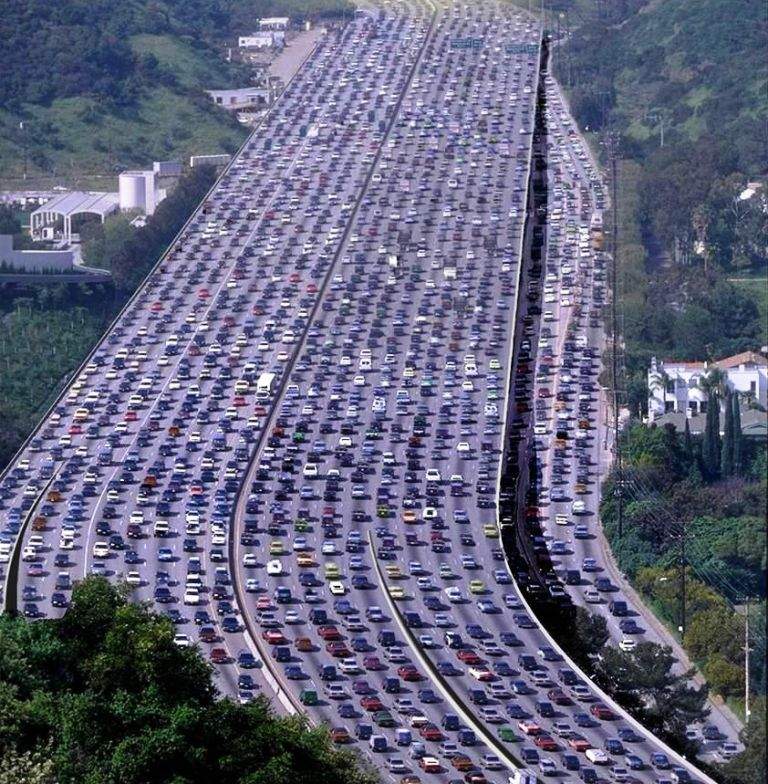
Some of the main contributors of greenhouse gases to the atmosphere from current society are cement making, paving the landscape and emissions from motor vehicle driving.
Last week,the Wisconsin Legislature’s Joint Finance Committee approved borrowing an additional $350 million to be paid later to put five major highway capacity expansion projects back on the schedule for road and bridge construction. The 5 major projects in Wisconsin include the following:
* the roadwork along Madison’s Beltline, Highway 12-18, at the Verona Road interchange;
* I-39/90 from the Illinois state line to Madison;
* Highway 10/441 in the Fox Valley;
* Highway 23 between Fond du Lac and Plymouth;
* Highway 15 near New London in Outagamie County.
Project completion dates for those project have been put off by two years, due to the lack of funds in the current Wisconsin state budget. The Wisconsin Department of Transportation (DOT) has already contracted for the start of work on these projects but because of the funding shortfall, the completion date for the projects was pushed later into the future.
The five major highway capacity projects are located throughout Wisconsin and their completion dates will be delayed pending full approval by the Wisconsin Legislature’s of the JFC’s ruling in a revised state budget signed by Governor Scott Walker. The bonding approval means the five projects will face delays of one year instead of two.
Meanwhile, the state of North Carolina and the Federal Highway Administration are reconsidering the widening an interstate highway through west Asheville to eight lanes. Highway builders want to complete the “missing link” of Interstate 26 running from Tennessee to Charleston. That missing link is actually already an interstate: I-240, built right though some of Asheville’s urban neighborhoods during the urban renewal era. The highway was a major dividing line between some of the black neighborhoods in west Asheville and some more affluent white neighborhoods.

Problem is, FHWA refuses to just rename it I-26 because the highway doesn’t meet some of the modern interstate standards. The DOT is exploring its options for a $600 million widening and “upgrade.”
The state recently released its draft environmental impact statement. The document seems to favor a design that would widen the highway from four lanes to eight — a plan many local residents say is unnecessary and potentially damaging. Last year, the U.S. Public Interest Research group named the project one of its top “highway boondoggles.”
Groups such as “Mountain True”, the Asheville Design Center and a number of community groups had been pushing for a more city-friendly approach. They wanted a design that would preserve urban land for development, minimize air pollution, and provide additional multi-modal connections for neighborhood residents.
“I keep seeing this stuff from U.S. DOT about ‘beyond traffic’ and moving beyond the old paradigm but we’re sort of having the old paradigm forced on us in Asheville”, said Don Kostelec, a local advocate and independent planner skeptical of the project.
Alternative to Verona Road/Beltline Highway Expansion
Obama and Nebraska Residents, Assisted by Neil Young and Willie Nelson, Reject Keystone Tar Sands Crude Oil Pipeline

By New York Times Writer Chas Danner
Nov. 9, 2015
Following a seven-year stint in political and regulatory purgatory, the Keystone XL project finally met its end last week when President Obama, eyeing the upcoming U.N. climate talks in Paris, formally rejected TransCanada’s request to build the cross-border oil pipeline. Climate activists [with help from two longtime progressive American artists/musicians who didn’t really need the exposure – Neil Young and Willie Nelson and who also opposed the plan] are celebrating their victory and already attempting to parlay the momentum into more wins. Proponents of the pipeline — a group that at this point consists mainly of Republicans and Republican presidential candidates, energy-industry lobbyists, and some labor unions who were looking forward to tens of thousands of temporary construction jobs — are decrying Obama’s decision and writing the whole thing off as a hallmark of irresponsible political capitulation….
Meanwhile, Bill McKibben, one of the central leaders of the anti-KXL fight, writes in The New Yorker that he now believes he and his allies, because of their new tactics, finally have fossil-fuel companies on the defensive:
[T]he Keystone rallying cry [has] quickly spread to protests against other fossil-fuel projects. One industry executive summed it up nicely this spring, when he told a conference of his peers that they had to figure out how to stop the “Keystone-ization” of all their plans. … [And] this fall, the governor of the Bank of England, Mark Carney, speaking to members of the insurance industry at Lloyds of London, used [“leave it in the ground“] language to tell them that they faced a “huge risk” from “unburnable carbon” that would become “stranded assets.” No one’s argued with the math, and that math indicates that the business plans of the fossil-fuel giants are no longer sane. Word is spreading: portfolios and endowments worth a total of $2.6 trillion in assets have begun to divest from fossil fuels. The smart money is heading elsewhere.
We won’t close that gap between politics and physics at the global climate talks next month in Paris. […] In many ways, the developments of the past two days are more important than any pledges and promises for the future, because they show the ways in which political and economic power has already started to shift. If we can accelerate that shift, we have a chance. It’s impossible, in the hottest year that humans have ever measured, to feel optimistic. But it’s also impossible to miss the real shift in this battle. [End of Danner text]
The nearly 1,200-mile (2,000-km) pipeline would carry 830,000 barrels a day of mostly Canadian oil sands crude to Nebraska en route to refineries and ports along the U.S. Gulf Coast.
Read more at Reutershttp://www.reuters.com/article/2015/11/05/us-transcanada-keystone-state-idUSKCN0ST2VX20151105#PXYjkPeuAjeDlY1G.99However, Enbridge Company pipeline projects permitted by Wisconsin Governor Scott Walker’s Department of Natural Resources, are planning on pumping 1.2 million barrels of tar sands crude across Wisconsin for processing into gasoline, diesel fuel and jet fuel, soon, and are planning on pumping another 600 million barrels of tar sands crude oil through a second parallel pipe from Alberta to Illinois in the not too distant future. Burning that much fuel will certainly add to the planet’s global warming troubles, probably sooner than most of us earthlings burning all those fossil fuels had anticipated.
Also see: Obama Urged to reject Keystone XL
NOAA: 2015 Global Average Temperatures for Oceans and Land Highest on Record for September and January–September


The National Oceanic and Atmospheric Administration (NOAA) reports that the September average temperature across global land and ocean surfaces was 1.62°F (0.90°C) above the 20th century average, and that this was the highest September temperature on record, surpassing the previous record set last year by +0.12°F (+0.19°C).
September’s high temperature was also the greatest rise above average for any month in the 136-year historical record, surpassing the previous record set in both February and March this year by 0.02°F (0.01°C), NOAA states.
The September globally-averaged land surface temperature was 2.09°F (1.16°C) above the 20th century average which was also the highest for September in the 1880–2015 record, surpassing the previous record set in 2009 by +0.16°F (+0.09°C), according to NOAA. Record warmth was observed across much of South America and parts of Africa, the Middle East, Europe, and Asia.
The September globally-averaged sea surface temperature was 1.46°F (0.81°C) above the 20th century average, which was the highest temperature for September in the 1880–2015 record, surpassing the previous record set in 2014 by +0.13°F (+0.07°C), NOAA reports.
The year-to-date temperature across global land and ocean surfaces was 1.53°F (0.85°C) above the 20th century average, which was the highest for January–September in the 1880–2015 record, surpassing the previous record set in 2014 by 0.19°F (0.12°C).
The year-to-date globally-averaged land surface temperature was also the highest for January–September in the 1880–2015 record at 2.32°F (1.29°C) above the 20th century average, surpassing the previous record of 2007 by 0.31°F (0.17°C).
The year-to-date globally-averaged sea surface temperature was 1.24°F (0.69°C) above the 20th century average and the highest for January–September in the 1880–2015 record, surpassing the previous record of 2010 by +0.11°F (+0.06°C).
President Obama’s Speech at the GLACIER Conference, Anchorage, Alaska
The full text of his speech to the Glacier Conference on 1 September 2015 follows:
I want to thank the people of Alaska for hosting this conference. I look forward to visiting more of Alaska over the next couple of days. The United States is, of course, an Arctic nation. And even if this isn’t an official gathering of the Arctic Council, the United States is proud to chair the Arctic Council for the next two years. And to all the foreign dignitaries who are here, I want to be very clear — we are eager to work with your nations on the unique opportunities that the Arctic presents and the unique challenges that it faces. We are not going to — any of us — be able to solve these challenges by ourselves. We can only solve them together.
Of course, we’re here today to discuss a challenge that will define the contours of this century more dramatically than any other — and that’s the urgent and growing threat of a changing climate.
Our understanding of climate change advances each day. Human activity is disrupting the climate, in many ways faster than we previously thought. The science is stark. It is sharpening. It proves that this once-distant threat is now very much in the present.
In fact, the Arctic is the leading edge of climate change — our leading indicator of what the entire planet faces. Arctic temperatures are rising about twice as fast as the global average. Over the past 60 years, Alaska has warmed about twice as fast as the rest of the United States. Last year was Alaska’s warmest year on record — just as it was for the rest of the world. And the impacts here are very real.
Thawing permafrost destabilizes the earth on which 100,000 Alaskans live, threatening homes, damaging transportation and energy infrastructure, which could cost billions of dollars to fix.
Warmer, more acidic oceans and rivers, and the migration of entire species, threatens the livelihoods of indigenous peoples, and local economies dependent on fishing and tourism. Reduced sea levels leaves villages unprotected from floods and storm surges. Some are in imminent danger; some will have to relocate entirely. In fact, Alaska has some of the swiftest shoreline erosion rates in the world.
I recall what one Alaska Native told me at the White House a few years ago. He said, “Many of our villages are ready to slide off into the waters of Alaska, and in some cases, there will be absolutely no hope -– we will need to move many villages.”
Alaska’s fire season is now more than a month longer than it was in 1950. At one point this summer, more than 300 wildfires were burning at once. Southeast of here, in our Pacific Northwest, even the rainforest is on fire. More than 5 million acres in Alaska have already been scorched by fire this year — that’s an area about the size of Massachusetts. If you add the fires across Canada and Siberia, we’re talking 300 [30] million acres -– an area about the size of New York.
This is a threat to many communities — but it’s also an immediate and ongoing threat to the men and women who put their lives on the line to protect ours. Less than two weeks ago, three highly trained firefighters lost their lives fighting a fire in Washington State. Another has been in critical condition. We are thankful to each and every firefighter for their heroism — including the Canadian firefighters who’ve helped fight the fires in this state.
But the point is that climate change is no longer some far-off problem. It is happening here. It is happening now. Climate change is already disrupting our agriculture and ecosystems, our water and food supplies, our energy, our infrastructure, human health, human safety — now. Today. And climate change is a trend that affects all trends — economic trends, security trends. Everything will be impacted. And it becomes more dramatic with each passing year.
Already it’s changing the way Alaskans live. And considering the Arctic’s unique role in influencing the global climate, it will accelerate changes to the way that we all live.
Since 1979, the summer sea ice in the Arctic has decreased by more than 40 percent — a decrease that has dramatically accelerated over the past two decades. One new study estimates that Alaska’s glaciers alone lose about 75 gigatons — that’s 75 billion tons — of ice each year.
To put that in perspective, one scientist described a gigaton of ice as a block the size of the National Mall in Washington — from Congress all the way to the Lincoln Memorial, four times as tall as the Washington Monument. Now imagine 75 of those ice blocks. That’s what Alaska’s glaciers alone lose each year. The pace of melting is only getting faster. It’s now twice what it was between 1950 and 2000 — twice as fast as it was just a little over a decade ago. And it’s one of the reasons why sea levels rose by about eight inches over the last century, and why they’re projected to rise another one to four feet this century.
Consider, as well, that many of the fires burning today are actually burning through the permafrost in the Arctic. So this permafrost stores massive amounts of carbon. When the permafrost is no longer permanent, when it thaws or burns, these gases are released into our atmosphere over time, and that could mean that the Arctic may become a new source of emissions that further accelerates global warming.
So if we do nothing, temperatures in Alaska are projected to rise between six and 12 degrees by the end of the century, triggering more melting, more fires, more thawing of the permafrost, a negative feedback loop, a cycle — warming leading to more warming — that we do not want to be a part of.
And the fact is that climate is changing faster than our efforts to address it. That, ladies and gentlemen, must change. We’re not acting fast enough.
I’ve come here today, as the leader of the world’s largest economy and its second largest emitter, to say that the United States recognizes our role in creating this problem, and we embrace our responsibility to help solve it. And I believe we can solve it. That’s the good news. Even if we cannot reverse the damage that we’ve already caused, we have the means — the scientific imagination and technological innovation — to avoid irreparable harm.
We know this because last year, for the first time in our history, the global economy grew and global carbon emissions stayed flat. So we’re making progress; we’re just not making it fast enough.
Here in the United States, we’re trying to do our part. Since I took office six and a half years ago, the United States has made ambitious investments in clean energy, and ambitious reductions in our carbon emissions. We now harness three times as much electricity from wind and 20 times as much from the sun. Alaskans now lead the world in the development of hybrid wind energy systems from remote grids, and it’s expanding its solar and biomass resources.
We’ve invested in energy efficiency in every imaginable way — in our buildings, our cars, our trucks, our homes, even the appliances inside them. We’re saving consumers billions of dollars along the way. Here in Alaska, more than 15,000 homeowners have cut their energy bills by 30 percent on average. That collectively saves Alaskans more than $50 million each year. We’ve helped communities build climate-resilient infrastructure to prepare for the impacts of climate change that we can no longer prevent.
Earlier this month, I announced the first set of nationwide standards to end the limitless dumping of carbon pollution from our power plants. It’s the single most important step America has ever taken on climate change. And over the course of the coming days, I intend to speak more about the particular challenges facing Alaska and the United States as an Arctic power, and I intend to announce new measures to address them.
So we are working hard to do our part to meet this challenge. And in doing so, we’re proving that there doesn’t have to be a conflict between a sound environment and strong economic growth. But we’re not moving fast enough. None of the nations represented here are moving fast enough.
And let’s be honest — there’s always been an argument against taking action. The notion is somehow this will curb our economic growth. And at a time when people are anxious about the economy, that’s an argument oftentimes for inaction. We don’t want our lifestyles disrupted. In countries where there remains significant poverty, including here in the United States, the notion is, can we really afford to prioritize this issue. The irony, of course, is, is that few things will disrupt our lives as profoundly as climate change. Few things can have as negative an impact on our economy as climate change.
On the other hand, technology has now advanced to the point where any economic disruption from transitioning to a cleaner, more efficient economy is shrinking by the day. Clean energy and energy efficiency aren’t just proving cost-effective, but also cost-saving. The unit costs of things like solar are coming down rapidly. But we’re still underinvesting in it.
Many of America’s biggest businesses recognize the opportunities and are seizing them. They’re choosing a new route. And a growing number of American homeowners are choosing to go solar every day. It works. All told, America’s economy has grown more than 60 percent over the last 20 years, but our carbon emissions are roughly back to where they were 20 years ago. So we know how to use less dirty fuel and grow our economy at the same time. But we’re not moving fast enough.
More Americans every day are doing their part, though. Thanks to their efforts, America will reach the emission target that I set six years ago. We’re going to reduce our carbon emissions in the range of 17 percent below 2005 levels by 2020. And that’s why, last year, I set a new target: America is going to reduce our emissions 26 to 28 percent below 2005 levels by 10 years from now.
And that was part of a historic joint announcement we made last year in Beijing. The United States will double the pace at which we cut our emissions, and China committed, for the first time, to limiting its emissions. Because the world’s two largest economies and two largest emitters came together, we’re now seeing other nations stepping up aggressively as well. And I’m determined to make sure American leadership continues to drive international action — because we can’t do this alone. Even America and China together cannot do this alone. Even all the countries represented around here cannot do this alone. We have to do it together.
This year, in Paris, has to be the year that the world finally reaches an agreement to protect the one planet that we’ve got while we still can.
So let me sum up. We know that human activity is changing the climate. That is beyond dispute. Everything else is politics if people are denying the facts of climate change. We can have a legitimate debate about how we are going to address this problem; we cannot deny the science. We also know the devastating consequences if the current trend lines continue. That is not deniable. And we are going to have to do some adaptation, and we are going to have to help communities be resilient, because of these trend lines we are not going to be able to stop on a dime. We’re not going to be able to stop tomorrow.
But if those trend lines continue the way they are, there’s not going to be a nation on this Earth that’s not impacted negatively. People will suffer. Economies will suffer. Entire nations will find themselves under severe, severe problems. More drought; more floods; rising sea levels; greater migration; more refugees; more scarcity; more conflict.
That’s one path we can take. The other path is to embrace the human ingenuity that can do something about it. This is within our power. This is a solvable problem if we start now.
And we’re starting to see that enough consensus is being built internationally and within each of our own body politics that we may have the political will — finally — to get moving.
So the time to heed the critics and the cynics and the deniers is past. The time to plead ignorance is surely past. Those who want to ignore the science, they are increasingly alone. They’re on their own shrinking island. (Applause.)
And let’s remember, even beyond the climate benefits of pursuing cleaner energy sources and more resilient, energy-efficient ways of living, the byproduct of it is, is that we also make our air cleaner and safer for our children to breathe. We’re also making our economies more resilient to energy shocks on global markets. We’re also making our countries less reliant on unstable parts of the world. We are gradually powering a planet on its way to 9 billion humans in a more sustainable way.
These are good things. This is not simply a danger to be avoided; this is an opportunity to be seized. But we have to keep going. We’re making a difference, but we have to keep going. We are not moving fast enough.
If we were to abandon our course of action, if we stop trying to build a clean-energy economy and reduce carbon pollution, if we do nothing to keep the glaciers from melting faster, and oceans from rising faster, and forests from burning faster, and storms from growing stronger, we will condemn our children to a planet beyond their capacity to repair: Submerged countries. Abandoned cities. Fields no longer growing. Indigenous peoples who can’t carry out traditions that stretch back millennia. Entire industries of people who can’t practice their livelihoods. Desperate refugees seeking the sanctuary of nations not their own. Political disruptions that could trigger multiple conflicts around the globe.
That’s not a future of strong economic growth. That is not a future where freedom and human rights are on the move. Any leader willing to take a gamble on a future like that — any
so-called leader who does not take this issue seriously or treats it like a joke — is not fit to lead.
On this issue, of all issues, there is such a thing as being too late. That moment is almost upon us. That’s why we’re here today. That’s what we have to convey to our people — tomorrow, and the next day, and the day after that. And that’s what we have to do when we meet in Paris later this year. It will not be easy. There are hard questions to answer. I am not trying to suggest that there are not going to be difficult transitions that we all have to make. But if we unite our highest aspirations, if we make our best efforts to protect this planet for future generations, we can solve this problem.
And when you leave this conference center, I hope you look around. I hope you have the chance to visit a glacier. Or just look out your airplane window as you depart, and take in the God-given majesty of this place. For those of you flying to other parts of the world, do it again when you’re flying over your home countries. Remind yourself that there will come a time when your grandkids — and mine, if I’m lucky enough to have some — they’ll want to see this. They’ll want to experience it, just as we’ve gotten to do in our own lives. They deserve to live lives free from fear, and want, and peril. And ask yourself, are you doing everything you can to protect it. Are we doing everything we can to make their lives safer, and more secure, and more prosperous?
Let’s prove that we care about them and their long-term futures, not just short-term political expediency.
I had a chance to meet with some Native peoples before I came in here, and they described for me villages that are slipping into the sea, and the changes that are taking place — changing migratory patterns; the changing fauna so that what used to feed the animals that they, in turn, would hunt or fish beginning to vanish. It’s urgent for them today. But that is the future for all of us if we don’t take care.
Your presence here today indicates your recognition of that. But it’s not enough just to have conferences. It’s not enough just to talk the talk. We’ve got to walk the walk. We’ve got work to do, and we’ve got to do it together.
So, thank you. And may God bless all of you, and your countries. And thank you, Alaska, for your wonderful hospitality. Thank you. (Applause.)
Stop Oil Development in Coastal Habitat

One oil spill or accident in Grays Harbor could wipe out a significant portion of the Red Knot population in the Pacific Flyway. Speak out against the development of oil terminals in Grays Harbor.
Critical coastal estuaries could face devastating consequences for birds if the oil industry is successful in expanding its operations in Grays Harbor in Washington state—a site visited by hundreds of thousands of migrating shorebirds every year. Three proposed new oil terminals would store roughly 91 million gallons of toxic crude, most of it for export to China. Our birds rely on this Pacific coast estuary to rest and refuel during migration. One oil spill would devastate this fragile marine ecosystem.
Write the Washington Department of Ecology and the City of Hoquiam today and tell them to reject the oil terminals.
Located on Washington’s outer coast, Grays Harbor is a critical spring migration stop-over site for Red Knots in the Pacific Flyway. A climate-endangered bird, the Red Knot uses the North Bay of Grays Harbor almost exclusively during the month of May to feed on rich marine food sources before flying non-stop to northwestern Alaska and Wrangel Island, Russia to nest and raise their young. One oil spill or accident could wipe out a significant portion of the Red Knot population in the Pacific Flyway.
Oil extraction, transport, and export across our country contributes to greenhouse gas emissions responsible for global warming. If the terminals are built, as much as 126,860 barrels of crude would arrive by train every day, another enormous source of risk. Oil trains have a bad safety record—in 2014 there were 141 oil train spills across the United States.
The deadline to speak out against two of the proposed terminals in Grays Harbor is October 29. Please add your voice in support of our birds. Tell the State of Washington that Grays Harbor is important to all of us who care about birds. We can’t afford to turn over our best coastal habitat to an industry that has shown it cannot prevent or contain oil spills. We’ve seen the devastating effects of oil spills in Alaska and the Gulf Coast—let’s keep that from happening in Washington.
Tell the Washington Department of Ecology and City of Hoquiam not to allow the development of oil terminals in Grays Harbor.
For your information and use, I am including a reproduction of the message I sent to the State of Washington’s Department of Ecology and the City of Hoquiam, Washington, on October 16, 2015, requesting that they NOT allow the development of the proposed crude oil terminals in Gray’s Harbor, Washington:
“Critical coastal estuaries could face devastating consequences for birds if the oil industry is successful in expanding its operations in Grays Harbor in Washington state–a site visited by hundreds of thousands of migrating shorebirds every year. Three proposed new oil terminals would store roughly 91 million gallons of toxic crude, most of it for export to China. Our birds rely on this Pacific coast estuary to rest and refuel during migration. One oil spill would devastate this fragile marine ecosystem.”
 All Things Environmental
Recent Comments