
Thanks to a Corporation-compliant Mass Media and Press in the United States: the American People, their Representatives in the Congress, and a Majority of State Legislatures and Governors in the U. S. Have Clearly Been Duped by the Many of the Fossil Fuel Dependent Industries and their Lobbyists into Not Taking Global Warming Seriously Enough

Hurricane Katrina, Late August, 2005
According to scientists who have studied and documented the causes and effects of changes in climates at various locations around the world, there has never been a time in Earth’s history during which climates around the world; ocean levels, temperatures, and chemistry; wildlife territorial changes and atmospheric properties have occurred so rapidly and so significantly as to create significant levels of concern to human the world over. The United Nations Intergovernmental Panel of Climate Change, made up of hundreds of the world’s most respected scientists predicts much more rapid global warming in the coming decades today if we humans collectively continue doing what we have done in the recent past – burning increased amounts of fossil fuels, destroying more and more forests in the name of economic “progress”, and we continue living “high on the hog” under the mantra of “business as usual”.
Volunteer host Esty Dinur of WORT-FM Community Radio Station in Madison, Wisconsin talked with climatologist Michael E. Mann and journalist John H. Richardson on the station’s “A Public Affair” Friday, August 21, 2015, from noon to 1:00 PM.
Dr. Michael E. Mann is Distinguished Professor of Meteorology at Penn State University, with joint appointments in the Department of Geosciences and the Earth and Environmental Systems Institute, and is the director of the Penn State Earth System Science Center. He is also the author of more than 180 peer reviewed and edited publications, and has published two books including Dire Predictions: Understanding Global Warming and The Hockey Stick and the Climate Wars: Dispatches from the Front Lines. He is also a co-founder of the award-winning science website RealClimate.org.
John H. Richardson is a writer and journalist for Esquire Magazine. He has also worked with The Albuquerque Tribune, The Los Angeles Daily News, Premiere Magazine, New York Magazine. He has taught at the Columbia University, the University of New Mexico, and Purchase College. He recently published an article in Esquire Magazine that looks into numerous climatologists’ research and the backlash that they received from various climate change “deniers”.
Today’s politicians in the U.S. Congress, State Legislators and governors’ offices who have continued to downplay the significance of global warming and excessive fossil fuel burning despite what has now become eminent, regrettably, deserve outright shaming, especially by children and those yet to be born into the world of global warming, climate havoc, disruption of plant and animal life, and global economic instability, overpopulation and extinction.
Listen to the entire 1-hour program.
When the End of Human Civilization Is Your Day Job
Among many climate scientists, gloom has set in. Things are worse than we think, but they can’t really talk about it.
Message to Obama on Fighting Poverty and Global Warming

Fight Poverty and Global Warming at the Same Time
I sent the following message to President Obama using Greenpeace’s petition letter as a template on Monday, August 17, 2015:
Dear President Obama,
You have declared that “No challenge poses a greater threat to future generations than climate change” and showed leadership in vetoing the Keystone XL pipeline bill. Why then, would you allow Shell to drill in Arctic waters after a Nature study declared that Arctic Oil MUST be kept in the ground to prevent catastrophic climate change?
One solution that has not been paid enough attention to is to reduce the demand for oil by offering the American public financial incentives to annually drive less (miles); avoid flying entirely, and reduce the amount of electricity they use annually in their homes. This proposal would benefit those who don’t add to the greenhouse gas burden on the atmosphere and oceans and cause other forms of pollution related to fossil fuel burning (including the need to drill and ship oil from the Arctic), who are often those in our society who need supplemental income the most to get out of poverty. Make it pay not to pollute! Right now, too many Americans are using the atmosphere as a “free” sewer to deposit their emissions from excessive burning of fossil fuels, often for recreational travel or other forms of entertainment (travel to “away” sporting events …). See proposal at http://www.allthingsenvironmental.com for more information.
Arctic oil must be left in the ground in order to avoid the catastrophic effects of climate change. The risks are simply too great to allow drilling in this fragile and important ecosystem.
See NASA’s “Vital Signs of the Planet”.
Obama Administration Attacks Leaks and Methane Gas Emissions from Oil Wells

The Obama administration on Tuesday proposed the first federal regulations requiring the nation’s oil and gas industry to cut emissions of wasted methane gas as part of an expanding and increasingly aggressive effort to combat climate change.
In a conference call with reporters, Janet McCabe, the Environmental Protection Agency’s acting assistant administrator for the Office of Air and Radiation, said the rules were designed to ensure that oil and gas companies reduced waste and sold more natural gas that would otherwise be lost, while protecting the climate and the health of the public. Natural gas and methane are actually one and the same gas; methane is commonly called natural gas when it is captured and burned for energy, generating carbon dioxide (CO2) emissions as the primary byproduct. When the methane gas is allowed to escape into the atmosphere unburned, it has a much stronger potential to increase the greenhouse gas effect of the atmosphere than the release of an equal amount of CO2 gas.
Ms. McCabe estimated that the proposals — which would require drillers to stop leaks and capture lost gas even in wells intended to extract only oil — would cost the industry up to $420 million to carry out by 2025, but that there would be savings, including reduced waste, of as much as $550 million during that period, bringing a net benefit of as much as $150 million.
The new rules, which were widely expected, are part of a broad push by the Obama administration to cut emissions of planet-warming gases from different sectors of the economy. This month, Mr. Obama unveiled the centerpiece of that plan, a final regulation meant to cut emissions of carbon dioxide by 32 percent from 2005 levels by 2030 and increase to 28 percent the proportion of the nation’s electricity generated by renewable sources like solar and wind.
The administration has proposed rules for methane emissions because methane emissions released to the atmosphere are 25 times more powerful than carbon dioxide in trapping heat. The administration has set a goal of reducing methane emissions by 40 to 45 percent from 2012 levels by 2025.
The latest proposed regulations are expected to reduce methane emissions by 20 to 30 percent, Ms. McCabe said, getting the administration about halfway to its overall methane reduction target.
Oil and gas companies oppose the proposals, calling them unnecessary and costly, while environmental advocacy groups say they do not go far enough, because they apply mainly to new wells and not most existing ones that already leak methane gas.
Primary Source: The New York Times, August 18, 2015
Extremly High Temperatures Along with High DewPoint Temperatures Leading to Higher Death Tolls from Heat Waves

Climate change is literally killing us. According to the Natural Resources Defense Council’s [NRDC’s] “Killer Summer Heat” report, more than 150,000 Americans could die by the end of this century due to the excessive heat caused by climate change. And that estimate only covers America’s top 40 cities.
Why will climate change cause so many casualties? Illnesses that are caused or made worse by extreme heat — including heat exhaustion, heat stroke, cardiovascular disease, and kidney disease — currently lead to hundreds of deaths each year.
As carbon pollution continues to rise, the number of dangerously hot days each summer will increase even further, leading to a dramatic increase in the number of lives lost.
While everyone in these urban areas is at risk, children and the elderly are the most vulnerable.
Scientists expect that average temperatures in North America will rise by another 4°F -11°F this century. The risks to public health are greatest when high temperatures mix with other weather conditions to cause what’s known as an “Excessive Heat Event,” or EHE. EHE days occur when a location’s temperature, dew point temperature, cloud cover, wind speed and surface atmospheric pressure throughout the day combine to cause or contribute to heat-related deaths in that location. [NRDC]
Health impacts spike during excessive heat events. For example, when California was hit by deadly heat waves in 2006, the heat caused during a two-week period 655 deaths, 1,620 excess hospitalizations, and more than 16,000 additional emergency room visits, resulting in nearly $5.4 billion in costs. During a 1995 record-setting heat wave in Chicago, over 700 people died due to the excessive heat.
EHE days vary by region and location. Factors such as geography, green space, local warning and preventive measures affect how much impact the weather will actually have on health.
Climate change is one of the most fiercely debated scientific issues of the past 20 years. Although a steady contingent of global warming deniers have remained insistent that climate change does not pose a threat, there is an overwhelming consensus among the worldwide scientific community that our planet is undergoing significant, highly problematic shifts. Experts point to rising sea levels, record-breaking temperatures across the globe, declining air quality and erratic weather patterns as different manifestations of climate change. Today, doctors, nurses and other medical personnel are drawing attention to the negative effects on human health caused by an increasingly warm, more heavily polluted environment.
According to a 2009 article in Scientific American, a team of climate change researchers from the World Health Organization (WHO) found that “global warming is [responsible] for some 150,000 deaths each year around the world”; they feared this number would double by the year 2030.
Egypt is the latest country outside the U.S. reporting a deadly heat wave occurring this year. At least 93 people have died during a heat wave in Egypt this week that sent air temperatures soaring to as high as 115 degrees Fahrenheit in southern parts of the country, the nation’s official Middle East News Agency (MENA) reported Friday. With high temperatures in the forecast for this weekend, authorities fear the death toll from the high heat may continue to mount.
Earlier this summer, record heat wave death tolls were reported to have occurred in India and Pakistan. France reported hundreds of death from a severe heat wave that occurred in July from 11th to 28th. About 2,065 excess deaths occurred in France during that spell that were attributable to the extreme weather.
To limit the health impacts of climate change, we need to reduce carbon pollution from top sources like power plants and refineries. The EPA has taken its first big step toward setting limits for industrial carbon sources by proposing limits on carbon pollution from new power plants. EPA should take the next step by setting limits on carbon from other sources as well, a government at the federal, state and local level should adopt laws and programs that offer all members of the public positive financial incentives ($) for for burning fewer and fewer amounts of fossil fuels over the year. This would reduce further additions being added to the accumulating carbon dioxide and other greenhouse gases in the environment, which is increasing the potential for more severe and deadly heat waves around the planet.
Hottest July yet, 2015 on Track to be Hottest by Far, Thickest Arctic Sea Ice Gone

January through July 2015 is the hottest first 7 months on record by a large margin.
July 2015 was the warmest on record and 2015 though July 31 is the warmest year on record, NASA reports, and the heat of the developing intense El Nino has just begun to impact global temperatures.
Temperatures in the central and eastern equatorial Pacific ocean have risen rapidly over the past month starting a strong El Nino event which models predict will bring a much warmer than normal fall and winter to the northern hemisphere and strong warming as far south as Antarctica in the southern hemisphere. This July, very warm temperatures in the Canadian Arctic and the Arctic ocean north of Canada melted and crushed the thickest sea ice in the Arctic ocean. Thus, not only was it the warmest July on record, but the stage is set for the possible collapse of late summer Arctic sea ice over the next 2 years as the impacts of El Nino heat drive global and Arctic temperatures upward.
NOAA is now predicting that this El Nino may become the strongest El Nino on record. NOAA’s models predict that heat released in the Pacific will cause strong warming in the north Atlantic in winter to spring 2016 as far north as the Barents sea which is the entry to the Arctic ocean.
The surging temperatures of the first seven months of 2015 may be the beginning of a surge in global temperatures and changes in global weather patterns that will be intensified by a warmer, darker and wetter Arctic.
President Obama Gives Reasons Going to Arctic
President Obama:
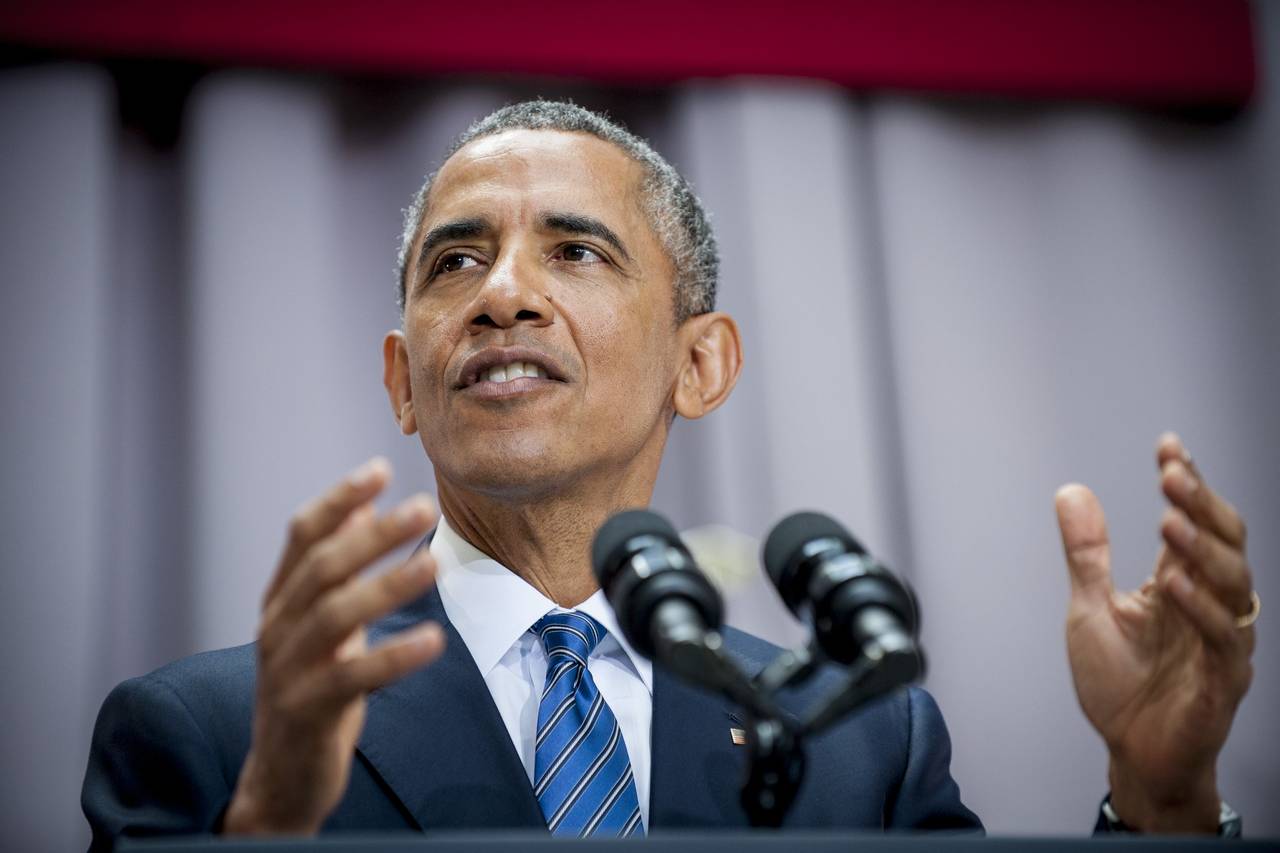
PHOTO: PETE MAROVICH/ZUMA PRESS
President Obama giving a speech at American University, August 5, Washington D.C..
Later this month, President Obama will travel to Alaska and shine a spotlight on what Alaskans in particular have come to know: Climate change is one of the biggest threats we face, it is being driven by human activity, and it is disrupting Americans’ lives right now. [White House]
Can A Global Warming Calamity Be Averted?

“Unless someone like you cares a whole awful lot,
Nothing is going to get better. It’s not.”
― Dr. Seuss, The Lorax
Global warming is often wrongly said to be a political issue. In fact, global warming is no more of a political issue than a tornado is a political issue, or an erupting volcano, or an earthquake or tsunami. These are factual occurrences that occur for known scientific reasons. As there is no debate on the existence or occurrence of these physical happenings nor should there be a need to debate the occurrence of human-caused global warming and climate change as these changes are, too, scientifically based and measured. In fact, sea level has already begun to rise from global warming, measurably. Migratory bird species are changing their patterns and timing of flight; temperature gradients for gardening around the world have changed; heat wave death tolls have risen; extreme weather has become more extreme; average monthly air temperatures at the surface have been steadily rising; dewpoint temperatures in the Midwest have exceeded precedence. Time is running out run out for acting responsibly to avert the worst outcomes possible from global warming. Alarm bells have rung. Action must be taken now, and on a grand scale, to prevent what scientists have been predicting for decades now – the catastrophic consequences of human fed global warming.
Longtime and well respected University of Wisconsin-Madison Chemistry Professor Bassam Shakhashiri recently summarized on Wisconsin Public Radio his own perceptions of the seriousness of the global warming threat and our collective responsibilities as citizens to work towards mitigating and adapting to this monumental threat as follows:
“We should have high expectation of all our government agencies and we should have high expectations of our elected officials and we should have high expectations of everyone who cares about the quality of life of where we live. We face grand challenges. Global warming is unequivocal. It’s not a matter of voting whether we will have global warming or not. It’s a matter of who we elect in the next election cycle to take responsible action to address and to solve this very, very serious and highly consequential question of climate change.
“We have elected officials from our state of Wisconsin who engage in conversations that label other people as deniers of climate change. I think it behooves us as learned individuals, as people who care about the quality of life that we have, to elect individuals to the U.S. Senate to the presidency, to our local government, who can take responsible action to mitigate and to address in responsible ways, and “responsible” is crucial, global warming. It’s not just local here. You can look at different displays of information. In the past 25 years, the plant hardening zones have been changing. Just in the past 25 years, the zone that we are in Wisconsin, is what it was 25 years ago in Florida. We have issues that relate to water quality. We have issues that relate to wellness, to health care.
“We have fabulous opportunities to make great progress in our society, and that’s why I have high expectations – always have high expectations – but I also live in the real world. We must, in the upcoming election cycle, be truly faithful to our core beliefs and to our values, so that our elected officials can act and can respond, in most good ways, to this one issue of climate change. There are other issues, too, but this is really a critical one.” [The Larry Meiller Show,Thursday, August 6, 2015, 11:00 am]
Global warming has all the marking of becoming a worldwide economic, environmental and human disaster. It could be a disaster that has no precedent in nature, at least during the time humans have been inhabiting Earth. Scientific models have demonstrated the inevitably of global warming due to our relentless burning of fossil fuels, in almost every device possible, and our continued deforestation practices, particularly in the tropics. Should global warming be allowed to continue at the current rates, the death toll from global warming effects could ultimately exceed the number of human losses from all wars, human atrocities, motor vehicle crashes, airplane crashes and worldwide epidemics.
History is repleat with examples of being “too little, too late”. U.S. President Hoover’s attempts to end the Great Depression by funding the construction of the Hoover Dam were believed by the American public as being “too little” to save the U.S. economy and “too late”. He was soundly defeated in the U.S. presidential election by Franklin Delano Roosevelt.
In medicine, if someone is sick and they do not get to a doctor until their sickness becomes fatal any remedy will be “too little, too late”.
The Obama administration’s Clean Power Plan to reduce global warming is also both too little and too late to prevent what scientists call a “runaway greenhouse effect”, as what happen on the planet Venus eons ago, making the planet’s former oceans of water boil away, due to surface atmospheric temperatures that continued to climb, unabated.
While the U.S. electrical energy power production may be the top emitting sector of greenhouse gases (GHGs) in the U.S. economy, timely and sufficiently large GHGs emissions reductions in the transportation and other GHG emitting sectors (construction industry sector, agriculture industry sector, consumer sector, export/import sectors, the military industrial complex) will nullify any gains made in the electricity production sector. This could leave the planet vulnerable for the positive GHG feedback mechanisms that contribute to more global warming to kick-in, which could cause a runaway greenhouse effect on Earth. Examples of positive feedback to more global warming of Earth include a reduced ability of the Arctic Ocean to reflect solar energy back into space (darker water absorbs more solar energy than snow and ice), causing additional heating of the oceans; melting of the permafrost region (1/5 of the earth’s surface) resulting in more methane gas (a much stronger GHG than carbon dioxide) production.
Albert Einstein once remarked: “We can’t solve problems by using the same kind of thinking we used when we created them.” Offering the public positive financial incentives to reduce actions that emit greenhouse gases, such as driving, flying and using fossil fuel created heat and electricity, could drastically reduce human caused climate change and as well as other problems created by our fossil fuel powered economy (such as oil spills, ground water pollution from petroleum waste, and natural gas explosions).
A Record 988 Billion Miles Driven on U.S. Highways During First Four Months of 2015
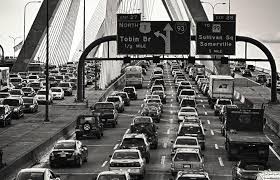
Data from the U.S. Federal Highway Administration show Americans drove a record 988 billion miles during the first four months of 2015. Motor gasoline consumption, which rose by 80,000 barrels per day in 2014, will increase by a projected 170,000 barrels per day (1.9%) in 2015 as the effects of employment growth and lower gasoline prices outweigh increases in vehicle fleet efficiency.
Lower prices along with higher rates of road traffic and more demand for larger vehicles continue to push gas consumption higher.
As refiners continue to produce at a near-record pace, U.S. gasoline stockpiles have declined. Gasoline stockpiles are down 10% since February.
Demand for automotive-grade gasoline increased to 9.17 million barrels (385.14 million gallons) per day, according to information from the Energy Information Administration (EIA).
The Energy Information Administration estimates that for each gallon of gasoline burned in an internal combustion engine, 19.564 pounds of carbon dioxide (CO2) are emitted to the atmosphere, as well as smaller amounts of nitrous oxide and other gases. This calculates to 7.7 billion pounds CO2 per day from U.S. drivers. Carbon dioxide remains in the atmosphere from year to year, building to higher and higher levels of concentration, which is known to be causing warmer temperatures at lower altitudes, warmer ocean surface temperatures. In Wisconsin, nightly low temperatures have increased the most, as reported by the Weather Guys.
Yet nationally, only 63% of U.S. citizens believe global warming is occurring!
Pope Urging the U.N. Take Very Strong Stand on Climate Change in Paris in December

In front of a Vatican-hosted conference of mayors from major world cities and governors, Pope Francis on Jul 21, 2015 urged the United Nations to take a “very strong stand” on climate change at a landmark summit this year in Paris on global warming.
The pope spoke at a Vatican-hosted conference of mayors and governors from major world cities who signed a declaration urging global leaders to take bold action at the U.N. summit, saying it may be the last chance to tackle human-induced global warming.
“I have a great hopes in the Paris summit,” he said. “I have great hopes that a fundamental agreement is reached. The United Nations needs to take a very strong stand on this.”
Last month, the pope issued an encyclical on climate change, the first ever dedicated to the environment. The call to his church’s 1.2 billion members could spur the world’s Catholics to lobby policymakers on ecology issues and climate change.
The Vatican conference linked climate change and modern slavery because, according to an introductory paper, “global warming is one of the causes of poverty and forced migration”.
Francis, speaking in unprepared comments in Spanish to the group at the end of the first day, said he hoped the Paris summit would address “particularly how it (climate change) affects the trafficking of people.”
The conference is the Vatican’s latest attempt to influence the Paris summit in December, the purpose of which is to reach a global agreement to combat climate change after past failures.
Mayors from South America, Africa, the United States, Europe and Asia signed a declaration stating that the Paris summit “may be the last effective opportunity to negotiate arrangements that keep human-induced warming below 2 degrees centigrade.”
Leaders should come to a “bold agreement that confines global warming to a limit safe for humanity while protecting the poor and the vulnerable…,” the declaration, which the pope also signed, reads.
High-income countries should help finance the cost of climate-change mitigation in low-income countries, it says.
In a rejection of so-called climate-change deniers, the declaration says: “Human-induced climate change is a scientific reality, and its effective control is a moral imperative for humanity.”
On Tuesday morning, California Governor Edmund “Jerry” Brown, whose state is suffering a severe drought, urged mayors to “fight the propaganda” of big business interests that deny that climate change is human induced.
“We have fierce opposition and blind inertia and that opposition is well-financed,” Brown said.
New York Mayor Bill de Blasio called Pope Francis “the most powerful voice on this earth for those whose voice is not being heard,” and added: “He did not convene us here to accept the status quo but to indict it”.
De Blasio announced that New York City would commit to reduce carbon emissions by 40 percent by 2030 on top of a previous commitment to reduced them by 80 percent by 2050.
Tony Chammany, the mayor of Kochi, India, said coastal areas were already feeling the effects of rising sea levels. “It is now or never, there may never be a replay,” he said.
Original by Philip Pullella
Reuters
Vatican Conference Linked Climate Change and Modern Slavery

Democracy Now:
Following the publication of Pope Francis’ encyclical on climate change, a major conference on climate change was held at the Vatican. Speakers included our guest, Naomi Klein, author of “This Changes Everything: Capitalism vs. the Climate.” We speak to Klein about her trip to the Vatican and the importance of the pope’s message – not only on climate change, but the global economy.
TRANSCRIPT
This is a rush transcript. Copy may not be in its final form.
AMY GOODMAN: Our guest is Naomi Klein, journalist, best-selling author. Her most recent book is This Changes Everything: Capitalism vs. the Climate, out today in paperback. A documentary film directed by Avi Lewis based on This Changes Everything will be released in the fall.
Naomi, you have recently returned from the Vatican. Can you describe that experience? What were you doing there?
NAOMI KLEIN: So I was there at a conference that was convened by Cardinal Peter Turkson. And Cardinal Peter Turkson is—has been doing a lot of the speaking on the encyclical. It wasn’t convened by Francis, just to set that record straight. It was convened by the Cardinal Turkson’s office and also by the organization representing Catholic development agencies. And it was part of the rollout for the climate change encyclical. The organizers described what they were doing as building a megaphone for the encyclical, because they understand that it’s words on a page unless there are groups of people around the world who are amplifying that message in various ways. So there were people from around the world.
There were people there, for instance, from Brazil, who were talking about how the movements there that have been fighting large dams, oil drilling, fighting for more just transit, are going to be putting huge resources behind popularizing the climate change encyclical, buying radio ads, producing videos, creating teaching materials for every chapter of the encyclical, and really using it as an organizing tool. That was one of the things I was really struck by while I was there, was just how ready particularly the movements in Latin America are to operationalize the encyclical, if you will.
And they also talked about not wanting it to be domesticated, was a phrase I heard a lot, domesticated by the church. You know, there’s a way in which you can just take this document that is, you know, almost 200 pages and just take out the safest parts of it—you know, “Oh, we’re against climate change, and we all need to kind of hold hands.” But, in fact, if you read the document, it’s very clear in calling for a different economic model, and it’s a challenge to what Pope Francis calls our throwaway culture. So they want to make sure that the parts of the encyclical that really do represent the deepest challenge to our current economic system and represent the most hope for the people who are excluded from the benefits of that economic system are really highlighted.
NERMEEN SHAIKH: Well, last month, Pope Francis went on a tour of South America in his first foreign trip after unveiling the historic encyclical urging climate action. In Ecuador, he reiterated his call for social justice and environmental preservation.
POPE FRANCIS: [translated] The goods of the Earth are meant for everyone. And however much someone may parade his property, it has a social mortgage. In this way, we move beyond purely economic justice, based on commerce, toward social justice, which upholds the fundamental human right to a dignified life. The tapping of natural resources, which are so abundant in Ecuador, must not be concerned with short-term benefits.
NERMEEN SHAIKH: That was Pope Francis speaking in Ecuador. Naomi Klein, could you talk—you’ve mentioned in the past the significance of the pope’s origins in Argentina and the particular form that Catholicism took in Latin America. Could you talk about the significance of that and the kind of turn that you witnessed at the Vatican in the focus of this new pope and the church under his leadership?
NAOMI KLEIN: Sure, Nermeen. Yeah, it was definitely striking that a lot of the people who are real players in the Vatican right now come from the Global South. As you mentioned, Pope Francis is from Argentina, and he is the first pope from the Global South. And Cardinal Turkson is originally from Ghana and is talked about as potentially going to be the first African pope. And you see the influence. There are a lot of people who have a history with liberation theology around this pope. He doesn’t come from that particular tradition, but there’s clearly an influence, because before he became pope, he worked with the Latin American Council of Bishops, which—you know, the form of Catholicism in Latin America is one that is more influenced by indigenous cosmology than perhaps in North America, and definitely in Europe, precisely because the genocide of indigenous people in Latin America was far less complete.
So, the first phrase of the encyclical, the first paragraph of the encyclical quotes Francis of Assisi, referring to the Earth as “sister” and as “mother,” and then goes on to talk about Francis—Francis of Assisi, not Pope Francis—and it’s significant that Pope Francis chose the name Francis, the first pope in history to choose that as his name—how we ministered to plants and animals, and saw them as his brothers and sisters. And obviously, in there, you have echoes of indigenous cosmologies that see all of creation as our relations. And while I was at the Vatican, I did ask and, before and afterwards, talked to different theologians about whether there is any precedent for a pope talking—using this language of Mother Earth so prominently, and nobody could think of a single example of this. So, I think what is significant about it is that it is very much a rebuke to the worldview that humans have been put on Earth to dominate and subjugate nature. That is very clear in the encyclical. And the major theme of the encyclical is the theme of interdependence.
You also mentioned—or you played that clip where Francis talks about natural resources as being something that everybody has a right to. And this, of course, is a challenge to a pretty basic principle of private property under capitalism, that if you buy it, it’s yours to do with whatever you want. And that’s something else that’s very strong in the encyclical, is the idea of the commons, that the atmosphere is a commons, that water is a right. And I do think that you can see the influence of Pope Francis’s many years in Argentina. You know, he ministered in the outskirts of Buenos Aires, and that’s somewhere where I spent some time doing reporting and filmmaking. And the outskirts of Buenos Aires, they have had one of the most catastrophic experiences with water privatization, where a French water company came in and put in the pipes, but then refused to put in the sewers. So every time it rains, there are these huge floods, and there’s even cases of bodies being washed up in the streets and in people’s basements, so—which is simply to say he knows of which he speaks. I mean, he has seen a very brutal form of deregulated capitalism introduced in the Southern Cone of Latin America, and he also understands that this is a form of capitalism that, in that part of the world, was imposed with tremendous violence.
AMY GOODMAN: Naomi Klein, as we wrap up, very quickly, the pope is coming to the United States in September, but before that, he will go to Cuba first. Can you talk about the significance of the Cuba trip, and then, within the presidential race here, the pope landing in the United States?
NAOMI KLEIN: Well, I think the timing of this trip is obviously going to be very awkward for several Republican candidates who are Catholic and understand that this is a very, very popular pope. He’s particularly popular among Latinos, and that’s a really coveted voting bloc. So, you know, picking a fight with this pope is not a very smart political move if you’re running for office right now.
And I met somebody while I was—I can’t use his name, because it was just—it wasn’t an interview situation. But I met a fairly prominent Catholic, while I was at the Vatican, from the United States, from a major U.S. organization, who said, “The holy father isn’t doing us any favors by going to Cuba first,” by which he meant that there are a lot of people talking about how this pope is sort of a closet socialist, and by going to Cuba first, he was reinforcing that narrative. So I think for conservative Republican Catholics, the fact that this pope is going to Cuba first, but also because he has said such critical things about deregulated capitalism and everything he’s saying about climate change, is putting them into, frankly, uncharted territories. They really don’t know how to navigate these waters.
AMY GOODMAN: It’s President Obama’s birthday today. Do you have any particular birthday wishes for him?
NAOMI KLEIN: Amy, I had no idea. Thanks for telling me. And I wish him a very happy birthday.
AMY GOODMAN: Naomi Klein, we want to thank you for being with us, journalist, best-selling author. Her most recent book is called This Changes Everything: Capitalism vs. the Climate. It’s out in paperback today. And she’s got a documentary film coming out. It’s directed by Avi Lewis, based on This Changes Everything. It’s out in the fall. She also, together with Avi Lewis, made The Take, about Argentina. Her past books, No Logo and The Shock Doctrine: The Rise of Disaster Capitalism.
 All Things Environmental
Recent Comments