
In U.N. Speech, Pope Francis Blasts “Selfish and Boundless Thirst for Power and Material Prosperity”
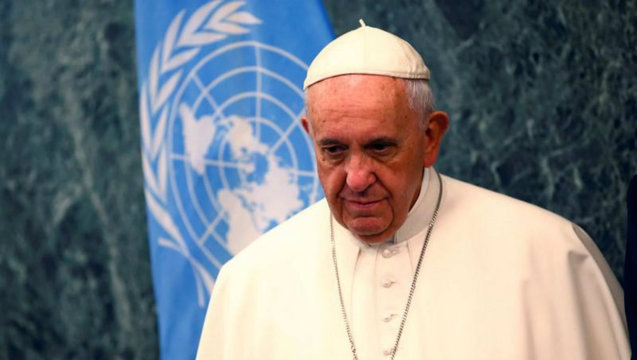
Speaking at the United Nations in New York City (NYC) today Friday, Pope Francis said: “Any harm done to the environment is harm done to humanity.” Moreover, he said: “Every creature has an intrinsic value, in its existence, its life, its beauty and its interdependence with other creatures.”
[Moreover] “We Christians, together with the other monotheistic religions, believe that the universe is the fruit of a loving decision by the Creator, who permits man respectfully to use creation for the good of his fellow men and for the glory of the Creator… he is not authorized to abuse it, much less to destroy it.”
[Furthermore] “In all religions, the environment is a fundamental good”, the pope said, adding that: [A] “selfish and boundless thirst for power and material prosperity leads both to the misuse of available natural resources and to the exclusion of the weak and disadvantaged” and that “the poorest are those who suffer most from such offenses, for three serious reasons: They are cast off by society, forced to live off what is discarded and suffer unjustly from the abuse of the environment.”
“They [the poor] are part of today’s widespread and quietly growing ‘culture of waste.'”, said Pope Francis, speaking in front of UN delegates present for his speech in NYC September 25, 2015.
Following is a transcript of the pope’s speech to the UN, compliments of Democracy NOW!:
Mr President, Ladies and Gentlemen,
Thank you for your kind words. Once again, following a tradition by which I feel honored, the Secretary General of the United Nations has invited the Pope to address this distinguished assembly of nations. In my own name, and that of the entire Catholic community, I wish to express to you, Mr Ban Ki-moon, my heartfelt gratitude. I greet the Heads of State and Heads of Government present, as well as the ambassadors, diplomats and political and technical officials accompanying them, the personnel of the United Nations engaged in this 70th Session of the General Assembly, the personnel of the various programs and agencies of the United Nations family, and all those who, in one way or another, take part in this meeting. Through you, I also greet the citizens of all the nations represented in this hall. I thank you, each and all, for your efforts in the service of mankind.
This is the fifth time that a Pope has visited the United Nations. I follow in the footsteps of my predecessors Paul VI, in1965, John Paul II, in 1979 and 1995, and my most recent predecessor, now Pope Emeritus Benedict XVI, in 2008. All of them expressed their great esteem for the Organization, which they considered the appropriate juridical and political response to this present moment of history, marked by our technical ability to overcome distances and frontiers and, apparently, to overcome all natural limits to the exercise of power. An essential response, inasmuch as technological power, in the hands of nationalistic or falsely universalist ideologies, is capable of perpetrating tremendous atrocities. I can only reiterate the appreciation expressed by my predecessors, in reaffirming the importance which the Catholic Church attaches to this Institution and the hope which she places in its activities.
The United Nations is presently celebrating its seventieth anniversary. The history of this organized community of states is one of important common achievements over a period of unusually fast-paced changes. Without claiming to be exhaustive, we can mention the codification and development of international law, the establishment of international norms regarding human rights, advances in humanitarian law, the resolution of numerous conflicts, operations of peace-keeping and reconciliation, and any number of other accomplishments in every area of international activity and endeavour. All these achievements are lights which help to dispel the darkness of the disorder caused by unrestrained ambitions and collective forms of selfishness. Certainly, many grave problems remain to be resolved, yet it is clear that, without all those interventions on the international level, mankind would not have been able to survive the unchecked use of its own possibilities. Every one of these political, juridical and technical advances is a path towards attaining the ideal of human fraternity and a means for its greater realization.
For this reason I pay homage to all those men and women whose loyalty and self-sacrifice have benefited humanity as a whole in these past seventy years. In particular, I would recall today those who gave their lives for peace and reconciliation among peoples, from Dag Hammarskjöld to the many United Nations officials at every level who have been killed in the course of humanitarian missions, and missions of peace and reconciliation.
Beyond these achievements, the experience of the past seventy years has made it clear that reform and adaptation to the times is always necessary in the pursuit of the ultimate goal of granting all countries, without exception, a share in, and a genuine and equitable influence on, decision-making processes. The need for greater equity is especially true in the case of those bodies with effective executive capability, such as the Security Council, the Financial Agencies and the groups or mechanisms specifically created to deal with economic crises. This will help limit every kind of abuse or usury, especially where developing countries are concerned. The International Financial Agencies are should care for the sustainable development of countries and should ensure that they are not subjected to oppressive lending systems which, far from promoting progress, subject people to mechanisms which generate greater poverty, exclusion and dependence.
The work of the United Nations, according to the principles set forth in the Preamble and the first Articles of its founding Charter, can be seen as the development and promotion of the rule of law, based on the realization that justice is an essential condition for achieving the ideal of universal fraternity. In this context, it is helpful to recall that the limitation of power is an idea implicit in the concept of law itself. To give to each his own, to cite the classic definition of justice, means that no human individual or group can consider itself absolute, permitted to bypass the dignity and the rights of other individuals or their social groupings. The effective distribution of power (political, economic, defense-related, technological, etc.) among a plurality of subjects, and the creation of a juridical system for regulating claims and interests, are one concrete way of limiting power. Yet today’s world presents us with many false rights and – at the same time – broad sectors which are vulnerable, victims of power badly exercised: for example, the natural environment and the vast ranks of the excluded. These sectors are closely interconnected and made increasingly fragile by dominant political and economic relationships. That is why their rights must be forcefully affirmed, by working to protect the environment and by putting an end to exclusion.
First, it must be stated that a true “right of the environment” does exist, for two reasons. First, because we human beings are part of the environment. We live in communion with it, since the environment itself entails ethical limits which human activity must acknowledge and respect. Man, for all his remarkable gifts, which “are signs of a uniqueness which transcends the spheres of physics and biology” (Laudato Si’, 81), is at the same time a part of these spheres. He possesses a body shaped by physical, chemical and biological elements, and can only survive and develop if the ecological environment is favorable. Any harm done to the environment, therefore, is harm done to humanity. Second, because every creature, particularly a living creature, has an intrinsic value, in its existence, its life, its beauty and its interdependence with other creatures. We Christians, together with the other monotheistic religions, believe that the universe is the fruit of a loving decision by the Creator, who permits man respectfully to use creation for the good of his fellow men and for the glory of the Creator; he is not authorized to abuse it, much less to destroy it. In all religions, the environment is a fundamental good (cf. ibid.).
The misuse and destruction of the environment are also accompanied by a relentless process of exclusion. In effect, a selfish and boundless thirst for power and material prosperity leads both to the misuse of available natural resources and to the exclusion of the weak and disadvantaged, either because they are differently abled (handicapped), or because they lack adequate information and technical expertise, or are incapable of decisive political action. Economic and social exclusion is a complete denial of human fraternity and a grave offense against human rights and the environment. The poorest are those who suffer most from such offenses, for three serious reasons: they are cast off by society, forced to live off what is discarded and suffer unjustly from the abuse of the environment. They are part of today’s widespread and quietly growing “culture of waste”.
The dramatic reality this whole situation of exclusion and inequality, with its evident effects, has led me, in union with the entire Christian people and many others, to take stock of my grave responsibility in this regard and to speak out, together with all those who are seeking urgently-needed and effective solutions. The adoption of the 2030 Agenda for Sustainable Development at the World Summit, which opens today, is an important sign of hope. I am similarly confident that the Paris Conference on Climatic Change will secure fundamental and effective agreements.
Solemn commitments, however, are not enough, even though they are a necessary step toward solutions. The classic definition of justice which I mentioned earlier contains as one of its essential elements a constant and perpetual will: Iustitia est constans et perpetua voluntas ius sum cuique tribuendi. Our world demands of all government leaders a will which is effective, practical and constant, concrete steps and immediate measures for preserving and improving the natural environment and thus putting an end as quickly as possible to the phenomenon of social and economic exclusion, with its baneful consequences: human trafficking, the marketing of human organs and tissues, the sexual exploitation of boys and girls, slave labor, including prostitution, the drug and weapons trade, terrorism and international organized crime. Such is the magnitude of these situations and their toll in innocent lives, that we must avoid every temptation to fall into a declarationist nominalism which would assuage our consciences. We need to ensure that our institutions are truly effective in the struggle against all these scourges.
The number and complexity of the problems require that we possess technical instruments of verification. But this involves two risks. We can rest content with the bureaucratic exercise of drawing up long lists of good proposals – goals, objectives and statistical indicators – or we can think that a single theoretical and aprioristic solution will provide an answer to all the challenges. It must never be forgotten that political and economic activity is only effective when it is understood as a prudential activity, guided by a perennial concept of justice and constantly conscious of the fact that, above and beyond our plans and programmes, we are dealing with real men and women who live, struggle and suffer, and are often forced to live in great poverty, deprived of all rights.
To enable these real men and women to escape from extreme poverty, we must allow them to be dignified agents of their own destiny. Integral human development and the full exercise of human dignity cannot be imposed. They must be built up and allowed to unfold for each individual, for every family, in communion with others, and in a right relationship with all those areas in which human social life develops – friends, communities, towns and cities, schools, businesses and unions, provinces, nations, etc. This presupposes and requires the right to education – also for girls (excluded in certain places) – which is ensured first and foremost by respecting and reinforcing the primary right of the family to educate its children, as well as the right of churches and social groups to support and assist families in the education of their children. Education conceived in this way is the basis for the implementation of the 2030 Agenda and for reclaiming the environment.
At the same time, government leaders must do everything possible to ensure that all can have the minimum spiritual and material means needed to live in dignity and to create and support a family, which is the primary cell of any social development. In practical terms, this absolute minimum has three names: lodging, labor, and land; and one spiritual name: spiritual freedom, which includes religious freedom, the right to education and other civil rights.
For all this, the simplest and best measure and indicator of the implementation of the new Agenda for development will be effective, practical and immediate access, on the part of all, to essential material and spiritual goods: housing, dignified and properly remunerated employment, adequate food and drinking water; religious freedom and, more generally, spiritual freedom and education. These pillars of integral human development have a common foundation, which is the right to life and, more generally, what we could call the right to existence of human nature itself.
The ecological crisis, and the large-scale destruction of biodiversity, can threaten the very existence of the human species. The baneful consequences of an irresponsible mismanagement of the global economy, guided only by ambition for wealth and power, must serve as a summons to a forthright reflection on man: “man is not only a freedom which he creates for himself. Man does not create himself. He is spirit and will, but also nature” (BENEDICT XVI, Address to the Bundestag, 22 September 2011, cited in Laudato Si’, 6). Creation is compromised “where we ourselves have the final word… The misuse of creation begins when we no longer recognize any instance above ourselves, when we see nothing else but ourselves” (ID. Address to the Clergy of the Diocese of Bolzano-Bressanone, 6 August 2008, cited ibid.). Consequently, the defense of the environment and the fight against exclusion demand that we recognize a moral law written into human nature itself, one which includes the natural difference between man and woman (cf. Laudato Si’, 155), and absolute respect for life in all its stages and dimensions (cf. ibid., 123, 136).
Without the recognition of certain incontestable natural ethical limits and without the immediate implementation of those pillars of integral human development, the ideal of “saving succeeding generations from the scourge of war” (Charter of the United Nations, Preamble), and “promoting social progress and better standards of life in larger freedom” (ibid.), risks becoming an unattainable illusion, or, even worse, idle chatter which serves as a cover for all kinds of abuse and corruption, or for carrying out an ideological colonization by the imposition of anomalous models and lifestyles which are alien to people’s identity and, in the end, irresponsible.
War is the negation of all rights and a dramatic assault on the environment. If we want true integral human development for all, we must work tirelessly to avoid war between nations and between peoples.
To this end, there is a need to ensure the uncontested rule of law and tireless recourse to negotiation, mediation and arbitration, as proposed by the Charter of the United Nations, which constitutes truly a fundamental juridical norm. The experience of these seventy years since the founding of the United Nations in general, and in particular the experience of these first fifteen years of the third millennium, reveal both the effectiveness of the full application of international norms and the ineffectiveness of their lack of enforcement. When the Charter of the United Nations is respected and applied with transparency and sincerity, and without ulterior motives, as an obligatory reference point of justice and not as a means of masking spurious intentions, peaceful results will be obtained. When, on the other hand, the norm is considered simply as an instrument to be used whenever it proves favorable, and to be avoided when it is not, a true Pandora’s box is opened, releasing uncontrollable forces which gravely harm defenseless populations, the cultural milieu and even the biological environment.
The Preamble and the first Article of the Charter of the United Nations set forth the foundations of the international juridical framework: peace, the pacific solution of disputes and the development of friendly relations between the nations. Strongly opposed to such statements, and in practice denying them, is the constant tendency to the proliferation of arms, especially weapons of mass distraction, such as nuclear weapons. An ethics and a law based on the threat of mutual destruction – and possibly the destruction of all mankind – are self-contradictory and an affront to the entire framework of the United Nations, which would end up as “nations united by fear and distrust”. There is urgent need to work for a world free of nuclear weapons, in full application of the non-proliferation Treaty, in letter and spirit, with the goal of a complete prohibition of these weapons.
The recent agreement reached on the nuclear question in a sensitive region of Asia and the Middle East is proof of the potential of political good will and of law, exercised with sincerity, patience and constancy. I express my hope that this agreement will be lasting and efficacious, and bring forth the desired fruits with the cooperation of all the parties involved.
In this sense, hard evidence is not lacking of the negative effects of military and political interventions which are not coordinated between members of the international community. For this reason, while regretting to have to do so, I must renew my repeated appeals regarding to the painful situation of the entire Middle East, North Africa and other African countries, where Christians, together with other cultural or ethnic groups, and even members of the majority religion who have no desire to be caught up in hatred and folly, have been forced to witness the destruction of their places of worship, their cultural and religious heritage, their houses and property, and have faced the alternative either of fleeing or of paying for their adhesion to good and to peace by their own lives, or by enslavement.
These realities should serve as a grave summons to an examination of conscience on the part of those charged with the conduct of international affairs. Not only in cases of religious or cultural persecution, but in every situation of conflict, as in Ukraine, Syria, Iraq, Libya, South Sudan and the Great Lakes region, real human beings take precedence over partisan interests, however legitimate the latter may be. In wars and conflicts there are individual persons, our brothers and sisters, men and women, young and old, boys and girls who weep, suffer and die. Human beings who are easily discarded when our only response is to draw up lists of problems, strategies and disagreements.
As I wrote in my letter to the Secretary-General of the United Nations on 9 August 2014, “the most basic understanding of human dignity compels the international community, particularly through the norms and mechanisms of international law, to do all that it can to stop and to prevent further systematic violence against ethnic and religious minorities” and to protect innocent peoples.
Along the same lines I would mention another kind of conflict which is not always so open, yet is silently killing millions of people. Another kind of war experienced by many of our societies as a result of the narcotics trade. A war which is taken for granted and poorly fought. Drug trafficking is by its very nature accompanied by trafficking in persons, money laundering, the arms trade, child exploitation and other forms of corruption. A corruption which has penetrated to different levels of social, political, military, artistic and religious life, and, in many cases, has given rise to a parallel structure which threatens the credibility of our institutions.
I began this speech recalling the visits of my predecessors. I would hope that my words will be taken above all as a continuation of the final words of the address of Pope Paul VI; although spoken almost exactly fifty years ago, they remain ever timely. “The hour has come when a pause, a moment of recollection, reflection, even of prayer, is absolutely needed so that we may think back over our common origin, our history, our common destiny. The appeal to the moral conscience of man has never been as necessary as it is today… For the danger comes neither from progress nor from science; if these are used well, they can help to solve a great number of the serious problems besetting mankind (Address to the United Nations Organization, 4 October 1965). Among other things, human genius, well applied, will surely help to meet the grave challenges of ecological deterioration and of exclusion. As Paul VI said: “The real danger comes from man, who has at his disposal ever more powerful instruments that are as well fitted to bring about ruin as they are to achieve lofty conquests” (ibid.).
The common home of all men and women must continue to rise on the foundations of a right understanding of universal fraternity and respect for the sacredness of every human life, of every man and every woman, the poor, the elderly, children, the infirm, the unborn, the unemployed, the abandoned, those considered disposable because they are only considered as part of a statistic. This common home of all men and women must also be built on the understanding of a certain sacredness of created nature.
Such understanding and respect call for a higher degree of wisdom, one which accepts transcendence, rejects the creation of an all-powerful elite, and recognizes that the full meaning of individual and collective life is found in selfless service to others and in the sage and respectful use of creation for the common good. To repeat the words of Paul VI, “the edifice of modern civilization has to be built on spiritual principles, for they are the only ones capable not only of supporting it, but of shedding light on it” (ibid.).
El Gaucho Martín Fierro, a classic of literature in my native land, says: “Brothers should stand by each other, because this is the first law; keep a true bond between you always, at every time – because if you fight among yourselves, you’ll be devoured by those outside”.
The contemporary world, so apparently connected, is experiencing a growing and steady social fragmentation, which places at risk “the foundations of social life” and consequently leads to “battles over conflicting interests” (Laudato Si’, 229).
The present time invites us to give priority to actions which generate new processes in society, so as to bear fruit in significant and positive historical events (cf. Evangelii Gaudium, 223). We cannot permit ourselves to postpone “certain agendas” for the future. The future demands of us critical and global decisions in the face of world-wide conflicts which increase the number of the excluded and those in need.
The praiseworthy international juridical framework of the United Nations Organization and of all its activities, like any other human endeavor, can be improved, yet it remains necessary; at the same time it can be the pledge of a secure and happy future for future generations. And so it will, if the representatives of the States can set aside partisan and ideological interests, and sincerely strive to serve the common good. I pray to Almighty God that this will be the case, and I assure you of my support and my prayers, and the support and prayers of all the faithful of the Catholic Church, that this Institution, all its member States, and each of its officials, will always render an effective service to mankind, a service respectful of diversity and capable of bringing out, for sake of the common good, the best in each people and in every individual.
Upon all of you, and the peoples you represent, I invoke the blessing of the Most High, and all peace and prosperity. Thank you.
Source: Democracy NOW!
One-year Anniversary of “Planet Earth: It Needs Our Help Now More Than Ever”, Broadcast on WORT-FM’s Public Access Hour on Labor Day 2014
Last year on Labor Day WORT-FM in Madison, Wisconsin I had the privilege of recording an hour of music and commentary on a subject I have researched for going on 16 years now: the likely effects of rising greenhouse gas concentrations in the atmosphere, in the oceans, on the landscape; in other words, our planet earth. Since other than president Obama, Pope Francis, the environmental community and the state of California are about the only ones talking seriously about starting to do something to head off what is certain to be catastrophic effects upon our planet and all its livings things in decades and centuries to come, it only seem appropriate to remind folks who would like to listen to the show again. Here it is. Planet Earth – It Needs Our Help More than Ever!
Touring Alaska last month to shine a spotlight on global warming, President Obama warned that “climate change is no longer some far-off problem. It is happening here; it is happening now. Climate change is already disrupting our agriculture and ecosystems, our water and food supplies, our energy, our infrastructure, human health, human safety. Now. Today.”
This wasn’t supposed to happen. In 2009, 114 countries signed the Copenhagen Accord, agreeing “to stabilize greenhouse gas concentration in the atmosphere at a level that would prevent dangerous anthropogenic interference with the climate system;” “recognizing the scientific view” that the increase in global temperature should be held to no more than 2 degrees Celsius” (3.6 degrees Fahrenheit) above the pre-industrial level; and promising greater “long-term cooperative action to combat climate change.”
Paradoxically, an accord that should have spurred the world to immediate action instead seemed to offer some breathing room. Two degrees was meant to be a ceiling, but repeated references to an internationally agreed-upon “threshold” led many people to believe that nothing really bad could happen below 2 degrees—or worse yet, that the number itself was negotiable. Perhaps the biggest failure of the Copenhagen Accord was its pact for “long-term” action. Forty years ago, climate change was a “long-term” problem. Today it’s an emergency.
As we’re coming ever so close to the dreaded 2-degree mark, which will have devastating effects especially on people and families less economically fortunate, everywhere, Pope Francis last week called upon the members of the U.S. Congress to find solutions to the problems of growing poverty, everywhere, and climate change, including warming and acidification of the oceans. As civilization’s industrial machinery marches on, we’re already at 400 ppm of carbon dioxide, and likely to go much higher and faster under current “business as usual” practices continue.
Such numbers may mean little to the general public, but they matter a lot to negotiators who will be at Paris climate change talks in December. Unfortunately, the numbers that these negotiators plan to propose will only be part of non-legally-binding pledges—and they represent only what is achievable without too much difficulty, rather than the drastic austerity measures needed to stabilize emissions. In fact, 2 degrees is not an upper limit that the nations of the world recognize and respect, only a target that negotiators know they will overshoot with their expected pledges. The very idea that the Paris conference is a negotiation is ridiculous. You can’t negotiate with the atmosphere.
What were they thinking? As Naomi Klein points out in her book This Changes Everything, the 2 degree goal “has always been a highly political choice that has more to do with minimizing economic disruption than with protecting the greatest number of people.” In theory, the Copenhagen Accord relied on the best available science of the time—an international scientific symposium held in 2005 and assessment reports published by the Intergovernmental Panel on Climate Change (IPCC) in 2007 and earlier, which in turn were based on even older scientific studies. You can trace the 2 degrees notion all the way back to a 1977 paper by Yale economist William D. Nordhaus.
In hindsight, though, the idea that even 2 degrees of warming would be tolerable is baffling. Homo sapiens have never lived in a world that hot. In an excellent series of special reports for CNN on what 2 degrees of global warming would mean, John D. Sutter lists some of the expected impacts: a melting Arctic, enormous wildfires, more intense hurricanes, water shortages, reduced crop yields, and animals and plants at risk of extinction. Even if warming can be held to 2 degrees, scientists predict that global sea level will rise by at least 20 feet as a result.
The Climate Vulnerable Forum, a coalition of 20 nations that expect severe global-warming effects, has called the 2-degree goal “inadequate” to protect fundamental human rights. “How can we possibly subscribe to more than double the current warming?” asked Mary Ann Lucille L. Sering, secretary of the Philippines Climate Change Commission.
Although the 2-degree target was endorsed in Copenhagen in 2009, and again in Cancún the following year, the parties also agreed to periodically review the adequacy of the target and to consider strengthening it. The majority of countries that have signed and ratified the United Nations Framework Convention on Climate Change now support a lower target of 1.5 degrees, and a review process reported that the lower limit would be “preferable” but that the science supporting it is “less robust.”
What is feasible? The World Bank has warned that a 1.5-degree rise is “locked in,” and that we’re headed toward a warming of 4 degrees by the end of the century. “Scientists, policy-makers and the public already accept that progress will not be enough to keep global average temperature rise within the 2°C limit,” wrote Oliver Geden, head of the EU Research Division at the German Institute for International and Security Affairs, in a recent Nature commentary. “The negotiations’ goal has become what is politically possible, not what is environmentally desirable.”
If you add up the pledges that have been made so far, and nations keep their promises, the world is in for about 3 degrees of warming by 2100. Limiting the warming to 2 degrees would require rapid emissions reductions over the next few decades, declining to zero net emissions shortly after 2050.
It is still possible to limit global warming to 1.5 degrees by 2100 (after a temporary overshoot), according to a paper published in Nature Climate Change a few months ago. But it would mean becoming carbon neutral even earlier than required for a 2-degree scenario.
A national security approach. President Obama made headlines in Alaska—and before that, New Orleans—with fervent talk about the urgency of the climate problem, the need to make communities more resilient, and the “failure of government to look out for its own citizens.” Can this be the same president who, a few months earlier, gave Royal Dutch Shell permission to begin drilling for oil off the coast of Alaska? Developing fossil fuel resources in the Arctic is “incommensurate with efforts to limit average global warming to 2°C,” according to a study by scientists at University College London.
There is an alternative to meaningless numbers and endless negotiations: going to war against climate change. If the United States can spend nearly $1.7 trillion on the “war on terror,”surely we can spend at least that much to keep our planet from overheating.
The 2-degree goal was chosen based on what was considered to be a scientific consensus about the most likely scenario for climate change. That is not how national security risks are evaluated. “When we think about keeping our country safe, we always consider the worst case scenarios,” said British Foreign Office Minister Baroness Joyce Anelay in a statement introducing a new climate risk assessment commissioned by her office. “That is what guides our policies on nuclear non-proliferation, counter-terrorism, and conflict prevention. We have to think about climate change the same way.”
In a foreword to the report, Anelay writes: “We must remember that in one way, climate change differs from any other subject of diplomatic negotiation: It is governed by a physical process. A process where the risk increases over time, and will continue to do so until we have entirely dealt with its cause.”
Increased risk is not an abstraction. It is record-setting heat, year after year. It is coastal erosion washing away villages in Alaska. It is massive wildfires raging in the American West. “We have to attack these at the source, which is carbon pollution,” Washington Gov. Jay Inslee told the Northwest News Network after flying over the worst fires in his state’s history. “It is difficult to comprehend a central fact of these fires,” Inslee said, “which is nature bats last.” Unfortunately, there won’t be any extra innings.
By Dawn Stover, from Bulleten of Atomic Scientists
Stover is a science writer based in the Pacific Northwest and is a contributing editor at the Bulletin. Her work has appeared in Scientific American, Conservation, Popular Science, New Scientist, The New York Times, and other publications. One of her articles is included in the 2010 Best American Science and Nature Writing, and another article was awarded a special citation by the Knight-Risser Prize for Western Environmental Journalism.
Thanks to a Corporation-compliant Mass Media and Press in the United States: the American People, their Representatives in the Congress, and a Majority of State Legislatures and Governors in the U. S. Have Clearly Been Duped by the Many of the Fossil Fuel Dependent Industries and their Lobbyists into Not Taking Global Warming Seriously Enough

Hurricane Katrina, Late August, 2005
According to scientists who have studied and documented the causes and effects of changes in climates at various locations around the world, there has never been a time in Earth’s history during which climates around the world; ocean levels, temperatures, and chemistry; wildlife territorial changes and atmospheric properties have occurred so rapidly and so significantly as to create significant levels of concern to human the world over. The United Nations Intergovernmental Panel of Climate Change, made up of hundreds of the world’s most respected scientists predicts much more rapid global warming in the coming decades today if we humans collectively continue doing what we have done in the recent past – burning increased amounts of fossil fuels, destroying more and more forests in the name of economic “progress”, and we continue living “high on the hog” under the mantra of “business as usual”.
Volunteer host Esty Dinur of WORT-FM Community Radio Station in Madison, Wisconsin talked with climatologist Michael E. Mann and journalist John H. Richardson on the station’s “A Public Affair” Friday, August 21, 2015, from noon to 1:00 PM.
Dr. Michael E. Mann is Distinguished Professor of Meteorology at Penn State University, with joint appointments in the Department of Geosciences and the Earth and Environmental Systems Institute, and is the director of the Penn State Earth System Science Center. He is also the author of more than 180 peer reviewed and edited publications, and has published two books including Dire Predictions: Understanding Global Warming and The Hockey Stick and the Climate Wars: Dispatches from the Front Lines. He is also a co-founder of the award-winning science website RealClimate.org.
John H. Richardson is a writer and journalist for Esquire Magazine. He has also worked with The Albuquerque Tribune, The Los Angeles Daily News, Premiere Magazine, New York Magazine. He has taught at the Columbia University, the University of New Mexico, and Purchase College. He recently published an article in Esquire Magazine that looks into numerous climatologists’ research and the backlash that they received from various climate change “deniers”.
Today’s politicians in the U.S. Congress, State Legislators and governors’ offices who have continued to downplay the significance of global warming and excessive fossil fuel burning despite what has now become eminent, regrettably, deserve outright shaming, especially by children and those yet to be born into the world of global warming, climate havoc, disruption of plant and animal life, and global economic instability, overpopulation and extinction.
Listen to the entire 1-hour program.
When the End of Human Civilization Is Your Day Job
Among many climate scientists, gloom has set in. Things are worse than we think, but they can’t really talk about it.
Message to Obama on Fighting Poverty and Global Warming

Fight Poverty and Global Warming at the Same Time
I sent the following message to President Obama using Greenpeace’s petition letter as a template on Monday, August 17, 2015:
Dear President Obama,
You have declared that “No challenge poses a greater threat to future generations than climate change” and showed leadership in vetoing the Keystone XL pipeline bill. Why then, would you allow Shell to drill in Arctic waters after a Nature study declared that Arctic Oil MUST be kept in the ground to prevent catastrophic climate change?
One solution that has not been paid enough attention to is to reduce the demand for oil by offering the American public financial incentives to annually drive less (miles); avoid flying entirely, and reduce the amount of electricity they use annually in their homes. This proposal would benefit those who don’t add to the greenhouse gas burden on the atmosphere and oceans and cause other forms of pollution related to fossil fuel burning (including the need to drill and ship oil from the Arctic), who are often those in our society who need supplemental income the most to get out of poverty. Make it pay not to pollute! Right now, too many Americans are using the atmosphere as a “free” sewer to deposit their emissions from excessive burning of fossil fuels, often for recreational travel or other forms of entertainment (travel to “away” sporting events …). See proposal at http://www.allthingsenvironmental.com for more information.
Arctic oil must be left in the ground in order to avoid the catastrophic effects of climate change. The risks are simply too great to allow drilling in this fragile and important ecosystem.
See NASA’s “Vital Signs of the Planet”.
Obama Administration Attacks Leaks and Methane Gas Emissions from Oil Wells

The Obama administration on Tuesday proposed the first federal regulations requiring the nation’s oil and gas industry to cut emissions of wasted methane gas as part of an expanding and increasingly aggressive effort to combat climate change.
In a conference call with reporters, Janet McCabe, the Environmental Protection Agency’s acting assistant administrator for the Office of Air and Radiation, said the rules were designed to ensure that oil and gas companies reduced waste and sold more natural gas that would otherwise be lost, while protecting the climate and the health of the public. Natural gas and methane are actually one and the same gas; methane is commonly called natural gas when it is captured and burned for energy, generating carbon dioxide (CO2) emissions as the primary byproduct. When the methane gas is allowed to escape into the atmosphere unburned, it has a much stronger potential to increase the greenhouse gas effect of the atmosphere than the release of an equal amount of CO2 gas.
Ms. McCabe estimated that the proposals — which would require drillers to stop leaks and capture lost gas even in wells intended to extract only oil — would cost the industry up to $420 million to carry out by 2025, but that there would be savings, including reduced waste, of as much as $550 million during that period, bringing a net benefit of as much as $150 million.
The new rules, which were widely expected, are part of a broad push by the Obama administration to cut emissions of planet-warming gases from different sectors of the economy. This month, Mr. Obama unveiled the centerpiece of that plan, a final regulation meant to cut emissions of carbon dioxide by 32 percent from 2005 levels by 2030 and increase to 28 percent the proportion of the nation’s electricity generated by renewable sources like solar and wind.
The administration has proposed rules for methane emissions because methane emissions released to the atmosphere are 25 times more powerful than carbon dioxide in trapping heat. The administration has set a goal of reducing methane emissions by 40 to 45 percent from 2012 levels by 2025.
The latest proposed regulations are expected to reduce methane emissions by 20 to 30 percent, Ms. McCabe said, getting the administration about halfway to its overall methane reduction target.
Oil and gas companies oppose the proposals, calling them unnecessary and costly, while environmental advocacy groups say they do not go far enough, because they apply mainly to new wells and not most existing ones that already leak methane gas.
Primary Source: The New York Times, August 18, 2015
Extremly High Temperatures Along with High DewPoint Temperatures Leading to Higher Death Tolls from Heat Waves

Climate change is literally killing us. According to the Natural Resources Defense Council’s [NRDC’s] “Killer Summer Heat” report, more than 150,000 Americans could die by the end of this century due to the excessive heat caused by climate change. And that estimate only covers America’s top 40 cities.
Why will climate change cause so many casualties? Illnesses that are caused or made worse by extreme heat — including heat exhaustion, heat stroke, cardiovascular disease, and kidney disease — currently lead to hundreds of deaths each year.
As carbon pollution continues to rise, the number of dangerously hot days each summer will increase even further, leading to a dramatic increase in the number of lives lost.
While everyone in these urban areas is at risk, children and the elderly are the most vulnerable.
Scientists expect that average temperatures in North America will rise by another 4°F -11°F this century. The risks to public health are greatest when high temperatures mix with other weather conditions to cause what’s known as an “Excessive Heat Event,” or EHE. EHE days occur when a location’s temperature, dew point temperature, cloud cover, wind speed and surface atmospheric pressure throughout the day combine to cause or contribute to heat-related deaths in that location. [NRDC]
Health impacts spike during excessive heat events. For example, when California was hit by deadly heat waves in 2006, the heat caused during a two-week period 655 deaths, 1,620 excess hospitalizations, and more than 16,000 additional emergency room visits, resulting in nearly $5.4 billion in costs. During a 1995 record-setting heat wave in Chicago, over 700 people died due to the excessive heat.
EHE days vary by region and location. Factors such as geography, green space, local warning and preventive measures affect how much impact the weather will actually have on health.
Climate change is one of the most fiercely debated scientific issues of the past 20 years. Although a steady contingent of global warming deniers have remained insistent that climate change does not pose a threat, there is an overwhelming consensus among the worldwide scientific community that our planet is undergoing significant, highly problematic shifts. Experts point to rising sea levels, record-breaking temperatures across the globe, declining air quality and erratic weather patterns as different manifestations of climate change. Today, doctors, nurses and other medical personnel are drawing attention to the negative effects on human health caused by an increasingly warm, more heavily polluted environment.
According to a 2009 article in Scientific American, a team of climate change researchers from the World Health Organization (WHO) found that “global warming is [responsible] for some 150,000 deaths each year around the world”; they feared this number would double by the year 2030.
Egypt is the latest country outside the U.S. reporting a deadly heat wave occurring this year. At least 93 people have died during a heat wave in Egypt this week that sent air temperatures soaring to as high as 115 degrees Fahrenheit in southern parts of the country, the nation’s official Middle East News Agency (MENA) reported Friday. With high temperatures in the forecast for this weekend, authorities fear the death toll from the high heat may continue to mount.
Earlier this summer, record heat wave death tolls were reported to have occurred in India and Pakistan. France reported hundreds of death from a severe heat wave that occurred in July from 11th to 28th. About 2,065 excess deaths occurred in France during that spell that were attributable to the extreme weather.
To limit the health impacts of climate change, we need to reduce carbon pollution from top sources like power plants and refineries. The EPA has taken its first big step toward setting limits for industrial carbon sources by proposing limits on carbon pollution from new power plants. EPA should take the next step by setting limits on carbon from other sources as well, a government at the federal, state and local level should adopt laws and programs that offer all members of the public positive financial incentives ($) for for burning fewer and fewer amounts of fossil fuels over the year. This would reduce further additions being added to the accumulating carbon dioxide and other greenhouse gases in the environment, which is increasing the potential for more severe and deadly heat waves around the planet.
Hottest July yet, 2015 on Track to be Hottest by Far, Thickest Arctic Sea Ice Gone

January through July 2015 is the hottest first 7 months on record by a large margin.
July 2015 was the warmest on record and 2015 though July 31 is the warmest year on record, NASA reports, and the heat of the developing intense El Nino has just begun to impact global temperatures.
Temperatures in the central and eastern equatorial Pacific ocean have risen rapidly over the past month starting a strong El Nino event which models predict will bring a much warmer than normal fall and winter to the northern hemisphere and strong warming as far south as Antarctica in the southern hemisphere. This July, very warm temperatures in the Canadian Arctic and the Arctic ocean north of Canada melted and crushed the thickest sea ice in the Arctic ocean. Thus, not only was it the warmest July on record, but the stage is set for the possible collapse of late summer Arctic sea ice over the next 2 years as the impacts of El Nino heat drive global and Arctic temperatures upward.
NOAA is now predicting that this El Nino may become the strongest El Nino on record. NOAA’s models predict that heat released in the Pacific will cause strong warming in the north Atlantic in winter to spring 2016 as far north as the Barents sea which is the entry to the Arctic ocean.
The surging temperatures of the first seven months of 2015 may be the beginning of a surge in global temperatures and changes in global weather patterns that will be intensified by a warmer, darker and wetter Arctic.
President Obama Gives Reasons Going to Arctic
President Obama:
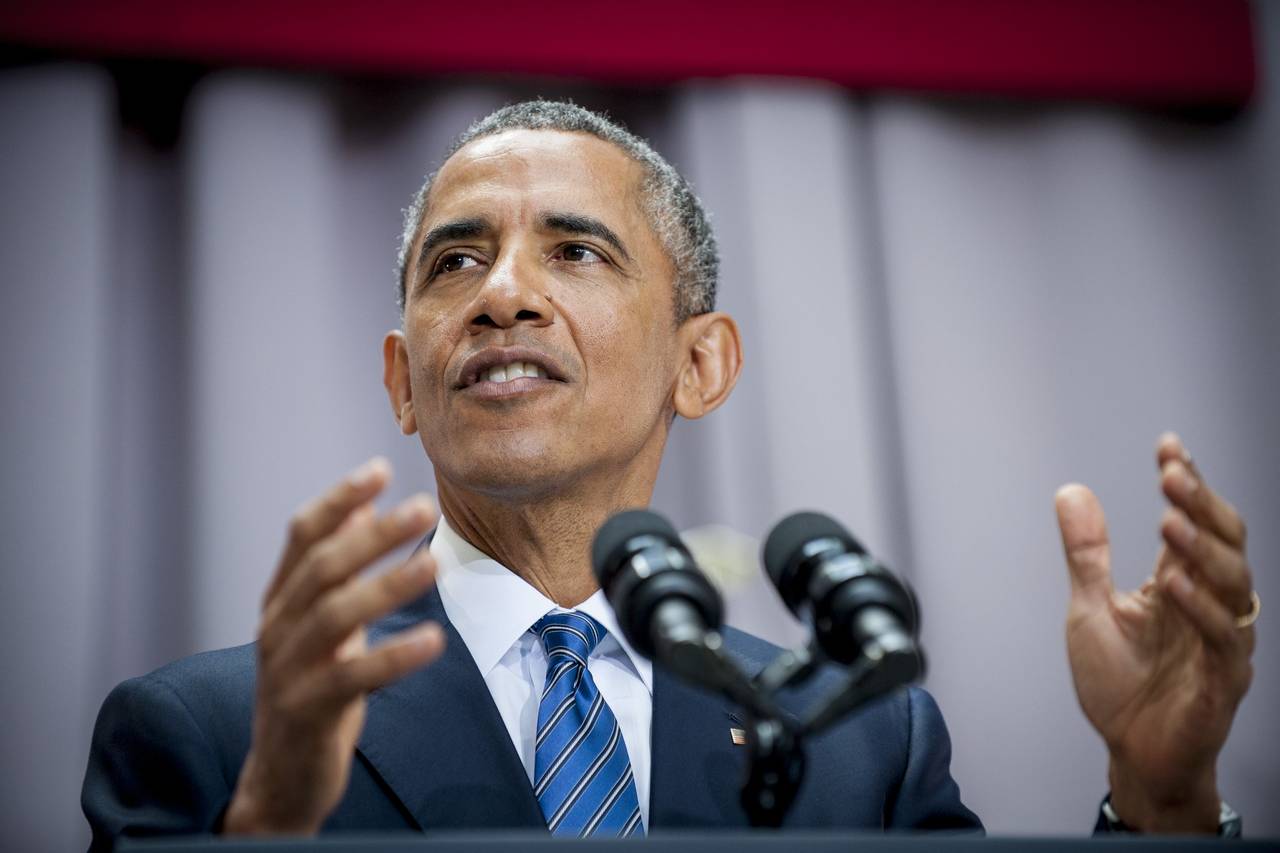
PHOTO: PETE MAROVICH/ZUMA PRESS
President Obama giving a speech at American University, August 5, Washington D.C..
Later this month, President Obama will travel to Alaska and shine a spotlight on what Alaskans in particular have come to know: Climate change is one of the biggest threats we face, it is being driven by human activity, and it is disrupting Americans’ lives right now. [White House]
Can A Global Warming Calamity Be Averted?

“Unless someone like you cares a whole awful lot,
Nothing is going to get better. It’s not.”
― Dr. Seuss, The Lorax
Global warming is often wrongly said to be a political issue. In fact, global warming is no more of a political issue than a tornado is a political issue, or an erupting volcano, or an earthquake or tsunami. These are factual occurrences that occur for known scientific reasons. As there is no debate on the existence or occurrence of these physical happenings nor should there be a need to debate the occurrence of human-caused global warming and climate change as these changes are, too, scientifically based and measured. In fact, sea level has already begun to rise from global warming, measurably. Migratory bird species are changing their patterns and timing of flight; temperature gradients for gardening around the world have changed; heat wave death tolls have risen; extreme weather has become more extreme; average monthly air temperatures at the surface have been steadily rising; dewpoint temperatures in the Midwest have exceeded precedence. Time is running out run out for acting responsibly to avert the worst outcomes possible from global warming. Alarm bells have rung. Action must be taken now, and on a grand scale, to prevent what scientists have been predicting for decades now – the catastrophic consequences of human fed global warming.
Longtime and well respected University of Wisconsin-Madison Chemistry Professor Bassam Shakhashiri recently summarized on Wisconsin Public Radio his own perceptions of the seriousness of the global warming threat and our collective responsibilities as citizens to work towards mitigating and adapting to this monumental threat as follows:
“We should have high expectation of all our government agencies and we should have high expectations of our elected officials and we should have high expectations of everyone who cares about the quality of life of where we live. We face grand challenges. Global warming is unequivocal. It’s not a matter of voting whether we will have global warming or not. It’s a matter of who we elect in the next election cycle to take responsible action to address and to solve this very, very serious and highly consequential question of climate change.
“We have elected officials from our state of Wisconsin who engage in conversations that label other people as deniers of climate change. I think it behooves us as learned individuals, as people who care about the quality of life that we have, to elect individuals to the U.S. Senate to the presidency, to our local government, who can take responsible action to mitigate and to address in responsible ways, and “responsible” is crucial, global warming. It’s not just local here. You can look at different displays of information. In the past 25 years, the plant hardening zones have been changing. Just in the past 25 years, the zone that we are in Wisconsin, is what it was 25 years ago in Florida. We have issues that relate to water quality. We have issues that relate to wellness, to health care.
“We have fabulous opportunities to make great progress in our society, and that’s why I have high expectations – always have high expectations – but I also live in the real world. We must, in the upcoming election cycle, be truly faithful to our core beliefs and to our values, so that our elected officials can act and can respond, in most good ways, to this one issue of climate change. There are other issues, too, but this is really a critical one.” [The Larry Meiller Show,Thursday, August 6, 2015, 11:00 am]
Global warming has all the marking of becoming a worldwide economic, environmental and human disaster. It could be a disaster that has no precedent in nature, at least during the time humans have been inhabiting Earth. Scientific models have demonstrated the inevitably of global warming due to our relentless burning of fossil fuels, in almost every device possible, and our continued deforestation practices, particularly in the tropics. Should global warming be allowed to continue at the current rates, the death toll from global warming effects could ultimately exceed the number of human losses from all wars, human atrocities, motor vehicle crashes, airplane crashes and worldwide epidemics.
History is repleat with examples of being “too little, too late”. U.S. President Hoover’s attempts to end the Great Depression by funding the construction of the Hoover Dam were believed by the American public as being “too little” to save the U.S. economy and “too late”. He was soundly defeated in the U.S. presidential election by Franklin Delano Roosevelt.
In medicine, if someone is sick and they do not get to a doctor until their sickness becomes fatal any remedy will be “too little, too late”.
The Obama administration’s Clean Power Plan to reduce global warming is also both too little and too late to prevent what scientists call a “runaway greenhouse effect”, as what happen on the planet Venus eons ago, making the planet’s former oceans of water boil away, due to surface atmospheric temperatures that continued to climb, unabated.
While the U.S. electrical energy power production may be the top emitting sector of greenhouse gases (GHGs) in the U.S. economy, timely and sufficiently large GHGs emissions reductions in the transportation and other GHG emitting sectors (construction industry sector, agriculture industry sector, consumer sector, export/import sectors, the military industrial complex) will nullify any gains made in the electricity production sector. This could leave the planet vulnerable for the positive GHG feedback mechanisms that contribute to more global warming to kick-in, which could cause a runaway greenhouse effect on Earth. Examples of positive feedback to more global warming of Earth include a reduced ability of the Arctic Ocean to reflect solar energy back into space (darker water absorbs more solar energy than snow and ice), causing additional heating of the oceans; melting of the permafrost region (1/5 of the earth’s surface) resulting in more methane gas (a much stronger GHG than carbon dioxide) production.
Albert Einstein once remarked: “We can’t solve problems by using the same kind of thinking we used when we created them.” Offering the public positive financial incentives to reduce actions that emit greenhouse gases, such as driving, flying and using fossil fuel created heat and electricity, could drastically reduce human caused climate change and as well as other problems created by our fossil fuel powered economy (such as oil spills, ground water pollution from petroleum waste, and natural gas explosions).
A Record 988 Billion Miles Driven on U.S. Highways During First Four Months of 2015
Data from the U.S. Federal Highway Administration show Americans drove a record 988 billion miles during the first four months of 2015. Motor gasoline consumption, which rose by 80,000 barrels per day in 2014, will increase by a projected 170,000 barrels per day (1.9%) in 2015 as the effects of employment growth and lower gasoline prices outweigh increases in vehicle fleet efficiency.
Lower prices along with higher rates of road traffic and more demand for larger vehicles continue to push gas consumption higher.
As refiners continue to produce at a near-record pace, U.S. gasoline stockpiles have declined. Gasoline stockpiles are down 10% since February.
Demand for automotive-grade gasoline increased to 9.17 million barrels (385.14 million gallons) per day, according to information from the Energy Information Administration (EIA).
The Energy Information Administration estimates that for each gallon of gasoline burned in an internal combustion engine, 19.564 pounds of carbon dioxide (CO2) are emitted to the atmosphere, as well as smaller amounts of nitrous oxide and other gases. This calculates to 7.7 billion pounds CO2 per day from U.S. drivers. Carbon dioxide remains in the atmosphere from year to year, building to higher and higher levels of concentration, which is known to be causing warmer temperatures at lower altitudes, warmer ocean surface temperatures. In Wisconsin, nightly low temperatures have increased the most, as reported by the Weather Guys.
Yet nationally, only 63% of U.S. citizens believe global warming is occurring!
 All Things Environmental
Recent Comments