Archive | Greenhouse Effect RSS for this section

The Killing of Eric Garner

moralityscales

On July 17, 2014, Eric Garner, an African American, died in the Tompkinsville neighborhood of Staten Island, New York, after a police officer put him in a chokehold, a tactic banned by the New York City Police Department (NYPD). Garner was initially approached by Officer Justin Damico on suspicion of selling “loosies”, single cigarettes from packs without tax stamps. After Garner expressed to the police that he was tired of being harassed and that he was not selling cigarettes, officers made the move to arrest Garner. Officer Daniel Pantaleo, also on scene, put his arms around the much taller Garner’s neck, applying a chokehold shown in a widely viewed video recording of the event. While lying face-down on the sidewalk surrounded by four officers, Garner is heard to repeat numerous times, “I can’t breathe”. Garner was pronounced dead approximately one hour later at the hospital.

After the incident, city medical examiners concluded that Garner was killed by neck compression from the chokehold, along with “the compression of his chest and prone positioning during physical restraint by police”. Contributing factors included bronchial asthma, heart disease, obesity, and hypertensive cardiovascular disease. As a result of Garner’s death, four EMTs and paramedics who responded to the scene were suspended without pay on July 21, 2014; officers Damico and Pantaleo were placed on desk duty; and Daniel Pantaleo was stripped of his service gun and badge.

On December 3, 2014, a grand jury decided not to indict officer Pantaleo. The event stirred public protests and rallies with charges of police brutality and was broadcast nationally over various media networks. Attorney General Eric Holder announced that the Justice Department would launch an “independent, thorough, fair, and expeditious” civil rights investigation into Garner’s death.

From Wikipedia, the free encyclopedia

Walker’s PSC Pitches Shutout for Wisconsin Utilities Against Public and Environment

mg&eProtest

Madisonians received a Thanksgiving greeting by Governor Scott Walker today in the form of increased monthly electric rates and reduced incentives for conserving on electricity in their homes. The Public Service Commission of Wisconsin (PSC), with two of its three commissioners appointed by Governor Scott Walker, granted its approval to the private utility Madison Gas & Electric’s (MG&E) proposal to significantly increase the monthly fixed charges its customers must pay, and its request to reduce the monetary benefits customer’s will save by conserving more on their power use.

This is the third major utility monopoly in the state to be granted such an approval by the state’s chief energy regulatory agency. Please see November 18, 2014 post “Public Service Commission of Wisconsin Doing Public a Disservice” for details on PSC’s approvals of the other two utilities’ requests (one for We Energies Corporation and the other for the Green Bay area Wisconsin Public Service Corp..

Despite PSC being given the mission “to protect the environment, the public interest and the public health and welfare of Wisconsin citizens” in its decisions, the Governor Walker’s appointed PSC commissioners Phil Montgomery and Ellen Nowak voted to make it more of a financial hardship for low income families and individuals to pay their energy bills. Eric Callisto, a Governor Doyle appointee to the Commission, voted no to all three utility proposals, which will also have negative impacts on everybody in the form of faster global warming and climate change because they slow the payback on residents of the state who invest in solar panels thus conserving on fossil fuel burning.

The MG&E decision will more than double the monthly fixed rate for Madisonians, from $10.50 a month to $19, while decreasing the charge for kilowatt-hour of power used. The increase is similar to two other two state utilities the PSC has already approved, one for the Wisconsin Public Service Corp., the other for We Energies.

As reported in Thursday’s issue of the Wisconsin State Journal, Callisto chastised fellow commissioners Montgomery and Nowak for supporting the new rate structure, saying they have ignored the comments of 1,100 people (including testimony) who have submitted comments urging the PSC to reject the MG&E plan, including people from the cities of Madison, Middleton and Monona, and other in Dane County.

“Shame on us”, Callisto said. “We have plainly disregarded our opportunity to protect the public interest.”

Madison Mayor Paul Soglin said “MG&E ‘s approved rate design is contrary to the city’s interests and will undermine energy conservation efforts, energy efficiency investments, and the newable energy investments in our community”, the State Journal reported.

Don Wichert, who helped organize RePower Madison, a citizens group opposed to the MG&E plan, said “our commission is now the worst commission in the country. It is clearly not the ‘public’ service commission”. the Wisconsin State Journal reported November 27th.

Flood Wall Street Activists Seek Trial to Mount “Necessity Defense” for Global Warming Protest

Protesters arrested in last month’s demonstration in the heart of Wall Street have appeared in court to a demand a trial. More than 100 people were detained as part of the “Flood Wall Street” action targeting the financial sector’s role in the extractive industries fueling global warming. As the cases were brought to court lastClimate-Change-Science-v2 week, a group among those arrested rejected a prosecution offer to dismiss the charges after six months. Instead, the protesters said they want their case to go to trial so they can mount a “necessity defense” — arguing that their actions were justified by how the financial industry worsens the climate change that threatens the planet. Flood Wall Street defendant John Tarleton explained the rationale on Tuesday.

John Tarleton: “Twelve of us have plead not guilty to these charges of disorderly conduct. We want to take the case to trial and argue a ‘necessity defense,’ that the harm being caused by Wall Street in financing all sorts of extreme energy projects in this country and around the world is so much greater than any harm that was done by a traffic jam on Broadway. And we feel that we have to continue to push this point that Wall Street and capitalism in general cannot solve the climate crisis because they are central to the problem.”

The “necessity defense” had been the plan of two climate activists set to go on trial in Massachusetts last month for blocking a coal shipment. But the case was resolved after the prosecutor all but adopted their reasoning and dropped the charges. He then joined them in the People’s Climate March.

Source: Democracy Now

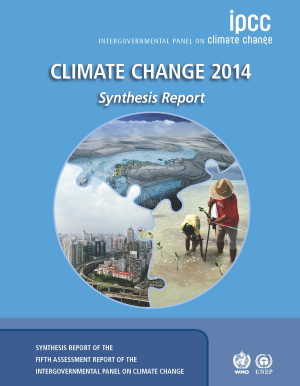
IPCC Releases Final Report on Global Warming and Climate Change

IPCClast

In a word: “dire” – the Intergovernmental Panel on Climate Change. The window of opportunity for doing something positive about it – closing. The time to start action on quickly reducing human causes releases of greenhouse gases – NOW!

From the Huffington Post (November 3, 2014):

COPENHAGEN, Denmark (AP) — Climate change is happening, it’s almost entirely man’s fault and limiting its impacts may require reducing greenhouse gas emissions to zero this century, the U.N.’s panel on climate science said Sunday.

The fourth and final volume of the Intergovernmental Panel on Climate Change’s giant climate assessment offered no surprises, nor was it expected to since it combined the findings of three reports released in the past 13 months.

But it underlined the scope of the climate challenge in stark terms. Emissions, mainly from the burning of fossil fuels, may need to drop to zero by the end of this century for the world to have a decent chance of keeping the temperature rise below a level that many consider dangerous.

The IPCC didn’t say exactly what such a world would look like but it would likely require a massive shift to renewable sources to power homes, cars and industries combined with new technologies to suck greenhouse gases from the atmosphere.

The report warned that failure to reduce emissions could lock the world on a trajectory with “irreversible” impact on people and the environment. Some impacts already being observed included rising sea levels, a warmer and more acidic ocean, melting glaciers and Arctic sea ice and more frequent and intense heat waves.

The science has spoken. There is no ambiguity in their message. Leaders must act. Time is not on our side,” U.N. Secretary-General Ban Ki-moon said at the report’s launch in Copenhagen.

Amid its grim projections, the report said the tools are there to set the world on a low-emissions path and break the addiction to burning oil, coal and gas which pollute the atmosphere with heat-trapping CO2, the chief greenhouse gas.

“All we need is the will to change, which we trust will be motivated by knowledge and an understanding of the science of climate change,” IPCC chairman Rajendra Pachauri said.

The IPCC was set up in 1988 to assess global warming and its impacts. The report released Sunday caps its latest assessment, a mega-review of 30,000 climate change studies that establishes with 95-percent certainty that most of the warming seen since the 1950s is man-made. The IPCC’s best estimate is that just about all of it is man-made, but it can’t say that with the same degree of certainty.

Today only a small minority of scientists challenge the mainstream conclusion that climate change is linked to human activity.

Global Climate Change, a NASA website, says 97 percent of climate scientists agree that warming trends over the past century are very likely due to human activities.

The American public isn’t as convinced. A year-old survey by Pew Research showed 67 percent of Americans believed global warming is occurring and 44 percent said the earth is warming mostly because of human activity. More recently, a New York Times poll said 42 percent of Republicans say global warming won’t have a serious impact, a view held by 12 percent of Democrats and 22 percent of independents.

Sleep-deprived delegates approved the final documents Saturday after a weeklong line-by-line review that underscored that the IPCC process is not just about science. The reports must be approved both by scientists and governments, which means political issues from U.N. climate negotiations, which are nearing a 2015 deadline for a global agreement, inevitably affect the outcome.

The rift between developed and developing countries in the U.N. talks opened up in Copenhagen over a passage on what levels of warming could be considered dangerous. After a protracted battle, the text was dropped from a key summary for policy-makers — to the disappointment of some scientists.

“If the governments are going to expect the IPCC to do their job,” said Princeton professor Michael Oppenheimer, a lead author of the IPCC’s second report, they shouldn’t “get caught up in fights that have nothing to do with the IPCC.”

The omission meant the word “dangerous” disappeared from the summary altogether. It appeared only twice in a longer underlying report compared to seven times in a draft produced before the Copenhagen session. The less loaded word “risk” was mentioned 65 times in the final 40-page summary.

“Rising rates and magnitudes of warming and other changes in the climate system, accompanied by ocean acidification, increase the risk of severe, pervasive, and in some cases irreversible detrimental impacts,” the report said.

World governments in 2009 set a goal of keeping the temperature rise below 2 degrees C (3.6 F) compared to before the industrial revolution. Temperatures have gone up about 0.8 C (1.4 F) since the 19th century.

Emissions have risen so fast in recent years that the world has used up two-thirds of its carbon budget, the maximum amount of CO2 that can be emitted to have a likely chance of avoiding 2 degrees of warming, the IPCC report said.

“This report makes it clear that if you are serious about the 2-degree goal … there is nowhere to hide,” said Alden Meyer of the Union of Concerned Scientists, an advocacy group. “You can’t wait several decades to address this issue.”

U.S. Secretary of State John Kerry said the report demands “ambitious, decisive and immediate action.”

“Those who choose to ignore or dispute the science so clearly laid out in this report do so at great risk for all of us and for our kids and grandkids,” Kerry said in a statement.

The IPCC said the cost of actions such as shifting to solar and wind power and other renewable sources and improving energy efficiency would reduce economic growth only by 0.06 percent annually.

Pachauri said that should be measured against the implications of doing nothing, putting “all species that live on this planet” at peril.

The report is meant as a scientific roadmap for the U.N. climate negotiations, which continue next month in Lima, Peru. That’s the last major conference before a summit in Paris next year, where a global agreement on climate action is supposed to be adopted.

The biggest hurdle is deciding who should do what. Rich countries are calling on China and other major developing countries to set ambitious targets; developing countries saying the rich have a historical responsibility to lead the fight against warming and to help poorer nations cope with its impacts. The IPCC avoided taking sides, saying the risks of climate change “are generally greater for disadvantaged people and communities in countries at all levels of development.”

AP: By KARL RITTER
Posted: 11/02/2014 7:35 am EST Updated: 11/03/2014 12:59 pm EST

IPCC Sounds Fresh Alarm as Fossil Fuel Interests Tighten Grip on Congress

The contrast between the increasingly partisan American political divide and the increasingly solid international scientific consensus couldn’t be starker.

By John H. Cushman Jr., InsideClimate News   November 3, 2014   Inside Climate

The leading international network of climate scientists is urging a rapid shift away from fossil fuels, just as allies of coal, oil and natural gas industries in the United States appear poised to tighten their grip on Congress—where opposition to cleaner energy is already entrenched.

That outcome of Tuesday’s midterm election would spell trouble for advocates of a strong international climate accord. Treaty negotiations are supposed to pick up in the next few months and culminate in Paris just over a year from now.

This weekend, the UN’s Intergovernmental Panel on Climate Change issued a synthesis report that sums up its years-long review of the climate crisis and what to do about it. The report called for the near-complete elimination of fossil fuel-burning by the end of the century. This, it said, is what is needed to have a reasonable chance of avoiding the most severe risks of man-made changes to the world’s climate.

Nothing could be further from the agenda of Sen. Mitch McConnell of Kentucky, the coal-state Republican who on the eve of the election appears to have significantly better than even odds of becoming the next majority leader. (Though, as the IPCC might put it, until the last votes are tallied any forecast of which party will prevail deserves only “medium confidence.”)

Even if the Republicans don’t gain a majority in the Senate on Nov. 4, they are likely to gain strength in that chamber as well as in the House—an election outcome that would undermine President Obama’s entire climate agenda, not just his influence in the Paris talks.

From the Keystone XL pipeline decision and so-called “war on coal,” to a carbon tax and the very foundations of climate science, Congressional Republicans have opposed Obama on anything having to do with global warming from his first days in office.

Just last year, on the day the IPCC released one of three exhaustive treatments that formed the basis of this week’s synthesis report, McConnell co-sponsored an amendment to block the EPA from regulating fossil fuels in electric power plants, the largest single source of carbon emissions in this country.

His co-sponsor, Sen. James Inhofe of Oklahoma, offered another amendment at the same time. It would have prohibited the administration from participating in international climate negotiations “unless the U.S. offers an addendum to the latest IPCC report stating that anthropogenic climate change is a scientifically unproven theory.” Inhofe, who reportedly aspires to be chairman of the environment committee in a Republican Senate, calls the whole IPCC enterprisea “conspiracy” and “a hoax.”

Their ascent would alarm participants in the climate talks who agree with IPCC chairman, Rajendra Pachauri, that the climate crisis could be solved if action is quick and decisive. “All we need,” Pachauri said as he released the new synthesis report, “is the will to change, which we trust will be motivated by knowledge and an understanding of the science of climate change.”

Emissions must fall by 40 to 70 percent between 2010 and 2050, and then to zero by 2100, he explained at a news conference.

Those are fighting words to anyone committed to defending the coal industry in Kentucky, the oil and gas industry in Oklahoma, or campaigning in any fossil fuel stronghold—from the Marcellus shale to the Bakken light oil play. And it helps explain why the politics of carbon are a feature of so many swing elections in states like West Virginia, Colorado, Louisiana and Alaska.

The contrast between this increasingly partisan American political divide and the increasingly solid international scientific consensus could hardly be starker.

“The scientists have done their jobs and then some,” said Alden Meyer of the Union of Concerned Scientists, who has tracked the negotiations for decades. “Politicians can either dramatically reduce emissions or they can spend the rest of their careers running from climate disaster to climate disaster.”

Other environmental advocates, too, issued statements emphasizing that the synthesis report—including its summary for policymakers, expressly designed to guide them toward early action —was as significant politically as it was scientifically.

“The report is alarming and should be a wake-up call to government leaders,” said Mindy Lubber, president of Ceres, a group that encourages businesses to show leadership on climate issues. Her statement called on them to “ramp up the pressure…especially in Washington.”

“The critical missing link is the oil and gas industry, which is doing its best to thwart concrete action,” she said.

The Sierra Club’s Michael Brune aimed a jibe at the Koch brothers and their favored candidates, saying that “we don’t have any more time to coddle fossil fuel billionaires or politicians who will eschew responsibility at every corner.”

Big environmental groups have spent heavily in this campaign, too—$85 million on state and federal races, according to Daniel Weiss of the League of Conservation Voters, including $40 million on just six key Senate races. And in the closing days, they were knocking on millions of doors to bring out a green vote.

The organizations released results from a Hart Research Associates poll taken in late October in swing states suggesting that the climate issue could break in their favor.

“The survey suggests that Republican candidates are losing ground as a result of their climate science denial and opposition to climate pollution reductions,” Hart reported. “This is true among independent swing voters, and particularly among women and younger voters.”

But only about 40 percent of those surveyed said they had heard much of candidates’ views on climate. A majority had heard about energy issues, but far more about abortion, jobs and Obamacare.


Leaked Final Draft Of U.N. Climate Report Shows Dire Global Warming Predictions

earth-from-spaceEinstein-Quotes-1BY ARI PHILLIPS, POSTED ON OCTOBER 27, 2014

Delegates from more than 100 governments and many of the world’s top climate scientists are meeting in Copenhagen this week to finalize a report that will be used as a foundation for important upcoming climate summits. The leaked United Nations draft report, due to be published on Nov. 2nd, says climate change may have “serious, pervasive and irreversible” impacts on human society and nature.
Hopes are set on a new, post-Kyoto Protocol global climate agreement to be reached at the Paris summit at the end of 2015. There will a major climate meeting in Lima, Peru at the end of this year to help set the framework for the 2015 gathering.

“The report will be a guide for us,” Peruvian Environment Minister Manuel Pulgar-Vidal, told Reuters.
This final report is a synthesis of three comprehensive IPCC reports published over the course of the last year. Those reports focused on the physical science; impacts, adaptation and vulnerability; and mitigation. This flagship report received over 2,000 comments from government officials relating to changes to be made prior to publication.

According to a Reuters analysis, many governments want the draft to be written in a more clear and accessible manner with a focus on extreme weather events such as storms, heat waves, and floods. The U.S. wrote that the report needs to be useful for those without deep technical knowledge of climate issues.

“What about drought? Cyclones? Wildfires? Policymakers care deeply about extreme events,” the U.S. team wrote. “After all, in many ways it is how extreme events will change that will determine many of the (near-term, at least) impacts from climate change. As such, the authors should strongly consider saying more about the projected changes in extreme events.”

>U.S. commenters also wrote that the report should stress impacts on rich countries more, saying “there are very few references to the vulnerability of wealthier countries to climate change.”

The E.U. team wrote that “the key messages should contain more substance that can help guide policy makers rather than general overarching statements,” and that “the overall storyline … is sometimes not clear and still looks fragmented.”

While the report warns of the dire consequences of the continued rise of GHGs, it also says the worst impacts can still be avoided. It states that a combination of adaptation and substantial, sustained reductions in GHGs can limit climate change risks and reduce the costs and challenges of mitigation.
Over the past five years some 2,000 scientists worked on the fifth iteration of the U.N.’s Intergovernmental Panel On Climate Change’s Assessment Report. With leaders gathering to finalize the report this week, Rajendra Pachauri, chairman of the IPCC, urged world governments not to be overcome by hopelessness as they engage in negotiations.

“May I humbly suggest that policymakers avoid being overcome by the seeming hopelessness of addressing climate change,” he said. “Tremendous strides are being made in alternative sources of clean energy. There is much we can do to use energy more efficiently. Reducing and ultimately eliminating deforestation provides additional avenues for action.”

In one hopeful indication, last week leaders of the European Union agreed to cut emissions by 40 percent below 1990 levels by 2030. European leaders hope this will build momentum for when the bloc hosts the critical Paris climate summit next year, and that it will encourage other major emitters yet to make pledges — such as the U.S. and China — to rise to the occasion. Countries have until early next year to announce the targets they intend to negotiate with at the Paris summit.

Is Human Activity Really to Blame for Climate Change? How Did Venus Get So Hot?

venusandearth

A recent debate between candidates for Congress in the Wisconsin’s 1st District — U.S. Rep. Paul Ryan, R-Janesville, and Democratic challenger Rob Zerban — included questions about the role of human beings in producing discernible changes in the climate over the last 150 years.

Unfortunately, this question, which is a matter of evidence, analysis and conclusion as all scientific questions are, has become a source of partisan political divide.

The Intergovernmental Panel on Climate Change (IPCC), a scientific body created by the United Nations to inform the UN regarding “scientific, technical and socio-economic information relevant to understanding the scientific basis of risk of human-induced climate change,” has issued five reports on this question since 1990.

These reports are a synthesis of many hundreds of peer-reviewed scientific studies on the issue.

With each successive report — they have been issued in 1995, 2001, 2007 and 2014 — the IPCC has increased the certainty of its conclusions.

The language in these reports has changed from “the balance of evidence suggests a discernible human influence on global climate” (1995) to “most of the observed warming is likely (a greater than 66 percent chance) due to human activities” (2001) to warming “over the last 50 years is very likely (a greater than 90 percent chance) due to human activities” to “It is extremely likely (a 95-100 percent chance) that human influence was the dominant cause of global warming between 1951-2010.”

This makes two things quite clear.

First, that scientists are a skeptical bunch and will move toward increased certainty only as evidence accumulates in favor of that conclusion.

Second, that human-induced global warming is a reality with which we must reckon.

During the debate, when asked if humans have a role in global warming, Ryan answered, “I don’t know the answer to that question. I don’t think science does either.”

He may well be correct in his first response, but he is certainly wrong in his second.

Article by Steve Ackerman and Jonathan Martin who are professors in the University of Wisconsin’s Department of Atmospheric and Oceanic Sciences in Madison, Wisconsin.

The above article was published in the Wisconsin State Journal print edition on October 20, 2014.

The IPCC also says “climate change is not a far-off problem. It is happening now and is having very real consequences on people’s lives. Climate change is disrupting national economies, costing us dearly today and even more tomorrow”, the IPCC states.

Astrobiologist David Grinspoon believes that scientists should look at our neighboring planets to help understand the perils of global warming. “It seems that both Mars and Venus started out much more like Earth and then changed. They both hold priceless climate information for Earth.”

The atmosphere of Venus is much thicker than Earth’s. Nevertheless, current climate models can reproduce its present temperature structure well. Now planetary scientists want to turn the clock back to understand why and how Venus changed from its former Earth-like conditions into the inferno of today.Climate scientists believe that the planet experienced a runaway greenhouse effect as the Sun gradually heated up. Astronomers believe that the young Sun was dimmer than the present-day Sun by 30 percent. Over the last 4 thousand million years, it has gradually brightened. During this increase, Venus’s surface water evaporated and entered the atmosphere.

“Water vapor is a powerful greenhouse gas and it caused the planet to heat-up even more. This is turn caused more water to evaporate and led to a powerful positive feedback response known as the runaway greenhouse effect,” says Grinspoon.

We have to make sure nothing like a runaway greenhouse effect doesn’t get started on Earth. Hopefully, it has not already started.