
Study Finds 4,000 Lynchings in Jim Crow South

A new report has uncovered shocking details about the history of lynchings in the United States and their legacy today. After five years of exhaustive research and interviews with local historians and descendants of lynching victims, the Equal Justice Initiative found white Southerners lynched nearly 4,000 black men, women and children between 1877 and 1950 — a total far higher than previously known.
The report details a 1916 attack in which a mob lynched Jeff Brown for accidentally bumping into a white girl as he ran to catch a train. In an example from 1940, a crowd lynched Jesse Thornton for not addressing a white police officer as “mister.”
In many cases, the lynchings were attended by the entire white community in an area. The Equal Justice Initiative’s (EJI) “Lynching in America: Confronting the Legacy of Racial Terror” documents EJI’s multi-year investigation into lynching in twelve Southern states during the period between the Reconstruction and World War II. EJI researchers documented 3959 racial terror lynchings of African Americans in Alabama, Arkansas, Florida, Georgia, Kentucky, Louisiana, Mississippi, North Carolina, South Carolina, Tennessee, Texas, and Virginia between 1877 and 1950 – at least 700 more lynchings of black people in these states than previously reported in the most comprehensive work done on lynching to date.
Lynching in America makes the case that lynching of African Americans was terrorism, a widely supported phenomenon used to enforce racial subordination and segregation. Lynchings were violent and public events that traumatized black people throughout the country and were largely tolerated by state and federal officials. This was not “frontier justice” carried out by a few marginalized vigilantes or extremists. Instead, many African Americans who were never accused of any crime were tortured and murdered in front of picnicking spectators (including elected officials and prominent citizens) for bumping into a white person, or wearing their military uniforms after World War I, or not using the appropriate title when addressing a white person. People who participated in lynchings were celebrated and acted with impunity. Not a single white person was convicted of murder for lynching a black person in America during this period.
The report explores the ways in which lynching profoundly impacted race relations in this country and shaped the contemporary geographic, political, social, and economic conditions of African Americans. Most importantly, lynching reinforced a narrative of racial difference and a legacy of racial inequality that is readily apparent in our criminal justice system today. Mass incarceration, racially biased capital punishment, excessive sentencing, disproportionate sentencing of racial minorities, and police abuse of people of color reveal problems in American society that were shaped by the terror era.
No prominent public memorial or monument commemorates the thousands of African Americans who were lynched in America. Lynching in America argues that is a powerful statement about our failure to value the black lives lost in this brutal campaign of racial violence. Research on mass violence, trauma, and transitional justice underscores the urgent need to engage in public conversations about racial history that begin a process of truth and reconciliation in this country.
“We cannot heal the deep wounds inflicted during the era of racial terrorism until we tell the truth about it,” said EJI Director Bryan Stevenson. “The geographic, political, economic, and social consequences of decades of terror lynchings can still be seen in many communities today and the damage created by lynching needs to be confronted and discussed. Only then can we meaningfully address the contemporary problems that are lynching’s legacy.” Report Summary
Hear famous jazz singer Billey Holiday sing “Strange Fruit”.
Wisconsin Legislature Votes to Call “Extraordinary Sessions” for Wrong Reasons
Organizing committees of both the Wisconsin Senate and Wisconsin Assembly called both houses of the Wisconsin legislature into extraordinary sessions this week to pass a “right-to-work” bill, making it illegal for employers and labor unions to charge their employees and any new employees union dues as a condition of accepting employment. The Wisconsin State Journal reported in today’s newspaper edition that the full Senate could vote on this highly charged legislation (Senate Bill 44) as early as Wednesday and the Wisconsin Assembly could vote on this legislation (AB 61) as soon as Monday.
Governor Scott Walker has said he would sign the bill into law.
The Senate and Assembly organizing committees ought have called their “extraordinary” sessions to address what the State of Wisconsin ought do to protect its citizens from global warming and climate change instead. Greenhouse gas emissions, global warming and climate change are far more significant to the future of Wisconsin than are unions charging union dues in the state.
Positive Incentives Plan Wages Three-Prong-Attack Against Climate Change

Please refer to “About this Blog” before proceeding.
The planet Venus is on the left; Earth is on the right. Nobody wants to see Earth go the route its that its commonly called twin planet Venus took, eons ago. You see Venus once had oceans of water, too, just like Earth does. But something went very wrong on the surface of Venus (possibly it is because the Sun got hotter), which started a “runaway greenhouse effect”. The oceans of water Venus once had boiled away. As temperatures began rising ocean water converted to water vapor, also a strong greenhouse gas. The water vapor increased the effectiveness of heat trapping and accelerated the greenhouse effect, which caused the temperature at the surface to rise further, thus causing the oceans to evaporate faster, etc., etc. This type of runaway is also called a “positive feedback loop”. When the oceans were gone the atmosphere finally stabilized at a much higher temperature and at much higher density, making the planet uninhabitable.
The sobering warning for us is obvious: we have to be extremely concerned about processes such as burning of fossil fuels in large volumes that might have the potential to trigger a runaway greenhouse effect and produce on the Earth atmospheric conditions that are incapable of supporting life.
That is why it is so essential that we initiate actions now, worldwide, to curb all forms of unnecessary activity that causes the greenhouse effect in our atmosphere to strengthen (meaning an increase concentrations of greenhouse gases). Carbon dioxide (CO2), a greenhouse gas, has increased in concentration in the atmosphere from 280 parts per million (ppm) in the 1880’s to 400 ppm today – mainly the result of humans burning coal, oil. and natural gas, the combustion producing significant amounts of (invisible) CO2.
As a result, the global average annual temperature of the Earth at the surface has risen, the temperature of Earth’s oceans have been increasing and, as a result of the ice melting off of the island of Greenland, the continent of Antarctica, and water runs down the mountainous glaciers on practically all the continents, and the property of the thermal expansion of water, Earth’s oceans levels are rising.
Meanwhile, the Earth’s once solid permafrost region, which is approximately 1/5 of the Earth’s surface, is now thawing in many places, decomposing,and releasing methane to the atmosphere, a greenhouse gas 37 times as strong as CO2 in trapping heat.
Furthermore, replacement of large areas of ice and white snow surface (ice cap) on the Arctic Ocean means the open Arctic ocean water absorbs more of the radiant heat from the Sun, causing the ice and snow to melt even faster still, an so on. If it were not for the vast amounts of ice in the Arctic Ocean, the water would warm even faster.
It is essential that people and businesses, the world over, especially those in countries burning vast quantities of fossil fuels, in power generation, motorized transportation and jet travel, for human travel and shipping, find alternatives that don’t burn fossil fuels for their pursuits. Presently, citizens from the United States fly 40% more than citizens from other countries, and more U.S. citizens are buying gas guzzling SUVs and pickup trucks than more fuel efficient vehicles – because gas is “cheap” again, They remain apathetic about global warming, or are members of the “Earth is flat” society. As John Lennon once said, “apathy is it”. The Earth is also round. Above all, we need to Conserve, NOW!
Wisconsin Must Join the All Out World Effort to Fight Global Climate Change Without Delay, BEFORE Time Runs Out

Wisconsin has traditionally prided itself as being a state that “cares”. Wisconsin residents care about its wild and domestic animals, its fish, birds and butterflies; its plants, trees, and its forests; its tens of thousands of lakes, streams and rivers, and the quality of its wetlands, groundwater and air; its mighty bluffs and gorges, its remaining prairies, and the state’s overall majestic scenic beauty.
Wisconsin has traditionally had a strong manufacturing economy, a top notch agricultural industry, a public education system second to none, a world class university system, and an equally top notch private schools, colleges, and other educational institutions. Wisconsin also boasts an excellent highway, airport, and bicycle transportation system, and communities that are walking and wheelchair friendly. It has always held all visitors to the state in high regards and treated them with respect the production and sustainability of its farms, the well being of its human population, without regard for race, heritage or creed. Wisconsinites treat visitors to their state with respect and dignity,satisfaction of its visitors and transients alike, and, perhaps above all, in leaving its land, water and its economy better condition than they received it. In a nutshell, that’s a statement of Wisconsin’s traditions and value, as I have come to know them.
Wisconsin residents often boast, and rightly so, that Wisconsin was the home of such renown conservationists and humanists as John Muir, Aldo Leopold, Senator Gaylord Nelson, Midge Miller and Vel Phillips. In the 1970s, Wisconsin was emulated by other states as the state to look at for developing effective environmental protection regulations to safeguard its treasures. With Wisconsin Departmental Resource Secretary Anthony “Tony” Earl at the helm, who would later become Wisconsin’s governor, and George “Knute” Knudson as its chief naturalist, Wisconsin natural resources were in good hands.
It is no exaggeration to say that all this is at risk the longer our Wisconsin Legislature, our governor, other state legislatures and governors, and the people’s representatives in the United States Congress continue to kick the issue of excess fossil fuel burning and greenhouse gas production by Americans down the road. What we don’t need is more highway development and expansion and more airport capacity expansion that encourage even more fossil fuel burning by the public. What we don’t need is more trade with distant countries that requires more fuel for shipping and flying. What we don’t need are more coal and natural gas burning power plants and the thousands of miles of high voltage transmission lines that go with them, and not Wisconsin power companies who restructure their rates in favor of more fossil fuel burning, thus discouraging their customers from investing in solar energy panels for their homes and businesses, and having the governor’s appointed Wisconsin Public Service Commission (the PSC) “rubber stamps” the fossil-fuel-dependent utilities’ proposals.
We are wasting valuable time and money by not relying less and less on fossil fuel dependent energy, and more on either energy conservation or on conversion to solar and wind generated power, in our homes, businesses and institutions; and that we desperately need to reduce aggregate driving and flying, which rely almost exclusively on burning fossil fuels that, when subject to combustion, release large quantities of greenhouse gases, especially carbon dioxide (CO2), to the atmosphere. Most of the greenhouse gases, such as CO2, remain in the atmosphere for centuries, accumulating to increasingly more ominous concentration levels, or they get absorbed in the oceans, making the earth’s ocean water more acidic, harming the biological species in the oceans.
But scientists the world over are in agreement that the rising concentrations of greenhouse gases from significantly increased fossil fuel burning by humans since the time of the Industrial Revolution (early 1800’s) have remained in earth’s atmosphere, trapping more and more of the Sun’s radiant energy and changing it into heat energy, causing the earth’s surface to warm, melting more of the polar ice caps and mountain glaciers, causing the vast permafrost region to thaw, releasing more and more methane gas, another greenhouse gas that’s known to have 37 times the heat-trapping power of CO2.
Scientists don’t know when global warming could begin accelerating, but it could be any day now. What they do know is that there are higher concentrations of greenhouse gases in the atmosphere now to push global surface temperatures much higher than what we have experienced thus far. Time is of the essence for the world’s populations who are relying on fossil fuel burning for energy to stop adding even higher concentration levels of greenhouse gases to the atmosphere, risking setting off positive feedback mechanisms in the system that could worsen the situation and amplify the weather extremes global warming has already caused in earth’s climate.
MLK Tribute – “Preserving Our Climate for Children and Humanity”

In honor of Dr. Martin Luther King Jr. and to celebrate his birthday, I am posting a tribute to him that I wrote and distributed on February 2, 2002. I am posting it here today for the same reason as then – to honor Dr. Martin Luther King Jr., and to celebrate his birthday (his exact birthday is January 15). After all, where would we be had Martin Luther King Jr. never been born?
Dr. King worked and died for the cause of freedom; he fought to end racism and do away with poverty and war but by peaceful means only, never by violence, even knowing his speaking out for these causes would likely ultimately cost him his life.
Dr. King would no doubt agree with humanitarian, environmentalist, and antiwar/nonviolent singer-songwriter Jackson Browne, who says on his newest album “Standing In The Breach”, in the song Walls and Doors : “There can be freedom only when nobody owns it”.
Preserving Our Climate for Children and Humanity (February 2, 2002)
Dr. Martin Luther King Jr. was a strong advocate for positive change for all people, especially children. Continued global warming will make the world we all share a much more hostile place for all people, especially today’s children who have a full life ahead of them. It will take a worldwide effort to stop global warming, and we owe it to children everywhere to do all we can before it becomes an irreversible, worldwide catastrophe.
My proposal is that we ALL petition our governments (with letters, petition, phone calls…) to reduce greenhouse gas emissions by adopting programs that REWARD PEOPLE AND FAMILIES WHO USE LESS ENERGY – by DRIVING LESS, FLYING LESS and USING LESS fossil fuel derived energy in their HOMES.
MLK once said: “We are prone to judge success by the index of our salaries or the size of our automobiles, rather than by the quality of our service and relationship to humanity.” We can serve humanity better by consuming less fossil fuel (gasoline, jet fuel, coal, natural gas and oil) by driving less, flying less and using less energy in our homes. Our children and their children will thank us for that.
Black Lives Matter in Madison and Wisconsin, If they Don’t Now, THEY WILL

A new generation of human rights activists mounted a passion-filled, peaceful march in South Madison Friday, tapping the energy around race issues sweeping the country to funnel it to local issues.
“Young black men are being murdered. It is a national problem,” organizer Brandi Grayson told the crowd that gathered at the Metro bus hub at South Park Street and West Badger Road. “It is time to educate ourselves, it is time to educate our neighbors, it is time to educate our employers. It is time, my people.”
“Black Lives Matter,” was the banner slogan and rallying cry of the action led by the Young Gifted and Black Coalition, as up to 150 demonstrators marched in traffic lanes a half-mile up South Park Street to North Ave., then back to the South District Police Station on Hughes Place for short speeches, poems and chants.
The crowd’s final march took them down Park Street up to, but not onto, the ramp to the west-bound Beltline as they held a silent vigil for four-and-a-half minutes to honor Michael Brown, whose body lay for four-and-a-half hours on a street in Ferguson, Missouri, after he was fatally shot by a white police officer in August.
The local activist group emerged following a grand jury decision not to indict Darren Wilson in Brown’s killing, in response to which they organized a rally and march around the Capitol Square last week. Like other race rights actions cropping up in the latest round of public outrage over the killing of black men by white police officers, the Madison coalition turned the failure of another grand jury this week to return an indictment in the killing of Eric Garner in New York City into an opportunity to demonstrate the depth of concern over civil rights.
Demonstrations over the lack of an indictment in the Garner case continued Friday in cities across the country.
The Young Gifted and Black Coalition of Madison is clearly organizing for the long haul.
The coalition points often to the disparities in education, incarceration and other aspects of life, documented in the Race to Equity report, as proof that even absent fatal police violence against blacks, racial inequities are rife in Dane County. The group is demanding an end to plans to build a new Dane County jail, immediate release of people incarcerated for crimes of poverty and investment in community initiatives.
Leaders called on demonstrators to join a planned protest Tuesday at a Dane County Board committee hearing on a proposal to spend $8 million for a study on the need for a new jail that could cost $150 million, and to participate in a community building and planning session next Friday evening at the South Madison Public Library.
“The civil rights movement brought change, but it didn’t happen because people were sitting down,” Grayson told the crowd. “Change happened because people were committed to change and were willing to sacrifice themselves and their time.”
The crowd demonstrating Friday was mixed racially and ethnically, but overwhelmingly young. Grayson said that older civil rights advocates and those whose work is enmeshed with majority establishment organizations are stepping back to let a younger generation take the lead on protests. “They can’t say the things we can say. We can take the action in the street; hopefully they will help make the policy.”
Will Williams, a long-time activist with Vietnam Vets for Peace and other local movements, watched the march take shape from the sidelines. “Old folks need to turn the baton over,” Williams said.”We have young people with the fire who understand what going on with racism overall and with cops who are murdering black people and not being held accountable.”
A handful of other older advocates were present on the edges of the demonstration, as well such leaders on race equity matters as Floyd Rose, president of 100 Black Men of Madison, and Mayor Paul Soglin.
The demonstrators chanted as they marched: “No Justice, No Peace! No Racist Police!” When they paused at North Avenue, the gathering took on something of the feel of a revival meeting where participants were called on to raise their fists and pledge to take up the fight for human rights.
“It starts with you, it starts with you, it starts with you, it starts with you, it starts with you, it starts with you, it starts with you, it starts with you, it starts with us,” Grayson shouted, pointing to individuals in the rapt and silent crowd.
“We are here to show what solidarity looks like. You are absolutely beautiful, don’t let anyone tell you anything different,” she said. “We are conditioned to fear black men; we are conditioned to think every black person is innately violent.”
Madison Police Chief Mike Koval watched from across Park Street, noted that marching in the traffic right-of-way was an act of civil disobedience, and spoke to the protesters rights to do so. “This is the First Amendment in action. This is how it’s supposed to work,” Koval said. “And the police in a free society should be here to facilitate it. This is democracy in action.”
Outside of the police station, protesters chanted slogans punctuated by trombone blasts and heard speeches and poems, one of which named many of those killed by police and lamented: “There is not enough skin to tattoo the names…We are black lives and we matter.”
The group fell into formation for the final march down Park Street just as darkness fell. “I came out to support everyone,” said one 20-something protester. “Human rights matter.”
Countries in Lima, Peru Ought to Declare World War III Against Global Warming and Catestrophic Climate Change
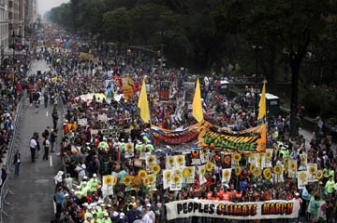
A day after December 7, 1941, the day U.S. President Franklin Delano Roosevelt said “will live in infamy” when Imperial Japan attacked the U.S.naval base at Pearl Harbor, Hawaii, the United States entered World War II as the U.S.Congress declared against the Empire of Japan, which aimed to dominate Asia and the Pacific and was already at war with the Republic of China in 1937. World War II had already been initiated by the invasion of Poland by Germany and subsequent declarations of war on Germany by France and the United Kingdom. From late 1939 to early 1941, Germany conquered or controlled much of continental Europe, and formed the Axis alliance with Italy and Japan. In June 1941, the Axis alliance launched an invasion of the Soviet Union. Japan attacked the United States that December, European territories in the Pacific Ocean, and the Empire of Japan quickly conquered much of the Western Pacific.
But during 1944 and 1945 the Japanese suffered major reverses in mainland Asia in South Central China and Burma, while the Allies crippled the Japanese Navy and captured key Western Pacific islands and the war in Europe ended with an invasion of Germany by the Western Allies and the Soviet Union culminating in the capture of Berlin by Soviet and Polish troops and the subsequent German unconditional surrender on 8 May 1945. Following the Potsdam Declaration by the Allies on 26 July 1945, the United States dropped atomic bombs on the Japanese cities of Hiroshima and Nagasaki on 6 August and 9 August, 1945, respectively.
The Axis advance halted in 1942 when Japan lost the critical Battle of Midway, near Hawaii, and Germany was defeated in North Africa and then, decisively, at Stalingrad in the Soviet Union. In 1943, with a series of German defeats on the Eastern Front, the Allied invasion of Italy which brought about Italian surrender, and Allied victories in the Pacific, the Axis lost the initiative and undertook strategic retreat on all fronts. In 1944, the Western Allies invaded France, while the Soviet Union regained all of its territorial losses and invaded Germany and its allies.
The war in Europe ended with an invasion of Germany by the Western Allies and the Soviet Union culminating in the capture of Berlin by Soviet and Polish troops and the subsequent German unconditional surrender on 8 May 1945. With an invasion of the Japanese imminent, the possibility of additional atomic bombings, and the Soviet Union’s declaration of war on Japan and invasion of Manchuria; Japan surrendered on 15 August 1945. Thus ended the war in Asia, and the final destruction of the Axis bloc. During 1944 and 1945 the Japanese suffered major reverses in mainland Asia in South Central China and Burma, while the Allies crippled the Japanese Navy and captured key Western Pacific islands.Following the Potsdam Declaration by the Allies on 26 July 1945, the United States dropped atomic bombs on the Japanese cities of Hiroshima and Nagasaki on 6 August and 9 August respectively. With an invasion of the Japanese archipelago imminent, the possibility of additional atomic bombings, and the Soviet Union’s declaration of war on Japan and invasion of Manchuria, Japan surrendered on 15 August 1945. Thus ended the war in Asia, and the final destruction of the Axis bloc.
World War II altered the political alignment and social structure of the world. The United Nations (UN) was established to foster international co-operation and prevent future conflicts.
World War II altered the political alignment and social structure of the world. The United Nations (UN) was established to foster international co-operation and prevent future conflicts.
World War II was the most widespread war in history, it directly involved more than 100 million people from over 30 countries, and the major participants threw their entire economic, industrial and scientific capabilities behind the war effort, erasing the distinction between civilian and military resources. An estimated 50 to 85 million fatalities, including the Holocaust during which approximately 11 million civilian people, including more than 6 millions Jews, were killed. Up until, now, World War II was the deadliest conflict in human history.
Many thousands of people have already lost their lives and homes and businesses, those of their family, friends, and communities to extreme weather events brought about by the excessive collective burning of fossil fuels by humans over the last century which, coupled with excessive deforestation by humans, especially in the tropics, have resulted in unnaturally high concentrations of carbon dioxide and other greenhouse gas in the atmosphere, causing global warming, rising sea levels, a warmer and more acidic ocean and the loss of arctic sea ice and melting glaciers. The number of lives lost as a result of human-caused global warming will ultimately number in the billions, probably more. To be continued …
The Killing of Eric Garner
On July 17, 2014, Eric Garner, an African American, died in the Tompkinsville neighborhood of Staten Island, New York, after a police officer put him in a chokehold, a tactic banned by the New York City Police Department (NYPD). Garner was initially approached by Officer Justin Damico on suspicion of selling “loosies”, single cigarettes from packs without tax stamps. After Garner expressed to the police that he was tired of being harassed and that he was not selling cigarettes, officers made the move to arrest Garner. Officer Daniel Pantaleo, also on scene, put his arms around the much taller Garner’s neck, applying a chokehold shown in a widely viewed video recording of the event. While lying face-down on the sidewalk surrounded by four officers, Garner is heard to repeat numerous times, “I can’t breathe”. Garner was pronounced dead approximately one hour later at the hospital.
After the incident, city medical examiners concluded that Garner was killed by neck compression from the chokehold, along with “the compression of his chest and prone positioning during physical restraint by police”. Contributing factors included bronchial asthma, heart disease, obesity, and hypertensive cardiovascular disease. As a result of Garner’s death, four EMTs and paramedics who responded to the scene were suspended without pay on July 21, 2014; officers Damico and Pantaleo were placed on desk duty; and Daniel Pantaleo was stripped of his service gun and badge.
On December 3, 2014, a grand jury decided not to indict officer Pantaleo. The event stirred public protests and rallies with charges of police brutality and was broadcast nationally over various media networks. Attorney General Eric Holder announced that the Justice Department would launch an “independent, thorough, fair, and expeditious” civil rights investigation into Garner’s death.
From Wikipedia, the free encyclopedia
Shooting of Michael Brown
(From Wikipedia, the free encyclopedia)
The shooting of Michael Brown occurred on August 9, 2014, in Ferguson, Missouri, a suburb of St. Louis. Brown, an 18-year-old black man, was fatally shot by Darren Wilson, 28, a white police officer. The disputed circumstances of the shooting and the resultant protests and civil unrest received considerable attention in the United States and abroad, and have sparked debate about Use of Force Doctrine in Missouri.
Brown and his friend Dorian Johnson were walking down the middle of the street when Wilson drove up and told them to move to the sidewalk. Brown and Wilson struggled through the window of the police vehicle until Wilson’s gun was fired as a result of the struggle. Brown and Johnson then fled in different directions, with Wilson in pursuit of Brown. Wilson shot Brown six times, killing him. Witness reports differ as to whether and when Brown had his hands raised, and whether he was moving toward Wilson, when the final shots were fired.
The shooting sparked protests and unrest in Ferguson, in part due to the belief among many that Brown was surrendering, as well as longstanding racial tensions between the majority-black Ferguson community and the majority-white city government and police.[2] Protests, both peaceful and violent, along with vandalism and looting, continued for more than a week, resulting in night curfews. The response of area police agencies in dealing with the protests received significant criticism from the media and politicians. There were concerns over insensitivity, tactics and a militarized response. Missouri Governor Jay Nixon ordered local police organizations to cede much of their authority to the Missouri State Highway Patrol. Mainly peaceful protests continued for several weeks.
A few days after the shooting, the Ferguson Police Department released a video of a convenience store robbery that occurred only minutes before the shooting. It showed Brown taking cigarillos and shoving a store employee who tried to prevent him from leaving. The timing of the video release received criticism from some media, the Brown family, and some public officials, who viewed the release as an attempt to impeach Brown. Others said the video was informative as to Brown’s state of mind, with the shooting incident coming so shortly after the robbery. There is conflicting evidence as to whether Officer Wilson knew of Brown’s involvement in the robbery.[3][4]
The events surrounding the shooting were investigated by a county grand jury. In a press conference on November 24, 2014, the St. Louis County Prosecutor announced that the jury had decided not to indict Darren Wilson for his actions.[5] The Department of Justice is reviewing Ferguson Police Department’s internal investigations of use of force during the last four years.
“Injustice anywhere is a threat to justice everywhere.” – Martin Luther King, Jr.
 All Things Environmental
Recent Comments