
NASA: Sea Level Rise of Several Feet is UNAVOIDABLE!

[Tide gauges have been used to measure sea level for more than 130 years. Satellite measurements now complement the historical record. (NASA Earth Observatory image by Joshua Stevens, based on data from the Commonwealth Scientific and Industrial Research Organization and NOAA)]
For thousands of years, sea level has remained relatively stable and human communities have settled along the planet’s coastlines. But now Earth’s seas are rising. Globally, sea level has risen about eight inches since the beginning of the 20th century and more than two inches in the last 20 years alone. According to the federal National Aeronautics and Space Administration (NASA), “all signs suggest that this rise is accelerating”.
Seas around the world have risen an average of nearly 3 inches since 1992, with some locations rising more than 9 inches due to natural variation, according to the latest satellite measurements from NASA and its partners. An intensive research effort now underway, aided by NASA observations and analysis, points to “an unavoidable rise of several feet in the future”.
“Sea level rise is a natural [physical] consequence of the warming of our planet”, states NASA’s press release dated August 26, 2015. “We know this from basic physics. When water heats up, it expands. So when the ocean warms, sea level rises. When ice is exposed to heat, it melts. And when ice on land melts and water runs into the ocean [water from unprecedented ice and snow melt off Antarctica, Greenland, land areas north of permafrost region in Northern Hemisphere, mountainous glaciers receding, worldwide] sea level rises”.
As the ocean has warmed, polar ice has melted, and porous landmasses have subsided, global mean sea level has risen by 8 inches (20 centimeters) since 1870. The rate of sea level rise is faster now than at any time in the past 2,000 years, and that rate has doubled in the past two decades.
While NASA and other agencies continue to monitor the warming of the ocean and changes to the planet’s land masses, the biggest concern is what will happen to the ancient ice sheets covering Greenland and Antarctica, which continue to send out alerts that a warming planet is affecting their stability.
NASA has been recording the height of the ocean surface from space since 1992, recording about 2.9 inches (7.4 centimeters) of sea level rise averaged for all the oceans in that 23 year period.
In 2002, NASA and the German space agency launched the Gravity Recovery and Climate Experiment (GRACE) twin satellites, capable of measuring the movement of mass, hence gravity, around Earth at intervals of every 30 days. GRACE has found that earth’s land masses move very little in a month; however, earth’s water masses move through melting, evaporation, precipitation and other processes. GRACE records these movements of water around the planet, while a new NASA network of more than 3,000 floating ocean sensors spread across the entire open ocean supplement that ocean water level data.
Observations from the new NASA ocean level data collection systems have revolutionized scientists’ understanding of contemporary sea level rise and its causes. NASA’s newest release state that: “We know that today’s sea level rise is about one-third the result of the warming of existing ocean water, with the remainder coming from melting land ice”, adding that “currently, regional differences in sea level rise are dominated by the effects of ocean currents and well known cycles, such as the Pacific Ocean’s El Niño phenomenon and the Pacific Decadal Oscillation.” But as the ice sheets located closer to the poles of the planet (which receive less direct solar radiation due to the tilting of the planet as it orbits the Sun), and the once “permanent” ice located at higher elevations around the world continues to melt as a direct result of measurably warming temperatures occurring as a direct consequence of a stronger greenhouse effect that is already unnaturally high due to human activities such as fossil fuel burning, deforestation, and paving over the earth’s still green landscape. NASA scientists now predict that the increasing meltwater resulting from the stronger greenhouse effect will overtake the formerly natural causes of regional variations of the ocean water levels and be the most significant contributor to the overall rise in sea level.
The recent advances in observing the world’s frozen regions using satellite measurements from NASA and its participating organizations have allowed scientists to accurately estimate annual ice losses from Greenland and Antarctica. Not only can they now determine how much sea level around the world is changing – as measured by satellite for the past 23 years – but they can also determine how much of the sea level rise is being caused by our warming of the earth’s biosphere, which includes both the atmosphere at or near the surface, the oceans, the land surface, and the biota (plant and animal kingdoms) that all together comprise earth’s biosphere.
GRACE’s record, spanning over the last decade, shows that the ice loss around the planet is now accelerating in Greenland and West Antarctica. The record shows Greenland has shed on average 303 gigatons of ice every year since 2004, while Antarctica has lost on average 118 gigatons of ice per year. Much of Antarctica’s ice loss has been shown to come from West Antarctica’s ice loss. Greenland’s ice loss has accelerated by 31 gigatons of ice per year, every year since 2004, while West Antarctica’s ice loss has accelerated to 28 gigatons per year.
“Given what we know now about how the ocean expands as it warms and how ice sheets and glaciers are adding water to the seas, it’s pretty certain we are locked into at least 3 feet of sea level rise and probably more,” said Steve Nerem of the University of Colorado, Boulder, and lead of NASA’s new Sea Level Change Team.
The Greenland Ice Sheet, spanning 660,000 square miles (an area almost as big as Alaska), and with a thickness at its highest point of almost 2 miles, has the potential to raise the world’s oceans by more than 20 feet. Situated in the Arctic, which is warming at twice the rate of the rest of the planet, Greenland has been shedding more ice in the summer than it gains back in the winter since 1992.
“In Greenland, everything got warmer at the same time: the air, the ocean surface, the depths of the ocean,” said Ian Joughin, a glaciologist at University of Washington. “We don’t really understand which part of that warming is having the biggest effect on the glaciers.”
What scientists do know is that warming Arctic temperatures – and a darkening surface of the Greenland ice sheet – are causing so much summer melting that it is now the dominant factor in Greenland’s contribution to sea level rise.
NASA has found that Greenland’s summer melt season now lasts 70 days longer than it did in the early 1970s. Every summer, warmer air temperatures cause melt over about half of the surface of the ice sheet – although recently, 2012 saw an extreme event where 97 percent of the ice sheet experienced melt at its top layer.
Greenland’s massive glaciers have sped up, too. Though many of the glaciers in the southeast, west and northwest of the island – an area that experienced quick thinning from 2000 to 2006 – have now slowed down, the melting rate at other areas Greenland’s massive ice sheet has not slowed. A study last year showed that the northeast Greenland ice stream had increased its ice loss rate due to warmer air temperatures.
“The early 2000s was when some big things revealed themselves, such as when we saw the fastest glacier we knew of, the Jakobshavn ice stream in Greenland, double its speed,” said Waleed Abdalati, director of the Cooperative Institute for Research in Environmental Sciences, Boulder, Colorado, and former NASA chief scientist. “The subsequent surprise was that these changes could be sustained for a decade – Jakobshavn is still going fast”, Abdalati said.
The Antarctic Ice Sheet covers nearly 5.4 million square miles, and area larger than the United States and India combined, and contains enough ice to raise the ocean level by about 190 feet. The Transantarctic Mountains split Antarctica in two major regions: West Antarctica and the much larger East Antarctica.
Though Antarctica’s contribution to sea level rise is still at less than 0.02 inches (0.5 millimeters) per year, several events over the past decade and a half have prompted experts to start warning about the possibility of more rapid changes this century.
The mountainous horn of the continent, the Antarctic Peninsula, gave one of the earliest warnings on the impact of a changing climate in Antarctica when warm air and warmer ocean temperatures led to the dramatically fast breakup of the Larsen B ice shelf in 2002. In about a month, 1,250 square miles of floating ice that had been stable for over 10,000 years were gone. In the following years, other ice shelves in the Peninsula, including the last remainder of Larsen B, collapsed, speeding up in the flow of the land lying glaciers that they were buttressing against the warming ocean.
In 2014, two studies focusing on the acceleration of the glaciers in the Amundsen Sea sector of West Antarctica showed that its collapse is currently well underway. And while one of the studies speculated that the demise of the ice overlaying West Antarctica could take as long as 200 to 1,000 years, depending on how rapidly the ocean heats up, both studies concurred that its collapse is already unstoppable, and that when it does collapse, the melt water will add up to 12 feet of sea level rise to the oceans.
The wind is also a factor in determining the timing of West Antarctica’s collapse. The “westerlies”, the winds that spin the ocean waters around Antarctica, are known to have intensified during the last decade, pushing the cold top layer away from the land, and thus allowing the warmer, deeper waters to rise and spill over the border of the continental shelf, flowing all the way back to the base of many of the ice shelves jetting out from the continent. As the ice shelves weaken from underneath, the glaciers behind them are predicted to speed up.
East Antarctica’s massive ice sheet, as vast as the lower continental U.S., remains an unknown in projections of sea level rise. Though it appears to be stable, a recent study on Totten Glacier, East Antarctica’s largest and most rapidly thinning glacier, hints otherwise. Research found two deep troughs that could lead warm ocean water to the base of the glacier and melt it in a similar way to what’s happening to the glaciers in West Antarctica. Other sectors grounded below sea level, such as the Cook Ice Shelf, Ninnis, Mertz and Frost glaciers, have also been found to be losing mass.
For the West Antarctic Ice Sheet, which largely rests on a bed that lies below sea level, the main driver of ice loss is the ocean. The waters of the Southern Ocean are layered: on top and at the bottom, the temperatures are frigid, but the middle layer is warm. The westerlies, the winds that spin the ocean waters around Antarctica, have intensified during the last decade, pushing the cold top layer away from the land. This allows the warmer, deeper waters to rise and spill over the border of the continental shelf, flowing all the way back to the base of many ice shelves. As the ice shelves weaken from underneath, the glaciers behind them speed up.
East Antarctica’s massive ice sheet, as vast as the lower continental U.S., remains the main unknown in projections of sea level rise. Though it appears to be stable, a recent study on Totten Glacier, East Antarctica’s largest and most rapidly thinning glacier, hints otherwise. The research found two deep troughs that could lead warm ocean water to the base of the glacier and melt it in a similar way to what’s happening to the glaciers in West Antarctica. Other sectors grounded below sea level, such as the Cook Ice Shelf, Ninnis, Mertz and Frost glaciers, are also losing mass.
Thanks to a Corporation-compliant Mass Media and Press in the United States: the American People, their Representatives in the Congress, and a Majority of State Legislatures and Governors in the U. S. Have Clearly Been Duped by the Many of the Fossil Fuel Dependent Industries and their Lobbyists into Not Taking Global Warming Seriously Enough

Hurricane Katrina, Late August, 2005
According to scientists who have studied and documented the causes and effects of changes in climates at various locations around the world, there has never been a time in Earth’s history during which climates around the world; ocean levels, temperatures, and chemistry; wildlife territorial changes and atmospheric properties have occurred so rapidly and so significantly as to create significant levels of concern to human the world over. The United Nations Intergovernmental Panel of Climate Change, made up of hundreds of the world’s most respected scientists predicts much more rapid global warming in the coming decades today if we humans collectively continue doing what we have done in the recent past – burning increased amounts of fossil fuels, destroying more and more forests in the name of economic “progress”, and we continue living “high on the hog” under the mantra of “business as usual”.
Volunteer host Esty Dinur of WORT-FM Community Radio Station in Madison, Wisconsin talked with climatologist Michael E. Mann and journalist John H. Richardson on the station’s “A Public Affair” Friday, August 21, 2015, from noon to 1:00 PM.
Dr. Michael E. Mann is Distinguished Professor of Meteorology at Penn State University, with joint appointments in the Department of Geosciences and the Earth and Environmental Systems Institute, and is the director of the Penn State Earth System Science Center. He is also the author of more than 180 peer reviewed and edited publications, and has published two books including Dire Predictions: Understanding Global Warming and The Hockey Stick and the Climate Wars: Dispatches from the Front Lines. He is also a co-founder of the award-winning science website RealClimate.org.
John H. Richardson is a writer and journalist for Esquire Magazine. He has also worked with The Albuquerque Tribune, The Los Angeles Daily News, Premiere Magazine, New York Magazine. He has taught at the Columbia University, the University of New Mexico, and Purchase College. He recently published an article in Esquire Magazine that looks into numerous climatologists’ research and the backlash that they received from various climate change “deniers”.
Today’s politicians in the U.S. Congress, State Legislators and governors’ offices who have continued to downplay the significance of global warming and excessive fossil fuel burning despite what has now become eminent, regrettably, deserve outright shaming, especially by children and those yet to be born into the world of global warming, climate havoc, disruption of plant and animal life, and global economic instability, overpopulation and extinction.
Listen to the entire 1-hour program.
When the End of Human Civilization Is Your Day Job
Among many climate scientists, gloom has set in. Things are worse than we think, but they can’t really talk about it.
Can A Global Warming Calamity Be Averted?

“Unless someone like you cares a whole awful lot,
Nothing is going to get better. It’s not.”
― Dr. Seuss, The Lorax
Global warming is often wrongly said to be a political issue. In fact, global warming is no more of a political issue than a tornado is a political issue, or an erupting volcano, or an earthquake or tsunami. These are factual occurrences that occur for known scientific reasons. As there is no debate on the existence or occurrence of these physical happenings nor should there be a need to debate the occurrence of human-caused global warming and climate change as these changes are, too, scientifically based and measured. In fact, sea level has already begun to rise from global warming, measurably. Migratory bird species are changing their patterns and timing of flight; temperature gradients for gardening around the world have changed; heat wave death tolls have risen; extreme weather has become more extreme; average monthly air temperatures at the surface have been steadily rising; dewpoint temperatures in the Midwest have exceeded precedence. Time is running out run out for acting responsibly to avert the worst outcomes possible from global warming. Alarm bells have rung. Action must be taken now, and on a grand scale, to prevent what scientists have been predicting for decades now – the catastrophic consequences of human fed global warming.
Longtime and well respected University of Wisconsin-Madison Chemistry Professor Bassam Shakhashiri recently summarized on Wisconsin Public Radio his own perceptions of the seriousness of the global warming threat and our collective responsibilities as citizens to work towards mitigating and adapting to this monumental threat as follows:
“We should have high expectation of all our government agencies and we should have high expectations of our elected officials and we should have high expectations of everyone who cares about the quality of life of where we live. We face grand challenges. Global warming is unequivocal. It’s not a matter of voting whether we will have global warming or not. It’s a matter of who we elect in the next election cycle to take responsible action to address and to solve this very, very serious and highly consequential question of climate change.
“We have elected officials from our state of Wisconsin who engage in conversations that label other people as deniers of climate change. I think it behooves us as learned individuals, as people who care about the quality of life that we have, to elect individuals to the U.S. Senate to the presidency, to our local government, who can take responsible action to mitigate and to address in responsible ways, and “responsible” is crucial, global warming. It’s not just local here. You can look at different displays of information. In the past 25 years, the plant hardening zones have been changing. Just in the past 25 years, the zone that we are in Wisconsin, is what it was 25 years ago in Florida. We have issues that relate to water quality. We have issues that relate to wellness, to health care.
“We have fabulous opportunities to make great progress in our society, and that’s why I have high expectations – always have high expectations – but I also live in the real world. We must, in the upcoming election cycle, be truly faithful to our core beliefs and to our values, so that our elected officials can act and can respond, in most good ways, to this one issue of climate change. There are other issues, too, but this is really a critical one.” [The Larry Meiller Show,Thursday, August 6, 2015, 11:00 am]
Global warming has all the marking of becoming a worldwide economic, environmental and human disaster. It could be a disaster that has no precedent in nature, at least during the time humans have been inhabiting Earth. Scientific models have demonstrated the inevitably of global warming due to our relentless burning of fossil fuels, in almost every device possible, and our continued deforestation practices, particularly in the tropics. Should global warming be allowed to continue at the current rates, the death toll from global warming effects could ultimately exceed the number of human losses from all wars, human atrocities, motor vehicle crashes, airplane crashes and worldwide epidemics.
History is repleat with examples of being “too little, too late”. U.S. President Hoover’s attempts to end the Great Depression by funding the construction of the Hoover Dam were believed by the American public as being “too little” to save the U.S. economy and “too late”. He was soundly defeated in the U.S. presidential election by Franklin Delano Roosevelt.
In medicine, if someone is sick and they do not get to a doctor until their sickness becomes fatal any remedy will be “too little, too late”.
The Obama administration’s Clean Power Plan to reduce global warming is also both too little and too late to prevent what scientists call a “runaway greenhouse effect”, as what happen on the planet Venus eons ago, making the planet’s former oceans of water boil away, due to surface atmospheric temperatures that continued to climb, unabated.
While the U.S. electrical energy power production may be the top emitting sector of greenhouse gases (GHGs) in the U.S. economy, timely and sufficiently large GHGs emissions reductions in the transportation and other GHG emitting sectors (construction industry sector, agriculture industry sector, consumer sector, export/import sectors, the military industrial complex) will nullify any gains made in the electricity production sector. This could leave the planet vulnerable for the positive GHG feedback mechanisms that contribute to more global warming to kick-in, which could cause a runaway greenhouse effect on Earth. Examples of positive feedback to more global warming of Earth include a reduced ability of the Arctic Ocean to reflect solar energy back into space (darker water absorbs more solar energy than snow and ice), causing additional heating of the oceans; melting of the permafrost region (1/5 of the earth’s surface) resulting in more methane gas (a much stronger GHG than carbon dioxide) production.
Albert Einstein once remarked: “We can’t solve problems by using the same kind of thinking we used when we created them.” Offering the public positive financial incentives to reduce actions that emit greenhouse gases, such as driving, flying and using fossil fuel created heat and electricity, could drastically reduce human caused climate change and as well as other problems created by our fossil fuel powered economy (such as oil spills, ground water pollution from petroleum waste, and natural gas explosions).
‘Godzilla El Niño’ Predicted for West Coast in Late Fall or Early Winter

The strengthening El Niño in the Pacific Ocean has the potential to become one of the most powerful on record, as warming ocean waters surge toward the Americas, setting up a pattern that could bring once-in-a-generation storms this winter to drought-parched California, the Los Angeles Times reported Thursday.
The National Weather Service’s Climate Prediction Center said Thursday that all computer models are predicting a strong El Niño to peak in the late fall or early winter. A host of observations have led scientists to conclude that “collectively, these atmospheric and oceanic features reflect a significant and strengthening El Niño.”
“This definitely has the potential of being the Godzilla El Niño,” said Bill Patzert, a climatologist with NASA’s Jet Propulsion Laboratory in La Cañada Flintridge.
Patzert said El Niño’s signal in the ocean “right now is stronger than it was in 1997,” the summer in which the most powerful El Niño on record developed.
“Everything now is going to the right way for El Niño,” Patzert said. “If this lives up to its potential, this thing can bring a lot of floods, mudslides and mayhem.”
“This could be among the strongest El Niños in the historical record dating back to 1950,” said Mike Halpert, deputy director of the Climate Prediction Center.
After the summer 1997 El Niño muscled up, the following winter gave Southern California double its annual rainfall and dumped double the snowpack in the Sierra Nevada, an essential source of precipitation for the state’s water supply, Patzert said.
The mass of warm water in the Pacific Ocean is also bigger and deeper than it was at this point in 1997, Patzert said.
Second, the so-called trade winds that normally keep the ocean waters west of Peru cool — by pushing warm water farther west toward Indonesia — are weakening.
That’s allowing warm water to flow eastward toward the Americas, giving El Niño more strength.
For this year’s El Niño to truly rival its 1997 counterpart, there still needs to be “a major collapse in trade winds from August to November as we saw in 1997,” Patzert said.
“We’re waiting for the big trade wind collapse,” Patzert said. “If it does, it could be stronger than 1997.”
There is a small chance such a collapse may not happen.
“There’s always a possibility these trade winds could surprise us and come back,” Patzert said.
Overall, the Climate Prediction Center forecast a greater-than-90% chance that El Niño will continue through this winter in the Northern Hemisphere, and about an 85% chance it will last into the early spring.
In California, officials have cautioned the public against imagining that El Niño will suddenly end the state’s chronic water challenges.
In fact, it would take an astonishing 2.5 to three times the average annual precipitation to make up for the rain and snow lost in the central Sierra mountain range over the last four years of drought, said Kevin Werner, the National Oceanic and Atmospheric Administration’s expert on climate in the western United States.
That amount far exceeds what happened in 1983, the wettest year on record for that region, when the area got 1.9 times the average annual precipitation, Werner said.
“A single El Niño year is very unlikely to erase four years of drought,” Werner said.
“The drought is not ending any time soon,” Halpert added.
California has been dry for much of the last 15 years. Even if California gets a wet winter this year, it could be followed by another severe multiyear drought.
Another problem is that the Pacific Ocean west of California is substantially warmer than it was in 1997. That could mean that though El Niño-enhanced precipitation fell as snow in early 1998, storms hitting the north could cause warm rain to fall this winter. Such a situation would not be good news “for long-term water storage in the snowpack,” said Daniel Swain, a climate scientist at Stanford University.
Drought officials prefer snow in the mountains in the winter because it slowly melts during the spring and summer and can trickle at a gentle speed into the state’s largest reservoirs in Northern California. Too much rain all at once in the mountains in the winter can force officials to flush excess water to the ocean to keep dams from overflowing.
Swain said it’s important to keep in mind that all El Niño events are different, and just because the current El Niño has the potential to be the strongest on record “doesn’t necessarily mean that the effects in California will be the same.”
“A strong El Niño is very likely at this point, namely because we’ve essentially reached the threshold already, but a wet winter is never a guarantee in California,” Swain said in an email.
“I think a good way to think about it is this: There is essentially no other piece of information that is more useful in predicting California winter precipitation several months in advance than the existence of a strong El Niño event,” Swain said. “But it’s still just one piece of the puzzle. So while the likelihood of a wet winter is increasing, we still can’t rule out other outcomes.”
Pope Urging the U.N. Take Very Strong Stand on Climate Change in Paris in December

In front of a Vatican-hosted conference of mayors from major world cities and governors, Pope Francis on Jul 21, 2015 urged the United Nations to take a “very strong stand” on climate change at a landmark summit this year in Paris on global warming.
The pope spoke at a Vatican-hosted conference of mayors and governors from major world cities who signed a declaration urging global leaders to take bold action at the U.N. summit, saying it may be the last chance to tackle human-induced global warming.
“I have a great hopes in the Paris summit,” he said. “I have great hopes that a fundamental agreement is reached. The United Nations needs to take a very strong stand on this.”
Last month, the pope issued an encyclical on climate change, the first ever dedicated to the environment. The call to his church’s 1.2 billion members could spur the world’s Catholics to lobby policymakers on ecology issues and climate change.
The Vatican conference linked climate change and modern slavery because, according to an introductory paper, “global warming is one of the causes of poverty and forced migration”.
Francis, speaking in unprepared comments in Spanish to the group at the end of the first day, said he hoped the Paris summit would address “particularly how it (climate change) affects the trafficking of people.”
The conference is the Vatican’s latest attempt to influence the Paris summit in December, the purpose of which is to reach a global agreement to combat climate change after past failures.
Mayors from South America, Africa, the United States, Europe and Asia signed a declaration stating that the Paris summit “may be the last effective opportunity to negotiate arrangements that keep human-induced warming below 2 degrees centigrade.”
Leaders should come to a “bold agreement that confines global warming to a limit safe for humanity while protecting the poor and the vulnerable…,” the declaration, which the pope also signed, reads.
High-income countries should help finance the cost of climate-change mitigation in low-income countries, it says.
In a rejection of so-called climate-change deniers, the declaration says: “Human-induced climate change is a scientific reality, and its effective control is a moral imperative for humanity.”
On Tuesday morning, California Governor Edmund “Jerry” Brown, whose state is suffering a severe drought, urged mayors to “fight the propaganda” of big business interests that deny that climate change is human induced.
“We have fierce opposition and blind inertia and that opposition is well-financed,” Brown said.
New York Mayor Bill de Blasio called Pope Francis “the most powerful voice on this earth for those whose voice is not being heard,” and added: “He did not convene us here to accept the status quo but to indict it”.
De Blasio announced that New York City would commit to reduce carbon emissions by 40 percent by 2030 on top of a previous commitment to reduced them by 80 percent by 2050.
Tony Chammany, the mayor of Kochi, India, said coastal areas were already feeling the effects of rising sea levels. “It is now or never, there may never be a replay,” he said.
Original by Philip Pullella
Reuters
Vatican Conference Linked Climate Change and Modern Slavery

Democracy Now:
Following the publication of Pope Francis’ encyclical on climate change, a major conference on climate change was held at the Vatican. Speakers included our guest, Naomi Klein, author of “This Changes Everything: Capitalism vs. the Climate.” We speak to Klein about her trip to the Vatican and the importance of the pope’s message – not only on climate change, but the global economy.
TRANSCRIPT
This is a rush transcript. Copy may not be in its final form.
AMY GOODMAN: Our guest is Naomi Klein, journalist, best-selling author. Her most recent book is This Changes Everything: Capitalism vs. the Climate, out today in paperback. A documentary film directed by Avi Lewis based on This Changes Everything will be released in the fall.
Naomi, you have recently returned from the Vatican. Can you describe that experience? What were you doing there?
NAOMI KLEIN: So I was there at a conference that was convened by Cardinal Peter Turkson. And Cardinal Peter Turkson is—has been doing a lot of the speaking on the encyclical. It wasn’t convened by Francis, just to set that record straight. It was convened by the Cardinal Turkson’s office and also by the organization representing Catholic development agencies. And it was part of the rollout for the climate change encyclical. The organizers described what they were doing as building a megaphone for the encyclical, because they understand that it’s words on a page unless there are groups of people around the world who are amplifying that message in various ways. So there were people from around the world.
There were people there, for instance, from Brazil, who were talking about how the movements there that have been fighting large dams, oil drilling, fighting for more just transit, are going to be putting huge resources behind popularizing the climate change encyclical, buying radio ads, producing videos, creating teaching materials for every chapter of the encyclical, and really using it as an organizing tool. That was one of the things I was really struck by while I was there, was just how ready particularly the movements in Latin America are to operationalize the encyclical, if you will.
And they also talked about not wanting it to be domesticated, was a phrase I heard a lot, domesticated by the church. You know, there’s a way in which you can just take this document that is, you know, almost 200 pages and just take out the safest parts of it—you know, “Oh, we’re against climate change, and we all need to kind of hold hands.” But, in fact, if you read the document, it’s very clear in calling for a different economic model, and it’s a challenge to what Pope Francis calls our throwaway culture. So they want to make sure that the parts of the encyclical that really do represent the deepest challenge to our current economic system and represent the most hope for the people who are excluded from the benefits of that economic system are really highlighted.
NERMEEN SHAIKH: Well, last month, Pope Francis went on a tour of South America in his first foreign trip after unveiling the historic encyclical urging climate action. In Ecuador, he reiterated his call for social justice and environmental preservation.
POPE FRANCIS: [translated] The goods of the Earth are meant for everyone. And however much someone may parade his property, it has a social mortgage. In this way, we move beyond purely economic justice, based on commerce, toward social justice, which upholds the fundamental human right to a dignified life. The tapping of natural resources, which are so abundant in Ecuador, must not be concerned with short-term benefits.
NERMEEN SHAIKH: That was Pope Francis speaking in Ecuador. Naomi Klein, could you talk—you’ve mentioned in the past the significance of the pope’s origins in Argentina and the particular form that Catholicism took in Latin America. Could you talk about the significance of that and the kind of turn that you witnessed at the Vatican in the focus of this new pope and the church under his leadership?
NAOMI KLEIN: Sure, Nermeen. Yeah, it was definitely striking that a lot of the people who are real players in the Vatican right now come from the Global South. As you mentioned, Pope Francis is from Argentina, and he is the first pope from the Global South. And Cardinal Turkson is originally from Ghana and is talked about as potentially going to be the first African pope. And you see the influence. There are a lot of people who have a history with liberation theology around this pope. He doesn’t come from that particular tradition, but there’s clearly an influence, because before he became pope, he worked with the Latin American Council of Bishops, which—you know, the form of Catholicism in Latin America is one that is more influenced by indigenous cosmology than perhaps in North America, and definitely in Europe, precisely because the genocide of indigenous people in Latin America was far less complete.
So, the first phrase of the encyclical, the first paragraph of the encyclical quotes Francis of Assisi, referring to the Earth as “sister” and as “mother,” and then goes on to talk about Francis—Francis of Assisi, not Pope Francis—and it’s significant that Pope Francis chose the name Francis, the first pope in history to choose that as his name—how we ministered to plants and animals, and saw them as his brothers and sisters. And obviously, in there, you have echoes of indigenous cosmologies that see all of creation as our relations. And while I was at the Vatican, I did ask and, before and afterwards, talked to different theologians about whether there is any precedent for a pope talking—using this language of Mother Earth so prominently, and nobody could think of a single example of this. So, I think what is significant about it is that it is very much a rebuke to the worldview that humans have been put on Earth to dominate and subjugate nature. That is very clear in the encyclical. And the major theme of the encyclical is the theme of interdependence.
You also mentioned—or you played that clip where Francis talks about natural resources as being something that everybody has a right to. And this, of course, is a challenge to a pretty basic principle of private property under capitalism, that if you buy it, it’s yours to do with whatever you want. And that’s something else that’s very strong in the encyclical, is the idea of the commons, that the atmosphere is a commons, that water is a right. And I do think that you can see the influence of Pope Francis’s many years in Argentina. You know, he ministered in the outskirts of Buenos Aires, and that’s somewhere where I spent some time doing reporting and filmmaking. And the outskirts of Buenos Aires, they have had one of the most catastrophic experiences with water privatization, where a French water company came in and put in the pipes, but then refused to put in the sewers. So every time it rains, there are these huge floods, and there’s even cases of bodies being washed up in the streets and in people’s basements, so—which is simply to say he knows of which he speaks. I mean, he has seen a very brutal form of deregulated capitalism introduced in the Southern Cone of Latin America, and he also understands that this is a form of capitalism that, in that part of the world, was imposed with tremendous violence.
AMY GOODMAN: Naomi Klein, as we wrap up, very quickly, the pope is coming to the United States in September, but before that, he will go to Cuba first. Can you talk about the significance of the Cuba trip, and then, within the presidential race here, the pope landing in the United States?
NAOMI KLEIN: Well, I think the timing of this trip is obviously going to be very awkward for several Republican candidates who are Catholic and understand that this is a very, very popular pope. He’s particularly popular among Latinos, and that’s a really coveted voting bloc. So, you know, picking a fight with this pope is not a very smart political move if you’re running for office right now.
And I met somebody while I was—I can’t use his name, because it was just—it wasn’t an interview situation. But I met a fairly prominent Catholic, while I was at the Vatican, from the United States, from a major U.S. organization, who said, “The holy father isn’t doing us any favors by going to Cuba first,” by which he meant that there are a lot of people talking about how this pope is sort of a closet socialist, and by going to Cuba first, he was reinforcing that narrative. So I think for conservative Republican Catholics, the fact that this pope is going to Cuba first, but also because he has said such critical things about deregulated capitalism and everything he’s saying about climate change, is putting them into, frankly, uncharted territories. They really don’t know how to navigate these waters.
AMY GOODMAN: It’s President Obama’s birthday today. Do you have any particular birthday wishes for him?
NAOMI KLEIN: Amy, I had no idea. Thanks for telling me. And I wish him a very happy birthday.
AMY GOODMAN: Naomi Klein, we want to thank you for being with us, journalist, best-selling author. Her most recent book is called This Changes Everything: Capitalism vs. the Climate. It’s out in paperback today. And she’s got a documentary film coming out. It’s directed by Avi Lewis, based on This Changes Everything. It’s out in the fall. She also, together with Avi Lewis, made The Take, about Argentina. Her past books, No Logo and The Shock Doctrine: The Rise of Disaster Capitalism.
10 Feet of Global Sea Level Rise Is Now Guaranteed

At least 10 feet of sea level rise is now guaranteed worldwide; it’s all but inevitable, a done deal. An ice sheet two miles thick has collapsed in West Antarctica. Glaciologists have been dreading this moment for decades, though in recent years, it was more of a question of when than if—and there is nothing that can stop it from melting now. Read more about it.
A new study finds that even if we slow rising temperatures now, we could still be in for higher seas.
Why Have Our Commercial and Public Media (TV, Radio, Newspapers, Magazines, Online Sources) and Officials in Federal and State Government in the United States Not Sounded the ALARM Yet on Continued Global Warming and Climate Change?


The following is a summary of a 2008 international conference entitled: “ENVIRONMENT: FROM GLOBAL WARNINGS TO MEDIA ALERT” that was held October 10 and 11, 2008, in Venice, Italy. The purpose of the conference was to challenge the international media to improve public understanding of the impact of climate change. Journalists and news executives from 29 countries representing six continents attended the conference which was held by the international World Political Forum (WPF).
Unfortunately, now almost five years after this conference was held, commercial and corporation funded TV and radio media in these United States continue to purposefully ignore said challenge by not sounding the alarm on the global warming world catastrophe in the making, as do many U.S. publicly elected government officials in federal and state government, leaving the at large public in the U.S. as confused as ever over whether human activities such as fossil fuel burning: in power plants that produce electricity; in home and business heating (natural gas; oil; propane; electric baseboard); in motor vehicle travel and product shipping, via trucks, ships, pipelines (fueling lift stations), in airplanes and in trains; and in cement making and paving the landscape (fuel burning in earth moving equipment). Another significant contributor to the growing global warming crisis is continued deforestation, worldwide, and especially the deforestation of the tropics, where previously large reductions in of carbon dioxide (CO2) were being taken out of the air by the vegetation there – through the process of photosynthesis. Less green vegetation on Earth means increasing buildup of CO2 in the atmosphere and oceans, adding to warmer global temperatures. Methane gas (unburned natural gas) that is released from oil wells, livestock, and rotting biological matter (permafrost thawing) compound the problem that is resulting in what the scientific community has called “a potentially very dangerous situation for all humanity and life on Earth and lasting far into the future. Reason is that many positive (lead to more warming) feedbacks . One such warming feedback is the loss of Earth’s albedo, where a reduction in the area of snow-covered land, ice caps, glaciers or sea ice has a compounding effect on the initial warming. As the loss of “white” snow and ice cover (the albedo) continues, the amount of solar energy absorbed by the ocean increases, leading to more warming, which reduces the albedo on the planet even more, which causes more warming, and so on. A small amount of snow melt exposes darker ground which absorbs more radiation, leading to more snowmelt.
The effect is most vividly demonstrated by the decline in Arctic sea ice in recent decades.

As humans are continuing to do things that add more heat-trapping greenhouse gases (GHGs) to the Earth’s atmosphere, the result is that climates all around Earth have been measurably and significantly changing, mostly to the detriment of humans and animal life.
The global warming that has already taken place has caused Earth’s ocean levels to rise – due to thermal expansion from increasing water temperatures and from melting glaciers on Greenland, Antarctica, and Earth’s numerous mountain ranges.
Ocean water acidification has already taken place (a 33% increase) which has already lead to significant environmental, economic, and social cost. These effects of expected to continue unabated which is expected to worsen in time, with projected increases in monetary losses, damage, and loss of human and animal life due to worse and worse “natural” disasters.
As examples of recent catastrophes suspected to have been made worse as a likely direct consequence of rising average global temperatures (global warming): in 2015 heat waves in India and Pakistan killed 1,400 and 2,500 people; in 2013, the thirtieth named storm of the 2013 Pacific typhoon season, Typhoon Haiyan — known as Typhoon Yolanda in the Philippines – with an estimated one-minute sustained winds of 315 km/h (196 mph; 170 kn), making the typhoon the strongest tropical cyclone ever observed based on one-minute sustained wind speed and the deadliest typhoon hitting the Philippines in recorded modern history, killing 6,300 people in that country alone (dozens of fatalities from the storm were also reported in Taiwan, China and Vietnam) and according to United Nation’s officials, about 11 million people were adversely impacted by the storm with many left homeless and an economic cost in the billions of dollars; in 2012, Hurricane Sandy, which remains the largest Atlantic hurricane on record (as measured by diameter, with winds spanning 1,100 miles (1,800 km)) is estimated to have caused monetary damages of over $68 billion and killed at least 233 people along its path on the eastern U S. seaboard including New Jersey and New York; and in 2005, Hurricane Katrina, the fifth hurricane of the 2005 Atlantic hurricane season, was not only the costliest “natural” disaster in the history of the United States. Total property damage from Hurricane Katrina was estimated at $108 billion; the hurricane and subsequent flooding took 1,833 human lives and an undetermined number of domesticated and wild animal lives.
Yet today, incredibly – almost six years later – there remain deniers of human-caused global warming and climate change, including our State of Wisconsin’s own U.S. Senator Ron Johnson, as well as announced U.S. presidential candidate and our current governor, Scott Walker, who continue to spread the false message that Earth’s climates have not been shown to have changed as a result of human activities, to the delight of corporations that are financially benefiting from continued and more fossil fuel burning, which releases carbon dioxide gas, the most abundant of the greenhouse gases, which compounds from year to year in the atmosphere and Earth’s oceans, leading to monumental negative consequences for humanity and other life forms on Earth.
WPF’s President Mikhail Gorbachev, the eighth and last leader of the Soviet Union and General Secretary of the Communist Party of the Soviet Union from 1985 until 1991 when the party was dissolved, chaired the conference at which participants reached a consensus that the problem of climate change is “URGENT”.
“Time is running out,” Mr. Gorbachev said in his closing remarks. “The most efficient way to tackle the urgent environmental problems facing our planet is transparency, in which the media have a vital role to play. This means global glasnost.”
Climate experts and media delegates approved a declaration calling for higher standards of reporting on strategic options to avert irreversible damage to the Earth’s eco-systems.
Stressing the importance of well-informed public opinion, the declaration set out the following main recommendations:
– The media have the central role in ensuring that politicians, corporations, non-governmental organisations and scientists keep the general public informed about the latest facts and policy options regarding climate change. Civil society formation and action are essential components in deliberation on this issue.
– Journalists have a responsibility to improve their knowledge and skills in order to be able effectively to question government policy-makers, to distinguish facts from opinion or advocacy, and to evaluate scientific arguments from an independent viewpoint.
– Journalists and civil society should redouble their efforts to combat restrictive measures by governments on journalists reporting on their deficiencies in fighting environmental degradation or in informing the public about the dangers of climate change.
– Journalists should avail themselves of existing international databanks of validated statistics and scientific research on climate change.
– Scientists need to acquire improved communications skills to explain their findings in accessible terms and to build relationships of trust with the media.
– Media proprietors should be prepared to invest more resources in investigative reporting to allow specialist journalists to carry out serious and objective coverage of complex issues, based on a thorough understanding of good science.
– Editors should provide more space for in-depth treatment of environmental issues, not just on-line but in print and on air, and encourage innovative approaches that will grab the attention of the audience in a responsible, independent and non-sensational manner.
– Journalism training organisations should develop ever more sophisticated exercises to improve reporters’ skills in explaining complex scientific arguments. An international network should be created to share information about the availability of training courses and the development of new training models.
The Conference concluded on a positive note, declaring: “There is, however, cause for optimism if we act now. Numerous positive solutions to the global environmental change proposed by science and made possible by innovations in technology, the potential inherent in global civil society organization and by citizens’ groups everywhere in the world; and contributions from socially responsible business leaders can make it possible for us to provide for a decent and full life for all, and for generations to come, within the limits of our planet’s resources.”
Congressional Action or Inaction on Impacts of Climate Change on Undeveloped Countries?

If carbon dioxide (CO2) was as visible as the colors of Old Glory, the color of the sky would be predominantly red, white and blue. That’s because over the last 100+ years, the United States has contributed more CO2 to the atmosphere (now considered a pollutant since additional CO2 adds to the atmosphere’s “greenhouse effect”) than any other of the world’s countries, including China.
None of the CO2 and other greenhouse gases emitted to the atmosphere from fuel burning the world over escapes the atmosphere to become outerspace; rather, it becomes part of the mix of gases already present tin the atmosphere for hundreds of years, making for an ever stronger greenhouse effect over time. And because the heat is latent in its expression, the warming effect of the combined total of all additional greenhouse gases emitted to the atmosphere during the first 15 years of the current century has not been fully realized. The warming effects of the first 15 years of this century are mostly the result of increased fuel burning in motor vehicles and jet air travel the period 1970 – 2000, along with burning coal and natural gas in electricity providing power plants.
Although China has recently surpassed the U.S. in estimated annual CO2 emissions, the U.S. is still considered the world’s largest historical emitter of CO2. The CO2 concentration in the atmosphere is important since any additional CO2 released to the atmosphere by fossil fuel burning adds to the strength of atmosphere’s greenhouse effect over time, adding to what would otherwise be a background concentration level of roughly 250 parts per million (ppm) in the atmosphere, the CO2 level present in the atmosphere prior to the initiation of wide spread fossil fuel burning which started during the Industrial Revolution. The presently now new globally averaged level of 400 ppm in the atmosphere is higher than at any other time in Earth’s history when humans were documented as being present. This is why the undeveloped countries of the world believe the United States has a special obligation to help their people cope with the impacts of the changing climate on them.
Next week, the Senate Appropriations Committee will consider the U.S. commitment to the Green Climate Fund for vulnerable people impacted by climate change. Are one of your senators on the congressional Appropriations Committee?
Pope Francis pointed out in his encyclical on ecology that it is the world’s poor who are bearing the brunt of climate impacts. As Americans, and as people of faith, we are obliged to advocate for those whose lives and livelihoods are threatened, and who cannot advocate for themselves.
The Green Climate Fund was conceived to help poor and vulnerable countries adapt to the unavoidable impacts of climate change like changing weather patterns, sea level rise, and extreme weather events while building more resilient societies. More than 30 countries have pledged $10.2 billion to get the fund up and running. President Obama has pledged $3 billion from the U.S., and requested the first installment of $500 million in this year’s budget. The U.S. Senate needs to deliver on that promise!
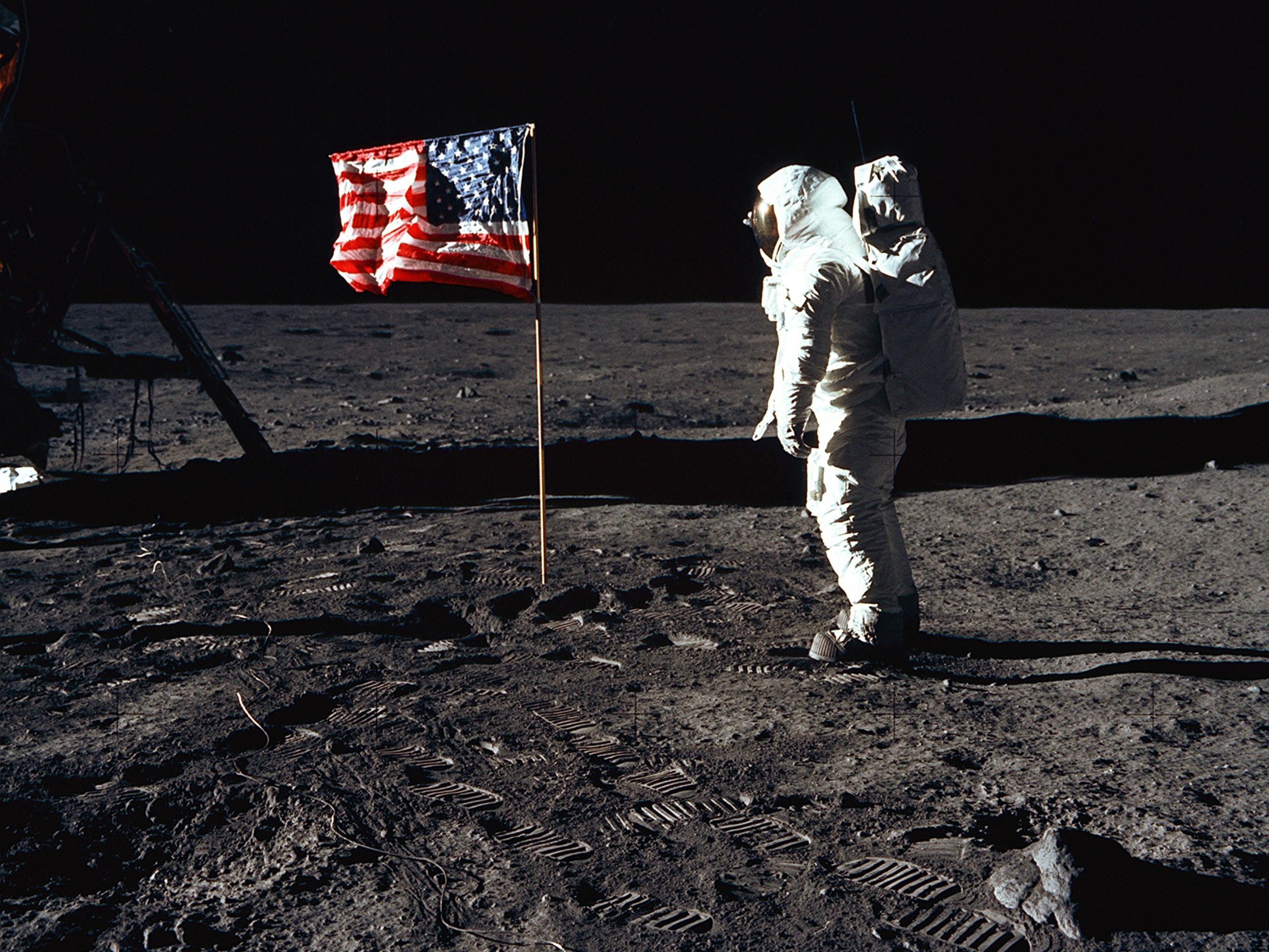
Old Glory saluted by first man on the moon.
The Capital Times’ Editorial Board Agrees: Pope Francis Right to Ring Alarm Bells on Climate Change

Madison Capital Newspaper’s Editorial Board of The Capital Times endorsed Pope Francis’ June 18 Encyclical on Climate Change last week, citing the pope’s recommendation for “cultural revolution” to correct what the pope also said is a “structurally perverse” economic system, exploiting the poor to benefit the rich, turning Earth into an “immense pile of filth”, the pope said.
The following appeared verbatim in The Cap Times’ newspaper and on Madison .com on June 24, 2015 as an opinion and commentary of The Cap Time’s Editorial Board:
Pope Francis is Absolutely Right about Climate Change
“I would like to enter a dialogue with all people about our common home,” writes Pope Francis in the remarkable encyclical on climate change that he has addressed to “every person living on this planet.”
The pope will bring that dialogue to the United States in September and, to our view, he cannot arrive soon enough. Francis is adding to the debate about environmental challenges and responses a sense of urgency that has, for the most part, been missing from the discussions of climate change among the political and economic elites in the United States.
“Doomsday predictions can no longer be met with irony or disdain,” explains the Catholic leader, who argues that the scientific and practical proof of global warming is as undeniable as it is unsettling.
“The Earth, our home, is beginning to look more and more like an immense pile of filth,” Francis argues. “In many parts of the planet, the elderly lament that once beautiful landscapes are now covered with rubbish.”
The pope’s message must be heard in the United States — especially in Washington, especially on Wall Street — as it challenges the superstitions and fantastical thinking of those who still try to deny the human role in creating climate change. And in addressing the crisis.
Some of the deniers are so out of touch with reality that they do not understand what the pope is talking about. Rick Santorum, a clueless conservative who is waging another doomed-to-fail campaign for the Republican presidential nomination, rejected the new encyclical with a bizarre announcement that the pope should “leave science to the scientists.”
Santorum has company in the reality-free zone. A supposedly more serious contender for the Republican nomination, former Florida Gov. Jeb Bush, who like Santorum is Catholic, says, “I don’t get economic policies from my bishops or my cardinals or my pope. I think religion ought to be about making us better as people and less about things that end up getting into the political realm.”
Bush’s fellow front-runner for the Republican presidential nod, Scott Walker, has what Mother Jones magazine refers to as an “inglorious history of anti-environmentalism” in Wisconsin, where the governor recently refused to join a chorus of objection to a move by the Republican-controlled state Board of Commissioners of Public Lands to bar its staffers from engaging in official discussions about climate change. (No thanks to Walker, that idiotic policy was subsequently changed.) And when Americans for Prosperity, the right-wing group funded by the Koch brothers, asked politicians to sign a document devised to restrict government action to address climate change, Walker signed the pledge “to oppose any legislation relating to climate change that includes a net increase in government revenue.”
The ignorance revealed in the statements and actions of political careerists like Santorum, Bush and Walker is such that they may be beyond redemption — at least as regards the climate change debate. They do not seem to understand that the pope is relying on science; Janos Pasztor, the U.N. assistant secretary-general for climate change, says of the pope’s stance: “We have a situation in which science and religion are totally aligned.” Nor do they seem to understand that Francis is not taking a political stand; he is making a moral statement that recognizes an environmental and social circumstance that is denied only by those who persist in placing politics above the facts.
“We are not faced with two separate crises, one environmental and the other social, but rather one complex crisis which is both social and environmental,” writes Francis.
That crisis is “aggravated,” the pope explains, “by a model of development based on the intensive use of fossil fuels.” But it is made worse by indifference of political and economic elites to the condition of those who are already being harmed by climate change, especially the poor who cannot retreat from the disasters that are already playing out and that will grow worse without a radical change of course.
Instead of recognizing that the poor will be the first and the most harmed victims of the environmental catastrophe that is in the making, corporate-aligned political and economic elites in the United States are so neglectful that, the pope writes, “when all is said and done, (the poor) frequently remain on the bottom of the pile.”
Ultimately, of course, we will all be on the bottom of the pile — unless our political and economic responses to climate charge are altered.
Polling shows that, despite massive misinformation campaigns financed by fossil-fuel companies and self-interested billionaires, the American people are beginning to recognize this reality. According to CNN, more than 70 percent of Americans believe the planet is growing warmer, while roughly half now attribute that warming to human causes.
The politicians may resist for a bit longer, but the people are ready for honest leadership on the environmental and economic issues that are arising in an age of considerable climate change. They are ready to ask, as Pope Francis does, “What kind of world do we want to leave to those who come after us, to children who are now growing up?” They are ready for the insight that says, again as the pope does, “The question not only concerns the environment in isolation; the issue cannot be approached piecemeal.”
What the pope proposes is more than mere awareness, however.
Francis seeks action — a “bold cultural revolution” that “(rejects) a magical conception of the market, which would suggest that the problems can be solved simply by an increase in the profits of companies or individuals.”
The pope is absolutely right when he argues that the “invisible forces of the market” will not steer us out of the ditch into which market fundamentalists have steered the planet and its people. But enlightened thinking about the environment along with new approaches to the economy will. This is the promise, and the possibility, that Pope Francis will bring to the United States.
 All Things Environmental
Recent Comments