
Message to Obama on Fighting Poverty and Global Warming

Fight Poverty and Global Warming at the Same Time
I sent the following message to President Obama using Greenpeace’s petition letter as a template on Monday, August 17, 2015:
Dear President Obama,
You have declared that “No challenge poses a greater threat to future generations than climate change” and showed leadership in vetoing the Keystone XL pipeline bill. Why then, would you allow Shell to drill in Arctic waters after a Nature study declared that Arctic Oil MUST be kept in the ground to prevent catastrophic climate change?
One solution that has not been paid enough attention to is to reduce the demand for oil by offering the American public financial incentives to annually drive less (miles); avoid flying entirely, and reduce the amount of electricity they use annually in their homes. This proposal would benefit those who don’t add to the greenhouse gas burden on the atmosphere and oceans and cause other forms of pollution related to fossil fuel burning (including the need to drill and ship oil from the Arctic), who are often those in our society who need supplemental income the most to get out of poverty. Make it pay not to pollute! Right now, too many Americans are using the atmosphere as a “free” sewer to deposit their emissions from excessive burning of fossil fuels, often for recreational travel or other forms of entertainment (travel to “away” sporting events …). See proposal at http://www.allthingsenvironmental.com for more information.
Arctic oil must be left in the ground in order to avoid the catastrophic effects of climate change. The risks are simply too great to allow drilling in this fragile and important ecosystem.
See NASA’s “Vital Signs of the Planet”.
Obama Administration Attacks Leaks and Methane Gas Emissions from Oil Wells

The Obama administration on Tuesday proposed the first federal regulations requiring the nation’s oil and gas industry to cut emissions of wasted methane gas as part of an expanding and increasingly aggressive effort to combat climate change.
In a conference call with reporters, Janet McCabe, the Environmental Protection Agency’s acting assistant administrator for the Office of Air and Radiation, said the rules were designed to ensure that oil and gas companies reduced waste and sold more natural gas that would otherwise be lost, while protecting the climate and the health of the public. Natural gas and methane are actually one and the same gas; methane is commonly called natural gas when it is captured and burned for energy, generating carbon dioxide (CO2) emissions as the primary byproduct. When the methane gas is allowed to escape into the atmosphere unburned, it has a much stronger potential to increase the greenhouse gas effect of the atmosphere than the release of an equal amount of CO2 gas.
Ms. McCabe estimated that the proposals — which would require drillers to stop leaks and capture lost gas even in wells intended to extract only oil — would cost the industry up to $420 million to carry out by 2025, but that there would be savings, including reduced waste, of as much as $550 million during that period, bringing a net benefit of as much as $150 million.
The new rules, which were widely expected, are part of a broad push by the Obama administration to cut emissions of planet-warming gases from different sectors of the economy. This month, Mr. Obama unveiled the centerpiece of that plan, a final regulation meant to cut emissions of carbon dioxide by 32 percent from 2005 levels by 2030 and increase to 28 percent the proportion of the nation’s electricity generated by renewable sources like solar and wind.
The administration has proposed rules for methane emissions because methane emissions released to the atmosphere are 25 times more powerful than carbon dioxide in trapping heat. The administration has set a goal of reducing methane emissions by 40 to 45 percent from 2012 levels by 2025.
The latest proposed regulations are expected to reduce methane emissions by 20 to 30 percent, Ms. McCabe said, getting the administration about halfway to its overall methane reduction target.
Oil and gas companies oppose the proposals, calling them unnecessary and costly, while environmental advocacy groups say they do not go far enough, because they apply mainly to new wells and not most existing ones that already leak methane gas.
Primary Source: The New York Times, August 18, 2015
Wisconsin’s Oil Refinery Abandons Plan to Ship Oil on the Great Lakes
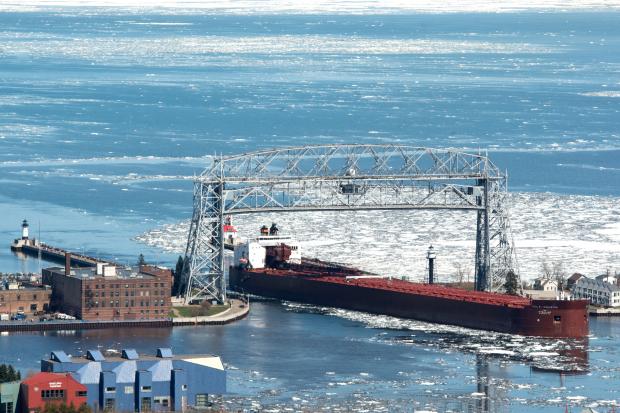
Two years ago, Calumet in Superior began exploring building a dock to load ships with Canadian and Bakken crude that would be carried across Lake Superior. But Superior refinery manager Kollin Schade said they pulled an air permit application with the state this year. He said falling crude prices have affected potential partners on the project, adding that railroads and pipeline operators have made significant investments to meet demand.
“You’re starting to see more pipelines go from North Dakota to other sources and that provides some opportunities for that locally sourced North Dakota crude to make its way to facilities that most want to use it,” said Schade.
Schade also said the length of the shipping season with a shut-down of shipments for several months during the winter also poses a challenge to securing potential partners.
Bakken oil production has dipped in recent months and is expected to fall for the fifth month in a row, according to the Energy Information Administration.
Enbridge Company is building 12 new pumping station on their Pipeline 61, to pump 1.2 Million barrels per day heavy tar sands across Wisconsin. Wisconsin DNR said EIS not needed.
CAFO’s Pollution of Kewaunee County Groundwater

A coalition of local, state and national organizations led by the Socially Responsible Agricultural Project (SRAP) released a damaging report and recommendations for reform on the hazardous, uncontrolled growth of industrial dairy pollution and its impact on the residents of Kewaunee County, Wisconsin. “The RAP SHEETS: Industrial Dairies in Kewaunee County, Wisconsin” is the result of more than a year-long investigation of government documents identifying negligent management of industrial dairy concentrated animal feeding operations (CAFOs) and a lack of oversight and enforcement by the Wisconsin Department of Natural Resources (WDNR) as catalysts for skyrocketing pollution that has pushed Kewaunee County to an environmental and public health crisis. The facilities in this report collectively received $14,417,910 of taxpayer-funded subsidies between the years 1995 – 2013.
Partner organizations Family Farm Defenders and Kewaunee CARES joined SRAP to research, publish and provide recommendations for the first-of-its-kind report on the multiple violations, hundreds of manure management failures and a host of operational problems at the 16 large CAFOs operating within Kewaunee County. Reform proposals include reversing the industry-friendly 2004 Livestock Facility Siting Law and reinstating community control over CAFO zoning and construction — an action that would begin to restore Kewaunee County, and save other Wisconsin counties from a similar fate.
Extremly High Temperatures Along with High DewPoint Temperatures Leading to Higher Death Tolls from Heat Waves

Climate change is literally killing us. According to the Natural Resources Defense Council’s [NRDC’s] “Killer Summer Heat” report, more than 150,000 Americans could die by the end of this century due to the excessive heat caused by climate change. And that estimate only covers America’s top 40 cities.
Why will climate change cause so many casualties? Illnesses that are caused or made worse by extreme heat — including heat exhaustion, heat stroke, cardiovascular disease, and kidney disease — currently lead to hundreds of deaths each year.
As carbon pollution continues to rise, the number of dangerously hot days each summer will increase even further, leading to a dramatic increase in the number of lives lost.
While everyone in these urban areas is at risk, children and the elderly are the most vulnerable.
Scientists expect that average temperatures in North America will rise by another 4°F -11°F this century. The risks to public health are greatest when high temperatures mix with other weather conditions to cause what’s known as an “Excessive Heat Event,” or EHE. EHE days occur when a location’s temperature, dew point temperature, cloud cover, wind speed and surface atmospheric pressure throughout the day combine to cause or contribute to heat-related deaths in that location. [NRDC]
Health impacts spike during excessive heat events. For example, when California was hit by deadly heat waves in 2006, the heat caused during a two-week period 655 deaths, 1,620 excess hospitalizations, and more than 16,000 additional emergency room visits, resulting in nearly $5.4 billion in costs. During a 1995 record-setting heat wave in Chicago, over 700 people died due to the excessive heat.
EHE days vary by region and location. Factors such as geography, green space, local warning and preventive measures affect how much impact the weather will actually have on health.
Climate change is one of the most fiercely debated scientific issues of the past 20 years. Although a steady contingent of global warming deniers have remained insistent that climate change does not pose a threat, there is an overwhelming consensus among the worldwide scientific community that our planet is undergoing significant, highly problematic shifts. Experts point to rising sea levels, record-breaking temperatures across the globe, declining air quality and erratic weather patterns as different manifestations of climate change. Today, doctors, nurses and other medical personnel are drawing attention to the negative effects on human health caused by an increasingly warm, more heavily polluted environment.
According to a 2009 article in Scientific American, a team of climate change researchers from the World Health Organization (WHO) found that “global warming is [responsible] for some 150,000 deaths each year around the world”; they feared this number would double by the year 2030.
Egypt is the latest country outside the U.S. reporting a deadly heat wave occurring this year. At least 93 people have died during a heat wave in Egypt this week that sent air temperatures soaring to as high as 115 degrees Fahrenheit in southern parts of the country, the nation’s official Middle East News Agency (MENA) reported Friday. With high temperatures in the forecast for this weekend, authorities fear the death toll from the high heat may continue to mount.
Earlier this summer, record heat wave death tolls were reported to have occurred in India and Pakistan. France reported hundreds of death from a severe heat wave that occurred in July from 11th to 28th. About 2,065 excess deaths occurred in France during that spell that were attributable to the extreme weather.
To limit the health impacts of climate change, we need to reduce carbon pollution from top sources like power plants and refineries. The EPA has taken its first big step toward setting limits for industrial carbon sources by proposing limits on carbon pollution from new power plants. EPA should take the next step by setting limits on carbon from other sources as well, a government at the federal, state and local level should adopt laws and programs that offer all members of the public positive financial incentives ($) for for burning fewer and fewer amounts of fossil fuels over the year. This would reduce further additions being added to the accumulating carbon dioxide and other greenhouse gases in the environment, which is increasing the potential for more severe and deadly heat waves around the planet.
Hottest July yet, 2015 on Track to be Hottest by Far, Thickest Arctic Sea Ice Gone

January through July 2015 is the hottest first 7 months on record by a large margin.
July 2015 was the warmest on record and 2015 though July 31 is the warmest year on record, NASA reports, and the heat of the developing intense El Nino has just begun to impact global temperatures.
Temperatures in the central and eastern equatorial Pacific ocean have risen rapidly over the past month starting a strong El Nino event which models predict will bring a much warmer than normal fall and winter to the northern hemisphere and strong warming as far south as Antarctica in the southern hemisphere. This July, very warm temperatures in the Canadian Arctic and the Arctic ocean north of Canada melted and crushed the thickest sea ice in the Arctic ocean. Thus, not only was it the warmest July on record, but the stage is set for the possible collapse of late summer Arctic sea ice over the next 2 years as the impacts of El Nino heat drive global and Arctic temperatures upward.
NOAA is now predicting that this El Nino may become the strongest El Nino on record. NOAA’s models predict that heat released in the Pacific will cause strong warming in the north Atlantic in winter to spring 2016 as far north as the Barents sea which is the entry to the Arctic ocean.
The surging temperatures of the first seven months of 2015 may be the beginning of a surge in global temperatures and changes in global weather patterns that will be intensified by a warmer, darker and wetter Arctic.
President Obama Gives Reasons Going to Arctic
President Obama:
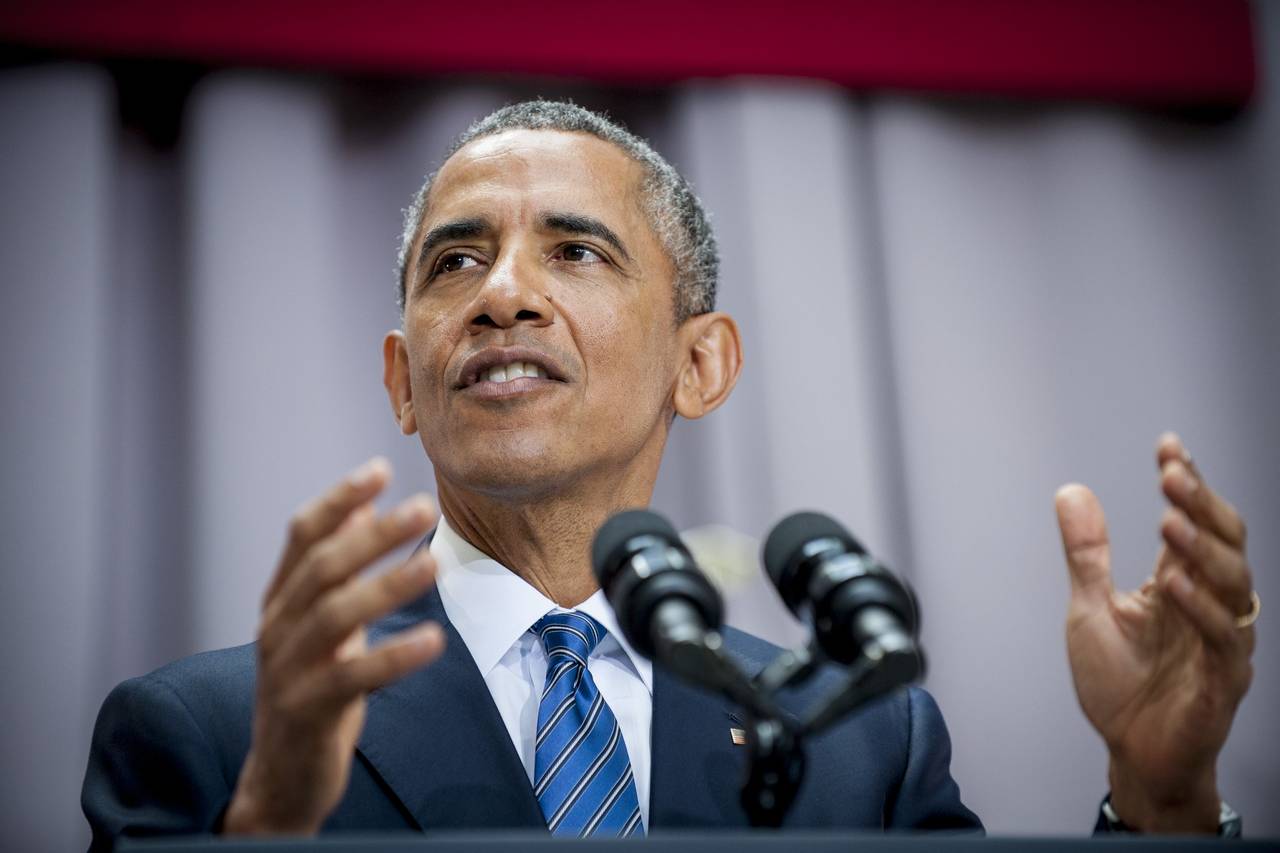
PHOTO: PETE MAROVICH/ZUMA PRESS
President Obama giving a speech at American University, August 5, Washington D.C..
Later this month, President Obama will travel to Alaska and shine a spotlight on what Alaskans in particular have come to know: Climate change is one of the biggest threats we face, it is being driven by human activity, and it is disrupting Americans’ lives right now. [White House]
Can A Global Warming Calamity Be Averted?

“Unless someone like you cares a whole awful lot,
Nothing is going to get better. It’s not.”
― Dr. Seuss, The Lorax
Global warming is often wrongly said to be a political issue. In fact, global warming is no more of a political issue than a tornado is a political issue, or an erupting volcano, or an earthquake or tsunami. These are factual occurrences that occur for known scientific reasons. As there is no debate on the existence or occurrence of these physical happenings nor should there be a need to debate the occurrence of human-caused global warming and climate change as these changes are, too, scientifically based and measured. In fact, sea level has already begun to rise from global warming, measurably. Migratory bird species are changing their patterns and timing of flight; temperature gradients for gardening around the world have changed; heat wave death tolls have risen; extreme weather has become more extreme; average monthly air temperatures at the surface have been steadily rising; dewpoint temperatures in the Midwest have exceeded precedence. Time is running out run out for acting responsibly to avert the worst outcomes possible from global warming. Alarm bells have rung. Action must be taken now, and on a grand scale, to prevent what scientists have been predicting for decades now – the catastrophic consequences of human fed global warming.
Longtime and well respected University of Wisconsin-Madison Chemistry Professor Bassam Shakhashiri recently summarized on Wisconsin Public Radio his own perceptions of the seriousness of the global warming threat and our collective responsibilities as citizens to work towards mitigating and adapting to this monumental threat as follows:
“We should have high expectation of all our government agencies and we should have high expectations of our elected officials and we should have high expectations of everyone who cares about the quality of life of where we live. We face grand challenges. Global warming is unequivocal. It’s not a matter of voting whether we will have global warming or not. It’s a matter of who we elect in the next election cycle to take responsible action to address and to solve this very, very serious and highly consequential question of climate change.
“We have elected officials from our state of Wisconsin who engage in conversations that label other people as deniers of climate change. I think it behooves us as learned individuals, as people who care about the quality of life that we have, to elect individuals to the U.S. Senate to the presidency, to our local government, who can take responsible action to mitigate and to address in responsible ways, and “responsible” is crucial, global warming. It’s not just local here. You can look at different displays of information. In the past 25 years, the plant hardening zones have been changing. Just in the past 25 years, the zone that we are in Wisconsin, is what it was 25 years ago in Florida. We have issues that relate to water quality. We have issues that relate to wellness, to health care.
“We have fabulous opportunities to make great progress in our society, and that’s why I have high expectations – always have high expectations – but I also live in the real world. We must, in the upcoming election cycle, be truly faithful to our core beliefs and to our values, so that our elected officials can act and can respond, in most good ways, to this one issue of climate change. There are other issues, too, but this is really a critical one.” [The Larry Meiller Show,Thursday, August 6, 2015, 11:00 am]
Global warming has all the marking of becoming a worldwide economic, environmental and human disaster. It could be a disaster that has no precedent in nature, at least during the time humans have been inhabiting Earth. Scientific models have demonstrated the inevitably of global warming due to our relentless burning of fossil fuels, in almost every device possible, and our continued deforestation practices, particularly in the tropics. Should global warming be allowed to continue at the current rates, the death toll from global warming effects could ultimately exceed the number of human losses from all wars, human atrocities, motor vehicle crashes, airplane crashes and worldwide epidemics.
History is repleat with examples of being “too little, too late”. U.S. President Hoover’s attempts to end the Great Depression by funding the construction of the Hoover Dam were believed by the American public as being “too little” to save the U.S. economy and “too late”. He was soundly defeated in the U.S. presidential election by Franklin Delano Roosevelt.
In medicine, if someone is sick and they do not get to a doctor until their sickness becomes fatal any remedy will be “too little, too late”.
The Obama administration’s Clean Power Plan to reduce global warming is also both too little and too late to prevent what scientists call a “runaway greenhouse effect”, as what happen on the planet Venus eons ago, making the planet’s former oceans of water boil away, due to surface atmospheric temperatures that continued to climb, unabated.
While the U.S. electrical energy power production may be the top emitting sector of greenhouse gases (GHGs) in the U.S. economy, timely and sufficiently large GHGs emissions reductions in the transportation and other GHG emitting sectors (construction industry sector, agriculture industry sector, consumer sector, export/import sectors, the military industrial complex) will nullify any gains made in the electricity production sector. This could leave the planet vulnerable for the positive GHG feedback mechanisms that contribute to more global warming to kick-in, which could cause a runaway greenhouse effect on Earth. Examples of positive feedback to more global warming of Earth include a reduced ability of the Arctic Ocean to reflect solar energy back into space (darker water absorbs more solar energy than snow and ice), causing additional heating of the oceans; melting of the permafrost region (1/5 of the earth’s surface) resulting in more methane gas (a much stronger GHG than carbon dioxide) production.
Albert Einstein once remarked: “We can’t solve problems by using the same kind of thinking we used when we created them.” Offering the public positive financial incentives to reduce actions that emit greenhouse gases, such as driving, flying and using fossil fuel created heat and electricity, could drastically reduce human caused climate change and as well as other problems created by our fossil fuel powered economy (such as oil spills, ground water pollution from petroleum waste, and natural gas explosions).
‘Godzilla El Niño’ Predicted for West Coast in Late Fall or Early Winter

The strengthening El Niño in the Pacific Ocean has the potential to become one of the most powerful on record, as warming ocean waters surge toward the Americas, setting up a pattern that could bring once-in-a-generation storms this winter to drought-parched California, the Los Angeles Times reported Thursday.
The National Weather Service’s Climate Prediction Center said Thursday that all computer models are predicting a strong El Niño to peak in the late fall or early winter. A host of observations have led scientists to conclude that “collectively, these atmospheric and oceanic features reflect a significant and strengthening El Niño.”
“This definitely has the potential of being the Godzilla El Niño,” said Bill Patzert, a climatologist with NASA’s Jet Propulsion Laboratory in La Cañada Flintridge.
Patzert said El Niño’s signal in the ocean “right now is stronger than it was in 1997,” the summer in which the most powerful El Niño on record developed.
“Everything now is going to the right way for El Niño,” Patzert said. “If this lives up to its potential, this thing can bring a lot of floods, mudslides and mayhem.”
“This could be among the strongest El Niños in the historical record dating back to 1950,” said Mike Halpert, deputy director of the Climate Prediction Center.
After the summer 1997 El Niño muscled up, the following winter gave Southern California double its annual rainfall and dumped double the snowpack in the Sierra Nevada, an essential source of precipitation for the state’s water supply, Patzert said.
The mass of warm water in the Pacific Ocean is also bigger and deeper than it was at this point in 1997, Patzert said.
Second, the so-called trade winds that normally keep the ocean waters west of Peru cool — by pushing warm water farther west toward Indonesia — are weakening.
That’s allowing warm water to flow eastward toward the Americas, giving El Niño more strength.
For this year’s El Niño to truly rival its 1997 counterpart, there still needs to be “a major collapse in trade winds from August to November as we saw in 1997,” Patzert said.
“We’re waiting for the big trade wind collapse,” Patzert said. “If it does, it could be stronger than 1997.”
There is a small chance such a collapse may not happen.
“There’s always a possibility these trade winds could surprise us and come back,” Patzert said.
Overall, the Climate Prediction Center forecast a greater-than-90% chance that El Niño will continue through this winter in the Northern Hemisphere, and about an 85% chance it will last into the early spring.
In California, officials have cautioned the public against imagining that El Niño will suddenly end the state’s chronic water challenges.
In fact, it would take an astonishing 2.5 to three times the average annual precipitation to make up for the rain and snow lost in the central Sierra mountain range over the last four years of drought, said Kevin Werner, the National Oceanic and Atmospheric Administration’s expert on climate in the western United States.
That amount far exceeds what happened in 1983, the wettest year on record for that region, when the area got 1.9 times the average annual precipitation, Werner said.
“A single El Niño year is very unlikely to erase four years of drought,” Werner said.
“The drought is not ending any time soon,” Halpert added.
California has been dry for much of the last 15 years. Even if California gets a wet winter this year, it could be followed by another severe multiyear drought.
Another problem is that the Pacific Ocean west of California is substantially warmer than it was in 1997. That could mean that though El Niño-enhanced precipitation fell as snow in early 1998, storms hitting the north could cause warm rain to fall this winter. Such a situation would not be good news “for long-term water storage in the snowpack,” said Daniel Swain, a climate scientist at Stanford University.
Drought officials prefer snow in the mountains in the winter because it slowly melts during the spring and summer and can trickle at a gentle speed into the state’s largest reservoirs in Northern California. Too much rain all at once in the mountains in the winter can force officials to flush excess water to the ocean to keep dams from overflowing.
Swain said it’s important to keep in mind that all El Niño events are different, and just because the current El Niño has the potential to be the strongest on record “doesn’t necessarily mean that the effects in California will be the same.”
“A strong El Niño is very likely at this point, namely because we’ve essentially reached the threshold already, but a wet winter is never a guarantee in California,” Swain said in an email.
“I think a good way to think about it is this: There is essentially no other piece of information that is more useful in predicting California winter precipitation several months in advance than the existence of a strong El Niño event,” Swain said. “But it’s still just one piece of the puzzle. So while the likelihood of a wet winter is increasing, we still can’t rule out other outcomes.”
A Record 988 Billion Miles Driven on U.S. Highways During First Four Months of 2015
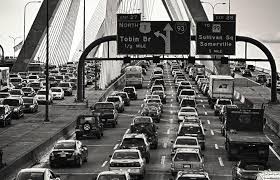
Data from the U.S. Federal Highway Administration show Americans drove a record 988 billion miles during the first four months of 2015. Motor gasoline consumption, which rose by 80,000 barrels per day in 2014, will increase by a projected 170,000 barrels per day (1.9%) in 2015 as the effects of employment growth and lower gasoline prices outweigh increases in vehicle fleet efficiency.
Lower prices along with higher rates of road traffic and more demand for larger vehicles continue to push gas consumption higher.
As refiners continue to produce at a near-record pace, U.S. gasoline stockpiles have declined. Gasoline stockpiles are down 10% since February.
Demand for automotive-grade gasoline increased to 9.17 million barrels (385.14 million gallons) per day, according to information from the Energy Information Administration (EIA).
The Energy Information Administration estimates that for each gallon of gasoline burned in an internal combustion engine, 19.564 pounds of carbon dioxide (CO2) are emitted to the atmosphere, as well as smaller amounts of nitrous oxide and other gases. This calculates to 7.7 billion pounds CO2 per day from U.S. drivers. Carbon dioxide remains in the atmosphere from year to year, building to higher and higher levels of concentration, which is known to be causing warmer temperatures at lower altitudes, warmer ocean surface temperatures. In Wisconsin, nightly low temperatures have increased the most, as reported by the Weather Guys.
Yet nationally, only 63% of U.S. citizens believe global warming is occurring!
 All Things Environmental
Recent Comments