
IPCC Releases Final Report on Global Warming and Climate Change
In a word: “dire” – the Intergovernmental Panel on Climate Change. The window of opportunity for doing something positive about it – closing. The time to start action on quickly reducing human causes releases of greenhouse gases – NOW!
From the Huffington Post (November 3, 2014):
COPENHAGEN, Denmark (AP) — Climate change is happening, it’s almost entirely man’s fault and limiting its impacts may require reducing greenhouse gas emissions to zero this century, the U.N.’s panel on climate science said Sunday.
The fourth and final volume of the Intergovernmental Panel on Climate Change’s giant climate assessment offered no surprises, nor was it expected to since it combined the findings of three reports released in the past 13 months.
But it underlined the scope of the climate challenge in stark terms. Emissions, mainly from the burning of fossil fuels, may need to drop to zero by the end of this century for the world to have a decent chance of keeping the temperature rise below a level that many consider dangerous.
The IPCC didn’t say exactly what such a world would look like but it would likely require a massive shift to renewable sources to power homes, cars and industries combined with new technologies to suck greenhouse gases from the atmosphere.
The report warned that failure to reduce emissions could lock the world on a trajectory with “irreversible” impact on people and the environment. Some impacts already being observed included rising sea levels, a warmer and more acidic ocean, melting glaciers and Arctic sea ice and more frequent and intense heat waves.
The science has spoken. There is no ambiguity in their message. Leaders must act. Time is not on our side,” U.N. Secretary-General Ban Ki-moon said at the report’s launch in Copenhagen.
Amid its grim projections, the report said the tools are there to set the world on a low-emissions path and break the addiction to burning oil, coal and gas which pollute the atmosphere with heat-trapping CO2, the chief greenhouse gas.
“All we need is the will to change, which we trust will be motivated by knowledge and an understanding of the science of climate change,” IPCC chairman Rajendra Pachauri said.
The IPCC was set up in 1988 to assess global warming and its impacts. The report released Sunday caps its latest assessment, a mega-review of 30,000 climate change studies that establishes with 95-percent certainty that most of the warming seen since the 1950s is man-made. The IPCC’s best estimate is that just about all of it is man-made, but it can’t say that with the same degree of certainty.
Today only a small minority of scientists challenge the mainstream conclusion that climate change is linked to human activity.
Global Climate Change, a NASA website, says 97 percent of climate scientists agree that warming trends over the past century are very likely due to human activities.
The American public isn’t as convinced. A year-old survey by Pew Research showed 67 percent of Americans believed global warming is occurring and 44 percent said the earth is warming mostly because of human activity. More recently, a New York Times poll said 42 percent of Republicans say global warming won’t have a serious impact, a view held by 12 percent of Democrats and 22 percent of independents.
Sleep-deprived delegates approved the final documents Saturday after a weeklong line-by-line review that underscored that the IPCC process is not just about science. The reports must be approved both by scientists and governments, which means political issues from U.N. climate negotiations, which are nearing a 2015 deadline for a global agreement, inevitably affect the outcome.
The rift between developed and developing countries in the U.N. talks opened up in Copenhagen over a passage on what levels of warming could be considered dangerous. After a protracted battle, the text was dropped from a key summary for policy-makers — to the disappointment of some scientists.
“If the governments are going to expect the IPCC to do their job,” said Princeton professor Michael Oppenheimer, a lead author of the IPCC’s second report, they shouldn’t “get caught up in fights that have nothing to do with the IPCC.”
The omission meant the word “dangerous” disappeared from the summary altogether. It appeared only twice in a longer underlying report compared to seven times in a draft produced before the Copenhagen session. The less loaded word “risk” was mentioned 65 times in the final 40-page summary.
“Rising rates and magnitudes of warming and other changes in the climate system, accompanied by ocean acidification, increase the risk of severe, pervasive, and in some cases irreversible detrimental impacts,” the report said.
World governments in 2009 set a goal of keeping the temperature rise below 2 degrees C (3.6 F) compared to before the industrial revolution. Temperatures have gone up about 0.8 C (1.4 F) since the 19th century.
Emissions have risen so fast in recent years that the world has used up two-thirds of its carbon budget, the maximum amount of CO2 that can be emitted to have a likely chance of avoiding 2 degrees of warming, the IPCC report said.
“This report makes it clear that if you are serious about the 2-degree goal … there is nowhere to hide,” said Alden Meyer of the Union of Concerned Scientists, an advocacy group. “You can’t wait several decades to address this issue.”
U.S. Secretary of State John Kerry said the report demands “ambitious, decisive and immediate action.”
“Those who choose to ignore or dispute the science so clearly laid out in this report do so at great risk for all of us and for our kids and grandkids,” Kerry said in a statement.
The IPCC said the cost of actions such as shifting to solar and wind power and other renewable sources and improving energy efficiency would reduce economic growth only by 0.06 percent annually.
Pachauri said that should be measured against the implications of doing nothing, putting “all species that live on this planet” at peril.
The report is meant as a scientific roadmap for the U.N. climate negotiations, which continue next month in Lima, Peru. That’s the last major conference before a summit in Paris next year, where a global agreement on climate action is supposed to be adopted.
The biggest hurdle is deciding who should do what. Rich countries are calling on China and other major developing countries to set ambitious targets; developing countries saying the rich have a historical responsibility to lead the fight against warming and to help poorer nations cope with its impacts. The IPCC avoided taking sides, saying the risks of climate change “are generally greater for disadvantaged people and communities in countries at all levels of development.”
AP: By KARL RITTER
Posted: 11/02/2014 7:35 am EST Updated: 11/03/2014 12:59 pm EST
IPCC Sounds Fresh Alarm as Fossil Fuel Interests Tighten Grip on Congress
The leading international network of climate scientists is urging a rapid shift away from fossil fuels, just as allies of coal, oil and natural gas industries in the United States appear poised to tighten their grip on Congress—where opposition to cleaner energy is already entrenched.
That outcome of Tuesday’s midterm election would spell trouble for advocates of a strong international climate accord. Treaty negotiations are supposed to pick up in the next few months and culminate in Paris just over a year from now.
This weekend, the UN’s Intergovernmental Panel on Climate Change issued a synthesis report that sums up its years-long review of the climate crisis and what to do about it. The report called for the near-complete elimination of fossil fuel-burning by the end of the century. This, it said, is what is needed to have a reasonable chance of avoiding the most severe risks of man-made changes to the world’s climate.
Nothing could be further from the agenda of Sen. Mitch McConnell of Kentucky, the coal-state Republican who on the eve of the election appears to have significantly better than even odds of becoming the next majority leader. (Though, as the IPCC might put it, until the last votes are tallied any forecast of which party will prevail deserves only “medium confidence.”)
Even if the Republicans don’t gain a majority in the Senate on Nov. 4, they are likely to gain strength in that chamber as well as in the House—an election outcome that would undermine President Obama’s entire climate agenda, not just his influence in the Paris talks.
From the Keystone XL pipeline decision and so-called “war on coal,” to a carbon tax and the very foundations of climate science, Congressional Republicans have opposed Obama on anything having to do with global warming from his first days in office.
Just last year, on the day the IPCC released one of three exhaustive treatments that formed the basis of this week’s synthesis report, McConnell co-sponsored an amendment to block the EPA from regulating fossil fuels in electric power plants, the largest single source of carbon emissions in this country.
His co-sponsor, Sen. James Inhofe of Oklahoma, offered another amendment at the same time. It would have prohibited the administration from participating in international climate negotiations “unless the U.S. offers an addendum to the latest IPCC report stating that anthropogenic climate change is a scientifically unproven theory.” Inhofe, who reportedly aspires to be chairman of the environment committee in a Republican Senate, calls the whole IPCC enterprisea “conspiracy” and “a hoax.”
Their ascent would alarm participants in the climate talks who agree with IPCC chairman, Rajendra Pachauri, that the climate crisis could be solved if action is quick and decisive. “All we need,” Pachauri said as he released the new synthesis report, “is the will to change, which we trust will be motivated by knowledge and an understanding of the science of climate change.”
Emissions must fall by 40 to 70 percent between 2010 and 2050, and then to zero by 2100, he explained at a news conference.
Those are fighting words to anyone committed to defending the coal industry in Kentucky, the oil and gas industry in Oklahoma, or campaigning in any fossil fuel stronghold—from the Marcellus shale to the Bakken light oil play. And it helps explain why the politics of carbon are a feature of so many swing elections in states like West Virginia, Colorado, Louisiana and Alaska.
The contrast between this increasingly partisan American political divide and the increasingly solid international scientific consensus could hardly be starker.
“The scientists have done their jobs and then some,” said Alden Meyer of the Union of Concerned Scientists, who has tracked the negotiations for decades. “Politicians can either dramatically reduce emissions or they can spend the rest of their careers running from climate disaster to climate disaster.”
Other environmental advocates, too, issued statements emphasizing that the synthesis report—including its summary for policymakers, expressly designed to guide them toward early action —was as significant politically as it was scientifically.
“The report is alarming and should be a wake-up call to government leaders,” said Mindy Lubber, president of Ceres, a group that encourages businesses to show leadership on climate issues. Her statement called on them to “ramp up the pressure…especially in Washington.”
“The critical missing link is the oil and gas industry, which is doing its best to thwart concrete action,” she said.
The Sierra Club’s Michael Brune aimed a jibe at the Koch brothers and their favored candidates, saying that “we don’t have any more time to coddle fossil fuel billionaires or politicians who will eschew responsibility at every corner.”
Big environmental groups have spent heavily in this campaign, too—$85 million on state and federal races, according to Daniel Weiss of the League of Conservation Voters, including $40 million on just six key Senate races. And in the closing days, they were knocking on millions of doors to bring out a green vote.
The organizations released results from a Hart Research Associates poll taken in late October in swing states suggesting that the climate issue could break in their favor.
“The survey suggests that Republican candidates are losing ground as a result of their climate science denial and opposition to climate pollution reductions,” Hart reported. “This is true among independent swing voters, and particularly among women and younger voters.”
But only about 40 percent of those surveyed said they had heard much of candidates’ views on climate. A majority had heard about energy issues, but far more about abortion, jobs and Obamacare.
Earth’s About to Lose What Little Chance It Had – Unless We Act Now!
Who’s Gonna Stand Up
Neil Young’s Who’s Gonna Stand Up (and Save the Earth)
Protect the wild, tomorrow’s child
Protect the land from the greed of man
Take down the dams, stand up to oil
Protect the plants, and renew the soil
Who’s gonna stand up and save the earth?
Who’s gonna say that she’s had enough?
Who’s gonna take on the big machine?
Who’s gonna stand up and save the earth?
This all starts with you and me
Damn the dams, save the rivers
Starve the takers and feed the givers
Build a dream, save the world
We’re the people know as earth
Who’s gonna stand up and save the earth?
Who’s gonna say that she’s had enough?
Who’s gonna take on the big machine?
Who’s gonna stand up and save the earth?
This all starts with you and me
Ban fossil fuel, draw the line
Before we build, one more pipeline
Ban fracking now, save the waters
And build a life, for our sons and daughters
Who’s gonna stand up and save the earth?
Who’s gonna say that she’s had enough?
Who’s gonna take on the big machine?
Who’s gonna stand up and save the earth?
This all starts with you and me
Who’s gonna stand up
Who’s gonna stand up
Who’s gonna stand up
Who’s gonna stand up
Who’s gonna stand up
Who’s Gonna Stand Up (and Save the Earth)?
(full orchestra & choir version)
Start here. Sign “Conserve NOW Petition to President Obama, U.S. Congress, Wisconsin Governor Walker and Wisconsin Legislature to Enact and Fund Climate Change Legislation” (September 16th post on this blog) or;
I’ve also started the petition “U.S. Congress: Enact and Fund Legislation to Pay Families and Individuals who Use Less Fossil Fuel Energy Annually on Changeorg
Will you take 30 seconds to sign it right now? Here’s the link:
Here’s why it’s important:
Using money that now goes to subsidize the fossil fuel industries (coal, oil, natural gas), instead offer that money to those who limit their driving, flying and household use of fossil fuel devived energy. This would helpslow global warming and sea level rises and would negate the need for raising the minimum wage and foodstamps.
You can sign my petition by clicking here.
.
Thanks
Conserve, NOW! Planet Earth Needs Our Help Now More Than Ever

On this Labor Day (September 1, 2014) Community Radio Station WORT-FM, 89.9 will broadcast a special program on its weekly show “The Access Hour”, from 7:00 to 8:00 PM. The Labor Day show is called: “Planet Earth: It Needs Our Help Now More Than Ever!”. The show can be heard live on radio in the listening area – south central Wisconsin including Madison, Wisconsin where it originates. The show can also be listened to anywhere in the world at http://www.wortfm.org. All earthlings are invited to listen in then, or on the archive of the WORTFM.org website at their convenience.
The program will consist of both music and dialog, appropriate to issues that confront many of us and those important to all of us and future generations.
Accordingly, I have initiated a petition drive to demand our federal and state legislative leaders to take immediate and major actions that will jointly confront these issues. If you wish to read and sign the petition, please do so. It’s sorely needed. Please send me an email to MTNeuman@gmail.com requesting it and I’ll forward the link to use for signing the petition.
The program being advanced advocating is designed to minimize our fossil burning before it’s too late, by telling our government to establish a program that provides positive financial incentives – supplemental income – for all individuals and families who burn less fuel annually: (1) by driving less or no miles (more $ for not at all); (2) by not flying in that year; and (3) by using less fossil fuel derived energy in heating, cooling and using electricity derived from burning fossil fuel in the year than the average household in a year. Money can be earned by doing (1), more by doing (2) and even more by doing (3), yearly,
Money used to finance this program could come from a number sources:
1) Money the U.S. Department of Transportation and states SAVE (billions of dollars) by not paving even more lanes of highways and bridges on the landscape with cement and asphalt (both require fossil fuel burning) to accommodate more driving of motor vehicles;
2) Money the U.S. Federal Aviation Administration would SAVE (more billions of dollars) by requiring the commercial airlines pay air flight controllers, instead of the federal government (U.S. citizens) providing these employees for the exclusive financial interests of commercial airlines and aviation fuel suppliers.
3) Money from levying a tax on all carbon emitted by electrical power generation plants in the U.S. which burn fossil fuels (more billions of dollars), and emitted by the transportation sector (jets, cars, motorcycles, trucks, trains and buses, work vehicles and fossil fueled equipment, and recreational vehicles, including but not limited to ATVs, motor boats, snowmobiles, jet skis).
4) Money from other extravagant federal expenditures, such as the billions of dollars paid to private defense contractors, at home and abroad, and also the billions of dollars of subsidies the U.S. government (American taxpayers) presently awards to the fossil fuel industry (coal, oil, natural gas) operating in the U.S..
Only individuals and families in the U.S. who conserve energy (emit fewer greenhouse gases) by driving less (or no) miles; by not flying; and by using less fossil fuel derived energy in their home during a year would earn the REWARDS.
More detailed information on this proposal can be viewed on the Conserve, NOW! post of August 16. 2014.
Call for Action on Climate Change by Renown Chemistry Professors’ Bell and Shakhashiri

In the March 17, 2014 Issue of Chemical and Engineering News, Volume 92 Issue 11, two renown educational scientists decided to co-author an editorial in the prestigious magazine to alert the public and politicians about the facts, causes, implications, and yes, the danger of unmitigated acceleration of greenhouse gases in the atmosphere and the need for immediate action to stem the growing changes to the earth’s climate. Their names are Jerry A. Bell and Bassam Z. Shakhashiri .
Dr. Bell is an emeritus professor in the department of chemistry at Simmons College, Boston, and chair of the American Chemical Society’s Presidential Working Group on Climate Science. After deciding on a career in science, Bell earned a bachelor’s degree in Chemistry followed by a PhD in Chemistry, both from Harvard University. During his time at Harvard, he worked as volunteer tutoring students in math and science.
Dr. Bell went on to hold teaching and research positions at colleges across the country, including UW-Madison, the University of California-Riverside, Brandeis University and Simmons College. He served at the National Science Foundation as director of the Division for Teacher Preparation and Enhancement (1984-1986), as director of the UW-Madison Institute for Chemical Education (1986-1989). He was director for Science, Mathematics, and Technology Education Programs at the American Association for the Advancement of Science (1992-1999), and was a senior scientist with the Education Division at the American Chemical Society (1999-2009) where he continues to serve as a consultant. He is widely recognized for his outstanding contributions to science education by many major awards including the ACS George C. Pimentel Award in Chemical Education (2000), the ACS James Flack Norris in Chemistry Education (1992) and the Chemical Manufacturers Catalyst Award (1977), and he travels to Wisconsin to work on programs of the Wisconsin Initiative for Science Literacy (WISL), founded by Dr. Shakashiri in 2002 who serves as its director. Bells work on behalf of the WISL in the Washington, DC area includes activities with educational groups and laboratory research in the chemistry department at the University of Maryland-College Park.He lives in Silver Springs, MD, with his wife, Mary Ann.
Bassam Z. Shakhashiri is the first holder of the William T. Evjue Distinguished Chair for the Wisconsin Idea at UW-Madison. He is well known internationally for his effective leadership in promoting excellence in science education at all levels, and for his development and use of demonstrations in the teaching of chemistry in classrooms as well as in less formal settings, such as museums, convention centers, shopping malls and retirement homes. The Encyclopedia Britannica sites him as the “dean of lecture demonstrators in America.” His scholarly publications, including the multi-volume series, Chemical Demonstrations: A Handbook for Teachers of Chemistry, are models of learning and instruction that have been translated into several languages. He is an advocate for policies to advance knowledge and to use science and technology to serve society. He promotes the exploration and establishment of links between science, the arts and the humanities, and the elevation of discourse on significant societal issues related to science, religion, politics, the economy, and ethics. Professor Shakhashiri was the 2012 president of the American Chemical Society, and will serve a one-year term as immediate past president in 2013.
A native of (Anfe, El-Koura) Lebanon, Professor Shakhashiri is the son of the late Dr. Zekin A. Shakhashiri, a pioneer in public health at the American University of Beirut, and the late Adma N. Shakhashiri, an alumna of what is now Lebanese American University. The Shakhashiris — father, mother, son and two daughters, Amal and Maha — came to the United States in 1957 when Bassam was 17 years old with one year of college (at the American University of Beirut) behind him. He completed undergraduate work at Boston University (Class of ’60) with an A. B. degree in chemistry, served as a teaching fellow at Bowdoin College for one academic year and then earned M.Sc. and Ph.D. degrees in chemistry at the University of Maryland (’64 and ’68, respectively).
After a year of post-doctoral research and two years as a junior member of the chemistry faculty at the University of Illinois-Urbana, Professor Shakhashiri joined the faculty of the UW-Madison in 1970, a position he still holds. In 1977 he became the founding chair of the UW System Undergraduate Teaching Improvement Council, now called the Office of Professional and Instructional Development. In 1983 he founded the Institute for Chemical Education (ICE) and served as its first director. His work with ICE inspired the establishment of the Center for Biology Education, the Merck Institute for Science Education, the Miami University (of Ohio) Center for Chemical Education, the Sacred Heart University SMART Center, and others. In 2002 he founded the Wisconsin Initiative for Science Literacy (WISL) and continues to serve as its director.
From 1984 to 1990 Professor Shakhashiri served as Assistant Director of the National Science Foundation (NSF) for Science and Engineering Education. As the NSF chief education officer he presided over the rebuilding of all the NSF efforts in science and engineering education after they had been essentially eliminated in the early 1980’s. His leadership and effectiveness in developing and implementing national programs in science and engineering education have helped set the annual NSF education budget at its current level of over $900 million. His NSF strategic plan launched the systemic initiatives and most of the other NSF education programs of the last two decades.
Professor Shakhashiri has given over 1400 invited lectures and presentations in North America, Europe, Asia, Australia, the Middle East and South America. He has been featured in newspapers, magazines, national and local radio and television; these include the New York Times, Washington Post, Newsweek, Time, the German-language Business Week, NBC Nightly News, National Public Radio, CNN, and the Larry King show. He appears as a regular guest on the Ideas Network of Wisconsin Public Radio.
Professor Shakhashiri is the recipient of over 35 awards, including Outstanding Lecturer of the Year in General Chemistry, University of Illinois (1969 and 1970), the 1977 Kiekhofer Distinguished Teaching Award from UW-Madison, and the 1979 Manufacturing Chemists Association Catalyst Award. He is the youngest recipient of two of the American Chemical Society’s (ACS) most coveted recognitions — the James Flack Norris Award for Outstanding Achievement in the Teaching of Chemistry (1983) and the ACS George Pimentel Award in Chemical Education (1986); he has been a member of the ACS since 1962. In 1982 he was given the Ron Gibbs Award of the Wisconsin Society of Science Teachers for “outstanding contributions to science education at the local, regional, national, and international levels.” In 1987, he was cited for distinguished public service by the District of Columbia Science Education Association, the National Science Teachers Association, the South Carolina Academy of Science, and the Boston University General Alumni Association.
He received the 2002 American Association for the Advancement of Science (AAAS) Award for Public Understanding of Science and Technology, “for his tireless efforts to communicate science to the general public, and especially children.” In 2004 he was inducted into the Hall of Fame of the national chemistry fraternity Alpha Chi Sigma. In 2005 he received the Madison Metropolitan School District Distinguished Service Award for a Citizen, the Chemical Pioneer Award from the American Institute of Chemists, the ACS Helen M. Free Award for Public Outreach for “lifelong accomplishments and for explaining and demonstrating science with charisma and passion.”In 2006 he received the Rotary Senior Service Award from the Rotary Club of Madison. In 2007 he received the National Science Board Public Service Award and was cited for “extraordinary contributions to promote science literacy and cultivate the intellectual and emotional links between science and the arts for the public.” In 2008 he received the inaugural Emerson Science Advocacy Medal from the University of Nevada-Las Vegas and was cited for “distinguished, sustained, and lasting contributions in the development of the sciences.”
Professor Shakhashiri is an elected fellow of the South Carolina Academy of Science, the Alabama Academy of Science, the New York Academy of Science, and the Wisconsin Academy of Sciences, Arts and Letters. He is the recipient of honorary doctoral degrees from George Washington University, Illinois State University, Ripon College, University of Colorado, Grand Valley State University, University of South Carolina and Lebanese American University. He is a national and international consultant to government agencies, academic institutions, industry, and private foundations on policy and practice matters related to science and to education at all levels. Professor Shakhashiri and his wife, June, live in Madison.
In the March 17, 2014 Issue of Chemical and Engineering News, Volume 92 Issue 11, the two renown educational and chemical scientists decided to join forces and co-author an editorial about the urgent need for climate action. A reproduction of that editorial follows.
“Action On Climate Change”
By Jerry A. Bell, Bassam Z. Shakhashiri
In Chemical and Engineering News
Atmospheric concentrations of carbon dioxide, methane, and other greenhouse gases are increasing. The well-known greenhouse effect caused by these gases traps solar energy, warming Earth’s atmosphere, land, and oceans and melting its ice. Thermal expansion of ocean water and liquid from melting land ice are raising sea levels, and dissolution of more carbon dioxide is lowering ocean pH. These observed changes are largely caused by human activities. The burning of fossil fuels drove the Industrial Revolution, which enormously raised the standard of living of much of the world, but it is also changing the climate.
Large increases in the amount of energy in Earth’s climate system of necessity produce changes, such as more water vapor in the air and more intense storms. The extent of these effects is not yet well characterized. But, as the system gains more energy, climate changes are likely to be larger and more lifestyle disruptive. Because the increasing amounts of greenhouse gases are responsible for the buildup of energy in the climate system, actions to reduce emission of these gases are needed now.
Actions by individuals and society as a whole, which includes scientific professional organizations such as the American Chemical Society (ACS), are required. Individuals, for example, can use more efficient lighting and appliances, make greater use of public transportation, drive low-emission vehicles, teleconference more and travel less, support efforts to mitigate the undesired consequences of climate change, and encourage government representatives to do the same. ACS has implemented approaches such as these in its headquarters buildings, which have been awarded platinum certification by the Leadership in Energy & Environmental Design (LEED) program of the U.S. Green Building Council.
Chemists and other scientists can reinforce their knowledge of climate science by using the ACS Climate Science Toolkit. The tool kit provides scientists with the background and incentive to engage others in discourse on the issues raised by climate change and the need to take action. Individual actions have small effects on energy consumption, but inaction has zero effect.
Individuals acting collectively—that is, society working through the social contract—can implement even more effective measures to mitigate climate change. But because the effects of collective action are larger and may affect individuals differently, these actions are more controversial, even when based on sound scientific and economic principles. An example of such a measure is a revenue-neutral carbon tax imposed at the source—the wellhead, mine, or port of entry. As the cost of the carbon is passed along, individuals have an incentive to lower their carbon footprint. As they do so, the value of their share of the tax proceeds that are distributed is maximized, and overall energy use and greenhouse gas emissions are reduced. In practice, the political will of the collective is required to enact any such approach, as is agreement that continued climate change will result in the severe consequences that climate scientists expect.
A responsibility of ACS is to further support and fortify its members in their efforts to communicate the science and effects of climate change. ACS has done this with its Climate Science Challenge Grants that local sections have received. ACS must continue to promote the ACS policy on global climate change developed by the Committee on Environmental Improvement and approved by the ACS Board of Directors. The policy provides credibility for members as they interact with others, including elected representatives, about the consequences of climate change. ACS should energize its members and affirm its commitment as a leader among scientific professional associations to advocate for local, national, and international actions that reduce the effects of climate change for the benefit of Earth and its people.
Chemical & Engineering News
ISSN 0009-2347
Copyright © 2014 American Chemical Society

Despite the excellent presentation of the facts and the implications by these renown scientists, our U.S. Congress, state Legislatures and governors, and the governments of other countries have been taken little or no timely action to meaningfully attack the source of this growing world calamity.
Putting off expensive measures to curb climate change will only cost the United States more in the long run. “Each decade we delay acting results in an added cost of dealing with the problem of an extra 40 percent,” said Jason Furman, chairman of Obama’s Council of Economic Advisers.”We know way more than enough to justify acting today,” Furman told reporters, drawing her conclusions from 16 recent economic studies that modeled the costs of climate change. The report was being released as the U.S. Environmental Protection Agency held public hearings on its plan to cut carbon emissions from power plants – the centerpiece of Obama’s climate action plan, in June 2014.
It’s not just the Obama administration that has been issuing these dire projections to detail the likely results of continuing the status quo of “business as usual” societal practices.
In June, a bipartisan report commissioned by former New York City Mayor Michael Bloomberg, former U.S. Treasury Secretary Henry Paulson and environmentalist Tom Steyer forecast a multibillion-dollar price tag for climate costs, such as property losses from storms, declining crop yields and soaring power bills during heatwaves. Their jointly prepared report Risky Business found the U.S. faces significant economic risks from climate change. Former HHS Sec. Donna Shalala and Johns Hopkins Dean Emeritus Dr. Alfred Sommer: “Imagine if we experienced multiple Chicago heat waves every summer, in cities all across the country. That is the direction we are headed unless we change course and take strong, decisive action to curb climate change.” “Everything that is challenging about producing more food for a world that is more populous, more urban and more affluent becomes more so when faced with a changing climate”, said Greg Page, executive chairman of Cargill Inc., the company headquartered in suburban Minneapolis that provides food, agriculture, financial and industrial products and services throughout the world in his article “Agriculture must engage in climate change discussion” in the August 10, 2014 Des Moines Register. We’ve already seen what climate change has brought to the most populous state in the country: California.
The following is by Ian James, The (Palm Springs, Calif.) Desert Sun (in USA Today)
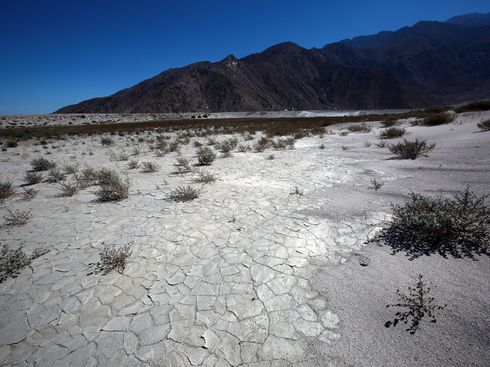 Cracks spread across the dry bed of parched percolation pond one at the Whitewater Groundwater Replenishment Facility near Palm Springs on Wednesday. / Crystal Chatham/The Desert Sun
In California, record heat is adding to extreme drought. The first half of 2014 was by far the hottest in California in 120 years of record-keeping, and that heat is exacerbating one of the most devastating droughts in state history along with massive, too numerous to count major wildfires.
Month after month, the red and burgundy patches on the California drought map have been spreading, with 82 percent of the state now classified as being in “extreme” or “exceptional” drought on the U.S. Drought Monitor website.
Reservoirs have been shrinking, aquifers have been declining, and an estimated 5 percent of the state’s irrigated farmland, from the Central Valley to Southern California, has been left dry and withering.
The increasingly dire water situation across California is being compounded by unusual heat. Long-term weather records maintained by the National Climatic Data Center show that California had its warmest January-June period since record-keeping began in 1895, with the average temperature 4.6 degrees Fahrenheit above average and more than 1 degree warmer than the previous record, set in 1934. July figures have yet to be released.
“In the business of climate science, this is a shattering of a record,” said Jonathan Overpeck, a professor of geosciences and co-director of the University of Arizona’s Institute of the Environment. “We are fairly certain that the unusual warmth is mostly due to human-caused global warming.”
For climate scientists, it can be difficult to trace the influence of climate change in the weather patterns of a year or two. But after decades with average temperatures on the rise, Overpeck said the extraordinary heat during this drought makes it a “global warming drought” that is indicative of the hotter dry spells expected in the future.
While California and the West is naturally prone to drought and have experienced long-lasting mega-droughts in the past, scientists say the long-term trend of rising average temperatures is now packing an extra punch. Hotter temperatures worsen droughts by reducing mountain snowpack and causing more evaporation from streams and reservoirs. Heat also draws more moisture from plants and the soil, and increases the amounts of water needed to irrigate crops and vegetation.
Meteorologist Richard Heim, a drought expert with the National Climatic Data Center in Asheville, North Carolina, said he has been amazed as high temperature records have been blown away this year in California.
“I’m just, ‘Wow,’ looking at these trends. Can it get any worse? Well, the models say yeah,” Heim said. “But how much more can we take as a society, as individual people? And how much more of this can the infrastructure and policies that have been put in place to deal with this at the state level, federal level, local level, how much more of this can you guys take?”
High pressure turns up heat
The main weather feature behind the drought and record temperatures has been a persistent high-pressure ridge over the West and the eastern Pacific Ocean. It has been called the “Ridiculously Resilient Ridge” since Stanford University graduate student Daniel Swain coined that term on his California Weather Blog last year, and the ridge has been keeping storms away from the region.
There is also a two-way relationship between the drought and heat, Heim explained. While the hotter temperatures are contributing to drier conditions, those same dry conditions are in turn amplifying the higher temperatures a bit. This occurs because dry ground tends to heat up faster than wet ground, adding more heat to the air.
In Sacramento as well as Washington, lawmakers have been debating measures that proponents say are aimed at coping with the drought and helping the West become more resilient to face growing water scarcity.
Sen. Barbara Boxer, D-Rancho Mirage, for instance, has recently backed legislation focused on addressing the drought and the impacts of climate change.
“As far back as 1995, climate scientists have predicted that increasing global temperatures would lead to more severe droughts in some regions of the world. We know that climate change is linked to the type of intense, record-breaking droughts that we are experiencing in California,” Boxer said by email. “The intensity and frequency of droughts will continue to worsen unless we take steps to address climate change by reducing carbon pollution.”
In addition to promoting President Barack Obama’s plan to reduce carbon emissions from power plants, Boxer touted the recently-passed Water Resources Reform and Development Act, which she said will help California respond to the deepening drought. The law will enable communities to obtain financing for projects such as water recycling, desalination and repairs of old water infrastructure.
Boxer, who leads the Environment and Public Works Committee, recently introduced another bill that would back local investments in water recycling and groundwater management, expand grants and rebates for water conservation, invest in water-related research, and create an open water data system. She said the measure would “help local communities take steps to become better prepared for drought.”
El Nino reprieve unlikely
Earlier this year, predictions of an El Nino raised hopes that a strong warming of the tropical Pacific could lead to drought-ending rains in California and the West. But in the past week, the National Weather Service updated its forecast and said the chance of an El Nino forming has decreased from about 80 percent to 65 percent during the fall and early winter.
State Climatologist Michael Anderson said, however, that an El Nino wouldn’t necessarily mean relief because both the wettest year and the driest year in the past 60 years were El Nino years.
“For Northern California, El Nino by itself is not a strong predictor,” Anderson said. “So we’ll have to look elsewhere.”
One wet winter could go a long way toward refilling many of the state’s dwindling reservoirs. But the depletion of the state’s aquifers is a much deeper problem.
“It will probably take a number of wet years,” Anderson said, “to make up some of the groundwater deficits that have been incurred.”
Groundwater vanishing
In many areas of California and the Southwest, groundwater levels have been declining for years as water has been heavily pumped for farmland and expanding development. The drought has added significantly to those strains.
In a new study, NASA and UC Irvine scientists used satellite data to track changes in the Colorado River Basin and determined that since late 2004, the region has lost nearly 53 million acre-feet of water. That’s almost double the volume of water that can be held in Lake Mead, the nation’s largest reservoir. The researchers also found that more than three-quarters of the water extracted was groundwater.
“That really forces you to raise your eyebrows and think about how long we can keep doing this, how long we can keep depleting groundwater at that rate,” said Jay Famiglietti, senior water scientist at NASA’s Jet Propulsion Laboratory and one of the study’s authors.
Famiglietti said the era of abundant water is clearly over in the West, and that the rapid declines of many aquifers point to a need for better management and additional studies to determine how much groundwater remains.
“We can see that we’re using a lot of it and so now we need to figure out how much is left,” Famiglietti said. “We need to do these explorations that need to be done – as if it were oil.”
Dramatic declines in the level of Lake Mead offer a glimpse of larger changes in water supplies taking place underground and across the region. The reservoir last month dropped to a record low, driven down by a 14-year drought that scientists say is one of the most severe to hit the Colorado River in more than 1,200 years. The lake, which supplies water to about 25 million people in three states, now stands about 39 percent full.
Rising costs
In the Central Valley, the heart of California’s $45 billion agriculture industry, water tables have declined dramatically for years – in some areas so much that the ground has been sinking by nearly 1 foot a year. And in times of drought, farms have been relying more heavily on groundwater to make up for diminished flows of water from the Sierra Nevada and the Sacramento-San Joaquin River Delta.
A recent study by the UC Davis Center for Watershed Sciences estimated that the drought is costing the state $2.2 million this year, including $1.5 billion in direct costs to agriculture. That includes losses of farm revenues as well as higher costs to pump water.
Those costs are likely to gradually climb as the drought persists. And with aquifers declining in many areas, there have been increasing calls for regulation of groundwater.
Unlike nearly all other Western states, California doesn’t have a statewide program for managing groundwater. The lack of statewide oversight has meant that owners of private wells can often pump as much as they wish, while some local water districts have permitted their aquifers to decline dramatically.
State lawmakers are now considering groundwater proposals that would strengthen local management procedures while giving the state new authority to step in when necessary as a “backstop” to safeguard water supplies.
Republican and Democratic lawmakers have also been debating proposals for a state water bond to go before voters. An $11.1 billion water bond is on the November ballot, but Gov. Jerry Brown has instead called for a “no-frills” $6 billion plan that would support projects ranging from water recycling to water efficiency improvements. Some of the money would also go to projects to protect and restore water habitats.
Water restrictions
As the drought persists, the effects on wildlife are also likely to grow more severe. Already, researchers in some parts of Southern California have been finding that birds of prey such as hawks seem to be reproducing less because they are finding less to eat.
“We’ve been seeing raptors that have not been breeding successfully, some of them showing signs of starvation, and that’s an indicator,” said Michael Lynes, director of public policy for the National Audubon Society in California.
The latest Monthly Drought Outlook from the National Weather Service predicts that in the coming weeks, the drought will likely persist or intensify across California and much of the West, with the heat also continuing. That will probably lead to increasing calls from the state and local water districts for Californians to cut back on water use.
The State Water Resources Control Board last month announced mandatory water restrictions, barring the washing of driveways and yard watering that creates runoff, among other things, and calling for fines of up to $500.
The state also instructed local agencies to activate water shortage contingency plans and restrict outdoor watering. Drought-plagued California set the record for the warmest first seven months of the year since records began there in 1895. The National Climatic Data Center found that the statewide average temperature was 60.9 degrees Fahrenheit, which was 4.6 degrees Fahrenheit above average.
This beat the previous record warm January-to-July period by 1.4 degrees Fahrenheit, which is a huge margin in the climate data world, where records are often set or missed by tenths of a degree.
Cracked earth is visible on what used to be the bottom of the Camanche Reservoir on August 8, 2014 in Ione, California. As the severe drought in California continues to worsen, the majority of the State’s major reservoirs are at or below 50 percent of capacity.
Divest from Fossil Fuel Industry or Suffer the Consequences
The following text is written by Lisa Neff and Published in Wisconsin Gazette.com, July 24,2014:
Over the Barrel
Activists champion efforts to divest from fossil-fuel industry.

Meet Planet Enemy No. 1: The fossil-fuel industry.
And meet the new sheriff in town: The growing movement to divest ownership of fossil-fuel stock.
The divestment concept is not without precedent. In the 1980s, people around the world withdrew support from companies — and more than a few artists — who did business with South Africa. The campaign spread from college campuses and eventually 155 campuses, 80 municipalities, 25 states and 19 nations took economic action against the apartheid regime. Archbishop Desmond Tutu has said the end of apartheid would not have come without international pressure, specifically “the divestment movement of the 1980s.”
Today, the Nobel Peace-Prize winner has called for an “anti-apartheid style boycott of the fossil fuel industry.”
Christiana Figueres, executive secretary of the United Nations Framework Convention on Climate Change, also endorsed the movement in a speech in May at St. Paul’s Cathedral in London.
“The scientific data on climate change is overwhelming, the experience of the affected overpowering. The few who still deny the science and argue for inaction of course have the right to hide their face in the sand, but the sand is warming rapidly, and they will soon have to face their children,” Figueres said.
She had praise for others: the institutional investors moving capital away from fossil fuels, the parties involved in the development of a “fossil free” investment index, the creation of a global finance lab in London and the activists in the campus and church campaigns driving divestment from fossil fuel assets.
Commitments to change
That movement, according to GoFossilFree.org, has resulted in commitments to the going fossil-free campaign from 11 colleges and universities, 37 faith-based groups, 26 foundations, two counties and 28 cities. Included on the commitment list are the First Unitarian Society of Milwaukee; Dane County, believed to be the first county in the United States to support the fossil-fuel movement; and Bayfield and Madison, among the first cities in the U.S. to adopt divestment resolutions.
Monona could join the league. The city sustainability committee unanimously approved a proposed resolution earlier this month that the city council is expected to take up this summer. The resolution, which doesn’t go as far as activists had hoped, would set as priorities the reduction of fossil-fuel consumption in municipal operations and the education of residents and business owners about “the importance of reducing carbon emissions from fossil fuels.” The resolution also suggests a variety of ways to work toward that goal,” including shareholder advocacy, fossil fuels divestment and reinvestment in renewable energy.
“I’m very proud of Monona for taking this step to not only acknowledge the reality of climate change but to take action on reducing its own fossil fuel use,” stated Monona resident Beth Esser. She’s co-coordinator of 350 Madison, an environmental action group at the forefront of the movement in the state.
Esser added, “This resolution solidifies the city’s commitment to addressing the harsh realities of our need to quit using fossil fuels if we want to preserve a livable future for our children and our grandchildren.”
Fossil-free advocates also are campaigning throughout the University of Wisconsin system, on the campuses of private schools such as Carthage College and Lawrence University, and for changes in the state retirement fund.
Campaigners in some cases want a pledge that institutions or foundations will freeze any new investment in fossil-fuel assets and divest within five years. Others are promoting resolutions to support the cause, which received a nod from President Barack Obama in mid-June, when he told graduates at the University of California-Irvine, “You need to invest in what helps, and divest from what harms.”
Do the math
Divestment advocates maintain that math is crucial to the argument for going fossil free. The fossil fuel industry has enough coal, oil and gas reserves to produce, if burned, 2,795 gigatons of CO2, according to the Carbon Tracker Initiative, a team of London financial analysts. That’s five times more CO2 than can be released to maintain 2 degrees of warming. And most governments agree that any warming above 2 degrees Celsius would be unsafe.
“The fossil-fuel industry’s business model is built on using up reserves that should not be used. We cannot invest in this recklessness,” said Gregory Ercherd, who is involved in the fossil-free movement in Portland, Oregon. “We have moral, ethical obligations to divest from fossil fuels.”
“And we have a spiritual obligation,” added Ercherd, observing the surge in support for the movement this summer among religious institutions. The Unitarian Universalist General Assembly voted to divest. The University of Dayton in Ohio became the first Catholic institution to join the movement. Quaker, Lutheran, Presbyterian and Episcopal denominations have voted to divest. And, in early July, the Central Committee of the World Council of Churches, a fellowship of more than 300 churches in 150 countries, endorsed divestment.
“This is a remarkable moment for the 590 million Christians in its member denominations: a huge percentage of humanity says today ‘this far and no further,’” McKibben said after the vote.
Serene Jones is president of the Union Theological Seminary in New York City, which is committed to divesting its $108.4 endowment of fossil fuel funds. She said earlier this month, “Scripture tells us that all of the world is God’s precious creation, and our place within it is to care for and respect the health of the whole. As a seminary dedicated to social justice, we have a critical call to live out our values in the world. Climate change poses a catastrophic threat, and as stewards of God’s creation we simply must act.”
Portfolio for the planet
“There’s no threat greater than the unchecked burning of fossil fuels,” according to Bill McKibben, leader of the environmental grassroots movement known as 350.org.
“The (fossil-fuel) industry alone, holds the power to change the physics and chemistry of our planet, and they’re planning to use it,” he wrote.
Earlier this year, 350.org and two asset management firms — Green Century Capital Management and Trillium Asset Management — released a guide people through divesting.
“Since fossil fuel corporations are determined to burn their carbon reserves, which are five times the amount that scientists say our planet can safely absorb, there is a growing concern that investors may face a ‘carbon-bubble’ if carbon restrictions are put into place,” said Leslie Samuelrich, president of Green Century Capital. “With so many unknowns in the future, why not avoid the widely reported possible risk of stranded assets?”
“Actions taken by individuals and municipalities to transition away from fossil fuels send an important message to industry and political leaders and encourage further efforts regionally nationally,” said Adam Gundlach, a Monona resident and fossil-free advocate. “The transition becomes a reality with each decision we make and each step we take toward a sustainable existence.”
Some other resourse on the Web:
350.org: http://350.org
GoFossilFree: http://gofossilfree.org
350 Madison: http://350madison.wordpress.com
Green Century: http://greencentury.com
Fossil-free faq
WHAT IS DIVESTMENT? It is the opposite of an investment. It is getting rids of stocks, bonds, investment funds.
WHAT DOES THE DIVESTMENT MOVEMENT WANT? For institutional leaders to freeze any new investment in fossil fuel companies and to divest from direct ownership and any commingled funds that include fossil fuel public equities.
HOW CAN DIVESTING IMPACT MULTI-BILLION DOLLAR COMPANIES? The top 500 university endowments hold nearly $400 billion. Plus, there are state pension funds, as well as investments from churches, synagogues and mosques.
INVESTING IS ABOUT MAKING MONEY. IS DIVESTING RISKY? Fossil fuel companies, presently, are extremely profitable. But they also can be risky investments — energy markets are volatile and their business models rest on emitting more carbon into the atmosphere than civilization can handle.
Connect with the reporter.
 All Things Environmental
Recent Comments