
U.S. Congress and President Obama Derelict for Not Considering Global Warming Effect of Proposed TPP Agreement

The Trans-Pacific Partnership (TPP) is a massive new international trade pact being pushed by the U.S. government at the behest of transnational corporations. The TPP is already being negotiated between the United States, Australia, Brunei Darussalam, Canada, Chile, Malaysia, Mexico, New Zealand, Peru, Singapore, Vietnam, and most recently, Japan — which together cover approximately 40% of the global economy. But it is also specifically intended as a “docking agreement” that other Pacific Rim countries would join over time, with the Philippines, Thailand, Colombia and others already expressing interest. It is poised to become the largest Free Trade Agreement in the world.
Governments intending to sign on to TTP must take into consideration that international trade generates greenhouse gas (GHG) emissions, not just from the production of traded goods, but perhaps more importantly from the fossil fuel burning required transport required between trading partners and their goods. Studies show that the greenhouse gas emissions generated by international transportation are substantial yet widely overlooked, both in regulations and in data collection efforts.
Those presently pushing for governmental support of the trading of products between the 27 countries listed in the TPP are derelict in not considering the added quantities of greenhouse gases that would be added to the global stockpile of greenhouse gases in the atmosphere as a result of implementing the TTP.
Children Crying Out for a Planet in Peril

Children in Wisconsin and elsewhere are getting wise to what’s happening to the planet. They’re beginning to speak out, and they will not accept the willful ignorance of the subject that so many Republicans are espousing.
This month, Home Box Office (HBO) in collaboration with New York City’s American Museum of Natural History, will air a new documentary called “Saving My Tomorrow”. The voices of children are heard crying out for universal action to prevent them from inheriting what they believe is a dying planet in desperate need of healing.
While Wisconsin governor Scott Walker, who has not yet announced he is running for the president of the United States, gallivants to Europe and elsewhere with a number of others interested in promoting trade oversees, not realizing that flying is said to be the paramount sin against global warming and the environment, children are crying out that adults everywhere clearly are not doing enough to stop climate catastrophe from occurring in their lifetime to our planet, Earth.
Preserve Our Climate Petition to Protect U.S. Citizenry from Runaway Greenhouse Effect

Petition requesting the U.S. Congress members and President Barack Obama to adopt the proposal called “Conserve, NOW” which would reduce greenhouse gas emissions from the United States and create jobs in the areas of adding to and reconstructing infrastructure in cities and counties of the U.S. to accommodate and encourage less fossil fuel burning in transportation and fossil fuel derived energy presently used in homes.
Wisconsin Utilities, Public Service Commission and Governor Walker Being Bad Actors in Leading Fight Against Solar Energy in Wisconsin
Once considered a Midwestern leader in clean energy development, Wisconsin is now referenced as one state where electric utilities with the backing of regulators are putting up financial roadblocks against the solar industry.
A new report in the Washington Post mentions Wisconsin along with New Mexico and Arizona as states where traditional utilities like WE Energies and Madison Gas & Electric are fighting to maintain electric sales in the face of a changing marketplace.
The story quotes from a private meeting three years ago where power company executives were told that as demand for residential solar continued to soar, traditional utilities could soon face serious problems from “declining retail sales” and a “loss of customers” to “potential obsolescence.”
“Industry must prepare an action plan to address the challenges,” warned the Edison Electric Institute, the leading industry trade association. All four of Wisconsin’s investor-owned utilities are members.
The meeting at a resort in Colorado Springs, Colorado, became “a call to arms for electricity providers in nearly every corner of the nation” wrote reporter Joby Warrick.
“Three years later, the industry and its fossil-fuel supporters are waging a determined campaign to stop a home-solar insurgency that is rattling the boardrooms of the country’s government-regulated electric monopolies,” he wrote.
Warrick’s report also makes the link between the electric utilities and the American Legislative Exchange Council, or ALEC, a nonprofit organization with financial ties to billionaire fossil fuel industrialists Charles and David Koch.
In Wisconsin last year, the state Public Service Commission approved major price increases in electric rate structures for state utilities. Utilities argued the changes were needed to cover the cost of maintaining the power plants, poles and wires in the face of slowing electric sales.
For MGE customers, fixed charges for residential electric service went from $10.50 to $19 a month.
MGE customers fought against the changes and eventually got the company to agree to a series of community listening sessions before pursuing additional fixed rate prices hikes going forward. At one point, MGE had talked about raising residential customer fixed charges to nearly $70 a month by 2017.
Meanwhile, the state Public Service Commission (PSC) of Wisconsin is facing a lawsuit from Madison-based Renew Wisconsin and the Alliance for Solar Choice of San Francisco, saying it was guilty of discrimination by passing additional fees on solar customers in the WE Energies 2014 rate case.
Gov. Scott Walker has appointed all three members of the PSC, with the naming in February of former Department of Administration secretary Mike Huebsch to the powerful regulatory agency.
Koch Industries has significant operations in Wisconsin, including Flint Hills Resources, which produces gasoline and asphalt; the C. Reiss Coal Co., which supplies coal throughout the Great Lakes region; and Georgia-Pacific, the packaging and paper firm. Georgia-Pacific’s chemical division is also a producer of proppant resin, a coating for small particles used in hydraulic fracturing.
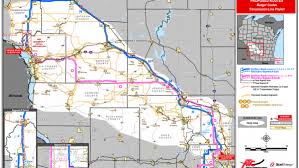
Another current decision of interest to the utility companies, the PSC, and the governor is American Transmission Company’s (ATC) and Xcel Energy’s proposed Badger-Coulee transmission line project, which stretches from the La Crosse area to Madison in Wisconsin. It is estimated 345-kilovolt, 180-mile line project will cost $580 million.
More than 200 people attended a public hearing in the Town of Holland by the PSC in December. Most of the people who testified in front of the Public Service Commission of Wisconsin voiced their opposition to the project. Some cited health concerns from massive power lines and others questioned whether it’s necessary.
Xcel Energy is one of project partners. A spokesman at the meeting, Tim Carlsgaard, said power lines need a capacity upgrade. Plus, he said, Wisconsin has a 10 percent renewable energy mandate and wind energy is the best option for the Midwest. Carlsgaard said it’s nearly impossible to develop wind energy in Wisconsin.
“Where it’s located is out in the rural areas,” Carlsgaard said. “Out in western Minnesota, southern Minnesota, parts of the Dakotas. The only way to bring that energy to the people is by building transmission lines. There are not existing lines in those areas.”
Dr. Patrice Tronstad, of Prairie View Elementary School, presented PSC administrative law Judge Michael Newmark with a poster signed by students opposing the project. The line could run right next to the Holmen school.
Onalaska Mayor Joe Chilsen said he doesn’t want the Badger-Coulee transmission line to be built at all. But, if the proposed project running from the La Crosse area to Madison is approved, he urged PSC officials not choose the route that could cut through his city. Chilsen said the power line could affect property values and aesthetically damage the city along the Mississippi River.
“This in essence kills all our future economic growth, our business growth in Onalaska,” he said. “I’m absolutely flabbergasted that this is even being considered.”
Chilsen also testified that future expansion plans for Mayo Clinic and other businesses could come to a halt if the Badger-Coulee line comes through the area.
Chilsen was one of the dozens of people who testified before two PSC commissioners: chairman Phil Montgomery and commissioner Ellen Nowak.
Commissioner Eric Callisto didn’t attend because his term is ended in February.
The now 3-person Walker appointed PSC decided last Thursday, March 26, 2015 to allow the construction of the new power line from La Crosse to Madison, over the objections by the public. Discussions and debate over the power line have lasted years, with many opposed citing environmental and aesthetic grievances. The Badger Coulee high-voltage transmission line will be built and it will follow a route from a substation near Holmen, north of La Crosse, to the Madison area, the Wisconsin Public Service Commission (PSC) decided in a unanimous preliminary vote.
Opponent group, Citizens Energy Task Force, said it is “appalled, but not surprised” by the decision, saying there was not enough study of alternatives to building another huge power line. It conceded the construction of the line is “economically driven, with the economic benefits going to utilities while ratepayers being saddled with massive unneeded debt and the health, environmental and quality-of-life consequences that come with these unsightly, unnecessary lines,” the citizen group said. Organizations that have been fighting the proposal said they are considering filing a petition for a rehearing by the PSC or challenging the validity of the PSC’s decision in circuit court.
“More than 90 units of local government tried in vain to understand why these lines are needed,” said Maureen Freedland, La Crosse County Board supervisor. “Our local planning rights have been stripped from us. The decision is a blow to our values and the way of life for our rural Wisconsin neighbors.”
The PSC is expected to issue a final order on the project within four weeks, and Wisconsin-based ATC and Minnesota-based Xcel said they will start contacting property owners on the chosen route yet this year. Construction of the line is expected to begin in 2016 and it is scheduled to go into service in 2018.
Sources: March 11, 2015, report by Mike Ivey of The Capital Times.
Reports aired on Wisconsin Public Radio.
Governor Walker’s Proposed 2015 -2017 State of Wisconsin Budget

Following are the comments I submitted by email on the governor’s proposed budget for July 1, 2015 to June 30, 2017.
Bad things can happen to good people. It happens all the time, and has occurred all throughout history. So when bad things, or threats, are predicted to occur or seem reasonably likely to occur, it’s best for one to take action, and involve others in removing the oncoming threat, before it gets realized and significant damage to life and our environment occurs.
Governor Walker’s biennial budget plan for Wisconsin for the next two years contains numerous threats to the people of Wisconsin and the state of Wisconsin’s natural resources. Some of those threats could have devastating and harmful impacts if they are allowed to occur without any attempts to prevent or ameliorate them.
Governor Walker’s budget plan as written will cause a great deal of harm for many thousands of Wisconsin’s people and their families. Some people who have worked their entire life at University of Wisconsin or UW-extension will likely lose their jobs, and the public who those people serve will lose out as well. Wisconsin’s elderly and disabled population, and families having children enrolled in Wisconsin’s excellent public school system will also suffer loses. Many hard working and dedicated school teachers and educational assistants serving special needs children will be without a job next fall if this budget is not revamped.
The governor’s budget also hurts those who watch over and protect our precious natural resources, both now and in the coming years, by cutting positions and land stewardship funds.
But really the worst thing about the governor’s budget is not what’s in it but rather what’s NOT IN IT BUT SHOULD IN IT. For example, despite Wisconsin’s aging population and increasing number of people who prefer not to drive, or who can’t drive because of the high cost of owning, maintaining and driving an automobile, the Walker budget proposes nothing new to help with mobility in the state, transit in particular. Rather, it borrows hundreds of millions of dollars to expand an already too large highway system at great environmental harm to the state, and for no good reason.
Numerous observations demonstrate that the climate of the Great Lakes Region, including Wisconsin’s climate, is changing. Average temperatures are getting warmer and extreme heat events are occurring more frequently. Total precipitation is increasing and heavy precipitation events are becoming more common. Winters are getting shorter and the duration of lake ice cover is decreasing over time. As a state, we should already be doing as much as we can to drastically cut back on our burning of fossil fuels but we seem to be doing almost the opposite. This tragedy grows in magnitude the longer it takes for our country and other countries to wean themselves off burning fossil fuels. There are many other unintended consequences of living in a fossil fuel burning dependent society.
But ironically, rather than then increasing substantially the funding of transit systems and the funding of positive financial incentive programs aimed at reducing greenhouse gas emissions and encourage walking and use of nonmotorized travel by state residents and businesses, the governor’s budget promotes more highway expansion. Instead, the state should reward those who drive less (miles), don’t fly, and minimizing their use of fossil fuel derived energy over the year. Use the money that Governor Walker’s budget borrows to fund a bigger highway system and a big new professional basketball arena instead – expenditures that not only subject state taxpayer to great financial risks but also promote adding millions more tons of greenhouse gases to the atmosphere including promoting jet airplanes flying of visiting teams and fans to the games.
Wisconsin Public Radio (part of state’s UW-extension) plans vacationing trips to Scotland and Australia, trips that not only release hundreds of millions of tons of greenhouse gases to the atmosphere but also give nothing back to the state’s own tourism businesses.
Governor Walker’s budgets include more trade promotions with foreign countries despite the fact that shipping products and working with foreign business interests similarly add millions and millions more tons of greenhouse gases to the atmosphere.
My plan would increase Wisconsin families’ and individuals’ annual income for polluting less and reducing the global warming threat, rather than adding to it. It would encourage Wisconsinites and Americans to buy from local entrepreneurs, whenever possible.
Governor Walker’s plan is to require a monthly drug test of food share (too low to begin with) recipients and proof of their having worked at least 80 hours at a place of employment before their receiving the meager food share benefits. It would do nothing to curb the rising income and employment inequalities and racial disparities in the state. The numbers of families and children living in poverty already will not be helped by Governor Walker’s budget. It is a fact that children of families living in poverty start their lives with a handicap because of many reason but the worst is that they do not receive adequate nutrition before and after they enter their school years. The governor’s budget insufficiently funds Wisconsin public schools and the families that live in poverty are disadvantaged in those schools from day one. Yet the governor’s budget does nothing to make up for previous cuts to public schools and add more financial stress for them by requiring them to pay vouchers for children attending private schools.
The budget should also refund the planned parenthood clinics the state had before Scott Walker took office. Certainly we ought not be adding to our human population pressures on the environment if we don’t have to.
Thank for the opportunity to submit my comments on the proposed state budget. For addition background on my concerns expressed here, please visit my blog at: http://www.allthingsenvironmental.com.
President Obama’s Executive Order Committing Federal Government to Cutting Its Greenhouse Gas Emissions

President Barack Obama signed an executive order on Thursday committing the federal government to cutting its own emissions 40 percent by 2025 and pledging to increase the amount of renewable energy used by federal agencies to 30 percent.
-
[This is a good addition but still not nearly enough. States and everyday Americans all have to greatly reduce the things they do that contribute to their daily and annual greenhouse gas emissions, as does the rest of the world. The U.S. still has the highest per capita GHG emissions. Forty percent of world travel by air (a large emitter of GHGs) is by American recreation and business travel pursuits. This has to change! Click on: “About this Blog” to read about how our government really could help make this happen – Power to the People]
The executive order builds on a previous administration directive to cut emissions from federal agencies 28 percent by 2020, compared with 2008 levels. “We are well on our way to meet that goal,” Brian Deese, senior adviser to the president, said in a call with reporters Thursday. “That’s what’s motivating us today to chart out a new and even more aggressive goal going forward.”
The administration is also setting a goal of cutting the per-mile emissions from the agencies’ vehicle fleet 30 percent, it said. It estimates the total commitment across the federal agencies will save taxpayers $18 billion — funds that won’t be spent on energy.
Christy Goldfuss, managing director of the Council on Environmental Quality, said that by the end of 2014, the federal government had cut emissions 17 percent since 2008, putting it well on the way to meeting Obama’s earlier goal. Much of that has come through energy efficiency improvements in federal buildings and with the installation of renewables.
As of the end of 2014, renewable energy accounted for 9 percent of the federal government’s energy use, and Thursday’s directive wants to increase that to 30 percent by 2025. The Department of Defense has set its own goal of deploying 3 gigawatts of solar energy on its installations around the world by 2025.
The federal government is the single largest energy user in the United States, Goldfuss said, with 360,000 buildings and 650,000 vehicles. “Not only is our footprint expansive, our impact is as well,” she said.
The administration also argued that the push to reduce emissions in the federal government has effects across the private sector as well. To that end, the administration also released a scorecard to track emissions from major federal contractors such as Lockheed Martin, Boeing and General Dynamics, which the administration is also calling on to make reductions.
The White House estimates that with reductions from the agency and those of private suppliers, the administration can cut greenhouse gas emissions by 26 million metric tons in the next 10 years.
“These goals will make sure the federal government is leading by example and pushing the envelope on cutting emissions,” said Deese, adding that it will “demonstrate that we are going to stay on offense in pushing our clean energy and climate change objectives.”
John Kerry Calls Out Florida’s Ban On Saying ‘Climate Change’

Secretary of State John Kerry, challenging climate change deniers to face reality, not-so-subtly called out Florida Gov. Rick Scott’s (R) administration on Thursday for banning the term “climate change” from all government communications.
“We literally do not have the time to waste debating whether we can say ‘climate change,'” Kerry said in a speech hosted by the Atlantic Council. “We have to talk about how we solve climate change. Because no matter how much people want to bury their heads in the sand, it will not alter the fact that 97 percent of peer-reviewed climate studies confirm that climate change is happening and that human activity is largely responsible.”
News of Florida’a ban, which also extends to the term “global warming,” came to light over the weekend in a report by the Florida Center for Investigative Reporting.
Scott in May declined to say whether he believed in climate change, but has said repeatedly that he is is not convinced by the science.
Such thinking is far too prevalent in Washington, and politicians who ignore the facts will not be remembered favorably by those who will face global warming’s worst perils, Kerry said in his speech.
“If we fail, future generations will not and should not forgive those who ignore this moment, no matter their reasoning,” Kerry said. “Future generations will judge our effort not just as a policy failure, but as a collective moral failure of historic consequence. And they will want to know how world leaders could possibly have been so blind or so ignorant or so ideological or so dysfunctional and, frankly, so stubborn.”
Kerry called for transitioning away from “dirty sources of energy.” But, as Politico noted, he didn’t mention whether he would approve the proposed Keystone XL oil pipeline, which would link Canada’s oil sands to the U.S. Gulf Coast. The project, which needs State Department approval to cross an international border, has been awaiting Kerry’s decision since early February. He will hand his recommendation to President Barack Obama, who will make the final decision on the project.
Environmental groups opposed to the pipeline said Kerry’s failure to mention it may be a positive sign.
“While Kerry didn’t bring up Keystone, he sure brought up more and more reasons why it should be rejected,” Sierra Club legislative director Melinda Pierce told Politico. “And he’s absolutely right: Burning fossil fuels has long-term costs that have to be at the front of our minds when evaluating both the pipeline project and development of the tar sands.”
The Huffington Post | By Lydia O’Connor
Lawmakers Calling for Stricter Rules for Trains Hauling Volatile Crude Oil to Ensure Public Safety
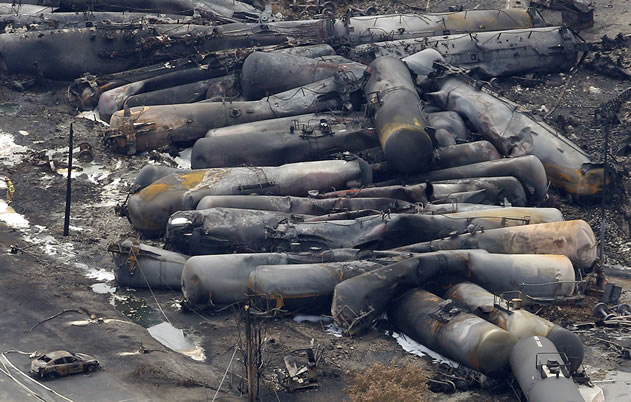
The wreckage after an oil train derailed and exploded in Lac-Mégantic, Quebec in July 2013.
When residents in the Quebec town of Lac-Mégantic describe the scene after an oil-train derailed and then exploded there last July, they say the burning petroleum was like a wall of fire, or a river of fire. The blaze, which burned for 36 hours, sent flames and smoke hundreds of feet into the air. At one point, the fire was pulling in so much oxygen that nearby trees were whipping about as if in a tropical storm. Several blocks from the blast site leaves turned an orange-red color from the overwhelming heat. It was early summer, but they looked like autumn foliage.
The explosions and fire destroyed some 40 buildings and killed 47 people, most of whom were enjoying live music at a popular cafe. Wooden homes along the lakeshore burned from the inside out as fire erupted out of water pipes, drains, and sewers. A 48-inch storm pipe that runs from the train yard to the nearby Chaudière River became a conduit for the petroleum, spewing flames and oil more than half a mile into the water. “It looked like a Saturn V rocket,” says Robert Mercier, director of environmental services in Lac-Mégantic. Manhole covers on the Boulevard des Veterans exploded as columns of fire shot into the air.
By the time the fire had been contained, the soil surrounding the blast site was a layer of grey ash. “It was like being on the moon,” says Sylvaine Perreault, an emergency responder who arrived early Saturday morning. “It was all dust.”
On Friday, July 5, a 79-car train carrying petroleum from North Dakota’s Bakken oil fields had been parked for the night on a modest but steady incline in the town of Nantes, seven miles outside of Lac-Mégantic. The sole engineer employed to secure the train and responsible for applying handbrakes in some of the cars left his shift at 11:25 p.m. At 11:30 p.m. a 911 call was made reporting a fire on one of the locomotives. Twelve firefighters from the town of Nantes arrived, along with two track-maintenance employees from Montreal, Maine & Atlantic, the company operating the train. They extinguished the fire and left the scene. Just before 1:00 a.m. the train began to roll down the incline. It eventually reached a speed of more than 60 miles per hour before it careened off the track toward the Musi Café nightclub and exploded.
Rejean Campagna, a 73-year-old Lac-Mégantic native, was awoken by the sound of the train screeching past his apartment and then of steel piling on steel. “As if somebody had a big drum of steel and was hammering on it with a sledgehammer right beside my window,” he told me. The train tracks are a scant 200 feet away from Campagna’s front window, and when he opened the blinds the first thing he saw was a large ball of fire. “It grew and grew and grew and then it mushroomed.”
Campagna and his wife, Claudette Lapointe, grabbed their pillboxes and cell phones and fled. The hood of their car was so hot that he couldn’t touch it. (According to Mercier, the heat could be felt for more than a mile.) From a safe distance, about a quarter-mile away, they watched as the town burned. In the early morning hours a steady rain began to fall. The surface of Campagna’s umbrella was so warm that when the drops of water bounced off it they sent spirals of steam into the night. If not for the rain, Campagna says, the whole town would have been destroyed. “The rain saved us,” he says.
Lapointe lost two cousins. Campagna knew everyone who lived in the homes along the lake, some of whom also died. Roger Paquette, a 61-year-old friend of Campagna’s, could not be awoken in time. “Neighbors tried to wake him up, but the back of his house was already on fire,” he says. “All of these people never had a chance to get out of their homes, so swift was the flow of fire.”
Lac-Mégantic residents had little warning they were in danger. Few residents interviewed for this article knew that millions of gallons of highly flammable light crude oil were passing through their lakeside village nearly every day. When it comes to transporting oil by rail, the railroad industry and oil and gas companies operate in near total secrecy, with little federal oversight or regulation to ensure public safety.
The oil moving through Lac-Mégantic was mislabeled – classified as packing group III instead of packing group II or I, which refer to more dangerous substances with lower flashpoints. A hazardous-materials inspection team issued safety warnings in 2011 and 2012, but no changes have been made to tank cars since then. Inspections of loading facilities in the Bakken oil fields conducted in October 2011 and June 2012 found that there were shortages of suitable rail cars; those in use were often being overloaded; and, because of the many different companies involved in transferring and shipping the oil, compliance was difficult to enforce. According to those inspection documents, which were obtained by NBC News shortly after the Lac-Mégantic accident, shippers were regularly using tank cars that did not meet industry specifications. “The pressure to ship those cars was more than the risk of failure in transportation or discovery by FRA [Federal Railroad Administration],” the inspectors noted. They also said the oil was extremely flammable and warned truck drivers and inspectors to take special precautions. “Fire retardant clothing, and grounded equipment, truck and rail cars are mandatory due to the high flammability of the crude and possibility of static discharge.”
The criminal investigation into the accident in Lac-Mégantic, which has focused on the question of whether the brakes were properly secured, was completed in late March. Charges had not been issued, though they were anticipated, when this story went to press.
Even as federal regulators discuss new safety measures – updating or retrofitting the standard petroleum tank cars, reducing train speeds near towns, and performing spot inspections of oil trains – oil trains continue to roll through towns and cities across the United States and Canada. In the last six years the quantity of oil being shipped by rail across North America has increased dramatically. Most of that increase comes from the recently tapped shale oil fields in North Dakota. The Bakken formation is now producing more than one million barrels of crude oil a day, and more than 60 percent of that is shipped by rail. According to the American Association of Railroads, there were 9,500 rail cars carrying crude oil in 2008. Last year there were more than 400,000.[Story from Earth Island Journal.]
In the wake of several recent rail disasters, lawmakers in Wisconsin and Minnesota are calling for new measures to improve oil train safety.
U.S. Sen. Tammy Baldwin and Rep. Ron Kind on Monday sent a letter urging President Barack Obama to impose new rules governing trains hauling volatile crude oil, like one that exploded after derailing near Galena, Ill.Lawmakers calling for new oil train rules
The Department of Transportation has proposed new rules, including new tank car standards, better classification for liquid petroleum products, route risk assessment planning for railroads and reduced speed limits for oil trains.
But the White House did not act by the Jan. 15 statutory deadline to release final rules. Kind and Baldwin asked the president to issue the final rules — with additional safety measures.
“It is time for you to take action,” the Wisconsin Democrats wrote in their letter to Obama. “We believe that recent accidents make clear the need for rules stronger than those originally proposed.”
They requested rules that would require shippers to stabilize oil — by taking out explosive gases like propane and butane — before it is transported as well as stricter safety standards for the tank cars that haul it.
Two recent derailments — in Galena and in West Virginia — involved cars built to the new safety standards proposed by the DOT.
Kind and Baldwin also called for lower speed limits and enhanced braking on trains carrying flammable materials and for increased transparency about the shipment of oil.
In Minnesota, two state lawmakers plan to unveil an oil train safety initiative Tuesday.
House Deputy Minority Leader Paul Marquart, DFL-Dilworth, and Rep. Frank Hornstein, DFL-Minneapolis, are proposing rail crossing enhancements along with a plan to make railroads pay for public safety improvements.
Emperor Walker Wearing No Clothes When It Comes to Wisconsin’s Natural Resources

Actually, this emperor has no clothes.
Wisconsin citizens have got to realize that Wisconsin’s governor has not had the best interests of the state at heart when it comes to natural resources issues, including the effects of rising greenhouse gas concentrations in the atmosphere’s significance to Wisconsin’s natural, economic and human resources in the absence of timely action by their governmental officials.
This politician looks only ahead to the next election. Our part-time governor has his attention turned to Iowa, New Hampshire and any road leading to Washington, D.C.
His tracks are the proposed budget that will leave scars on the state.
For a state with the legacy of people like Aldo Leopold, John Muir, Gaylord Nelson, and Warren Knowles, it is an embarrassment that Gov. Walker would submit a budget that:
• Strips the Natural Resources board of its authority, making it advisory only to the DNR – leaving all decisions up to the DNR secretary;
• Eliminates 18 research scientists from the DNR Sciences Services Bureau;
• Eliminates environmental education programs;
• Places a moratorium on land buying through the Stewardship Fund.
The problem is that politicians care about money brought into their campaigns, and getting re-elected.
That is why the Natural Resources Board was established originally: to keep natural resources governance at arm’s length from politicians. The NRB (citizens who in the past came together to put natural interests foremost), can make decisions taking into account biological and sociological information.
The NRB was also charged with hiring a DNR secretary, but Tommy Thompson and Jim Doyle looked to their self-interest and changed a system that worked well since 1927.
Now Scott Walker has manipulated the system, put politicians in charge of the DNR, silenced scientists, and changed agency priorities from natural resource protection to job creation.
How long can people who hunt, fish, trap, bird watch, hike, camp, and enjoy the state’s scenery, sit on their hands while the governor trashes our state?
Source: original article by Tim Eisele, Wisconsin Outdoor News, February 28, 2015
Note: “Emperor’s New Clothes” is an old children’s story by Hans Christian Andersen about an emperor who pays a lot of money for some new magic clothes which can only be seen by wise people. The clothes do not really exist, but the emperor does not admit he cannot see them, because he does not want to seem stupid. Everyone else pretends to see the clothes too, until a child shouts, “The Emperor has no clothes on!”
Wisconsin Legislature Votes to Call “Extraordinary Sessions” for Wrong Reasons

Organizing committees of both the Wisconsin Senate and Wisconsin Assembly called both houses of the Wisconsin legislature into extraordinary sessions this week to pass a “right-to-work” bill, making it illegal for employers and labor unions to charge their employees and any new employees union dues as a condition of accepting employment. The Wisconsin State Journal reported in today’s newspaper edition that the full Senate could vote on this highly charged legislation (Senate Bill 44) as early as Wednesday and the Wisconsin Assembly could vote on this legislation (AB 61) as soon as Monday.
Governor Scott Walker has said he would sign the bill into law.
The Senate and Assembly organizing committees ought have called their “extraordinary” sessions to address what the State of Wisconsin ought do to protect its citizens from global warming and climate change instead. Greenhouse gas emissions, global warming and climate change are far more significant to the future of Wisconsin than are unions charging union dues in the state.
 All Things Environmental
Recent Comments