
Public and Future Citizens Biggest Losers in WBA Second and Final Gubernatorial Debate

Democrat Mary Burke argued during a debate last Friday night (Oct. 17) in Wisconsin’s hotly contested governor’s race that Republican incumbent Scott Walker mismanaged Wisconsin’s finances, leading to a projected $1.8 billion budget shortfall, and enacted tax cuts that benefited the wealthy over the middle class (which he did).
Which candidate would be better for Wisconsin’s economy is a central part of the race that’s attracted national attention both because it’s close and because Walker is widely considered to be in the mix for a 2016 presidential run should he win re-election, according to the Associated Press.
Unfortunately, as was the case in the first Wisconsin Broadcasters Association (WBA) televised debate, neither Walker nor Burke were even asked about the growing catastrophe of human-caused global warming let alone the two largest sector contributors of greenhouse gases from the U.S. and most other developed countries: energy production and transportation. The people most negatively impacted by global warming and the havoc it’s already wreaking on the Earth are the young, those yet to be borne, and billions of people living without air conditioning and already living in poverty, many seeing their water and food supplies either drying up or being contaminated by flood waters.
But since the WBA interviewers did not see fit to test the candidates for Wisconsin’s next governor on what they have in mind as to what the state of Wisconsin should be doing to reduce Wisconsin’s contributions to the growing world catastrophe of global warming and how Wisconsin’s people might best plan for the inevitable changes, viewers were left wondering if either of the candidates is even thinking about the subject, let alone what Secretary of State John Kerry said about the seriousness and urgency of addressing climate change: [climate change] “should be addressed with as much “immediacy” as confronting the Islamic State in Iraq and Syria (ISIS), and the Ebola outbreak”.
Earth a Lucky Fluke?

Is the Earth one of many habitable planets in the universe, or are human beings alone, the product of a lucky fluke? Author of “Lucky Planet: Why Earth is Exceptional–and What That Means for Life in the Universe”, David Waltham says it’s more likely the latter, thanks to our planet’s unusually stable climate and early development of life.
But whether Earth’s climate can still said to be “stable” is now, unfortunately, open to question. We humans have have relied far too extensively on fossil fuel burning – especially coal, oil (gasoline, diesel fuel, jet fuel, propane, fuel oil) and natural gas (methane), which all emit greenhouse gases to the atmosphere upon combustion, since the onset of the Industrial Revolution. What Earth needs now is another kind of revolution, a peaceful revolution, but where humans use their own physical power and the energy of the Sun and the wind and rid themselves from the over-dependence on burning fossil fuels. Read about a plan to do just that right here and then sign the petition to our elected governmental officials demanding they undertake the necessary changes to make this happen before its too late! Thank you.
Earth’s About to Lose What Little Chance It Had – Unless We Act Now!
Who’s Gonna Stand Up
Neil Young’s Who’s Gonna Stand Up (and Save the Earth)
Protect the wild, tomorrow’s child
Protect the land from the greed of man
Take down the dams, stand up to oil
Protect the plants, and renew the soil
Who’s gonna stand up and save the earth?
Who’s gonna say that she’s had enough?
Who’s gonna take on the big machine?
Who’s gonna stand up and save the earth?
This all starts with you and me
Damn the dams, save the rivers
Starve the takers and feed the givers
Build a dream, save the world
We’re the people know as earth
Who’s gonna stand up and save the earth?
Who’s gonna say that she’s had enough?
Who’s gonna take on the big machine?
Who’s gonna stand up and save the earth?
This all starts with you and me
Ban fossil fuel, draw the line
Before we build, one more pipeline
Ban fracking now, save the waters
And build a life, for our sons and daughters
Who’s gonna stand up and save the earth?
Who’s gonna say that she’s had enough?
Who’s gonna take on the big machine?
Who’s gonna stand up and save the earth?
This all starts with you and me
Who’s gonna stand up
Who’s gonna stand up
Who’s gonna stand up
Who’s gonna stand up
Who’s gonna stand up
Who’s Gonna Stand Up (and Save the Earth)?
(full orchestra & choir version)
Start here. Sign “Conserve NOW Petition to President Obama, U.S. Congress, Wisconsin Governor Walker and Wisconsin Legislature to Enact and Fund Climate Change Legislation” (September 16th post on this blog) or;
I’ve also started the petition “U.S. Congress: Enact and Fund Legislation to Pay Families and Individuals who Use Less Fossil Fuel Energy Annually on Changeorg
Will you take 30 seconds to sign it right now? Here’s the link:
Here’s why it’s important:
Using money that now goes to subsidize the fossil fuel industries (coal, oil, natural gas), instead offer that money to those who limit their driving, flying and household use of fossil fuel devived energy. This would helpslow global warming and sea level rises and would negate the need for raising the minimum wage and foodstamps.
You can sign my petition by clicking here.
.
Thanks
September 2014 – Another Month of Record High Global Average Temperature

This past September was the warmest since records began in 1880, according to new data released by NASA this weekend. The announcement continues a trend of record or near-record breaking months, including May and August of this year.
The newly released data could make it very likely that 2014 will become the warmest year on record.
Miami Beach Prepares For Annual ‘King Tide’ Flooding And A Taste Of Future Sea Level Rise Reuters
By Zachary Fagenson and David Adams
MIAMI BEACH, Fla., Oct. 3 (Reuters) – Construction crews are wading into chest high pools of muck in a race against time to install pumps Miami Beach officials hope will help control an annual super-high tide threatening to flood south Florida’s popular seaside city next week.
Around Oct. 9, a so-called “King Tide” is expected to push almost an extra foot (30 cm) of water onto streets, going over sea walls and forcing residents to wade through flooded streets, an annual event causing widespread damage.
“It’s been a nightmare,” said Andreas Schreiner, who has seen past high tides bring water up to and even inside his group of neighborhood restaurants, causing tens of thousands of dollars in losses due temporary shut downs and cleanup.
The event, caused by the alignment of the sun, moon and Earth, provides a taste of the potential impact of a longer-term two-foot sea level rise predicted for south Florida by 2060, according to the United States Geological Survey.
The low-lying greater Miami area, with a population of 5.7 million, is one of the world’s most at-risk urban communities, scientists told a U.S. Senate subcommittee hearing in April.
The King Tide is expected to rise to almost four feet. With seven miles of coastline, Miami Beach is already seeing more frequent salt-water street flooding at high tide, according to Miami Beach City Manager Jimmy Morales.
To combat such widespread flooding, the city has set aside $300 million to 400 million to install up to 50 pumps in the coming years in what some say is a vain effort to protect an estimated $23 billion of real estate.
Bigger sea walls are not an option as Miami Beach’s flooding is caused largely by water rising underfoot through porous limestone bedrock. Officials concede pumping water back into the ocean is only a short-term solution.
Standing near four pumps that will each push 7,000 gallons per second when switched on, Miami Beach’s chief engineer, Bruce Mowry, said rising seas pose a constant challenge.
“The technology is never as effective as it was when you first installed it,” he said.
The city is also retrofitting 300 outflow valves that allow stormwater to drain into the bay, inserting plugs to prevent the reverse flow of sea water. Dunes are being reinforced with sea oats and engineers are looking into pumping water into underground storage.
Apart from these measures, Miami Beach has begun to develop a long-term plan for coping with sea level rise, including pushing developers to sacrifice street-level space for more elevated building designs.
“It’s a retreat up,” said Morales.
Doing so is critical to quell concerns of insurers and lenders backing the city’s blockbuster development.
“In order to keep the real estate market hot, we need to assure people who understand this that we are doing everything in our power,” Morales added. “Do you wait till it’s at your ankles and knees?” (Editing by David Adams and Steve Orlofsky)
Source: The Huffington Post
All Good Things Need Not Come to an End

Demonstrators make their way down New York’s Sixth Avenue on Sunday.
PHOTOGRAPH BY JASON DECROW, AP
Last week was quite a week for U.S. advocates of protecting the environment. Four hundred thousand of them, including people of all ages, cultures and locations (people from all 50 States), joined together and marched through the streets of New York City, the country’s’s most populous city otherwise known as “The Big Apple”. Their reason for making the trip (many chose to endure long bus rides) was to demonstrate to the world and their county’s political leaders, and in no uncertain terms, their deep and growing concern with the increasing amounts of “greenhouse gases”, most notably carbon dioxide (CO2) which has 42% higher concentration levels in the atmosphere now than in pre-industrial times, before the widespread burning of fossil fuels for energy, which releases predominantly CO2 gas as an invisible byproduct. The greenhouse gases in the atmosphere have historically kept the planet warm by absorbing the Sun’s radiant energy and trapping it near the surface. However, too many of them being added to the atmosphere causes what is commonly known now as “global warming”, which causes ice and snow to melt at the poles and mountainous glaciers, and ultimately leads to rising and warming ocean waters that are more acidic (a certain percentage of CO2 is absorbed in the oceans). Global warming also causes more extreme weather events (a warmer atmosphere is more volatile), including heavier rainfalls and flooding, stronger storms, hotter and longer heat waves, worse drought and related problems (such as buckling highways and dwindling water supplies).
“Our citizens keep marching,” U.S. President Barack Obama said in his Tuesday address, acknowledging the protest. “We cannot pretend we do not hear them. We have to answer the call.”
Despite the biggest and most diverse climate march ever – one having almost 400,000 people, including people from every state of the Union marching through the streets of New York City in a huge show of strength in advance of last week’s United Nations General Meeting, it’s back to “business as usual” in the USA this week.
Global warming deniers, who flat-out refuse to believe rising greenhouses gas emissions from fossil fuel burning the last two centuries are affecting the atmosphere, the oceans, plants, wildlife, the weather and people; and that the effects are likely to grow stronger in intensity and thus in damage as the world adds to the aggregate amount of greenhouse gases emitted to the atmosphere, cannot deny the fact that the poor and middle class in the U.S. and the rest of the world will be the ones who suffer the greater effects from global warming. Those who are at the top of the economic ladder in the U.S., many who refuse to pay their fair share of U.S. taxes to help poor individuals and families yet purposely deny the existence of global warming are all now likely breathing a huge sigh of relief.
Last week’s groundswell of the people’s demands and concern for urgent action is now past history for them. They survived the four-hundred thousand people from all over the country marching through NYC Sunday, September 21, demanding action be taken by government and business to slow the global warming – already causing brutal climate change impacts throughout the globe and the country; they survived Wall Street being flooded with protesters Monday, September 22, that brought Wall Streets Financial District to a grinding halt over the course of a day-long sit-in by environmental activists; they survived any action by the U.S. Congress which adjourned after last week for the year.
“We can easily forgive a child who is afraid of the dark; the real tragedy of life is when men are afraid of the light.”
― Plato
U.S. Congress Needs to Take Action to Slow Climate Change and Ensure Public Saftey

Julia Pierson, a 30-year veteran of the Secret Service agency who became director in 2013, was forced to resign under pressure as director Wednesday after breaches of White House security that resulted in nobody getting hurt and no damage to property.

The U.S. Congress has 535 members: 435 Representatives and 100 Senators. The One Hundred Thirteenth United States Congress first met in Washington, D.C. on January 3, 2013, and is scheduled to end on January 3, 2015. Widespread public dissatisfaction with the institution has increased in recent years, and some commentators have ranked it among the worst in United States congressional history. According to a Gallup Poll released in August 2014, the 113th Congress had the highest disapproval rating of any Congress since 1974, when data first started being collected: 83% of Americans surveyed said that they disapproved of the job Congress was doing, while only 13% said that they approved.
So why aren’t we forcing some of these folks to resign?
A New York Times/CBS News poll found that nearly half of Americans believe that global warming is causing a serious impact now, while about 60 percent said that protecting the environment should be a priority “even at the risk of curbing economic growth.”
Fifty-four percent of those surveyed said that global warming is caused by human activity. This, the New York Times notes, is the “highest level ever recorded by the national poll.”
Those results echo those of another survey conducted by the Chicago Council on Global Affairs, which found that more than 70 percent of Americans believe climate change is either a critical or an important threat “to the vital interests” of the country, while more than 80 percent said that combating climate change is either a “very important” or “somewhat important” goal for the U.S.
The survey also found that 50 percent of the American public believe that the government is not doing enough to address the problem of climate change. According to poll makers, this is an increase of five percentage points from 2012 poll results.
Dealing appropriately with reducing causes of global warming and insuring protection of citizens from climate change is government responsibility. But this Congress (and the Congresses preceding it) have failed to act on it, as have many states, Wisconsin included. They all ought consider resignation for their failure to enact legislation to slow global warming and ensure the America public is protected from climate change.
Picture – 35,000 walruses are swarming Alaska’s shore — because their sea ice is vanishing

New images captured by NOAA aerial surveys of the Alaska coast on September 27 show an estimated 35,000 walruses ashore near Point Lay. (Corey Arrardo / NOAA/NMFS/AFSC/NMML)
.
“We can easily forgive a child who is afraid of the dark; the real tragedy of life is when men are afraid of the light.”
― Plato
Global Warming is a No-Brainer
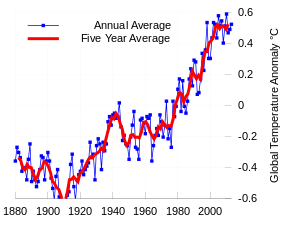
August 2014 was the hottest August ever recorded (global average temperature of 61.45°F), with records dating back to 1880. Rising global temperatures have been accompanied by changes in weather and climate. Many places have seen changes in rainfall, resulting in more floods, droughts, or intense rain, as well as more frequent and severe heat waves. The planet’s oceans and glaciers have also experienced some big changes – oceans are warming and becoming more acidic, ice caps are melting, and sea levels are rising. As these and other changes become more pronounced in the coming decades, they will likely present challenges to our society and our environment. [U.S. Environmental Protection Agency]
The increase in global temperature across the world’s land and ocean surfaces for August 2014 was 1.35°F higher than the 20th century average of 60.1°F.
Nine of the 10 warmest Augusts on record have occurred during the 21st century. Additionally, August 2014 marked the 38th consecutive August with a temperature above the 20th century average. The last below-average global temperature for August occurred in 1976.
Sea surface temperatures have been higher during the past three decades than at any other time since reliable observations began in 1880.
Over the past century, human activities have released large amounts of carbon dioxide and other greenhouse gases into the atmosphere. The majority of greenhouse gases come from burning fossil fuels to produce energy, although deforestation, industrial processes, and some agricultural practices also emit gases into the atmosphere. The energy is produced by power plants burning predominantly coal and natural gas, who sell the energy for heating and electricity. Commercially owned power plant are the number one emitter of carbon dioxide to the atmosphere, followed closely by the transportation sector’s burning of petroleum products (oil, gasoline, and jet fuel). Transportation accounted for over half of the net increase in total U.S. GHG emissions from 1990-2011.
Carbon dioxide can stay in the atmosphere for nearly a century, so Earth will continue to warm in the coming decades.
The warmer it gets, the greater the risk for more severe changes to the climate and Earth’s system. Although it’s difficult to predict the exact impacts of climate change, what’s clear is that the climate we are accustomed to is no longer a reliable guide for what to expect in the future.
The temperature record shows the fluctuations of the temperature of the atmosphere and the oceans through various spans of time. The most detailed information exists since 1850, when methodical thermometer-based records began.
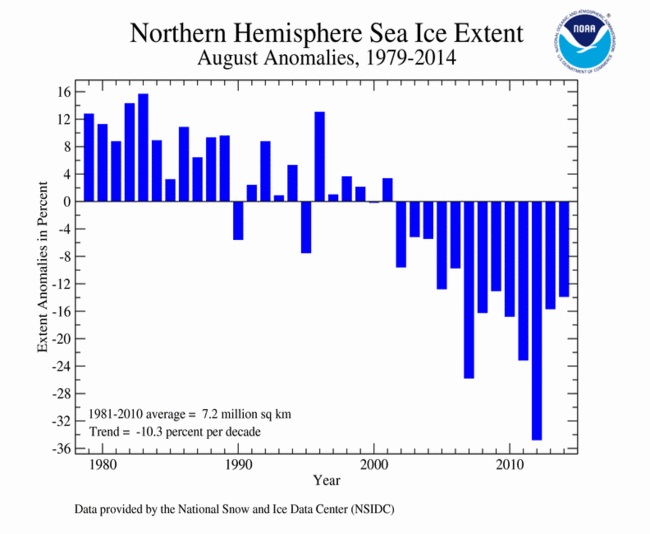
The Northern Hemisphere (Arctic) sea ice extent — which is measured from passive microwave instruments onboard NOAA satellites — averaged for August 2014 was 6.22 million square km (2.40 million square miles), 1.00 million square km (390,000 square miles), or 13.85 percent, below the 1981-2010 average. This was the seventh smallest August Arctic sea ice extent on record.
The second most important anthropogenic greenhouse gas (after carbon dioxide, or CO2), is methane (CH4). Although its concentration in the atmosphere is far less than that of CO2, it’s a much stronger greenhouse gas on a per-molecule basis. It also is eventually is transformed into CO2 by atmospheric chemistry processes. More than half the atmospheric CH4 load is due to human activities. Atmospheric methane concentration had stabilized from about 1999 to 2007, but recently began rising again.

Follow – Up to Labor Day WORT Radio Show: “Plant Earth -It Needs our Help Now More The Ever”

I broadcast my second show on finding a solution to the global warming and income disparity problems this past Labor Day Monday, September 1, on the weekly “Access Hour”, 7-8 pm, on Madison, Wisconsin’s WORT-FM at 89.9 (HD) radio station. With the friendly assistance of Access Hour engineer Ken Rineer, I was able to provide what I hope listener found to be an informational and enjoyable listening experience, on a problem of serous consequence to the habitability of our planet in the future. If you missed the Labor Day show, for the next 60-days, anyone in the world having access to the Internet can listen to the archived show from WORT-FM September 2, 2014 here.
Those who wish to sign a petition for the U.S. Congress and state governors and Legislatures to petition the government to enact legislation to provide positive monetary incentives to individual and families who minimize their global footprint can sign the petition here.
Conserve, NOW! Planet Earth Needs Our Help Now More Than Ever

On this Labor Day (September 1, 2014) Community Radio Station WORT-FM, 89.9 will broadcast a special program on its weekly show “The Access Hour”, from 7:00 to 8:00 PM. The Labor Day show is called: “Planet Earth: It Needs Our Help Now More Than Ever!”. The show can be heard live on radio in the listening area – south central Wisconsin including Madison, Wisconsin where it originates. The show can also be listened to anywhere in the world at http://www.wortfm.org. All earthlings are invited to listen in then, or on the archive of the WORTFM.org website at their convenience.
The program will consist of both music and dialog, appropriate to issues that confront many of us and those important to all of us and future generations.
Accordingly, I have initiated a petition drive to demand our federal and state legislative leaders to take immediate and major actions that will jointly confront these issues. If you wish to read and sign the petition, please do so. It’s sorely needed. Please send me an email to MTNeuman@gmail.com requesting it and I’ll forward the link to use for signing the petition.
The program being advanced advocating is designed to minimize our fossil burning before it’s too late, by telling our government to establish a program that provides positive financial incentives – supplemental income – for all individuals and families who burn less fuel annually: (1) by driving less or no miles (more $ for not at all); (2) by not flying in that year; and (3) by using less fossil fuel derived energy in heating, cooling and using electricity derived from burning fossil fuel in the year than the average household in a year. Money can be earned by doing (1), more by doing (2) and even more by doing (3), yearly,
Money used to finance this program could come from a number sources:
1) Money the U.S. Department of Transportation and states SAVE (billions of dollars) by not paving even more lanes of highways and bridges on the landscape with cement and asphalt (both require fossil fuel burning) to accommodate more driving of motor vehicles;
2) Money the U.S. Federal Aviation Administration would SAVE (more billions of dollars) by requiring the commercial airlines pay air flight controllers, instead of the federal government (U.S. citizens) providing these employees for the exclusive financial interests of commercial airlines and aviation fuel suppliers.
3) Money from levying a tax on all carbon emitted by electrical power generation plants in the U.S. which burn fossil fuels (more billions of dollars), and emitted by the transportation sector (jets, cars, motorcycles, trucks, trains and buses, work vehicles and fossil fueled equipment, and recreational vehicles, including but not limited to ATVs, motor boats, snowmobiles, jet skis).
4) Money from other extravagant federal expenditures, such as the billions of dollars paid to private defense contractors, at home and abroad, and also the billions of dollars of subsidies the U.S. government (American taxpayers) presently awards to the fossil fuel industry (coal, oil, natural gas) operating in the U.S..
Only individuals and families in the U.S. who conserve energy (emit fewer greenhouse gases) by driving less (or no) miles; by not flying; and by using less fossil fuel derived energy in their home during a year would earn the REWARDS.
More detailed information on this proposal can be viewed on the Conserve, NOW! post of August 16. 2014.
 All Things Environmental
Recent Comments