
One-year Anniversary of “Planet Earth: It Needs Our Help Now More Than Ever”, Broadcast on WORT-FM’s Public Access Hour on Labor Day 2014
Last year on Labor Day WORT-FM in Madison, Wisconsin I had the privilege of recording an hour of music and commentary on a subject I have researched for going on 16 years now: the likely effects of rising greenhouse gas concentrations in the atmosphere, in the oceans, on the landscape; in other words, our planet earth. Since other than president Obama, Pope Francis, the environmental community and the state of California are about the only ones talking seriously about starting to do something to head off what is certain to be catastrophic effects upon our planet and all its livings things in decades and centuries to come, it only seem appropriate to remind folks who would like to listen to the show again. Here it is. Planet Earth – It Needs Our Help More than Ever!
Touring Alaska last month to shine a spotlight on global warming, President Obama warned that “climate change is no longer some far-off problem. It is happening here; it is happening now. Climate change is already disrupting our agriculture and ecosystems, our water and food supplies, our energy, our infrastructure, human health, human safety. Now. Today.”
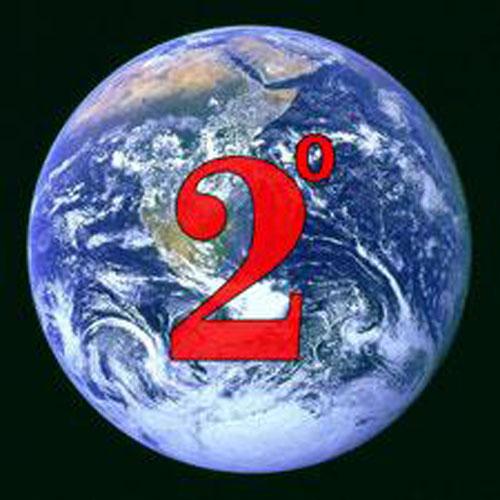
This wasn’t supposed to happen. In 2009, 114 countries signed the Copenhagen Accord, agreeing “to stabilize greenhouse gas concentration in the atmosphere at a level that would prevent dangerous anthropogenic interference with the climate system;” “recognizing the scientific view” that the increase in global temperature should be held to no more than 2 degrees Celsius” (3.6 degrees Fahrenheit) above the pre-industrial level; and promising greater “long-term cooperative action to combat climate change.”
Paradoxically, an accord that should have spurred the world to immediate action instead seemed to offer some breathing room. Two degrees was meant to be a ceiling, but repeated references to an internationally agreed-upon “threshold” led many people to believe that nothing really bad could happen below 2 degrees—or worse yet, that the number itself was negotiable. Perhaps the biggest failure of the Copenhagen Accord was its pact for “long-term” action. Forty years ago, climate change was a “long-term” problem. Today it’s an emergency.
As we’re coming ever so close to the dreaded 2-degree mark, which will have devastating effects especially on people and families less economically fortunate, everywhere, Pope Francis last week called upon the members of the U.S. Congress to find solutions to the problems of growing poverty, everywhere, and climate change, including warming and acidification of the oceans. As civilization’s industrial machinery marches on, we’re already at 400 ppm of carbon dioxide, and likely to go much higher and faster under current “business as usual” practices continue.
Such numbers may mean little to the general public, but they matter a lot to negotiators who will be at Paris climate change talks in December. Unfortunately, the numbers that these negotiators plan to propose will only be part of non-legally-binding pledges—and they represent only what is achievable without too much difficulty, rather than the drastic austerity measures needed to stabilize emissions. In fact, 2 degrees is not an upper limit that the nations of the world recognize and respect, only a target that negotiators know they will overshoot with their expected pledges. The very idea that the Paris conference is a negotiation is ridiculous. You can’t negotiate with the atmosphere.
What were they thinking? As Naomi Klein points out in her book This Changes Everything, the 2 degree goal “has always been a highly political choice that has more to do with minimizing economic disruption than with protecting the greatest number of people.” In theory, the Copenhagen Accord relied on the best available science of the time—an international scientific symposium held in 2005 and assessment reports published by the Intergovernmental Panel on Climate Change (IPCC) in 2007 and earlier, which in turn were based on even older scientific studies. You can trace the 2 degrees notion all the way back to a 1977 paper by Yale economist William D. Nordhaus.
In hindsight, though, the idea that even 2 degrees of warming would be tolerable is baffling. Homo sapiens have never lived in a world that hot. In an excellent series of special reports for CNN on what 2 degrees of global warming would mean, John D. Sutter lists some of the expected impacts: a melting Arctic, enormous wildfires, more intense hurricanes, water shortages, reduced crop yields, and animals and plants at risk of extinction. Even if warming can be held to 2 degrees, scientists predict that global sea level will rise by at least 20 feet as a result.
The Climate Vulnerable Forum, a coalition of 20 nations that expect severe global-warming effects, has called the 2-degree goal “inadequate” to protect fundamental human rights. “How can we possibly subscribe to more than double the current warming?” asked Mary Ann Lucille L. Sering, secretary of the Philippines Climate Change Commission.
Although the 2-degree target was endorsed in Copenhagen in 2009, and again in Cancún the following year, the parties also agreed to periodically review the adequacy of the target and to consider strengthening it. The majority of countries that have signed and ratified the United Nations Framework Convention on Climate Change now support a lower target of 1.5 degrees, and a review process reported that the lower limit would be “preferable” but that the science supporting it is “less robust.”
What is feasible? The World Bank has warned that a 1.5-degree rise is “locked in,” and that we’re headed toward a warming of 4 degrees by the end of the century. “Scientists, policy-makers and the public already accept that progress will not be enough to keep global average temperature rise within the 2°C limit,” wrote Oliver Geden, head of the EU Research Division at the German Institute for International and Security Affairs, in a recent Nature commentary. “The negotiations’ goal has become what is politically possible, not what is environmentally desirable.”
If you add up the pledges that have been made so far, and nations keep their promises, the world is in for about 3 degrees of warming by 2100. Limiting the warming to 2 degrees would require rapid emissions reductions over the next few decades, declining to zero net emissions shortly after 2050.
It is still possible to limit global warming to 1.5 degrees by 2100 (after a temporary overshoot), according to a paper published in Nature Climate Change a few months ago. But it would mean becoming carbon neutral even earlier than required for a 2-degree scenario.
A national security approach. President Obama made headlines in Alaska—and before that, New Orleans—with fervent talk about the urgency of the climate problem, the need to make communities more resilient, and the “failure of government to look out for its own citizens.” Can this be the same president who, a few months earlier, gave Royal Dutch Shell permission to begin drilling for oil off the coast of Alaska? Developing fossil fuel resources in the Arctic is “incommensurate with efforts to limit average global warming to 2°C,” according to a study by scientists at University College London.
There is an alternative to meaningless numbers and endless negotiations: going to war against climate change. If the United States can spend nearly $1.7 trillion on the “war on terror,”surely we can spend at least that much to keep our planet from overheating.
The 2-degree goal was chosen based on what was considered to be a scientific consensus about the most likely scenario for climate change. That is not how national security risks are evaluated. “When we think about keeping our country safe, we always consider the worst case scenarios,” said British Foreign Office Minister Baroness Joyce Anelay in a statement introducing a new climate risk assessment commissioned by her office. “That is what guides our policies on nuclear non-proliferation, counter-terrorism, and conflict prevention. We have to think about climate change the same way.”
In a foreword to the report, Anelay writes: “We must remember that in one way, climate change differs from any other subject of diplomatic negotiation: It is governed by a physical process. A process where the risk increases over time, and will continue to do so until we have entirely dealt with its cause.”
Increased risk is not an abstraction. It is record-setting heat, year after year. It is coastal erosion washing away villages in Alaska. It is massive wildfires raging in the American West. “We have to attack these at the source, which is carbon pollution,” Washington Gov. Jay Inslee told the Northwest News Network after flying over the worst fires in his state’s history. “It is difficult to comprehend a central fact of these fires,” Inslee said, “which is nature bats last.” Unfortunately, there won’t be any extra innings.
By Dawn Stover, from Bulleten of Atomic Scientists
Stover is a science writer based in the Pacific Northwest and is a contributing editor at the Bulletin. Her work has appeared in Scientific American, Conservation, Popular Science, New Scientist, The New York Times, and other publications. One of her articles is included in the 2010 Best American Science and Nature Writing, and another article was awarded a special citation by the Knight-Risser Prize for Western Environmental Journalism.
Hottest July yet, 2015 on Track to be Hottest by Far, Thickest Arctic Sea Ice Gone

January through July 2015 is the hottest first 7 months on record by a large margin.
July 2015 was the warmest on record and 2015 though July 31 is the warmest year on record, NASA reports, and the heat of the developing intense El Nino has just begun to impact global temperatures.
Temperatures in the central and eastern equatorial Pacific ocean have risen rapidly over the past month starting a strong El Nino event which models predict will bring a much warmer than normal fall and winter to the northern hemisphere and strong warming as far south as Antarctica in the southern hemisphere. This July, very warm temperatures in the Canadian Arctic and the Arctic ocean north of Canada melted and crushed the thickest sea ice in the Arctic ocean. Thus, not only was it the warmest July on record, but the stage is set for the possible collapse of late summer Arctic sea ice over the next 2 years as the impacts of El Nino heat drive global and Arctic temperatures upward.
NOAA is now predicting that this El Nino may become the strongest El Nino on record. NOAA’s models predict that heat released in the Pacific will cause strong warming in the north Atlantic in winter to spring 2016 as far north as the Barents sea which is the entry to the Arctic ocean.
The surging temperatures of the first seven months of 2015 may be the beginning of a surge in global temperatures and changes in global weather patterns that will be intensified by a warmer, darker and wetter Arctic.
President Obama Gives Reasons Going to Arctic
President Obama:
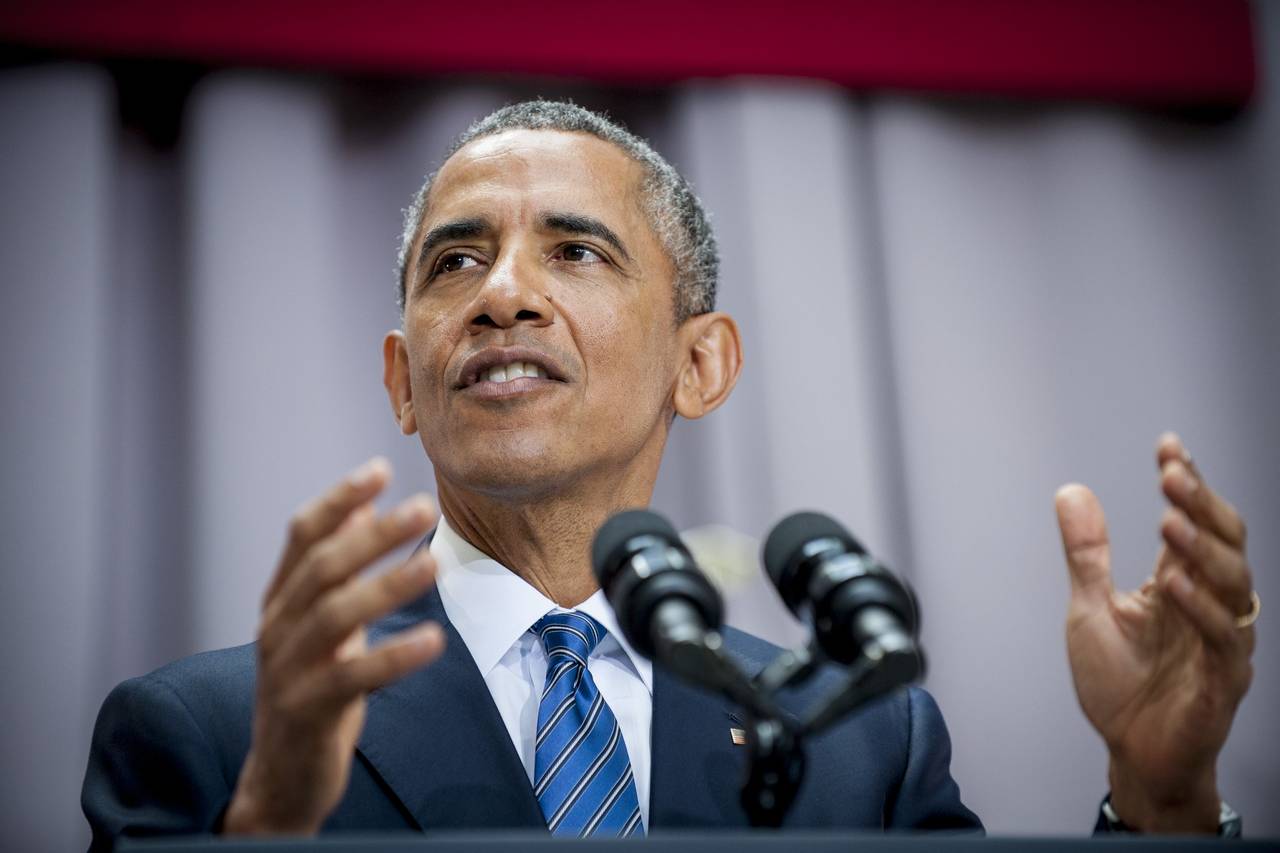
PHOTO: PETE MAROVICH/ZUMA PRESS
President Obama giving a speech at American University, August 5, Washington D.C..
Later this month, President Obama will travel to Alaska and shine a spotlight on what Alaskans in particular have come to know: Climate change is one of the biggest threats we face, it is being driven by human activity, and it is disrupting Americans’ lives right now. [White House]
Can A Global Warming Calamity Be Averted?

“Unless someone like you cares a whole awful lot,
Nothing is going to get better. It’s not.”
― Dr. Seuss, The Lorax
Global warming is often wrongly said to be a political issue. In fact, global warming is no more of a political issue than a tornado is a political issue, or an erupting volcano, or an earthquake or tsunami. These are factual occurrences that occur for known scientific reasons. As there is no debate on the existence or occurrence of these physical happenings nor should there be a need to debate the occurrence of human-caused global warming and climate change as these changes are, too, scientifically based and measured. In fact, sea level has already begun to rise from global warming, measurably. Migratory bird species are changing their patterns and timing of flight; temperature gradients for gardening around the world have changed; heat wave death tolls have risen; extreme weather has become more extreme; average monthly air temperatures at the surface have been steadily rising; dewpoint temperatures in the Midwest have exceeded precedence. Time is running out run out for acting responsibly to avert the worst outcomes possible from global warming. Alarm bells have rung. Action must be taken now, and on a grand scale, to prevent what scientists have been predicting for decades now – the catastrophic consequences of human fed global warming.
Longtime and well respected University of Wisconsin-Madison Chemistry Professor Bassam Shakhashiri recently summarized on Wisconsin Public Radio his own perceptions of the seriousness of the global warming threat and our collective responsibilities as citizens to work towards mitigating and adapting to this monumental threat as follows:
“We should have high expectation of all our government agencies and we should have high expectations of our elected officials and we should have high expectations of everyone who cares about the quality of life of where we live. We face grand challenges. Global warming is unequivocal. It’s not a matter of voting whether we will have global warming or not. It’s a matter of who we elect in the next election cycle to take responsible action to address and to solve this very, very serious and highly consequential question of climate change.
“We have elected officials from our state of Wisconsin who engage in conversations that label other people as deniers of climate change. I think it behooves us as learned individuals, as people who care about the quality of life that we have, to elect individuals to the U.S. Senate to the presidency, to our local government, who can take responsible action to mitigate and to address in responsible ways, and “responsible” is crucial, global warming. It’s not just local here. You can look at different displays of information. In the past 25 years, the plant hardening zones have been changing. Just in the past 25 years, the zone that we are in Wisconsin, is what it was 25 years ago in Florida. We have issues that relate to water quality. We have issues that relate to wellness, to health care.
“We have fabulous opportunities to make great progress in our society, and that’s why I have high expectations – always have high expectations – but I also live in the real world. We must, in the upcoming election cycle, be truly faithful to our core beliefs and to our values, so that our elected officials can act and can respond, in most good ways, to this one issue of climate change. There are other issues, too, but this is really a critical one.” [The Larry Meiller Show,Thursday, August 6, 2015, 11:00 am]
Global warming has all the marking of becoming a worldwide economic, environmental and human disaster. It could be a disaster that has no precedent in nature, at least during the time humans have been inhabiting Earth. Scientific models have demonstrated the inevitably of global warming due to our relentless burning of fossil fuels, in almost every device possible, and our continued deforestation practices, particularly in the tropics. Should global warming be allowed to continue at the current rates, the death toll from global warming effects could ultimately exceed the number of human losses from all wars, human atrocities, motor vehicle crashes, airplane crashes and worldwide epidemics.
History is repleat with examples of being “too little, too late”. U.S. President Hoover’s attempts to end the Great Depression by funding the construction of the Hoover Dam were believed by the American public as being “too little” to save the U.S. economy and “too late”. He was soundly defeated in the U.S. presidential election by Franklin Delano Roosevelt.
In medicine, if someone is sick and they do not get to a doctor until their sickness becomes fatal any remedy will be “too little, too late”.
The Obama administration’s Clean Power Plan to reduce global warming is also both too little and too late to prevent what scientists call a “runaway greenhouse effect”, as what happen on the planet Venus eons ago, making the planet’s former oceans of water boil away, due to surface atmospheric temperatures that continued to climb, unabated.
While the U.S. electrical energy power production may be the top emitting sector of greenhouse gases (GHGs) in the U.S. economy, timely and sufficiently large GHGs emissions reductions in the transportation and other GHG emitting sectors (construction industry sector, agriculture industry sector, consumer sector, export/import sectors, the military industrial complex) will nullify any gains made in the electricity production sector. This could leave the planet vulnerable for the positive GHG feedback mechanisms that contribute to more global warming to kick-in, which could cause a runaway greenhouse effect on Earth. Examples of positive feedback to more global warming of Earth include a reduced ability of the Arctic Ocean to reflect solar energy back into space (darker water absorbs more solar energy than snow and ice), causing additional heating of the oceans; melting of the permafrost region (1/5 of the earth’s surface) resulting in more methane gas (a much stronger GHG than carbon dioxide) production.
Albert Einstein once remarked: “We can’t solve problems by using the same kind of thinking we used when we created them.” Offering the public positive financial incentives to reduce actions that emit greenhouse gases, such as driving, flying and using fossil fuel created heat and electricity, could drastically reduce human caused climate change and as well as other problems created by our fossil fuel powered economy (such as oil spills, ground water pollution from petroleum waste, and natural gas explosions).
Vatican Conference Linked Climate Change and Modern Slavery

Democracy Now:
Following the publication of Pope Francis’ encyclical on climate change, a major conference on climate change was held at the Vatican. Speakers included our guest, Naomi Klein, author of “This Changes Everything: Capitalism vs. the Climate.” We speak to Klein about her trip to the Vatican and the importance of the pope’s message – not only on climate change, but the global economy.
TRANSCRIPT
This is a rush transcript. Copy may not be in its final form.
AMY GOODMAN: Our guest is Naomi Klein, journalist, best-selling author. Her most recent book is This Changes Everything: Capitalism vs. the Climate, out today in paperback. A documentary film directed by Avi Lewis based on This Changes Everything will be released in the fall.
Naomi, you have recently returned from the Vatican. Can you describe that experience? What were you doing there?
NAOMI KLEIN: So I was there at a conference that was convened by Cardinal Peter Turkson. And Cardinal Peter Turkson is—has been doing a lot of the speaking on the encyclical. It wasn’t convened by Francis, just to set that record straight. It was convened by the Cardinal Turkson’s office and also by the organization representing Catholic development agencies. And it was part of the rollout for the climate change encyclical. The organizers described what they were doing as building a megaphone for the encyclical, because they understand that it’s words on a page unless there are groups of people around the world who are amplifying that message in various ways. So there were people from around the world.
There were people there, for instance, from Brazil, who were talking about how the movements there that have been fighting large dams, oil drilling, fighting for more just transit, are going to be putting huge resources behind popularizing the climate change encyclical, buying radio ads, producing videos, creating teaching materials for every chapter of the encyclical, and really using it as an organizing tool. That was one of the things I was really struck by while I was there, was just how ready particularly the movements in Latin America are to operationalize the encyclical, if you will.
And they also talked about not wanting it to be domesticated, was a phrase I heard a lot, domesticated by the church. You know, there’s a way in which you can just take this document that is, you know, almost 200 pages and just take out the safest parts of it—you know, “Oh, we’re against climate change, and we all need to kind of hold hands.” But, in fact, if you read the document, it’s very clear in calling for a different economic model, and it’s a challenge to what Pope Francis calls our throwaway culture. So they want to make sure that the parts of the encyclical that really do represent the deepest challenge to our current economic system and represent the most hope for the people who are excluded from the benefits of that economic system are really highlighted.
NERMEEN SHAIKH: Well, last month, Pope Francis went on a tour of South America in his first foreign trip after unveiling the historic encyclical urging climate action. In Ecuador, he reiterated his call for social justice and environmental preservation.
POPE FRANCIS: [translated] The goods of the Earth are meant for everyone. And however much someone may parade his property, it has a social mortgage. In this way, we move beyond purely economic justice, based on commerce, toward social justice, which upholds the fundamental human right to a dignified life. The tapping of natural resources, which are so abundant in Ecuador, must not be concerned with short-term benefits.
NERMEEN SHAIKH: That was Pope Francis speaking in Ecuador. Naomi Klein, could you talk—you’ve mentioned in the past the significance of the pope’s origins in Argentina and the particular form that Catholicism took in Latin America. Could you talk about the significance of that and the kind of turn that you witnessed at the Vatican in the focus of this new pope and the church under his leadership?
NAOMI KLEIN: Sure, Nermeen. Yeah, it was definitely striking that a lot of the people who are real players in the Vatican right now come from the Global South. As you mentioned, Pope Francis is from Argentina, and he is the first pope from the Global South. And Cardinal Turkson is originally from Ghana and is talked about as potentially going to be the first African pope. And you see the influence. There are a lot of people who have a history with liberation theology around this pope. He doesn’t come from that particular tradition, but there’s clearly an influence, because before he became pope, he worked with the Latin American Council of Bishops, which—you know, the form of Catholicism in Latin America is one that is more influenced by indigenous cosmology than perhaps in North America, and definitely in Europe, precisely because the genocide of indigenous people in Latin America was far less complete.
So, the first phrase of the encyclical, the first paragraph of the encyclical quotes Francis of Assisi, referring to the Earth as “sister” and as “mother,” and then goes on to talk about Francis—Francis of Assisi, not Pope Francis—and it’s significant that Pope Francis chose the name Francis, the first pope in history to choose that as his name—how we ministered to plants and animals, and saw them as his brothers and sisters. And obviously, in there, you have echoes of indigenous cosmologies that see all of creation as our relations. And while I was at the Vatican, I did ask and, before and afterwards, talked to different theologians about whether there is any precedent for a pope talking—using this language of Mother Earth so prominently, and nobody could think of a single example of this. So, I think what is significant about it is that it is very much a rebuke to the worldview that humans have been put on Earth to dominate and subjugate nature. That is very clear in the encyclical. And the major theme of the encyclical is the theme of interdependence.
You also mentioned—or you played that clip where Francis talks about natural resources as being something that everybody has a right to. And this, of course, is a challenge to a pretty basic principle of private property under capitalism, that if you buy it, it’s yours to do with whatever you want. And that’s something else that’s very strong in the encyclical, is the idea of the commons, that the atmosphere is a commons, that water is a right. And I do think that you can see the influence of Pope Francis’s many years in Argentina. You know, he ministered in the outskirts of Buenos Aires, and that’s somewhere where I spent some time doing reporting and filmmaking. And the outskirts of Buenos Aires, they have had one of the most catastrophic experiences with water privatization, where a French water company came in and put in the pipes, but then refused to put in the sewers. So every time it rains, there are these huge floods, and there’s even cases of bodies being washed up in the streets and in people’s basements, so—which is simply to say he knows of which he speaks. I mean, he has seen a very brutal form of deregulated capitalism introduced in the Southern Cone of Latin America, and he also understands that this is a form of capitalism that, in that part of the world, was imposed with tremendous violence.
AMY GOODMAN: Naomi Klein, as we wrap up, very quickly, the pope is coming to the United States in September, but before that, he will go to Cuba first. Can you talk about the significance of the Cuba trip, and then, within the presidential race here, the pope landing in the United States?
NAOMI KLEIN: Well, I think the timing of this trip is obviously going to be very awkward for several Republican candidates who are Catholic and understand that this is a very, very popular pope. He’s particularly popular among Latinos, and that’s a really coveted voting bloc. So, you know, picking a fight with this pope is not a very smart political move if you’re running for office right now.
And I met somebody while I was—I can’t use his name, because it was just—it wasn’t an interview situation. But I met a fairly prominent Catholic, while I was at the Vatican, from the United States, from a major U.S. organization, who said, “The holy father isn’t doing us any favors by going to Cuba first,” by which he meant that there are a lot of people talking about how this pope is sort of a closet socialist, and by going to Cuba first, he was reinforcing that narrative. So I think for conservative Republican Catholics, the fact that this pope is going to Cuba first, but also because he has said such critical things about deregulated capitalism and everything he’s saying about climate change, is putting them into, frankly, uncharted territories. They really don’t know how to navigate these waters.
AMY GOODMAN: It’s President Obama’s birthday today. Do you have any particular birthday wishes for him?
NAOMI KLEIN: Amy, I had no idea. Thanks for telling me. And I wish him a very happy birthday.
AMY GOODMAN: Naomi Klein, we want to thank you for being with us, journalist, best-selling author. Her most recent book is called This Changes Everything: Capitalism vs. the Climate. It’s out in paperback today. And she’s got a documentary film coming out. It’s directed by Avi Lewis, based on This Changes Everything. It’s out in the fall. She also, together with Avi Lewis, made The Take, about Argentina. Her past books, No Logo and The Shock Doctrine: The Rise of Disaster Capitalism.
Who’s Gonna Stand Up and Save the Earth – Neil Young

Originally published on Sep 27, 2014, as requested by Neil himself. More than one version. “Please feel free to create any video of “Who’s Gonna Stand Up” u wish. Use social media to spread the word. – NY”
The above photo is of the Alberta, Canada area which was once boreal forest but was converted into a tar sands mine.
The Koch Brothers are the main owners. A Koch Industries subsidiary holds leases on 1.1 million acres in the northern Alberta oil sands, an area nearly the size of Delaware. The Washington Post confirmed the group’s findings with Alberta Energy, the provincial government’s ministry of energy. Koch Industries has been involved with almost every aspect of the tar sands industry, from mining bitumen to transportation, exportation, distribution and, of course, refining the petrochemicals — a large part of their empire.
Koch Industries is “one of Canada’s largest crude oil purchasers, shippers, and exporters, with more than 130 crude oil customers,” and is also responsible for about 25 percent of oil sands crude imports into the U.S., for use at its refineries, according to a Post article by Ari Philips, March 20, 2014.
Koch Industries on a net acreage basis is the largest American and foreign holder of leases in Canada’s oil sands.
The Enbrige owned pipeline cuts diagonally across Wisconsin from Superior to the border with Illinois The Wisconsin Department of Natural Resources (DNR) approved its permit to triple the volume pumped through the current 42 inch pipeline to 1.1 million barrels (42-gallons) per day. Dane County added a condition to placing a pumping station on the Dane County that they appropriately insure the project in case of a spill like the one that occurred in 2012 in Kalamazoo, Michigan part but Wisconsin state legislators nullified that with language prohibiting local action. The Wisconsin DNR determined there was no significant environmental impacts warranting a public review and Environmental Impact Statement EIS.
Boreal Forest
Pope Calls for Swift Actions to Save the Planet from Environmental Ruin

“The pace of consumption, waste and environmental change has so stretched the planet’s capacity that our contemporary lifestyle, unsustainable as it is, can only precipitate catastrophe”.
Pope Francis, June 18, 2015
In his long-awaited encyclical on the environment and climate change publicly released last week, Pope Francis called for swift action to save the planet from environmental ruin, urging world leaders to hear “the cry of the Earth and the cry of the poor.” He called for a change of lifestyle in rich countries steeped in a “throwaway” consumer culture, and an end to “obstructionist attitudes” that sometimes put profit before the common good. Pope Francis said protecting the planet is a moral and ethical “imperative” for believers and nonbelievers alike that should supersede political and economic interests.
A major theme of the encyclical is the disparity between rich and poor. “We fail to see that some are mired in desperate and degrading poverty, with no way out, while others have not the faintest idea of what to do with their possessions, vainly showing off their supposed superiority and leaving behind them so much waste which, if it were the case everywhere, would destroy the planet,” he said.
“Our house is going to ruin, and that harms everyone, especially the poorest. Mine is therefore an appeal for responsibility, based on the task that God has given to man in creation: “till and keep the garden” in which he was placed. I invite everyone to accept with open hearts this document, which follows the church’s social doctrine”, the pope said.
In a transcript of the pope’s encyclical on the DemocracyNow.org website, Pope Francis said protecting the planet is a moral and ethical imperative, for believers and nonbelievers alike, that should supersede political and economic interests. He also dismissed those who argue that technology will solve all environmental problems and that global hunger and poverty will be resolved simply by market growth.
A major theme of the encyclical is the disparity between rich and poor. “We fail to see that some are mired in desperate and degrading poverty, with no way out, while others have not the faintest idea of what to do with their possessions, vainly showing off their supposed superiority and leaving behind them so much waste which, if it were the case everywhere, we destroy the planet.”
Climate change is already happening, and its effects have already been disastrous on the poorest countries and the poorest people, who don’t have the means to defend themselves from it. They are also part of the human population who have the least responsibility for what is happening, being that they consume less fossil fuels.
Author Naomi Klein said on Democracy Now Thursday that “this encyclical, we can’t overstate the importance of it, the impact that it will have. It’s hard to respond to a document that runs close to 200 pages, when it was just released in non-draft form a few hours ago. We’re all still digesting it, Amy. But it is very clear that a door has just been opened, and a gust of wind is blowing through, where it is now possible to say some very powerful truths about the real implications of climate change, really the root causes.”
“And I think a lot of the discussion about the encyclical in the U.S. media cycle has focused and will continue to focus on the impact on Republicans and on climate deniers, many of whom are Catholic. And it is certainly a challenge to that demographic in the United States, because the pope is coming out so clearly on the side of climate science in saying this is real and this is happening. But I think that it’s too easy to say that this is just a challenge to Rick Santorum and Jeb Bush. Frankly, it is also a challenge to Hillary Clinton and Barack Obama and to large parts of the green movement, because it is a rebuke of slow action. It very specifically says that climate denial is not just about denying the science, it’s also about denying the urgency of the science. The document is very strong in condemning delays, half-measures, so-called market solutions. It very specifically criticizes carbon markets, the carbon offsetting, as an inadequate measure that will encourage speculation and rampant consumption.
“And I think probably the most significant part of it, the big picture, is the foregrounding of the culture of frenetic consumption in the wealthy world and among the wealthy. And this is really significant, because I think large parts of the climate change discussion tries to have it all ways and say, “No, we’ll just have green growth. We’ll just have—we’ll consume green products.” And, you know, this goes a lot deeper than that and says, no, we need to get at the underlying values that are feeding this culture of frenetic consumption that is entirely unsustainable.”
In the encyclical, the pope states that: “In a corrupt culture, we can’t believe that laws will be enough to change behaviors that affect the environment.” Naomi Kline responds: Well, I think, when he’s referring to corruption, I believe he’s referring to the influence of polluting companies, of multinational corporations, which he also goes after in the encyclical. And I think this is one of the most significant things about the document. One might expect of a religious document about climate change to erase difference, right? to say, “Well, we’re all in this together,” and certainly it talks about the Earth as our common home. But it also recognizes explicitly the power dynamics in capitalism, which is to say that there are forces within the system that are actively working against change. And that is probably what he’s referring to when he’s talking about how there may be laws, but the laws aren’t enforced. And, you know, indeed the laws are also inadequate, which is also addressed in the document, and it has some very specific calls for another level of environmental law, which is a part of the document that I haven’t been able to look at, you know, closely enough.
And another thing I have to say is, you know, I am—I have accepted this invitation to speak at a conference which is about digging more deeply into the document, because there’s an understanding that it does take time to digest a document of this length, this multilayered, and it requires that kind of deeper analysis. And I think that this intervention, five months ahead of U.N. climate conference in Paris, is tremendously significant. It’s going to push political leaders to go further. It’s going to be a tool for social movements.
A lot of the language of the climate justice movement has just been adopted by the pope—I mean, even of phrases like “ecological debt.” The pope is talking about the debt that the wealthy world owes to the poor. I mean, this is a framing that comes originally from Ecuador, from the movement against drilling in the Amazon. And, you know, this is a phrase that was never heard in mainstream circles until just now, actually. I mean, I’ve never seen such a mainstream use of that term.
So, it is very important in that way. But, I mean, I have to say, on a personal level, that as thrilled as I am that the Vatican is leading in this way and that this pope is leading in this way and bringing together the fight against poverty with the fight to act on climate change, that doesn’t mean that there’s a complete merger between the climate justice movement and the Vatican here. I mean, obviously there are huge differences that remain over issues like marriage equality, reproductive rights and freedom, to name just a few.”
Nathan Schneider, columnist with the Catholic weekly, America, who has been covering Catholic engagement with climate change, talks about what the encyclical means for the Catholic community and the number of languages it’s been released in and how large the document is: “Well, this is really the first Third World encyclical. You know, this is coming from a pope who was shaped in really significant ways by economic crises during the Cold War in Argentina and being in the middle of a battleground between the First and Second World powers. It was drafted by a cardinal from Ghana. So this is coming from the side of the world that we don’t normally hear from. And it’s very much in line with things that popes have been saying for decades, you know, going back to Paul VI, then John Paul II, Benedict XVI. So, a lot of the content is actually not so new for Catholics, but the emphasis and that—the language of climate debt, the language—the recognition that there is a divide here between the rich countries and the poor. And this is a cry from the developing world, from what has been labeled the Third World, for change.”
“The pope is calling here for us to change how we live, how we—what we do with our resources. You know, this is not just moving from one kind of consumerism to another. This is a kind of spiritual renewal and also a material renewal, that—in which we turn ourselves toward an economy that’s sustainable, that’s life-giving, both for humanity and the rest of the world.”
Source: Democracynow.org
Baking in Alaska: Anchorage is hotter than Los Angeles

Temperatures in Alaska’s biggest city hit 83 degrees on Monday and Tuesday, records for both calendar days and just two degrees shy of the June record set in 1969. Temperatures could again hit 80 on Wednesday. In Los Angeles, temperatures on Monday and Tuesday didn’t crack 80.
The normal high for Anchorage is just 63 degrees, as measured between 1981 and 2010, according to the National Weather Service.
Despite this heat wave, cooler-than-normal temperatures in the first 10 days of the month means it probably won’t go down as one of the hottest Junes on record for much of the state. Contributing to the warmer weather in recent years have been sea surface temperatures far above normal as well as earlier melting of winter ice.
Alaska glaciers sending 75 billion tons of water into sea each year.
The Children of Today and Tomorrow are in for a Rude Awakening

The global warming genie has escaped his bottle! He has begun to show his wrath, which is only likely to worsen in the coming years, decades and centuries, and there is presently no end in sight!
He’s leaving plenty of evidence. The only way we can all help weaken him is by stopping our nonessential burning of fossil fuels, stopping deforestation especially of the tropics, and doing things which naturally result in more greenhouse gases being added into the earth’s atmosphere and oceans (such as overeating, wasting food, not recycling, not reusing things whenever possible, running our air conditioning and furnaces needlessly, using energy derived from tar sands industry, doing other things that frivolously burn fossil fuels such as going for joy rides, cruising, etc.. Because our atmosphere is where Global Warming lives and breathes (now that he’s escaped the bottle) and because he gets his tremendous strength to wreak havoc on the world by his breathing in greenhouse gases that have been accumulating to record high concentrations in the earth’s atmosphere (as a by-product of our burning carbon-based fuels in our cars, trucks, airplanes, power plants, ships, boats, trains, machinery, recreational products and the like) we need to all put him on a crash diet, NOW!
According to David Owen, author of Green Metropolis and The Conundrum: How Scientific Innovation, Increased Efficiency, and Good Intentions Can Make Our Energy and Climate Problems Worse, the proportional share of the fuel burned during a round trip from New York City to Melbourne, Australia, is greater than the total amount of energy that the average resident of the earth uses, for all purposes, in a year. Forestalling global calamity is a preemptively worthy, ethically justifiable and economically achievable goal for everyone on the planet, especially in this era of television, radio, computers, Skype, the iPhone and virtual reality. Climatologists, environmentalists, CEOs, religious leaders, students and tourists seeking entertainment or to broaden their horizons, and government officials ought use the least greenhouse gas emitting technologies available to them to accomplish their objectives; they should not have to cross the oceans and great land masses of world (requiring vast burning fossil fuels) just to be present in person. Likewise, our government leaders and business people ought minimize the amount of products traded with distant countries, so as to minimize the amount of fuel burning required in the shipment of goods by air, sea and over miles and miles of terrain. Transportation of billions of tons of goods along with extensive long distance vacationing and business trips by millions of people every year is simply no longer sustainable. Such activities are becoming ethically wrong because they are unquestionably harming the planet and all the living things it is home to, both now and in the future.
We cannot and must not wait for technology to bail us out. Scientists the world over say it is now paramount that all humans begin acting in significant ways to reduce their annual greenhouse gas emissions. Otherwise, we will never get Global Warming to go back into his bottle – where he belongs! Greenhouse gases accumulate atmospherically over time – they build up in the atmosphere and oceans from year to year. Their volume is accelerating in earth’s atmosphere and as well as in its oceans, and the total volume will likely keep accelerating for some time due to compounding factors (positive feedbacks) of the earth’s natural systems. That’s why it’s of the utmost importance – paramount – that everyone act in ways to reduce their annual carbon footprint, immediately, before Global Warming becomes all to powerful, uncontrollable and for generations, a tragedy for civilization.
Scientists: Long-Awaited “Jump” in Global Temperatures Now Appears “Imminent”

The National Center for Atmospheric Research’s leading climatologist Kevin Trenberth said this week that he believes “a jump [in global temperatures] is imminent”, according to article posted April 2 on Climate Progress.
New research from a major national lab projects that the rate of climate change, which has risen sharply in recent decades, will soar by the 2020s, with the Arctic warming by 1 degree Fahrenheit per decade.
The speed with which temperatures change will continue to increase over the next several decades, intensifying the impacts of climate change, according to the U.S. Department of Energy.
New research documents evidence that global warming causes more global warming and that, as Earth warms, the warmer temperatures correspond with an increase in greenhouse gases, which means the earth warms the earth even more. “We discovered that not only does thickening the blanket of heat-trapping gases around our planet cause it to get warmer, but also, crucially, when it gets warmer this increases thickens the blanket of heat-trapping gases,” scientist Tim Lenton said.
While previous studies have suggested a correlation between warming temperatures and an increase in greenhouse gas, Lenton’s team is the first to prove the relationship using direct evidence, taken from ice cores nearly one million years old. The team — comprised of scientists from the University of Exeter, the Scripps Institution of Oceanography, and Wageningen University in the Netherlands — analyzed Antarctic ice core data from the end of ice age cycles 400,000 and 800,000 years ago. That ancient ice is important, because it offers an extremely large amount of historical global temperature and greenhouse gas concentration data, which the scientists were able to analyze to figure out how the two interact.
The findings provide even more support to the overwhelming evidence that humans are causing global warming by pumping greenhouse gases into the atmosphere. The surprise, Lenton explained, is that the findings also show that increasing temperature eventually increases greenhouse gases.
“It implies that we should expect the ‘Earth system’ to respond to anthropogenic global warming by amplifying it with the release of additional greenhouse gases,” Lenton said.
 All Things Environmental
Recent Comments