
Republican Brewhaha on Wisconsin Highway Funding Symptomatic of Larger Problem

Wisconsin Governor Scott Walker’s proposed borrowing plan for highway construction the next two years has finally hit the skids! GOP lawmakers said as much in a letter to the governor yesterday. Not only is the governor’s proposed $1.3 billion transportation borrowing plan too high, said the 33 Assembly Republicans who signed the letter, but also any reduction to $800 million must include reductions in the massive Milwaukee area freeway projects already under construction.
The Republicans lawmakers, who are in the majority in both houses of the Wisconsin Legislature, are negotiating among themselves over the reduction in bonding to $800 million according to a story in the Milwaukee Journal Sentinel website Monday.
Allthingsenvironmental emailed the Republican dominated Joint Finance way last March after the governor’s proposed biennial budget for 2015-17 hit the streets sending them the following message:
So it’s not just the governor’s highway plan part of the 2-year budget that’s unsustainable. It’s virtually everything Scott Walker has done as governor, starting January 2010 with his Act 10 that destroyed collective bargaining in public employee unions, having appeared out of the blue.
Meanwhile, as probable presidential candidate Scot Walker heads his way to yet another Wisconsin taxpayer funded speaking engagement, this time in California, the brewhaha simmering among his fellow Republicans is beginning to reach the boiling point. One has to wonder how many frequent flyer miles the governor and his security people have racked up over the past 5 years? A lot? Yes, but undoubtedly not even close to the millions of tons of greenhouse gases his jets, autos and motorcycles have emitted to the atmosphere for the next generation to be burdened with.
The Children of Today and Tomorrow are in for a Rude Awakening

The global warming genie has escaped his bottle! He has begun to show his wrath, which is only likely to worsen in the coming years, decades and centuries, and there is presently no end in sight!
He’s leaving plenty of evidence. The only way we can all help weaken him is by stopping our nonessential burning of fossil fuels, stopping deforestation especially of the tropics, and doing things which naturally result in more greenhouse gases being added into the earth’s atmosphere and oceans (such as overeating, wasting food, not recycling, not reusing things whenever possible, running our air conditioning and furnaces needlessly, using energy derived from tar sands industry, doing other things that frivolously burn fossil fuels such as going for joy rides, cruising, etc.. Because our atmosphere is where Global Warming lives and breathes (now that he’s escaped the bottle) and because he gets his tremendous strength to wreak havoc on the world by his breathing in greenhouse gases that have been accumulating to record high concentrations in the earth’s atmosphere (as a by-product of our burning carbon-based fuels in our cars, trucks, airplanes, power plants, ships, boats, trains, machinery, recreational products and the like) we need to all put him on a crash diet, NOW!
According to David Owen, author of Green Metropolis and The Conundrum: How Scientific Innovation, Increased Efficiency, and Good Intentions Can Make Our Energy and Climate Problems Worse, the proportional share of the fuel burned during a round trip from New York City to Melbourne, Australia, is greater than the total amount of energy that the average resident of the earth uses, for all purposes, in a year. Forestalling global calamity is a preemptively worthy, ethically justifiable and economically achievable goal for everyone on the planet, especially in this era of television, radio, computers, Skype, the iPhone and virtual reality. Climatologists, environmentalists, CEOs, religious leaders, students and tourists seeking entertainment or to broaden their horizons, and government officials ought use the least greenhouse gas emitting technologies available to them to accomplish their objectives; they should not have to cross the oceans and great land masses of world (requiring vast burning fossil fuels) just to be present in person. Likewise, our government leaders and business people ought minimize the amount of products traded with distant countries, so as to minimize the amount of fuel burning required in the shipment of goods by air, sea and over miles and miles of terrain. Transportation of billions of tons of goods along with extensive long distance vacationing and business trips by millions of people every year is simply no longer sustainable. Such activities are becoming ethically wrong because they are unquestionably harming the planet and all the living things it is home to, both now and in the future.
We cannot and must not wait for technology to bail us out. Scientists the world over say it is now paramount that all humans begin acting in significant ways to reduce their annual greenhouse gas emissions. Otherwise, we will never get Global Warming to go back into his bottle – where he belongs! Greenhouse gases accumulate atmospherically over time – they build up in the atmosphere and oceans from year to year. Their volume is accelerating in earth’s atmosphere and as well as in its oceans, and the total volume will likely keep accelerating for some time due to compounding factors (positive feedbacks) of the earth’s natural systems. That’s why it’s of the utmost importance – paramount – that everyone act in ways to reduce their annual carbon footprint, immediately, before Global Warming becomes all to powerful, uncontrollable and for generations, a tragedy for civilization.
2014 in review
The WordPress.com stats helper monkeys prepared a 2014 annual report for this blog.

Here’s an excerpt:
A San Francisco cable car holds 60 people. This blog was viewed about 1,600 times in 2014. If it were a cable car, it would take about 27 trips to carry that many people.
Article that received most views: “Homeless Children in the United States” (Nov. 2014)
Scant Progress As UN COP 20 Talks Enter Final Stretch

U.N. global warming talks seemed set to spill over into the weekend as negotiators bickered Friday over the content of climate action plans that countries should unveil in the run-up to a key summit in Paris next year.
The yearly U.N. climate meetings rarely close on time and the two-week session in Lima was no exception as disputes that arose in the opening days remained unresolved by Friday’s scheduled close of the conference.
“This will not be over today,” Chinese delegate Zhang Jiutian said. “There are still some points in the agenda that need more discussion.”
One of the most problematic issues in Lima was getting the more than 190 countries participating to agree on what information should go into the pledges that governments are supposed to put on the table for a global climate pact expected to be adopted a year from now in Paris.
Rich countries insisted the pledges should focus on efforts to control emissions of carbon dioxide and other heat-trapping greenhouse gases and were resisting demands that they include promises of financing to help poor countries absorb the effects of climate change.
Meanwhile, top carbon polluter China and other major developing countries opposed plans for a review process so the pledges can be compared against one another before Paris. Their reluctance angered some delegates from countries on the front lines of climate change.
“We are shocked that some of our colleagues would want to avoid a process to hold their proposed targets up to the light,” said Tony de Brum, the foreign minister of the Marshall Islands, a Pacific nation of low-lying atolls at risk of being flooded by rising seas.
Though negotiating tactics always play a role, virtually all disputes in the U.N. talks reflect the wider issue of how to divide the burden of fixing the planetary warming that scientists say results from human activity, primarily the burning of oil, coal and natural gas.
Historically, Western nations are the biggest emitters. Currently, most CO2 emissions are coming from developing countries as they grow their economies and lift millions of people out of poverty.
During a brief stop in Lima on Thursday, U.S. Secretary of State John Kerry said fixing the problem was “everyone’s responsibility, because it’s the net amount of carbon that matters, not each country’s share.”
According to the U.N.’s scientific panel on climate change, the world can pump out no more than about 1 trillion tons of carbon to have a likely chance of avoiding dangerous levels of warming. It has already spent about half of that carbon budget as emissions continue to rise, driven by growth in China and other emerging economies.
Scientific reports say climate impacts are already happening and include rising sea levels, intensifying heat waves and shifts in weather patterns causing floods in some areas and droughts in others.
* COP 20 — 20th Annual Conference of the Parties
By KARL RITTER – 12/12/2014. Associated Press writer Nestor Ikeda contributed to this report.
Also on HuffPost.
Earth a Lucky Fluke?

Is the Earth one of many habitable planets in the universe, or are human beings alone, the product of a lucky fluke? Author of “Lucky Planet: Why Earth is Exceptional–and What That Means for Life in the Universe”, David Waltham says it’s more likely the latter, thanks to our planet’s unusually stable climate and early development of life.
But whether Earth’s climate can still said to be “stable” is now, unfortunately, open to question. We humans have have relied far too extensively on fossil fuel burning – especially coal, oil (gasoline, diesel fuel, jet fuel, propane, fuel oil) and natural gas (methane), which all emit greenhouse gases to the atmosphere upon combustion, since the onset of the Industrial Revolution. What Earth needs now is another kind of revolution, a peaceful revolution, but where humans use their own physical power and the energy of the Sun and the wind and rid themselves from the over-dependence on burning fossil fuels. Read about a plan to do just that right here and then sign the petition to our elected governmental officials demanding they undertake the necessary changes to make this happen before its too late! Thank you.
Another Global Warming Trend: Tornadoes in Swarms
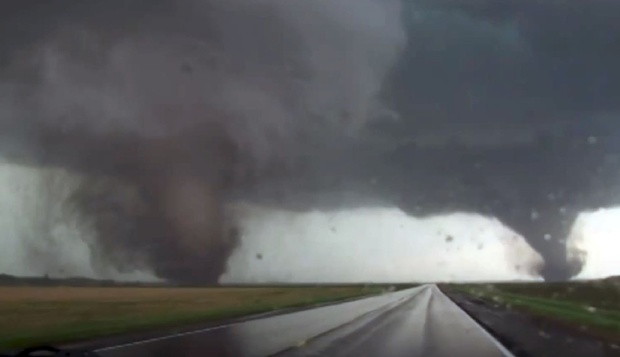
October 16, 2014
Tornado Swarms Increasing In U.S.: NOAA Study Tracks Deadly Storms
 “>Read more.
WASHINGTON (Reuters) – Tornadoes in the United States are increasingly coming in swarms rather than as isolated twisters, according to a study by U.S. government meteorologists published on Thursday that illustrates another trend toward extreme weather emerging in recent years.
According to a study published by government meteorologists in the journal Science on Thursday, tornadoes are increasingly coming in swarms, meaning on the days a tornado hits, it is far more likely that several more — possibly dozens — will occur that same day.
Researchers looked at tornado activity over the past 60 years and found that although the number of the deadly storms occurring each year had remained relatively steady, since the mid 1990s they have been more likely to come in swarms over fewer days per year rather than as isolated tornadoes spread throughout the season.
On the list of the 10 single days with the most tornadoes since 1954, eight have occurred since 1999, including five since 2011. That year alone had days with 115, 73, 53 and 52 twisters.
The meteorologist who led the study, Harold Brooks of the U.S. National Oceanic and Atmospheric Administration’s National Severe Storms Laboratory in Norman, Oklahoma, said emergency management agencies and insurers should be prepared to deal more often with days with lots of tornado damage.
The study analyzed the official U.S. tornado database for the six-decade period ending last year, excluding twisters below Category F1, with wind speeds of 73-112 mph (117-180 kph), on the Enhanced Fujita Tornado Intensity Scale.
Some experts have blamed weather intensity seen in recent years on global climate change they attribute to human activities. This study did not, however, offer a conclusion as to a cause.
“Knowing that the climate now has changed from that of the 1970s makes for a circumstantial argument in favor of a changing climate playing at least some role in the tornado changes,” said meteorologist Patrick Marsh of NOAA’s Storm Prediction Center.
“There are indications that heavy rainfall events are occurring with greater frequency globally, and given a warmer climate, this makes sense,” added Storm Prediction Center meteorologist Greg Carbin.
But “any trend in tornado events is much more difficult to discern,” Carbin added.
The average number of days annually with at least 20 tornadoes has more than doubled since the 1970s to upwards of five days per year in the past decade. For days with at least 30 tornadoes, there has been an average of three per year in the past decade, compared to 0.6 days per year in the 1970s.
Records for both the most and fewest tornadoes over a 12-month period have come in the past five years, with 1,050 from June 2010 to May 2011 and 236 tornadoes from May 2012 to April 2013. May is the month with the most tornado activity, followed by June and April.
Tornadoes, rapidly spinning columns of air usually spawned by rotating thunderstorms, can be among the most violent weather events. They have been reported on every continent except Antarctica but most often hit a U.S. region covering the Great Plains and parts of the Midwest and South.
Tornadoes can cause extensive loss of life and property damage like the May 2011 twister in Joplin, Missouri, that killed about 160 people and wrecked thousands of homes.
(Reporting by Will Dunham, editing by G Crosse)
Answer “No” to Transportation Amendment on November 4th Ballot

Wisconsin law presently requires that specific revenue streams, such as gasoline and diesel fuel taxes and license fees collected from motor vehicle owners, be deposited into the transportation fund; however, the Wisconsin Supreme Court has recognized that the Wisconsin Legislature may, at times, have greater needs other than transportation, and it is therefore authorized to transfer certain amounts from the Transportation Fund to non-transportation state needs, such as education, health care, and shared revenue.
However, the Wisconsin Department of Transportation and the highway building industry – which includes such contracting entities as the Wisconsin road and bridge builders (the Transportation Builders Association), sand and gravel suppliers, cement and asphalt production companies, trucking firms, and other businesses financially tied to transportation in Wisconsin, have been very vocal in their criticisms of the previous administration’s use of some transportation generated money for purposes not financially benefiting Wisconsin’s transportation infrastructure.
So a Transportation Amendment referendum question was approved for placement on the November 4th ballot which, if the majority of Wisconsin voters answer “yes” (to Question 1 on the ballot), would so amend Wisconsin’s Constitution to mandate that all money generated by transportation taxes in Wisconsin after December 31, 2010 be deposited into the state’s Transportation Fund, and furthermore that no such money be lapsed, further transferred, or used for any program that is not directly administered by the department of transportation, in furtherance of the department’s responsibility for the planning, promotion, and protection of all transportation systems in the state. In short, all transportation collected money could only be used for transportation purposes if the majority of people voting on November 4th answer “yes” to Referendum Question #1.
If the majority of Wisconsin voters on November 4th answer “no” to amending Wisconsin’s Constitution regarding the Transportation Amendment, tax money from transportation in Wisconsin would still be deposited in the Transportation Fund and used for transportation; however, certain amounts approved by the Legislature for use in other state programs or the state budget other than for transportation projects would be permissible. The Wisconsin Constitution would not therefore be amended to provide for the exclusive use of motor vehicle fuel taxes and annual vehicle registration fees by the Wisconsin Department of Transportation for road and bridge expansion, reconstruction, and rehabilitation programs.
Wisconsin Senator Fred Risser recommends voters answer “no” to the Transportation Fund Constitutional Amendment, saying “it serves no useful purpose to submit to the highway lobby and guarantee them a constitutionally protected fund that can never be touched even in the case of economic crisis or statewide emergency”.
Wisconsin’s highway and bridge system and its use, and other state and federal highway systems and their use, have already exceeded the level of environmental and fiscal sustainability. In addition to the billions of dollars of state and federal money that has been collected and awarded to various highway and bridge contractor from Transportation Funds, there have been very real damages inflicted on Wisconsin’s and other state’s natural landscapes, wildlife and wildlife habitat, the climate and the human population. Despite many of these costs being significantly high, they are seldom quantified and simply go unpaid. Most (loss of wildlife habitat, climate change, small particle pollution) are growing more serious over time.
The public health impacts from 60 billion motor vehicle miles being driven annually in the state are growing evermore significant and serious (from climate change, loss of green space, farmland loss, small particle air pollution). Yet we have seen no actions being undertaken or even discussed so far by the Governor Scott Walker administration, the Wisconsin Legislature, or candidate for governor Mary Burke. Action is needed to encourage less fossil fuel burning vehicular travel in the state, to mitigate for many impacts that have already occurred or are still occurring, and to prepare for a climate that will be rapidly changing.
Despite seeing motor vehicle driving in Wisconsin finally leveling off, after decades of growth, the state and federal governments are planning to continue pouring vast sums of money into the construction of new highways and the expansion of old ones. Wisconsin’s governor is leading the way, with Wisconsin the politically powerful road and bridge building industry’s support.
Today’s Wisconsin State Journal newspaper states that Governor Scott Walker, in meeting with the State Journal’s editorial board Monday, said that he is considering replacing the state’s current gasoline tax with a sales tax on gas and alternative vehicle fuel sources “to stabilize long-term transportation funding in the state”. The state currently taxes gasoline, blended gasoline, and diesel fuel for motor vehicle fuel at a flat rate of 31 cents per gallon. The present gasoline tax generates about $1 billion in revenue for the Transportation Fund. The tax on is levied on gasoline suppliers but in turn gets build into the pump price. (The state also taxes liquefied propane gas, compressed natural gas and liquefied natural gas but not electricity, although The Journal reports Walker saying “that’s something that needs to be considered”.
Neither Walker nor Democratic challenger for governor Mary Burke have identified any specific plans for addressing the state’s projected $680 million shortfall in the Transportation Fund in the next biennial budget, according to the Wisconsin State Journal report written by Mathew DeFour and Mary Spicuzza and published October 14, 2014. The state will be short $15.3 billion in the Transportation Budget over the next decade according to a state transportation commission reported last year, despite there being fewer annual vehicle miles predicted to be traveled on the state highways in the coming years.
As alluded to previously (above), there is serious and significant concern regarding the continued burning of fossil fuels and the emission of greenhouse gases (GHGs) from motor vehicles travelly 60 billion miles, or 600 billion miles since 2004. The reason is that these gases, in particular carbon dioxide, have already accumulated to record high levels in the atmosphere, and the added accumulation of them in the atmosphere is growing ever more dangerous. Presently, the concentration of carbon dioxide (CO2) has reached record of over 400 parts per millions in the atmosphere, which is 42% above the CO2 concentration level present in the atmosphere before the Industrial Age. We are now witnessing rising sea levels from thermal expansion of water and ice melt over lands on an unprecedented scale.
Roughly 20 pounds of carbon dioxide is emitted to the atmosphere for each gallon of gasoline burned in a motor vehicle. Even if we assume that all vehicles driven in the state achieved 2013’s record high efficiency of 24.1 miles per gallon, this amounts to roughly 2.5 billion gallons of gasoline being burned on Wisconsin’s highways each year, which translates into 50 billion pounds (25 million tons) of carbon dioxide being emitted from tailpipes each year, or 250 tons over the last decade. Since carbon dioxide has a lifetime exceeding 100 years in the atmosphere, much of this CO2 will still be in the atmosphere by the end of this century, along with CO2 and other greenhouse gases accumulations.
Not only should the state be working harder and faster on reducing it’s GHG emissions – it should not be prohibited from using transportation generated money for this purpose. In fact, there should be a moratorium on adding more capacity (lane) for additional use of motor vehicles on the state’s highway system. This would save the state $3 billion in taxpayer money that is slated for highway expansion now, including work of the I-94 south of Madison project and the addition of two more lanes of Beltline highway in the vicinity of the Verona Road/Beltline interchange in Madison.
As discussed in a previous post on this blog, high motor vehicle traffic areas also generate dangerous levels of small and ultra small particle pollution. It has been reported in numerous that people who live very close to heavy traffic and get exposed to high levels of ultra fine particle pollution have more health problems, including heart and vascular problems. Transportation Funds should be used to minimize and mitigate for these transportation related health costs.
Verona Road/Beltline Expansion: despite the majority of people speaking at a meeting held by DOT in 2003 saying they were opposed to more motor vehicle traffic in the areas of West Madison near the proposed project, DOT proceeded with it plan for the project anyway, as expected.
Conserve NOW Petition to President Obama, U.S. Congress, Wisconsin Governor Walker and Wisconsin Legislature to Enact and Fund Climate Change Legislation

PETITION TO: U.S. PRESIDENT OBAMA, U.S. CONGRESS, WISCONSIN GOVERNOR SCOTT WALKER, WISCONSIN STATE LEGISLATURE
Title of petition: “Pay Individuals and Families, Annually, for Maintaining a Smaller Global Footprint”
(Sign petition here.)
Enact and Fund Legislation to Annually Pay Families and Individuals who Record a Smaller Global Footprint Each Year.
People would voluntarily apply to a “Minimize My Global Footprint” program, and work towards (1) minimizing the number of miles they drive their vehicle(s) in a year. The families and individuals who record the fewest number of driving miles in a year’s time, as recorded on their vehicle(s) odometers (illegal to modify in Wisconsin), or if they do no driving at all over the year, would earn the most money for their “low global footprint of driving”; (2) people who choose not to fly by an airplane anywhere during that year (flying emits the largest global impact due to the long distances traveled) would earn the maximum amount of money allowed for their “zero global footprint of flying” that year; and (3) people who minimize their household use of fossil-fuel-derived electricity and/or heating (by installing solar panels, installing more efficient windows, replacing light bulbs with LED lights, adding more insulation, or turning the heat down in winter and up in summer, or using less hot water) or obtaining their energy from wind turbines, would earn the “minimum household energy use global footprint”.
Depending on how successful each individual or family was at minimizing their driving mileage and flying, and minimizing their energy use in their home, they could earn up to $22,800 in a year. African-American individuals and families would be eligible to earn a higher maximum of $30,400 per year. (For tables identifying lower amounts, see “Conserve, NOW” at: http://www.allthingsenvironmental.com and multiply by four.)
or:
Conserve Now ex sum
Conserve NOW!1.doc; Final
As with practically every new major governmental initiative, there would undoubtedly be some “bugs” to work out. But “TIME IS OF THE ESSENCE “when it comes to reducing our aggregate annual emissions of greenhouse gases to our atmosphere, because, at 400+ parts per million (ppm) carbon dioxide (CO2), we have already far exceeded the natural concentration level of those gases (eg. 350 ppm CO2) in the atmosphere that scientists claim to be “safe” for the planet. Continuing to pave over the landscape with Portland cement and bituminous asphalt, for the purpose of expanding highways and building more freeways and bridges to accommodate more motor vehicle driving, and adding more airplane runways to accommodate more flying by everyone, is totally unsustainable for the preservation of our planet for life in the future.
In fact, NOTHING is more URGENT than for everyone to SIGNIFICANTLY REDUCE their activities THAT BURN LARGE QUANTITIES OF FOSSIL FUELS (and emit tons more greenhouse gases to the atmosphere, where they remain upwards of 100 years. One way to do this is to fly less (or not at all), and drive less, or not at all, by using more sustainable modes of transportation (such as bicycling, walking, using mass transit), and by conserving on fossil fuel burning in their home, or by using less electricity (that which is generated by burning of fossil fuels; i.e. solar and wind powered electricity not counted).
Unfortunately, our planet is already exhibiting the damaging impacts of having excessive concentrations of greenhouse gases in its atmosphere. The climate has already changed in many places: heat records have been broken, massive flooding has occurred, oceans are rising and becoming more acidic, extreme drought and massive wildfires has cost the nation billions of dollars – all will worsen with more global warming
Another problem this proposal aims to address is the clearly grotesque disparities between the top and lowest annual income levels in the U.S., especially for African American families. Some say the low income levels of African American families and individuals in the U.S. is rooted in the U.S. government’s condoned enslavement of African Americans on plantations in America for close to 400 years (40 generations), until finally being outlawed by President Lincoln’s Emancipation Proclamation. The government’s order provided the slaves with their freedom but failed to require or cover payment of financial reparations to the African Americans for their long period of enslavement (close to 40 generations of slavery!); hence, the increase in annual financial incentives for African American families and individuals to reduce greenhouse emissions.
In short, the U.S. Congress, President Obama, state Legislatures and our governors should, without delay, go to work and adopt this revolutionary new approach to addressing global warming and the inequalities that remain within the American economy, while only touching the surface of the reparations that really ought to be made to present day African Americans, for nearly 400 years of slavery of their ancestors. Our current political leaders need to show the courage that millions of American’s soldier exhibited in World Wars I & II, and all the many other wars where American soldiers put themselves in harm’s way and adopt this proposal into law.
The prognosis for Planet Earth and all life forms that exist on it is getting increasingly dire by each day we fail to have political action to slow global warming and prepare for the increasingly bad effects of global warming. We need a new paradigm to counter global warming which is the now is widely accepted as reality and our fault.
The effects of increasing global warming are overwhelmingly negative and severe, cause massive negative environmental changes, and continuing global warming will create environmental, social, and economic havoc that would not otherwise occur. This proposal needs to be fast-tracked in the Congress, not only to provide supplemental income for families demonstrating their small global footprints annually, and annually thereafter. The alternative of “no action”, which has continued to be employed by our governmental officials in Washington D.C. and by our state Legislature, is that catastrophic global warming effects will not only continue but worsen, and the effects are, for all intents and purposes, irreversible.
Money for this program could come from a variety of sources. First, Congress should use the billions of dollars ($18.5 billion in 2013) that subsidize U.S. fossil fuel industries (coal, oil, natural gas) and instead use those funds to pay incentives to the public who apply to this program, and minimize their global footprint. Hopefully, this will help slow global warming in time and reduce the current rate of sea level rise. The rate of changes in the climate that have already been set in motion (drought in California and Guatemala, ice melting at poles, mountain glaciers receding) might at least be slowed but we must act now.
Our economy and public health would be expected to improve with the full implementation of this program, and while the primary purpose of the program is to slow climate change, the benefits of not using as much coal, natural gas and oil will help the environment by reducing the need for additional infrastructure for providing fossil fuels, such as pipelines carrying dirty crude oil from the tar sand region of Canada and other negative environmental impact developments. There would need to be less flammable products transported by rail. The air would get cleaner with less coal being burned and fewer car and jet airplanes emissions. The additional income would help families presently struggling from having insufficient family and individual income, due to the low minimum wages in the U.S., reductions in monthly food shares, having children with disabilities that require extra money and discrimination in employment. Income disparities have never been higher in the U.S.. Transit systems and pedestrian and bicycling infrastructure is needed in many communities for people who choose not to own and use cars. Madison, Wisconsin, for example, has had a long history of building for travel without cars and serves as a model for promoting non fossil fuel transportation, year round.
Adoption of this program would help all individuals and families that conserve energy and preserve our environment.
The funds could come from a multiple sources of sources not just the fossil fuel industry. The airline industry is heavily subsidized by the U.S.Federal Aviation Administration, despite the fact that a large percentage of American don’t fly at all during the year. The National Air Traffic Controllers Association has more than 15,000 FAA-employed controllers, The FAA has an operation budget of $16 billion. Groups such as the National Business Aviation Association, a Washington-based trade group for corporate flight departments, have opposed any arrangement requiring fees. Of course they do, its in their own best interest. But is it in the interests of all Americans and the future of the planet to reduce global warming caused by too much fossil fuel burning.
Wisconsin DNR Denies Candidate for Governor and State Legislator’s Appeal of Enbridge Oil Storage Tanks at Superior, WI
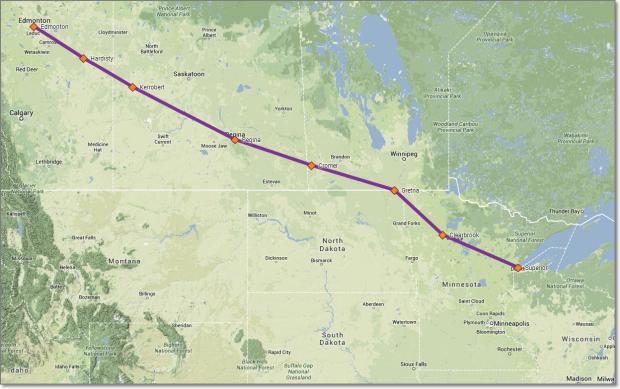
Above is the Canadian route used to pump tar-sands-derived oil from the tar sand mines of Alberta, Canada to the city of Superior, Wisconsin, a 1,000 mile route. Enbridge Energy company received a permit to build three 1/2 million gallons of oil capacity tanks earlier this summer, according to a report by Mike Simonson of Wisconsin Public Radio (WPR).
The city of Superior, Wisconsin is located adjacent the City of Duluth, Minnesota, which are both commercial harbors located on the southwestern shore of Lake Superior, the largest fresh water lake in the world and upper most of the world’s chain of 5 Great Lakes. The permit for the massive tanks is the last legal hurdle the Enbridge Company is required to complete before embarking on its project to expand the capacity of the pipelines that will transport up to 1.5 million gallons of dirty, heavy crude oil through the state of Wisconsin on Enbridge’s “Southern Access” pipeline.
From Superior, Enbridge Energy’s already built Southern Access 42-inch pipeline, built in 2006 (DNR determined that no environmental impact Statement or contested case hearing would be required for the project) the pipeline goes southeast from Superior, diagonally through the center of Wisconsin, then all the way south through Rock County and into Illinois. Enbridge officials claim they intend to TRIPLE THE CAPACITY OF THE PIPELINE BY UPGRADING, OR BUILDING 17 PUMPING STATIONS along the way.
The Wisconsin DNR last month turned down an appeal of a recently issued DNR air permit for the project which had been filed by state Rep. Brett Hulsey (D-Madison), a candidate for Wisconsin governor in 2015.
According to a report on Madison’s independent news radio program, “In Our Backyard” (WORT-FM), Hulsey said when he filed his appeal that it was only the first step he planned to take in challenging the permit, and that if they were not pleased with DNR’s action, “we could go to state or federal court from there” to stop the project. Hulsey’s said he is most concerned with the quality of the pipeline and the history of the company operating it: “my concern again is they’re trying to expand this pipeline [capacity], run this dirty tar sand oil through it, and the pipeline wasn’t designed for that.”
Hulsey also said Enbrige has a “horrible” record of pollution spills across Wisconsin and Michigan, “and honestly based on their record they’re not qualified to run a two-car parade”, he said. “I want DNR to ensure there are spill plans to protect people along the route.”
The three half-million barrel tanks are being built to hold tar sands oil from Alberta and the Bakken oil fields in North Dakota, where fracking is used to access the oil from wells. Enbridge Energy, located out of Houston Texas, is required to obtain an air quality permit from the state for the project.
Last Tuesday, the DNR denied Hulsey’s appeal, saying his argument had nothing to do with the air quality permit issued for the tank construction. Additionally, a second petition was denied to Peter Bormuth, a man from Jackson, Mich., who like Hulsey contended that Enbridge Energy has a record of pipeline leaks (which it does). Bormuth also said the tanks violate the public trust doctrine over navigable waterways like Lake Superior and the Nemadji River. The DNR called Bormouth’s argument too general of an allegation, according to Simonson’s report.
The DNR got more than 200 letters and 3,400 emails during the comment period, “many” of those opposed the air quality permit for the tanks, Simonson said.
The DNR approved a permit for Enbridge to build the three massive oil storage tanks in Superior in early June of this year. The pipeline company said the tanks will be complete in two years,
Sierra Club John Muir Chapter Conservation Program director Elizabeth Ward said it was important for the DNR and Enbrige Energy to look at the big picture of the tar sands and climate change. She said the DNR wasn’t listening to the public, and that it was also ignoring the dangers a pipeline spill could pose.
“We know that by increasing pressure in the tar sands pipeline, the likelihood of a rupture is greater,” said Ward. “So that warrants a full environmental impact statement and assessment by the DNR. But instead, the DNR chose to do this piecemeal permitting, really leaving the public out of the process”, Simonson quoted Ward as saying.
Groups and some local governments are still after state officials to take a closer look at the proposed expansion of an oil pipeline that’s buried under much of Wisconsin.
Dave Spitzer, of the group 350 Madison, said some counties in the state are also asking for a more comprehensive state review.
Ben Callan, of the DNR, recently issued a wetlands permit for five of the Enbridge Energy pump stations. Callan said current law doesn’t require a new assessment beyond what that DNR did eight years ago.
Callan said he understands counties are raising concerns, but he said the federal government has oversight over pipeline capacity and safety.
Enbridge officials have hired a former Republican state cabinet secretary to try to keep its Line 61 expansion flowing smoothly.
Hulsey said Bakken oil is dirty and expensive. He said storing it will emit benzene and other carcinogenic fumes, as well as allow more of the crude to flow through Wisconsin pipelines.
“Actually the real proposal is to use less oil,” said Hulsey. “My clean energy jobs plan invests $700 million in our state facilities to use less energy.”
Enbridge Energy spokeswomen said her company was “surprised” by the level of public interest, that the tanks are important, “but not exactly as controversial as something like the Keystone Pipeline”, she said.
Enbridge Energy is planning a $7 billion upgrade to their existing pipeline, which runs from the Canadian oil tar sands to Superior. Environmental groups compare this with the stalled Keystone XL pipeline in size and scope.
The expansion would replace a 47-year-old pipeline from Hardisty, Alberta to Superior, Wisconsin. Enbridge Energy spokeswoman Lorraine Little says the 1,000-mile long line would almost double the carrying capacity from the Alberta oil [tar] sands region to Superior.
Wisconsin Sierra Club John Muir Chapter President Shahla Werner said after a million gallon spill into Kalamazoo River in 2010, this Enbridge Energy line is as potentially hazardous as the higher profile Keystone pipeline, which is still waiting for approval from the U.S. State Department in Washington DC.
“The public should not just be concerned about Keystone and it’s not just about the impacts in Canada. It’s a real risk to our Great Lakes region and to Lake Superior,” Werner said.
Enbridge Energy notified its stockholders last December that they’re going to proceed with a $2.5 billion pipeline expansion, Simonson reported on WPR. “It’ll run 600 miles from the booming North Dakota Bakken Oil Fields to their Superior facility”, he said.
“Five years ago, the Bakken oil sands produced 200,000 barrels of light crude oil a day. Now it’s up to 700,000 barrels a day and is expected to reach 1.2 million barrels a day in the next five years. Enbridge Energy can pipe 225,000 gallons of that crude oil a day to Superior and points south to Chicago, Detroit and Toledo”, his report added.
Enbridge Energy Partners spokeswoman Lorraine Little told Simonson this expansion, dubbed “Sandpiper,” would more than double their capacity from North Dakota, “Because of that increasing supply of availability, you’ve got refineries in other parts of the U.S. who are interested in taking that light crude oil”. So these projects really represent moving the oil where the refineries are.
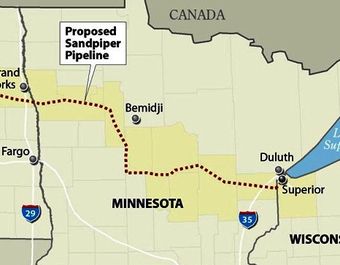
Little said this pipeline project, along with increased oil [tar] sands production, will shift supply from Middle Eastern and South America to North America, “So you might think of it a bit as re-piping America. The Sandpiper pipeline could be in service by early 2016.
“They’re increasing the capacity of the line by 360,000 barrels a day and they’re changing the type of oil so that it can carry both light and tar sands oil,” Werner said. “So they’re changing the product. Sierra Club’s been working on blocking tar sands expansion for a long time.” Excavation and production of tar sands to make it into oil involves large quantities of fossil fuel burning for heating it on the front end, before the dirty oil is made thin enough to flow in the pipelines.
22. The Evidence of Global Warming is Overwhelming Yet the U. S. House of Representatives Denies It


The evidence is now overwhelming that our continuing to burn fossil fuels – for heating, electricity production and in transportation – has led to a significant warming of the atmosphere, namely global warming. Yet our U. S. House of Representatives of the U. S. Congress has foolishly – and dangerously – refused to acknowledge global warming is a problem much less acknowledge any awareness that greenhouse gases from fossil fuel burning by humans is causing the warming.
One month after President Obama laid out a bold plan to tackle climate change, the U.S. House of Representatives has passed a bill to say that carbon pollution is not a problem. They are wrong, big time.
The burning of fossil fuels and other fuels that emit carbon dioxide when burned has undeniably led to the following: a profound melting of the polar ice caps; the receding of numerous mountain glaciers, worldwide; a significant and accelerating rise in sea level; ocean acidification (by 30%!) and resulting in harm to the lobster and other species living in the oceans; the loss of billions of dollars as a consequences of global warming caused drought and flooding; and the loss of human life from increasingly more extreme weather events such as hurricanes, more severe storms, heat waves, and fires, plus the increased threat of deadly mosquito and tick transmitted diseases in the U. S., including dengue fever and West Nile virus infection, to name just two.
Scientists the world over predicted all these things could happen, that catastrophic consequences would be inevitable if humankind took no action, and that the number and intensity of such tragedies would worsen over time. Regrettably, especially for the young people of today and future generations – who will have to face the wrath of global warming and its awful consequences their entire life – those predictions are now becoming reality.
Yet today a committee of the U. S. House of Representatives voted to prevent the U. S. Environmental Protection Agency from limiting greenhouse gas emissions, and then the House voted to cut the EPA’s budget by 34 percent!
And now it’s not just the national academy of scientists of the world who are warning others of the global warming threat. Last week, four former EPA administrators under Republican presidents wrote in The New York Times: “The costs of inaction are undeniable. The lines of scientific evidence grow only stronger and more numerous. And the window of time remaining to act is growing smaller: delay could mean that warming becomes ‘locked in.'”
But still there are so many politicians in Congress who are still choosing to ignore the problems that global warming is already causing our U. S. citizens and other populations of the world, by their continued silence about the issue, or even worse, their ridicule of others who have concluded the threat is great enough to speak out about, including the president of the United States himself.;
They should be singled out and openly chastised, as they are undoubtedly doing so because of financial contributions they receive from the fossil fuel industries. And then we should thank those who are standing up for our environment by fight against global warming with their votes. This is a call for action to contact your representatives in the U. S. Congress and tell them to vote for actions that reduce U. S. greenhouse gas emissions, that reward individuals and families in the U. S. who use less fuel burning derived energy in their home, business and in transportation, and that will help us all to better adapt to the changing climate that global warming is now already bringing.
We’ve already heard from our president about the need for swift and major governmental action now to confront global warming enemy. Below is how he concluded his June 25, 2013 speech at Georgetown University in Washington, D.C.:
“THE QUESTION NOW IS WHETHER WE WILL HAVE TIME TO ACT BEFORE IT’S TOO LATE. AS A PRESIDENT AND AS A FATHER AND AS AN AMERICAN, I’M HERE TO SAY: “WE NEED TO ACT!”‘

See post #7 “Positive Financial Incentives: An Environmentally Just Approach for Reducing Greenhouse Gas Emissions” for a proposal to reward using less greenhouse gas emitting energy on an annual basis .
 All Things Environmental
Recent Comments