
Madison Butterfly Update

Butterflies I’ve seen in Madison thus far in 2015 include the following: the Great Spangled Fritillary; Red Admiral; Red Spotted Purple; Tortoiseshell, White, Monarch, Black Swallowtail and Grey Hairstreak.
The Great Spangled Fritylery (above) is a medium sized butterfly that can fly very quickly and is easy to see while nectaring. They enjoy grassy, prairie areas that have a water source close and the caterpillars feed on Violets, so a partially shaded area will be beneficial for this winged beauty.

The Red Admiral is an admired butterfly, popular in much of North America, Asia, and Europe. This butterfly enjoys many types of environments and has a strong affinity to flowers. The males are territorial and many times can be found in the same location day to day. The undersides of the wings are a mottled brown and tan with a curved bright red color on the upper side of the brown/black wings. Although a quick flier, this beauty is a more docile butterfly, it tends to be a friendly visitor in gardens.

Milbert’s Tortoiseshell is a swift-flying butterfly that is always a pleasure to see. This butterfly varies widely in abundance from year to year.

The Red-spotted Purple is a common butterfly in the southern half of Wisconsin. Throughout central Wisconsin, this subspecies and the White Admiral are both present, and sometimes they hybridize. The offspring can have characteristics anywhere between the two subspecies. This butterfly is often found taking nutrients from gravel roads, roadsides, or scat.

One of the most common butterflies seen flying around urban and suburban America is the cabbage White. More often than not, it is the white butterfly flying around your yard. Cabbage whites use a variety of mustards as larval host plants from leafy garden vegetables such as broccoli, cauliflower, and cabbage to weeds such as london rocket, flixweed, garlic mustard, and whitetop.

The monarch butterfly may be the most familiar North American butterfly. Its wings feature an easily recognizable orange and black pattern, with a wingspan of 8.9–10.2 cm(3½–4 in).
The eastern North American monarch population is notable for its annual southward late-summer/autumn migration from the United States and southern Canada to Mexico. During the fall migration, it covers thousands of miles, with a corresponding multi-generational return North. The western North American population of monarchs west of the Rocky Mountains most often migrate to sites in California but have been found in overwintering Mexico sites.

The (Eastern) Black Swallowtail is found throughout much of North America. They are usually found in open areas like fields, parks, marshes or deserts, and they prefer tropical or temperate habitats. Black swallowtails rely on a variety of herbs in the carrot family. Species of host plants include Mock bishopweed, Roughfruit scaleseed, Spotted water hemlock, Water cowbane, Wedgeleaf eryngo, Canby’s dropwort, Queen Anne’s lace and Dill.

The Gray Hairstreak (Strymon melinus) is one of the most common hairstreaks in North America, ranging over nearly the entire continent. It occurs also throughout Central America and in northern South America. Its larvae feed on the fruits and flowers of a variety of host plants including several species mallows, members of the pea family, buckwheats, clovers, and many other plants.
Sources: Gardens With Wings; Wikipedia, the free encyclopedia;
Media Reports The World Will Enter A ‘Mini Ice Age’ In The 2030s; Actually, It’s the Reverse That’s the Real Truth!

U.K. tabloids, conservative media, and others are (mis)reporting that the Earth will enter a “mini ice age” in the 2030s. In fact, not only is the story wrong, the reverse is actually true.
The Earth is headed toward an imminent speed-up in global warming, as many recent studies have made clear, like this June study by NOAA. Indeed, a March study, entitled “Near-term acceleration in the rate of temperature change,” makes clear that a stunning acceleration in the rate of global warming is around the corner — with Arctic warming rising 1°F per decade by the 2020s!
Also, right now, we appear to be in the midst of a long-awaited jump in global temperatures. Not only was 2014 the hottest year on record, but 2015 is in the process of blowing that record away. On top of that, models say a massive El Niño is growing, as USA Today reported last week. Since El Niños tend to set the record for the hottest years (since the regional warming adds to the underlying global warming trend), if 2015/2016 does see a super El Niño then next year may well crush the record this year sets.
Whatever near-term jump we see in the global temperatures is thus likely to be followed by an accelerating global warming trend — one that would utterly overwhelm any natural variations such as a temporary reduction in solar intensity. A recent study concluded that “any reduction in global mean near-surface temperature due to a future decline in solar activity is likely to be a small fraction of projected anthropogenic warming.”
That’s true even for one as big as the Maunder Minimum, which was linked to the so-called Little Ice Age.
The “Little Ice Age” is a term used to cover what appears to have been two or three periods of modest cooling in the northern hemisphere between 1550 and 1850.
I know you are shocked, shocked to learn that unreliable climate stories appear in U.K. tabloids, the conservative media, and those who cite them without actually talking to leading climate scientists. Often there is a half truth underlying such stories, but in this case it is more like a nano-truth.
Last week, in Llandudno, north Wales, the Royal Astronomical Society (RAS) held Cyfarfod Seryddiaeth Cenedlaethol 2015 — the “National Astronomy Meeting 2015″ (in case you don’t speak Welsh). An RAS news release had this startling headline, “Irregular Heartbeat Of The Sun Driven By Double Dynamo.”
Okay, that wasn’t the startling part. This was: “Predictions from the model suggest that solar activity will fall by 60 per cent during the 2030s to conditions last seen during the ‘mini ice age’ that began in 1645.”
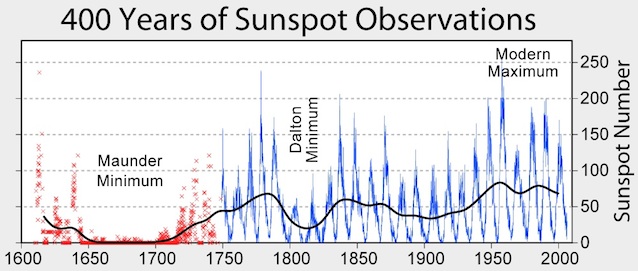
Ah, but the word choice was confusing. We’re not going to have temperature “conditions” last seen during the Little Ice Age. If this one study does turn out to be right, we’d see solar conditions equivalent to the Maunder Minimum in the 2030s.
This won’t cause the world to enter a mini ice age — for three reasons:
The Little Ice Age turns out to have been quite little.
What cooling there was probably was driven more by volcanoes than the Maunder Minimum.
The warming effect from global greenhouse gases will overwhelm any reduction in solar forcing, even more so by the 2030s.
So how little was the Little Ice Age?
The most comprehensive reconstruction of the temperature of the past 2000 years done so far, the “PAGES 2k project,” concluded that “there were no globally synchronous multi-decadal hot or cold intervals that define a worldwide Medieval Warm Period or Little Ice Age.”

Green dots show the 30-year average of the new PAGES 2k reconstruction. The red curve shows the global mean temperature, according HadCRUT4 data from 1850 onwards. In blue is the original hockey stick of Mann, Bradley and Hughes (1999 ) with its uncertainty range (light blue). Graph by Klaus Bitterman.
The Little Ice Age was little in duration and in geographic extent. It was an “Age” the way Pluto is a planet.
Writing on Climate Progress, climatologist Stefan Rahmstorf noted the researchers “identify some shorter intervals where extremely cold conditions coincide with major volcanic eruptions and/or solar minima (as already known from previous studies).”
That brings us to the second point: The latest research finds that what short-term cooling there was during the Little Ice Age was mostly due to volcanoes, not the solar minimum. As “Scientific American” explained in its 2012 piece on the LIA, “New simulations show that several large, closely spaced eruptions (and not decreased solar radiation) could have cooled the Northern Hemisphere enough to spark sea-ice growth and a subsequent feedback loop.” The period associated with the LIA “coincide with two of the most volcanically active half centuries in the past millennium, according to the researchers.”
The cooling effect from the drop in solar activity during even a Maunder Minimum is quite modest. Environmental scientist Dana Nuccitelli discussed the literature underscoring that point in a U.K. Guardian post from the summer of 2013, the last time the “Maunder Minimum” issue popped up.
That brings us to the third point: Whatever cooling the Little Ice Age saw as result of the Maunder Minimum, it pales in comparison to the warming we are already experiencing — let alone the accelerated warming projected by multiple studies. That’s clear even in Pages 2k reconstruction above.
Just last month “Nature Communications” published a study called, “Regional climate impacts of a possible future grand solar minimum.” This found that, “any reduction in global mean near-surface temperature due to a future decline in solar activity is likely to be a small fraction of projected anthropogenic warming.” As with the Little Ice Age, any significant effects are likely to be regional in nature — and, of course, temporary, since a grand solar minimum typically lasts only decades.
So, no, the Daily Mail is quite wrong when it trumpets, “Scientists warn the sun will ‘go to sleep’ in 2030 and could cause temperatures to plummet.”
In actuality, what is going to happen in the business-as-usual emissions scenario (RCP8.5) is closer to “rate of change” of warming.
Original story by Joe Romm on Climate Progress
Why Have Our Commercial and Public Media (TV, Radio, Newspapers, Magazines, Online Sources) and Officials in Federal and State Government in the United States Not Sounded the ALARM Yet on Continued Global Warming and Climate Change?


The following is a summary of a 2008 international conference entitled: “ENVIRONMENT: FROM GLOBAL WARNINGS TO MEDIA ALERT” that was held October 10 and 11, 2008, in Venice, Italy. The purpose of the conference was to challenge the international media to improve public understanding of the impact of climate change. Journalists and news executives from 29 countries representing six continents attended the conference which was held by the international World Political Forum (WPF).
Unfortunately, now almost five years after this conference was held, commercial and corporation funded TV and radio media in these United States continue to purposefully ignore said challenge by not sounding the alarm on the global warming world catastrophe in the making, as do many U.S. publicly elected government officials in federal and state government, leaving the at large public in the U.S. as confused as ever over whether human activities such as fossil fuel burning: in power plants that produce electricity; in home and business heating (natural gas; oil; propane; electric baseboard); in motor vehicle travel and product shipping, via trucks, ships, pipelines (fueling lift stations), in airplanes and in trains; and in cement making and paving the landscape (fuel burning in earth moving equipment). Another significant contributor to the growing global warming crisis is continued deforestation, worldwide, and especially the deforestation of the tropics, where previously large reductions in of carbon dioxide (CO2) were being taken out of the air by the vegetation there – through the process of photosynthesis. Less green vegetation on Earth means increasing buildup of CO2 in the atmosphere and oceans, adding to warmer global temperatures. Methane gas (unburned natural gas) that is released from oil wells, livestock, and rotting biological matter (permafrost thawing) compound the problem that is resulting in what the scientific community has called “a potentially very dangerous situation for all humanity and life on Earth and lasting far into the future. Reason is that many positive (lead to more warming) feedbacks . One such warming feedback is the loss of Earth’s albedo, where a reduction in the area of snow-covered land, ice caps, glaciers or sea ice has a compounding effect on the initial warming. As the loss of “white” snow and ice cover (the albedo) continues, the amount of solar energy absorbed by the ocean increases, leading to more warming, which reduces the albedo on the planet even more, which causes more warming, and so on. A small amount of snow melt exposes darker ground which absorbs more radiation, leading to more snowmelt.
The effect is most vividly demonstrated by the decline in Arctic sea ice in recent decades.

As humans are continuing to do things that add more heat-trapping greenhouse gases (GHGs) to the Earth’s atmosphere, the result is that climates all around Earth have been measurably and significantly changing, mostly to the detriment of humans and animal life.
The global warming that has already taken place has caused Earth’s ocean levels to rise – due to thermal expansion from increasing water temperatures and from melting glaciers on Greenland, Antarctica, and Earth’s numerous mountain ranges.
Ocean water acidification has already taken place (a 33% increase) which has already lead to significant environmental, economic, and social cost. These effects of expected to continue unabated which is expected to worsen in time, with projected increases in monetary losses, damage, and loss of human and animal life due to worse and worse “natural” disasters.
As examples of recent catastrophes suspected to have been made worse as a likely direct consequence of rising average global temperatures (global warming): in 2015 heat waves in India and Pakistan killed 1,400 and 2,500 people; in 2013, the thirtieth named storm of the 2013 Pacific typhoon season, Typhoon Haiyan — known as Typhoon Yolanda in the Philippines – with an estimated one-minute sustained winds of 315 km/h (196 mph; 170 kn), making the typhoon the strongest tropical cyclone ever observed based on one-minute sustained wind speed and the deadliest typhoon hitting the Philippines in recorded modern history, killing 6,300 people in that country alone (dozens of fatalities from the storm were also reported in Taiwan, China and Vietnam) and according to United Nation’s officials, about 11 million people were adversely impacted by the storm with many left homeless and an economic cost in the billions of dollars; in 2012, Hurricane Sandy, which remains the largest Atlantic hurricane on record (as measured by diameter, with winds spanning 1,100 miles (1,800 km)) is estimated to have caused monetary damages of over $68 billion and killed at least 233 people along its path on the eastern U S. seaboard including New Jersey and New York; and in 2005, Hurricane Katrina, the fifth hurricane of the 2005 Atlantic hurricane season, was not only the costliest “natural” disaster in the history of the United States. Total property damage from Hurricane Katrina was estimated at $108 billion; the hurricane and subsequent flooding took 1,833 human lives and an undetermined number of domesticated and wild animal lives.
Yet today, incredibly – almost six years later – there remain deniers of human-caused global warming and climate change, including our State of Wisconsin’s own U.S. Senator Ron Johnson, as well as announced U.S. presidential candidate and our current governor, Scott Walker, who continue to spread the false message that Earth’s climates have not been shown to have changed as a result of human activities, to the delight of corporations that are financially benefiting from continued and more fossil fuel burning, which releases carbon dioxide gas, the most abundant of the greenhouse gases, which compounds from year to year in the atmosphere and Earth’s oceans, leading to monumental negative consequences for humanity and other life forms on Earth.
WPF’s President Mikhail Gorbachev, the eighth and last leader of the Soviet Union and General Secretary of the Communist Party of the Soviet Union from 1985 until 1991 when the party was dissolved, chaired the conference at which participants reached a consensus that the problem of climate change is “URGENT”.
“Time is running out,” Mr. Gorbachev said in his closing remarks. “The most efficient way to tackle the urgent environmental problems facing our planet is transparency, in which the media have a vital role to play. This means global glasnost.”
Climate experts and media delegates approved a declaration calling for higher standards of reporting on strategic options to avert irreversible damage to the Earth’s eco-systems.
Stressing the importance of well-informed public opinion, the declaration set out the following main recommendations:
– The media have the central role in ensuring that politicians, corporations, non-governmental organisations and scientists keep the general public informed about the latest facts and policy options regarding climate change. Civil society formation and action are essential components in deliberation on this issue.
– Journalists have a responsibility to improve their knowledge and skills in order to be able effectively to question government policy-makers, to distinguish facts from opinion or advocacy, and to evaluate scientific arguments from an independent viewpoint.
– Journalists and civil society should redouble their efforts to combat restrictive measures by governments on journalists reporting on their deficiencies in fighting environmental degradation or in informing the public about the dangers of climate change.
– Journalists should avail themselves of existing international databanks of validated statistics and scientific research on climate change.
– Scientists need to acquire improved communications skills to explain their findings in accessible terms and to build relationships of trust with the media.
– Media proprietors should be prepared to invest more resources in investigative reporting to allow specialist journalists to carry out serious and objective coverage of complex issues, based on a thorough understanding of good science.
– Editors should provide more space for in-depth treatment of environmental issues, not just on-line but in print and on air, and encourage innovative approaches that will grab the attention of the audience in a responsible, independent and non-sensational manner.
– Journalism training organisations should develop ever more sophisticated exercises to improve reporters’ skills in explaining complex scientific arguments. An international network should be created to share information about the availability of training courses and the development of new training models.
The Conference concluded on a positive note, declaring: “There is, however, cause for optimism if we act now. Numerous positive solutions to the global environmental change proposed by science and made possible by innovations in technology, the potential inherent in global civil society organization and by citizens’ groups everywhere in the world; and contributions from socially responsible business leaders can make it possible for us to provide for a decent and full life for all, and for generations to come, within the limits of our planet’s resources.”
Republican Brewhaha on Wisconsin Highway Funding Symptomatic of Larger Problem

Wisconsin Governor Scott Walker’s proposed borrowing plan for highway construction the next two years has finally hit the skids! GOP lawmakers said as much in a letter to the governor yesterday. Not only is the governor’s proposed $1.3 billion transportation borrowing plan too high, said the 33 Assembly Republicans who signed the letter, but also any reduction to $800 million must include reductions in the massive Milwaukee area freeway projects already under construction.
The Republicans lawmakers, who are in the majority in both houses of the Wisconsin Legislature, are negotiating among themselves over the reduction in bonding to $800 million according to a story in the Milwaukee Journal Sentinel website Monday.
Allthingsenvironmental emailed the Republican dominated Joint Finance way last March after the governor’s proposed biennial budget for 2015-17 hit the streets sending them the following message:
So it’s not just the governor’s highway plan part of the 2-year budget that’s unsustainable. It’s virtually everything Scott Walker has done as governor, starting January 2010 with his Act 10 that destroyed collective bargaining in public employee unions, having appeared out of the blue.
Meanwhile, as probable presidential candidate Scot Walker heads his way to yet another Wisconsin taxpayer funded speaking engagement, this time in California, the brewhaha simmering among his fellow Republicans is beginning to reach the boiling point. One has to wonder how many frequent flyer miles the governor and his security people have racked up over the past 5 years? A lot? Yes, but undoubtedly not even close to the millions of tons of greenhouse gases his jets, autos and motorcycles have emitted to the atmosphere for the next generation to be burdened with.
The Children of Today and Tomorrow are in for a Rude Awakening
The global warming genie has escaped his bottle! He has begun to show his wrath, which is only likely to worsen in the coming years, decades and centuries, and there is presently no end in sight!
He’s leaving plenty of evidence. The only way we can all help weaken him is by stopping our nonessential burning of fossil fuels, stopping deforestation especially of the tropics, and doing things which naturally result in more greenhouse gases being added into the earth’s atmosphere and oceans (such as overeating, wasting food, not recycling, not reusing things whenever possible, running our air conditioning and furnaces needlessly, using energy derived from tar sands industry, doing other things that frivolously burn fossil fuels such as going for joy rides, cruising, etc.. Because our atmosphere is where Global Warming lives and breathes (now that he’s escaped the bottle) and because he gets his tremendous strength to wreak havoc on the world by his breathing in greenhouse gases that have been accumulating to record high concentrations in the earth’s atmosphere (as a by-product of our burning carbon-based fuels in our cars, trucks, airplanes, power plants, ships, boats, trains, machinery, recreational products and the like) we need to all put him on a crash diet, NOW!
According to David Owen, author of Green Metropolis and The Conundrum: How Scientific Innovation, Increased Efficiency, and Good Intentions Can Make Our Energy and Climate Problems Worse, the proportional share of the fuel burned during a round trip from New York City to Melbourne, Australia, is greater than the total amount of energy that the average resident of the earth uses, for all purposes, in a year. Forestalling global calamity is a preemptively worthy, ethically justifiable and economically achievable goal for everyone on the planet, especially in this era of television, radio, computers, Skype, the iPhone and virtual reality. Climatologists, environmentalists, CEOs, religious leaders, students and tourists seeking entertainment or to broaden their horizons, and government officials ought use the least greenhouse gas emitting technologies available to them to accomplish their objectives; they should not have to cross the oceans and great land masses of world (requiring vast burning fossil fuels) just to be present in person. Likewise, our government leaders and business people ought minimize the amount of products traded with distant countries, so as to minimize the amount of fuel burning required in the shipment of goods by air, sea and over miles and miles of terrain. Transportation of billions of tons of goods along with extensive long distance vacationing and business trips by millions of people every year is simply no longer sustainable. Such activities are becoming ethically wrong because they are unquestionably harming the planet and all the living things it is home to, both now and in the future.
We cannot and must not wait for technology to bail us out. Scientists the world over say it is now paramount that all humans begin acting in significant ways to reduce their annual greenhouse gas emissions. Otherwise, we will never get Global Warming to go back into his bottle – where he belongs! Greenhouse gases accumulate atmospherically over time – they build up in the atmosphere and oceans from year to year. Their volume is accelerating in earth’s atmosphere and as well as in its oceans, and the total volume will likely keep accelerating for some time due to compounding factors (positive feedbacks) of the earth’s natural systems. That’s why it’s of the utmost importance – paramount – that everyone act in ways to reduce their annual carbon footprint, immediately, before Global Warming becomes all to powerful, uncontrollable and for generations, a tragedy for civilization.
Koalas in Peril in Southern Australia and Victoria- Call for All Knitters

A Wildlife hospital in Southern Australia has issued a mitten appeal to help treat koalas with burnt paws following the fires in South Australia and Victoria.
Struggling heat-stricken koalas with burnt paws are in desperate need for mittens followed by the devastating bushfires in South Australia and Victoria.
The International Fund for Animal Welfare (IFAW) has launched a public appeal in a bid to get cotton-made mittens from knitters to help treat injured koalas.
The injured marsupials typically come into care with severe burns, especially on their paws, caused by contact with burning trees or from fleeing across fire grounds.
It comes as South Australia endured the state’s worst fire conditions since the Ash Wednesday and Black Saturday, destroying more than 30 homes and leaving 134 people injured.
When koalas come into care, they get treatment with burns cream and their paws would be covered with bandages before being protected with the special cotton mittens.
‘We don’t know how many mittens we need but once the grounds are reopened to the wildlife rescuers, they will begin their black walk,’ an IFAW spokeswoman told Daily Mail Australia.
 All Things Environmental
Recent Comments